Inspiration - RKT Newsletter
July 2026

E-Newsletter
July 2026



Quote
स वै पुंसां परो धर्मो यतो भक्तिरधोक्षजे । अहैतुकी अप्रतिहता ययात्मा सुप्रसीदति ॥ (Shrimad Bhagavatam 1.2.6)
Sa vai pumsam paro dharmo Yato bhaktir adhokshaje Ahaituki apratihata Yayatma suprasidati
The supreme occupation for all humanity is that by which one develops loving devotional service unto the Lord. Such devotion must be causeless and uninterrupted, for only then does the soul become completely satisfied.
From the Editor’s Desk
The lives of the great sages reveal a profound truth: Lasting joy does not arise from the absence of challenges, but from the presence of an unwavering connection with the Divine. While the world constantly pulls the mind toward fear, attachment, and distraction, the path of devotion offers an inner sanctuary where peace remains steady amidst all circumstances.
Through the examples of God-realized saints of India, we are reminded that divine love has the power to transform our consciousness and reveal a happiness that cannot be eliminated by external events.
May the reflections in this July issue of Inspiration encourage us to deepen our spiritual journey and discover the eternal joy found in our relationship with God.
Bhakti Ras
Bhakti Ras: The Shield of Divine Love
To an ordinary observer, the lives of great saints often seem beyond human possibility. How could they remain joyful amidst persecution, loss, humiliation, and physical suffering? Were they simply born with extraordinary strength, or did they possess something that the rest of us have yet to discover?
The scriptures reveal that their remarkable steadiness did not arise from emotional suppression or indifference to life's difficulties. Rather, it flowed from immersion in bhakti ras—the divine nectar of loving devotion. Having experienced a joy far greater than anything the world could offer, their hearts remained anchored in God regardless of external circumstances.
Swami Mukundananda ji explains that the mind cannot remain empty. It naturally seeks happiness and relinquishes lower pleasures only after experiencing a higher one. That higher taste is the bliss of divine love. The saints were not merely enduring suffering through willpower; they had discovered something infinitely sweeter than worldly pleasures and therefore were no longer enslaved by worldly pain.
As divine love deepens, it becomes an inner sanctuary where the storms of the world lose their power. Just as a lamp enclosed within glass remains steady despite fierce winds outside, the mind of a surrendered and God-realized saint remains undisturbed because it is sheltered by unwavering remembrance of the Lord. Shree Krishna revealed the transformational secret to Arjun:
दु:खेष्वनुद्विग्नमना: सुखेषु विगतस्पृह: । वीतरागभयक्रोध: स्थितधीर्मुनिरुच्यते ॥ 56॥ duḥkheṣhv-anudvigna-manāḥ sukheṣhu vigata-spṛihaḥ vīta-rāga-bhaya-krodhaḥ sthita-dhīr munir uchyate
One whose mind remains undisturbed amidst misery, who does not crave for pleasure, and who is free from attachment, fear, and anger, is called a sage of steady wisdom. (Bhagavad Gita 2.56)
The lives of the great Bhakti Saints beautifully illustrate this ideal. Their steadiness did not arise from suppressing emotions, but from redirecting their deepest love toward God. Let us briefly review the lives of a few such saints in Indian history.
Meerabai's Unshakable Faith
Princess Meerabai faced relentless opposition for her exclusive devotion to her Giridhar Gopal (Shree Krishna). For her, even a cup of poison meant to end her life became nectar when she lovingly offered it to her Beloved before drinking it. Whether viewed literally or symbolically, the deeper lesson remains the same. A heart completely absorbed in God transcends fear itself. When love for God becomes supreme, even the greatest dangers lose their power to disturb the mind.
Sant Tukaram's Unwavering Joy
Sant Tukaram endured devastating personal losses. Famine claimed members of his family, his business collapsed, and his generosity often left him with little for himself. Yet his devotion to Lord Vitthal never diminished. His abhangas overflow not with bitterness but with gratitude and divine longing. Having discovered the inexhaustible wealth of God's name, worldly gain and loss appeared insignificant beside the treasure he carried within.
Absolute Gratitude of Sant Ravidas
Born into a low-caste family due to a past-life curse, Sant Ravidas faced severe discrimination throughout his life. His father eventually exiled him because of his constant acts of charity, leaving him to survive by mending shoes. Yet despite poverty and rejection, Ravidas viewed every circumstance as an expression of God's grace.
Even when religious elites publicly challenged his spiritual legitimacy before the King of Kashi, Ravidas remained unbothered, focusing entirely on his devotion to Shree Krishna. He famously proved that a pure mind transforms even a humble shoemaker's water pot into the holy Ganges, demonstrating that true gratitude requires no material wealth.
Kabir's Fearless Faith
Kabir's uncompromising devotion often invited fierce opposition. There were several attempts to silence him through drowning, fire, and other forms of persecution. Yet Kabirdas remained fearless because his identity no longer rested in the temporary body, but in his eternal relationship with God.
When the soul recognizes its eternal connection with the Divine, changing worldly circumstances lose their power to create fear. Kabir's life beautifully illustrates that true courage arises not from physical strength, but from complete surrender to God.
The Inner Vision of Surdas
Blind from birth and abandoned by his family at a young age, Sant Surdas entered a world that many would consider filled with darkness. Yet through devotion, he discovered a vision far deeper than physical sight.
Rather than lamenting his blindness, Surdas regarded it as a special blessing that protected him from worldly distractions and allowed his heart to remain absorbed in Shree Radha Krishna. His profound inner realization inspired thousands of exquisitely detailed devotional compositions describing the beauty, compassion, and divine pastimes of the Lord.
His life reminds us that true vision belongs not to the eyes, but to the soul. When the heart is illuminated by devotion, even outward limitations become opportunities for spiritual growth.
These saints are not remembered merely because they endured hardship. They are revered because they transformed hardship through the power of divine love.
The mind naturally dwells upon whatever it loves most. When it clings to worldly possessions, success brings excitement and loss brings sorrow. But when it becomes absorbed in God, His infinite bliss gradually eclipses the fleeting experiences of pleasure and pain. The saints were not escaping reality—they had discovered a deeper reality that remained untouched by life's changing circumstances.
As Shree Krishna beautifully explained in the Bhagavad Gita, “Having gained that state, one does not consider any attainment to be greater. Being thus established, one is not shaken even in the midst of the greatest calamity” (Verse 6.22). This was the true ecstasy of the true sages who surrendered to God.
This was the true ecstasy of the great saints. Their peace did not arise because life became easy. It arose because they had discovered something infinitely greater than hardship itself, an unbreakable relationship with God.
Anchored in divine love, they carried an inner sanctuary wherever they went: One that no insult could penetrate, no loss could diminish, and no adversity could destroy.
Bal-Mukund: Playground for Vedic Wisdom
The Story of the Window in the Wall
Long ago, in the town of Udupi, lived a great saint named Kanakadas. Though his heart was filled with love for Shree Krishna, the temple priests would not let him enter because of his humble background.
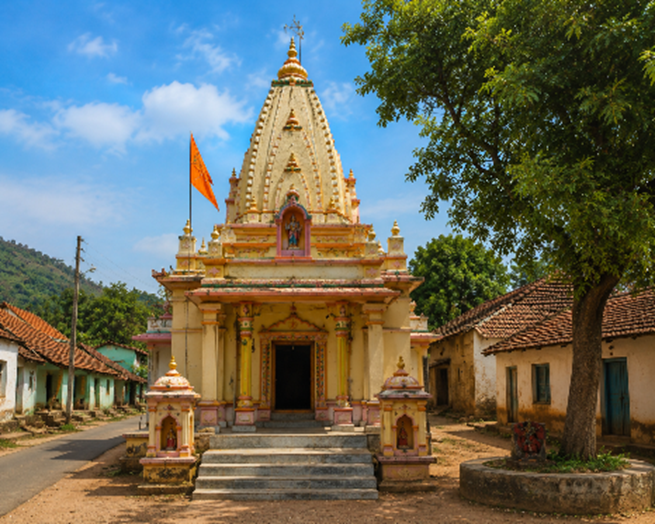
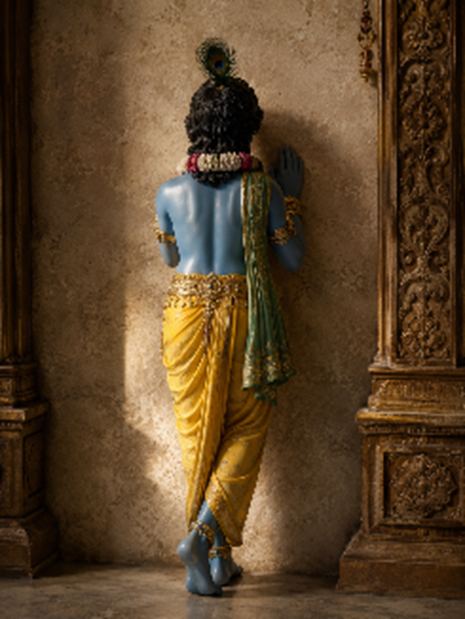
Kanakadas did not get angry. Instead, he went to the back of the temple and began to sing. His songs were so beautiful and his love so pure that something miraculous happened. Legend says that the solid stone wall of the temple cracked open, and the deity of Shree Krishna, which had always faced the front, turned 180 degrees to face the back wall. Shree Krishna wanted to see his devotee just as much as Kanakadas wanted to see Him. Today, that spot is known as Kanakana Kindi (Kanaka’s Window).
Practical Wisdom:
- The deity of Shree Krishna turned 180 degrees to face the back wall. God does not look at our clothes, our money, or our status. He only looks at the purity of our love.
- Kanakadas began singing devotional songs for Shree Krishna from behind the temple. Constant remembrance of and service to God is a profound and powerful means of purifying the heart. Through sincere devotional service, the soul’s true nature gradually reveals itself, enabling one to realize and perceive the soul through spiritual realization.
- Kanakadas did not become angry when the priests refused him entry into the temple. Instead, he remained devoted and continued singing in praise of Shree Krishna. His response teaches us an important lesson: when our desires are not fulfilled, anger often arises from our attachment to a specific outcome. By accepting that things may unfold differently than we expect and letting go of the need for events to happen a certain way, we can find greater peace and remain calm in challenging moments.
Youth Insights
Finding Focus in a Fast-Paced World
Have you ever picked up your phone to check one notification and found yourself still scrolling twenty minutes later? Between school, extracurricular activities, social media, and endless notifications, our minds are constantly pulled in different directions. It's no surprise that many of us struggle to stay focused or feel overwhelmed by the pace of everyday life.
The great sages described in our scriptures lived in a very different world, yet they faced the same challenges that we face today. Yet, they managed their mind beautifully. Their joy came not from avoiding responsibilities, but from developing discipline and directing their minds toward Bhagwan. Swami Mukundananda ji explains that when we cultivate a "higher taste" for spiritual growth, many of the distractions that once seemed so important naturally begin to lose their hold on us.
One of the most powerful ways to build that focus is by creating a simple morning routine. As students, we often stay up late studying and wake up early to prepare for tests, so setting aside a large amount of time for spiritual practice may not always be realistic. Instead, start with something simple. A morning routine that I follow is waking up, reading a few prayers from Swamiji's My Wisdom Book, and spending about 15 minutes meditating using one of Swami Ji's guided meditations. My personal favorite is Swamiji’s Garden of God meditation, then continuing with the rest of my day. I also make it a point not to check my phone before completing my spiritual routine, which helps me begin the day with a calmer and more focused mind.
A similar routine can also help us unwind at night. I end my day by reading bedtime prayers from My Wisdom Book, spend a few minutes reflecting on the day, and offering my thoughts to God before going to sleep. Beginning and ending the day with devotion creates moments of peace that help us stay grounded, even in the midst of a busy schedule.

Another practice that can help us stay focused is chanting or listening to kirtan. These moments of devotion allow us to slow down, quiet our thoughts, and reconnect with Bhagwan. Whenever I feel overwhelmed with schoolwork or stressed before an exam, I find that taking a few minutes to chant or listen to kirtan helps calm my mind and brings me back to the present.
Our perspective on school and work also makes a difference. It's easy to become focused on grades, achievements, or comparing ourselves with others. While working hard is important, we can also remember that our abilities are gifts from God. I try to remind myself that studying isn't just about getting good grades, it's also a way of making the most of the talents Bhagwan has given me. When we approach our studies and future careers with an attitude of gratitude and service, our efforts take on a deeper purpose. Success becomes an opportunity to express gratitude, and setbacks become chances to learn, grow, and trust Bhagwan's plan.
I'd like to leave other youth with a simple challenge. For the next seven days, try starting each morning with just 15 minutes of quiet kirtan or meditation before you check your phone. It may not seem like a big change, but small, consistent habits often have the greatest impact. At the end of the week, take a moment to reflect on how it affected your focus, mindset, and sense of peace. You might be surprised by the difference those first few minutes of your day can make.
Holistic Health Tidbits
The Physiology of Devotion
Practicing devotion with the mind and body—whether through prayer, meditation, chanting, singing, kneeling, bowing, sacred dance, or raising the hands—can have measurable physiological effects. While the specific outcomes vary by individual, research in neuroscience, psychophysiology, and behavioral medicine suggests several potential benefits. Imagine a biofeedback loop that creates a shield for the mind and body from outside interference. Some of the benefits include:
|
Practice |
Physiological Impact |
Why it Works |
|
Slow
Breathing/ Rhythmic Chanting |
Parasympathetic
Nervous System Activation |
Slow
breathing lowers blood pressure, slows the heart rate, improves digestion,
and reduces muscle tension. The vibrational frequency of sacred sound helps
regulate the nervous system. |
|
Divine
Visualization (Meditation) |
Brain
Activity and Immunity Support |
Focusing
on a peaceful, divine form activates the prefrontal cortex (focus), reduces
amygdala activity (fear), and minimizes systemic inflammation and cortisol
production caused by stress. |
|
Gratitude |
Emotional
Well-Being |
Gratitude,
whether remembered in daily prayer or journaling, cultivates compassion,
hope, love, and forgiveness. |
|
Surrender
(Prapatti) |
Rapid
Recovery |
Letting
go of worry allows the body to reduce the intensity of pain, increase
endorphin release, and enhance our coping mechanism, so that we become more
resilient. |
Practical Health Tips:
- Mindful Cleansing: The sages taught us to treat the body as a sacred temple. The next time you take a shower, visualize the water washing away not just physical dirt, but also mental stress and negative thoughts. This simple shift turns a daily chore into a powerful act of mindfulness and health.
- Purposeful Breathing: Sit comfortably upright. Take 5 diaphragmatic breaths, inhaling for four seconds and exhaling for eight. Imagine breathing in the divine power of God, and breathing out the fear, anxiety, and pain you may be experiencing.
- Walking Devotion: Synchronize your breathing with your steps. Inhale: "You are with me." Exhale: "I walk in peace." Repeat a sacred word, verse, or prayer.

Reflection Questions
Bhakti Ras / Inspiration
- Whenever a difficult situation arises, pause before reacting and ask yourself: "Have I given this challenge more importance than my relationship with God?" How did the Saints deal with such challenges?
Bal-Mukund: Playground for Vedic Wisdom
- Why did the deity of Shree Krishna turn towards the back wall?
Youth Insights
- What is one distraction you can replace with a few minutes of prayer, meditation, or kirtan this week?
Holistic Health Tidbits
- Where did I experience peace today? Where did I react from fear or pride? What am I grateful for? What can I release before sleep?
Upcoming Events
We are very excited to share details regarding a spiritually uplifting upcoming event at the Radha Krishna Temple of Dallas, the official Headquarters of JKYog.
JKYog Dallas Spiritual Retreat 2026
A spiritual retreat with Swami Mukundananda ji is the most inspirational, devotional, and blissful of all programs. Hundreds of devotees take advantage of the opportunity to “leave the whole world behind” and focus on their personal sadhana. For Dallasites, this is the best opportunity to give yourselves the gift of time for inner spiritual aspirations.
Swamiji’s discourses this year will focus on the most devotional verses of the Kathopanishad, moving forward from the concepts discussed at the Spiritual Retreat and Family Camp at the Radha Krishna Temple of Dallas in July 2026.
In addition, devotees can participate in yoga, pranayam, meditation, kirtans, lectures, picnic, parikrama, and other interactive activities. There are parallel activities for youth and Bal-Mukund kids, so participants do not need to worry about childcare or the quality of knowledge disseminated to youngsters.
Most of all, no one should miss the opportunity to connect with Swamiji – our source of inspiration, divine knowledge, bliss, and spiritual growth.
Registration includes lodging and meals throughout the stay. Once you arrive, there is nothing to worry about for the duration of the retreat!
- Dates: August 21 to 23, 2026 (Friday to Sunday)
- Venue: Hyatt Place Dallas/Garland/Richardson, 5101 N President George Bush Hwy, Garland, TX 75043, USA
- Registration: Register now if not done already! Time is running out!