The Midnight When the Heart Remembers
The clock slowly moves toward midnight, and the grand hall fills with thousands of devotees, families standing shoulder to shoulder, children fighting sleep in their parents' arms, grandparents waiting with folded hands. Somewhere a teenager who came only because the family insisted is now clapping with the kirtan. Somewhere else, a devotee who promised not to become emotional is already wiping away tears. Nobody minds the wait.
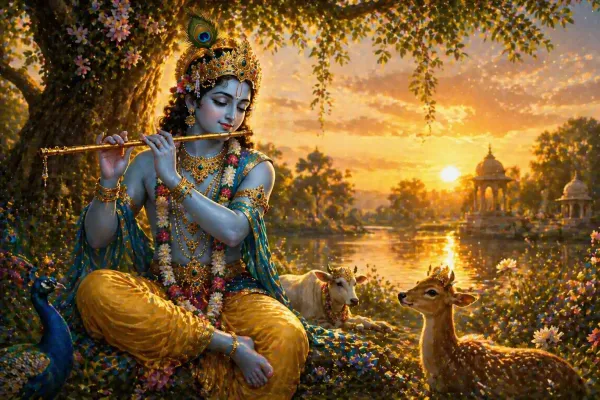
Every eye remains fixed upon the beautifully decorated curtain, behind which rests the divine form of Shree Krishna, the beloved Lord of Vrindavan. Soon the conch will sound, the bells will ring, and the curtain will open, so that thousands of voices can cry out together in celebration of the One who appeared at midnight thousands of years ago, yet somehow still makes the heart feel that He has come tonight.
This is Janmashtami at Radha Krishna Temple of Dallas, where thousands gather year after year, traveling long distances, standing for hours, fasting, singing, serving, and waiting, only to return the following year with the same eagerness. Janmashtami is not merely the celebration of Krishna's appearance. It is the night when the soul remembers its Beloved, and sometimes one night of remembrance is enough to awaken a longing that has been sleeping for years.
Radhe Radhe. Come, let us enter this celebration together.

He Did Not Have to Come
Before celebrating Krishna's appearance, it is worth pausing on something astonishing: He did not have to come. The Supreme Lord lacks nothing. Countless universes exist within His infinite power, and He needs no throne, no recognition, no worship, no offering from us. Yet He came anyway, not into a palace but into a prison cell in Mathura, not surrounded by royal celebrations but before Devaki and Vasudev, imprisoned under the tyranny of Kansa.
The Infinite enters the finite out of pure grace. Swami Mukundananda repeatedly explains the principle behind the divine descents: God does not descend because He is compelled by some necessity.
His avatar is an expression of His causeless grace and compassion for souls.
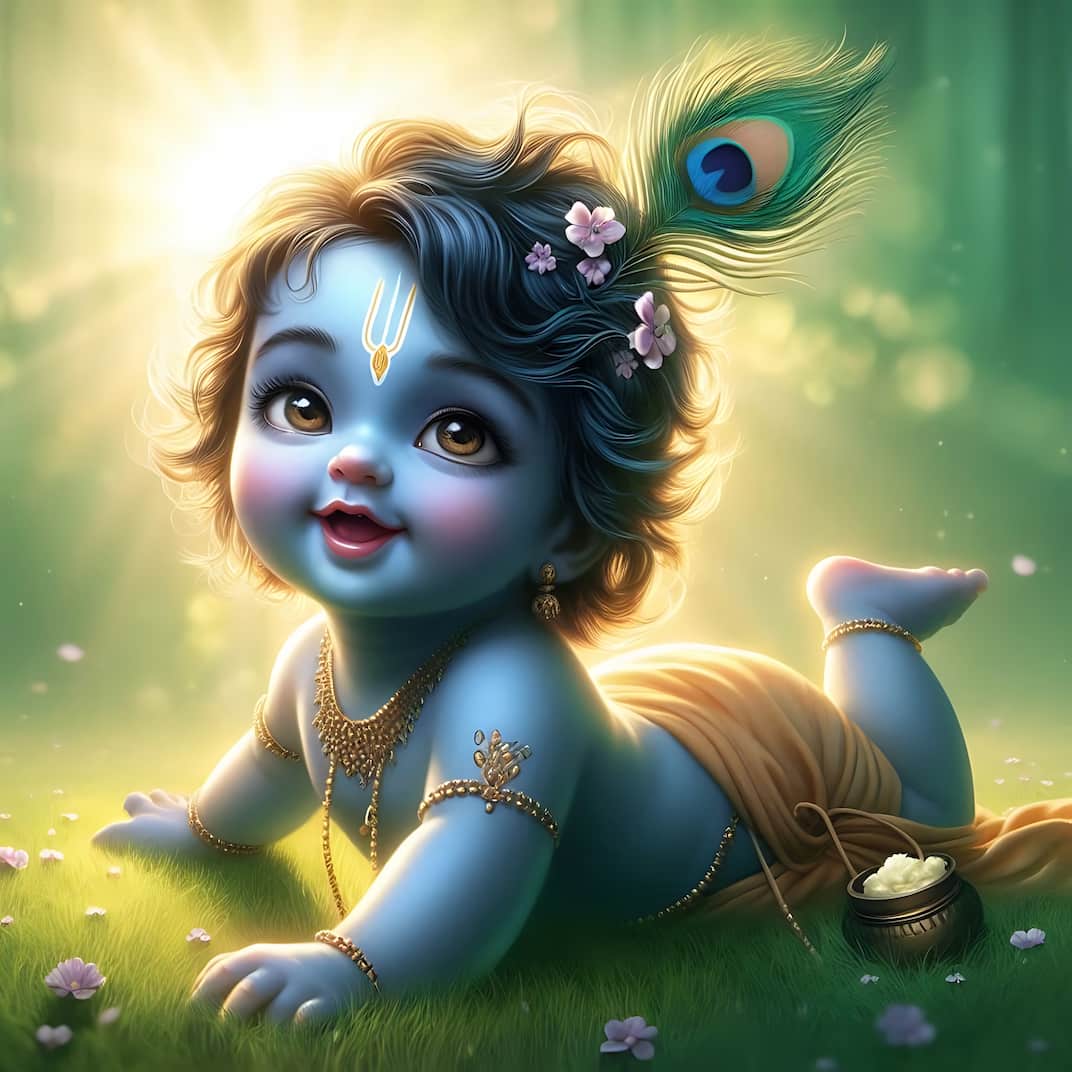
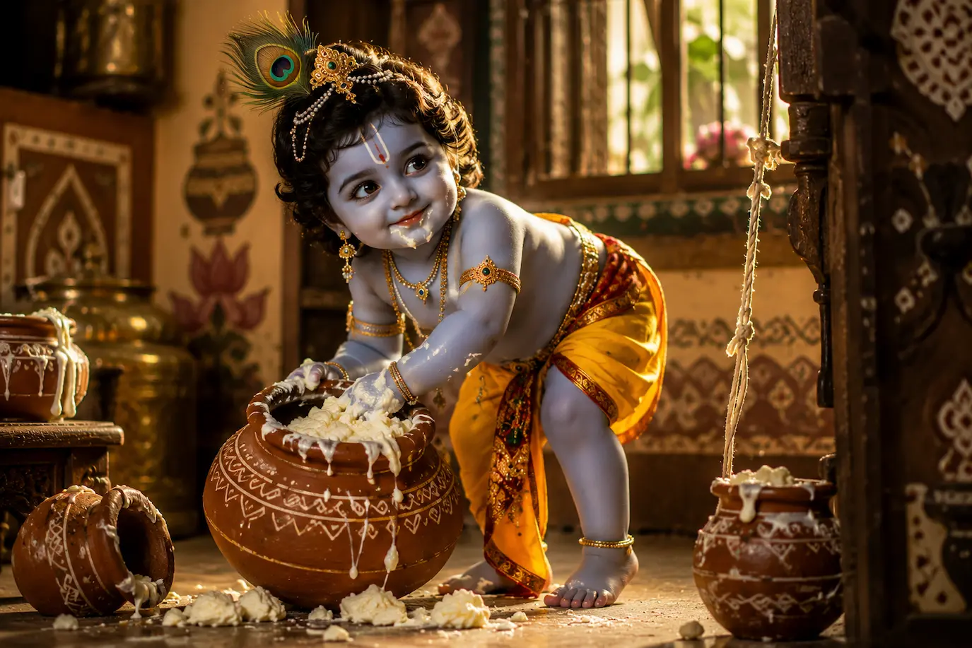
Krishna does something even more extraordinary than descending, for He does not merely come near us but allows us to love Him. The Lord whom the Vedas struggle to describe becomes little Kanha. The omnipotent becomes Yashoda's child. The Lord of creation steals butter. The Supreme Being runs from a mother holding a rope, and the ruler of countless universes carries the lunch boxes of His cowherd friends. Majesty may make us bow before God, but it is sweetness that makes us love Him, and this is why Krishna's pastimes carry such tenderness, not to diminish His greatness, but to make that greatness approachable to the human heart.
The God Who Allowed Himself to Be Bound
There may be no image in Krishna bhakti more tender than Mother Yashoda running behind little Krishna with a rope. Within that image lies a beautiful paradox. Maya binds the individual soul through attachment, desire, anger, greed, and ego, yet the Lord who controls Maya allows Himself to be caught by a village mother. Yashoda tries to tie Him to a grinding mortar, not because she is stronger than Krishna, but because He allows Himself to be conquered.
This reveals something the scriptures teach again and again: the Lord who cannot be bound by anything in creation allows Himself to be bound by love. Not by scholarship, not by position, not by wealth, not by spiritual pride, only by love. This is one reason Janmashtami touches the heart differently from an ordinary celebration. We are not approaching only the almighty God before whom creation trembles. We are approaching our own Krishna, the Krishna who permits friendship, who permits motherly affection, who allows the soul to feel, in time, that it belongs to Him as surely as He belongs to it.
Swami Mukundananda explains this devotional intimacy through mamatva, the feeling of “mine-ness” toward God. Knowing “Krishna is God” is wonderful, but bhakti deepens further when knowledge becomes relationship, when “Krishna is my God” gradually ripens into the simplest and deepest recognition of all: Krishna is mine.
Why the Heart Keeps Returning
The world keeps us extraordinarily busy, with careers to build, families to care for, bills to pay, responsibilities to fulfill, problems to solve, messages to answer, and goals waiting just beyond the previous goals. After achieving something we desperately wanted, another desire appears. Again we run. Again we attain. Again the mind searches for the next thing.
Swami Mukundananda explains that this endless search for happiness exists because the soul is a fragment of the divine and naturally seeks the infinite bliss of God. Finite objects may please the senses and mind temporarily, but they cannot permanently satisfy the soul. Janmashtami interrupts that endless running. For a few sacred hours, thousands stop chasing the world and begin calling, “Radhe Krishna.”
This is why tears sometimes appear without warning during kirtan. The intellect may not understand what happened, but the heart recognizes something the mind had long forgotten: this was what the soul had been searching for all along.
When a Thousand Voices Become One
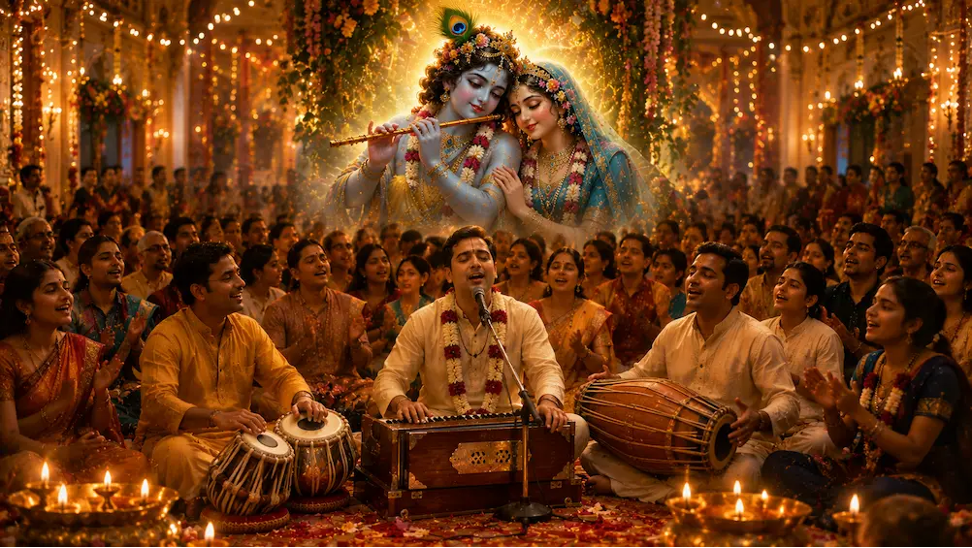
One of the most powerful experiences of Janmashtami at Radha Krishna Temple is kirtan. At first, hundreds of people are simply singing together, “Radhe Shyam… Radhe Shyam…” Then something begins to change. The repetition deepens, and the mind that arrived carrying ten worries begins carrying nine, then five, then one, until for a few precious moments, even that one worry dissolves. Only Krishna remains.
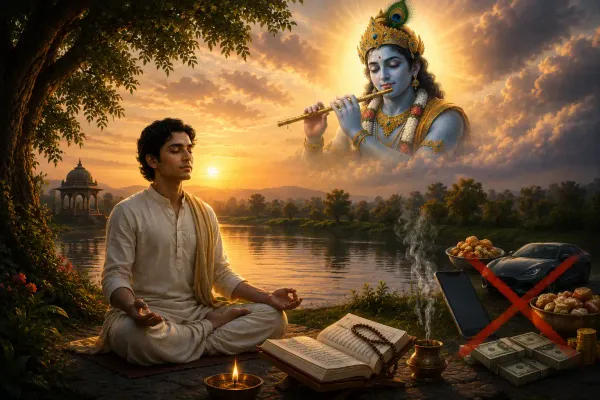
Swami Mukundananda teaches the practice of Roopdhyan, lovingly meditating upon the divine form of God while engaging in devotion. While singing, Krishna's name need not remain merely upon the tongue. It can be carried before the mind, in the dark curling hair, the peacock feather, the radiant face, the yellow pitambar, the Vaijayanti mala, the flute resting gently in His hands, and beside Him, Shree Radha, the very embodiment of divine love. In this way, kirtan becomes more than music. It becomes remembrance, and remembrance in turn becomes relationship.
Krishna Leelas: When God Becomes Someone We Can Love
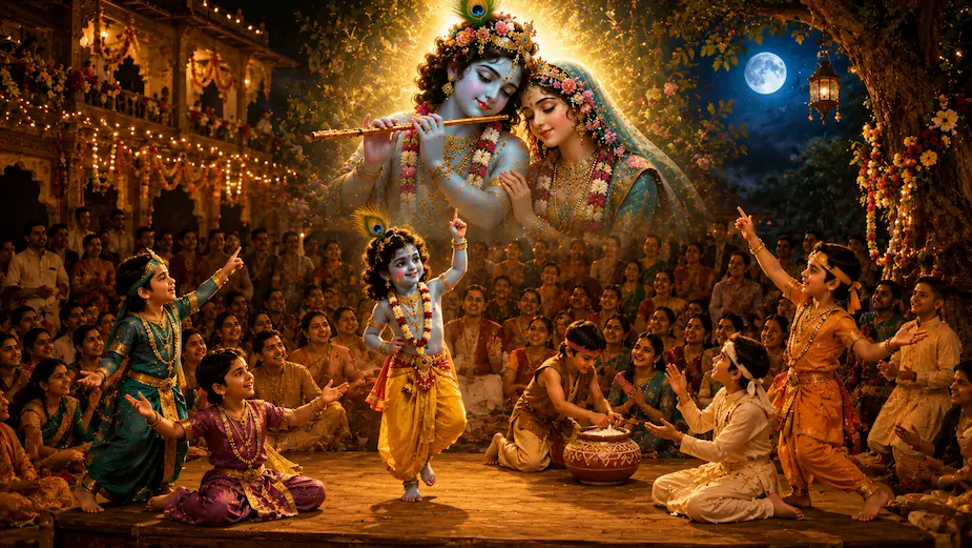
Children dressed as Krishna appear with tiny flutes and peacock feathers, and Krishna's childhood pastimes come alive through performances and storytelling. To a casual observer, these may look like charming cultural traditions. To a devotee, they reveal something profound about God: the Supreme Lord is not distant. He allows Himself to be approached through love.
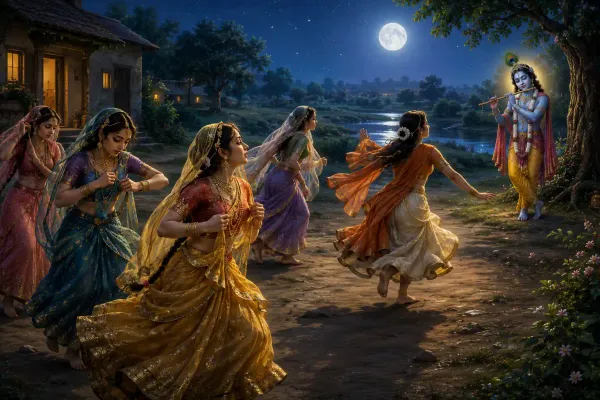
The same Krishna who lifted Govardhan Hill plays with cowherd boys. The Lord feared by Kansa becomes the delight of Yashoda. The One worshipped through elaborate rituals steals butter from the gopis' homes. This sweetness is the very heart of Krishna bhakti. A child may laugh at Makhan Chor. A young person may admire Krishna's courage. A parent may feel Yashoda's affection. An elderly devotee may close their eyes and remember decades of calling His name. Krishna gives every heart its own doorway.
Dahi Handi: Bhakti Was Never Meant to Be Lonely
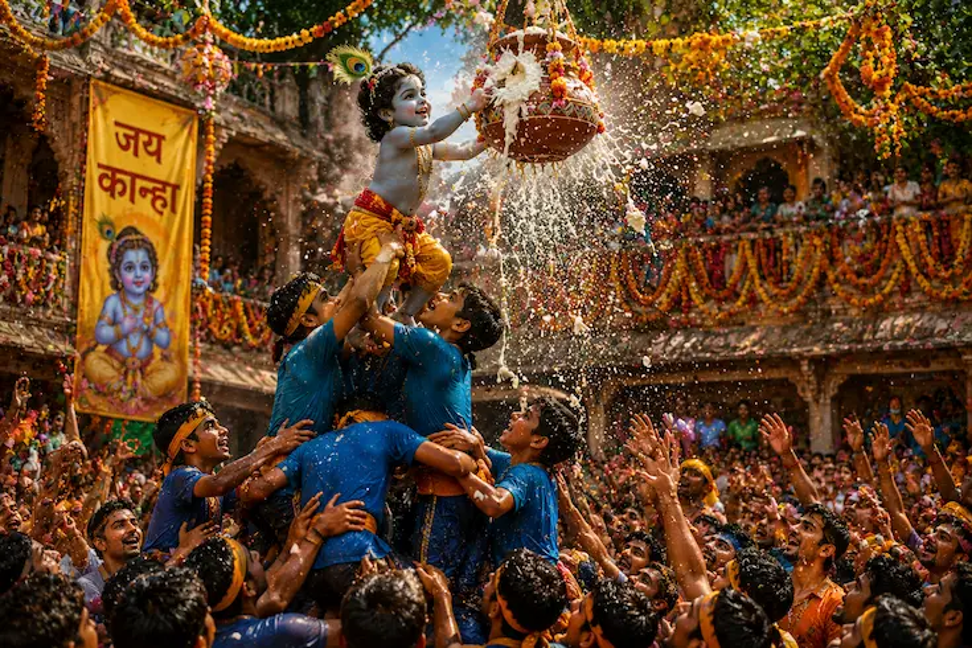
Then comes the laughter and excitement of Dahi Handi, as devotees form human pyramids, supporting one another as they reach toward the hanging pot, remembering Krishna and His cowherd companions. Hidden inside the playfulness is a beautiful lesson: the person at the top cannot rise without those supporting them below.
Spiritual life carries the same truth. We need satsang, the association of people who remind us of God when our own remembrance weakens. One person's faith strengthens another. One devotee's kirtan carries another person's tired mind. Someone else's seva inspires us to serve, and someone else's tears remind us that devotion can still become real. This is why thousands gathering together matters, for sometimes another devotee remembers Krishna for us until we can remember Him again ourselves.
Seva: When Ordinary Work Becomes Love


Long before the crowds arrive, seva has already begun. Someone arranges flowers. Someone prepares prasad. Someone rehearses a performance. Someone welcomes families. Someone manages parking. Someone cleans. Someone stays late after everyone else has gone home. Most of these names will never be announced, and this is precisely what makes their seva so beautiful.
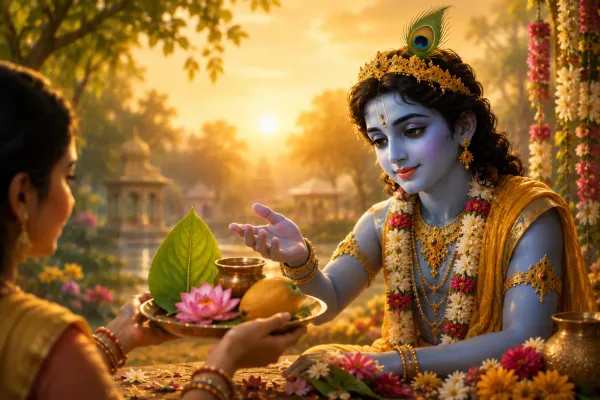
Bhakti transforms the very posture of the heart, turning it from receiving toward offering. A flower placed before Krishna with love becomes worship. Food prepared for devotees becomes worship. Cleaning a forgotten corner becomes worship. Helping a tired family becomes worship. The greatness of seva is never determined by how visible the task is, but by the love placed inside it.
Why Radha Stands Beside Krishna
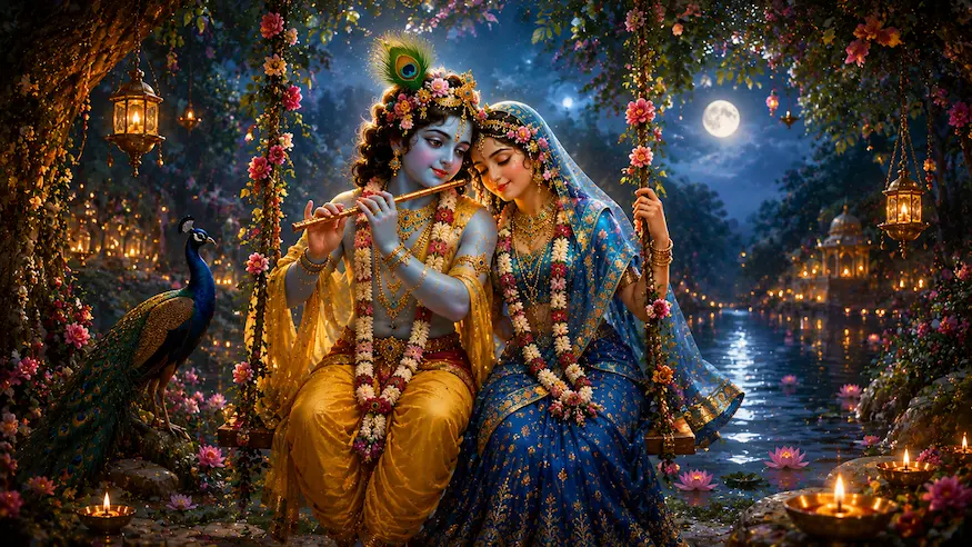
At the heart of Radha Krishna Temple stands a teaching deeper than the festival itself: Radha stands beside Krishna. If Krishna teaches us whom to love, Radha teaches us how to love Him. Ordinary love seeks its own fulfillment. Radha's love seeks only Krishna's happiness.
This is the very direction in which bhakti gradually carries the heart. We may begin by asking Krishna to solve our problems, protect our families, grant success, and remove our difficulties, and Krishna lovingly accepts us even there. But devotion does not wish to leave us there forever. As love matures, another posture begins to emerge: a growing desire to offer rather than to receive. This movement from receiving to offering is the very beginning of nishkam bhakti, devotion increasingly freed from selfish expectation.
The highest devotee does not love Shree Krishna merely because He gives, but simply because He is lovable. And Radha remains the supreme ideal of that selfless, unwavering love.
Midnight: The Curtain Opens
Then comes the moment everyone has been waiting for. Midnight arrives. The kirtan intensifies, the anticipation grows, the conch sounds, the bells begin ringing, and the curtain finally opens. Thousands behold Shree Krishna together, some folding their hands, some chanting louder, some falling silent, some closing their eyes, some simply looking, and some discovering tears already falling.
Darshan is more than looking at the Deity. The devotee comes with the aspiration to see with the heart. For those few moments, deadlines disappear, disappointments loosen their grip, status becomes irrelevant, and the stranger standing beside you and the family standing behind you are calling the very same Krishna. Thousands of separate lives converge upon one Beloved.
Perhaps the simplest prayer at that moment is also the deepest: that Krishna would take birth in the heart. Take birth where anger has lived. Take birth where ego has lived, where resentment has lived, where fear has lived, where the world has occupied far too much space, and in that moment, the devotee's own heart can simply say: Come, Kanha. There is room now.
The Real Janmashtami Begins After Midnight
Eventually the celebration ends. The decorations come down, the crowds leave, the parking lot empties, and Monday arrives. This is where Janmashtami faces its real test: whether we merely celebrated Krishna's appearance, or whether something inside us actually changed.
Swami Mukundananda emphasizes repeatedly that spiritual knowledge must be practiced, that the goal is never temporary inspiration but the lasting transformation of the mind and heart. So Janmashtami must be carried home: through the daily chanting of His names, through the practice of Roopdhyan, through reading and contemplating the Bhagavad Gita, through seeking satsang, through offering one's abilities in seva, through remembering Him while working, and through offering Him the fruits of one's actions.
Gradually, one intention begins to accompany ordinary life: the intention to please Shree Krishna in each moment. Then Janmashtami no longer lasts one night, but becomes a way of living.
Why Thousands Return Every Year
Thousands gather at Radha Krishna Temple every Janmashtami, not merely because of the decorations, not merely because of Dahi Handi, not merely because of performances, prasadam, music, or tradition. They return because love longs to meet the Beloved again.
A child who once watched Krishna Leela grows older carrying that samskara. A newcomer who entered out of curiosity leaves wondering why Krishna's name touched something so deep. A devotee burdened by life stands before Radha Krishna and remembers that there is still somewhere the heart can surrender. Those who came last year return because the soul never rests content with having remembered Krishna only once. Love wants to remember again, to see again, to sing again, to serve again, to surrender again. This is perhaps the real secret behind the thousands. They are not merely returning to a festival. They are returning to Someone.
Come This Janmashtami

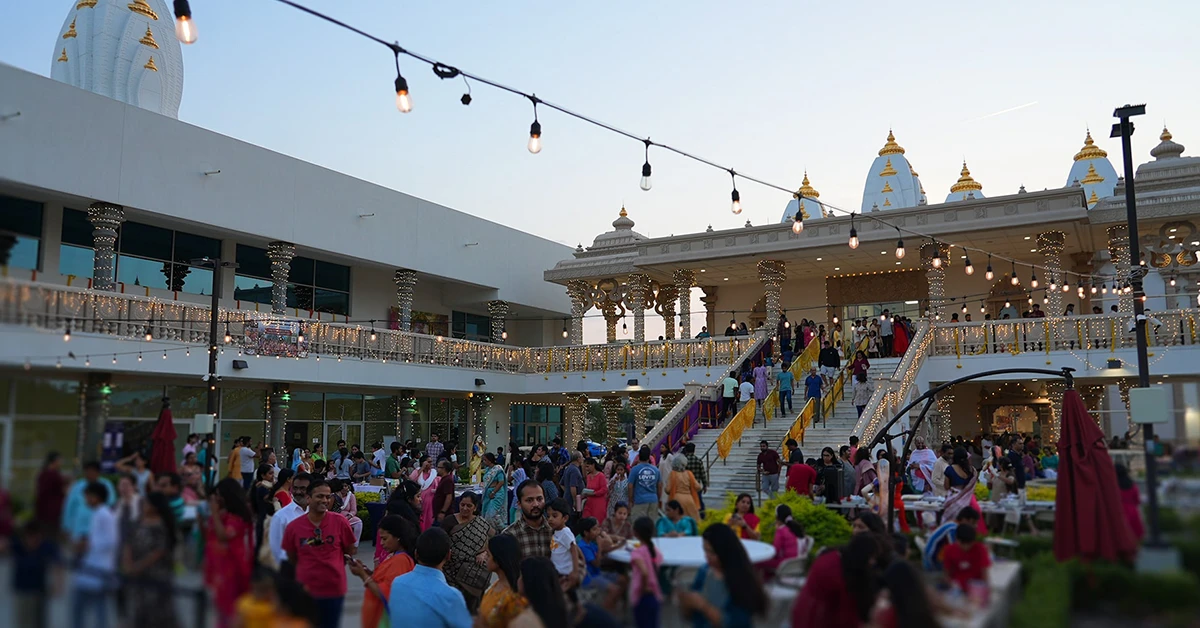
This Janmashtami, come to Radha Krishna Temple of Dallas not merely to attend another event, but to meet Him. Bring the devotion you have, not the devotion you think you should have. Bring the restless mind, the unanswered prayer, the family, the children who may not sit still, the heart that has grown tired from asking the world to satisfy it.
Come for the kirtan. Come for Krishna Leela. Come for Dahi Handi. Come for seva and satsang. Come for the sacred midnight darshan. But somewhere amid the celebration, find one quiet moment before Shree Radha Krishna. Look at Them, and let the heart move beyond asking what Krishna will give, toward asking instead what may be given to Him.
Perhaps it is one habit. One attachment. One act of seva. One daily remembrance. One corner of the heart that has long been kept closed. Whatever it is, it may simply be brought, for Krishna never demanded that we arrive with perfect devotion. He only asks that we begin.
And when the bells ring at midnight and the curtain finally opens, may we remember: the deepest miracle of Janmashtami is not only that Krishna appeared in Mathura thousands of years ago. It is that after everything we have done, forgotten, chased, feared, gained, and lost, He is still willing to appear in our heart.
May Radha teach us how to love Him. May Krishna teach us how to belong to Him. And may this Janmashtami become the night when the heart stops merely searching for God, and begins, at last, loving its Beloved.
Key Takeaways
• Krishna's appearance is an expression of divine grace. The Infinite comes near so that finite souls may develop a loving relationship with Him.
• Bhakti grows from reverence into relationship. Through mamatva, “Krishna is God” gradually deepens into “Krishna is mine, and I am His.”
• Krishna allows Himself to be conquered by love. Yashoda binding Damodar reveals the extraordinary intimacy God permits His devotees.
• Kirtan combined with Roopdhyan transforms singing into remembrance. Keep Krishna's form in the mind while His name is on the lips.
• Satsang strengthens devotion. Like the human pyramid of Dahi Handi, devotees spiritually support one another.
• Seva turns action into an offering. The smallest task becomes sacred when performed for Radha Krishna without seeking recognition.
• Shree Radha reveals the destination of bhakti. Love matures from “What will Krishna give me?” toward “What can I offer Krishna?”
• Janmashtami should continue after the festival. Kirtan, Roopdhyan, satsang, scriptural contemplation, seva, and remembrance allow the celebration to become a daily spiritual practice.
Frequently Asked Questions
1. Why is Janmashtami celebrated at midnight?
Shree Krishna appeared at midnight in Mathura. Devotees remain absorbed in fasting, kirtan, remembrance, and prayer as they approach that sacred hour, culminating in the joyous celebration of His divine appearance.
2. What makes Janmashtami at Radha Krishna Temple of Dallas special?
The celebration brings together kirtan, Krishna Leelas, Dahi Handi, devotional programs, seva, satsang, darshan, prasadam, and a large community of devotees. Together they create an environment in which it becomes easier for the mind to turn toward Radha Krishna.
3. What is Roopdhyan?
Roopdhyan is loving meditation upon the divine form of God. While chanting or singing kirtan, a devotee lovingly visualizes Krishna's form and pastimes so that both the mind and senses become engaged in remembrance.
4. What is mamatva in bhakti?
Mamatva is the devotional feeling that God belongs to me and I belong to Him. It transforms an abstract understanding of God into a deeply personal relationship.
5. Why is Shree Radha worshipped alongside Krishna?
Shree Radha represents the highest ideal of selfless divine love. Her devotion seeks Krishna's happiness rather than personal fulfillment. For the devotee, Her love reveals the direction in which bhakti ultimately wishes to take the heart.
6. Can someone attend Janmashtami without knowing much about Hinduism?
Yes. Janmashtami can be experienced by newcomers as well as longtime devotees. Come respectfully and with an open heart. The kirtan, stories, darshan, and devotional atmosphere themselves provide an introduction to Krishna bhakti.
7. How can I continue Janmashtami after the festival?
Begin simply. Chant Krishna's names, practice Roopdhyan, read a verse from the Bhagavad Gita, seek satsang, offer some seva, and remember Radha Krishna during ordinary activities. Consistency gradually turns festival inspiration into spiritual transformation.