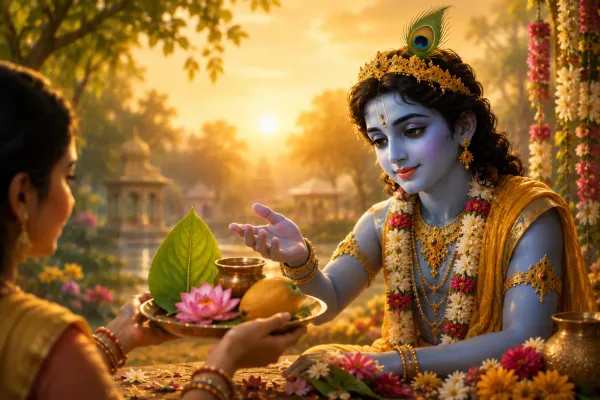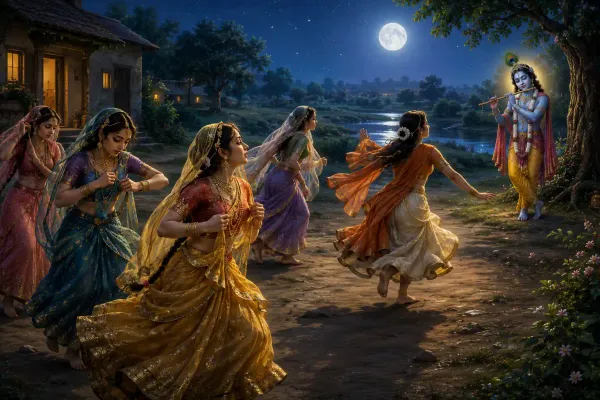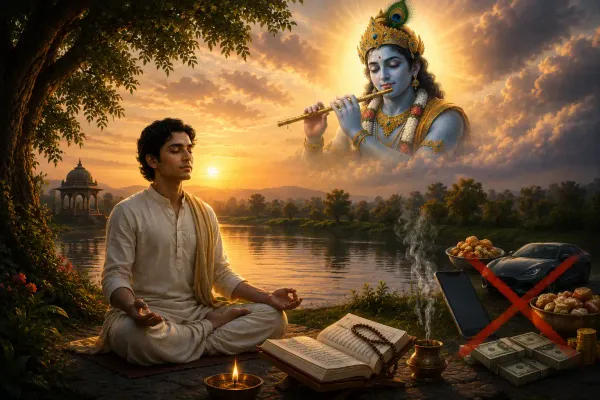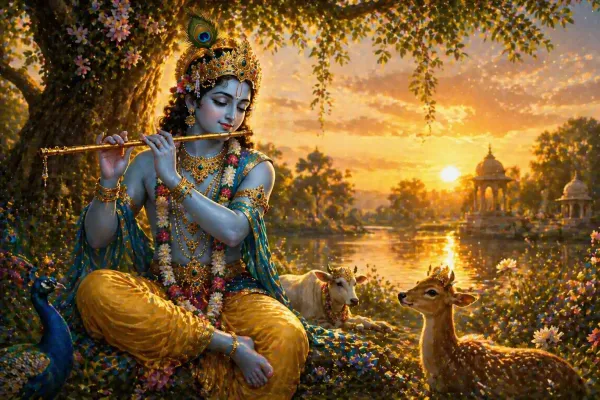
Every Janmashtami, devotees joyfully celebrate the birth of Shree Krishna by remembering His enchanting childhood pastimes in the sacred land of Braj. We delight in His playful mischief, His irresistible smile, and the countless leelas that reveal His boundless compassion. Yet beneath every pastime lies a profound spiritual teaching, carefully woven into the fabric of His divine life.

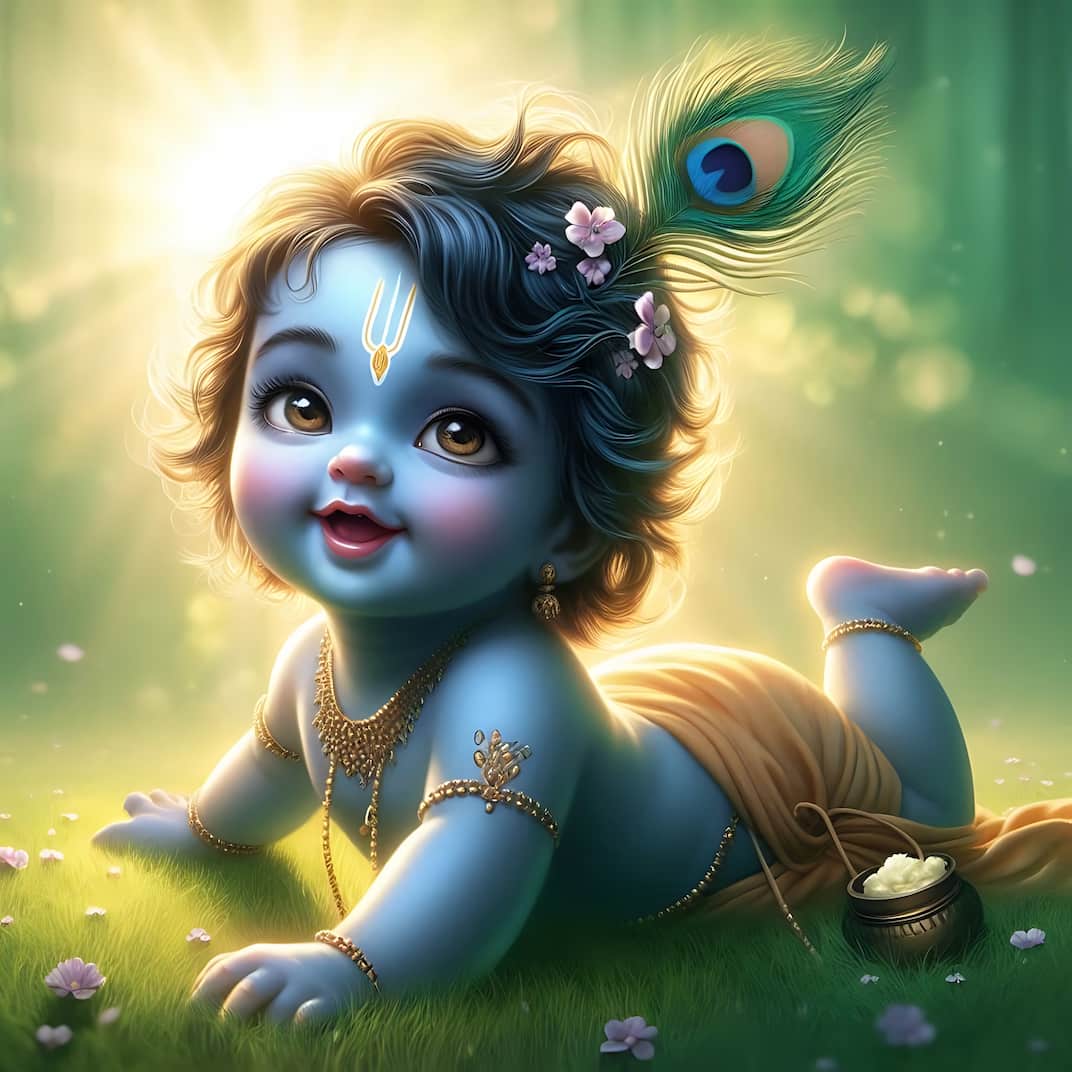
Among these, the Govardhan Leela shines as one of the most significant. To many, it is remembered simply as the miracle in which little Krishna lifted an enormous mountain on the tip of His little finger to protect the residents of Braj from a devastating storm. While the miracle itself fills the heart with wonder, the Srimad Bhagavatam reveals that its deeper purpose was far greater.
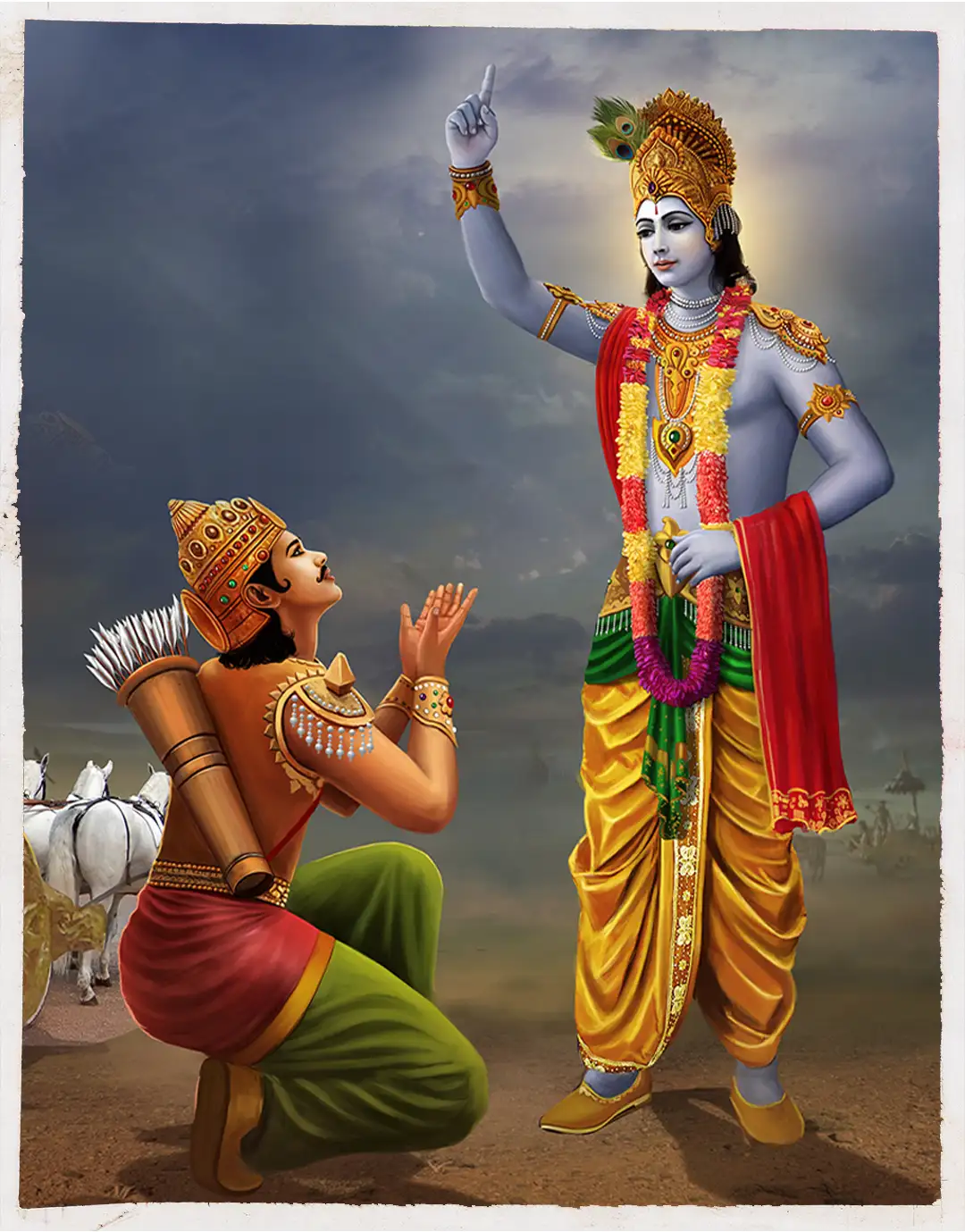
Swami Mukundananda explains that the Govardhan Leela was not merely about humbling Indra, the celestial king of heaven. Rather, it was Krishna's compassionate preparation for one of the greatest spiritual truths He would later reveal in the Bhagavad Gita: that the soul's ultimate refuge is not in any worldly power, celestial being, or external ritual, but in the Supreme Lord alone. Years before speaking the immortal words of Bhagavad Gita 18.66 on the battlefield of Kurukshetra, Krishna demonstrated their meaning through His own divine actions in Braj:
सर्वधर्मान्परित्यज्य मामेकं शरणं व्रज ।
अहं त्वां सर्वपापेभ्यो मोक्षयिष्यामि मा शुच: ॥ 66॥
sarva-dharmān parityajya mām ekaṁ śharaṇaṁ vraja
ahaṁ tvāṁ sarva-pāpebhyo mokṣhayiṣhyāmi mā śhuchaḥ
BG 18.66: Abandon all varieties of dharmas and simply surrender unto Me alone. I shall liberate you from all sinful reactions; do not fear.
The Govardhan Leela therefore marks a turning point in Krishna's earthly pastimes. It gently redirects the hearts of His devotees from ritualistic observances toward exclusive, loving surrender. It teaches that the highest religion is not merely performing ceremonies but cultivating an unwavering relationship with God.
The Worship of Indra in Braj
The residents of Braj lived simple lives centred on agriculture and cow protection. Their prosperity depended upon timely rainfall, fertile pastures, and healthy cattle. Like many communities of the time, they believed that Indra, the celestial administrator responsible for rain, should be worshipped each year to ensure abundant harvests.
This practice was not born out of malice or ignorance. According to the Vedic tradition, the devas perform important responsibilities within God's universal administration. Just as a government functions through different ministers overseeing various departments, the cosmic order is maintained by celestial beings entrusted with specific functions. Agni presides over fire, Vayu governs the wind, Surya illuminates the world with sunlight, and Indra oversees the rains. Even today, traditions honouring Indra can still be found in parts of the Indian subcontinent.
As preparations began for the annual Indra Puja, young Krishna watched with innocent curiosity. He asked His father, Nanda Baba, why such elaborate arrangements were being made. Nanda lovingly explained that their community depended upon rainfall for survival and that they wished to express gratitude to Indra for his blessings. Krishna listened attentively, then began asking questions.
His inquiries appeared simple, yet each one invited the villagers to think more deeply about the nature of devotion. If rain ultimately comes according to God's universal arrangement and the law of karma, why should one's faith rest solely upon a celestial administrator? Should not gratitude be directed toward the Supreme Lord, who empowers every deva to perform their respective duties?
What appeared to be the innocent curiosity of a seven-year-old child was, in reality, the beginning of one of the greatest spiritual lessons in the Bhagavatam.
Preparing the World for the Bhagavad Gita
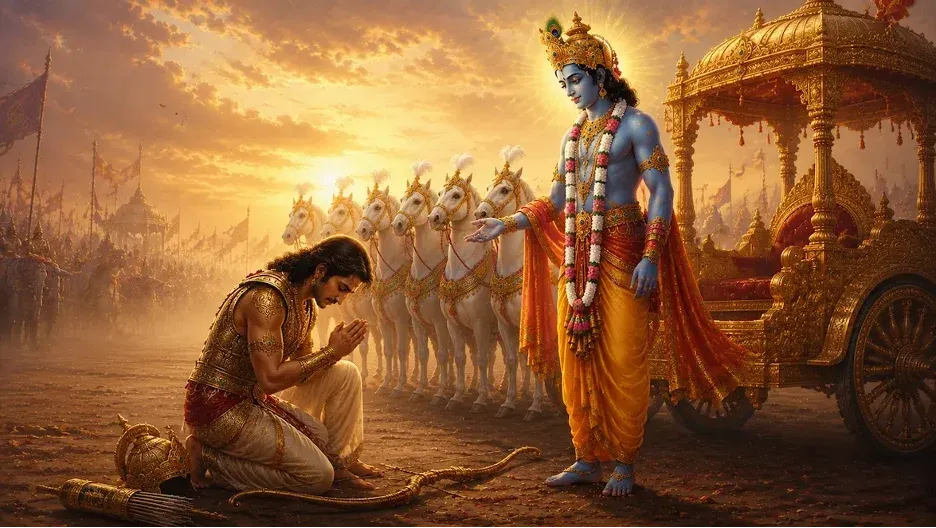
At first glance, Krishna's challenge to the Indra Puja might seem like a simple correction of an old custom. Yet Swami Mukundananda explains that something far more profound was taking place.
Years later, on the battlefield of Kurukshetra, Krishna would reveal the culmination of all Vedic wisdom in a single instruction:
BG 18.66: Abandon all varieties of dharmas and simply surrender unto Me alone. I shall liberate you from all sinful reactions; do not fear.
This verse is often described as the crown jewel of the Bhagavad Gita because it reveals the soul's highest duty. Krishna was not rejecting the Vedas, nor was He asking Arjun to neglect righteousness. Rather, He was revealing that beyond every social, familial, and material obligation lies a higher calling: the soul's eternal relationship with God.
Swami Mukundananda explains that there are two kinds of dharma. The first is Apara Dharma, our material responsibilities arising from bodily identification. These include our duties to family, society, profession, and the world around us. The second is Para Dharma, the soul's eternal duty of loving devotional service to God. When one truly embraces Para Dharma, all other responsibilities are naturally fulfilled because God is the source of all existence.
The Govardhan Leela was Krishna's way of demonstrating this truth long before He formally taught it.
Rather than allowing His beloved Brajvasis to believe that their welfare depended upon Indra, Krishna lovingly redirected their attention toward the Supreme Lord Himself.
Govardhan Hill: A Living Manifestation of God's Grace
Krishna then suggested an entirely different celebration: instead of worshipping Indra, He encouraged the residents of Braj to honour Govardhan Hill.
To an outsider, this proposal may have seemed unusual. Why worship a mountain?
Krishna explained that Govardhan lovingly sustained every aspect of their lives. Its lush grasses nourished the cows, its forests provided fruits, flowers, herbs, and firewood, while its streams and caves offered beauty, shelter, and delight. Every day the people of Braj benefited from Govardhan's generosity without giving much thought to its blessings.
Swami Mukundananda explains that Govardhan was no ordinary mountain. It is revered as a divine manifestation of Lord Vishnu Himself, descending to participate in Krishna's earthly pastimes and facilitate the loving exchanges between the Lord and His devotees.
Krishna first won over His young cowherd friends, who readily embraced the joyful idea of celebrating the hill they loved so dearly. Together they persuaded the elders of Braj, and soon the entire village enthusiastically prepared for a grand festival unlike anything they had celebrated before.
Mountains of delicious food were lovingly prepared. Sweets, fruits, vegetables, milk preparations, and countless delicacies were arranged as offerings before Govardhan Hill.
Then something astonishing happened.
To the amazement of every resident of Braj, Krishna manifested an immense divine form upon Govardhan Hill and personally accepted their offerings, revealing that the worship they had directed toward Govardhan had in fact reached Him, the Supreme Lord Himself.
The lesson could not have been clearer.
The devas are worthy of respect because they faithfully carry out God's will, but the Supreme Lord alone is the ultimate object of devotion.
Indra's Pride Clouds His Vision
Not everyone welcomed this spiritual revolution.
When news reached Indra that the people of Braj had discontinued his annual worship, his heart filled with anger.
Blinded by pride, he forgot that the authority entrusted to him had been granted by the Supreme Lord. Instead of seeing himself as God's humble servant, he mistook his position for personal greatness.
Swami Mukundananda reminds us that pride is one of the greatest obstacles on the spiritual path. Whether it arises from wealth, knowledge, power, beauty, or status, ego creates the illusion that we are independent. Even a celestial king like Indra was not immune to this subtle danger.
Determined to punish the residents of Braj, Indra summoned the fearsome Samvartaka clouds, the devastating storm clouds reserved for cosmic destruction. Torrential rain poured relentlessly upon the land. Violent winds uprooted trees. Lightning flashed across the sky, and floodwaters rapidly engulfed the fields.
The peaceful village of Braj seemed destined for destruction.
Yet while panic spread among the villagers, Krishna remained perfectly calm. The same child who had persuaded them to worship Govardhan now prepared to reveal why complete surrender to God is never misplaced.
The Divine Umbrella of Govardhan
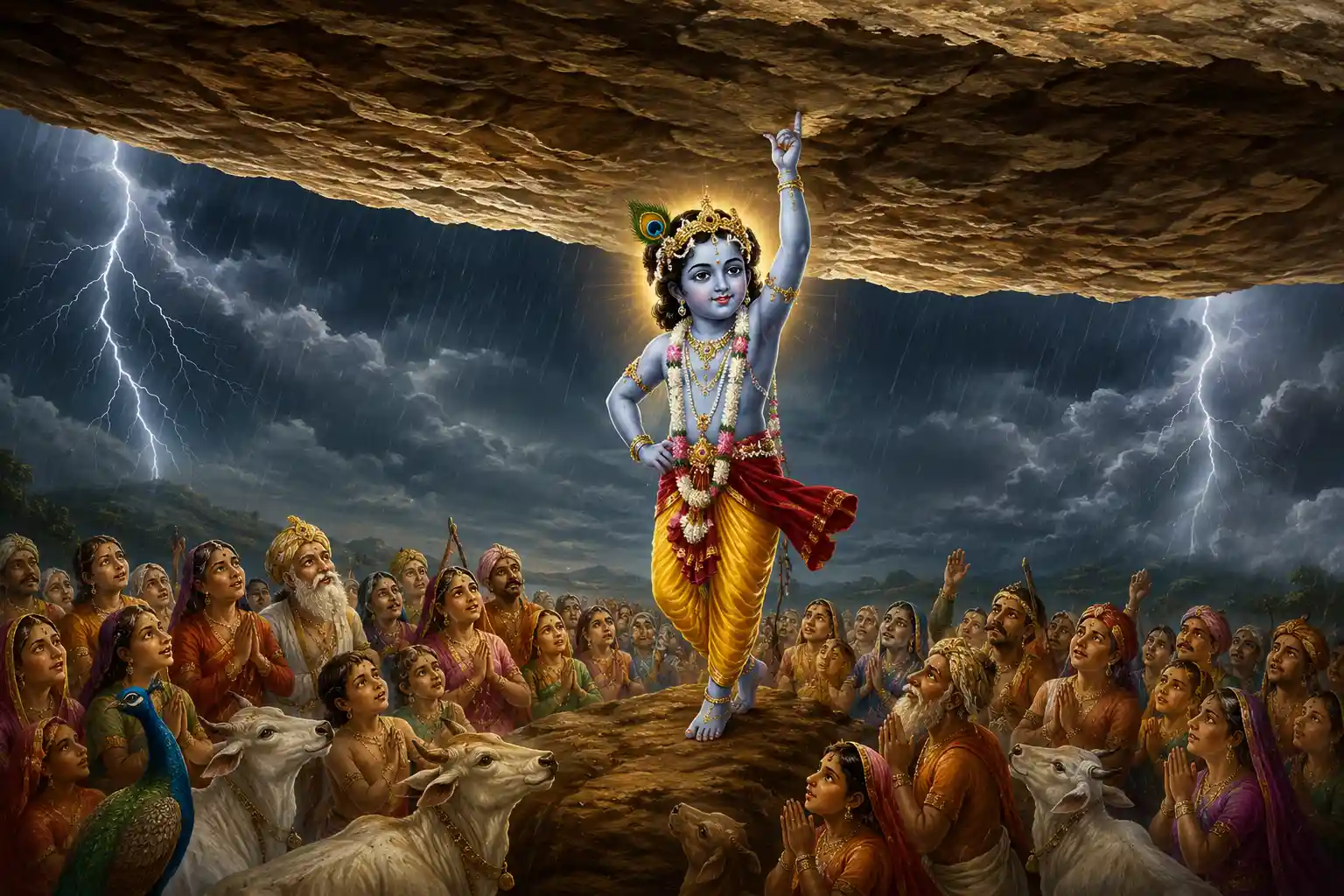
As the terrifying storm intensified, the residents of Braj realised there was no earthly shelter that could protect them. Their homes were being battered by fierce winds, the fields were disappearing beneath rising waters, and their beloved cows trembled in fear. In that desperate moment, they did what every devotee eventually learns to do: they turned to Krishna.
Without the slightest trace of anxiety, the young cowherd boy smiled.
Then, in a moment that has inspired devotees for thousands of years, Shree Krishna bent down, placed the little finger of His left hand beneath Govardhan Hill, and effortlessly lifted the entire mountain as though it weighed nothing at all.
He then invited every resident of Braj: men, women, children, cows, calves, and every living creature, to gather beneath it. What had moments before been a mountain became a vast divine umbrella, protecting all who sought refuge in Him.
The miracle was extraordinary, but the saints remind us that Krishna did not perform it merely to display His divine power. Had He wished, He could have stopped the rain with a glance or dissolved the storm with a single thought. Instead, He chose to hold Govardhan aloft for seven continuous days, inviting every devotee to remain close to Him.
This reveals the true heart of the Leela: Krishna was not only protecting His devotees from the storm outside; He was drawing them into uninterrupted association with Himself.
Why the Little Finger?
The Srimad Bhagavatam repeatedly reminds us that the Supreme Lord's actions are never accidental. Every detail carries spiritual significance.
Swami Mukundananda explains that Krishna deliberately lifted Govardhan Hill with the smallest finger of His left hand. What appears to be the weakest part of the body effortlessly accomplished what no power in creation could achieve. The Lord wished to show that for Him, sustaining an entire mountain required no exertion whatsoever. What astonishes the world is effortless for the Supreme Being.
Yet Krishna performed this astonishing feat without any trace of pride. His smile remained as gentle as ever. He stood among His devotees exactly as He always had, not as a distant ruler demanding worship, but as their beloved Krishna.
This beautiful combination of supreme power and supreme sweetness is one of the defining characteristics of Krishna's personality. His majesty never overshadows His affection.
The Sweetness of Sakhya Bhav
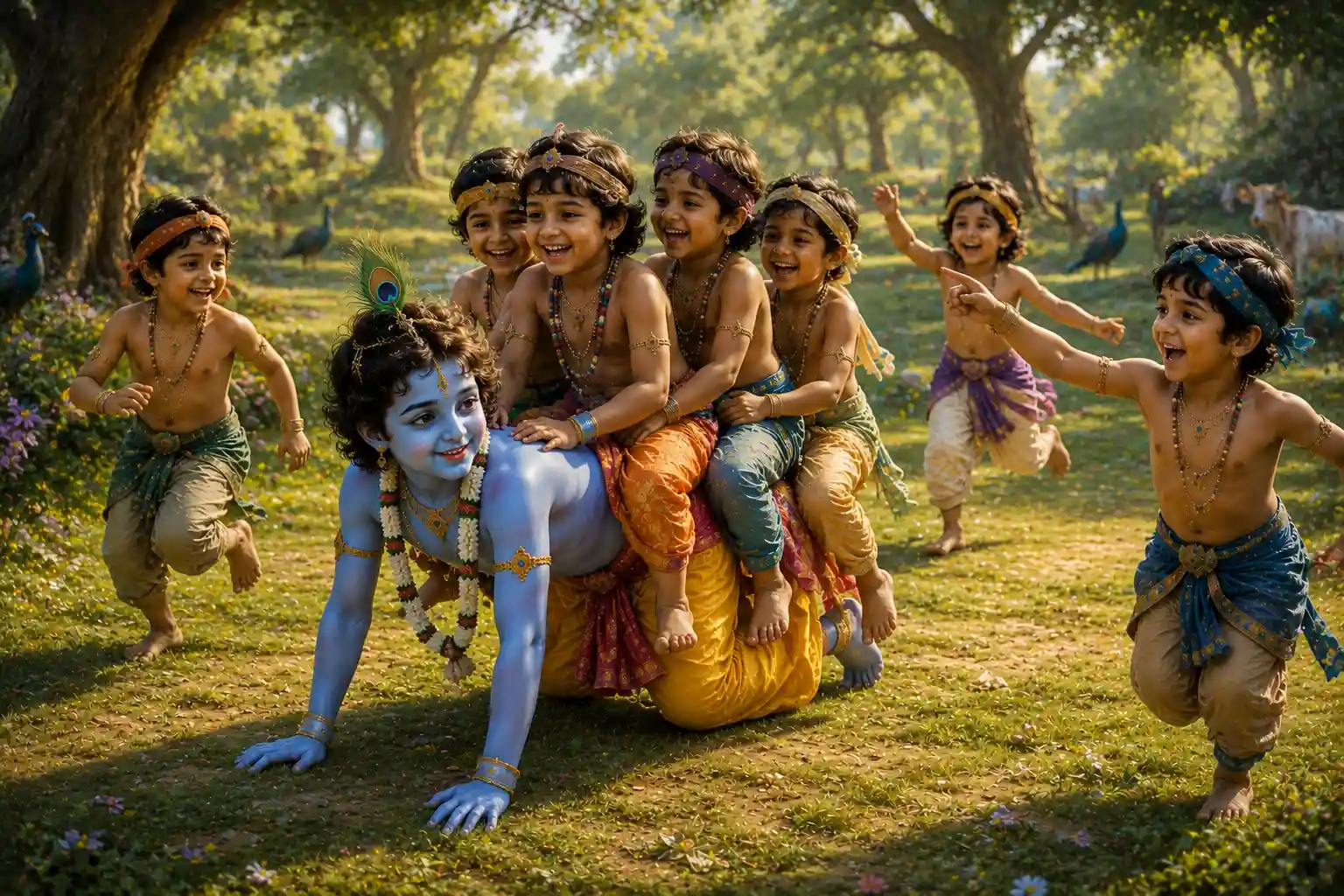
Among everyone gathered beneath Govardhan Hill, perhaps no one responded more beautifully than Krishna's cowherd friends.
The adults stood amazed. They recognised that something utterly miraculous was taking place. But Krishna's closest companions saw things very differently.
Their friendship with Krishna was so intimate that even while watching Him hold an entire mountain aloft, they refused to abandon the simplicity of their love. Seeing Krishna standing with one arm raised, they worried that He might become tired.
Immediately, they ran forward carrying their own wooden sticks. "Don't worry," they said in essence, "we'll help You hold it."
To everyone else, this was clearly unnecessary. Yet to Krishna's friends, it was perfectly natural. They did not see themselves as servants standing before the Almighty. They saw themselves helping their dear companion.
Swami Mukundananda often highlights the extraordinary purity of this Sakhya Bhav, the mood of divine friendship. Even the greatest display of Krishna's divine opulence could not diminish the sweetness of their relationship. They still thought of Him as their 'Langotiya Yaar', their childhood friend with whom they played games, grazed cows, laughed, and shared meals.
This is one of the most touching aspects of the Govardhan Leela, for Krishna does not merely desire reverence. He longs for love.
Seven Days in Krishna's Presence
For seven days and seven nights, the residents of Braj remained beneath Govardhan Hill.
From a worldly perspective, they had taken shelter from a storm, but spiritually, something far more precious was taking place.
For seven uninterrupted days they remained constantly in Krishna's company. Every glance rested upon His beautiful form, every conversation revolved around Him and every worry disappeared in His reassuring presence.
Even while holding Govardhan effortlessly upon His little finger, Krishna continued interacting lovingly with everyone around Him. The atmosphere beneath the mountain was not one of fear but of complete security, joy, and loving dependence upon the Lord.
This offers a profound lesson for spiritual seekers: The greatest blessing is not merely to be rescued from life's difficulties. The greatest blessing is to grow closer to God through them.
Often, we pray for our storms to disappear immediately. Yet sometimes, like the residents of Braj, we discover that our deepest spiritual growth occurs while standing beneath Krishna's protective shelter.
Indra Learns the Meaning of Humility
Meanwhile, Indra watched in disbelief as the storm clouds he had summoned with such confidence had accomplished nothing.
The little cowherd boy whom he had dismissed was effortlessly protecting every resident of Braj. Gradually, pride gave way to understanding.
Indra realised that he had forgotten his true position. The authority he possessed had never been his own. Like every celestial administrator, he served only by the grace of the Supreme Lord.
Filled with remorse, Indra descended from heaven upon his white elephant, Airavata. Bowing before Krishna, he offered heartfelt prayers of repentance and acknowledged his mistake. Krishna, whose compassion is as limitless as His power, forgave him completely. The devastating storm ceased, the skies cleared, and life in Braj returned to its peaceful rhythm.
Humility had replaced pride. This transformation reveals another timeless truth. Spiritual advancement begins not when we become powerful, but when we recognise that every ability, position, and blessing ultimately comes from God.
Krishna Preferred Love Over Majesty
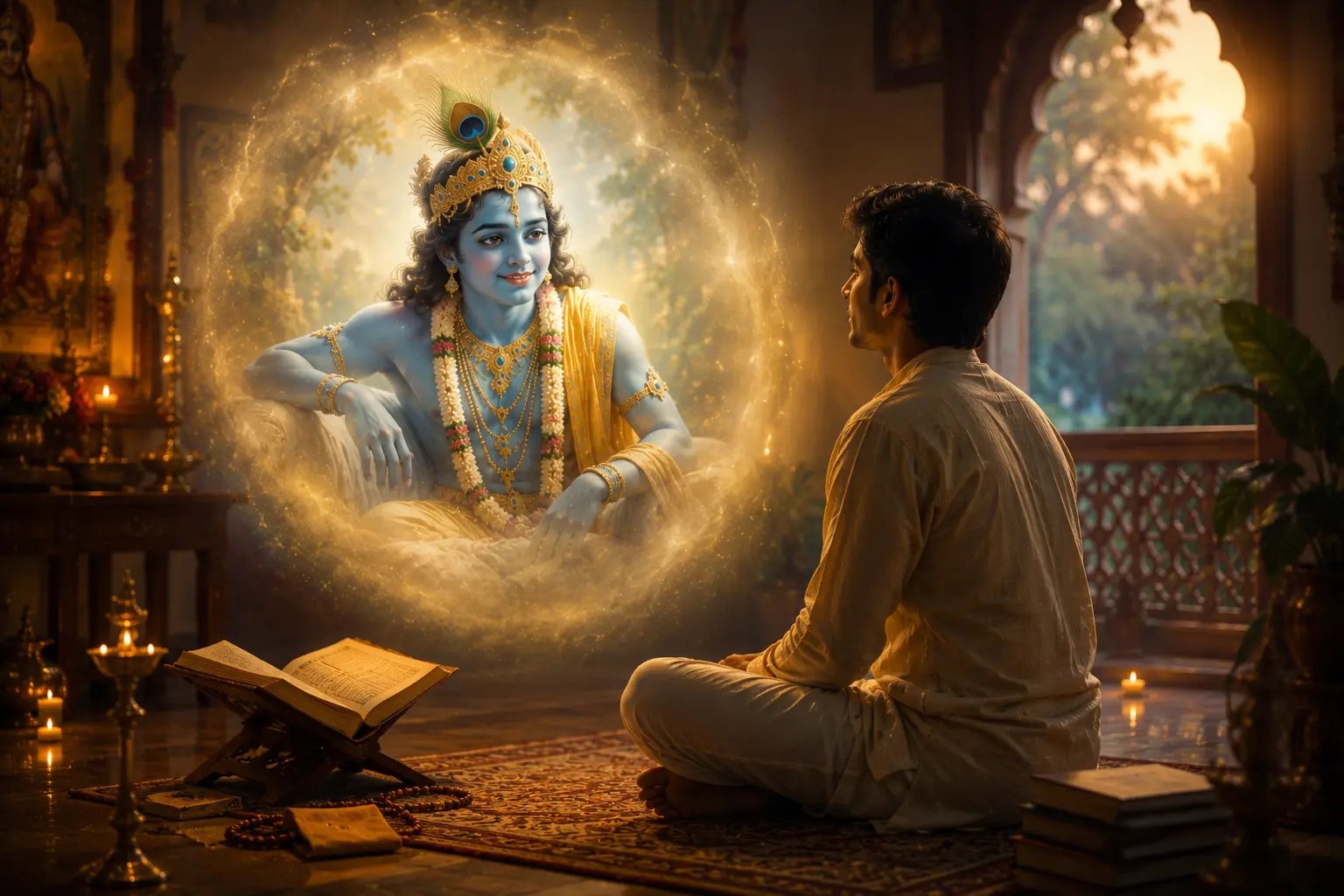
One might imagine that after witnessing such an astonishing miracle, Krishna would delight in everyone's newfound reverence.
Instead, the opposite happened.
Swami Mukundananda narrates a deeply moving episode that reveals Krishna's heart. News spread throughout Braj that the King of Heaven himself had bowed before Krishna. Gradually, people began looking at Him differently. Those who had once embraced Him freely as a son, a friend, or a playful companion now began thinking, "He is God."
Krishna became unhappy.
The spontaneous sweetness of their relationships began to fade beneath feelings of awe and reverence. The intimacy that He cherished was being replaced by distance.
His cowherd friends, however, refused to accept this change.
"What kind of God loses to us in wrestling?" they laughed. "Our parents don't know what they're talking about. He is simply our Krishna."
Through His Yogamaya, Krishna restored their natural affection, allowing the sweetness of Braj to continue exactly as before.
This episode beautifully illustrates one of the central teachings of JKYog.
God is certainly all-powerful, but His greatest joy is not in displaying His majesty. It is in receiving the pure, selfless love of His devotees.
The Govardhan Leela and Bhagavad Gita 18.66
The deeper meaning of the Govardhan Leela becomes fully clear years later on the battlefield of Kurukshetra.
There, the same Krishna who lovingly protected Braj revealed the culmination of all spiritual teachings:
BG 18.66: Abandon all varieties of dharmas and simply surrender unto Me alone. I shall liberate you from all sinful reactions; do not fear.
Swami Mukundananda explains that Krishna is not asking us to become irresponsible or neglect our worldly obligations. Rather, He distinguishes between Apara Dharma, the duties that arise from identifying with the body, and Para Dharma, the eternal duty of the soul, which is to lovingly serve God. When we become established in this higher dharma, every other obligation naturally finds its proper place.
The Srimad Bhagavatam beautifully illustrates this principle by comparing it to watering the root of a tree. Once the root receives nourishment, every branch, leaf, flower, and fruit is sustained automatically. In the same way, when we surrender ourselves to God with sincere devotion, our responsibilities toward the world become harmonised because we are connected to their ultimate source.
This was precisely the lesson Krishna taught the residents of Braj.
He did not ask them to disrespect Indra. He lovingly redirected their devotion toward the Supreme Lord, from whom every deva derives both power and purpose.
Living the Govardhan Leela This Janmashtami
The Govardhan Leela continues to speak powerfully to every devotee celebrating Janmashtami today.
Like the residents of Braj, we often place our security in temporary sources—our careers, wealth, achievements, relationships, or abilities. While these have their place, they cannot become our ultimate refuge.
Krishna invites us to take shelter beneath a different umbrella: that shelter is loving remembrance of Him.
As Swami Mukundananda teaches, this shelter is cultivated through Trida Bhakti. We engage our ears in Shravanam, listening to Krishna's glories. We engage our tongue in Kirtanam, joyfully chanting His holy names. We engage our mind in Smaranam, lovingly remembering His divine form, qualities, and pastimes. Gradually, the heart learns to depend less upon the changing circumstances of the world and more upon the unchanging grace of God.
The storms of life may still come and difficulties may still arise, but just as Govardhan became a divine umbrella for the people of Braj, Krishna's grace continues to shelter every soul that sincerely turns toward Him.
Conclusion
The Govardhan Leela is far more than a story of miraculous strength. It is the childhood pastime that quietly prepared the world for the highest teaching of the Bhagavad Gita.
Before Krishna instructed Arjun to surrender exclusively to Him, He first demonstrated what such surrender looks like through His beloved devotees in Braj. He showed that true refuge is found not in worldly power, ritual alone, or celestial administrators, but in a loving relationship with the Supreme Lord.
This Janmashtami 2026, may we remember the child who held a mountain effortlessly upon His little finger; not simply because He possessed infinite power, but because His infinite love compelled Him to become the eternal shelter of His devotees.
When we step beneath that divine umbrella through faith, surrender, and selfless devotion, we discover that the greatest protection Krishna offers is not merely from the storms around us, but from the ignorance that keeps us separated from Him.
Call to Action
This Janmashtami 2026, go beyond simply celebrating the birth of Shree Krishna; begin living His teachings.
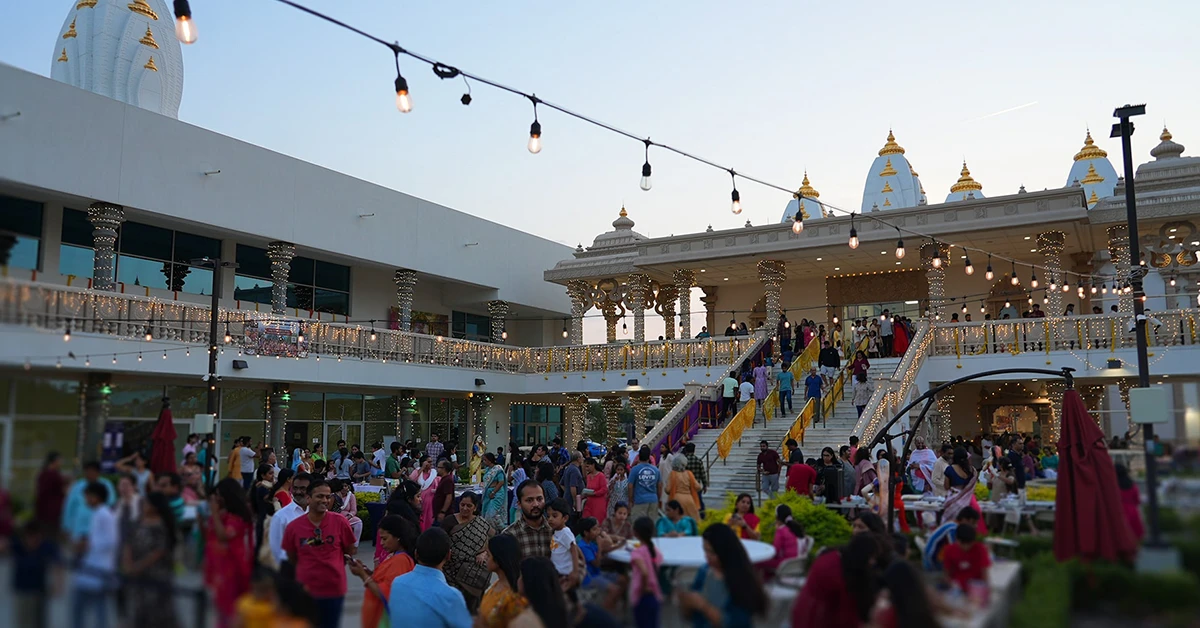
- Visit the Radha Krishna Temple of Dallas for one of their many offerings, or to offer some seva

- Study the Bhagavad Gita with Swami Mukundananda's authentic commentary.

- Download the JKYog Bhagavad Gita & Krishna Bhakti App for daily inspiration, guided meditations, bhajans, lectures, and spiritual resources.
 JKYog
JKYog

Frequently Asked Questions
1. What is the spiritual significance of the Govardhan Leela?
The Govardhan Leela teaches the principle of exclusive surrender to the Supreme Lord. Rather than depending on worldly powers or celestial administrators, Shree Krishna lovingly directed the people of Braj to place their faith in God alone. Swami Mukundananda explains that this pastime foreshadows Krishna's ultimate instruction in Bhagavad Gita 18.66: to surrender completely to Him.
2. Why did Shree Krishna stop the worship of Indra?
Krishna did not teach disrespect for Indra or the other devas. Instead, He taught that while the devas faithfully carry out God's universal administration, the Supreme Lord alone is the ultimate refuge of the soul. By encouraging the worship of Govardhan, Krishna prepared His devotees for the principle of Ananya Bhakti: exclusive devotion to God.
3. Why did Krishna lift Govardhan Hill with His little finger?
Swami Mukundananda explains that Krishna deliberately lifted Govardhan Hill with the smallest finger of His left hand to demonstrate that what appears impossible to the world is effortless for the Supreme Lord. More importantly, He held the mountain aloft for seven days so that every resident of Braj could remain under His loving protection and enjoy uninterrupted association with Him.
4. Why did Krishna's friends offer their sticks to support the mountain?
The cowherd boys were immersed in Sakhya Bhav, the devotional mood of friendship. Even while witnessing Krishna perform an extraordinary miracle, they continued to see Him as their beloved companion rather than a distant deity. Their simple offer to help hold the mountain reveals the sweetness of pure, selfless love that Krishna cherishes above displays of awe and reverence.
5. Why did Krishna become unhappy after the Govardhan Leela?
After Indra bowed before Krishna, many residents of Braj began seeing Him primarily as the Supreme Lord rather than as their playful son, friend, or beloved. Swami Mukundananda explains that Krishna missed the intimacy of these loving relationships. Through Yogamaya, He restored the natural affection of Braj because He delights in pure love more than formal reverence.
6. How is the Govardhan Leela connected to Bhagavad Gita 18.66?
The Govardhan Leela demonstrates through Krishna's actions what He later teaches in words in the Bhagavad Gita: "Abandon all varieties of dharma and simply surrender unto Me alone." Swami Mukundananda explains that when we embrace Para Dharma, loving devotion to God, we naturally fulfil every other responsibility, just as watering the root nourishes the entire tree.
7. What lesson does the Govardhan Leela offer for Janmashtami 2026?
This Janmashtami, the Govardhan Leela reminds us to seek our ultimate shelter in Shree Krishna. By practising Trida Bhakti: Shravanam (hearing), Kirtanam (chanting), and Smaranam (loving remembrance), we gradually cultivate the same spirit of surrender and trust shown by the residents of Braj beneath Govardhan Hill.