Serving the Guru's Mission is Serving Shree Radha Krishna
Every temple tells a story that unfolds far beneath what any visitor's eye can capture in a single glance. Those who come to Radha Krishna Temple of Dallas see the beautifully adorned Deities, hear the melodious rise and fall of kirtan, and feel the peace that settles so naturally within a sacred space, yet beneath everything visible lies another story altogether, written not in marble or stone but in thousands of quiet acts of devotion offered patiently over many years.
Every lamp that is lit, every meal lovingly served, every guest who feels welcomed the moment they walk through the door, all of it exists because countless devotees have quietly chosen, again and again, to offer their hearts through seva. A true Guru does not raise a temple simply to create a beautiful structure of marble and stone; he builds a home where hearts can awaken, where strangers discover that they have always belonged to God, and where a single sincere prayer can quietly change the direction of an entire life.
To serve such a mission is to participate, in however small a way, in the Divine Couple's own work of drawing souls closer to Themselves, of preparing within this world a home for the Beloved. The volunteer arranging chairs before Their arrival may never know that someone sitting in one of those very chairs will hear Shree Krishna's message for the first time, for love rarely sees the harvest of what it plants. It simply plants, and leaves the rest in the tender care of Shree Radha Krishna.


The Grace of Being Allowed to Serve
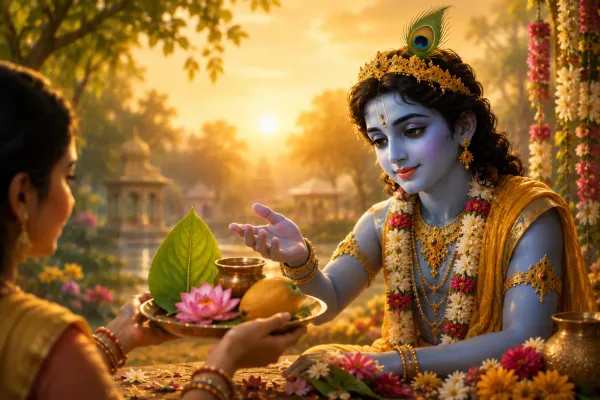
There is a truth that rasik devotees carry quietly in their hearts, the difference between thinking that I am serving God and coming, by grace, to understand instead that God has allowed me to serve. That single shift changes everything, for the devotee who grasps it no longer feels the quiet pride that so easily creeps into service, but only gratitude, because what could any of us possibly offer to the One who already owns everything that exists.
The flowers we bring, the temple itself, every talent we imagine as our own, even these hands with which we serve, all of it already belongs to Him, and the only thing truly ours to give is our willingness to love, which awakens in us only by His grace.
Swami Mukundananda often illustrates this through the image of a mother who invites her small child to help prepare a meal, not because she needs the help, for flour will surely be spilled and little truly accomplished, but because she treasures the child's participation far more than the perfection of the dish, and it is this participation that deepens the bond between them.
In just this way, Shree Radha Krishna do not wait for us to become perfect before accepting our service. They lovingly draw imperfect souls near, not because They need our work, but because it is our hearts They desire.
Where the Ego Quietly Disappears
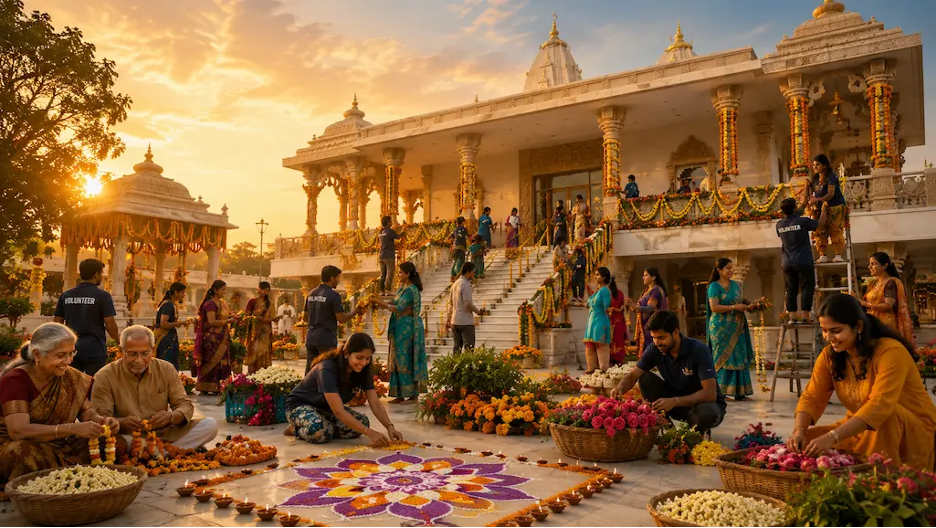
One of the most beautiful sights during the preparations for Janmashtami is the gentle dissolving of worldly identity that seva alone seems able to accomplish. A physician carries heavy boxes beside a college student. A business owner happily takes up a broom. Grandparents patiently tie flower garlands while children place shoes upon the racks.
Outside the temple, the world is forever asking what a person does for a living, yet inside those walls, another question quietly takes its place, how may I serve, and titles, status, and the pull of recognition all fall away in the presence of Shree Radha Krishna, where every devotee shares one eternal identity, that of a servant.
This is also why the Guru so lovingly rotates seva rather than assigning it once and leaving it fixed. One day a devotee may coordinate an entire team, and the next quietly carry garbage bags after midnight, and nothing is lost in this shifting, for every change gently teaches the same lesson, that we are not our role, we are His. The ego longs for a fixed identity to hold, while love longs only to serve.
Every Seva is a Rehearsal for Vraj
Swami Mukundananda often explains that our very constitution is to serve, comparing the soul's relationship with God to a hand that serves the body, not out of duty alone but because service is simply the hand's natural function, one through which it receives its own nourishment in return.
Seva at the temple carries this same quiet logic, so that stringing a single garland, preparing prasadam, or folding chairs long after midnight becomes, in the language of the Gita, action performed without attachment to its fruit, each offering resting in the doing itself rather than in what it might return.
The rasik tradition adds a further sweetness to this understanding, seeing every such offering as a small rehearsal for the eternal service the devotee prays one day to perform, where every resident lives only for the happiness of the Divine Couple and asks not what it will receive, only how it may bring Them joy today.
As the days of preparation unfold, something quietly changes within the devotee even as the outward work stays the same, until the heart settles into a simple, quiet prayer: Beloved, do not let these hands become attached to recognition, teach them only to serve, and if my service remains hidden from the world, may it never be hidden from You.
Perhaps this is the quiet secret at the center of seva, that the volunteer arrives hoping to prepare something for the Lord, and somewhere along the way, without ever noticing when it happened, it is the Lord who has quietly begun preparing the volunteer's own heart to serve Him more purely.
Love Does Not Count the Cost
There is something beautiful that happens when love, rather than obligation, becomes the reason for serving, for the world has always known how to count, while love has simply forgotten how.
In the weeks before Janmashtami, devotees arrive before sunrise and remain long after midnight, vacation days are lovingly set aside, and kitchens stay busy from dawn until late into the night, yet to the devotee living it, none of this feels like sacrifice. It feels like gratitude, for a heart that has once tasted the sweetness of serving Shree Radha Krishna no longer measures what it has given, but simply rejoices that another opportunity has been received, because love, unlike so much else, is nourished precisely by giving itself away.
This is why Radha Krishna Temple of Dallas has never truly been built by marble alone. Visitors admire the altar, the fragrance of fresh flowers, the melodious kirtan, yet beneath all of it, every flower arranged, every meal prepared, every guest welcomed with kindness has become another stone in an invisible temple raised within countless hearts.
A newcomer who knows nothing of Shree Krishna may forget the decorations and even the lecture in years to come, but will remember, with a clarity time cannot erase, how they were made to feel: loved, accepted, and entirely at home, for sometimes the first darshan of Shree Krishna comes to a soul through nothing more than the kindness of His devotee.
Where Character is Quietly Refined
The world is forever asking what a person has achieved, but bhakti asks a different question, who is this person becoming. It is easy to speak of humility, and far harder to feel it when another volunteer receives the appreciation we had quietly hoped for, or when we are lovingly asked to perform a service we would never have chosen ourselves.
Yet, what first appears to be inconvenience slowly becomes grace, for Shree Radha Krishna are not merely preparing a successful festival each year, They are gently preparing servants whose love is becoming purer, patience deepening, gratitude taking the place of entitlement.
This quiet refinement is nowhere sweeter than among families serving side by side, a father teaching his son to fold chairs, a grandmother showing her granddaughter how to string jasmine, parents and children washing dishes together without a word needing to be spoken.
Years from now, these children may not remember exactly how the temple looked, but they will remember serving beside the people they love, and they will remember that Shree Krishna was never simply someone their parents worshipped from a distance, but someone their whole family served together. These memories quietly become part of their spiritual inheritance, carried forward long after the details of any single festival have faded.
The Joy of Serving Together
One of the greatest blessings of Janmashtami is that no devotee ever truly serves alone. As preparations continue, strangers slowly become friends, and friends become spiritual companions walking the same path, experienced volunteers gently guiding those serving for the first time, someone quietly encouraging a nervous newcomer who wonders whether they truly belong.
Without anyone planning it, a family begins to form, not through shared professions, but through a single shared Beloved who draws every heart toward the same center, souls of different ages, cultures, and journeys moving toward the one purpose of bringing joy to Shree Radha Krishna.
This is why devotees so often leave long days of seva with tired bodies and remarkably peaceful minds, for outwardly they have spent the day decorating a temple, while inwardly, Shree Radha Krishna have been quietly decorating their hearts instead, and somewhere in the midst of it all, service slowly becomes affection, affection becomes longing, and longing begins gently to blossom into love.
When the Curtains Open
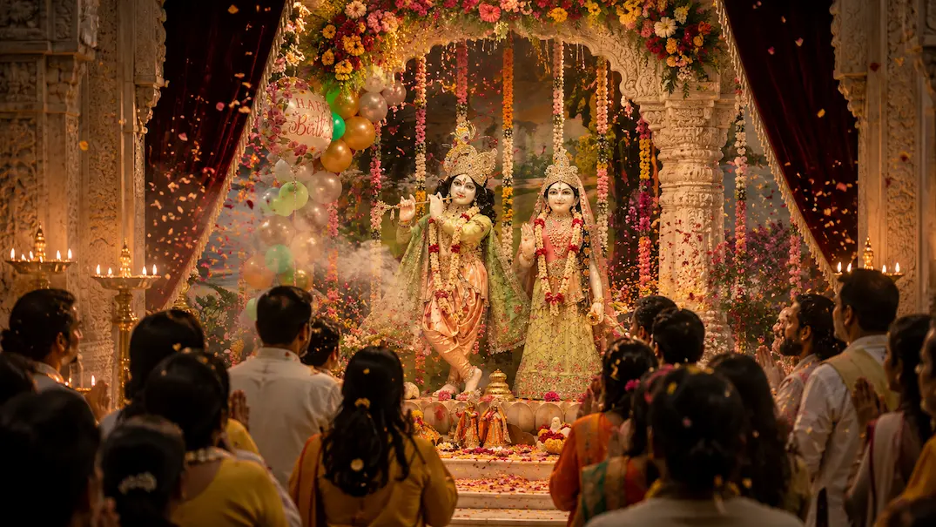
As the evening deepens, the temple grows still in a way that feels almost holy, the fragrance of flowers mingling with sandalwood incense, kirtan rising like a prayer carried from heart to heart, until the bells ring, the conches echo, and the curtains slowly open.
There They are, Shree Radha Krishna, beautifully adorned, smiling with the same eternal sweetness that has captivated saints across generations, and for this one moment the devotee forgets the long hours of preparation, tiredness quietly disappearing as only gratitude remains. In this sacred stillness, another realization dawns, that Shree Radha Krishna never truly needed the flowers or the decorations at all, for what They have always desired is simply the love with which each offering was prepared.
Somewhere within that gathered crowd, a devotee may quietly whisper that her garland was imperfect, that her mind wandered while she served, and yet if even a small part of today's seva brought Them joy, then her life has already become worthwhile. That prayer may never be spoken aloud, but it is heard nonetheless, for love, in the end, always is.
When Everyone Goes Home
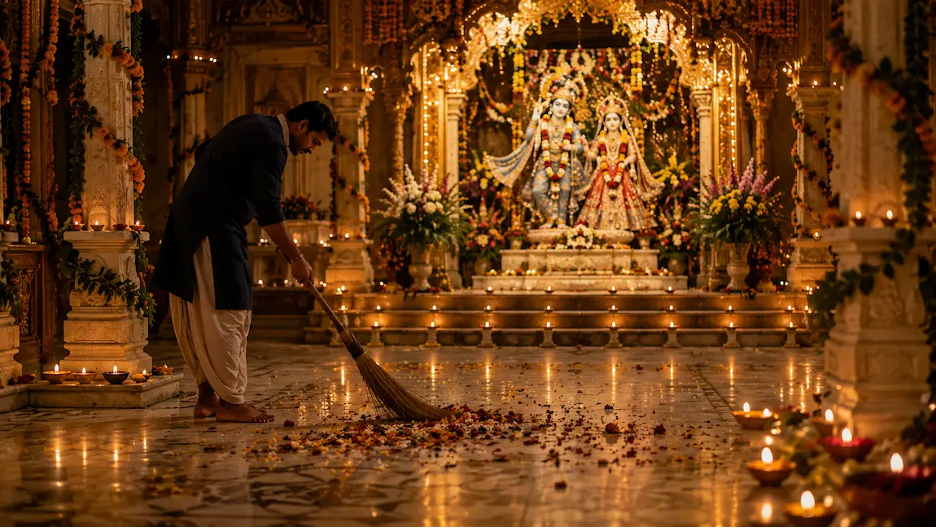
Eventually the crowds leave, the lights grow softer, and the temple grows quiet, yet for many devotees the seva has not truly ended. Someone gathers fallen flower petals, someone folds hundreds of chairs, someone quietly sweeps the floor beneath the altar long after the lights above have dimmed, with no cameras, no applause, only Shree Radha Krishna Themselves, for perhaps this is the sweetest seva of all, the kind offered without any witness at all.
Janmashtami was never meant to remain a single beautiful night celebrated once each year. Swami Mukundananda often reminds us that any action can become divine the moment it is performed for God's pleasure rather than our own, so that listening patiently to someone we love, preparing a meal with gratitude, speaking gently, or forgiving someone who has wronged us all quietly become seva as well. The same heart that arranged flowers before the altar can fill the world with kindness, and life itself, moment by ordinary moment, slowly becomes worship, one more home quietly prepared for the Beloved.
An Invitation from the Divine Couple
Perhaps this year finds you planning to celebrate Janmashtami with your family, or visiting the temple for the first time, or quietly wondering whether there is truly a place here for someone like you.
There is, for the Divine Couple have never searched for perfect servants, only for willing hearts, and so no extraordinary talent, no years of experience, no mastery of scripture is required, only the willingness to say that if there is even one small way to bring joy to the Beloved, you wish simply to be allowed to serve.
When history remembers Janmashtami 2026 at Radha Krishna Temple of Dallas, it may remember the decorations, the kirtans, and the thousands who gathered for darshan, yet Shree Radha Krishna may remember something else altogether, the volunteer who welcomed a nervous newcomer with a smile, the grandmother who stayed to finish one more garland, the child who offered a single flower with both hands, for the greatest miracle of Janmashtami is not simply that Shree Krishna appeared in a prison cell thousands of years ago, but that He still chooses to appear wherever a heart has been emptied of ego and filled with loving seva.
May every act of service soften our hearts and draw us one step closer to the eternal service of Shree Radha Krishna, until that blessed day when, by Their causeless mercy, They allow us to serve Them in Their eternal Vraj.
Every garland strung, every guest welcomed with a smile, and every floor swept long after midnight was never simply preparing a temple for one more Janmashtami. It was preparing a home for the Beloved, and quietly, almost without anyone noticing, the Beloved was preparing a home within each of those very hearts in return. The hands that serve Him, it turns out, were already home.
Key Takeaways
• Seva at Janmashtami is never merely help offered to an organization. It is participation in the Divine Couple's own work of drawing souls closer to Themselves.
• The shift from “I am serving God” to “God has allowed me to serve” transforms pride into gratitude and is the heart of nishkam seva.
• In the presence of Shree Radha Krishna, every devotee shares one identity, that of a servant, and the Guru's rotation of tasks trains the heart to love the service itself rather than a fixed role.
• Devotion is measured not by how visible or difficult a service was, but by the affection hidden quietly within it.
• Families who serve side by side pass devotion to the next generation not through words alone, but through shared, lived experience.
• Seva offered at the temple is meant to be carried into daily life, so that even ordinary actions, performed for God's pleasure, become worship.
Frequently Asked Questions
What is seva, and why is it so central to Janmashtami at Radha Krishna Temple of Dallas?
Seva is selfless service offered to Shree Radha Krishna, not as an obligation but as an expression of love. During Janmashtami, seva becomes the quiet, unseen foundation beneath every visible moment of celebration, from the lamps that are lit to the prasadam that is served.
Do I need any experience or special skill to volunteer?
No. No extraordinary talent or years of experience is required, only a willing heart. Every volunteer, whether serving for the first time or the fiftieth, is welcomed exactly as they are.
Can children and families serve together?
Wholeheartedly, yes. Some of the most joyful seva happens when parents, children, and grandparents work side by side, and those shared hours often become memories a child carries for life.
Does it matter which task I am asked to do?
No task is greater than another in seva. Whether you are serving in the kitchen, greeting guests at the door, or arranging flowers on the altar, each offering carries the same sacred weight when it is given with love.
Is seva only for Janmashtami, or can I continue serving afterward?
Seva is meant to continue well beyond a single festival. Radha Krishna Temple of Dallas offers ongoing opportunities to serve throughout the year, and Janmashtami is simply the night this spirit shines most brightly, not the only night it is asked of us.
A Closing Prayer
Beloved Shree Radhe-Shyam, thank You for allowing these imperfect hands to serve You. I have no offering worthy of Your infinite love, no flower beautiful enough, no words pure enough, no seva perfect enough, and yet You lovingly accept even the smallest offering when it is placed before You with sincerity. Please keep my heart near Your lotus feet. Do not let me seek recognition, and do not let me become discouraged by my own imperfections. Teach me instead to rejoice in another devotee's service, to love Your mission more than my own comfort, and to find my happiness simply in Your happiness.
And if I am not yet worthy to serve You in Your eternal Vrindavan, then please allow every act of seva in this life to become a preparation for that blessed day when You will call me home. Until then, let me never forget that the greatest joy of my life is simply this, that You have allowed me to serve.