
Every Ganesh Chaturthi, millions of hearts turn toward Lord Ganesh as Vighnaharta, the remover of obstacles. We pray for His blessings before new beginnings. We ask Him to clear difficulties from our path, bring wisdom to our decisions, and remove the hurdles that stand between us and our goals.

.webp)
Yet there is one obstacle that does not wait for us on the road ahead. We carry it with us.
A difficult conversation ends, but the mind continues it for hours. Someone receives the recognition we hoped for, and comparison quietly begins. A worry about tomorrow steals the peace of today. We know resentment is hurting us, yet the mind returns to the same incident again and again. We sit down to pray, determined to focus on God, and within moments the mind has traveled through unfinished work, family concerns, old memories, future plans, and seemingly everything except the prayer before us.
We know what we should think, yet the mind seems to have plans of its own.
If this feels familiar, the Bhagavad Gita offers an unexpected comfort. Even the mighty warrior Arjun experienced this struggle. Standing before Shree Krishna, he confessed:

चञ्चलं हि मन: कृष्ण प्रमाथि बलवद्दृढम् ।
तस्याहं निग्रहं मन्ये वायोरिव सुदुष्करम् ॥ 34॥
chañchalaṁ hi manaḥ kṛiṣhṇa pramāthi balavad dṛiḍham
tasyāhaṁ nigrahaṁ manye vāyor iva su-duṣhkaram
BG 6.34: The mind is very restless, turbulent, strong and obstinate, O Krishna. It appears to me that it is more difficult to control than the wind.
Swami Mukundananda explains that each word Arjun uses reveals something about the mind we experience every day. It is restless because it keeps jumping from one subject to another. It is turbulent because it generates powerful waves of anger, greed, envy, anxiety, fear, attachment, and desire. It is strong enough to overpower the intellect even when we know better. And it is obstinate because once it catches hold of a thought, it can keep returning to it long after we wish it would stop.
Shree Krishna does not dismiss Arjun's struggle. He acknowledges the difficulty and then tells Arjun what can be done about it.
The mind can be managed.
Perhaps, then, Ganesh Chaturthi offers us an opportunity to look more deeply at the meaning of an obstacle. As we bow before Vighnaharta and ask Him to clear the path ahead, the wisdom of the Bhagavad Gita invites us to also look within.

The Mind Can Be Your Enemy, But It Does Not Have to Stay That Way
Shree Krishna tells Arjun:
उद्धरेदात्मनात्मानं नात्मानमवसादयेत् ।
आत्मैव ह्यात्मनो बन्धुरात्मैव रिपुरात्मन: ॥ 5॥
uddhared ātmanātmānaṁ nātmānam avasādayet
ātmaiva hyātmano bandhur ātmaiva ripur ātmanaḥ
BG 6.5: Elevate yourself through the power of your mind, and not degrade yourself, for the mind can be the friend and also the enemy of the self.
We naturally look outside ourselves when something disturbs our peace. Someone spoke harshly. A colleague received the opportunity we wanted. A family member disappointed us. A plan failed. Circumstances did not cooperate.
Yet Shree Krishna asks us to look more carefully. He explains that for one who has conquered the mind, it becomes a friend. For one who has not, the same mind behaves like an enemy.
Swami Mukundananda points out that we spend enormous energy thinking about external sources of disturbance, while some of our most formidable enemies, anger, greed, envy, attachment, resentment, and uncontrolled desire, operate within the mind.
An unpleasant incident may last five minutes. The mind can keep it alive for five years or more. Someone says something hurtful once, yet we repeat those words internally that evening, the next morning, and whenever we see that person again. The external event has ended. The mind keeps recreating it.
Jagadguru Shree Kripaluji Maharaj therefore advises the spiritual aspirant:
mana ko mano shatru usaki sunahu jani kachhu pyare
Swamiji explains the teaching: regard the uncontrolled mind as an enemy, and do not come under its sway.
The word uncontrolled matters.
The mind itself is not inherently our enemy. The same mind that can repeatedly contemplate resentment can contemplate gratitude. The same imagination that manufactures anxiety can practice roopdhyan. The same mind that develops attachment to worldly objects can develop attachment to God.
The enemy can become the friend. But first, we need to understand how it gets trapped.
How One Thought Becomes a Downward Spiral
In Bhagavad Gita 2.62–2.63, Shree Krishna traces exactly how one thought becomes a downfall:

Contemplation → Attachment → Desire → Anger or Greed → Clouded Judgment → Loss of Discrimination → Downfall
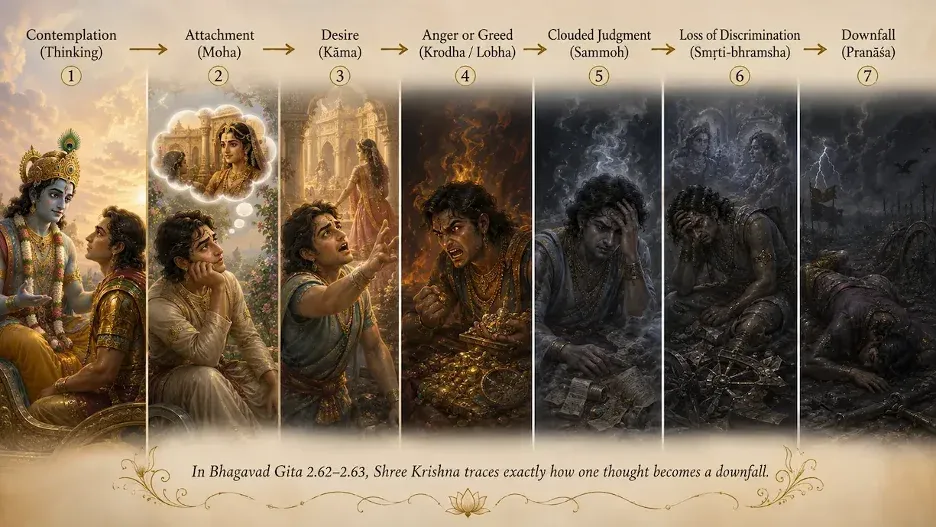
We often notice the problem only when we become angry, jealous, anxious, or frustrated. Shree Krishna takes us much further back. It begins with what we repeatedly contemplate.
Perhaps we repeatedly look at someone else's life and think about what they have. Comparison develops. Then attachment to having something similar. Soon the mind says, “I need that to be happy.”
If the desire is fulfilled, greed can demand more. If it is obstructed, anger can arise. Swamiji explains that anger does not simply appear from nowhere. It often grows from obstructed desire, while desire grows from attachment, and attachment develops through repeated contemplation.
We often try to control the emotion at the end of the chain. Shree Krishna teaches us to catch the mind earlier, at the very first thought, before comparison hardens into attachment.
What are we repeatedly telling ourselves that will make us happy? Every repeated thought is training the mind. We can practice worry. We can practice resentment. We can practice comparison. We can practice finding faults. Or we can begin practicing something higher.
Your Mind May Not Be the Real Problem
If the mind is so powerful, what can control it?
Shree Krishna explains:

इन्द्रियाणि पराण्याहुरिन्द्रियेभ्य: परं मन: ।
मनसस्तु परा बुद्धिर्यो बुद्धे: परतस्तु स: ॥ 42॥
indriyāṇi parāṇyāhur indriyebhyaḥ paraṁ manaḥ
manasas tu parā buddhir yo buddheḥ paratas tu saḥ
BG 3.42: The senses are superior to the gross body, and superior to the senses is the mind. Beyond the mind is the intellect, and even beyond the intellect is the soul.
The mind was never intended to be the highest authority within us. The mind desires, imagines, likes, dislikes, remembers, and reacts. The intellect possesses the ability to discriminate.
The mind says, “I don't feel like going to work.” The intellect remembers our responsibilities.
The mind says, “Respond to that message right now.” The intellect can say, “Wait until you are calm.”
The mind says, “Keep thinking about what that person did.” The intellect can recognize, “Replaying this is disturbing me more than them.”
Sometimes when we say, “My mind doesn't listen to me,” the deeper problem is that our intellect is not sufficiently convinced. Swam Mukundananda illustrates this with a simple example. Imagine a person who is extremely hungry and is offered delicious hot Gulab Jamun. The senses want it. The mind wants it. But then someone trustworthy says, “Don't eat it. There is poison in it.” Immediately, the person pushes it away. The hunger did not disappear. The sweet did not change. The senses still function.
What changed? The intellect became convinced.
This is why studying the Bhagavad Gita is not merely about accumulating spiritual information. Shree Krishna is educating the very faculty that must govern the mind.
In Bhagavad Gita 3.43, He teaches Arjun to use the higher self to subdue the lower self. Swamiji explains that the soul seeks divine and unlimited happiness. Material objects are finite and cannot satisfy this innate longing. We must repeatedly nourish the intellect with this knowledge until it becomes conviction.
Knowing the truth and being convinced by it are very different. Once conviction deepens, the mind may still be loud, but it no longer has to occupy the highest seat.
Shree Krishna Says It Can Be Done
Arjun understands the theory, but he still has a very human concern. The mind feels as uncontrollable as the wind.
Shree Krishna replies:
श्रीभगवानुवाच ।
असंशयं महाबाहो मनो दुर्निग्रहं चलम् ।
अभ्यासेन तु कौन्तेय वैराग्येण च गृह्यते ॥ 35॥
śhrī bhagavān uvācha
asanśhayaṁ mahā-bāho mano durnigrahaṁ chalam
abhyāsena tu kaunteya vairāgyeṇa cha gṛihyate
BG 6.35: Lord Krishna said: O mighty-armed son of Kunti, what you say is correct; the mind is indeed very difficult to restrain. But by practice and detachment, it can be controlled.
Difficult does not mean impossible. Shree Krishna gives two tools: abhyāsa and vairāgya.
Vairāgya is detachment. The mind naturally runs toward what it believes will make it happy. We gradually detach it from the mistaken conviction that lasting happiness lies in temporary worldly objects.
Abhyāsa is repeated practice. We train the mind in a higher direction.
In bhakti, Swami Mukundananda puts it simply: take the mind away from the world and bring the mind to God. The first is vairāgya. The second is abhyāsa.

The Mind Wandered Again: Bring It Back.
This is where many seekers become discouraged. We sit for prayer, meditation, or roopdhyan. For a few moments the mind rests on God. Then suddenly we are thinking about tomorrow's schedule or yesterday's conversation. We conclude, “I cannot meditate.”
Shree Krishna anticipated this:
यतो यतो निश्चरति मनश्चञ्चलमस्थिरम् ।
ततस्ततो नियम्यैतदात्मन्येव वशं नयेत् ॥ 26॥
yato yato niśhcharati manaśh chañchalam asthiram
tatas tato niyamyaitad ātmanyeva vaśhaṁ nayet
BG 6.26: Whenever and wherever the restless and unsteady mind wanders, one should bring it back and continually focus it on God.
Notice what Shree Krishna does not say. He does not say that a successful seeker never experiences a wandering mind. He tells us what to do when it wanders. Bring it back. It wanders again. Bring it back again. The wandering of the mind is not the end of the practice. Bringing it back is the practice.
A simple framework can help:
NOTICE → DETACH → REDIRECT → REPEAT
● Notice where the mind has gone.
● Detach from the assumption that every thought deserves your attention.
● Redirect it using the intellect. Remember Shree Krishna's wisdom. Practice gratitude. Chant God's name. Bring His divine form before the mind in roopdhyan. Return to the seva or duty before you.
● Repeat.
Tomorrow morning try not to conquer the mind for the whole day. Catch it once. When you notice comparison, resentment, worry, or craving beginning, pause. Notice where the mind has gone. Detach from the thought instead of feeding it. Remind the intellect of Shree Krishna's wisdom. Then redirect the mind toward gratitude, naam, roopdhyan, seva, or the duty in front of you. If the mind returns to the same thought five minutes later, simply repeat the process. That return itself is the practice.
Do not measure your practice only by how many times the mind wandered. Measure it by your willingness to bring it back. A hundred wanderings can become a hundred opportunities to practice returning.
Don't Just Control the Mind: Give It Somewhere Beautiful to Go.
If spirituality meant spending our lives saying no to everything the mind wants, the path would become an exhausting battle of suppression. Shree Krishna offers something more than restraint.
Instead, He teaches:
तानि सर्वाणि संयम्य युक्त आसीत मत्पर: ।
वशे हि यस्येन्द्रियाणि तस्य प्रज्ञा प्रतिष्ठिता ॥ 61॥
tāni sarvāṇi sanyamya yukta āsīta mat-paraḥ
vaśhe hi yasyendriyāṇi tasya prajñā pratiṣhṭhitā
BG 2.61: They are established in perfect knowledge, who subdue their senses and keep their minds ever absorbed in Me.
Swami Mukundananda explains that the senses need proper engagement.
King Ambarish engaged his mind in remembering Shree Krishna's lotus feet, his tongue in glorifying God, his ears in hearing divine narrations, his eyes in darshan, his hands in seva, and his feet in going toward places connected with God.
Nothing had to become useless. Everything received a divine direction.

The eyes that wander can behold God's form. The ears can hear Hari-katha and kirtan. The tongue can chant the divine names. The hands can perform seva. The imagination can practice roopdhyan. And the heart that longs for attachment can become attached to God.
Bhagavad Gita 2.64 deepens this principle. Shree Krishna explains that one who controls the mind and becomes free from attachment and aversion, even while interacting with the world, attains God's grace.
रागद्वेषवियुक्तैस्तु विषयानिन्द्रियैश्चरन् ।
आत्मवश्यैर्विधेयात्मा प्रसादमधिगच्छति ॥ 64॥
rāga-dveṣha-viyuktais tu viṣhayān indriyaiśh charan
ātma-vaśhyair-vidheyātmā prasādam adhigachchhati
BG 2.64: But one who controls the mind, and is free from attachment and aversion, even while using the objects of the senses, attains the Grace of God.
Swami Mukundananda explains that attachment and aversion are two sides of the same coin. Attachment says, “I cannot stop thinking about what I want.” Aversion says, “I cannot stop thinking about what I don't want.” Either way, something has captured the mind. The answer is not to make the heart barren.
The soul naturally seeks happiness. The question is where we seek it. If we repeatedly contemplate happiness in worldly objects, attachment develops there. If we repeatedly contemplate, “my true happiness is in God,” another attachment begins growing. Divine attachment. Unlike material attachment, divine attachment purifies the mind.
Bhakti does not ask us to stop loving. It teaches us where to place our love. We do not merely stop the mind from contemplating. We give it something divine to contemplate. We do not merely pull the mind away from the world. We bring it toward God. The wandering mind needs a home. And in bhakti, its sweetest home is remembrance of the divine names, form, virtues, pastimes, and loving presence of God.
When Effort Meets Grace
Then Shree Krishna takes us beyond every technique:
प्रसादे सर्वदु:खानां हानिरस्योपजायते ।
प्रसन्नचेतसो ह्याशु बुद्धि: पर्यवतिष्ठते ॥ 65॥
prasāde sarva-duḥkhānāṁ hānir asyopajāyate
prasanna-chetaso hyāśhu buddhiḥ paryavatiṣhṭhate
BG 2.65: By divine grace comes the peace in which all sorrows end, and the intellect of such a person of tranquil mind soon becomes firmly established in God.
Until now, we have focused on what we can do. Strengthen the intellect. Watch what we contemplate. Practice detachment. Bring the mind back. Engage it in devotion. However, bhakti does not end with self-effort, but divine grace.
Swami Mukundananda beautifully compares the intellect transformed by divine grace to the North Star, firmly established in God's knowledge, love, and bliss. Think of where we began. A mind compared to the wind. And where Shree Krishna has brought us. An intellect steady like the North Star.
Through spiritual knowledge, the intellect learns that God alone is the source of true happiness. Through practice, the mind is repeatedly directed toward Him. Through devotion, divine attachment grows. And through divine grace comes a higher taste that mere willpower could never manufacture.
Mind management has now become something much greater than self-control. It has become a journey from worldly contemplation to divine remembrance, from material attachment to divine attachment, from restlessness to inner fulfillment, and from personal effort to divine grace.
This Ganesh Chaturthi, Remove the Obstacle Within
We began before Lord Ganesha as Vighnaharta, asking Him to remove the obstacles before us. Perhaps our prayer can now become deeper. Not every obstacle is outside us.
Sometimes the situation is difficult but worry makes it heavier. Sometimes another person hurts us once, but resentment repeats the hurt. Sometimes another person's success changes nothing about our life, yet comparison steals our contentment. Sometimes tomorrow has not arrived, but fear has already filled today. Sometimes an unfulfilled desire becomes anger because we never examine the attachment underneath it.
And sometimes we sit before God with everything required for devotion except the one offering He most desires from us: our mind.
This Ganesh Chaturthi, perhaps we can pray:
O Vighnaharta, remover of obstacles, remove not only the obstacles that stand before me, but also those that arise within me. Bless my intellect with divine wisdom so that I may recognize where my mind is leading me. Give me the strength to detach from thoughts that pull me away from my highest welfare, the perseverance to bring my mind back whenever it wanders, and the devotion to place it again and again at the lotus feet of God. May the wisdom of Hari and Guru guide my effort, and may divine grace purify my heart until my restless mind becomes an instrument of love and seva.
The mind that troubles us today need not remain our enemy forever.
The mind that has practiced worry can practice remembrance. The mind that has practiced resentment can practice forgiveness. The mind that has practiced comparison can practice gratitude. And the mind that wanders away from God a hundred times can be lovingly brought back a hundred and one.
This Ganesh Chaturthi, as we bow before Vighnaharta and ask Him to clear the path before us, may we also offer Him the greatest obstacle within us, and begin teaching this restless mind where it truly belongs.
At the lotus feet of God.

Key Takeaways
● The uncontrolled mind can be our greatest obstacle, but the same mind can become our greatest friend.
● Catch the chain early. Repeated contemplation creates attachment, attachment creates desire, and desire can lead to anger, greed, and clouded judgment.
● Strengthen the intellect with divine knowledge. Knowledge becomes transformative when it becomes conviction.
● Practice abhyāsa and vairāgya. Detach the mind from lower sources of happiness and repeatedly redirect it toward God.
● Remember: NOTICE → DETACH → REDIRECT → REPEAT. A wandering mind is not a failed mind.
● Bhakti gives the mind a higher destination. Engage the senses and mind in naam, roopdhyan, Hari-katha, kirtan, remembrance, and seva.
● Effort opens the heart to grace. Through divine grace, the restless mind becomes tranquil and the intellect becomes firmly established in God.
Call To Action
Explore the schedule for the grand Ganesh Mahotsav at the Radha Krishna Temple of Dallas:
Frequently Asked Questions
1. Why is the mind considered such a great obstacle in the Bhagavad Gita?
Bhagavad Gita 6.5–6.6 explains that the mind has the capacity either to elevate or degrade us, depending on whether it is disciplined. An uncontrolled mind nourishes anger, attachment, and anxiety. A purified mind becomes our closest ally on the spiritual path.
2. Why do negative thoughts keep returning even when I know they are harmful?
Bhagavad Gita 2.62–2.63 explains that repeated contemplation creates attachment, and attachment deepens with every return to the thought. Notice the thought earlier, before it has a chance to take hold, and redirect the mind toward something higher.
3. What should I do when my mind wanders during prayer, meditation, or roopdhyan?
Bring it back. Bhagavad Gita 6.26 tells us that whenever the mind wanders, we should gently return it to God. Notice, detach, redirect, repeat. Every return is part of the practice, not a sign that the practice failed.
4. How can I strengthen my intellect so that it guides the mind?
Study divine knowledge until it becomes conviction, not mere information. Bhagavad Gita 3.42–3.43 explains that the intellect is superior to the mind. Regular reflection on scripture and satsang strengthens its ability to guide the mind rather than follow it.
5. Does controlling the mind mean giving up family, career, enjoyment, and ordinary life?
No. Bhagavad Gita 2.64 describes interacting with the objects of the senses while remaining free from attachment and aversion. We can work, care for our families, and participate fully in life while increasingly remembering God and offering our actions as seva. The goal is not to escape life. It is to stop letting the world decide where our mind finds its happiness.