Beginning With Ganesha, Beginning with Grace
There is a quiet comfort in beginning with God. Before entering a new home, celebrating a wedding, beginning a child’s education, starting a new venture, or performing a sacred ceremony, our hearts naturally turn to Lord Ganesha. With folded hands, we remember Vighnaharta and seek His grace: May this beginning be auspicious. May the path ahead be blessed.
Yet, as we stand at the threshold of something new, perhaps our prayer can go a little deeper. We do not know what lies ahead. There may be decisions we cannot see clearly, unexpected difficulties, or moments when our own fear, impatience, or pride clouds the way. At such times, we need more than an obstacle-free path. We need the wisdom to recognize the right one and the faith to keep walking when it becomes difficult.
This is where Lord Ganesha’s grace as the giver of Buddhi, or divine wisdom, becomes so precious. We come to Him not merely asking, “Lord, make everything go my way,” but praying with humility: “Guide me when I cannot see clearly. Correct me when I am wrong. Strengthen me when I lose courage.”
Ganesh Chaturthi 2026 invites us to welcome this beloved Lord not only into our homes, but more deeply into our hearts. Before we rush into the next beginning, can we pause, remember Him, seek His guidance, and take our first step with faith?
Perhaps this is the beauty of beginning with Ganesha: before we begin the work before us, we allow His grace to begin its work within us.

.webp)
Vighnaharta: When Grace Clears the Path Within
When we call Lord Ganesha Vighnaharta, there is reassurance in the name itself. We place our worries before Him and pray that the difficulties ahead may be removed. Sometimes His grace clears the path in ways we could never have managed ourselves. A door opens, an uncertainty passes, and what seemed impossible becomes possible.
But what about the times when the obstacle does not disappear? The situation remains difficult, the answer does not come immediately, or the road ahead still asks something of us. Could His grace be present even then?
When the Obstacle Lies Within
Perhaps Vighnaharta does not only remove what stands before us. With His grace, we may also begin to recognize what stands within us: fear that makes us hesitate, impatience that makes us rush, attachment that clouds our judgment, or ego that prevents us from seeing our own mistakes.
Then our prayer begins to deepen: “Lord, if something within me needs to change, give me the humility to see it and the wisdom to change.”
An obstacle removed may bring relief for today. But the Buddhi Lord Ganesha blesses us with can illuminate many steps yet to come.
And so, when the path is uncertain, we place both the path and ourselves at His feet. Sometimes He may clear the road before us; at other times, He may quietly give us what we need to walk through it.
In either case, Vighnaharta has not left our side.
Buddhi: Seeking Lord Ganesha’s Gift of Wisdom
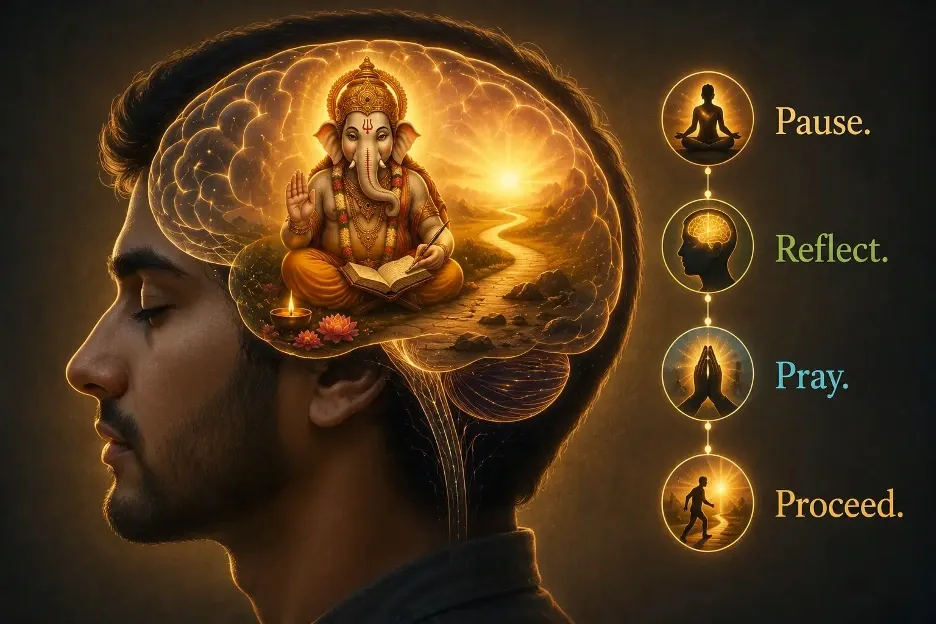
When we stand before Lord Ganesha at the beginning of something new, we carry many hopes: May this work succeed. May everything go well. May no difficulty arise. Yet perhaps one of the most precious blessings we can seek is Buddhi, the wisdom to recognize the right path and walk it with faith.
When the Mind Rushes Ahead
How easily the mind rushes! Excitement carries us forward, fear makes us hesitate, and attachment to a particular outcome can cloud our judgment. At such moments, remembering Ganesha becomes especially meaningful. His presence seems to gently remind us: Be still for a moment. Look again.
That pause itself can become a prayer: “Ganapati, my mind cannot see clearly. Guide my intellect. Help me recognize what is right, not merely what I want.”
Wisdom Is Also His Grace
Buddhi does not mean having every answer ourselves. There is humility in accepting that we do not. We make our best effort while seeking the Lord’s guidance, trusting that His vision is greater than our own.
And so, before we begin:
Pause. Reflect. Pray. Proceed.
We pause so the mind may settle. We reflect with humility. We pray because wisdom itself is His grace. And then we proceed, doing our best while leaving space for God to guide the journey.
Perhaps this is what makes a beginning truly auspicious: we ask Ganesha to walk before us with His wisdom, beside us with His grace, and within us as the strength to keep going.
Wisdom Before Speed: Lord Ganesha and Kartikeya
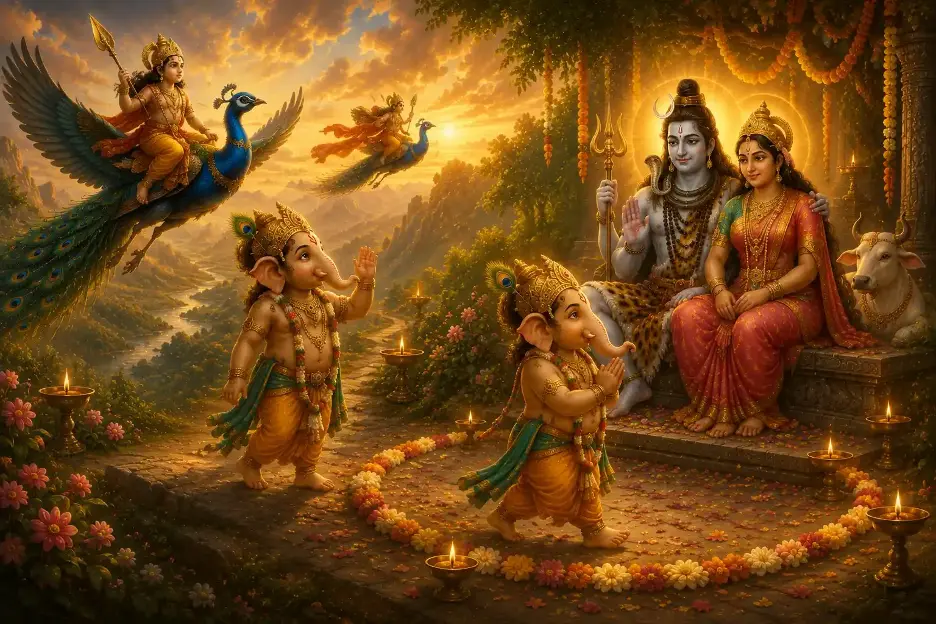
A beautiful story from Lord Ganesha’s life brings the gift of Buddhi alive. Lord Shiva and Mother Parvati once gave their sons, Ganesha and Kartikeya, a challenge: whoever went around the world and returned first would be the winner.
Kartikeya immediately set off on his swift peacock. Ganesha, knowing He could not match His brother’s speed, paused and reflected. Then, with love and reverence, He circumambulated Lord Shiva and Mother Parvati, seeing His divine parents as the center of the entire creation.
Ganesha did not become anxious about what He lacked or try to compete with Kartikeya’s strength. He looked deeper and found another way.
How often do we rush toward a goal, compare ourselves with others, or worry that we do not have enough? Ganesha gently reminds us that before every journey, there can first be a moment of remembrance. Instead of asking only, “How quickly can I reach there?” perhaps we can ask, “Lord, which way would You have me go?”
Placing God at the Center
Ganesha’s wisdom was not merely cleverness. At the heart of His response was reverence: He placed the Divine at the center of His world.
We too may not always know the shortest road or feel certain about the first step. But we can pause, bow within, and place God at the center of what we are about to undertake.
“O Ganapati, when my mind rushes ahead, teach me to pause. When I cannot see the way clearly, bless me with the wisdom to recognize the path You would have me take.”
For when a beginning starts with remembrance of God, even the first step becomes an offering.
Understanding Before Action: Lord Ganesha, Ved Vyas and the Broken Tusk
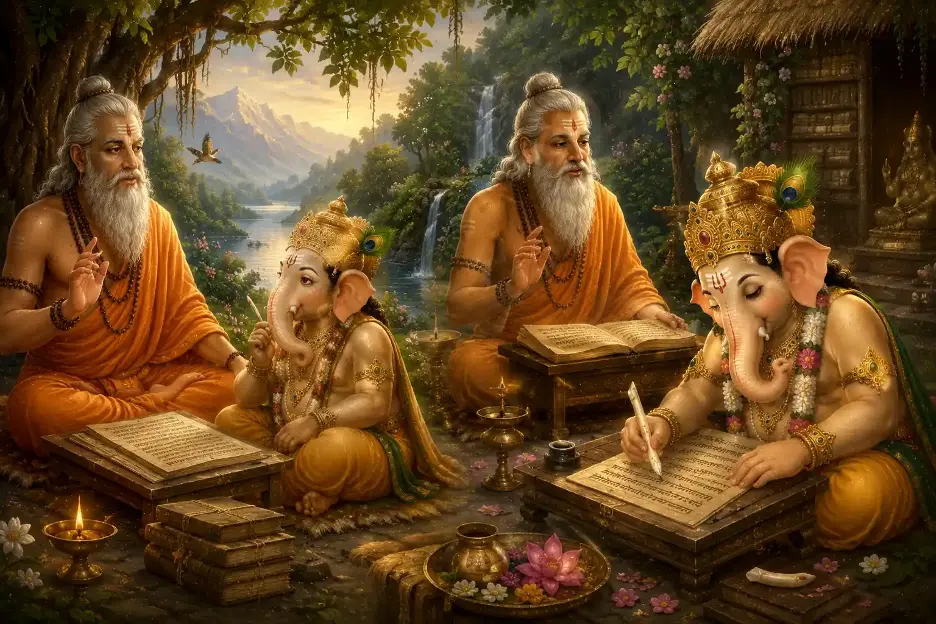
When Sage Ved Vyas was ready to compose the Mahabharata, he needed someone capable of writing the sacred verses as he dictated them. Lord Ganesha agreed to become his scribe, on the condition that the dictation continued without interruption. Ved Vyas accepted but placed a condition of his own: Ganesha should write each verse only after understanding its meaning.
And so began the sacred task. Ved Vyas composing and Ganesha writing, with understanding accompanying every word.
Not Just to Do, but to Understand
How often, in our eagerness to begin, do we become so occupied with doing that we forget to understand? Lord Ganesha gently reminds us to look deeper: Why am I doing this? Is my intention, right? Am I seeing clearly?
Perhaps our prayer can simply be: “Ganapati, help me understand before I act. When my own desires cloud my thinking, give me the clarity to see what is right.”
When the Path Becomes Difficult
A beloved traditional telling adds that while Ganesha was writing, His writing instrument broke. Rather than allow the sacred work to stop, He broke off one of His own tusks and continued writing, giving us the cherished image of Ekadanta, the One-Tusked Lord.
What a beautiful reminder: an obstacle need not always mean that the journey should end. When the purpose is worthy and the path is right, we may be called to adapt, persevere, and continue with faith.
“Ganapati, if this is the right path, give me the strength not to turn back simply because it has become difficult. Show me another way forward and let my effort remain an offering at Your feet.”
From Pride to Humility: Lord Ganesha and Kubera
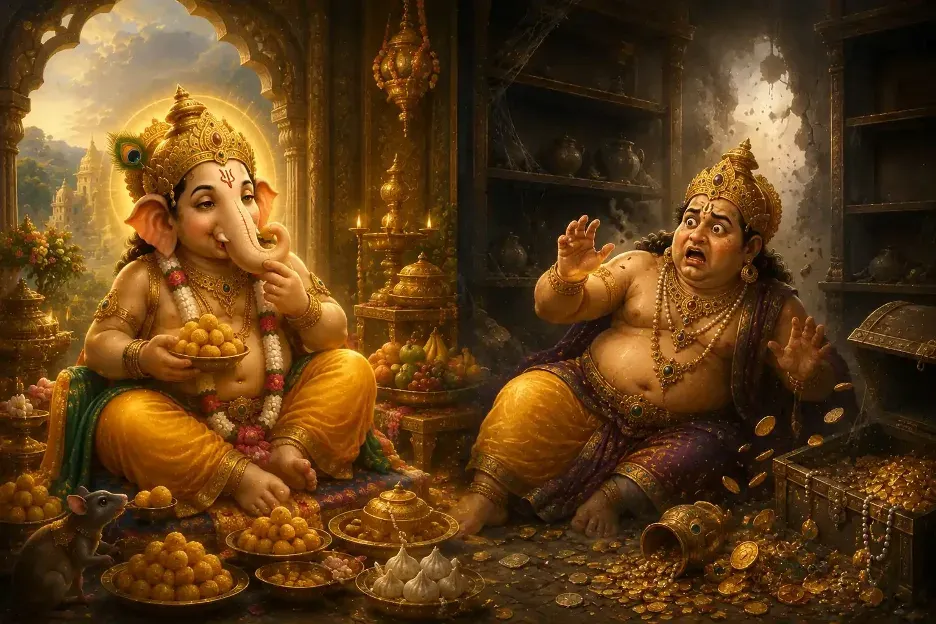
Kubera, the lord of wealth, was proud of his immense riches. Eager to display his abundance, he invited Lord Shiva and Mother Parvati to a grand feast. Instead, young Ganesha came to accept his hospitality.
Kubera brought out his finest dishes, but Ganesha ate them all and continued asking for more. Soon even Kubera’s abundant stores could not satisfy Him. Humbled and helpless, Kubera realized the pride with which he had offered the feast and turned to Lord Shiva for guidance.
What had begun as a display of wealth became a lesson in humility.
When Ganesha Turns Our Gaze Within
How gently this story brings us back to Vighnaharta. Kubera’s wealth was not an obstacle. The pride that had quietly attached itself to his wealth was.
We too may begin with good intentions, yet somewhere along the way ego can enter unnoticed: I accomplished this. I know what is best. Why was my effort not recognized?
Before Ganesha, we need not be afraid to look within. We can simply pray:
“Ganapati, if pride has entered my heart, help me see it. If I am holding too tightly to my own way, teach me to surrender. Remind me that all I possess and all I am able to do are themselves Your gifts.”
From Pride to Gratitude
Humility does not ask us to deny the gifts God has given us. The deeper question is how we hold those gifts in our hearts.
Our talents, knowledge, achievements, and possessions can nourish the ego when we see them only as mine. But when we recognize them as blessings entrusted to us, those same gifts can become opportunities for seva.
Perhaps this too is the grace of Vighnaharta. Sometimes He clears what lies before us; sometimes, with compassion, He reveals what lies within us so that we may place it at His feet.
Then even seeing our own shortcomings can become grace.
Through Swami Mukundananda’s Lens: The Wisdom to Choose the Right Path
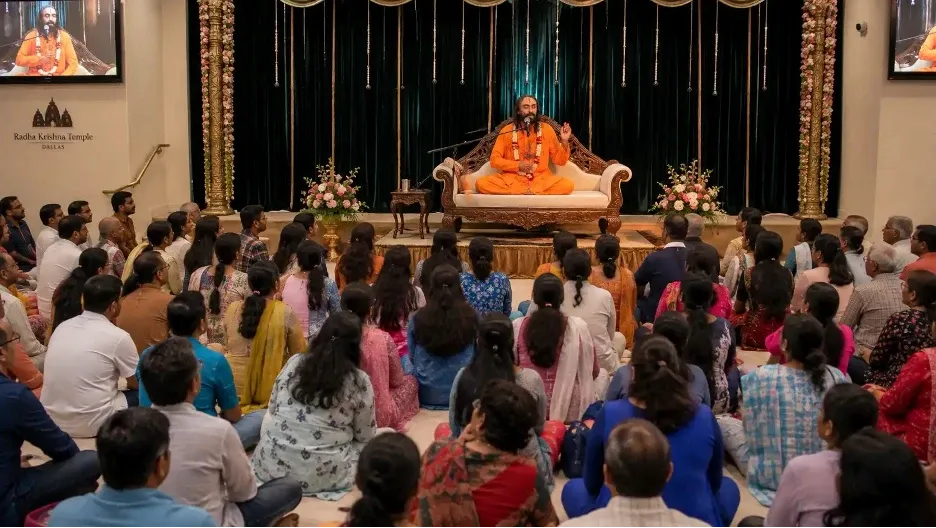
The stories of Lord Ganesha lead us to a deeper question: how do we allow wisdom to guide us when the mind wants something else?
Swami Mukundananda explains that the mind may be pulled by emotions, desires, and habits, while the intellect has the capacity to discern what is truly beneficial. But merely knowing that all our thoughts are not always right. The intellect itself must be strengthened with spiritual knowledge so that it can guide the mind in the right direction.
When Buddhi Guides the Mind
This gives deeper meaning to our prayer for Buddhi. We are not merely asking Ganesha to make us cleverer or more capable. We seek an intellect illumined by higher wisdom, one that helps us recognize what draws us closer to God and what takes us away from Him.
When the mind says, “I want this,” wisdom asks, “Is this truly good for me?”
When the ego says, “I am right,” wisdom gives us the humility to look again.
When fear says, “Turn back,” wisdom helps us discern whether we should pause or persevere.
In his Ganesh Chaturthi teaching, Swamiji draws attention to Ganesha’s deeper understanding in the challenge with Kartikeya. Ganesha did not merely see the external task; He recognized the higher truth behind it.
That is the wisdom we seek, not simply the intelligence to accomplish more, but the Buddhi to see rightly and choose wisely.
And so, our prayer becomes quieter:
“Ganapati, You can see what I cannot. Strengthen my intellect with divine wisdom. If I am going the wrong way, help me recognize it. If the path is right but difficult, give me courage. And if I need to change, give me the humility to change.”
Then we seek not merely an easier journey, but the wisdom to walk the right path in a way that brings us closer to God.
The Real Vighnaharta: Removing Obstacles Outside and Within
We often come before Lord Ganesha with a simple prayer: “Ganapati, please remove this difficulty from my path.” We turn to Him because we trust that what seems impossible to us is never beyond His grace.
But as our understanding deepens, perhaps our prayer deepens too.
When Grace Works Differently
Sometimes the road does not become smooth. A problem remains, a plan changes, or a door we hoped would open stays closed. Does that mean Vighnaharta did not hear us?
Perhaps His grace is working differently. Instead of changing the road, He may be strengthening the one who must walk it. Instead of removing the difficulty, He may give us the Buddhi to see another way, the humility to change, or the courage to take one more step.
And sometimes His grace turns our gaze inward, helping us recognize that the vighna may lie within, in our fear, attachment, impatience, or pride.
The Deeper Grace of Vighnaharta
And so, the name Vighnaharta begins to hold a deeper meaning:
Sometimes His grace removes the obstacle.
Sometimes it gives us the wisdom to understand it.
Sometimes it gives us the humility to change.
And sometimes it gives us the strength to walk through it without losing faith.
Perhaps, then, our deepest prayer is not merely, “Lord, make my path easy,” but:
“Lord, whatever path You place before me, give me the wisdom to recognize what is right, the humility to accept Your guidance, and the strength to keep walking with You.”
For the blessing of Vighnaharta is not that we will never meet an obstacle again, but that we need never face one without His grace.
The Form of Lord Ganesha: A Divine Reminder of Wisdom
There is something about Lord Ganesha’s beautiful form that immediately draws the heart. His elephant head, gentle eyes, large ears, curved trunk, the little Mushaka at His feet, and the modak in His hand are all so familiar and beloved. Yet they can also remind us of the qualities we seek when we bow before Him.
His large head reminds us to think deeply, His large ears to listen carefully, and His focused eyes to keep sight of what truly matters. His trunk, both powerful and delicate, reminds us that wisdom also knows when to remain firm and when to adapt.
The Little Mushaka at His Feet
How striking that mighty Ganesha rides upon the tiny Mushaka. The restless mouse can remind us of our own wandering desires, always running from one attraction to another. Yet before Ganesha, the little Mushaka rests under His command.
What a tender prayer this awakens: “Ganapati, my mind too wanders in so many directions. Bring it gently under Your guidance.”
The modak in His hand reminds us of the sweetness of spiritual wisdom, while His single tusk, Ekadanta, brings us back to the perseverance we saw in His sacred work with Ved Vyas.
And so, when we look upon Lord Ganesha, we see not merely symbols to understand, but qualities we long to receive:
Wisdom to think clearly. Patience to listen. Focus to remain steady. Humility to master our desires. Strength to persevere.
With folded hands, the heart quietly asks:
“Ganapati, let these not remain qualities that I admire only in You. Through Your grace, awaken a little of them within me too.”
Bringing Ganesha into Our Everyday Life
Lord Ganesha’s wisdom is not meant to remain only in the prayer room. We need it in ordinary moments too, when a difficult conversation begins, a decision must be made, or something does not unfold as we had hoped.
A Sacred Pause
What if, before reacting, we simply remember Ganesha?
A quiet “Ganapati, guide me” may be enough to create that precious pause between impulse and action. We may still need to make a difficult choice, speak firmly, or change our plans, but we do so after placing the moment before Him.
Perhaps this too is an auspicious beginning, choosing to begin our response with remembrance rather than reaction.
Celebrating Ganesh Chaturthi: Welcoming Him into Our Hearts
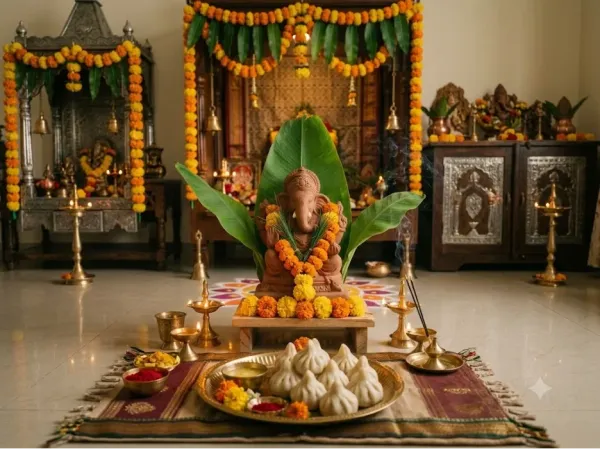
Ganesh Chaturthi arrives with a special joy. Homes and temples come alive as Lord Ganesha is lovingly welcomed with flowers, prayers, aarti, and His beloved modaks. For those precious days, His beautiful form becomes the center of our worship, and the heart delights in His presence.
Yet perhaps the most meaningful welcome takes place quietly within.
Welcoming Him into the Heart
As we make a beautiful place for Ganesha in our homes, can we also make a little more room for Him within ourselves?
The flowers will fade, the lamps will be extinguished, and the festivities will eventually end. But the wisdom, humility, and faith we have sought at His feet can remain.
Perhaps this can be our offering to Him — a sincere willingness to let His grace continue its work within us.
“Ganapati, as we welcome You into our homes, come a little deeper into our hearts. Guide our thoughts, purify our intentions, and remain with us long after the celebration is over.
Ganesh Visarjan: When the Murti Departs, His Wisdom Remains
The days of celebration eventually draw to a close, and the time comes for Ganesh Visarjan. With devotion and gratitude, we bid farewell to the beloved form of Ganesha we so lovingly welcomed.
There is tenderness in that farewell. Yet Ganesha is not truly leaving us.
What Do We Carry with Us?
The murti may depart and the festivities may end, but something precious can remain, the wisdom He awakened within us.
Perhaps we carry a little less haste and a little more reflection; a little less pride and a little more humility; a little less fear of obstacles and a little more faith in His grace.
“Ganapati, you may no longer be before my eyes but remain within my heart. Let Your wisdom guide my steps and Your grace give me courage along the way.”
Then Visarjan is not merely an ending. It quietly prepares the heart for another beginning, with Ganesha still beside us.
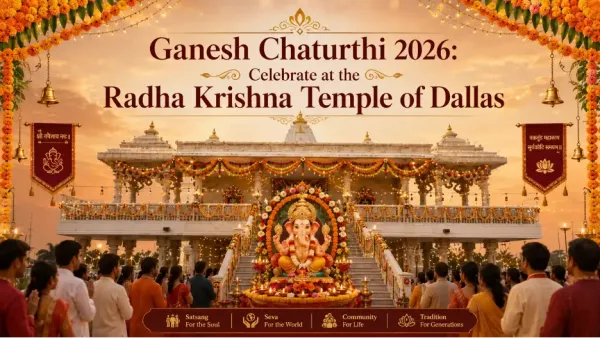
Celebrating Ganesh Chaturthi 2026 at Radha Krishna Temple of Dallas
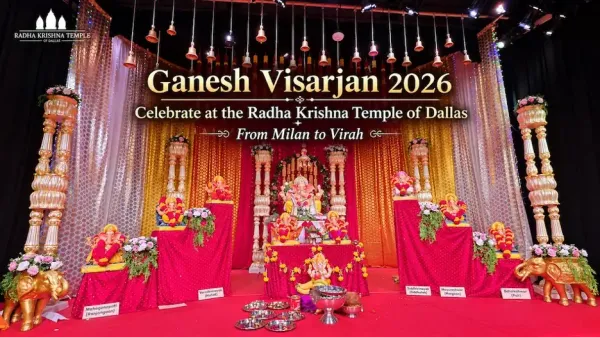
Ganesh Chaturthi becomes even more joyful when celebrated in the loving company of devotees. At the Radha Krishna Temple of Dallas, families and devotees can come together to welcome Lord Ganesha with prayer, darshan, and the shared joy of devotion.
Amid the sacred atmosphere of the temple, we can place our hopes, uncertainties, and new beginnings at His feet and seek the blessings of Vighnaharta and the grace of His divine wisdom.
Come, celebrate Ganesh Chaturthi 2026 with devotion and joy, and carry Lord Ganesha’s blessings into every new beginning.
Before Every Beginning, Begin with God
We began with a simple question: Why is Lord Ganesha worshipped before every auspicious beginning?
Perhaps the answer is deeper than our wish for an obstacle-free path. We seek Ganesha’s grace for the wisdom to choose rightly the humility to look within, and the strength to continue when the road becomes difficult.
Through His gentle presence, we learn that not every obstacle needs to disappear for the journey to remain blessed. Sometimes the path changes; sometimes we change as we walk it.
And so, before the next beginning, may we pause and remember Him. Before placing our trust in our plans, abilities, and understanding, may we place God first.
“O Ganapati, when my mind rushes ahead, teach me to pause. When I cannot see the way, bless me with wisdom. When pride enters my heart, awaken humility. And when obstacles make me want to turn back, give me the strength to continue with faith.”
For perhaps this is what makes a beginning truly auspicious:
We do not begin alone. We begin with God.
Key Takeaways
1. Begin with God: Worshipping Lord Ganesha before an auspicious beginning reminds us to seek divine guidance before relying only on our own plans and abilities.
2. Vighnaharta removes obstacles within too: Fear, impatience, attachment, and pride can sometimes become greater obstacles than the difficulties before us.
3. Seek Buddhi, not merely an easier path: Lord Ganesha's gift of wisdom helps us recognize what is right, make thoughtful choices, and find another way forward when difficulties arise.
4. Pause before you proceed: Ganesha's wisdom teaches us to pause, reflect, pray, and then act rather than allowing the restless mind to rush ahead.
5. Let success deepen humility: The story of Kubera reminds us that our talents, achievements, and possessions become more meaningful when received with gratitude and offered in seva.
6. Carry Ganesha beyond Ganesh Chaturthi: The festivities and Visarjan may come to an end, but His wisdom can remain in our hearts, guiding every new beginning.
Frequently Asked Questions About Ganesh Chaturthi and Lord Ganesha
1. Why is Lord Ganesha worshipped before every auspicious beginning?
Lord Ganesha is revered as Vighnaharta, the remover of obstacles, and the giver of Buddhi, or wisdom. Invoking Him before a new beginning is not only a prayer for difficulties to be removed, but also for the wisdom to choose rightly the humility to look within, and the strength to continue when challenges arise.
2. What does Vighnaharta mean?
Vighnaharta means the remover of obstacles. While devotees pray to Lord Ganesha for external difficulties to be cleared, the deeper message is also inward. Fear, impatience, attachment, and pride can become obstacles within us. Ganesha's grace helps us recognize and overcome them.
3. Why is Lord Ganesha associated with Buddhi or wisdom?
Lord Ganesha represents the wisdom to pause, discern, and choose the right course of action. His story with Kartikeya beautifully illustrates this: instead of relying on speed, Ganesha reflected deeply and placed the Divine at the center of His response.
4. What does Lord Ganesha's broken tusk symbolize?
A traditional telling associated with Ganesha writing the Mahabharata describes Him breaking off His tusk when His writing instrument failed so that the sacred work could continue. In the context of our blog, Ekadanta, the One-Tusked Lord, reminds us of perseverance, adaptability, and commitment when a worthy path becomes difficult.
5. What can we learn from the story of Lord Ganesha and Kubera?
Kubera's story teaches that abundance itself is not the obstacle; pride attached to it can be. Our talents, achievements, knowledge, and possessions become spiritually meaningful when we receive them with gratitude and use them in a spirit of seva rather than allowing them to nourish the ego.
6. What is the spiritual significance of Ganesh Visarjan?
Ganesh Visarjan marks the farewell to the lovingly worshipped murti, but it need not mean leaving Ganesha behind. The festival may end, while His wisdom, humility, faith, and grace remain within us. In this way, Visarjan can become not merely an ending, but preparation for another beginning with Ganesha still in our hearts.
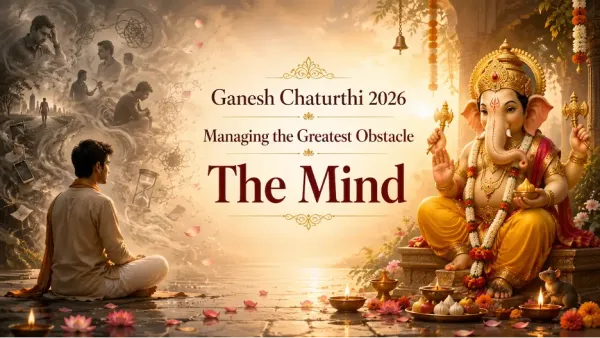
Feature Image: Before every new beginning, we place our hopes and challenges at Ganesha’s feet, seeking His wisdom, guidance, and grace.