
The Triple Celebration: Birth, Enlightenment, and Nirvana

What does enlightenment mean in a world of endless scrolling, constant pressure, and quiet burnout?
We live in an age where success is visible, but peace is rare. Our days are filled with notifications, deadlines, and the subtle anxiety of always needing to be “on.” And yet, beneath all this activity, many people carry the same unspoken question: Is this all there is?
Over 2,500 years ago, Gautama Buddha asked that very question,not from a place of lack, but from abundance. Born as Prince Siddhartha, he had everything one could desire: luxury, comfort, and power. Yet something within him remained unsettled. That quiet dissatisfaction led him on a journey that would transform not only his life, but the spiritual direction of humanity.
Buddha Jayanti commemorates three defining moments of that journey:his birth, enlightenment, and Mahaparinirvana. That all three are believed to have occurred under the same full moon is deeply symbolic. The full moon represents illumination; the movement from confusion to clarity, from ignorance to awareness.
And perhaps that is why this day still matters.
Because the journey it celebrates is not just his it is ours.
Each of us begins with potential (birth), moves through moments of realization (awakening), and seeks freedom from confusion and suffering (liberation). Buddha Jayanti is not merely a historical remembrance; it is a reflection of the path we are all walking ,consciously or not.
The birth of Gautama Buddha is often seen not just as a historical event, but as a profound declaration of human potential. At a time when people believed their fate was controlled by divine forces and rigid social structures, the Buddha’s message was revolutionary because it affirmed that human beings have the capacity to understand, grow, and transform themselves through their own efforts.
Declaration of Human Independence
The story of Buddha Jayanti begins with the birth of Prince Siddhartha Gautama in present-day Nepal around 2,500 years ago. Born into immense privilege, his father shielded him from all suffering, creating an illusion of a perfect world filled only with music and luxury. Yet, the spiritual significance of his birth goes far beyond the historical facts of royalty.
The Buddha's birth is fundamentally viewed as a declaration of independence for the human race
In ancient India, society was heavily influenced by the belief that human fate was entirely controlled by deities, and the rigid caste system dictated that only a privileged few had the right to education and spiritual liberation. Buddha shattered these paradigms. It is said that upon his birth, he declared: "I am the foremost of the world. I am the supreme in the world. I am the best in the world". This was not a statement of ego, but rather a revolutionary announcement that humans possess the ultimate potential to learn, train, and improve themselves to become better persons without relying on supernatural intervention. He taught that a person's worth is defined by their actions and wisdom, not by their birth or class, thereby introducing a powerful philosophy of self-reliance, mass education, and human dignity that profoundly shaped global civilization
A Journey of Self-Discovery
The Buddha’s path was deeply personal. Rather than asking others to blindly follow, he encouraged exploration and direct experience.
Today, personal growth is often framed around achievement. But a deeper question remains:
Do we understand ourselves?
Instead of asking, “How can I achieve more?” this path asks:
- Why do I feel restless even when things are going well?
- What am I holding onto unnecessarily?
- Am I reacting, or aware of my reactions?
Even a small pause before responding or reacting can shift everything.
Nothing changes until we notice it.
What makes the Buddha’s insight even more remarkable is how closely it aligns with modern psychology. His teaching of the Four Noble Truths mirrors the structure of therapeutic healing:
Recognizing suffering
Identifying its cause
Understanding that change is possible
Following a path toward well-being
Today, practices like mindfulness-based therapy draw directly from these ancient insights.
The Enlightenment: The Original Psychological Blueprint
The second great event commemorated on Buddha Jayanti is the Buddha's Enlightenment under the Bodhi tree in Bodh Gaya. After venturing outside his palace and witnessing old age, sickness, and death, Siddhartha renounced his wealth to seek an end to human suffering. Through deep meditation, he awakened to the ultimate truth, discovering what we now know as the Four Noble Truths .In modern times, the Buddha is increasingly viewed not just as a religious figure, but as a pioneering psychologist. His enlightenment represents a profound mapping of the human mind. The Four Noble Truths perfectly mirror the modern therapeutic process:
- Life is suffering: Acknowledging that everyone goes through tough times, much like admitting a problem to a counselor.
- The cause of suffering is craving: Identifying the root cause of our pain, similar to a therapist diagnosing the source of anxiety.
- The end of suffering is possible: Providing the hope that we can overcome our mental anguish.
- The path to end suffering: Offering a custom-made plan to boost mental well-being, known as the Noble Eightfold Path.
The Power of Karuna: Practicing Active Compassion in an Increasingly Fragmented Society
Compassion is often seen as a feeling, but in the Buddha’s teachings, Karuna is something more. It is compassion in action.
In today’s world, it is easy to feel disconnected. News cycles highlight conflict. Social media amplifies division. Differences in opinion can quickly turn into distance between people.
In this environment, compassion can feel difficult—but it is also more necessary than ever.
And it doesn’t have to be dramatic.
It can look like:
- Listening to someone without interrupting or judging
- Being patient with someone who is struggling, even when it’s inconvenient
- Offering help without expecting recognition
Consider a simple situation: a colleague who seems distracted or irritable. The immediate reaction might be frustration, but a moment of compassion, recognizing that they may be dealing with something unseen, can shift your response entirely.
Instead of reacting, you respond with understanding.
That small shift changes not only the interaction, but the environment around it.
Karuna reminds us that everyone is carrying something we may not fully see.
And when compassion becomes a practice rather than just a feeling, it begins to reshape how we relate to the world.
To truly understand what compassion looks like beyond theory or philosophy, it helps to turn to lived examples, where empathy is not just spoken, but embodied. One such story from the life of Gautama Buddha powerfully illustrates how genuine compassion can transform even the deepest human suffering.
This story reminds us that compassion is not abstract; it is the ability to meet suffering without turning away.
The Buddha's approach to mental health was radically compassionate and destigmatizing, functioning centuries ahead of modern psychiatric care.
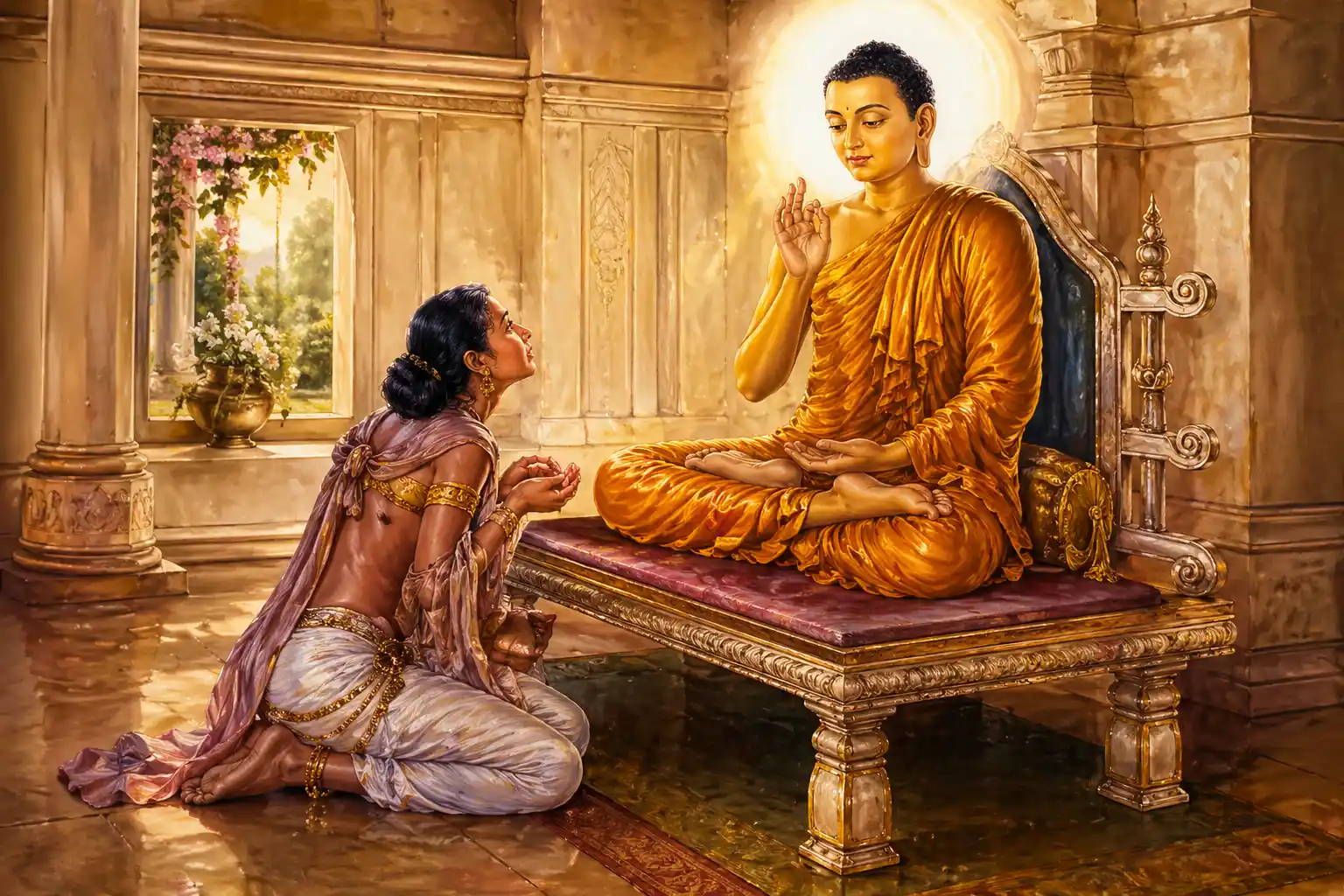
A deeply moving example of compassion in action is the story of Patacara, one of the most revered disciples of Gautama Buddha. Her life was marked by unimaginable tragedy. Within a short span, she lost her husband to a snakebite, one child to a river’s current, another to a predatory bird, and finally her parents in a sudden disaster. Overwhelmed by grief, she lost her sanity and wandered aimlessly, rejected and ridiculed by society.
When she eventually came into the presence of the Buddha, something extraordinary happened. Unlike others, he did not turn away or judge her condition. Instead, he met her with profound empathy and quiet dignity. Through gentle words and patient guidance, he helped her regain awareness and understand a fundamental truth: the impermanence of all worldly attachments.
This moment was not just an act of kindness; it was a transformative encounter. Patacara not only recovered but went on to become a respected spiritual teacher, guiding others through their suffering. Her journey illustrates that compassion is not passive sympathy, but is the courage to face suffering directly and respond with understanding.
In many ways, the Buddha’s response reflects an approach to mental and emotional suffering that feels strikingly modern. His method was neither dismissive nor punitive, but deeply humane. It acknowledged pain, restored dignity, and offered a path forward. Long before contemporary psychology began addressing trauma with empathy and awareness, the Buddha demonstrated a model of care rooted in wisdom and compassion.
Patacara’s journey shows that healing did not come from suppressing her pain, but from learning how to relate to it with awareness and understanding. The Buddha guided her to observe her suffering rather than be consumed by it. This shift lies at the heart of many modern therapeutic practices and forms the foundation of Mindfulness-Based Stress Reduction (MBSR), where individuals are trained to respond to stress with calm, non-judgmental awareness instead of reacting impulsively.
Modern therapeutic frameworks like Mindfulness-Based Stress Reduction (MBSR) and Mindfulness-Based Cognitive Therapy (MBCT) are directly derived from Buddhist meditation techniques.
MBCT, which helps patients break away from negative thought loops to prevent depression relapses, and MBSR, which teaches individuals to respond calmly to stressors rather than reacting impulsively, prove that the Buddha's psychological insights are highly effective medical tools today. Author Robert Wright notes that evolutionary psychology confirms the Buddhist view: our brains evolved for survival, not happiness, leaving us perpetually wanting more. Buddhist mindfulness trains the brain to counter this evolutionary default, allowing us to handle modern life's challenges with peace
While mindfulness helps us transform our inner world, the Buddha’s teachings were never meant to remain confined within the mind—they extend outward into how we live, work, and contribute to society. Patacara’s story, too, is not just about personal healing, but about how that healing enabled her to serve others with wisdom and compassion. This naturally leads to another essential aspect of the Buddha’s path: ethical living. In today’s complex and often morally ambiguous economy, the principle of Right Livelihood invites us to align our professional choices with compassion, integrity, and a deeper sense of purpose.
Ethical Living and Right Livelihood: Navigating a Complex Economy with Compassion and Integrity
In today’s global economy, this teaching becomes especially relevant. Industries built around harm, whether through exploitation, environmental damage, or unethical practices, challenge us to reflect on the true cost of our work.
Right livelihood invites a shift in perspective:
- Not just “What do I earn?”
- But “What impact does my work create?”
As we begin to examine our careers through the lens of Right Livelihood, an important question naturally arises: what does ethical work actually look like in today’s fast-paced, profit-driven world? The Buddha’s teachings don’t offer rigid rules, but they do invite deep reflection—especially for modern professionals navigating ambition, competition, and purpose. This is where contemporary voices help bring ancient wisdom into sharper focus. Insights from thinkers like Emma Roche highlight how Buddhist principles can reshape our understanding of success, encouraging us to move beyond purely financial goals toward work that is meaningful, ethical, and beneficial to society as a whole.
Right Livelihood: Career Nirvana in the 21st Century
As we celebrate Buddha Jayanti, it is worth asking whether the principles we honor spiritually are reflected in the way we live professionally. After all, our jobs occupy the majority of our waking hours, so should they not also align with our deepest values?
Following his enlightenment, the Buddha outlined the Noble Eightfold Path, which includes the concept of "Right Livelihood" (Samma Ajiva).Right Livelihood argues that the work we do must be ethical, meaningful, and cause no harm to others or the planet. The Buddha explicitly advised his followers to avoid five specific trades: weapons, living beings, meat, intoxicants, and poisons .When we look at the modern global economy, we see a vast gulf between the Buddha's vision and our current reality.
- The Weapons Industry: The defense sector and firearms manufacturing employ millions globally, thriving on the prospect of conflict and deterrence, an industry that would likely have horrified the Buddha.
- The Meat Industry: Slaughterhouses and meat processing plants, while hidden from public view, are massive employers built on a mechanized reality of transforming life into sustenance, directly violating the principle of harmlessness.
- Intoxicants and Poisons: The alcohol and rapidly growing cannabis industries capitalize on the human appetite for altered states. Furthermore, the chemical manufacturing sector, which creates everything from industrial solvents to agricultural pesticides, blurs the line between what sustains life and what quietly destroys it.
Buddhism challenges modern professionals to reflect deeply on whether our chosen careers align with our core ethical values.
It is one thing to admire spiritual principles, but another to live by them in the real world. When applied to our professional lives, these teachings become deeply introspective. Buddhism challenges modern professionals to reflect on whether our chosen careers truly align with our core ethical values.
According to philosophical life coach Emma Roche, Buddhist wisdom helps shift our focus from solely seeking financial gain to finding a deeper purpose and contributing positively to society. The phrase "not-for-profit" heavily echoes the Buddha's vision. The Buddha did not condemn wealth, but he taught that true Right Livelihood means using one's resources wisely and compassionately to alleviate suffering. For modern professionals feeling a sense of alienation or burnout, evaluating our work through the lens of Right Livelihood can be transformative. It shifts the paradigm from asking "How much does this pay?" to "How does this contribute to the well-being of the world?"
But even when our work aligns with our values, modern professional life can still feel overwhelming. Deadlines, competition, and constant connectivity create inner turbulence, making the Buddha’s teachings on the Middle Way and mindfulness at work more relevant than ever.
The Middle Way and Mindfulness at Work

Even if our careers are ethical, how we work matters just as much as what we do. Before his enlightenment, Siddhartha engaged in severe asceticism, nearly starving himself to death. He soon realized that extreme deprivation was just as unhelpful as the extreme indulgence he experienced in his palace. This profound realization led to The Middle Way—a path of balance .In the modern workplace, The Middle Way is the ultimate antidote to the hustle culture that prizes relentless productivity over mental well-being. It teaches us to balance intense professional efforts with essential self-care and sustainability. Furthermore, the Buddha taught that rushing through tasks without proper attention inevitably leads to mistakes, ethical lapses, and suffering. In his book Old Path White Clouds, Vietnamese Zen Master Thích Nhất Hạnh explains that the Buddha encouraged full attention to the present moment, whether one was sweeping a courtyard or discussing philosophy. In modern work psychology, this is recognized as the "flow state"—a condition of complete absorption that leads to optimal performance and deep satisfaction.Professionals who practice Buddhist-inspired mindfulness find that it significantly enhances their emotional intelligence (EQ), which is a vital skill for leadership and managing inclusive workplaces. Bianca Riemer, a professional who left the financial sector to pursue healing practices, noted that meditation lowers stress and fear-based procrastination. She observed that simply allowing herself to eat lunch properly and take a short walk without checking emails reduced her anxiety so much that she was able to take calculated risks at work, ultimately winning industry awards. Mindfulness does not hinder professional success; by clearing mental clutter and increasing our capacity for calm, creative thinking, it frequently enhances it.
While mindfulness enhances clarity and performance, it also reveals a deeper insight:the source of much of our stress is not the work itself, but our attachment to its outcomes. This is where the Buddha’s teaching of non-attachment becomes especially powerful.
The Power of Non-Attachment to Outcomes

One of the most profound, and often misunderstood, concepts in Buddhism is non-attachment. It is the conscious practice of letting go of our clinging to impermanent things, including material possessions, relationships, thoughts, and even our own emotions. In a corporate world where success is exclusively defined by measurable results and failure is treated as a personal disaster, the Buddhist philosophy of non-attachment offers a revolutionary alternative. Non-attachment does not mean apathy, nor does it mean we stop trying to do our jobs well. Instead, non-attachment teaches us to focus intensely on our effort and the present process, rather than clinging desperately to the final outcome. It is the ability to work incredibly hard, make ethical decisions, and strive for excellence, without being consumed by anxiety over external validation or financial results. The Buddha stated in the Dhammapada, "Let go of attachment to the fruits of action, and act with mindfulness and integrity" This creates a paradox that modern workers are invited to embrace: an active life of deep engagement, coupled with a state of upekkha (equanimity) where one remains unshaken by successes or setbacks. As Thich Nhat Hanh explained, when we let go of our desperate craving for success, we actually discover a deep, sustainable joy in the work itself. This philosophy reduces our suffering by freeing us from the belief that material possessions or job titles are the source of our happiness. By finding a balance between passion for our work and detachment from its ultimate results, we cultivate a clear, focused mind capable of immense creativity and resilience
A Modern Perspective: Swami Mukundananda’s Insights
The insights of Swami Mukundananda offer a meaningful bridge between the Buddha’s teachings and modern spiritual practice rooted in Vedic teachings. While Gautama Buddha emphasized mindfulness, detachment, and inner awareness, Swami Mukundananda highlights the power of directing the mind toward a higher purpose through devotion and disciplined thinking. Both approaches converge on a central truth: the mind is the source of both suffering and liberation. By cultivating awareness, reducing attachment, and aligning our actions with compassion and purpose, we can achieve not only inner peace but also a more balanced and fulfilling life.
When we begin to practice non-attachment, we slowly come to terms with a deeper truth that all things are impermanent. The Buddha did not just teach this idea; he embodied it in his final moments, offering one last, profound lesson through his passing.
The Passing (Mahaparinirvana): A Call to Heedfulness
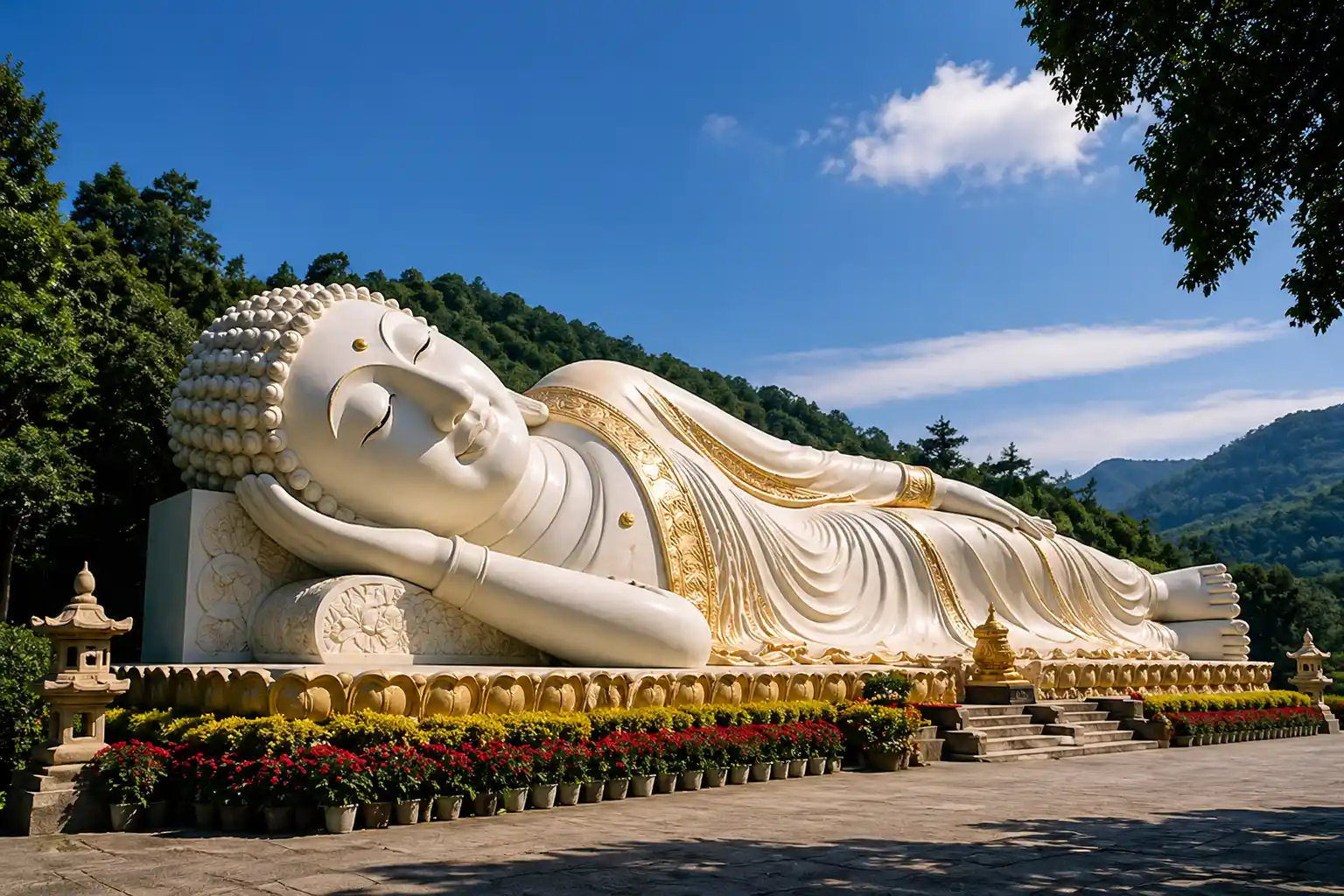
The final event honored on Buddha Jayanti is the Buddha's passing away, or Mahaparinirvana. The Buddha lived to the age of eighty, and his death is a profound reminder of the reality of impermanence .His final words to his disciples were: "Transient are conditioned things. Try to accomplish your aim with diligence". He also urged his followers to strive to bring heedfulness to perfection, warning that all things, including human life and great civilizations, are of the nature to decay and fade away. This is not a pessimistic view, but a highly motivating one. Because our time is limited and everything is subject to change, we cannot afford to be careless or complacent with our lives. The truth of impermanence is a call to action. It urges us to actively improve ourselves, to cultivate virtuous habits like right speech and right action, and to understand the law of cause and effect so we can foster the conditions that lead to prosperity and avoid those that lead to ruin. When we celebrate Vesak, we are not merely looking back at a historical figure. We are engaging in the "worship of practice" (patipatti puja). The Buddha taught that simply offering flowers or incense (amisa puja) is vastly inferior to the actual practice of his teachings. To truly venerate the Buddha is to bring his virtues into our own hearts—to live mindfully, work ethically, and treat others with the deep compassion that stems from understanding our shared, interconnected existence.
When we truly absorb the Buddha’s message on impermanence and awareness, celebration takes on a new meaning. Buddha Jayanti is no longer just a commemoration of the past:it becomes more than a festival, a sacred invitation to turn inward and reflect.
More Than a Festival: A Day of Inner Reflection
For many, Buddha Jayanti is marked by rituals: visiting temples, offering prayers, lighting lamps, and performing acts of charity. These practices are meaningful, but their deeper purpose is often overlooked.
This day is not only about what we do, it is about what we notice.
When was the last time you sat in silence without reaching for your phone?
When did you last observe your thoughts without trying to change them?
In modern life, we are constantly pulled outward—toward productivity, validation, and distraction. Even moments of rest are often filled with noise. Buddha Jayanti gently interrupts this pattern. It invites us to pause, not as an escape, but as an act of awareness.
Consider a simple moment: scrolling through social media late at night, moving from one post to another without intention. That restless movement mirrors a deeper habit—the inability to sit with ourselves. Reflection breaks that cycle. It allows us to see not just what we are doing, but why we are doing it.
The Relevance of His Journey Today
From Luxury to Liberation: What Prince Siddhartha’s Renunciation Teaches Us About Modern Materialism
At first glance, Prince Siddhartha’s renunciation feels distant from modern life. After all, how many of us are living in palaces, surrounded by luxury, shielded from suffering?
But look closer—and the story feels surprisingly familiar.
Today, luxury doesn’t always look like royal gardens or silk robes. It looks like a high-paying job, a curated social media life, the latest gadgets, and the quiet pressure to “have it all together.” We may not live in palaces, but many of us live in carefully constructed bubbles, designed to keep discomfort, uncertainty, and deeper questions at bay.
And yet, just like Siddhartha, something often feels incomplete.
Consider the modern professional who spends years chasing success—late nights, constant deadlines, promotions earned through sacrifice. From the outside, everything looks perfect. But in quiet moments, there is restlessness. A sense that despite having more, something essential is missing.
Or think about the habit of upgrading—phones, cars, lifestyles. Each new purchase brings a brief sense of satisfaction, but it fades quickly, replaced by the desire for the next thing. It’s not the object itself that’s the problem—it’s the expectation that it will bring lasting fulfillment.
This is the illusion Siddhartha saw through.
When he encountered sickness, aging, and death, it shattered the belief that comfort could protect him from life’s deeper realities. His renunciation was not a rejection of wealth—it was a rejection of the idea that external conditions alone could create inner peace.
That insight feels especially relevant today.
Modern materialism doesn’t just encourage us to have more—it quietly teaches us to become what we have. Our identities get tied to our roles, our possessions, and how others perceive us. The result is a fragile sense of self, one that fluctuates with success, comparison, and external validation.
Siddhartha’s journey offers an alternative.
He didn’t abandon the world because it was meaningless—he stepped away to understand it more deeply. His path invites us to do the same, not by giving up everything, but by questioning our attachments.
In practical terms, this might mean:
- Noticing when achievement turns into pressure rather than purpose
- Recognizing when consumption becomes a substitute for contentment
- Creating space in our lives that isn’t driven by comparison or validation
For example, choosing to disconnect from social media for a few hours, not as a trend, but as a conscious act of reclaiming attention. Or redefining success, not just as income or status, but as clarity, balance, and peace of mind.
Renunciation, in the modern sense, is not about withdrawal, it is about awareness.
It is the ability to enjoy what we have without being defined by it.
Key Takeaways
- Buddha Jayanti is a call to reflect, not just celebrate.
- The teachings of Gautama Buddha remain deeply relevant in today’s fast-paced, stressful world.
- Mindfulness helps us navigate life with clarity, focus, and emotional balance.
- Compassion, as seen in the story of Patacara, has the power to heal and transform.
- Non-attachment reduces stress and frees us from constant pressure over outcomes.
- Right Livelihood encourages aligning our work with purpose and ethical values.
- The Middle Path reminds us to live and work with balance.
- True success lies in inner peace, not just external achievement.
- Real change begins when wisdom is applied in everyday life.

Conclusion: Ancient Wisdom for a Modern World
Carrying the Light Forward: Turning Wisdom into Action
Buddha Jayanti is a profound celebration of the highest peaks of human potential. It reminds us that over two millennia ago, a human being proved that we are not bound by fate, but rather, we have the power to liberate our own minds. Whether we are struggling with the mental health challenges of modern life, navigating the ethical dilemmas of a globalized economy, or simply trying to find a moment of peace in a hectic workday, the teachings commemorated on Vesak Day offer a timeless guiding light. By embracing Right Livelihood, practicing the Middle Way, and cultivating a mindful non-attachment to the chaotic outcomes of the world, we can transform our daily lives from a state of suffering into one of deep purpose, clarity, and enduring joy .
Call to Action
As you reflect on the timeless teachings of Gautama Buddha this Buddha Jayanti, remember that wisdom is not meant to remain in words, it is meant to be lived. The real tribute lies not in celebration alone, but in transformation.
Take a moment today to pause and ask yourself:
Where can I bring more mindfulness into my life?
FAQs
1. What is Buddha Jayanti and why is it important?
Buddha Jayanti commemorates the birth, enlightenment, and Mahaparinirvana of Gautama Buddha. It is important because it reminds us of the path to wisdom, compassion, and inner peace.
2. Why are all three events celebrated on the same day?
Traditionally, it is believed that these three major events in the Buddha’s life occurred on the same full moon day. This symbolizes the complete journey from birth to awakening to liberation.
3. How is Buddha Jayanti relevant in modern life?
In today’s fast-paced and stressful world, Buddha Jayanti encourages mindfulness, balance, and self-awareness-helping us manage anxiety, distractions, and emotional challenges.
4. What is the “Middle Way” and how can we apply it today?
The Middle Way is a path of balance-avoiding extremes of indulgence and deprivation. In modern life, it means maintaining a healthy balance between work, rest, ambition, and well-being.
5. How can I practice mindfulness in daily life?
You can practice mindfulness by:
- Focusing on one task at a time
- Taking conscious breaths
- Observing your thoughts without reacting immediately