Every evening in Vrindavan, as the sun sank low and the dust of returning cows turned the sky to gold, the gopis would leave whatever they were doing and come to their doorways. All day long Shree Krishna had been away in the forest with the herds, and each moment of that separation felt to them like an age. Then He would appear on the path home, His body decked in the dust of the cows' hooves, His curly black hair moving in the breeze, the peacock crown swaying as He walked with the easy grace of a young elephant, the flute resting on His lips. The gopis would stand and drink in that sight, and they would even complain about the Creator, for Brahma had given them only two eyes, and on top of that had given those eyes eyelids, so that every blink stole a fraction of a second of their darshan.
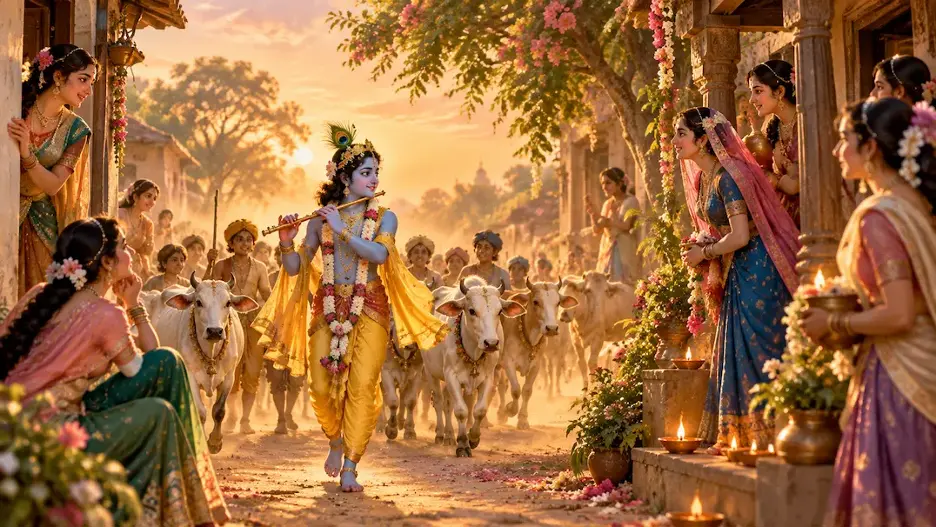
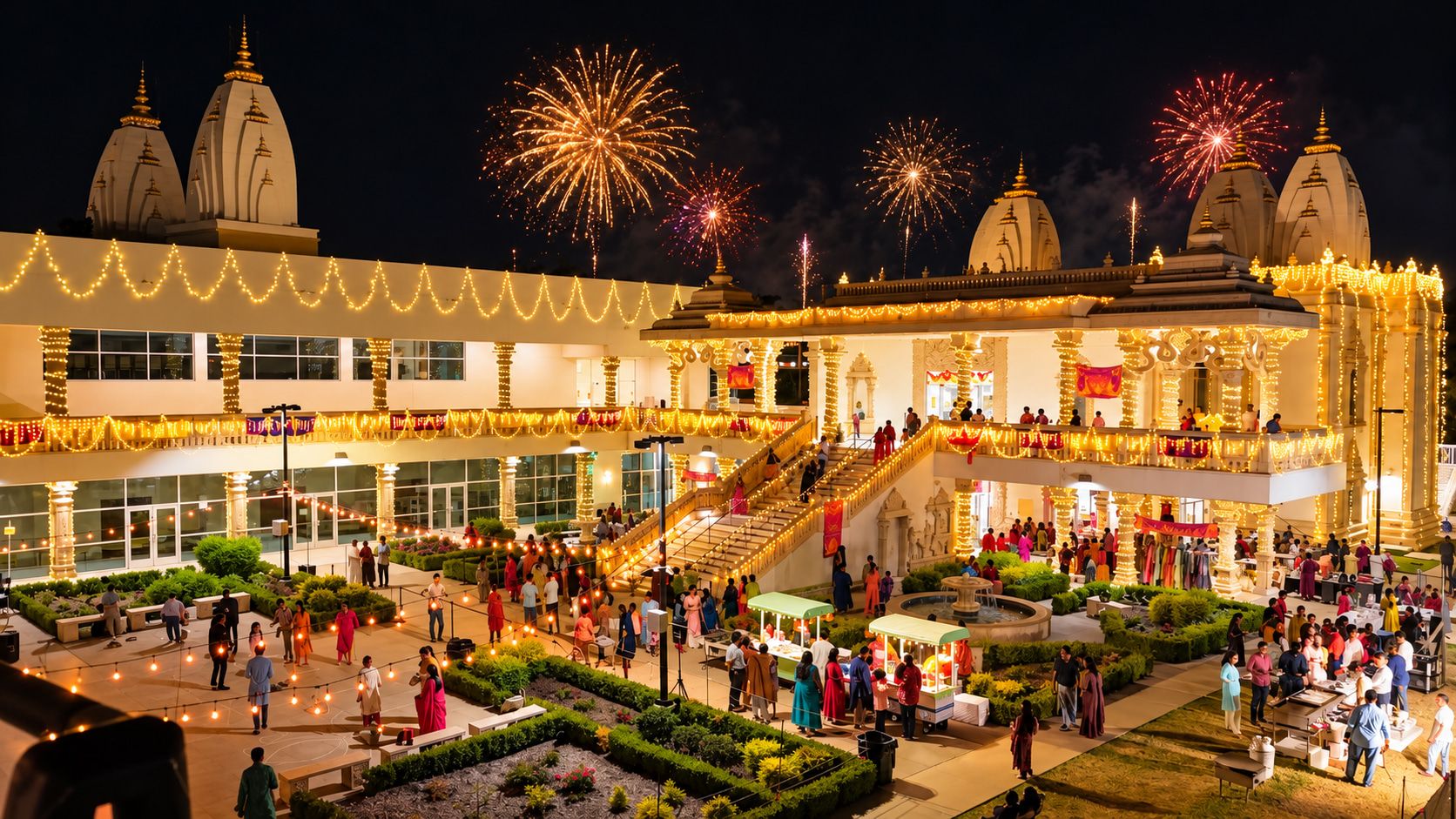
That is the feeling hidden inside every lamp of Diwali. Beneath the sweets and the fireworks, the new clothes and the joyful crowds, there is a heart standing at its doorway at dusk, waiting for the Beloved to come home. Let us walk through the traditions of the festival one by one, the stories behind them and the way they come alive at the Radha Krishna Temple of Dallas in Allen, Texas, so that each familiar custom can be seen for what it truly is: a way of remembering Shree Radha Krishna.

Why Every Diwali Tradition Leads Back to Krishna
Many of us inherit Diwali the way we inherit a family recipe, following each step faithfully without always knowing why. Swami Mukundananda offers a key that unlocks all of them at once. He explains that all the rituals of our tradition were created with two objectives: first, always remember Shree Krishna, and second, never forget Him. If we remember God, he says, we are fulfilling the purpose of every ritual. He points to the little mantra recited at the start of almost every pooja, from the Padma Puran, which says that whether we are clean or unclean, wherever we may be, the one who remembers the lotus-eyed Lord becomes pure inside and out.
This changes how we celebrate. Swamiji never asks us to abandon the customs, because a festival, he says, must be joyful for everyone. He asks only that the customs do their real work. He gives an image that every child can understand. If we light up an entire house with lamps, the night outside still remains. On a clear night all the stars shine together, and still it is night. Even the full moon cannot drive the darkness away. But when one sun rises, the night vanishes completely. The darkness of the heart, made of lust, anger, greed and envy, is like that night, and it needs the divine Sun.
“Krishna surya sama, maya hoi andhakar, jahan Krishna tahan maya nahi adhikar, Krishna is like the sun and maya is like darkness, and where Krishna is, maya has no power.”
Even a darkness a thousand years old leaves a cave the moment a single match is struck, and God's promise to us is just as simple: bring me into your heart, bring my love and my remembrance, and the darkness of endless lifetimes will begin to disappear.
The Diya: A Heart Waiting at the Doorway
The lamp is the soul of the festival, and its story begins in Ayodhya, where the people lit their homes and streets to welcome Shree Ram after fourteen long years. But for the rasik devotee, whose heart lovingly dwells on the intimate pastimes of Radha and Krishna, the diya also carries the longing of Braj. When Shree Krishna left Vrindavan for Mathura, the gopis suffered such pain in separation that they felt their life breath would leave them, and yet Mathura was only a couple of hours away on foot. They never went. If Shyamsundar wished to meet us, they said, He would come Himself. Perhaps He has other work to do, other devotees to bless, and to go there for our own happiness would be against everything our love stands for. They chose to bear the pain of separation rather than disturb His happiness in the smallest way.
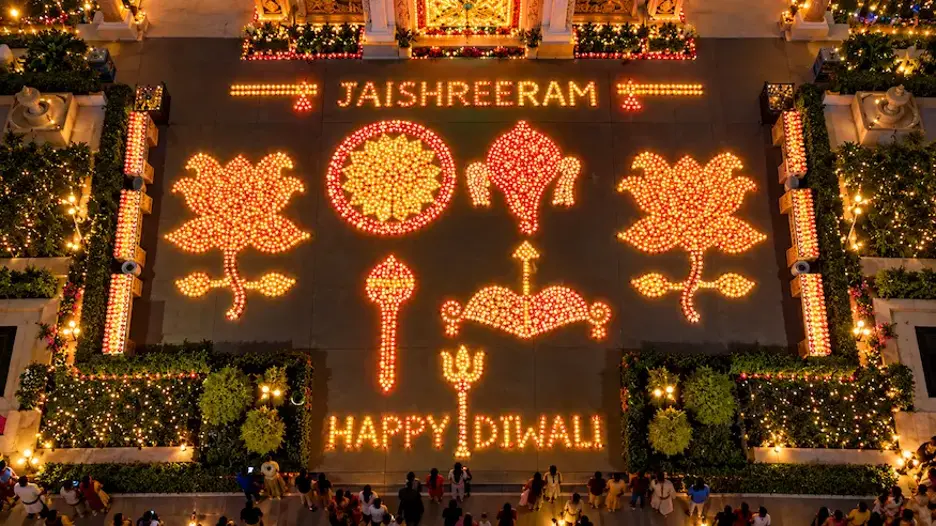
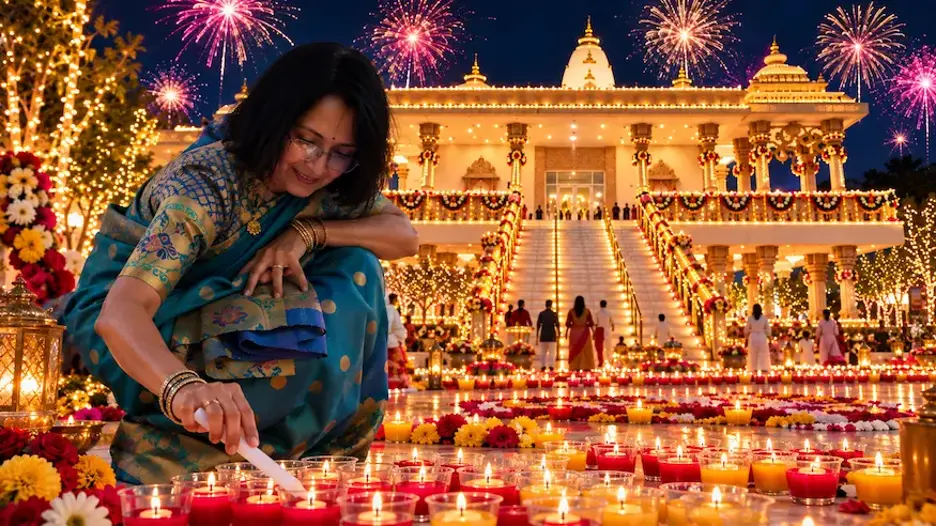
When we place a small clay lamp at our doorway on Diwali night, we can let it carry that same feeling. It is not a demand that God appear on our schedule. It is a quiet declaration that the door of the heart is open and the light is on, whenever He chooses to come. At the Radha Krishna Temple of Dallas, this becomes a shared prayer when the community gathers to light 11,111 diyas across the grounds, arranged into lotuses and the sacred Om, each flame offered by a different family and each one a little doorway waiting for the Lord.
Cleaning, Decorating and Dressing for the Beloved
In the days before Diwali, homes are swept and scrubbed, rangoli patterns bloom at the threshold, and families bring out new clothes. These customs traditionally welcome Goddess Lakshmi into the home, and Swamiji invites us to pause while we clean and ask whether we are cleaning our hearts as well. Is there some forgotten corner where a little grudge, impatience or intolerance has collected, which needs to be swept out so that the heart becomes a fit place for the Lord of the universe to reside?
Dressing up has its own beautiful story. Hanuman once watched Mother Sita applying sindoor and asked her why she did it. She told him that it pleases Shree Ram. Hanuman's simple heart reasoned that if a little sindoor pleases the Lord, a great deal would please him even more, so he covered his entire body in it and came before Ram glowing red from head to toe. That is why Hanuman's murti is adorned with sindoor to this day, as a symbol of the simplicity of his love. When we put on our finest clothes for Diwali, Hanuman shows us the sweetest reason to do it: not to impress others, but because the One we love may be pleased to see us ready for Him.
Lakshmi Pooja: Wealth Seen Through Rasik Eyes
The heart of Diwali night is the worship of Goddess Lakshmi. Lakshmi is the divine consort of the Lord, the embodiment of his Yogmaya, his own divine energy, worshipped as the primordial Mother of the world. People approach her in different ways. Some see her as a mother who fulfills every wish, the way a child asks for chocolate and expects to receive it. Ravan made a far greater mistake. He wanted to possess her for his own enjoyment, and so he stole the very consort of God, an attempt that could only end in failure, for who can steal the Lord's own power? That grasping attitude, Swamiji says, is the demonic tendency still alive within us whenever we think of wealth only as a means to enjoy the world.
The divine attitude, he teaches, is to see Lakshmi as a beloved daughter. Loving parents raise their daughter with tender care, educate her and help her flourish, all the while knowing she is not their possession and will one day go to another home. In the same way, whatever wealth comes to us belongs to God, and we are its custodians, not its owners. The scriptures say we may keep what is needed to sustain the body, and the rest is meant for the Lord's service. The soul's true nature, he adds, is not to be an enjoyer but a servant of God, and if we do not serve him, we end up serving the world anyway.
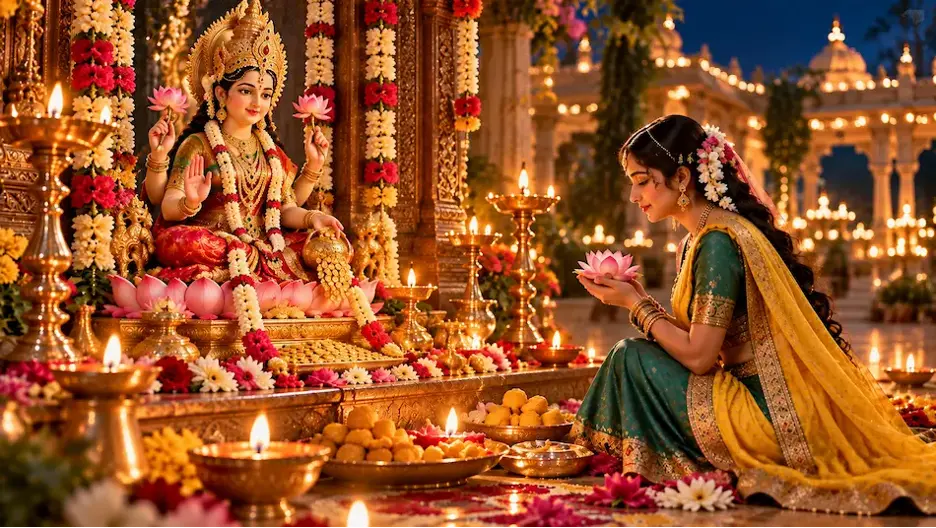
Here the rasik heart finds something even sweeter. Swamiji explains from the Puranas that the Divine Mother takes many forms, as Sita, Parvati, Durga and Lakshmi, and that Mahalakshmi herself manifested from the left side of Shree Radha Rani. Radha and Krishna are as inseparable as milk and its whiteness. And yet in Braj, the equation between the Lord and his energy changes completely. Shree Krishna Himself is bound by the selfless love of Radha Rani. The poet Raskhan, who came to Krishna devotion from another background, could not believe that in the leelas of Braj the Lord takes the lower position, until Radha Krishna gave him darshan in the groves of Vrindavan with Radha Rani seated and Shree Krishna lovingly pressing her feet. So when we offer a lamp to Mother Lakshmi this Diwali, we can follow the light back to its source and pray for the treasure truly worth seeking, the wealth of divine love that travels with the soul from life to life.
The Festivals and Stories Behind Diwali
Diwali gathers many sacred stories into one season. Besides Shree Ram's return to Ayodhya, the festival is celebrated as Naraka Chaturdashi, the day Shree Krishna and Satyabhama defeated the demon Narakasura, that Jain friends honor it as the day Bhagwan Mahavir attained nirvana, and that Sikh friends celebrate it as Bandi Chhor Divas, the release of their sixth Guru from imprisonment. In all of them, light triumphs over darkness.
Even within the familiar Ramayan there are hidden depths of love, as in the tender story of Kaikeyi, who is usually remembered only as the queen who sent Ram into exile. When Ram was a little boy, Kaikeyi adored Him and was always by His side. One day He asked her whether she truly loved Him, and she said she loved Him more than anything. Then He told her that devotees in the forest were waiting for Him, among them Shabari, who had waited for years in the hope that He would come to her hut, and He needed a reason to go to them. You will be that reason, He said, and it will cost you your husband, your son's closeness and your good name. Kaikeyi accepted it all. If your happiness requires that I carry a bad name, she said, I do not mind. To this day no mother names her daughter Kaikeyi, and yet Swamiji sees in her sacrifice a lesson in what love really is, for love is never self-seeking; it is always sacrifice.
The season of Diwali flows on into Govardhan Pooja, when the Annakoot, a mountain of food offered to the Lord, remembers the feast the Brajwasis, the people of Braj, once carried to Govardhan Hill, and into Bhai Dooj, which honors the bond between brothers and sisters. Each festival is another doorway into the same truth: the Lord treasures the love of those who belong to Him.
Sweets, Gifts and Giving
Diwali is a festival of sharing, of boxes of sweets passed between neighbors and gifts exchanged among family. Our scriptures also ask us to give away a tenth of what we earn in charity, so that the rest of our wealth is purified. On Diwali, business families traditionally close their old account books and open new ones, and Swamiji encourages us to do the same with our spiritual accounts. How much did we earn this year, and how much did we lose? Every negative thought, every time we dwelt on another's faults, every needless worry was a loss, and on this day we can resolve to reduce the losses and increase the gains, so that each Diwali finds our spiritual balance a little higher than the last.
Giving reaches its sweetest form when we give with no thought of what it may cost us, and the gopis show where such giving leads. In Dwarka, Shree Krishna once complained of a terrible headache that no remedy would cure, and He told Narad that only the dust of a devotee's feet, dissolved in water, could heal it. The queens of Dwarka refused, fearing it would be a grave offense to give their foot dust to God, and even Narad hesitated. So Krishna sent him to Vrindavan. The moment the gopis heard their Shyamsundar was in pain, they held out their feet. Narad warned them that giving foot dust to God might send them to hell. The gopis replied that heaven and hell only matter to those who seek their own happiness. Our only desire, they said, is Shree Krishna's happiness, and if He is happy, we are happy wherever we are. Now please stop talking and take the dust to him. Narad was so moved that he sat beneath a tree on the way back and marveled that he could never match the quality of their love. That is the spirit we can bring to every sweet we share and every gift we give this Diwali.
Gathering Together: Family, Satsang and Community
Diwali is a festival of togetherness, and the company we keep shapes who we become. When Hanuman was searching Lanka at night, he found one house marked with the emblem of Ram's bow and tulsi growing in the courtyard. At three in the morning Vibhishan woke with Ram's name on his lips and came out to find Hanuman at his door. Vibhishan confessed that he had been chanting Ram's name for years and wondered why grace had not come, and Hanuman told him the answer: you are taking Ram's name, but you are not doing Ram's work. From that moment Vibhishan resolved to stand with Ram, and a single meeting with a true devotee changed his destiny. Swamiji teaches that through satsang, the company of devotees gathered in God's remembrance, faith grows first, then interest in devotion, and finally bhakti itself begins to blossom in the heart.
In Braj, that closeness reaches its height, for Shree Krishna is so one with Radha Rani that whatever touches her heart touches Him. After a hundred years of separation, Radha Rani and the gopis met Shree Krishna again at Kurukshetra during a solar eclipse. The queens of Dwarka invited Radha to their camp and, without thinking, offered her milk that was far too hot. She drank it without a word. That night, as Rukmini pressed the Lord's feet, she found them covered in blisters, and when she asked why, Shree Krishna told her that His feet always reside in the heart of Radha. Love among devotees is never separate from love for God.
This is why Swamiji has described Diwali as the flagship event of the whole community. Speaking to the temple's community partners, he described people with different mother tongues and different customs gathering as one, and compared the community to the great cable of the Golden Gate Bridge, which looks like a single rope but is made of tens of thousands of slender strands whose combined strength carries all the traffic. Our scriptures say that in this age, strength lies in unity, and a celebration that belongs to everyone is how our children inherit the treasures of our culture with pride.
How Radha Krishna Temple Brings Every Tradition Alive
At the temple, these traditions are not explained from a distance; they are lived together over several days. The Diwali Mahotsav opens with Govatsa Dwadashi, honoring the cows and calves so dear to Shree Krishna, and moves through Dhanteras and Lakshmi Pooja, Choti Diwali with the lighting of 11,111 diyas, the main Diwali night with the Lakshmi Ganesh Pooja and Diwali Maha Pooja, Govardhan Pooja and the magnificent Annakoot, and Bhai Dooj. Along the way there is a special Diwali satsang with Swami Mukundananda, soulful kirtan, the Diwali Leela bringing the Ramayan to life on stage, an open stage for the community's talents, a festive food festival, children's workshops and fireworks lighting up the sky.
In the temple we fill ourselves with devotion, and then in daily life we offer every action as worship, just as Shree Krishna asks in the Gita that whatever we do, eat, offer or give be done as an offering to him. When we live that way, Swamiji says, every day becomes a Diwali. A family may come for the lamps and the fireworks and leave having glimpsed something that stays with them all year.
Let the Smile on His Face Never Fade
One more story holds the whole meaning of Diwali. When Uddhav was returning from Vrindavan to Mathura, he asked the gopis what message he should carry back to Shree Krishna. One group said to tell Him they were happy, so He would not worry. Uddhav pointed out that Krishna might then think they never loved Him. Another group said to tell Him the truth about their suffering, and Uddhav replied that this would hurt Krishna's tender heart. A third group suggested saying nothing at all, but silence could be taken to mean the worst. Then Radha Rani settled it. Tell Him whatever you like, she said, but keep one thing in mind: the smile on His face should not fade.
That is the prayer we can carry into every tradition of the festival. Let the lamp be lit, the home cleaned, the sweets shared and the pooja offered, and let all of it be done so that the smile on our Beloved's face grows a little brighter. Swamiji teaches that this kind of selfless love grows through seva, through serving God and Guru with no thought of return, and that our goal is not merely to reach God quickly but to reach the highest love. May this Diwali bring us one step closer to it.
Radhey Radhey! Shubh Deepawali!
Key Takeaways: The Traditions of Diwali and Their Spiritual Meaning
| Tradition | What We Do | Its Deeper Meaning |
|---|---|---|
| Lighting diyas | Lamps at the doorway and 11,111 diyas at the temple | A heart waiting for the Beloved, like the gopis at dusk |
| Cleaning and rangoli | Sweeping and decorating the home | Clearing grudges and impatience so the heart can welcome the Lord |
| New clothes | Dressing in our finest | Adorning ourselves for His pleasure, like Hanuman's sindoor |
| Lakshmi Pooja | Worship of the Divine Mother for prosperity | Wealth held as God's trust, and the love of Radha Rani as the true treasure |
| Sweets and giving | Sharing sweets and giving in charity | Giving for His happiness, as the gopis gave their foot dust |
| Closing accounts | Opening new account books | Reviewing our spiritual balance sheet for the year |
| Family and satsang | Gathering with loved ones and the temple community | Holy company that awakens faith, interest, and devotion |
Diwali Mahotsav 2026 at Radha Krishna Temple of Dallas
This year's Diwali Mahotsav runs from October 30 to November 10, 2026, with the main festival days from November 5 to November 10. Highlights include the lighting of 11,111 diyas, the Diwali Special Satsang with Swami Mukundananda on Sunday, November 8 at 10:30 AM, the Lakshmi Ganesh Pooja, Govardhan Pooja and Annakoot, the Diwali Leela, the food festival and fireworks. For the full schedule, registration and diya seva, visit the official Diwali Mahotsav 2026 page.
Frequently Asked Questions About Diwali at Radha Krishna Temple
1. Why is Goddess Lakshmi worshipped on Diwali?
Lakshmi Pooja invites the blessings of the Divine Mother, and Swami Mukundananda teaches that the right attitude is to see wealth as belonging to God and ourselves as its custodians, using what we need and offering the rest in the Lord's service while praying for the lasting wealth of divine love.
2. Why is Diwali celebrated at a Radha Krishna temple when it remembers Shree Ram?
Diwali gathers many sacred stories, including Shree Ram's return to Ayodhya and Shree Krishna's victory over Narakasura with Satyabhama, and Swamiji teaches that every divine form is the same Supreme Lord, so the festival is a natural time to welcome Shree Radha Krishna into the heart.
3. What do the diyas of Diwali symbolize?
The diyas symbolize light overcoming darkness, and Swamiji explains that the darkness of the heart can only be removed by the divine Sun, so each lamp becomes a prayer to bring Shree Krishna's remembrance into our lives.
4. Can families and first-time visitors join the Diwali celebrations?
Yes, the temple welcomes everyone, and families can enjoy the poojas, satsang, Diwali Leela, kirtan, food festival, children's activities and fireworks together, with city-approved sparklers for kids and no outside fireworks allowed.
5. How can I celebrate Diwali more spiritually at home?
Swamiji suggests enjoying every custom while letting it remind you of God, cleaning the heart along with the home, giving in charity, reviewing your spiritual balance sheet, and offering every action as worship so that each day can become a Diwali.