Discover the timeless spiritual lessons of Govardhan Puja, where Shree Krishna transforms a devastating storm into a divine revelation of gratitude, surrender, humility, and unconditional love.
Every year, as the sacred festival of Govardhan Puja arrives, the hearts of devotees turn toward a remarkable scene from the divine pastimes of Shree Krishna. In the beautiful land of Vrindavan, a young cowherd boy stands beneath a mountain held effortlessly upon the little finger of His left hand. Around Him gather frightened villagers, their beloved cows, elderly parents, playful children, and devoted companions. Outside their extraordinary shelter, furious winds sweep across the landscape, thunder shakes the heavens, and relentless rain floods the earth. Yet beneath Govardhan Hill, an entirely different atmosphere prevails. What began as a terrifying calamity has become an intimate celebration of divine protection, unwavering faith, and boundless love.
The pastime of Govardhan Puja is among the most spiritually profound episodes described in the Shrimad Bhagavatam. At first glance, it appears to be the story of Shree Krishna protecting the residents of Vrindavan from the wrath of Indra, the celestial king of rain. However, beneath this enchanting narrative lies a wealth of spiritual wisdom that speaks directly to the deepest struggles of the human heart. It explores why we worship, how we respond to uncertainty, where we seek security, and what it truly means to depend upon God.
Through this extraordinary pastime, Shree Krishna reveals that genuine devotion is not sustained by fear, bargaining, or the desire to control circumstances. Rather, it blossoms through heartfelt gratitude, humble surrender, and loving dependence upon the Supreme Lord. The festival invites us to examine our relationship with the Divine and discover how the simplest experiences of everyday life can become opportunities for spiritual awakening.
In a world increasingly shaped by ambition, anxiety, competition, and the pursuit of material security, Govardhan Puja offers a gentle yet transformative message. We may not possess the power to prevent every storm, but we can cultivate a relationship with the One who remains our eternal shelter. By understanding the spiritual significance of this sacred pastime, we begin to realize that the greatest blessing is not a life free from difficulties, but a heart that remembers Shree Krishna through every circumstance.

Introduction to the Govardhan Pastime
The Context of Braja: Understanding the Traditional Indra Puja and the Dependence of the Residents on Nature
The residents of Braja lived close to the rhythms of nature. Their cows grazed upon nourishing grasses, streams refreshed the land, and seasonal rainfall sustained their fields and forests. A prosperous harvest was never simply a matter of individual effort; it required favorable conditions beyond human command. Recognizing the importance of rain, the villagers traditionally organized a sacrifice honoring Indra, the celestial administrator associated with rainfall.
As preparations began, young Krishna approached His father, Nanda Maharaj, and inquired about the ceremony. Why were the villagers arranging so many offerings? Nanda Maharaj lovingly explained the community's dependence upon rain and the custom of honoring Indra for its timely arrival. Krishna's questions seemed innocent, yet they gently opened an opportunity to examine assumptions that had long guided village life.
The scene reflects an experience familiar even today. We depend upon sunlight, food, water, employment, communities, and countless forms of cooperation. Yet regular access to these blessings can make them nearly invisible. Krishna's conversation with His father invites us to recover the awareness that sustenance is never entirely self-created. Our lives remain woven into a vast web of gifts and relationships.
Krishna’s Divine Intervention: Shifting the Focus from the Demigod of Rain to the Actual Provider of Sustenance, Govardhan Hill
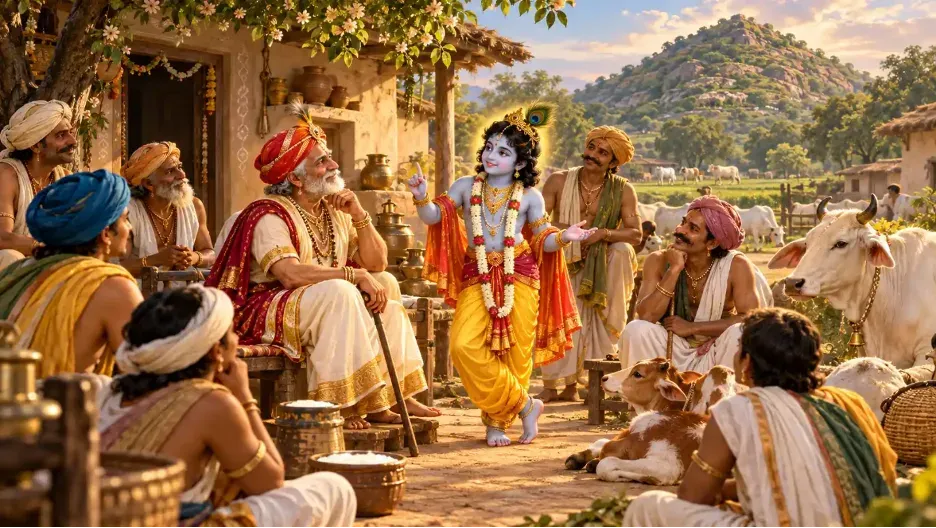
Krishna suggested that the villagers redirect their celebration toward Govardhan Hill, the cows, and the brahmanas. Instead of continuing a ceremony simply through habit or fear, He encouraged them to honor the blessings directly sustaining their lives. The residents gladly followed His guidance, preparing offerings, decorating their cows, serving others, and circumambulating Govardhan in a joyful procession.
In the devotional tradition, Govardhan is not merely a picturesque mountain. Revered as Giriraj Maharaj, he is beloved for providing an exquisite setting for Krishna's pastimes and serving the Lord with every grove, pond, and pathway. Krishna also manifested a magnificent form associated with Govardhan and accepted the offerings, revealing the sacred significance of their worship.
The deeper lesson is not that rainfall, or its celestial administrator lacks importance. Gratitude toward nature reaches spiritual fulfillment when it awakens remembrance of the Supreme Source. Krishna was teaching Braja vasis to see beyond immediate instruments of provision and recognize the loving presence underlying creation.
The Wrath of Indra: The Devastating Storm and the Sudden Crisis Facing the Residents of Vrindavan
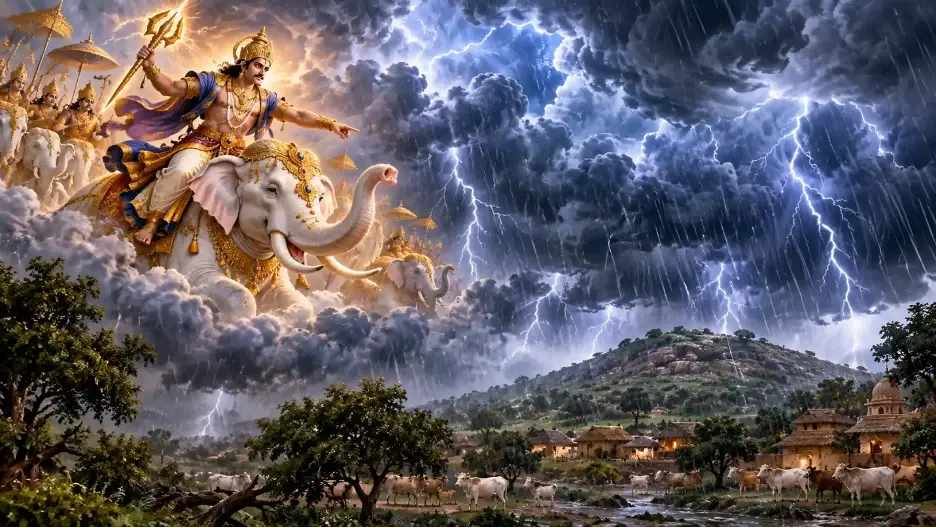
When Indra discovered that the annual sacrifice had been discontinued, his pride erupted. He interpreted the villagers' decision as disregard for his authority and ordered formidable clouds to unleash destructive rain upon Braja. The sky darkened, thunder roared, and violent torrents flooded the countryside. Cows shivered, children cried, and families struggled to protect themselves.
In their distress, the residents turned instinctively toward Shree Krishna. They did not first calculate whether a young boy could physically stop a storm. They sought the one whose presence was the center of their lives.
Indra's anger reveals how easily responsibility can become pride. A gift or position entrusted for service may gradually be mistaken for personal ownership. Yet Krishna would transform the storm into an opportunity to reveal divine protection and correct Indra's illusion. The seeming triumph of power would become a lesson in humility.
Cultivating True Gratitude (Kritajnata)
Moving Beyond Transactional Worship: Shifting from Fear-Based Appeasement to Heart-Centered Appreciation
We pray for success, security, good health, or favorable circumstances, and may feel satisfied when those wishes are fulfilled. When life moves differently, however, disappointment can weaken our remembrance of God. The Govardhan pastime invites us beyond this transactional relationship into a more generous way of loving.
The grass feeding their cows, the waters refreshing their land, and the community supporting their families were blessings worthy of acknowledgment. Appreciation could become an expression of love rather than merely a strategy for securing the next season's rain.
True gratitude does not forbid us from asking for help. Instead of treating the Lord as a distant distributor of desired outcomes, we approach Him as our eternal well-wisher. We begin to thank Him for visible gifts and for the wisdom, patience, and growth that may emerge from difficult experiences.
It frees the heart from constantly measuring divine kindness against personal preferences. Prayer becomes not only an appeal for blessings but also an offering of affection. A thankful heart discovers that loving Krishna is itself a blessing greater than any temporary reward.
Recognizing the Unseen Providers: Seeing Krishna’s Hand Behind the Natural Resources, Food, and Shelter We Receive Daily
Consider an ordinary meal. Before its ingredients arrive upon our plate, the earth must nourish seeds, the sun must provide energy, rainfall must replenish the fields, and many people must contribute their labor. Even advanced technology cannot eliminate our dependence upon the foundational conditions of life.
Govardhan Puja encourages us to perceive these everyday gifts with spiritual awareness. A tree offering shade, a river supporting communities, or a cow providing nourishment can remind us of the generosity sustaining creation. It recognizes them as precious parts of a world ultimately upheld by the Lord.
Awareness of these unseen providers also deepens ethical responsibility. When food is understood as a gift, waste becomes harder to justify. When nature is approached with reverence, conservation and compassion become extensions of worship.
We may express such gratitude through modest actions: thanking those who prepare our meals, avoiding unnecessary waste, helping a neighbor, or caring thoughtfully for animals and the environment. The heart that remembers Krishna in the temple learns to recognize His gifts throughout daily life.
The Offering of Annakut: How the Mountain of Food Symbolizes Returning Everything Back to the Source with a Thankful Heart
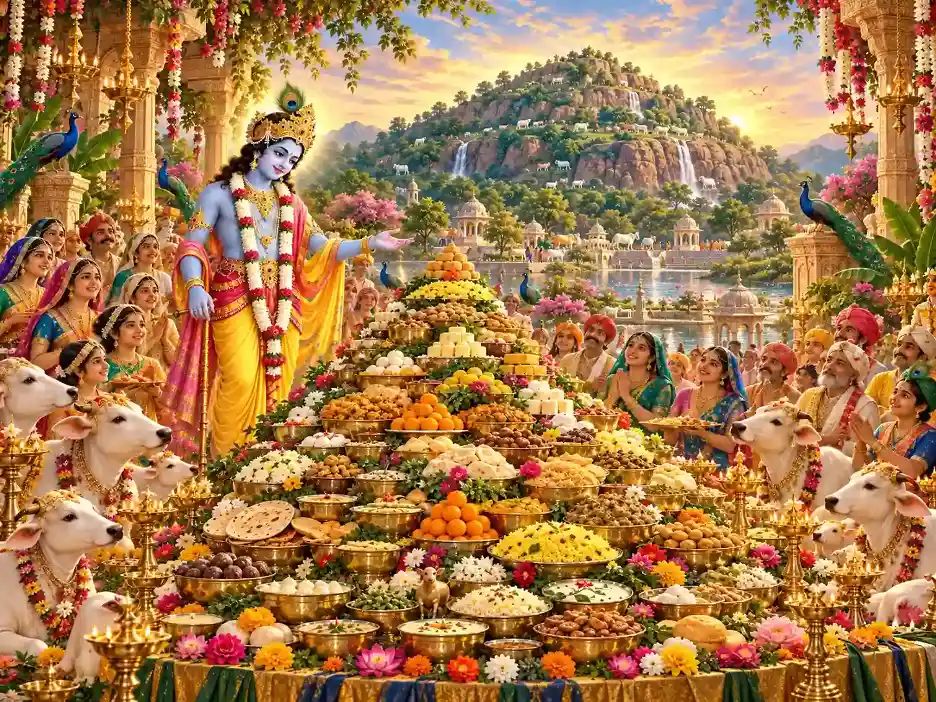
One of the most beautiful features of Govardhan Puja is Annakut, the ceremonial mountain of food lovingly prepared for Shree Krishna. Its abundance recalls the feast prepared by the residents of Braja and celebrates the nourishing generosity of the Divine.
Annakut, however, is not a display intended to impress God with material wealth. Its deepest meaning lies in offering back what has already come through His grace. The ingredients, the hands preparing them, the intelligence guiding the work, and the opportunity to serve are all gifts.
In the Bhagavad Gita, Krishna teaches that even a leaf, flower, fruit, or water is accepted when offered with devotion. The sincerity behind an offering matter more than its quantity. A modest meal prepared with loving remembrance carries profound value.
After being offered, food is received as prasad and shared with others. The festival teaches us that blessings are not merely possessions to accumulate. They are opportunities to honor the Lord, nourish our communities, and experience the joy of giving.
The Dynamics of Surrender (Sharanagati)
Stepping Out of the Storm: Recognizing Our Limitations When Material Miseries and Storms Overwhelm Us
The thunderstorm over Vrindavan is also an image of the uncertainties that enter every human life. A sudden illness, unexpected loss, family difficulty, or professional setback may overturn carefully made plans. The residents of Braja faced precisely such a moment when their familiar resources could no longer protect them.
Their decision to seek Krishna expresses the essence of sharanagati, spiritual surrender. Surrender begins with the recognition that we are not independent masters of every outcome. Our intelligence and effort matter, but they cannot guarantee permanent security. It can open the heart to a deeper source of strength.
Yet trusting Krishna does not mean refusing medical care, neglecting responsibilities, or abandoning practical judgment. It means acting with sincerity while releasing the anxious insistence that everything must unfold according to our expectations. We fulfill our duties and remember that results arise through many forces beyond our command.
It allows us to acknowledge fear without becoming its prisoner. We continue walking through life's storms, supported by prayer, wise action, and confidence in the Lord's compassionate guidance.
The Shelter of the Lifting: How the Lifting of Govardhan Hill Represents Krishna Offering a Sanctuary to Those Who Seek Him
Seeing the suffering of His beloved devotees, Krishna lifted Govardhan Hill effortlessly upon the little finger of His left hand. He invited everyone beneath it, including their families, cows, and belongings. The immense mountain became a protective umbrella, while the Lord stood at its center with serene grace.
Krishna's compassion is not distant or impersonal. He responds to the distress of those who seek His shelter, revealing protection through an intimate relationship of love. The residents discovered safety not because the storm ceased immediately, but because they were together with Him beneath Govardhan.
We may not always receive an immediate change in external circumstances, yet prayer, meditation, and remembrance can create a sanctuary of spiritual perspective. A mind anchored in Krishna becomes better able to respond thoughtfully rather than react only through fear.
Divine protection should not be reduced to a promise that devotees will never suffer. The lasting promise of devotion lies in the meaningful relationship that accompanies us through uncertainty. Beneath Govardhan, we learn that true refuge is found in Krishna's loving presence.
Renouncing False Ego: Learning from Indra's Pride and Ultimate Purification Through Acknowledging the Supreme Will
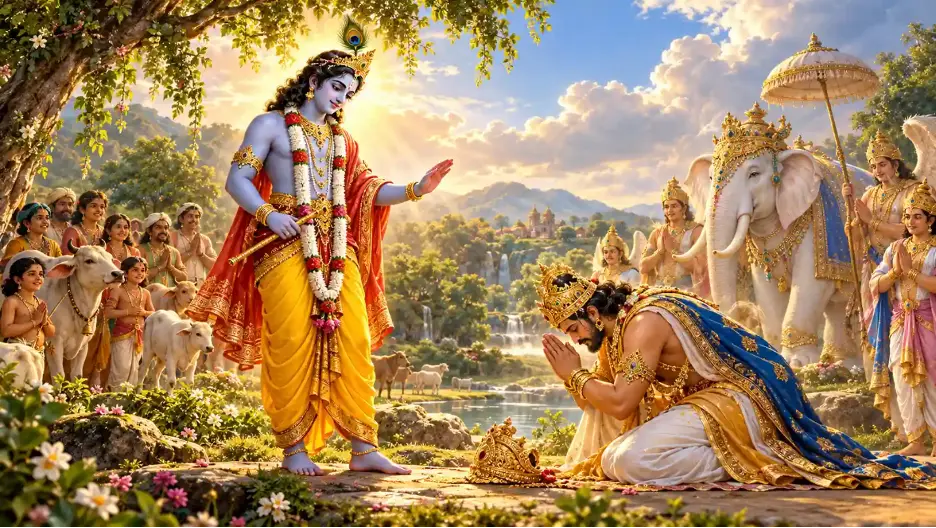
Indra's storm arose from injured pride. Entrusted with an important celestial responsibility, he had begun to mistake his delegated authority for independent greatness. The villagers' choice felt like a personal insult, and his anger harmed the very community he was meant to support.
When Indra witnessed Krishna holding Govardhan, he recognized the limits of his power. His arrogance gave way to remorse, and he approached the Lord with prayers of humility. The pastime therefore offers not only a warning against pride but also a hopeful vision of correction and renewal.
We encounter smaller versions of Indra's struggle whenever recognition becomes more important than responsibility. These reactions often reveal a hidden belief that our talents and achievements belong to us alone.
Humility does not require denying genuine abilities. Knowledge can guide others, resources can relieve suffering, and influence can become an instrument of compassion. When we remember that our capacities are gifts entrusted for service, success becomes an occasion for gratitude rather than superiority. Indra's repentance reminds us that acknowledging mistakes can be a doorway to spiritual growth.
Deepening Loving Dependence (Bhakti)
Seven Days Under the Mountain: The Intimate Association Where the Vrajavasis Did Nothing but Gaze at and Love Krishna
For seven days and nights, Krishna supported Govardhan while the residents remained safely beneath it. Inside, the villagers enjoyed the extraordinary blessing of remaining close to their beloved Lord. The event was not merely a suspension of danger. It became a celebration of divine intimacy.
In ordinary life, the residents of Braja attended to different duties. Cowherd boys accompanied Krishna into the forest, elders tended their households, and families cared for their animals. Their attention rested upon His radiant face, His gentle assurance, and the astonishing ease with which He supported the mountain.
The sweetness of this scene arises from the distinctive love of Braja. Krishna was not simply a majestic ruler whom the villagers admired from a distance. He was their cherished child, companion, friend, and very life. Even His astonishing miracle could not erase the tenderness of their relationship.
The greatest gift is not always the removal of inconvenience or the arrival of prosperity. Sometimes it is a deeper awareness of Krishna, made possible through circumstances we would never have chosen. The residents found, beneath a mountain during a storm, the incomparable joy of His company.
Pure Dependence Without Anxiety: How Complete Reliance on the Lord Transforms Fear into a Deeper, Sweeter Relationship
At the beginning of the storm, fear naturally filled the hearts of the villagers. Once gathered around Krishna, however, their attention found a new center. Their security no longer depended upon the changing sky but upon the one holding Govardhan.
Human beings seek stability through savings, relationships, status, and careful planning. If our peace depends entirely upon their permanence, anxiety follows us even during moments of success. Bhakti offers a deeper foundation by directing the heart toward the eternal Lord.
This does not mean a devotee becomes incapable of sadness or worry. Loving dependence means learning to return, repeatedly and sincerely, to remembrance of Krishna. We seek help when needed, make wise decisions, and cultivate trust without demanding perfect certainty.
The Brajavasis demonstrates a particularly sweet form of this dependence. They did not relate to Krishna as strangers petitioning a powerful official. Their example encourages us to develop devotion through closeness, affection, and daily remembrance. Faith matures when reliance upon Krishna becomes not merely an emergency response but the natural language of the heart.
The Little Finger Principle: Understanding That While Krishna Does the Heavy Lifting, He Invites Us to Cooperate with Our Small Efforts
A beloved devotional retelling pictures the cowherd boys placing their sticks beneath Govardhan, eager to help Krishna support the mountain. Although the Bhagavatam emphasizes the Lord's effortless strength, the image of their small contributions conveys a charming lesson about loving service.
We may offer a meal, encourage someone facing hardship, teach a child, volunteer at a temple, or spend a few quiet minutes in prayer. Compared with the vastness of creation, these gestures may appear insignificant. Yet Krishna gives us opportunities to serve, and devotion transforms ordinary actions into offerings of love.
We should never assume that spiritual trust excuses laziness, nor should we believe that every accomplishment depends entirely upon us. We contribute our best effort, seek wisdom, and remain grateful for assistance beyond our control.
The joy lies not in proving that our sticks hold up the mountain, but in being allowed to stand beside the Lord in loving cooperation. When service becomes our motivation, even small duties acquire dignity.
Practical Application for Modern Seekers
Lifting Our Personal Govardhans: Applying the Lessons of Patience and Faith to Our Daily Modern Struggles
For some, the burden is financial pressure or professional uncertainty. For others, it is grief, family conflict, loneliness, or an unresolved decision. The Govardhan pastime does not invite us to deny these challenges. It teaches us to approach them with effort, patience, and a heart directed toward Krishna.
When circumstances become overwhelming, we can begin by separating what requires our action from what lies beyond our control. Alongside this practical response, prayer offers a way to entrust our worries to the Lord.
The residents remained beneath Govardhan throughout the storm; protection did not require the rain to disappear at once. Likewise, faith may deepen during a prolonged season of uncertainty. Through remembrance, we gradually learn that our value and spiritual purpose are not determined by temporary success or failure.
Krishna's lifted mountain becomes a reminder that we need not carry life's burdens through isolated self-reliance. We are invited to act sincerely, receive support graciously, and place our ultimate trust in His wisdom.
Living a Life of Thankfulness: Practical Ways to Cultivate Daily Gratitude Through the Lens of the Govardhan Pastime
A morning moment of prayer allows us to acknowledge the gift of life before responsibilities take hold. Offering food to Krishna before eating turns nourishment into remembrance. Thanking those who help us brings humility into relationships and makes appreciation visible.
Avoiding waste, caring for animals, conserving resources, and sharing what we possess honor the network of blessings celebrated in Baja. Such acts may be modest, but they gradually reshape the character of the heart.
Before resting, we might recall three moments of kindness, beauty, or grace experienced during the day. Exercise does not erase suffering or require artificial optimism. It gently widens our attention so that hardship does not eclipse every gift.
It develops into a spiritual habit through which we recognize Krishna's generosity in ordinary circumstances. The festival's mountain of food then becomes an enduring invitation to turn everything received into an opportunity for loving service.
Finding Our Shelter: Developing a Consciousness That Relies on Spiritual Anchoring Over Material Security
Education, work, savings, and supportive relationships help us navigate daily responsibilities. When we expect temporary arrangements to provide permanent peace, we place upon them a burden they cannot bear. Govardhan Puja encourages us to care responsibly for material needs while establishing our deepest security in our relationship with Krishna.
This inward shelter grows through consistent spiritual practice. Chanting the divine names, studying sacred teachings, meditating upon Krishna, joining satsang, and performing selfless service gradually anchor the mind in remembrance. They help us respond to life's changing circumstances with steadier judgment and a more compassionate heart.
Eventually, devotion need not remain confined to designated moments of worship. Work becomes an opportunity for integrity, family life becomes an occasion for service, and success becomes a reason for gratitude.
The shelter of Govardhan is therefore both a sacred historical pastime and a continuing invitation. We can remember that worldly circumstances change, while our deepest spiritual relationship offers a lasting source of meaning and love.
Conclusion: Living Beneath the Shelter of Divine Love
Govardhan Puja begins with a village preparing an annual sacrifice and culminates in a breathtaking revelation of Krishna's compassion. Gratitude awakens as the residents honor the gifts sustaining their lives. Humility emerges through Indra's repentance, while the loving exchanges beneath the mountain reveal the sweetness of bhakti.
Gratitude softens entitlement, humility weakens pride, and surrender frees the heart from the exhausting need to command every outcome. Loving dependence then becomes a joyful relationship rather than a desperate response to danger. The devote does not cease acting, planning, or caring. Instead, every effort becomes an offering supported by remembrance of the Lord.
As we celebrate Annakut and remember Giriraj Maharaj, may we recognize the countless gifts surrounding us. May we offer our small sticks of sincere service without imagining that we alone support the mountain. And whenever life's storms gather, may our hearts turn with confidence toward Shree Krishna, whose shelter is not merely a place of safety, but the eternal home of divine love.
Jai Shree Krishna! Jai Giriraj Maharaj!
Call To Action
Celebrate Govardhan Puja: Experience the Joy of Gratitude, Surrender & Divine Love
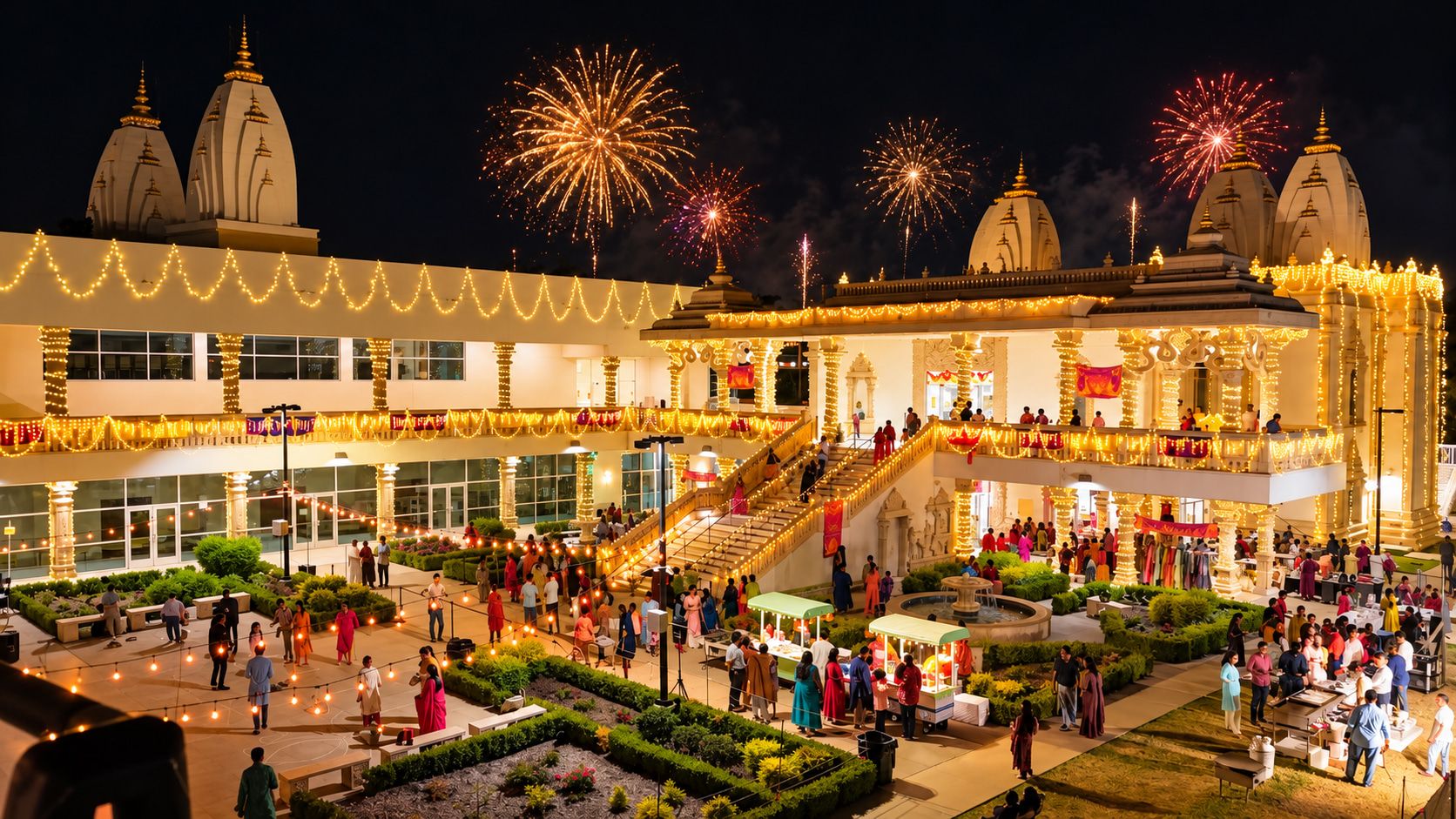
This Govardhan Puja, deepen your devotion to Shree Krishna and experience the blessings of His divine shelter. Join us at the Radha Krishna Temple of Dallas for a spiritually uplifting Govardhan Puja and Annakut celebration, filled with heartfelt devotion, sacred offerings, and the joy of coming together as one spiritual family.
Offer your gratitude to Giriraj Maharaj, strengthen your faith, and discover the sweetness of loving dependence on Shree Krishna.
🙏 Celebrate with Us and Seek the Divine Blessings of Giriraj Maharaj!
FAQs
1. Why is Govardhan Puja celebrated?
Govardhan Puja celebrates the divine pastime of Shree Krishna lifting Govardhan Hill to protect the residents of Vrindavan from Indra's devastating storm. It teaches gratitude, humility, surrender, and unwavering faith in Krishna's protection.
2. What is the spiritual significance of Govardhan Puja?
Govardhan Puja reminds devotees that Shree Krishna is the ultimate source of all blessings. The festival inspires us to cultivate gratitude, overcome false ego, and develop loving dependence upon the Supreme Lord.
3. Why did Shree Krishna lift Govardhan Hill?
Shree Krishna lifted Govardhan Hill on His little finger to shelter the residents of Vrindavan from torrential rains unleashed by Indra. Through this divine act, He demonstrated His boundless compassion and the power of surrender.
4. What is Annakut, and why is it offered during Govardhan Puja?
Annakut means "mountain of food." Devotees prepare and offer various vegetarian dishes to Shree Krishna as an expression of gratitude for His blessings. The offerings are later shared as sacred prasad.
5. What can we learn from Govardhan Puja in daily life?
Govardhan Puja teaches us to practice gratitude, remain humble during success, trust Krishna during difficulties, and perform our duties with devotion. Its central message is to seek lasting peace through loving surrender to Shree Krishna.