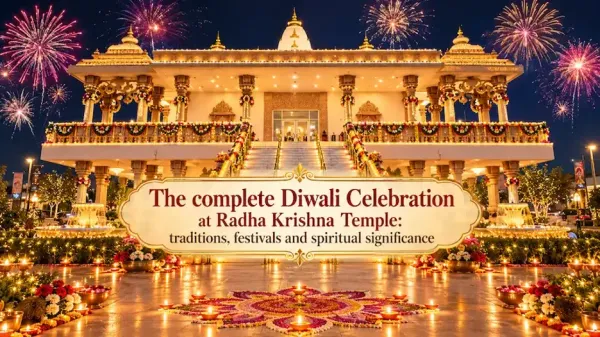
Close your eyes for a moment. Can you hear it?
It is the soft, rhythmic chime of Shree Radha Rani's golden anklets echoing through the groves of Vrindavan. It is the enchanting melody of a distant flute, calling out your name, reminding your soul of a love it has forgotten but has secretly pined for across lifetimes.
That flute has been calling since long before we were born, and every year in the holy month of Kartik it seems to come a little closer. This is the month of Damodar. Swami Mukundananda narrates how Mother Yashoda, exasperated by her little Lala's mischief, tried to tie him to a grinding mortar, yet however many ropes the sakhis joined together, the cord always fell two fingers short, for how could anyone bind the One within whom the whole universe resides? Then word reached Shree Radha, and she sent a single silken cord to Maiya, and with it the Lord whom the greatest yogis cannot hold with all their austerities was bound at last and became known forever as Damodar.
Diwali falls on the darkest night of this very month. On that night Ayodhya remembers the joy of welcoming Shree Ram home after fourteen years of waiting, while the heart of a rasik devotee wanders to the banks of the Yamuna, longing for a glimpse of the dark, flute-playing Shyamsundar who has captivated every soul in Braj.
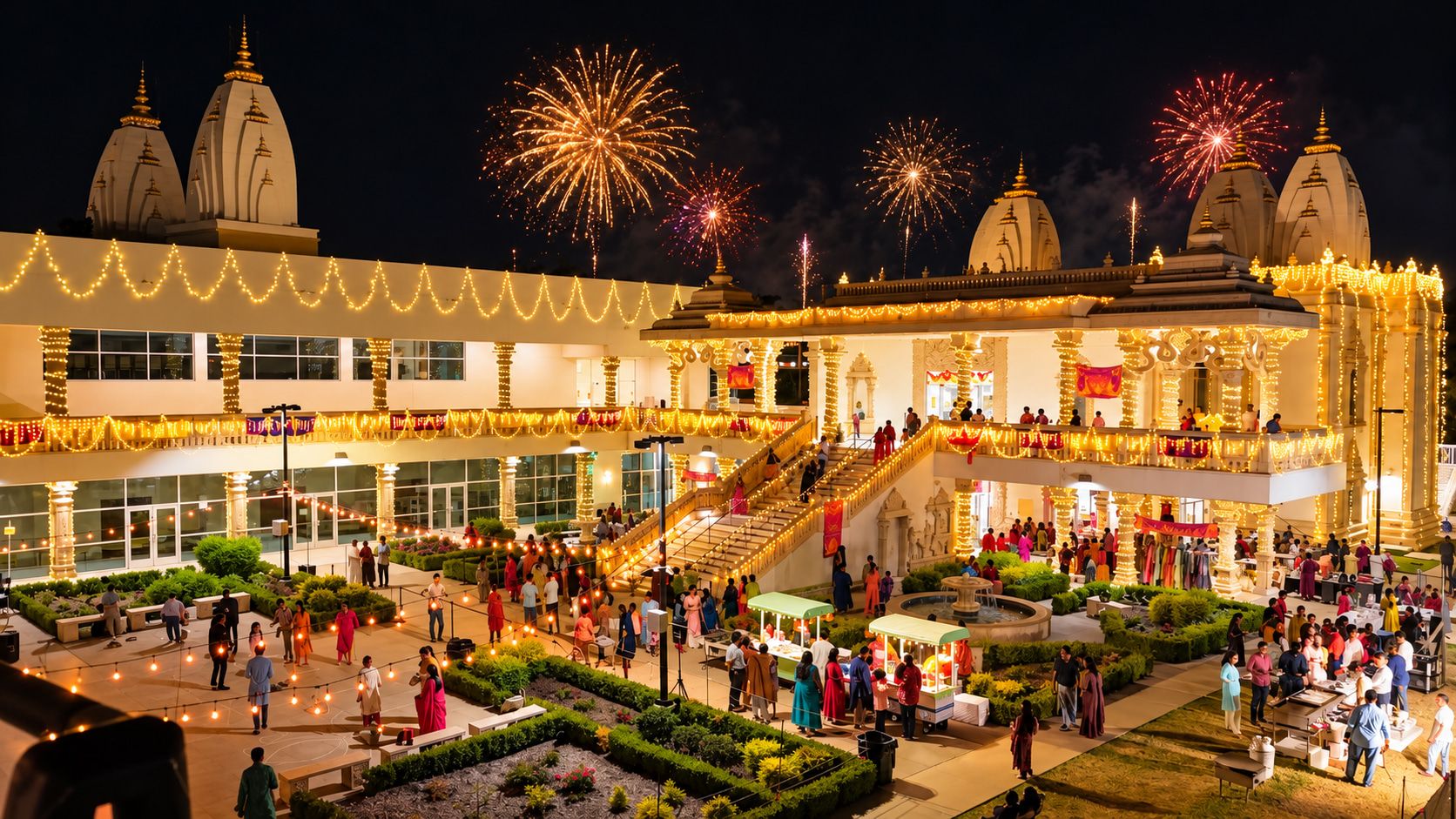
From November 5 to November 10, 2026, that ancient longing comes to the Radha Krishna Temple of Dallas in Allen, where 11,111 diyas will glow across the temple grounds and six sacred days, from Govatsa Dwadashi to Bhai Dooj, will draw us again and again toward Shree Radha Krishna. Under the loving guidance of Swami Mukundananda, these days become a pilgrimage of the heart, where the Divine Couple receive every offering, however small, and treasure every tear of longing shed for them. If your soul has been thirsty for a love that never changes and never abandons, perhaps it is Shree Radha Rani's grace, and not chance, that has drawn your heart toward her this Diwali.
The Inner Light of Diwali: Turning Back Toward the Beloved
Swami Mukundananda teaches that the soul is an eternal fragment of God, as Shree Krishna declares in the Bhagavad Gita, mamaivansho jiva-loke jiva-bhutah sanatanah (15.7), "the embodied souls in this material world are my eternal fragmental parts," and because we belong to him, our endless search for happiness through possessions, relationships and achievements can never be fully satisfied anywhere but in his love.
Swamiji teaches that when we stand with our backs to the light, all we can see is our own shadow stretching out before us, and in the same way, when the soul turns away from God, it sees only the darkness of material illusion. The darkness that Diwali dispels, then, is the forgetfulness of the One who has never once forgotten us, and the moment we turn our consciousness back toward God, the journey from darkness into light has already begun.
Swamiji does not ask us to give up the joy of the festival in order to find this inner light, for a festival, he says, must be fun for everyone. He encourages us to enjoy the sweets, the music and the gatherings fully while going deeper, letting each one nourish the spiritual life, so that cleaning the home becomes a reminder to clean the heart, and decorating the doorway becomes a prayer that the Lord will find it worthy of his welcome.
Govatsa Dwadashi, November 5: Remembering the Tender Love of Shree Krishna
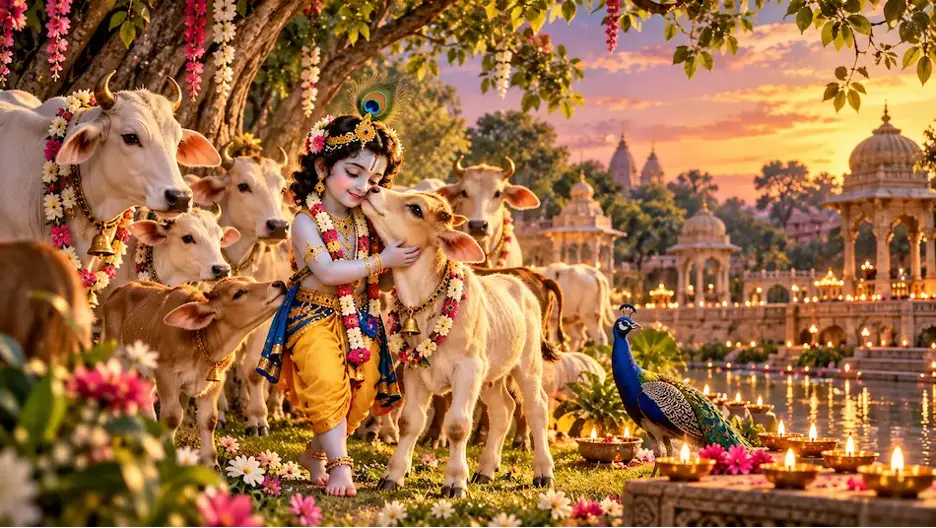
The journey begins in the affectionate mood of Braj, where every tree, cow and calf is precious because of Shree Krishna, and where the Lord of countless universes chose to be known simply as Gopal, the little cowherd who ran through the pastures of Vrindavan with His friends and His beloved cows. Swamiji describes how, on the day Krishna first went out to herd the cows and earned the name Gopal, He walked barefoot, as the Vedic rule for cow-herding requires, across a Braj full of thorns and pebbles, for having descended as one of us, the Lord of all the universes chose to live exactly as a cowherd boy lives, and in that small detail we glimpse the tenderness of a God who allows Himself to be loved as a child, a friend and the very life of His devotees.
To honor the mother cow and her calf on Govatsa Dwadashi is to step directly into that childhood world, where love was expressed not in grand gestures but in the patient daily service of feeding, protecting and caring for those who depended on Him. The cow, who gives so much and asks so little, becomes a quiet teacher of the selfless giving at the root of devotion, and as the first fireworks of the festival rise over the temple after dark, it feels as though the whole celebration has been set in motion by that simple act of reverence and gratitude. The first offering of this journey may be nothing more than a quiet prayer: Gopal, make my heart gentle enough to recognize you in all that you have lovingly created.
Dhanteras, November 6: Discovering the Wealth That Never Diminishes
Dhanteras welcomes prayers for health, prosperity and auspiciousness, as devotees remember Lord Dhanvantari and seek the blessings of Goddess Lakshmi, and the temple's Lakshmi Pooja invites every family to pray for those they love. Worldly prosperity has its rightful place, yet Swamiji gently invites us to reconsider what we call wealth, and to seek the treasure that stays with the soul when everything gathered in this world must one day be returned.
In his discourse, Swamiji explains that when we approach God only to fulfill our worldly desires, the mind stays attached to those desires rather than to God Himself, and he recalls the devotion of five-year-old Prahlad, who, when Lord Narasimha offered him any boon, replied that if he asked for something he would become a businessman rather than a devotee, and when pressed, asked only for the boon that he should never ask for anything at all.
This is nishkam prem, the love that seeks the happiness of the Beloved rather than its own gain, and it is the wealth the gopis possessed in such abundance that the wise Uddhav prayed to be born as a humble shrub in Vrindavan, just to receive the dust of their feet. So, as we fold our hands before Mahalakshmi this Dhanteras, we may pray for the well-being of our loved ones and still let another prayer rise quietly beneath it: Shree Radha Krishna, teach me to love You not for what You may give me, but for the joy of loving and serving You.
The evening carries that joy into music as the Diwali Bhajan Clubbing Concert begins at 6:30 PM, filling the hall with soulful bhajans that draw young and old alike into kirtan, and anyone who has stood in a crowd with hands raised, singing the names of Shree Ram and Shree Krishna until the anxious sense of separateness begins to dissolve, will understand why Swamiji teaches that while meditation, yajna and deity worship were the paths of earlier ages, in this age of Kaliyug the path is Hari naam kirtan, as Tulsidas sings, kalijug kewal naam adhara, sumiri sumiri nara utarahin para, that in this age the Name is the only support, and by remembering it again and again, souls cross the ocean of material existence.
Choti Diwali, November 7: When 11,111 Diyas Become a Prayer
Choti Diwali, remembered also as Naraka Chaturdashi, recalls the day Shree Krishna, with Satyabhama at his side, destroyed the demon Narakasura and freed the thousands of princesses held captive in his fortress. Remembering this leela, we may recognize that the real Narakasura resides within us, in the anger, greed, envy and pride that hold our minds captive, and pray that through sincere effort and the grace of God and Guru they may gradually loosen their hold, just as the Lord once came for the princesses and set them free.
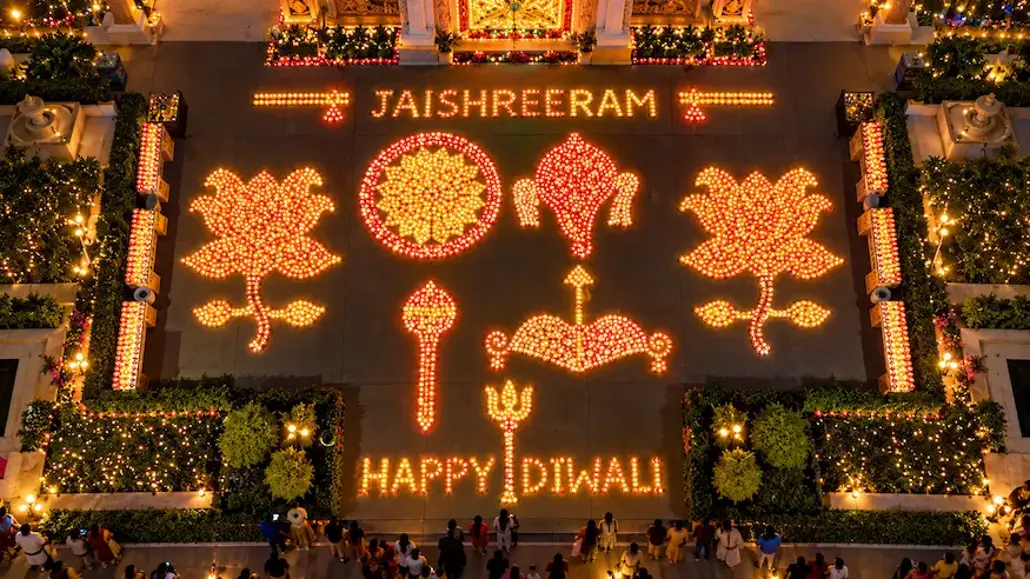
That night the community joins in the lighting of 11,111 diyas arranged in lotuses, the sacred Om and the words Happy Diwali, until the whole campus seems to float on a sea of small, steady flames beneath the night sky. Diyas can be sponsored for a dollar each, and the beauty of the offering lies precisely in its smallness, for the Lord does not measure a gift by its cost but by the love with which it is given. As Swamiji reminds us, "When we light diyas, we should also light the lamp of wisdom, compassion, and devotion in our souls."
He teaches that loving remembrance in the mind is the very soul of devotion, since our hands may offer worship and our lips may chant His names, but it is the mind that must draw close to Him. So, while lighting a diya, we might close our eyes once more and behold little Shyamsundar standing beneath a kadamba tree, His peacock feather swaying as He lifts the flute to His lips, or lovingly remember the compassionate glance of Shree Radha Rani, for this roop dhyan turns a lamp that will burn for only a few hours into a remembrance that can stay with us long after the festival has ended.
Earlier in the day, the Open Stage at 1:00 PM invites community members to sing, dance, play or recite, and the Diwali Leela brings Shree Ram's victory and return to Ayodhya to life on stage in costume, music and dance for the whole family.
Diwali, November 8: Welcoming Shree Ram Into the Temple of the Heart
Diwali begins at 10:30 AM with the Diwali Special Satsang with Swami Mukundananda, open to all. Swamiji has expressed the essence of the day in words the temple shares with every visitor: "Diwali is not just about external lights, but about lighting the lamp of knowledge within our hearts." Shree Krishna makes the same promise in the Gita (10.11), that dwelling within his devotees' hearts he destroys the darkness of ignorance with the shining lamp of knowledge, so the lamp we light outside becomes our prayer and the lamp he lights inside becomes his answer.
When Shree Ram returned to Ayodhya, the people did not light their lamps because they had been told to, for their love had carried them through fourteen years of viraha, the ache of separation, and could no longer stay hidden. Swamiji invites us to see our own lives in that homecoming, for just as Ayodhya was left barren without its Lord, we too have drifted from God in pursuit of worldly allurements, until the mind becomes riddled with attachment, desire, greed, anger and pride.
This Diwali, he says, let us celebrate by welcoming the Lord into our hearts and uniting our consciousness with him in a spirit of loving surrender, sharanagati. As we clean our homes, he asks whether we are also cleaning our hearts, searching out the corner where some grudge, impatience or intolerance has quietly gathered, so that the heart becomes a fit place for the Lord of the universe to reside. The evening's Lakshmi Ganesh Pooja and Diwali Maha Pooja, the festive Mahaprasad and the fireworks over the temple then become the celebrations of a city that has finally received its King, and the sweetest welcome we can offer Him is not a decorated doorway but a heart that longs to remember Him.
Govardhan Pooja and Annakoot, November 9: When the Lord Longs to Be Loved
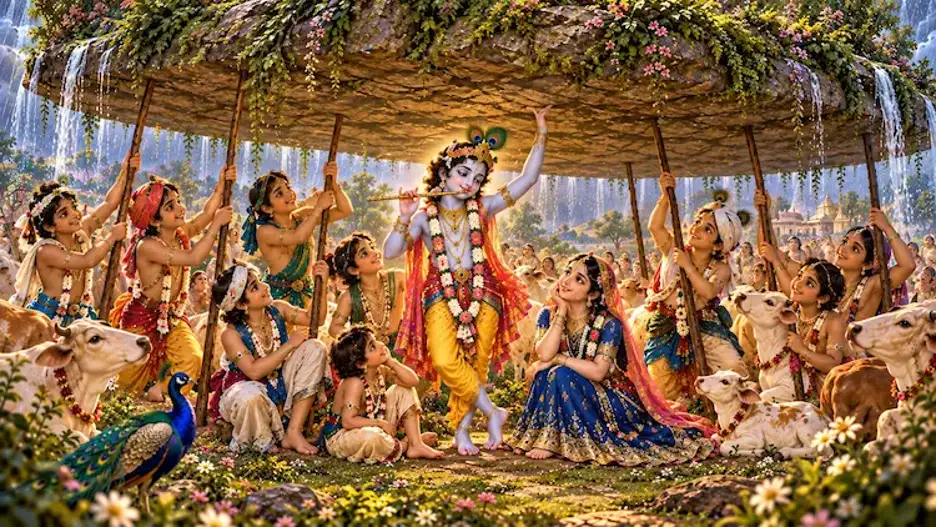
Swami Mukundananda narrates that the Brajwasis once worshipped Indra for the rain their fields depended on, but Krishna, knowing that devotion belongs to God alone, first won the children of Braj to His side and then persuaded the whole village to worship Govardhan Hill instead. They carried a vast variety of dishes to the hill, and as they offered them, Shree Krishna himself took the form of Giriraj and accepted every one.
Furious, Indra sent the mighty Samvartak clouds to drown Braj, and Krishna lifted Govardhan on the nail of the little finger of his left hand and held it aloft for seven days and nights. Some Brajwasis, who saw Him only as their friend and little child, pressed their own sticks against the hill, sure they were helping Him carry it, and when Shree Radha came and stood before Him, Krishna was so overcome with divine love that He trembled and the whole mountain shook, until Balram stepped between them and reminded his brother that this was no time for loving exchanges. Swamiji's own Guru adds a delightful sequel, for when the storm was over and the elders praised Krishna for saving Braj, the sakhas grumbled that they had held up the mountain with their sticks while He had only touched it with one finger, and yet he got the title Giridhari.
The sweetest moment, Swamiji tells us, came afterward. When Indra descended from his elephant Airavat and begged forgiveness, the cowherd boys looked at one another and thought that if the king of the devatas bows to our Kanha, He must be God, and the easy friendship with which they once threw their arms around His neck turned to hesitation and awe. Seeing this, Shree Krishna began to weep, and when His friends asked why, He told them they no longer looked at Him as their own. So, the sakhas held a little meeting and decided that someone must have spread false news, for He was not God but simply their friend, and the elders knew nothing at all, and soon they forgot the whole matter. The Lord whom Indra bows to wants nothing so much as to be loved without fear, and this is the sweetness of Braj that the rasik heart longs for.
The Annakoot at the temple, a magnificent mountain of dishes arranged before the deities alongside the New Year Archana and Aarti, continues the tradition the Brajwasis began that day, and Gita 9.26 assures us that the Lord accepts even a leaf, a flower, a fruit or a little water offered with devotion. As we behold it, a tender prayer may arise: Shyamsundar, let me love You with even a little of the simplicity of the Brajwasis, asking for nothing but the chance to bring You happiness.
Bhai Dooj, November 10: Bringing Divine Love Into Family Relationships
The sacred journey closes with Bhai Dooj, remembered through the story of Yamuna Devi lovingly welcoming her brother Yamraj to her home. For the rasik devotee there is a sweetness hidden here, because the same Yamuna flows through Vrindavan as the beloved river of Shree Krishna, on whose banks He played with the gopis and danced the Maharaas, so that even a festival of sibling love quietly carries the heart back to Braj.
As a sister prays for her brother and a brother remembers his promise to care for his sister, Bhai Dooj gently reminds us that love finds its beauty not in what we receive but in what we are willing to give. Swamiji teaches that we need not abandon our family responsibilities to grow spiritually, only change the consciousness with which we fulfill them, and when affection at home is offered in remembrance of God, the ordinary moments of family life become places to practice patience, kindness and selfless service.
A Glimpse of Braj in the Heart of Dallas
Throughout the festival, the temple grounds come alive with festive food, vendor booths and family activities, while volunteers quietly serve wherever they are needed. Swamiji teaches that whatever we do, whatever we eat and whatever we give can be offered as service to God, and that when we live this way every day becomes a Diwali, so helping someone find a seat or serving a meal with a smile becomes seva the moment it is done for his pleasure rather than our own recognition.
For families far from Vrindavan, this is what makes the temple so precious, for loving remembrance of God is not bound by geography. A grandmother may quietly remember the Diwali of her childhood while a young child discovers the joy of lighting a first diya, and an elderly devotee may find the greatest happiness simply sitting before the beautiful deities of Shree Radha Krishna, letting the mind rest on them while kirtan rises all around.
Let the Light of Diwali Become the Light of Divine Love
When the diyas fade, the fulfillment of this sacred journey lies in what we carry home in our hearts. Govatsa Dwadashi shows us the tenderness of Shree Krishna's love, Dhanteras teaches us which wealth to seek, Choti Diwali asks us to call on him against our inner enemies, Diwali invites us to turn back toward the light and prepare the heart as his home, Govardhan reveals how dearly he longs to be loved without fear, and Bhai Dooj lets that love shine through the relationships entrusted to our care.
So this year, perhaps our prayer before Shree Radha Krishna can be a little different. Instead of asking for more possessions or the fulfillment of another worldly desire, we may ask for a heart that remembers them more often, and for the chance to love them a little more for their happiness and a little less for our own. Then, when the final aarti has ended and the last diya has flickered into darkness, the little lamp of devotion within may go on glowing, until the soul, like Ayodhya on that darkest night, is finally ready to welcome its eternal Beloved home.
Whether you have celebrated Diwali at the Radha Krishna Temple of Dallas for many years or will be walking through its doors for the first time, may these sacred days give you a little rest from the rush of life, a little more remembrance of Shree Radha Krishna, and the joy of celebrating among those who share that love.
Radhey Radhey! Shubh Deepawali!
Major Events and Spiritual Highlights of Diwali Mahotsav 2026
The Radha Krishna Temple of Dallas in Allen, Texas, celebrates Diwali Mahotsav 2026 with evening programs from 6:00 to 9:00 PM Central Time, November 5 to 9, and Bhai Dooj on November 10.
| Date | Sacred Celebration | Spiritual Significance |
|---|---|---|
| October 30 | Kids Workshop | Introducing children to Diwali through crafts, stories and festive activities |
| October 31 | Family Day | Bringing generations together in shared festive joy |
| November 5 | Govatsa Dwadashi | Remembering Shree Krishna's tender love for the cows and calves of Braj |
| November 6 | Dhanteras, Lakshmi Pooja and Bhajan Clubbing Concert (6:30 PM) | Seeking the wealth of selfless love that never diminishes |
| November 7 | Choti Diwali, 11,111 Diya Lighting, Open Stage (1:00 PM) and Diwali Leela | Lighting the lamp of loving remembrance within the mind |
| November 8 | Diwali Special Satsang with Swami Mukundananda (10:30 AM), Diwali Poojas and Mahaprasad | Welcoming Shree Ram into the heart |
| November 9 | Govardhan Pooja, Annakoot and New Year Archana | Celebrating the intimate love between Shree Krishna and the Brajwasis |
| November 10 | Bhai Dooj | Honoring the sacred bond between siblings |
Fireworks light the sky over the temple after dark on November 5, 6, 7 and 8, and the food festival, vendor booths and family activities continue throughout. For registration, diya seva, sponsorships and the latest schedule, visit:

Frequently Asked Questions About Diwali Mahotsav 2026
1. When and where is Diwali Mahotsav 2026?
Diwali Mahotsav 2026 takes place at the Radha Krishna Temple of Dallas in Allen, Texas, with evening celebrations from November 5 to November 9 and Bhai Dooj on November 10.
2. What is the spiritual significance of lighting 11,111 diyas?
The diyas symbolize the victory of light over darkness, and in Swami Mukundananda's teaching each one can become a moment of loving remembrance, turning the mind back toward God and kindling devotion to Shree Radha Krishna.
3. Why are Govardhan Pooja and Annakoot so meaningful?
They remember how Shree Krishna lifted Govardhan Hill to shelter the residents of Braj and how dearly he cherished their simple, fearless love, and the Annakoot offering of countless dishes expresses the devotee's wish to offer everything for the Lord's happiness.
4. Is the festival suitable for families, children and newcomers?
Yes, the temple welcomes people of every age and background, and families can enjoy the Kids Workshop, Diwali crafts, the Diwali Leela, open stage performances, the food festival and city-approved sparklers, although no outside fireworks are allowed for everyone's safety.
5. How can I participate or offer seva?
You can register online, attend the poojas and Swamiji's satsang, sponsor diyas, book a pooja or Mahaprasad seva, or volunteer for teams such as parking, food service, decoration and welcome, with questions directed to [email protected].