
Introduction: 24,000 Miles. 64 Days. Advanced Cancer.
Twenty-four thousand miles.
Sixty-four days.
Alone at sea.
And he won.
In January 2025, French sailor Charlie Dalin crossed the finish line of the Vendée Globe, one of the most punishing sporting events on Earth: a nonstop, solo sailing race around the world, completed without outside assistance.
He did it in record time.
What the world did not yet know was that Dalin had been racing while living with a gastrointestinal stromal tumor and undergoing treatment for cancer. He had been diagnosed in 2023, continued training, and ultimately sailed around the planet while managing both the brutal demands of offshore racing and the effects of his illness.
Later, when speaking about those weeks at sea, Dalin said something surprisingly simple:
“I was happy at sea.”
The ocean did not cure him.
The race did not erase his cancer.
And it would be deeply misleading to suggest that purpose somehow made illness disappear. Dalin competed with medical guidance, and after the race his health challenges continued.
But his story raises a profound question.
What enables a human being to keep moving toward something meaningful when life becomes extraordinarily difficult?
What allows us to endure discomfort, uncertainty, fatigue, or fear without losing our sense of direction?
Psychology has a word for part of the answer:
Purpose.
And the Science of Purpose suggests that having a deeply felt “why” may affect not only what we pursue, but how we meet the inevitable difficulties along the way.
What Is the Science of Purpose?
Psychologists generally describe purpose in life as a sense that our lives have direction, meaningful goals, and something worthwhile toward which we are moving.
Purpose is more than having a busy calendar.
It is more than achievement.
It is even more than setting goals.
A goal answers:
“What do I want to accomplish?”
Purpose asks:
“Why does this matter?”
That distinction becomes especially important when circumstances become difficult.
Your Tidbit captures it beautifully:
Purpose does not necessarily change what we have to endure.
It may profoundly change how we meet it.
That may be one of the most important insights within the Science of Purpose.
Purpose does not guarantee an easier life.
It gives effort a direction.
Why Does Having a “Why” Matter?
Research has increasingly linked a stronger sense of purpose with a range of positive psychological and physical outcomes.
People who report greater purpose also tend to report:
- lower perceived stress,
- healthier behaviors,
- stronger psychological well-being,
- better physical health,
- and greater resilience during adversity.
A large individual-participant meta-analysis involving more than 108,000 people found that greater purpose in life was associated with lower subjective stress across a diverse range of populations. Importantly, the researchers described the findings as associational, not proof that purpose itself directly causes lower stress.
That distinction matters.
The Science of Purpose is not telling us:
“Find your purpose and nothing bad will happen.”
It is telling us something much more realistic—and perhaps much more useful.
A sense of purpose may help organize our inner lives around what matters.
When we know why something matters, effort feels different.
Sacrifice feels different.
Even adversity can feel different.
Purpose Organizes Attention
Imagine two people doing exactly the same difficult task.
One believes the task is meaningless.
The other believes it serves something deeply important.
Their physical actions may look identical from the outside.
Their internal experience may be completely different.
Purpose gives the mind a center of gravity.
It can help organize:
attention • choices • effort • resilience
around something we believe is worthy of pursuit.
That does not mean we suddenly become endlessly motivated.
Human beings still become tired.
We procrastinate.
We doubt ourselves.
We sometimes wonder whether continuing is worth it.
But when the inevitable question arises—
“Why keep going?”
—a deeply rooted purpose gives us something to answer with.
The Science of Purpose and Longevity
One of the most striking recent findings comes from a 2026 meta-analysis examining purpose in life and mortality.
Researchers analyzed 25 samples representing 488,765 people, with nearly 49,000 deaths recorded during follow-up periods extending as long as 32 years.
Across those studies, greater purpose in life was associated with a substantially lower risk of earlier mortality. Even after accounting for behavioral, clinical, and psychological factors, an association remained.
Again, we should interpret this carefully.
Purpose is not medicine.
Purpose does not make anyone invulnerable to illness.
Purpose cannot guarantee longevity.
The researchers themselves examined associations, and many factors may contribute to the connection.
People with greater purpose may be more likely to exercise, pursue preventive healthcare, regulate stress more effectively, maintain relationships, or engage in other behaviors that support health.
So perhaps the most responsible conclusion from the Science of Purpose is not:
Purpose makes us live longer.
It is:
How we understand the meaning and direction of our lives appears to be deeply connected with how we live them.
Charlie Dalin: Purpose Did Not Remove the Storm
That brings us back to Charlie Dalin.
His story would become less meaningful if we turned it into a simplistic tale about positive thinking overcoming disease.
That is not what happened.
He was sick.
Treatment was difficult.
The Vendée Globe itself placed extraordinary demands on his body.
And his cancer did not disappear because he had something meaningful to pursue.
But during the race, sailing gave him something precious.
Normality.
Identity.
Direction.
For a time, he could again inhabit the life he knew and loved.
He described feeling happy at sea, even saying that the race allowed him to feel as though he had gotten his old life back.
Perhaps that is why his story belongs so naturally in a conversation about the Science of Purpose.
Purpose does not always change the storm.
Sometimes it changes the sailor.
When Psychology Ends, Spirituality Asks Another Question
Psychology can help us understand why purpose matters.
But spirituality asks something even deeper:
What is worthy of becoming our purpose?
We can organize our lives around many things.
Comfort.
Achievement.
Possessions.
Recognition.
Status.
Family.
Career.
Creative expression.
Contribution.
Many of these can be beautiful and worthwhile.
But Swami Mukundananda invites us to ask whether this rare human life holds an even higher possibility.
We possess an extraordinary capacity for self-reflection.
We can examine our own thoughts.
Question our habits.
Choose between immediate pleasure and long-term meaning.
Ask why we exist.
Ask who we truly are.
Ask what, if anything, lies beyond the material life we can see.
As Swamiji explains in his teachings on the goal of life, the human form gives us the unique capacity to consciously decide our life’s purpose and seek the ultimate truth.
The question therefore changes.
Instead of simply asking:
“What do I want from life?”
we begin asking:
“What is my life for?”
That is a very different question.
Swami Mukundananda’s Wisdom: The Higher Purpose of Life
From the Bhakti perspective, our intelligence has not been given merely to help us survive more comfortably or accumulate more successfully.
Human life offers us the opportunity to rediscover our spiritual nature and our eternal relationship with God.
Swamiji’s teachings repeatedly return to this central movement:
Know God.
Love God.
Serve God.
Realize our true self.
In The Art & Science of Happiness, Swamiji describes service as an ultimate attitude toward life and explains that our nature as souls is fulfilled through loving service to God.
This gives the Science of Purpose a spiritual destination.
Science tells us that purpose matters.
Bhakti asks us to orient that power toward what is highest.
Bhagavad Gita: When Our Work Becomes Worship
The Bhagavad Gita offers a beautiful verse that connects work, purpose, and devotion.

यत: प्रवृत्तिर्भूतानां येन सर्वमिदं ततम् ।
स्वकर्मणा तमभ्यर्च्य सिद्धिं विन्दति मानव: ॥ 46॥
yataḥ pravṛittir bhūtānāṁ yena sarvam idaṁ tatam
sva-karmaṇā tam abhyarchya siddhiṁ vindati mānavaḥ
BG 18.46: By performing one’s natural occupation, one worships the Creator from whom all living entities have come into being, and by whom the whole universe is pervaded. By such performance of work, a person easily attains perfection.
Swamiji’s commentary adds a beautiful dimension: when our duties are performed in devotional consciousness, our work itself can become worship.
That transforms purpose.
Our career need not compete with spiritual life.
Our family responsibilities need not be spiritually irrelevant.
Our talents need not exist only for personal achievement.
When offered in the right consciousness, the ordinary terrain of life itself can become part of our journey toward God.
Purpose Does Not Promise an Easier Path
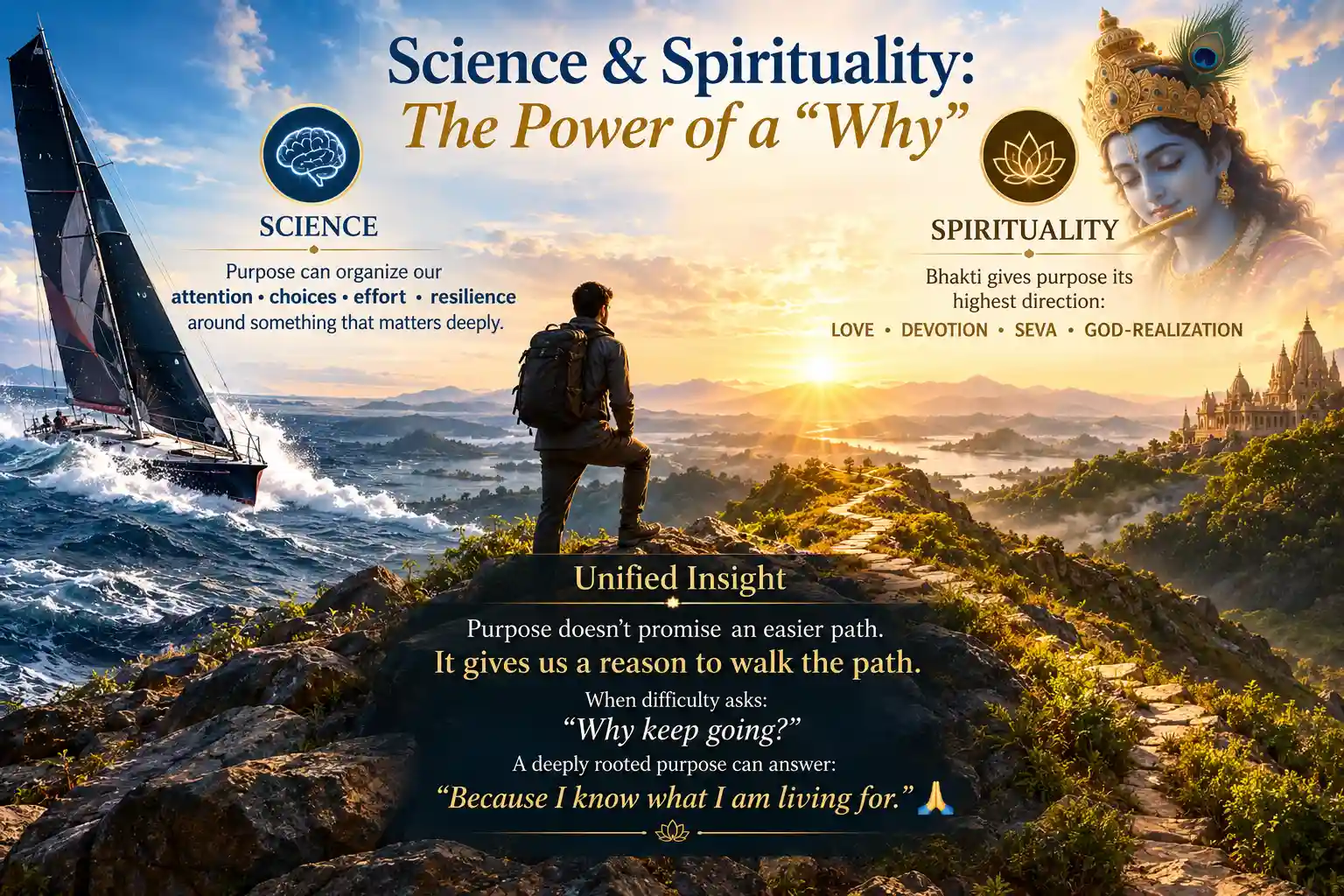
There is an important danger in conversations about purpose.
We can accidentally make purpose sound like a secret formula for avoiding pain.
It is not.
A meaningful life still contains:
- illness,
- loss,
- disappointment,
- uncertainty,
- fatigue,
- rejection,
- and grief.
Devotion does not exempt us from difficulty.
Purpose does not remove every obstacle.
Sometimes the road becomes harder precisely because what we are pursuing matters so deeply.
That is why the central insight of this Tidbit is worth sitting with:
Purpose doesn’t promise an easier path.
It gives us a reason to walk the path.
That may be the essence of the Science of Purpose.
Purpose is not an escape from difficulty.
It is an answer to difficulty.
What Happens When Meaning Changes Suffering?
There is a subtle but profound difference between pain that feels meaningless and pain that belongs to something we deeply value.
Consider a parent awake all night with a sick child.
The exhaustion is real.
But love changes the meaning of the exhaustion.
Consider an athlete training before dawn.
The discomfort is real.
But the goal changes the meaning of the discomfort.
Consider a devotee undertaking seva that requires time, patience, or sacrifice.
The effort is real.
But devotion changes what the effort represents.
Purpose does not erase the cost.
It places the cost inside a larger story.
This is one reason the Science of Purpose feels so intuitively true.
Human beings can endure extraordinary effort when the effort belongs to something they believe matters.
How Can We Cultivate a Stronger Sense of Purpose?
Purpose does not always arrive as one dramatic revelation.
Often, it is clarified through reflection and lived experience.
Here are five questions that can help.
1. What matters enough that I am willing to work for it?
Our calendar often reveals our priorities more honestly than our aspirations do.
Look at where your attention repeatedly goes.
Then ask whether those investments reflect what you actually value.
2. Who benefits from the way I am using my life?
Purpose often becomes stronger when it extends beyond the self.
Contribution, service, mentorship, caregiving, and seva can connect individual effort to something larger.
3. What kind of person am I becoming?
Purpose is not only about reaching a destination.
It is also about character.
Are your goals cultivating generosity, discipline, humility, courage, and devotion—or strengthening ego, anxiety, and comparison?
4. Which goals are temporary, and which are eternal?
There is nothing wrong with worldly goals.
But spirituality asks us not to mistake temporary achievements for our ultimate purpose.
5. What is my life for?
This is the question beneath all the others.
Not:
What can I acquire?
Not merely:
What can I accomplish?
But:
What is worthy of this precious human life?
Science and Spirituality: The Power of a “Why”
The Science of Purpose and Bhakti meet at a beautiful intersection.
Science suggests that purpose can organize our:
attention • choices • effort • resilience
around something that matters deeply.
Spirituality asks:
What deserves that depth of commitment?
Bhakti answers:
Love • Devotion • Seva • God-realization
The two perspectives are not identical.
Psychological science does not establish that God-realization is the purpose of life.
And spiritual teaching is not a substitute for empirical science.
But together, they invite a compelling reflection.
Human beings seem to benefit from having something meaningful to move toward.
Spiritual wisdom then asks us to examine the destination.
Not every “why” is equally worthy.
A life can be highly purposeful and still be aimed at something narrow, selfish, or temporary.
Bhakti seeks to elevate not only the strength of our purpose but its direction.
Key Takeaways: The Science of Purpose
The Science of Purpose gives us several important insights:
- Purpose is a sense of direction, meaning, and movement toward worthwhile goals.
- Greater purpose has been associated with lower perceived stress and healthier patterns of living.
- Large-scale research also finds an association between purpose and lower risk of earlier mortality, though this does not prove causation.
- Purpose does not eliminate illness, adversity, or uncertainty.
- It can organize attention, choices, and effort around something we believe is worth pursuing.
- Bhakti takes the idea further by asking what is worthy of becoming our highest purpose.
- From the spiritual perspective, human life reaches its fulfillment in knowing, loving, and serving God.
- Our ordinary work can itself become spiritually meaningful when performed in devotional consciousness.
And perhaps most importantly:
Purpose does not promise an easier path.
It gives us a reason to walk the path.
Final Reflection: What Are You Living For?
Picture Charlie Dalin once more.
Alone on a vast ocean.
Thousands of miles from land.
Wind tearing across the deck.
Waves rising around him.
A body already carrying an invisible burden.
There were easier things he could have been doing.
But the sea was part of the life he loved.
For sixty-four days, he kept sailing.
The deepest question his story leaves us with is not:
“Could I sail 24,000 miles?”
Most of us never will.
The question is much closer to home.
When our own storms arrive—and eventually, they will—what will hold us steady?
When motivation disappears...
when the outcome is uncertain...
when circumstances are painful...
when life itself seems to ask:
“Why keep going?”
what will our answer be?
The Science of Purpose suggests that having a “why” matters.
Bhakti asks us to make that “why” worthy of the life we have been given.
So perhaps there is one question worth carrying with us into our work, our relationships, our goals, our difficulties, and even our ordinary days:
What am I living for?
Not simply:
What do I want to accomplish?
Not simply:
What do I want to acquire?
But:
What is worthy of this precious human life?
Because purpose does not promise us an easier path.
It gives us a reason to walk the path.
And Bhakti gives us the highest answer to why we walk it:
To know God.
To love God.
And to serve God.
Frequently Asked Questions About the Science of Purpose
What is the Science of Purpose?
The Science of Purpose examines how having a sense of meaning, direction, and worthwhile goals relates to psychological and physical well-being. Research has linked greater purpose with lower perceived stress, healthier behaviors, and several measures of well-being.
Can having a purpose make you healthier?
Research shows associations between greater purpose and better health outcomes, including lower stress and lower risk of earlier mortality. However, this does not mean purpose directly causes good health or prevents disease. Many behavioral, psychological, social, and biological factors may contribute.
What is the difference between a goal and a purpose?
A goal describes something you want to accomplish. Purpose provides the deeper reason that accomplishment matters. Goals can change throughout life, while purpose often provides a broader sense of direction that organizes many different goals.
Does purpose make difficult experiences easier?
Not necessarily. Purpose does not remove pain, illness, loss, or uncertainty. Instead, the Science of Purpose suggests that meaning may help us meet adversity with greater direction and resilience.
What does the Bhagavad Gita teach about purpose?
Bhagavad Gita 18.46 teaches that our natural work can become a form of worship when it is performed in consciousness of God. Swami Mukundananda explains that duties performed devotionally can become part of our journey toward spiritual perfection.
What is the highest purpose of life according to Bhakti?
From the Bhakti perspective, the highest purpose of human life is to realize our spiritual nature and deepen our eternal relationship with God—to know Him, love Him, serve Him, and ultimately attain God-realization.
How can I discover my purpose in life?
Begin by asking what matters deeply to you, how your abilities can serve others, what kind of person your goals are helping you become, and which aspirations have lasting significance. Spiritual reflection adds an even deeper question: “What is my life for?”
Call to Action: Discover Your Higher Purpose
If this exploration of the Science of Purpose resonated with you, consider going deeper with Swami Mukundananda’s teachings on meaning, happiness, service, devotion, and the ultimate purpose of human life.
In the talk featured in this Tidbit, Swamiji explores four powerful questions for discovering purpose and connecting our efforts with something greater than ourselves.
Watch “4 Powerful Questions to Find Purpose in Your Life and Achieve Highest Happiness”
And for hundreds of additional teachings on the Bhagavad Gita, mind management, Bhakti, happiness, spiritual growth, seva, and God-realization:

When difficulty asks:
“Why keep going?”
May we each be able to answer:
“Because I know what I am living for.”