

Introduction
Every year, Janmashtami fills hearts with joy as millions of devotees celebrate the divine appearance of Shree Krishna, the Supreme Divine Personality. Temples come alive with melodious kirtans, beautiful decorations, devotional dramas, and the enchanting narration of His divine pastimes. While these celebrations deepen our love for God, Janmashtami also invites us to reflect upon an important question: How can we honour Shree Krishna not only on His appearance day, but every day of our lives?
The answer lies in the timeless wisdom of the Bhagavad Gita.
More than five thousand years ago, on the battlefield of Kurukshetra, Shree Krishna delivered this extraordinary dialogue to His beloved devotee Arjun. Although spoken amidst the tension of an impending war, the Bhagavad Gita is far more than a conversation about conflict. It is a complete guide to living with purpose, wisdom, inner peace, and above all, loving devotion to God.
Many people admire the Bhagavad Gita as one of humanity's greatest spiritual masterpieces. They quote its verses, study its philosophy, and appreciate its profound insights. Yet, they often wonder how its teachings can be applied amid the pressures of modern life. Can its ancient wisdom truly help us navigate demanding careers, family responsibilities, financial worries, personal relationships, and the constant distractions of the digital age?
The answer is an emphatic yes.
Swami Mukundananda explains that spirituality is not about withdrawing from the world. Rather, it is about transforming the consciousness with which we live in the world.
The Bhagavad Gita does not ask us to abandon our duties; it teaches us how to perform them in a way that purifies the heart and brings us closer to God. Every responsibility becomes an opportunity for devotion. Every challenge becomes an opportunity for spiritual growth. Every interaction becomes a chance to cultivate divine qualities.
The beauty of the Bhagavad Gita is that its teachings are not reserved for monks or scholars. They are equally relevant for students preparing for examinations, parents raising children, professionals striving for excellence, business owners making ethical decisions, retirees seeking deeper fulfilment, and anyone longing for lasting happiness. Wherever we are in life, Shree Krishna's guidance meets us exactly where we are.
Janmashtami is therefore much more than a celebration of Shree Krishna's birth. It is an invitation to welcome His teachings into our hearts. The greatest offering we can make to the Supreme Divine Personality is not merely flowers, sweets, or lamps, precious though they are. It is the sincere effort to live according to His divine instructions.


The encouraging truth is that we do not need to transform our entire lives overnight. Spiritual growth happens through small, consistent steps taken with sincerity. Every day offers fresh opportunities to remember God, serve selflessly, cultivate the right attitude, and deepen our devotion.
This Janmashtami 2026, let us explore ten simple yet powerful ways to live the Bhagavad Gita every day and gradually transform ordinary life into an extraordinary spiritual journey.
1. Begin Every Day by Remembering Shree Krishna

How we begin our day often shapes everything that follows. The first few moments after waking are precious because the mind is still relatively calm and receptive. Yet, for many people, these moments are immediately consumed by checking messages, reading news headlines, or thinking about the countless tasks awaiting them.
The Bhagavad Gita gently redirects our attention towards something far more important:
मन्मना भव मद्भक्तो मद्याजी मां नमस्कुरु ।
मामेवैष्यसि युक्त्वैवमात्मानं मत्परायण: ॥ 34॥
man-manā bhava mad-bhakto mad-yājī māṁ namaskuru
mām evaiṣhyasi yuktvaivam ātmānaṁ mat-parāyaṇaḥ
BG 9.34: Always think of Me, be devoted to Me, worship Me, and offer obeisance to Me. Having dedicated your mind and body to Me, you will certainly come to Me.
This beautiful instruction is both simple and profound. Shree Krishna does not ask us to remember Him only during religious ceremonies or while visiting a temple. He invites us to make remembrance of Him a natural part of everyday life.
Beginning the day with prayer, gratitude, or loving contemplation immediately changes our inner perspective. Instead of allowing the world to dictate our thoughts from the moment we wake, we consciously place the Supreme Divine Personality at the centre of our day. Even a few quiet minutes spent reflecting upon His beautiful form, His divine qualities, or His boundless compassion gradually fills the heart with peace and purpose.
Swami Mukundananda explains that the mind naturally flows towards whatever it repeatedly contemplates.
If we begin each morning by remembering God, that remembrance gradually accompanies us throughout the day, influencing our thoughts, decisions, and interactions.
Imagine the difference it makes when every meeting, conversation, challenge, and responsibility begins with the awareness, "Today, I wish to please Shree Krishna." Suddenly, the ordinary acquires extraordinary meaning.
The day may still bring difficulties, but we face them with greater steadiness because our anchor has already been established in God.
2. Offer Your Work to God
One of the greatest misconceptions about spirituality is that it requires abandoning worldly responsibilities. The Bhagavad Gita teaches exactly the opposite.
Shree Krishna does not ask Arjun to renounce his duties. Instead, He teaches him how to perform those duties with divine consciousness. This is the essence of Karma Yog.
Shree Krishna declares:
यत्करोषि यदश्नासि यज्जुहोषि ददासि यत् ।
यत्तपस्यसि कौन्तेय तत्कुरुष्व मदर्पणम् ॥ 27॥
yat karoṣhi yad aśhnāsi yaj juhoṣhi dadāsi yat
yat tapasyasi kaunteya tat kuruṣhva mad-arpaṇam
BG 9.27: Whatever you do, whatever you eat, whatever you offer as oblation to the sacred fire, whatever you bestow as a gift, and whatever austerities you perform, O son of Kunti, do them as an offering to Me.
This single verse transforms our understanding of work.
Whether we are preparing a business presentation, caring for elderly parents, teaching children, cleaning the house, studying for examinations, volunteering in the community, or serving in the temple, every action can become an offering to the Supreme Divine Personality.
The activity itself may remain unchanged, but the intention behind it changes completely.
Most people work primarily for external rewards such as salary, recognition, success, appreciation, or personal achievement. While these may come, they are uncertain and temporary. When our happiness depends entirely upon them, disappointment becomes inevitable.
The Bhagavad Gita offers a higher motivation.
When we sincerely think, "I am performing this task as an offering to Shree Krishna," our work becomes worship.
Excellence still matters because offerings to God should always be our best. However, the work is no longer driven by ego but by devotion.
Swami Mukundananda beautifully explains that Karma Yog does not merely change what we do; it transforms why we do it. The same office desk becomes an altar. The same household responsibilities become acts of loving service. The same profession becomes a means of spiritual growth.
As this consciousness deepens, even routine tasks become infused with joy because they are performed for the pleasure of the One who lovingly resides within every heart.
3. Give Your Best Without Becoming Attached to the Result

Few teachings of the Bhagavad Gita are quoted as frequently, and misunderstood as often, as Shree Krishna's instruction regarding the fruits of action.
Some mistakenly think that detachment means becoming indifferent, lowering our standards, or caring less about success. The Bhagavad Gita teaches none of these.
Shree Krishna instructs Arjun:

कर्मण्येवाधिकारस्ते मा फलेषु कदाचन ।
मा कर्मफलहेतुर्भूर्मा ते सङ्गोऽस्त्वकर्मणि ॥ 47 ॥
karmaṇy-evādhikāras te mā phaleṣhu kadāchana
mā karma-phala-hetur bhūr mā te saṅgo ’stvakarmaṇi
BG 2.47: You have a right to perform your prescribed duties, but you are not entitled to the fruits of your actions. Never consider yourself to be the cause of the results of your activities, nor be attached to inaction.
This verse encourages wholehearted effort combined with inner surrender.
We are responsible for our intentions, our preparation, and our actions. We are not the ultimate controllers of results. Countless factors beyond our understanding influence every outcome.
A student may study diligently and still find the examination unexpectedly difficult. A business owner may make wise decisions and yet face unforeseen economic challenges. A parent may lovingly guide a child who nevertheless chooses a different path. Life constantly reminds us that effort and outcome are not always directly proportional.
Swami Mukundananda often explains that attachment reveals itself through our reactions. If success inflates our pride or failure shatters our peace, attachment still governs the heart. But when we continue serving sincerely regardless of external results, we begin to experience genuine freedom.
This is not passivity. Rather, it is one of the highest forms of strength.
Detachment allows us to work with greater concentration because anxiety about the future no longer drains our energy. Instead of constantly worrying about what might happen, we invest ourselves fully in what needs to be done today, while placing complete faith in the wisdom of the Supreme Divine Personality.
When results arrive, whether pleasant or difficult, we accept them as opportunities for further spiritual growth, trusting that Shree Krishna's divine plan always exceeds our limited understanding.
4. See Every Challenge as an Opportunity to Grow
Life inevitably brings moments of disappointment, uncertainty, and hardship. While we naturally pray for comfort and success, the Bhagavad Gita reminds us that difficulties themselves often become the greatest teachers.
It is significant that Shree Krishna delivered the Bhagavad Gita not in a peaceful forest or secluded monastery, but on a battlefield, precisely when Arjun felt overwhelmed by confusion, grief, and fear.
This teaches us that divine wisdom is most needed when life becomes difficult.
Shree Krishna says:
मात्रास्पर्शास्तु कौन्तेय शीतोष्णसुखदु:खदा: ।
आगमापायिनोऽनित्यास्तांस्तितिक्षस्व भारत ॥ 14॥
mātrā-sparśhās tu kaunteya śhītoṣhṇa-sukha-duḥkha-dāḥ
āgamāpāyino ’nityās tāns-titikṣhasva bhārata
BG 2.14: O son of Kunti, the contact between the senses and the sense objects gives rise to fleeting perceptions of happiness and distress. These are non-permanent, and come and go like the winter and summer seasons. O descendent of Bharat, one must learn to tolerate them without being disturbed.
The changing seasons provide a beautiful analogy. Just as summer eventually gives way to autumn and winter yields to spring, life's joys and sorrows are constantly changing. No difficulty lasts forever.
Recognising this truth gives us remarkable resilience.
Instead of asking, "Why is this happening to me?" we can begin asking, "What is Shree Krishna teaching me through this experience?"
A setback may strengthen our patience. A disappointment may deepen our humility. A delay may cultivate perseverance. A painful experience may teach compassion towards others facing similar struggles.
Swami Mukundananda explains that every circumstance can become spiritually beneficial when we respond with the right consciousness. The obstacle itself does not determine our growth; our response to it does.
When viewed through the wisdom of the Bhagavad Gita, challenges cease to be interruptions on the spiritual journey. They become an essential part of it.
And gradually, we begin to discover that the moments we once wished to avoid often become the very experiences that draw us closest to the loving shelter of the Supreme Divine Personality.
5. Cultivate Divine Qualities in Your Relationships
The Bhagavad Gita teaches that genuine spirituality is not measured merely by the amount of scriptural knowledge we possess or the number of religious practices we perform. Rather, it is reflected in the transformation of our character.
As our love for Shree Krishna deepens, it naturally begins to express itself through the way we treat others. The heart that is becoming purified by devotion grows in compassion, humility, patience, and forgiveness because these qualities are reflections of God's own divine nature.
Shree Krishna beautifully describes the qualities that make a devotee especially dear to Him:

अद्वेष्टा सर्वभूतानां मैत्र: करुण एव च ।
निर्ममो निरहङ्कार: समदु:खसुख: क्षमी ॥ 13॥
सन्तुष्ट: सततं योगी यतात्मा दृढनिश्चय: ।
मय्यर्पितमनोबुद्धिर्यो मद्भक्त: स मे प्रिय: ॥ 14॥
adveṣhṭā sarva-bhūtānāṁ maitraḥ karuṇa eva cha
nirmamo nirahankāraḥ sama-duḥkha-sukhaḥ kṣhamī
santuṣhṭaḥ satataṁ yogī yatātmā dṛiḍha-niśhchayaḥ
mayy arpita-mano-buddhir yo mad-bhaktaḥ sa me priyaḥ
BG 12.13-14: Those devotees are very dear to Me who are free from malice toward all living beings, who are friendly, and compassionate. They are free from attachment to possessions and egotism, equipoised in happiness and distress, and ever-forgiving. They are ever-content, steadily united with Me in devotion, self-controlled, of firm resolve, and dedicated to Me in mind and intellect.
This verse serves as a mirror in which we can gently examine our own lives.
How do we respond when someone criticises us? Are we patient when family members disagree with us? Do we forgive easily, or do we cling to resentment? Are we genuinely happy when others succeed, or does envy quietly arise within?
These questions are not meant to discourage us but to inspire sincere growth. Every interaction throughout the day becomes an opportunity to practise the qualities Shree Krishna describes. The workplace becomes a place to cultivate honesty and kindness. Family life becomes an opportunity to develop patience and selflessness. Friendships become opportunities to encourage and uplift one another.
Swami Mukundananda often explains that divine love is not merely an emotion directed towards God. It gradually transforms our dealings with every soul because we begin to recognise that everyone belongs to the Supreme Divine Personality.
When we see others as beloved children of God rather than obstacles to our happiness, our relationships begin to change. We become slower to judge, quicker to forgive, more willing to serve, and more eager to bring joy to those around us.
In this way, every relationship becomes part of our spiritual practice, and every act of kindness becomes an offering at the lotus feet of Shree Krishna.
6. Spend Time Every Day Nourishing Your Mind
We readily understand the importance of nourishing the body with healthy food, regular exercise, and sufficient rest. Yet the mind also requires nourishment, and what we feed it each day profoundly shapes the direction of our lives.
Modern life bombards us with an endless stream of information. News headlines, social media, entertainment, advertisements, and countless opinions compete for our attention from morning until night. Without realising it, our minds can become filled with anxiety, comparison, distraction, and restlessness.
The Bhagavad Gita reminds us that true purification comes through divine wisdom.
Shree Krishna declares:
न हि ज्ञानेन सदृशं पवित्रमिह विद्यते ।
तत्स्वयं योगसंसिद्ध: कालेनात्मनि विन्दति ॥ 38॥
na hi jñānena sadṛiśhaṁ pavitramiha vidyate
tatsvayaṁ yogasansiddhaḥ kālenātmani vindati
BG 4.38: In this world, there is nothing as purifying as divine knowledge. One who has attained purity of mind through prolonged practice of Yog, receives such knowledge within the heart, in due course of time.
Just as clear water gradually washes away accumulated dust, regular study of the Bhagavad Gita gently cleanses the mind of misconceptions that have developed over many lifetimes. We begin to see ourselves not merely as the body or the mind, but as eternal souls. We gradually understand that lasting happiness does not arise from possessions or achievements, but from our loving relationship with the Supreme Divine Personality.
This transformation does not happen overnight. It unfolds through consistent exposure to divine knowledge.
Rather than trying to read large portions of scripture all at once, it is often more beneficial to study a single verse thoughtfully. Reflect upon its meaning. Ask how it applies to your present circumstances. Carry that wisdom with you throughout the day.
Swami Mukundananda frequently emphasises that spiritual knowledge should not remain intellectual. It must be contemplated, internalised, and practised until it becomes our natural way of thinking.
The Bhagavad Gita is not simply a book to be admired; it is a living guide that illuminates every decision we make. As we regularly immerse ourselves in its wisdom, our perspective gradually changes. Situations that once disturbed us begin to lose their power, while faith in God's loving guidance steadily grows.
Over time, we discover that the mind becomes calmer, clearer, and increasingly absorbed in thoughts that elevate rather than agitate.
7. Practise Loving Remembrance Through Meditation

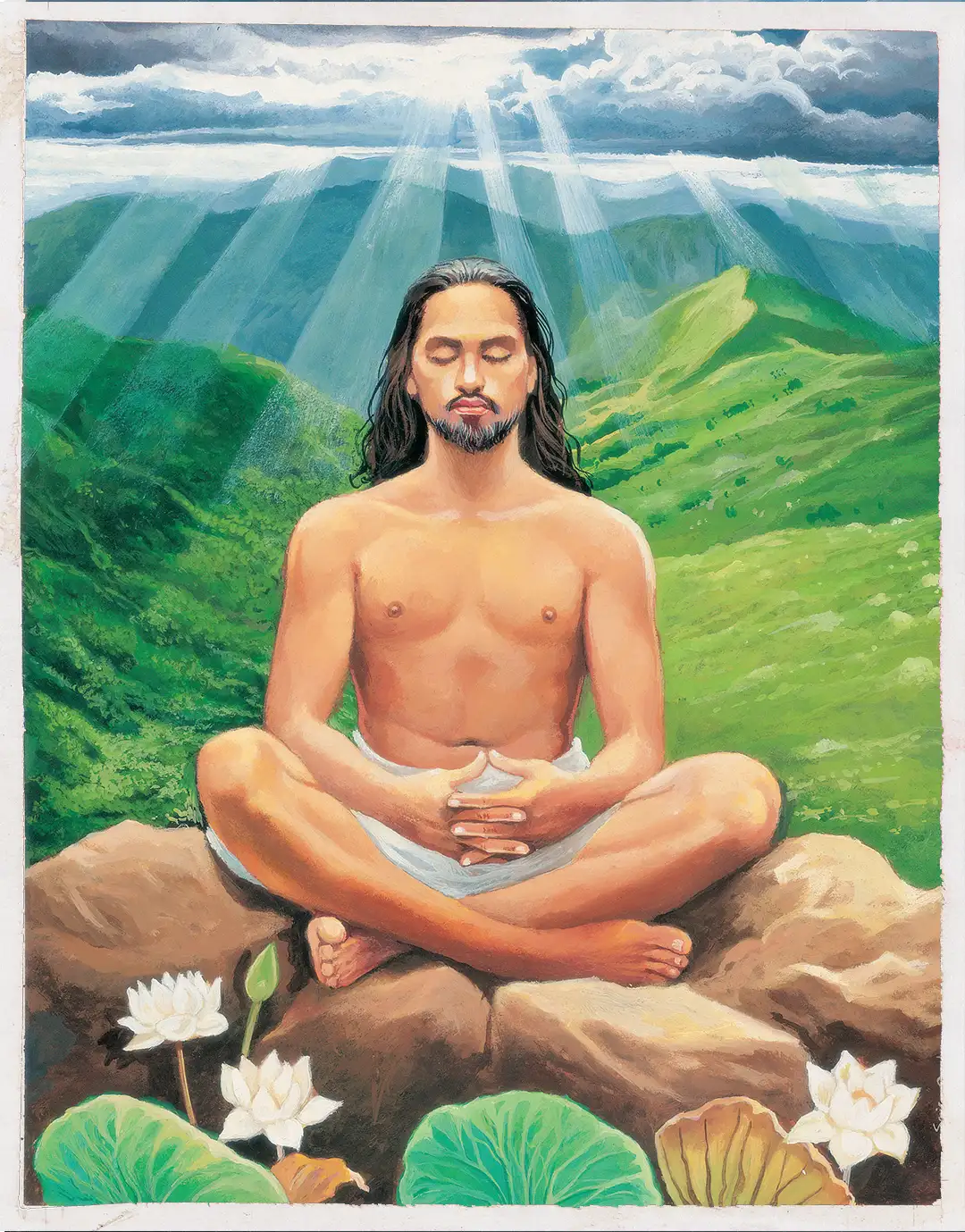
One of the greatest challenges on the spiritual path is learning to steady the restless mind. It is the nature of the mind to wander constantly from one thought to another, chasing memories of the past or worries about the future. Left unchecked, it becomes difficult to experience lasting peace or develop a deep relationship with God.
Shree Krishna acknowledges this reality, but He also gives us the solution.
यतो यतो निश्चरति मनश्चञ्चलमस्थिरम् ।
ततस्ततो नियम्यैतदात्मन्येव वशं नयेत् ॥ 26॥
yato yato niśhcharati manaśh chañchalam asthiram
tatas tato niyamyaitad ātmanyeva vaśhaṁ nayet
BG 6.26: Whenever and wherever the restless and unsteady mind wanders, one should bring it back and continually focus it on God.
Notice the compassion in this instruction. Shree Krishna does not criticise the wandering mind. Instead, He lovingly encourages us to bring it back again and again.
Swami Mukundananda explains that the mind cannot remain empty for long. If we merely try to suppress thoughts, other thoughts quickly arise to take their place. The secret is not to empty the mind but to lovingly engage it with the all-attractive personality of Shree Krishna.
This is the essence of Roop Dhyan meditation.
During Roop Dhyan, we lovingly contemplate the enchanting divine form of Shree Krishna: His compassionate smile, His lotus eyes, His peacock feather, His flute, His beautiful yellow garments, and His boundless love for every soul. We also reflect upon His divine names, qualities, and transcendental pastimes. The more the mind becomes absorbed in His sweetness, the less attractive worldly distractions appear.
This is not an exercise in imagination but an expression of loving remembrance. Just as a person naturally thinks about someone they deeply love, the devotee seeks to lovingly dwell upon the Supreme Divine Personality.
As this practice becomes regular, meditation gradually extends beyond the time spent sitting quietly. Remembrance of Shree Krishna begins to accompany daily activities. His presence is felt while working, serving, walking, speaking, and even during life's ordinary moments.
The goal is not simply to meditate for a few minutes each day, but to gradually cultivate a heart that naturally longs to remain connected with God.
8. Seek a Guru and the Company of Like-Minded Devotees
No one walks the spiritual path alone.
Just as a single coal quickly loses its warmth when separated from the fire, our spiritual enthusiasm can gradually diminish if we isolate ourselves from uplifting association. Conversely, when we spend time with sincere devotees, our own faith, inspiration, and determination naturally increase.
Recognising this, Shree Krishna emphasises the importance of approaching those who have realised spiritual truth.
तद्विद्धि प्रणिपातेन परिप्रश्नेन सेवया ।
उपदेक्ष्यन्ति ते ज्ञानं ज्ञानिनस्तत्त्वदर्शिन: ॥ 34॥
tad viddhi praṇipātena paripraśhnena sevayā
upadekṣhyanti te jñānaṁ jñāninas tattva-darśhinaḥ
BG 4.34: Learn the Truth by approaching a spiritual master. Inquire from him with reverence and render service unto him. Such an enlightened Saint can impart knowledge unto you because he has seen the Truth.
This verse beautifully captures the spirit of the guru-disciple tradition that has preserved the wisdom of the Bhagavad Gita for thousands of years. Divine knowledge is not merely information to be collected; it is living wisdom that is lovingly received from realised souls and applied through sincere practice.
Swami Mukundananda often explains that satsang is one of the greatest blessings available to a spiritual seeker. Through the company of saints and devotees, we receive encouragement when our enthusiasm weakens, guidance when doubts arise, and inspiration to keep progressing on the path of devotion.
This association may take many forms. Visiting the temple, attending spiritual discourses, participating in devotional programmes, engaging in seva, studying scripture with fellow seekers, and celebrating festivals such as Janmashtami together all strengthen our connection with God.
9. Reflect on Your Day Before Going to Sleep
Every day presents countless opportunities to move closer to God, but it also presents moments when we lose sight of Him. The spiritual journey is not about never making mistakes; it is about becoming increasingly aware of them and steadily correcting our course.
Just as a traveller occasionally checks a map to ensure they are still heading towards their destination, a spiritual seeker benefits from pausing each day to reflect upon the direction of their life.
Shree Krishna reminds us of the extraordinary power of the mind:
उद्धरेदात्मनात्मानं नात्मानमवसादयेत् ।
आत्मैव ह्यात्मनो बन्धुरात्मैव रिपुरात्मन: ॥ 5॥
uddhared ātmanātmānaṁ nātmānam avasādayet
ātmaiva hyātmano bandhur ātmaiva ripur ātmanaḥ
BG 6.5: Elevate yourself through the power of your mind, and not degrade yourself, for the mind can be the friend and also the enemy of the self.
The mind becomes our greatest friend when it encourages us to remember God and cultivate noble qualities. It becomes our greatest obstacle when it continually drags us towards worldly distractions, negative emotions, and selfish desires.
Before retiring for the night, spend a few quiet moments in honest yet compassionate reflection.
Ask yourself:
- Did I remember Shree Krishna today?
- Did I perform my duties as an offering to Him?
- Where did attachment disturb my peace?
- Did I respond to others with kindness and humility?
- How can I serve with greater love tomorrow?
These questions are not intended to create guilt or self-criticism. Spiritual progress flourishes through sincerity, not discouragement. Every day becomes another opportunity to learn, grow, and renew our determination.
Swami Mukundananda often explains that transformation takes place gradually. Just as a sculptor patiently removes one small piece of stone at a time until a beautiful form emerges, God gradually shapes the heart of a sincere devotee.
Daily reflection allows us to cooperate consciously with that divine process.
When we end the day remembering Shree Krishna and expressing gratitude for His guidance, we retire with a peaceful heart, ready to begin the next day with renewed enthusiasm for our spiritual journey.
10. Let Loving Devotion Become the Centre of Your Life

As we journey through the Bhagavad Gita, one truth becomes increasingly clear. Although Shree Krishna discusses many profound subjects such as selfless action, spiritual knowledge, meditation, self-discipline, and the nature of the soul; every teaching ultimately leads towards one sublime destination: loving devotion to the Supreme Divine Personality.
Karma Yog purifies the heart. Divine knowledge removes ignorance. Meditation steadies the mind. Association with devotees strengthens faith. Together, these practices prepare the soul for its highest purpose: developing an intimate, loving relationship with God.
Shree Krishna expresses this beautifully:
मय्येव मन आधत्स्व मयि बुद्धिं निवेशय ।
निवसिष्यसि मय्येव अत ऊर्ध्वं न संशय: ॥ 8॥
mayy eva mana ādhatsva mayi buddhiṁ niveśhaya
nivasiṣhyasi mayy eva ata ūrdhvaṁ na sanśhayaḥ
BG 12.8: Fix your mind on Me alone and surrender your intellect to Me. There upon, you will always live in Me. Of this, there is no doubt.
This is the essence of the Bhagavad Gita.
Shree Krishna does not seek occasional remembrance or partial commitment. He lovingly invites us to make Him the centre of our thoughts, decisions, aspirations, and affections. Such devotion does not diminish our worldly responsibilities; rather, it sanctifies them. Work becomes worship. Family life becomes an opportunity to serve. Success becomes an offering of gratitude. Challenges become opportunities to deepen surrender.
Swami Mukundananda beautifully explains that the soul is eternally a loving servant of God. No amount of material success, recognition, or pleasure can fully satisfy the heart because its deepest longing is for reunion with the Supreme Divine Personality.
When devotion becomes the foundation of life, we begin to experience the fulfilment we have unknowingly been searching for all along.
This does not mean perfection is achieved overnight. The spiritual journey is one of gradual transformation. There will be moments of progress and moments of struggle. Yet every sincere effort to remember Shree Krishna, every act of selfless service, every verse of scripture contemplated, every meditation practised with love, and every opportunity to cultivate divine qualities brings us one step closer to Him.
Living the Bhagavad Gita is therefore not about becoming extraordinary in the eyes of the world. It is about allowing God's grace to transform the ordinary moments of everyday life into expressions of extraordinary devotion.
Conclusion
Janmashtami is a celebration unlike any other. It commemorates the divine appearance of Shree Krishna, the Supreme Divine Personality, whose boundless compassion led Him to descend upon this earth to uplift humanity and lovingly guide every soul back to Him.
While the joyous festivities of Janmashtami inspire devotion, the greatest way to celebrate this sacred occasion is to carry Shree Krishna's teachings beyond the temple and into every aspect of our lives.
The Bhagavad Gita reminds us that spirituality is not confined to moments of worship. It is expressed in the way we begin each morning, the sincerity with which we perform our work, the patience we show in difficult situations, the kindness we extend to others, the wisdom we seek through scripture, the love with which we meditate upon God, the company we keep, and the humility with which we reflect upon each day.
These ten simple practices are not separate disciplines but interconnected expressions of one spiritual path. As we remember Shree Krishna, our work becomes an offering. As we offer our work, attachment gradually loosens its grip. As attachment diminishes, divine qualities begin to blossom. As our hearts become purified, meditation deepens. As meditation deepens, devotion naturally flourishes.
Ultimately, every teaching of the Bhagavad Gita culminates in Shree Krishna's final and most compassionate invitation:

सर्वधर्मान्परित्यज्य मामेकं शरणं व्रज ।
अहं त्वां सर्वपापेभ्यो मोक्षयिष्यामि मा शुच: ॥ 66॥
sarva-dharmān parityajya mām ekaṁ śharaṇaṁ vraja
ahaṁ tvāṁ sarva-pāpebhyo mokṣhayiṣhyāmi mā śhuchaḥ
BG 18.66: Abandon all varieties of dharmas and simply surrender unto Me alone. I shall liberate you from all sinful reactions; do not fear.
These reassuring words are the very heart of the Gita. The Supreme Divine Personality does not ask us to rely solely upon our own strength or wisdom. He lovingly invites us to place our faith in Him, knowing that He Himself will guide, protect, and uplift those who sincerely seek His shelter.
This Janmashtami 2026, let us celebrate not only the appearance of Shree Krishna, but also the awakening of His teachings within our hearts. If we strive to practise even one teaching of the Bhagavad Gita each day with sincerity and devotion, we will gradually discover that the transformation we seek is already unfolding.
Step by step, thought by thought, and offering by offering, we move closer to the eternal goal of life: a loving relationship with the Supreme Divine Personality.
May this Janmashtami mark not simply another festival on the calendar, but the beginning of a lifelong journey of living the Bhagavad Gita every day.
Call to Action
This Janmashtami 2026, go beyond simply celebrating the birth of Shree Krishna; begin living His teachings.
- Visit the Radha Krishna Temple of Dallas for one of their many offerings, or to offer some seva


- Study the Bhagavad Gita with Swami Mukundananda's authentic commentary.

- Download the JKYog Bhagavad Gita & Krishna Bhakti App for daily inspiration, guided meditations, bhajans, lectures, and spiritual resources.
 JKYog
JKYog

Frequently Asked Questions
1. Why is the Bhagavad Gita especially relevant during Janmashtami?
Janmashtami celebrates the divine appearance of Shree Krishna, the Supreme Divine Personality. It is therefore the perfect time not only to remember His divine pastimes but also to reflect upon and apply the timeless wisdom He revealed in the Bhagavad Gita. Living His teachings is one of the greatest ways to honour Him.
2. Can I practise the Bhagavad Gita while living a busy modern life?
Absolutely. The Bhagavad Gita was taught to Arjun while he was preparing to fulfil his worldly responsibilities, not withdraw from them. Its teachings show us how to transform work, family life, and daily responsibilities into opportunities for spiritual growth and devotion.
3. What is the first step towards living the Bhagavad Gita?
A wonderful place to begin is by remembering Shree Krishna each morning and offering the day's activities to Him. Even small daily practices, performed consistently with sincerity, gradually transform the heart and deepen our relationship with God.
4. Does the Bhagavad Gita teach us to renounce the world?
No. The Bhagavad Gita teaches inner renunciation rather than abandoning responsibilities. Shree Krishna encourages us to perform our duties wholeheartedly while remaining detached from selfish desires and offering every action in loving devotion to Him.
5. How does meditation help us live the Bhagavad Gita?
Meditation helps steady the restless mind and deepen our remembrance of Shree Krishna. Swami Mukundananda teaches Roop Dhyan meditation, in which we lovingly contemplate the divine form, qualities, and pastimes of the Supreme Divine Personality, gradually developing deeper devotion and inner peace.
6. Which teaching of the Bhagavad Gita is the most important?
Although the Bhagavad Gita contains many profound teachings on Karma Yog, knowledge, meditation, and self-discipline, they all culminate in loving surrender to the Supreme Divine Personality. Shree Krishna's invitation in Bhagavad Gita 18.66 beautifully summarises the ultimate goal of the entire scripture.