
Introduction: The Forest Beneath the Forest
Walk into a forest and, at first glance, it can look like a world of competition.
Every tree reaches toward the sunlight.
Roots spread through the earth in search of water and nutrients. Leaves compete for space in the canopy. Seedlings struggle to establish themselves beneath towering trees that arrived long before them.
Look only at the surface, and nature can seem to tell a familiar story:
Survive. Compete. Win.
But beneath our feet, another story is unfolding.
Tree roots form intimate relationships with vast networks of mycorrhizal fungi. The plants provide fungi with carbon compounds produced through photosynthesis. In return, the fungi extend through the surrounding soil and help plants acquire nutrients such as phosphorus and nitrogen.
What appears above ground to be a collection of individual organisms is, below ground, also a world of relationship and exchange.
We should be careful not to romanticize this underground world. Scientists caution against imagining trees as tiny human beings consciously choosing generosity or friendship. Mycorrhizal relationships can involve cooperation, competition, and even conflict depending upon the ecological circumstances.
But the biological relationships themselves are real.
And they invite a fascinating question:
What if competition is only part of the story of life?
That question lies at the heart of the Science of Cooperation.
Is “Survival of the Fittest” the Whole Story?
Many of us learned evolution through one unforgettable phrase:
“Survival of the fittest.”
It can easily conjure an image of nature as one enormous contest. The strongest survive. The weakest perish. Organisms compete until the winners pass their advantages to the next generation.
There is truth within that picture, but it is incomplete.
Competition absolutely exists in nature. Natural selection remains foundational to modern evolutionary biology. And “fitness,” scientifically speaking, does not simply mean being stronger or more aggressive; it refers to reproductive success within a particular environment.
Yet the Science of Cooperation reveals that evolutionary history also contains extraordinary examples of organisms working together.
Cooperation appears at multiple levels of life:
- Genes function together within genomes.
- Cells coordinate to form multicellular organisms.
- Plants and fungi exchange resources.
- Animals cooperate in families and social groups.
- Human beings collaborate, communicate, teach, share knowledge, and create communities.
In other words, life is not merely filled with competitors.
It is also filled with relationships.
And some of the most important transitions in the history of life occurred when previously independent entities became integrated into larger, more complex wholes.
That gives us another way of contemplating evolution.
Not only: “Who can defeat whom?”
But also: “What can flourish together?”
The Science of Cooperation and Life’s Great Transitions
Consider your own body.
You experience yourself as one person.
Yet your body contains trillions of cells performing astonishingly specialized tasks. Heart cells contract. Neurons transmit signals. Immune cells identify threats. Red blood cells transport oxygen.
No single cell could be you.
Human life emerges through extraordinary coordination among countless components.
Evolutionary biologists sometimes describe major events in life's history as major evolutionary transitions—moments when entities that could once reproduce or function more independently became integrated into new biological units.
The emergence of multicellular organisms is one striking example.
Cells did not simply become better competitors against one another.
They became parts of something larger.
The Science of Cooperation therefore complicates any simplistic picture of nature as relentless individual struggle.
Life certainly competes.
But life also coordinates.
Life exchanges.
Life specializes.
Life forms partnerships.
Life becomes more complex through relationship.
And nowhere is that easier to visualize than beneath a forest floor.
What Trees and Fungi Can Teach Us, Without Turning Them Into People
The beautiful underground image in this Tidbit deserves a little scientific care.
Mycorrhizal fungi form associations with the roots of most terrestrial plant species. Their threadlike hyphae can extend far beyond the reach of a plant's own roots, improving access to nutrients and sometimes water. Plants, in turn, supply carbon compounds to their fungal partners.
Some fungal networks can connect multiple plants.
This has given rise to the popular phrase “wood wide web.”
It is an irresistible metaphor—but one we should handle carefully.
Trees are not necessarily “sharing” because they possess human-like compassion. Resource movement through mycorrhizal networks is shaped by complex biological and ecological processes, and scientists continue to debate how some popular claims about forest communication should be interpreted.
That qualification does not make the reality less remarkable.
Perhaps it makes it more so.
We do not need to turn trees into people to marvel at the fact that life is profoundly relational.
The Science of Cooperation asks us simply to notice what is there:
An organism that looks independent may depend upon relationships invisible to us.
And perhaps that observation resonates beyond biology.
How many of the conditions that allow us to flourish are equally easy to overlook?
Human Beings: Built for Relationship
Human cooperation operates at a remarkable scale.
We do not merely cooperate with close relatives.
We collaborate with strangers.
We form institutions.
We transmit knowledge across generations.
We create languages, legal systems, schools, hospitals, temples, technologies, music, and cultures that no individual human being could build alone.
Think about something as ordinary as a morning cup of tea.
Someone grew the leaves.
Someone harvested them.
Someone transported them.
Someone designed the packaging.
Someone stocked the store.
Someone built the roads.
Someone generated the electricity that heated the water.
The simplest moment in our day rests upon a vast network of human contribution.
We are more interdependent than we usually recognize.
The Science of Cooperation therefore does not merely tell us something about forests or cells.
It holds up a mirror.
We flourish through relationships too.
And this is where the question begins to move beyond biology.
Because science can help explain how cooperation functions.
Spirituality asks something different:
What should we do with our extraordinary human capacity to cooperate?
From Beyond Darwin to a Bigger Question
This Tidbit was originally inspired by Bruce Lipton's book Beyond Darwin, which raises provocative questions about competition, cooperation, biology, and consciousness. Some of Lipton's broader scientific claims remain controversial, and they should not be treated as representing a consensus within evolutionary biology.
But one question prompted by the book is both scientifically legitimate and deeply interesting:
Is competition the whole story of life?
Modern biology gives us a clear answer.
No.
Competition matters enormously.
So do cooperation, mutualism, symbiosis, social behavior, and interdependence.
Yet even that richer scientific picture cannot tell us the ultimate purpose of human existence.
For that, the Tidbit turns toward a different source of knowledge.
Toward spirituality.
Swami Mukundananda’s Wisdom: Life Is More Than Survival
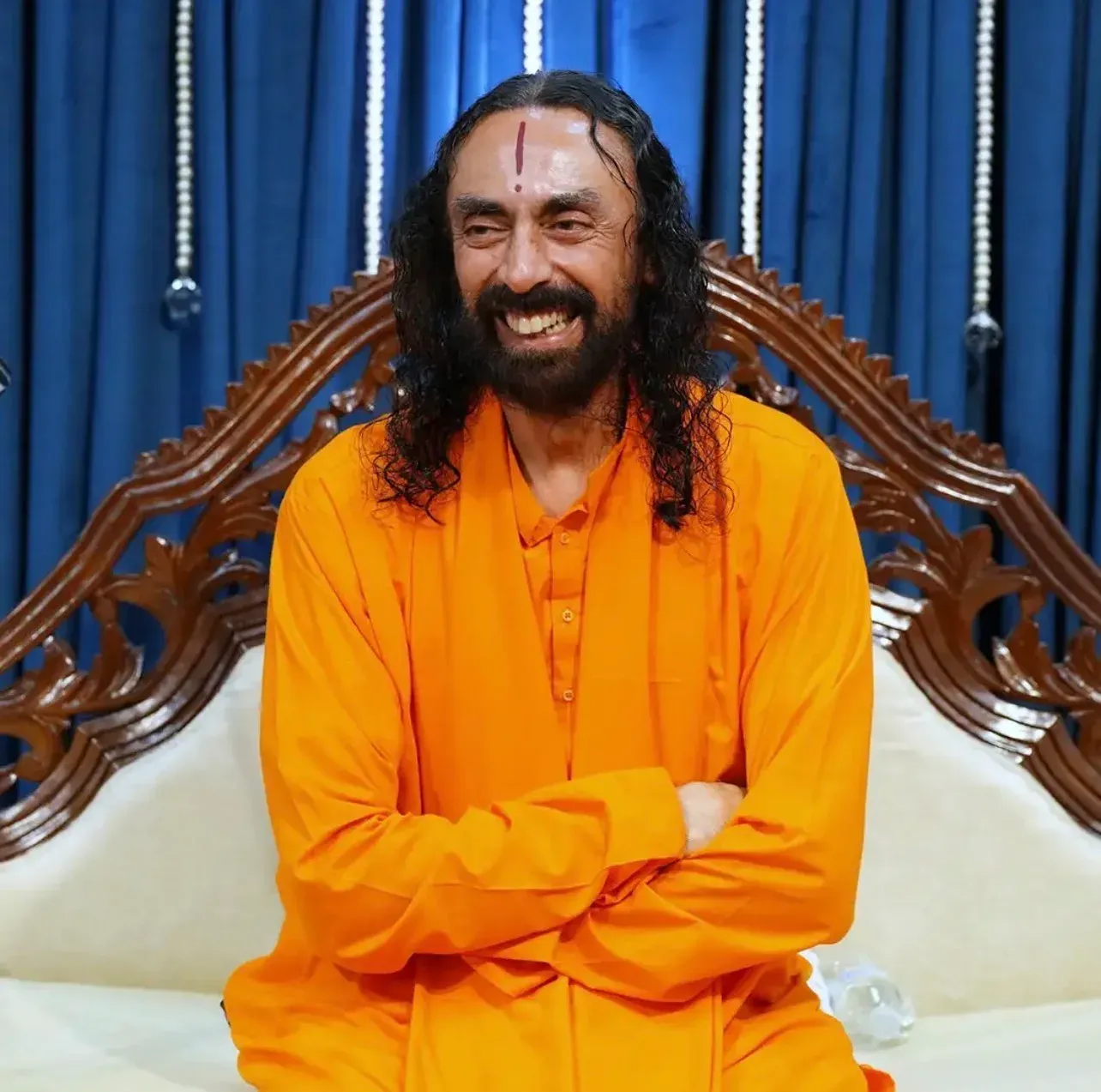
Swami Mukundananda has spoken directly about Darwinian evolution and the Vedic understanding of creation.
The Vedic perspective begins from a fundamentally different premise than a purely material account of existence.
Life exists within a divine order.
The universe is not spiritually purposeless.
And human existence therefore cannot be reduced to one objective:
survival.
This changes the question we ask about our lives.
If my highest purpose is merely to survive successfully, then life can easily become organized around:
acquiring, competing, protecting, outperforming.
But Bhakti invites us toward something higher:
Love.
Service.
Growth.
God-realization.
The movement is subtle but profound.
From: “What can I get?” to:“How can I serve?”
The highest expression of human life, from the Bhakti perspective, is not domination.
It is loving service.
The Bhagavad Gita: From Self-Interest to the Welfare of All
The Bhagavad Gita offers a beautiful vision of the spiritually elevated person; someone whose consciousness has expanded beyond narrow self-interest.

ये त्वक्षरमनिर्देश्यमव्यक्तं पर्युपासते ।
सर्वत्रगमचिन्त्यञ्च कूटस्थमचलन्ध्रुवम् ॥ 3॥
सन्नियम्येन्द्रियग्रामं सर्वत्र समबुद्धय: ।
ते प्राप्नुवन्ति मामेव सर्वभूतहिते रता: ॥ 4॥
ye tv akṣharam anirdeśhyam avyaktaṁ paryupāsate
sarvatra-gam achintyañcha kūṭa-stham achalandhruvam
sanniyamyendriya-grāmaṁ sarvatra sama-buddhayaḥ
te prāpnuvanti mām eva sarva-bhūta-hite ratāḥ
BG 12.3-4: But those who worship the formless aspect of the Absolute Truth—the imperishable, the indefinable, the unmanifest, the all-pervading, the unthinkable, the unchanging, the eternal, and the immoveable—by restraining their senses and being even-minded everywhere, such persons, engaged in the welfare of all beings, also attain Me.
The phrase sarva-bhūta-hite ratāḥ is especially beautiful: those who delight in, or are devoted to, the welfare of all beings.
What a radically different vision of success.
Not: How much can I accumulate?
Not: How far ahead can I get?
But: How can my life contribute to the good of others?
The Science of Cooperation shows us that relationship is woven throughout the living world.
The Bhagavad Gita asks us to make our human relationships something more:
an expression of conscious care.
Science and Spirituality: Different Questions, a Bigger Story
This distinction is important.
We should not ask science to prove spirituality.
And we should not ask scripture to function as a biology textbook.
They are asking different kinds of questions.
Science investigates mechanisms.
How do organisms interact?
How does natural selection operate?
Under what conditions does cooperation evolve?
How do symbiotic relationships function?
Spirituality asks:
Who am I?
Why am I here?
What is the highest use of this human life?
How should I relate to God and to others?
Keeping those domains distinct does not prevent them from entering into meaningful conversation.
In fact, it makes the conversation richer.
The Science of Cooperation reveals a natural world in which competition and cooperation coexist.
Bhakti then asks us what kind of relationship we will consciously choose to cultivate.
Science shows us that flourishing often requires relationship.
Spirituality teaches us to make relationship an expression of love and service.
From Competition to Contribution
Our culture often trains us to measure ourselves comparatively.
Who is ahead?
Who has more?
Who received the recognition?
Who succeeded first?
Comparison can quietly turn life into a scoreboard.
But the spiritual question is different.
Not: “How do I rank?”
But: “What can I contribute?”
That shift does not require us to abandon excellence. Bhakti does not ask us to become passive or mediocre.
We can work diligently.
Develop our talents.
Pursue meaningful goals.
Strive for excellence.
But the purpose of excellence changes.
Instead of cultivating our abilities merely to elevate ourselves, we can offer them in service.
Our intelligence can serve.
Our creativity can serve.
Our professional expertise can serve.
Our patience can serve.
Our resources can serve.
Even our struggles can eventually become sources of compassion through which we serve others.
This may be one of the deepest spiritual implications of the Science of Cooperation:
Our gifts reach their highest expression when they become contributions.
Five Ways to Move From Competition Toward Contribution
How might we bring this insight into everyday life?
1. Ask a Different Question
When entering a meeting, relationship, family interaction, or seva opportunity, try replacing:
“What am I going to get from this?”
with:
“What can I contribute here?”
One question turns attention inward.
The other opens it outward.
2. Notice Invisible Interdependence
Pause occasionally to notice how many people make your ordinary life possible.
Gratitude naturally grows when we recognize how little we accomplish entirely alone.
3. Let Other People’s Success Expand You
Someone else's flourishing does not always diminish ours.
Practice celebrating another person's success without immediately comparing it with your own.
4. Turn Excellence Into Seva
Ask how your particular talents can become instruments of service.
The goal is not to become less capable.
It is to become more purposeful about what our capabilities are for.
5. Remember the Highest Relationship
Bhakti ultimately places every relationship within our relationship with God.
When service is offered as devotion, even ordinary actions can become spiritually meaningful.
Key Takeaways: The Science of Cooperation
The Science of Cooperation gives us a richer picture of life than the popular caricature of “survival of the fittest.”
A few central insights emerge:
- Competition is real and important in evolution, but it is not the entire story.
- Cooperation, symbiosis, mutualism, and sociality occur throughout the living world.
- Major increases in biological complexity have sometimes depended upon formerly independent units becoming integrated into larger wholes.
- Mycorrhizal relationships demonstrate profound biological interdependence, although we should avoid anthropomorphizing trees and fungi.
- Human beings possess extraordinary capacities for large-scale cooperation.
- Science can explain mechanisms of cooperation; it does not establish the spiritual purpose of life.
- Bhakti invites us beyond mere survival and self-interest toward love, seva, devotion, and God-realization.
Perhaps the most important shift is therefore remarkably simple:
From competition to contribution.
From: “What can I gain?” to: “How can I serve?”
Final Reflection: Life Does Not Flourish Alone
Return once more to the forest.
Above ground, each tree appears separate.
One trunk.
One crown.
One organism reaching toward the light.
But beneath the soil lies another dimension of the story: roots, fungi, nutrients, microorganisms, exchanges, dependencies, relationships.
The visible tree was never quite as solitary as it appeared.
Perhaps neither are we.
Every one of us stands upon an invisible network of gifts.
People who raised us.
People who taught us.
People who grew our food.
People who built our homes.
People who challenged us.
People who loved us.
Teachers whose wisdom entered our lives across centuries.
And above all, from the Bhakti perspective, the grace of God that sustains every moment of our existence.
The Science of Cooperation does not prove the spiritual meaning of those relationships.
But it can awaken us to something worth contemplating:
Life does not flourish alone.
And Bhakti takes that insight one beautiful step further.
We flourish most deeply when we stop living merely for ourselves.
When our abilities become offerings.
When our relationships become opportunities for compassion.
When our work becomes contribution.
When contribution becomes seva.
And when seva becomes love.
Perhaps, then, the deepest question of a human life is not simply: “How do I survive?”
Nor even: “How do I succeed?”
Perhaps it is: “What can I contribute?”
And deeper still: “How can I serve?”
Because the purpose of this precious human life is not merely to survive successfully.
It is to learn to love and serve God.
Frequently Asked Questions About the Science of Cooperation
What is the Science of Cooperation?
The Science of Cooperation examines how cooperative relationships arise and function throughout biological and social systems. Cooperation appears at many levels of life, from interactions among cells and organisms to complex human societies.
Does modern evolutionary biology reject “survival of the fittest”?
No. Natural selection remains central to evolutionary biology. But “survival of the fittest” is often misunderstood as meaning that evolution is exclusively about ruthless competition. Modern biology recognizes that cooperation, mutualism, symbiosis, and social behavior can also affect evolutionary success.
Does “fittest” mean the strongest organism?
Not necessarily. In evolutionary biology, fitness generally concerns reproductive success in a particular environment. Strength can sometimes matter, but so can adaptability, cooperation, parental care, social behavior, and many other characteristics.
What are mycorrhizal networks?
Mycorrhizal networks arise through relationships between fungi and plant roots. Fungi receive carbon compounds from plants while helping plants acquire soil nutrients. Some fungal networks connect multiple plants, although scientists caution against describing these relationships as if trees consciously communicate or behave altruistically like humans.
Does the Science of Cooperation prove spirituality?
No. Scientific evidence for cooperation does not prove spiritual claims, and the two should not be conflated. Science investigates how natural systems function. Spirituality addresses questions of meaning, purpose, consciousness, God, and how we should live.
What does Bhakti teach about cooperation and service?
Bhakti elevates relationship into loving service, or seva. Rather than organizing life primarily around “What can I get?”, the spiritual seeker increasingly asks, “How can I serve?” Ultimately, loving service to God becomes the highest purpose of human life.
How can I practice cooperation rather than competition?
Begin by noticing interdependence, celebrating others' successes, collaborating generously, and asking what you can contribute in your relationships, work, community, and seva. The goal is not to eliminate healthy striving but to place our abilities in service of something greater than ourselves.
Call to Action: From Cooperation to Loving Service
If this exploration of the Science of Cooperation inspired you to think differently about life, purpose, and our relationship with one another, consider going deeper into the wisdom of Swami Mukundananda.
Swamiji offers extensive teachings on the Bhagavad Gita, Bhakti, seva, mind management, devotion, the nature of the soul, and the ultimate purpose of human life.
Subscribe to Swami Mukundananda on YouTube
Life does not flourish alone. And human life flourishes most beautifully when we transform connection into compassion, contribution into seva, and service into love.