
The Essence of Dussehra: Understanding the Victory of Dharma
As the sacred days of Navratri reach their joyous culmination, Dussehra arrives with one of the most enduring messages of Sanatan Dharma: dharma ultimately triumphs over adharma. Also celebrated as Vijayadashami, this auspicious day reminds us that truth is stronger than falsehood, humility is greater than pride, and divine wisdom can illuminate even the darkest corners of the human mind.
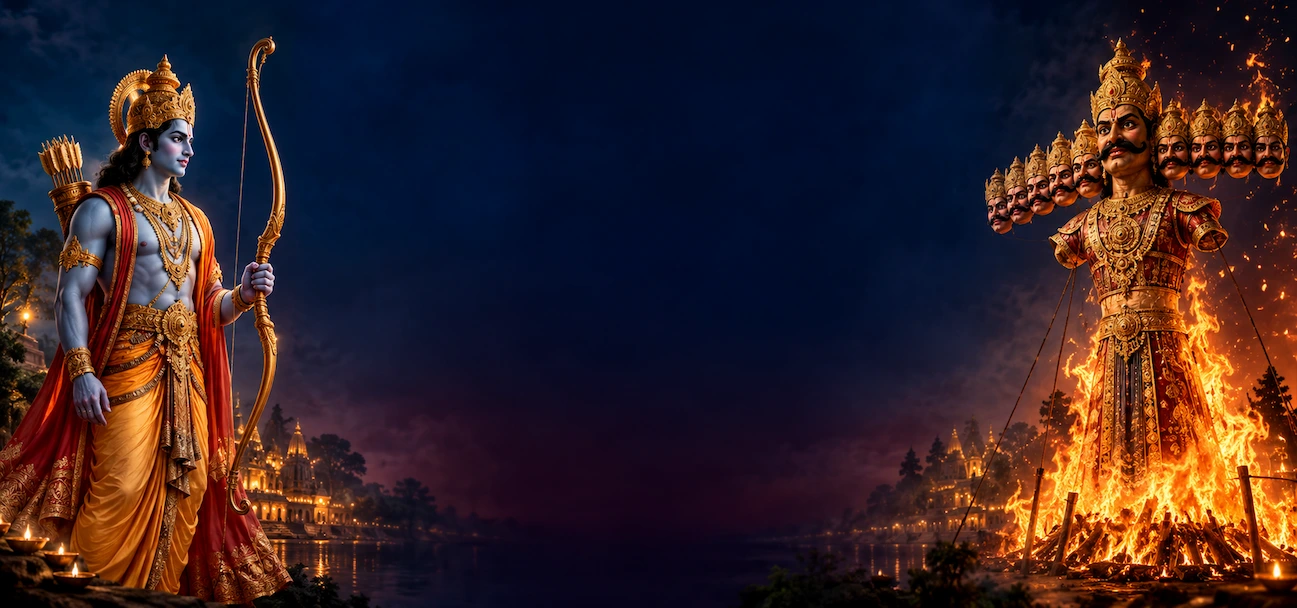
The festival is closely associated with the glorious victory of Bhagwan Shree Ram over Ravan. Yet its meaning extends far beyond the conclusion of an ancient battle. The Ramayan presents before humanity two very different expressions of power. Ravan possessed extraordinary knowledge, strength, wealth, and authority, but pride and uncontrolled desire clouded his wisdom. Shree Ram embodied strength guided by righteousness, courage guided by compassion, and action guided by dharma.
Dussehra therefore invites us to consider what true victory really means. The greatest triumphs of life are not always measured by what we accomplish externally. Sometimes they occur quietly within us, when patience conquers anger, humility softens pride, forgiveness dissolves resentment, and devotion redirects the restless mind toward God.
Vijayadashami celebrates precisely this possibility of transformation. It reminds us that however deeply negative tendencies may have taken root, the light of wisdom can overcome them when we sincerely choose the path of dharma.

Dussehra 2026: Aligning Ancient Cosmic Wisdom with Modern-Day Devotion
The world in which we celebrate Dussehra today is very different from the world described in the Ramayan, yet the inner challenges faced by humanity remain remarkably familiar. We still encounter anger, attachment, greed, pride, jealousy, and the desire for recognition. We still face moments when doing what is convenient conflicts with doing what is right.
This is why the wisdom of Vijayadashami remains profoundly relevant in 2026.
Modern life gives us extraordinary opportunities, but it also surrounds us with constant stimulation, comparison, competition, and distraction. In such an environment, Dussehra becomes an invitation to return to what is enduring. It encourages us to examine whether our ambitions are accompanied by integrity, whether our knowledge is balanced by humility, and whether our relationships are guided by compassion.
Ancient spiritual wisdom becomes meaningful when it influences present-day choices. The message of Shree Ram can guide how we respond to conflict. The strength of Maa Durga can inspire us when confronting adversity. The symbolism of Ravan can help us recognize tendencies within ourselves that require transformation.
Celebrating Dussehra today is therefore not simply about preserving tradition. It is about allowing tradition to illuminate the way we live.
Why We Gather: The Spiritual Mission of Radha Krishna Temple
On Tuesday, October 20, 2026, Radha Krishna Temple of Dallas will bring the community together to celebrate Vijayadashami through worship, culture, reflection, and joyful participation.
A temple festival offers something uniquely meaningful. Sacred stories that may have been heard at home become shared experiences. Children encounter their spiritual heritage in a vibrant community setting. Parents and grandparents pass traditions to younger generations. Friends gather not merely for entertainment, but around values that have guided seekers for centuries.
The Dussehra celebration at Radha Krishna Temple of Dallas reflects this union of spirituality and community. The evening begins at 6:00 PM with Dussehra Yantra and Ayudh Pooja, continues at 6:30 PM with Dussehra Cultural Performances and Ravan Dahan, and culminates at 7:30 PM with Garba and Dandiya.
Each experience expresses a different dimension of the festival. Worship cultivates gratitude. Sacred stories impart wisdom. Ravan Dahan inspires introspection. Music and dance allow the community to express its joy together.
In this way, Dussehra becomes not merely something we observe, but something we experience.
Shree Ram's Triumph: Defeating the Ten Heads of Adharma
Among the most beloved manifestations of the Supreme Lord, Shree Ram holds a special place in the hearts of devotees. Revered as Maryada Purushottam, the supreme exemplar of righteous conduct, His divine life reveals how dharma can be upheld even when circumstances become extraordinarily difficult.
When Shree Ram was asked to leave Ayodhya and spend fourteen years in exile, He accepted the situation with dignity and commitment to duty. Through the hardships of forest life, separation from Sita, and ultimately the confrontation with Ravan, He remained steadfast in His principles. His strength was never separated from wisdom, and His courage was not motivated by personal hatred.
His victory over Ravan therefore represents much more than the triumph of one warrior over another. It is the triumph of character over ego.
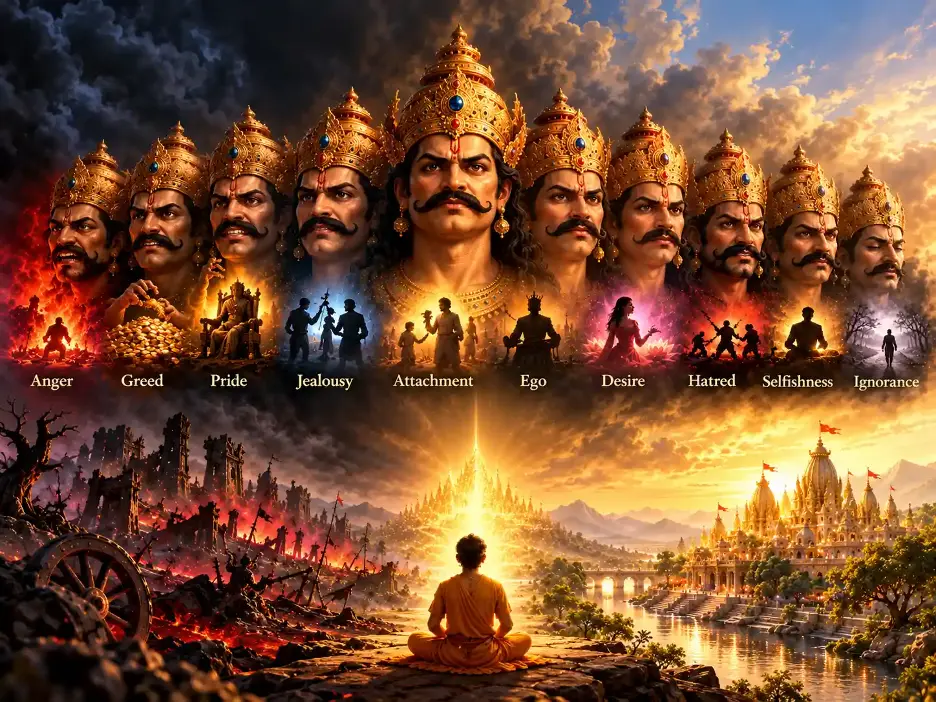
The ten-headed form of Ravan also lends itself to profound spiritual reflection. The heads may be contemplated as symbols of negative tendencies such as anger, greed, pride, jealousy, attachment, ego, uncontrolled desire, hatred, selfishness, and ignorance.
These qualities do not always manifest dramatically. Anger may appear as an impatient response to someone we love. Pride may prevent us from acknowledging a mistake. Jealousy can disturb our peace when another person succeeds. Attachment may cause our happiness to depend entirely upon possessions, recognition, relationships, or circumstances.
When these tendencies are repeatedly nourished, they gradually influence our character.
The story of Shree Ram and Ravan therefore becomes a mirror through which we can examine ourselves. The battlefield is not only Lanka. In a spiritual sense, another battlefield exists within the human mind, where wisdom and impulse, humility and ego, devotion and distraction continually compete for our attention.
Every time we consciously choose the higher response, the victory of Shree Ram is reflected within us.
Goddess Durga's Victory: Mahishasura Mardini and the Awakening of Divine Strength
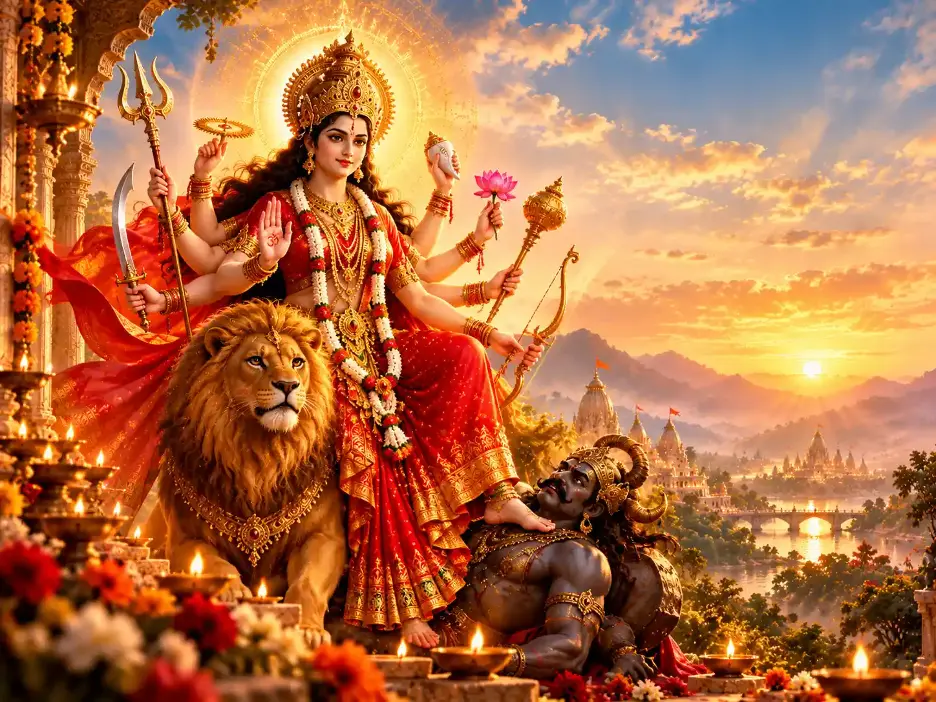
Vijayadashami also carries the glorious message of the Divine Mother. Navratri celebrates Maa Durga and the divine Shakti that protects righteousness and destroys forces of darkness. Her victory over Mahishasur is remembered as a powerful expression of the triumph of divine strength over negativity.
This sacred narrative adds another dimension to the meaning of Dussehra. Dharma requires goodness, but it also requires strength.
There are moments in life when we must patiently endure, but there are also moments when we must courageously stand for what is right. Maa Durga embodies this fearless divine strength. Her victory reminds devotees that spiritual life is not weakness or passivity. It requires discipline, discernment, determination, and courage.
Throughout Navratri, devotees contemplate the nine manifestations of the Divine Mother: Shailaputri, Brahmacharini, Chandraghanta, Kushmanda, Skandamata, Katyayani, Kalaratri, Mahagauri, and Siddhidatri. Together, these forms represent a beautiful spiritual progression through strength, purification, wisdom, devotion, and fulfillment.
When the nine sacred nights culminate in Vijayadashami, the sequence itself carries a profound lesson. Victory is preceded by preparation. Transformation requires sincere effort. Before celebrating the triumph of light, we cultivate the strength necessary to confront darkness.
Thus, the victory of Maa Durga and the victory of Shree Ram illuminate the same eternal principle from complementary perspectives. Dharma requires both purity of intention and strength of character.
The Universal Truth: How Good Ultimately Overcomes Evil
The enduring appeal of Dussehra lies in the universality of its message. Every generation encounters moments when negativity appears powerful and righteousness seems difficult. The stories of Shree Ram and Maa Durga assure us that appearances do not determine the final outcome.
Adharma often promises immediate rewards. Anger can feel easier than patience. Revenge may seem more satisfying than forgiveness. Pride can feel stronger than humility. Selfishness may appear more profitable than service.
Yet these choices eventually disturb the individual who embraces them.
Dharma works differently. Its rewards may not always be immediate, but it gradually creates harmony within the individual and in the world around them. Truth strengthens character. Compassion strengthens relationships. Humility opens the heart to learning. Self-control protects us from impulsive choices. Devotion gives life a higher direction.
The victory celebrated on Vijayadashami is therefore not simply the destruction of an external enemy. It is the affirmation of a universal spiritual principle: that which is aligned with truth and divine wisdom possesses an enduring strength that adharma cannot ultimately overcome.
Sacred Worship for New Beginnings: Dussehra Yantra and Ayudh Pooja
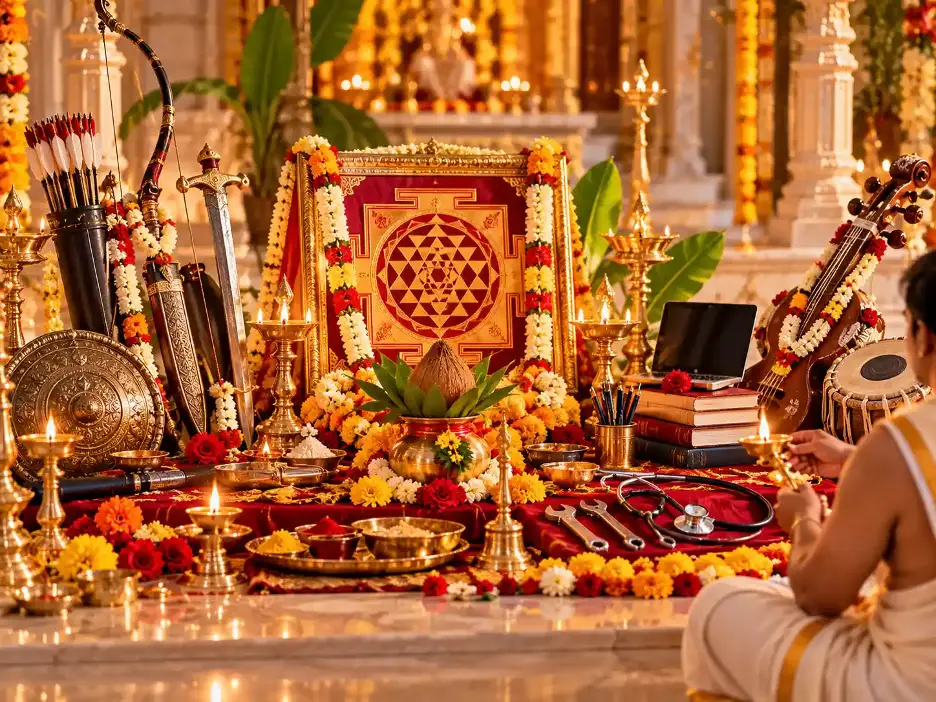
The Dussehra 2026 celebration at Radha Krishna Temple of Dallas will begin at 6:00 PM with Dussehra Yantra and Ayudh Pooja, setting a reverent tone for the evening.
A yantra is a sacred geometric representation used within Hindu spiritual traditions for worship, concentration, and contemplation. The period surrounding Vijayadashami is also associated with seeking divine blessings for knowledge, learning, wisdom, and meaningful new beginnings.
Ayudh Pooja beautifully expands this spirit of reverence by honoring the instruments and tools through which we perform our duties. Depending upon one's role in life, these may be books and educational materials, musical instruments, professional tools, equipment, or other objects connected with one's responsibilities.
The ritual encourages us to see these objects differently. Rather than taking our skills, education, professions, and resources for granted, we recognize them as blessings and accept the responsibility to use them wisely.
For students, Vijayadashami can become an opportunity to renew their commitment to learning. For artists, it can inspire gratitude for creativity. For professionals, it offers a moment to reflect on how knowledge and abilities can be used ethically and constructively.
The deeper principle extends to everyone. Whatever talents and resources we have received become most meaningful when they are connected with gratitude, humility, and service.
Cultural Performances: Reliving the Virtues of the Ramayan
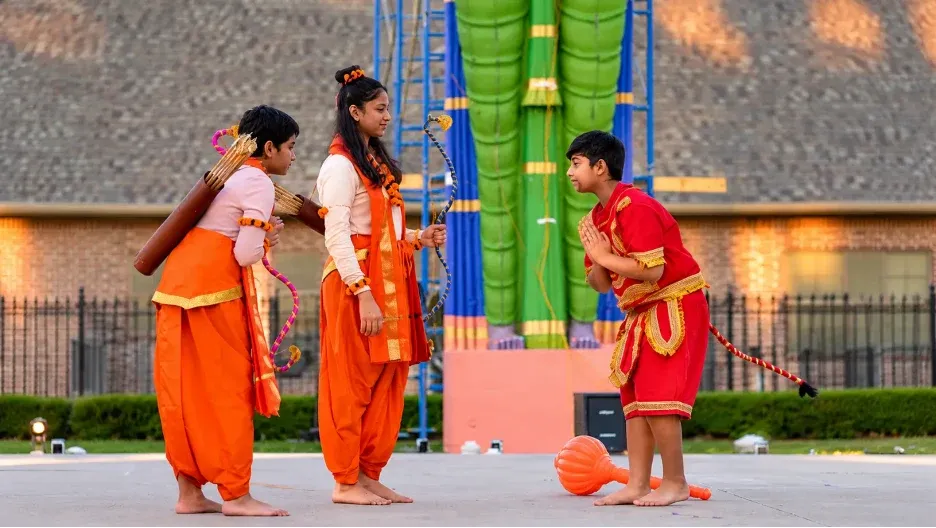
At 6:30 PM, the celebration will continue with Dussehra cultural performances, bringing the spirit and teachings of Vijayadashami alive through community expression.
The Ramayan has endured across generations not merely because it tells an extraordinary story, but because its characters embody choices that remain relevant to human life. Shree Ram teaches righteousness and responsibility. Sita embodies devotion, dignity, and inner strength. Lakshman represents loyalty and service. Hanuman Ji reveals the extraordinary power of humility combined with unwavering devotion.
Cultural presentations allow these values to move beyond the written page and enter the imagination of the community. Music, storytelling, performance, and visual expression can make profound spiritual principles accessible to children while allowing adults to reconnect with stories they have cherished for years.
For younger generations especially, such experiences are invaluable. A lesson heard in a classroom may eventually be forgotten, but a sacred story experienced with family amid the excitement of a festival can become a treasured memory.
Culture therefore becomes a vehicle for transmitting dharma.
The Climax of Vijayadashami: Ravan Dahan
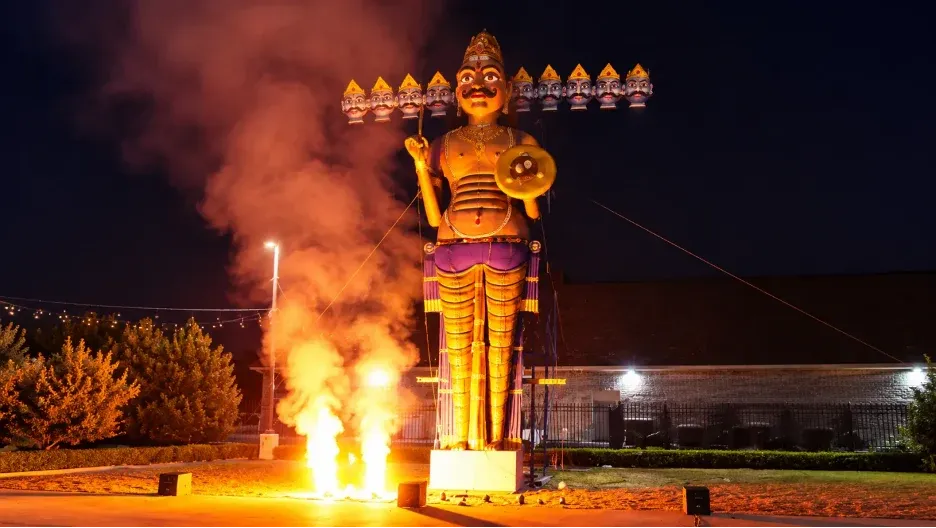
The cultural celebration will culminate in one of Dussehra's most powerful traditions, Ravan Dahan.
As the towering effigy of Ravan is consumed by flames, the ancient victory of Shree Ram becomes dramatically visible. The glowing fire, rising sparks, and collective anticipation create an unforgettable experience, particularly for children witnessing the tradition.
Yet beneath the spectacle lies a deeply introspective message.
The flames can represent the purification of tendencies that prevent spiritual growth. As the effigy burns, devotees can silently consider what they wish to release from their own lives. Perhaps it is anger that repeatedly harms a relationship. Perhaps it is resentment that has been carried for years. Perhaps it is pride that prevents an apology, jealousy that disturbs contentment, or attachment that has become a source of anxiety.
Seen in this way, Ravan Dahan becomes a personal spiritual exercise.
The goal is not simply to watch Ravan burn outside us. It is to recognize and gradually overcome the tendencies represented by Ravan within us.
Rhythms of Devotion: Garba and Dandiya
After the sacred rituals, cultural performances, and Ravan Dahan, the evening will transition into joyful celebration with Garba and Dandiya at 7:30 PM.
Garba and Dandiya bring together music, movement, tradition, and community in a uniquely uplifting way. Circles of dancers moving rhythmically together create an atmosphere of shared celebration where children, parents, young adults, and elders can participate side by side.
Coming at the culmination of Navratri, the celebration carries special significance. After days dedicated to worship of Maa Durga, the energy of devotion finds expression through music and movement.
This progression from prayer to reflection and then joyful celebration beautifully demonstrates the breadth of Sanatan Dharma. Spirituality is not confined to silent contemplation. Joy itself can become sacred when it is connected with gratitude and remembrance of God.
A valid ticket is required for Garba hall entry, so participants planning to join the Garba and Dandiya celebration should register accordingly.
The Spirit of Prasadam, Seva, and Community Fellowship
Food and fellowship have always played a meaningful role in temple life. The principle behind prasadam reminds us that when something is first offered to God and then received with gratitude, even an ordinary act such as eating can acquire spiritual significance.
The broader spirit of seva carries the same lesson. Festivals of this scale are made possible through the collective contribution of devotees, volunteers, organizers, performers, families, and community members. Some serve visibly, while many others contribute quietly behind the scenes.
Such service transforms a festival from something we merely attend into something we help create.
This spirit is particularly appropriate for Dussehra because seva directly challenges the ego. Instead of asking, "What will I receive?" seva encourages us to ask, "How may I contribute?"
When performed with devotion and without expectation of recognition, even a simple act of service becomes part of one's spiritual practice.
Passing the Torch: Engaging the Next Generation in Dharmic Values
Perhaps one of the most meaningful aspects of celebrating Dussehra at Radha Krishna Temple is the opportunity to introduce younger generations to the beauty and wisdom of Sanatan Dharma.
Children are naturally drawn to the excitement of festivals. Traditional clothing, music, cultural performances, Garba, and the dramatic sight of Ravan Dahan create lasting memories. Yet the deeper value lies in helping them understand the teachings behind what they witness.
The life of Shree Ram can teach children that doing what is right sometimes requires courage. Hanuman Ji can show them that great strength and extraordinary humility can coexist. The story of Ravan can help them understand that intelligence and talent require good character to guide them.
Parents can make these teachings relevant through simple examples. Shree Ram's commitment to truth can inspire a child to admit a mistake honestly. Hanuman Ji's seva can encourage helping someone without expecting a reward. Ravan's pride can begin a conversation about listening respectfully and accepting when we are wrong.
The learning can continue after the festival through family prayer, reading stories from the Ramayan, chanting the divine names, expressing gratitude, and performing simple acts of kindness.
When children experience spirituality through both understanding and joyful participation, their connection with their heritage becomes natural rather than forced. Dussehra then becomes a bridge between generations, carrying the light of dharma from one heart to another.
Conclusion & Takeaways: How to Defeat the "Inner Ravan" in Daily Life
The deepest meaning of Dussehra begins to unfold after the celebration ends.
It is relatively easy to recognize Ravan when he appears as a towering effigy. It is far more challenging to recognize anger, ego, greed, jealousy, and attachment when they quietly arise within our own thoughts.
This is where the festival becomes practical.
When anger arises, we can pause before responding. When pride makes an apology difficult, we can choose humility. When jealousy appears, we can consciously practice appreciation. When selfishness dominates our thinking, we can perform an act of seva. When worldly distractions overwhelm the mind, we can redirect it toward prayer, spiritual knowledge, and remembrance of God.
The teachings of Swami Mukundananda offer valuable insight into this inner transformation. Swamiji emphasizes the importance of training and elevating the mind because our repeated thoughts gradually influence our habits, character, and actions. The mind can be compared to fertile soil. The seeds we repeatedly nourish are the ones that eventually grow.
If we continually nourish gratitude, devotion, compassion, humility, and divine knowledge, these qualities gradually become stronger. If anger, resentment, jealousy, and ego are repeatedly entertained, they too become deeply rooted.
The victory over the inner Ravan therefore rarely occurs in one dramatic moment. It happens through countless small choices. Each time we choose a higher thought over a lower impulse, we move closer to the ideal represented by Vijayadashami.
May the victory of dharma illuminate every heart and bring greater peace, harmony, devotion, and divine love into our lives.
Jai Shree Ram!
Frequently Asked Questions
1. When is Dussehra 2026 celebrated at Radha Krishna Temple of Dallas?
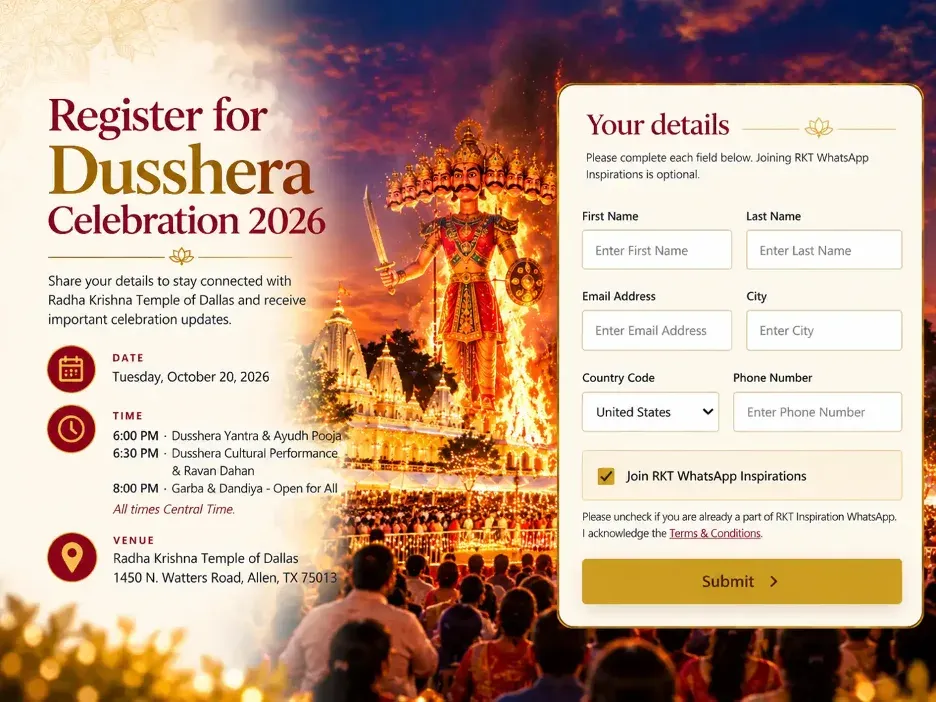
Dussehra 2026 will be celebrated on Tuesday, October 20, 2026, at Radha Krishna Temple of Dallas, 1450 N. Watters Road, Allen, TX 75013. The evening will bring together sacred worship, cultural programs, Ravan Dahan, and Garba and Dandiya.
2. What is the spiritual significance of Dussehra or Vijayadashami?
Dussehra celebrates the victory of dharma over adharma. It commemorates Shree Ram's triumph over Ravan and is also associated with Maa Durga's victory over Mahishasur. Spiritually, Vijayadashami inspires us to overcome negative tendencies such as anger, ego, greed, jealousy, attachment, and ignorance while cultivating righteousness, devotion, humility, and wisdom.
3. What is the schedule for Dussehra 2026 at Radha Krishna Temple?
The celebration begins at 6:00 PM with Dussehra Yantra and Ayudh Pooja. At 6:30 PM, the program continues with Dussehra Cultural Performances and Ravan Dahan, followed by Garba and Dandiya at 7:30 PM.
4. What is the significance of Dussehra Yantra and Ayudh Pooja?
Dussehra Yantra worship is associated with seeking divine blessings for wisdom, knowledge, concentration, and auspicious new beginnings. Ayudh Pooja expresses gratitude for the tools, books, instruments, and resources through which we study, work, create, and fulfill our responsibilities. Together, these traditions remind us to use our knowledge and abilities with humility and in accordance with dharma.
5. What does Ravan Dahan symbolize?
Ravan Dahan commemorates Shree Ram's victory over Ravan, but it also carries a powerful inner meaning. Ravan's ten heads can be contemplated as negative tendencies such as anger, greed, pride, jealousy, attachment, ego, desire, hatred, selfishness, and ignorance. Watching the effigy burn encourages us to identify and overcome these tendencies within ourselves, making Dussehra a celebration of both outer and inner victory.