
Introduction: A Story About a Story
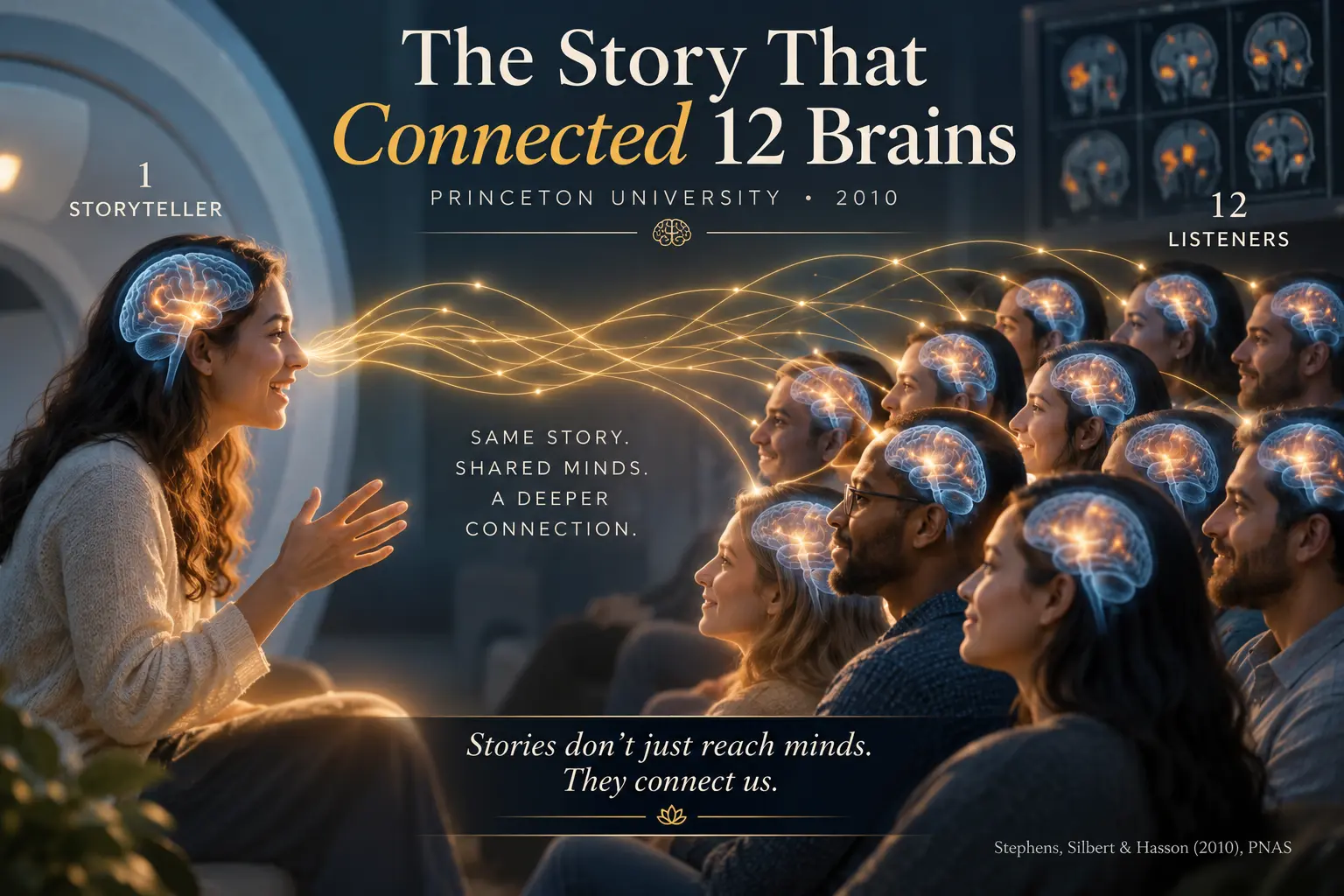
In 2010, a young woman lay inside an fMRI scanner at Princeton University and began telling a story.
Not a lecture.
Not a list of facts.
A story.
She remembered a disastrous experience from high school: a prom, two suitors, a fistfight, even a car accident.
Later, other people listened to her recorded story while researchers measured their brain activity.
And something extraordinary happened.
As the listeners followed her words, patterns of activity in their brains began to resemble patterns in the storyteller’s brain.
Different people.
Different histories.
Different minds.
Yet for a few minutes, one story created measurable alignment between them.
Even more fascinating, researchers found that the degree of speaker-listener neural coupling was related to how well listeners understood the story. In some brain regions, listeners even appeared to anticipate the speaker’s neural activity, and stronger anticipatory coupling was associated with better comprehension.
This is part of the Science of Storytelling.
Stories do something that information alone often cannot.
They invite us inside another person’s experience.
They engage imagination.
They hold attention.
They stir emotion.
They allow meaning to travel from one mind toward another.
And spirituality has understood the extraordinary power of stories for thousands of years.
In the Bhakti tradition, sacred storytelling is not merely a way of communicating information about God.
It is a way of bringing the mind toward God.
So perhaps the deeper question is not simply:
Why are human beings drawn to stories?
Perhaps it is:
What stories are we allowing to shape our minds and hearts?
What Is the Science of Storytelling?
The Science of Storytelling explores what happens in our minds and brains when one human being communicates an experience through narrative and another human being listens.
A story is different from a disconnected collection of facts.
Stories unfold.
Something happens.
Something changes.
We begin wondering what will happen next.
We imagine characters, places, motives, danger, hope, disappointment, and possibility.
The listener becomes mentally involved.
That involvement is part of what made the Princeton research so intriguing.
Neuroscientist Uri Hasson and his colleagues found that successful natural communication can produce corresponding patterns of brain activity across speaker and listener. They called this speaker-listener neural coupling.
The researchers were careful about what this meant.
The brains did not literally become identical.
Nor does storytelling somehow allow us to transmit thoughts directly from one brain into another.
Rather, during successful communication, patterns of neural activity across parts of the speaker’s and listeners’ brains became temporally related. When communication broke down, much of that coupling disappeared.
That gives us a beautiful scientific insight:
Stories do not merely transmit information.
They can help us experience meaning together.
That idea lies at the heart of the Science of Storytelling.
When One Mind Begins to Follow Another
Think about the difference between hearing these two statements:
“A woman experienced difficulty at her high-school prom.”
and:
“She arrived at the prom with one young man, another suitor appeared, a fight broke out, and before the evening was over there had even been a car accident.”
Immediately, the second version begins creating a world.
Who were these people?
What happened?
How did she feel?
What came next?
The Science of Storytelling helps explain why narrative can be so compelling.
A meaningful story can simultaneously recruit:
- attention
- imagination
- understanding
- emotion
Instead of merely receiving an abstract proposition, the listener begins constructing an experience.
We picture.
We predict.
We interpret.
We feel.
And this may be one reason stories often remain in memory long after individual facts have faded.
The story gives the facts somewhere to live.
Neural Coupling: What Did the Princeton Study Actually Find?
The 2010 Princeton study, published in the Proceedings of the National Academy of Sciences, examined brain activity during natural verbal communication.
Researchers recorded the storyteller’s brain activity while she told a real-life narrative and compared it with the brain activity of people listening to the story.
They found that the storyteller’s and listeners’ neural activity became coupled across multiple brain regions.
Importantly, when the researchers disrupted meaningful communication—for example, by having English speakers listen to an unintelligible Russian story—the extensive coupling largely disappeared beyond early auditory processing.
In other words, simply hearing the same sounds was not enough.
Meaning mattered.
And the researchers reported another remarkable finding: the stronger the neural coupling between speaker and listener, the better the communication tended to be.
This does not mean that every good story produces some perfect neurological synchronization.
But the Science of Storytelling gives us biological evidence for something human beings have sensed intuitively for millennia:
A powerful story can bring people into a shared mental space.
Why Stories Can Reach Us Differently Than Facts
Facts matter.
Accuracy matters.
Reason matters.
The Science of Storytelling is not an argument against any of them.
Instead, storytelling can give facts emotional and human context.
Consider hearing:
“Loneliness is associated with suffering.”
Now consider hearing about an elderly man who sets two cups on the table each morning even though his wife died the previous year.
The first communicates an idea.
The second gives the idea a face.
Stories transform abstractions into lived experience.
They can help us imagine a perspective we have never personally inhabited.
For a moment, someone else’s fear, joy, grief, hope, or struggle becomes easier to understand.
That is why storytelling has always mattered not only in entertainment but also in families, education, culture, leadership, history, and spiritual traditions.
Stories help human beings make meaning.
But they can also do something else.
They can shape what we repeatedly contemplate.
And that takes the Science of Storytelling into spiritual territory.
Swami Mukundananda’s Wisdom: The Power of Divine Stories

In Bhakti, storytelling has an ancient and sacred place.
Katha refers to the narration and contemplation of divine stories.
Shravan is attentive hearing of spiritual wisdom.
Swami Mukundananda explains that hearing Bhagavat Katha—the divine leelas, qualities, names, and glories of Shree Krishna—is far more than spiritual entertainment.
When we listen sincerely and repeatedly, sacred narratives help nurture:
Bhakti: devotion
Gyan: spiritual wisdom
Vairagya: detachment from worldly attachments
This gives the Science of Storytelling a beautiful spiritual counterpart.
Neuroscience asks:
What happens when minds become engaged by a story?
Bhakti asks:
What happens when the story filling the mind is divine?
The distinction is profound.
Katha is not merely about learning information about God.
It is about learning to fill the mind with God.
The Bhagavad Gita: Speaking and Hearing the Glories of God
The Bhagavad Gita offers a verse that could hardly be more appropriate to the spiritual dimension of storytelling.

मच्चित्ता मद्गतप्राणा बोधयन्त: परस्परम् ।
कथयन्तश्च मां नित्यं तुष्यन्ति च रमन्ति च ॥ 9॥
mach-chittā mad-gata-prāṇā bodhayantaḥ parasparam
kathayantaśh cha māṁ nityaṁ tuṣhyanti cha ramanti cha
BG 10.9: With their minds fixed on Me and their lives surrendered to Me, My devotees remain ever content in Me. They derive great satisfaction and bliss in enlightening one another about Me and in conversing about My glories.
Notice the language.
The devotees do not merely possess knowledge privately.
They enlighten one another.
They speak about God’s glories.
They hear.
They remember.
They rejoice.
Swamiji’s commentary explicitly connects this verse with shravan, hearing about God, as well as remembrance and chanting.
The spiritual power of story, then, is relational.
One person speaks.
Another listens.
And through that exchange, both minds can be lifted toward the Divine.
The Stories We Feed the Mind
The Science of Storytelling becomes especially relevant when we consider how many stories enter our minds every day.
Before breakfast, we may already have absorbed several.
A headline tells us the world is dangerous.
A social media post tells us someone else’s life is better.
An advertisement tells us we are incomplete without another purchase.
A conversation tells us someone has wronged us.
An inner narrative whispers:
“I’m behind.”
“I’m not enough.”
“Nothing ever works out for me.”
Not every story comes in the form of “Once upon a time.”
Some are interpretations repeated so frequently that we stop recognizing them as narratives at all.
The Science of Storytelling reminds us that stories attract attention and organize meaning.
Spiritual wisdom adds:
What we repeatedly contemplate matters.
Our minds gradually move toward the objects on which we repeatedly dwell.
That is why the stories we consume are not spiritually neutral.
They become part of the mental environment in which our thoughts, emotions, desires, and values develop.
What Stories Are Shaping Your Inner World?
This question sits at the center of the Science of Storytelling:
What stories are we allowing to shape our inner world?
Every day, we encounter narratives through:
- conversations,
- entertainment,
- news,
- social media,
- memories,
- relationships,
- and the stories we tell ourselves.
We cannot control everything we encounter.
But we can become more intentional about what receives repeated attention.
The question is not whether we should abandon ordinary stories.
Human stories can teach empathy, wisdom, courage, compassion, and truth.
The deeper question is whether our inner world contains enough sacred narrative to counterbalance the endless stream of worldly narrative.
Do we hear about Shree Krishna?
Do we contemplate His leelas?
Do we remember the lives of saints?
Do we listen to teachings that turn our minds toward devotion?
Do we give divine stories enough space to become emotionally real within us?
Because attention is precious.
And whatever repeatedly receives it begins to shape the landscape of the mind.
From Shravan to Chintan: Letting the Story Sink Deeper
Hearing is only the beginning.
A story can pass through our ears and disappear almost immediately.
Spiritual transformation requires something more.
Shravan gives us sacred wisdom.
Chintan, contemplation, allows that wisdom to sink deeper.
We hear the story.
Then we return to it.
We ask why it matters.
We imagine the scene.
We contemplate Shree Krishna’s qualities.
We consider what the leela reveals about love, surrender, compassion, grace, or devotion.
The Science of Storytelling shows that narrative can deeply engage human cognition.
Bhakti asks us to intentionally turn that capacity toward spiritual realization.
A divine story is therefore not merely something we hear once.
It becomes something we revisit until its meaning begins entering our own life.
Science and Spirituality: Two Different Insights Into Story
Science and spirituality are not making the same claim.
That distinction is important.
The Princeton research does not prove that sacred stories connect us to God.
And Bhakti does not need neuroscience to validate the spiritual significance of Katha.
They address different dimensions of human experience.
The Science of Storytelling examines mechanisms of communication, comprehension, attention, and neural alignment.
Spirituality asks what deserves our deepest attention and how contemplation can transform consciousness.
Placed beside one another, however, they offer a beautiful complementary insight:
Science shows us that stories can connect human minds.
Bhakti teaches us that divine stories can connect the mind and heart to God.
One describes communication.
The other points toward transformation.
Four Ways to Use Storytelling More Intentionally
The Science of Storytelling becomes more meaningful when it changes how we live.
1. Notice the Stories You Consume
For one day, simply observe.
What narratives are entering your mind through media, conversations, and entertainment?
Which leave you peaceful, compassionate, and elevated?
Which leave the mind restless?
Awareness itself can begin changing our choices.
2. Question the Stories You Tell Yourself
Not every inner narrative is true.
When you hear yourself thinking, “I always fail,” or “Nothing will ever change,” pause.
Ask:
Is this a fact—or a story my mind has created from selected facts?
3. Make Sacred Stories Part of Daily Life
Listen to Bhagavat Katha.
Read about Shree Krishna’s leelas.
Hear Swamiji explain scripture.
Allow sacred narrative to become part of the mind’s regular nourishment.
4. Contemplate, Don’t Merely Consume
After hearing a divine story, linger with it.
Ask:
What quality of God did this reveal?
What does this teach me about devotion?
How could this story change the way I live today?
That is where storytelling begins becoming transformation.
Key Takeaways: The Science of Storytelling
The Science of Storytelling reveals several beautiful truths.
- Storytelling can produce measurable coupling between patterns of neural activity in speakers and listeners.
- Greater speaker-listener coupling has been associated with better understanding.
- Stories can engage attention, imagination, comprehension, and emotion at the same time.
- Narrative can help us enter another person’s experience and construct shared meaning.
- The stories we repeatedly consume can influence what receives our attention.
- Bhakti has long recognized the spiritual power of Katha and Shravan.
- Swamiji teaches that sincerely hearing divine stories can cultivate Bhakti, Gyan, and Vairagya.
- Bhagavad Gita 10.9 describes devotees finding joy in speaking together about God’s glories.
- Sacred stories do more than tell us about God. They give the mind something divine to contemplate.
And perhaps the deepest insight is this:
Stories shape minds.
Divine stories can awaken hearts.
Final Reflection: What Story Will You Carry With You?
Return for a moment to that MRI scanner in Princeton.
One person begins speaking.
Across the room—and later, across different moments in time—other people listen.
Nothing physical travels between their brains except sound.
Yet through language, memory, imagination, and meaning, something extraordinary happens.
One person’s experience begins becoming understandable inside another person’s mind.
That is the wonder at the heart of the Science of Storytelling.
Stories help us cross the distance between human beings.
But every story also leaves something behind.
An image.
A feeling.
A belief.
A question.
A way of seeing.
And that means our deepest responsibility may not simply be to ask whether a story is interesting.
Perhaps we should also ask:
Where is this story taking my mind?
Because our minds are listening all day long.
To culture.
To other people.
To our memories.
To our fears.
To our own inner narrator.
Bhakti invites us to add another voice.
The stories of the Divine.
The leelas of Shree Krishna.
The wisdom of saints.
The words of scripture.
The teachings that remind us who we truly are and what this human life is ultimately for.
The Science of Storytelling shows us something remarkable about the capacity of stories to connect minds.
Bhakti gives that capacity its highest direction.
Through Katha, we do not merely learn another story.
We give our minds something sacred to return to.
Something beautiful to contemplate.
Something eternal to love.
So perhaps we can become more intentional about the stories we invite into our hearts.
Because stories can connect our minds.
And through Bhakti, divine stories can help connect our hearts to God.
That is the beautiful power of Katha.
Frequently Asked Questions About the Science of Storytelling
What is the Science of Storytelling?
The Science of Storytelling examines how narrative affects attention, comprehension, emotion, memory, communication, and brain activity. Research has shown that meaningful communication can produce correlated patterns of neural activity between storyteller and listener.
What is neural coupling in storytelling?
Neural coupling refers to temporal similarities between patterns of activity in a speaker’s brain and those of a listener during successful communication. In the Princeton research, stronger coupling was associated with better understanding of the story.
Do storytellers and listeners literally have the same brain activity?
No. “Neural coupling” should not be interpreted as two brains becoming identical or perfectly synchronized. Rather, researchers found corresponding temporal patterns across particular brain regions during meaningful communication.
Why are stories often more engaging than facts alone?
Stories provide context, sequence, people, motives, emotion, and uncertainty. They invite listeners to imagine what is happening and predict what may happen next. Facts remain essential, but narrative can help turn abstract information into meaningful human experience.
What is Katha in Bhakti?
Katha is the narration and contemplation of sacred stories, especially the divine names, qualities, and leelas of God. Swami Mukundananda teaches that sincerely hearing Bhagavat Katha can nurture devotion, spiritual wisdom, and detachment.
What is Shravan?
Shravan means attentive hearing of spiritual wisdom and the glories of God. It is one of the important practices of Bhakti and is closely related to Katha.
What does Bhagavad Gita 10.9 teach about sacred storytelling?
Bhagavad Gita 10.9 describes devotees whose minds are fixed on God finding satisfaction and bliss in enlightening one another and speaking about His glories. Swamiji connects this with hearing, chanting, and remembering God.
How can I choose better stories for my mind?
Begin by noticing what you repeatedly consume and how it affects your inner state. Limit narratives that continually provoke restlessness, comparison, or negativity, and intentionally make space for stories that cultivate wisdom, compassion, devotion, gratitude, and remembrance of God.
Call to Action: Fill the Mind With Divine Stories
If this exploration of the Science of Storytelling inspired you, consider discovering the deeper spiritual power of Katha through the teachings of Swami Mukundananda.
In the teaching featured with this Tidbit, Swamiji explores the life-changing spiritual significance of the Srimad Bhagavatam and why hearing and contemplating divine wisdom can elevate the mind and nourish devotion.
And for hundreds of additional teachings on the Bhagavad Gita, Shree Krishna’s leelas, Bhakti, mind management, meditation, devotion, happiness, and God-realization:


We cannot prevent every story in the world from reaching our ears.
But we can become more intentional about which stories we allow to live in our hearts.
Stories can connect our minds.
Divine stories can help connect our hearts to God.