

|
“Emi dova lachu vadu? Emi cheppina vadu?” What can be given to Him? What can be said of Him? — Annamacharya, in surrender to Tirumala |
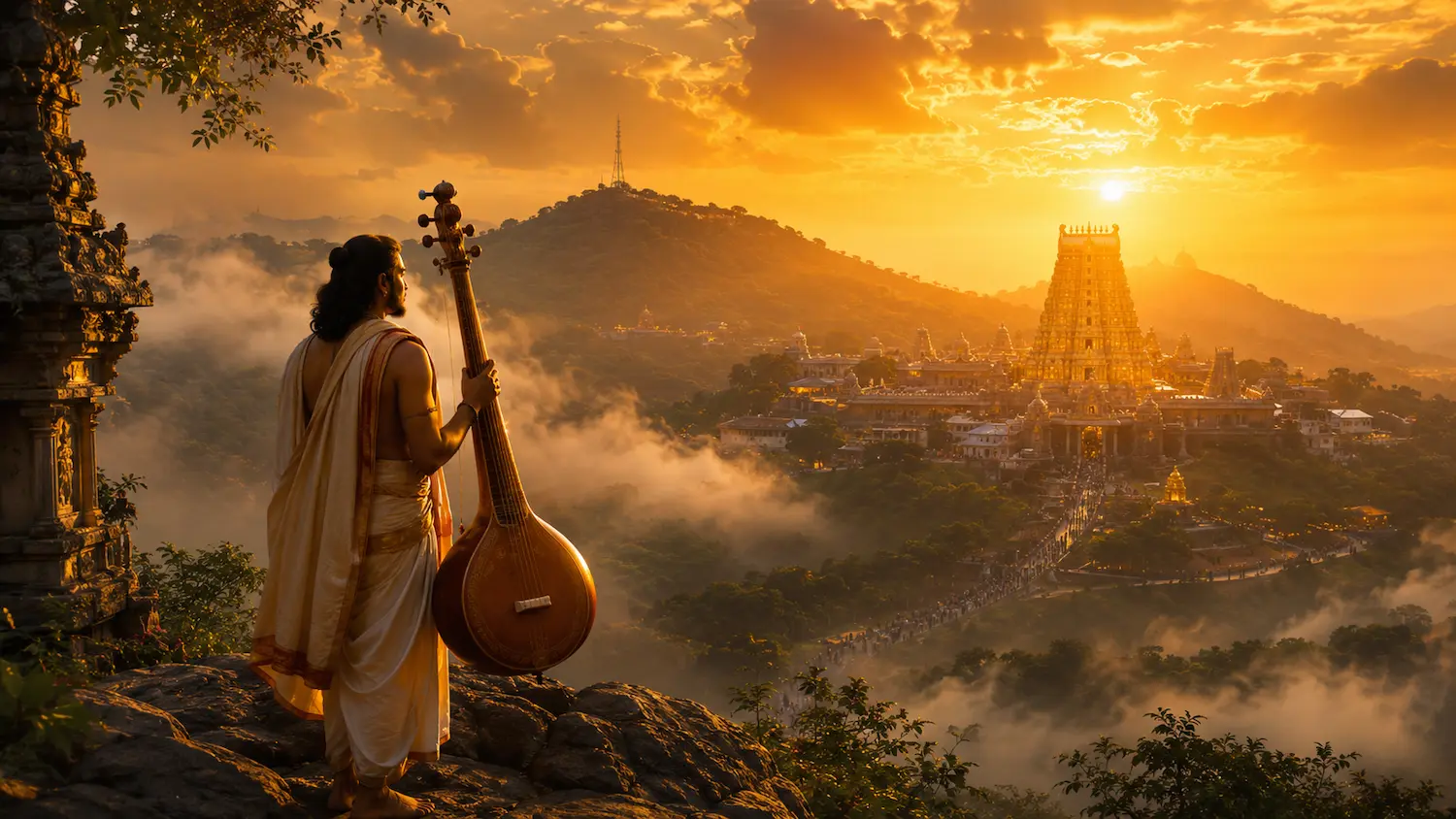
There are saints who speak about God. And then there are those rare souls who dissolve into God, who lose themselves so completely in His beauty, His names, and His love that their every breath becomes a kirtan, their every tear a prayer, and their every silence a song.
Annamacharya was one such soul.
For 94 years, he poured himself like an offering into the lotus feet of Lord Venkateswara, the presiding deity of Tirumala and the Lord of the Seven Hills. In that act of complete surrender, he became immortal.
He composed thousands of devotional songs, but his legacy rests on something deeper than literary achievement. His compositions emerged from a life immersed in remembrance, surrender, and love.
To read Annamacharya is to stand at the gates of Tirumala, not as a tourist, but as a longing child who has been separated from the most beloved of all beloveds. His Sanskrit kirtans and Telugu sankeertanas are more than religious poetry. They offer a glimpse into the inner world of a devotee whose entire life revolved around God.
Swami Mukundananda teaches that the highest purpose of human life is to develop deep love for God, what the scriptures call bhakti. Through that lens, the life of Annamacharya shine like a beacon. His story shows not only who God is, but who we can become when we turn our faces, our hearts, and our very existence toward the Lord.
This is not merely a historical account. It is the story of a soul transformed by divine love, and of the songs that continue to inspire seekers six centuries later.
|
✨ Lord Venkateswara Is Coming to Dallas — July 1–5, 2026 The life of Annamacharya makes this article especially timely right now. For the first time in the Dallas–Fort Worth area, Radha Krishna Temple of Dallas (Allen, TX) will perform the historic Śrī Venkateśwara Prāṇa Pratiṣṭhā Mahotsavam — the sacred Vedic consecration through which the divine life of Lord Balaji will be invoked into His new home, just twenty minutes from thousands of North Texas devotees. Five days of Vedic homams, Agamic rituals, and community celebrations. The same Lord Annamacharya walked 100 kilometres to behold is arriving at your doorstep. |
|
Annamacharya — At a Glance Born: 1408 CE, Tallapaka village, Andhra Pradesh Passed away: 1503 CE, age 94 Total compositions: 32,000 sankeertanas (one every day by divine instruction) Recovered compositions: 14,000 (inscribed on 141 copper plates, rediscovered in 1922) Published: 1992, as 29 volumes of Tallapaka Sahitya Dominant mood: Madhurya Bhava (70% of all compositions) Spiritual guru: Ghana Vishnu of Tirumala Titles: Pada Kavita Pitamaha; Adi Kavi of Telugu Pada Sahitya; one of the three pillars of Telugu Sahitya |
Who Was Annamacharya? A Life Soaked in Devotion
Tallapaka Annamacharya, known simply as Annamacharya and lovingly honored as Pada Kavita Pitamaha ("the grandfather of devotional poetry"), was born in 1408 CE in the village of Tallapaka in the Cuddapah district of present-day Andhra Pradesh, India. He lived for 94 years and, according to tradition, composed a sankeertana every day of his life.
He is revered as the Adi Kavi of Telugu Pada Sahitya, the first great poet of devotional song in the Telugu tradition. He stands as one of the three supreme pillars of Telugu Sahitya, alongside Ramadasu and Thyagaraja.
A Destiny Prepared Across Generations
Annamacharya was born into a Telugu Brahmin family of the Nandavarika Kamma tradition. According to tradition, his parents, Narayasuri and Lakambamba, longed for a child and prayed earnestly to Lord Venkateswara at Tirumala. One night, the Lord appeared to them in a dream and assured them that a special child would be born into their home.
Soon afterward, Annamaya was born.
His name carries its own significance. Derived from a name of Lord Vishnu found in the Vishnu Sahasranama, it connects the child to the Lord from his very first breath.
Tradition also holds that Annamacharya was an incarnation of Nandaka, the celestial sword of Lord Vishnu. Whether understood literally or symbolically, the image is striking. A sword cuts away illusion and ignorance. In much the same way, Annamacharya's mission was to awaken devotion through music and remembrance.
His songs were not ornaments. They were instruments of awakening.
|
The Name ‘Annamaya’ The name Annamaya comes from the 105th verse of the Vishnu Sahasranama — a name for Lord Vishnu Himself. It refers to Vishnu as the one who energizes anna — the food that all living beings eat. In one sense, He is the Prana-Rasa, the life-essence described in the Upanishads as the prana of all living beings. The child named Annamaya was thus named after the Lord from his very first breath. |
A Childhood Saturated in the Divine
From an early age, Annamaya displayed an unusual attraction to Lord Venkateswara. Stories preserved in the tradition describe him refusing ordinary food and accepting only the Lord Venkateswara's prasad. At bedtime, his parents filled his imagination with stories of Tirumala, the Seven Hills, and the pastimes of the Lord.
He grew up inside those stories, and those stories grew inside him.
Swami Mukundananda explains this beautifully: when you relate the pastimes of the Lord to little children, they are remarkable at visualizing. They create in their minds the imagery that provides them the basis for bhakti for a lifetime. For Annamaya, these stories were more than lessons. They became part of his inner world. The Seven Hills were not merely a place on a map. They felt like home.
He learned Sanskrit, Telugu, music, and philosophy from a young age. He could comprehend philosophical ideas and expound on them with ease. Even while tending cattle in the fields, his mind remained absorbed in thoughts of the Lord.
The Sickle, the Blood, and the Question That Changed Everything
Annamaya was sixteen years old. One day, while tending cattle, he was cutting grass with a sickle when the blade slipped and sliced his finger. Blood began to flow.
The wound itself was minor. What followed was not.
Standing alone in the field, he found himself asking questions that most people spend a lifetime avoiding. Why had this happened? Who was truly responsible for his suffering? Were my relatives who sent me here responsible? Am I responsible? And even if they were responsible, do they have the ability to help me right now, in this moment of pain? What is my connection with them truly? Will they be with me at the last moment of my life?
As he reflected, a realization arose within him: no earthly bond could offer permanent shelter. The only lasting refuge was God.
At that very moment, a group of pilgrims passed by on their way to Tirumala, singing the names of Lord Venkateswara. His spiritual samskaras, the deep impressions from devotion in past lives, were awakening. Something stirred inside him. Without hesitation, he left the cows. He left the fields. He left everything behind and joined that joyful band of devotees, singing and walking with them on a 100-kilometer journey toward Tirumala.
He was not running away. He was running toward.
The Ascent: Every Step a Prayer
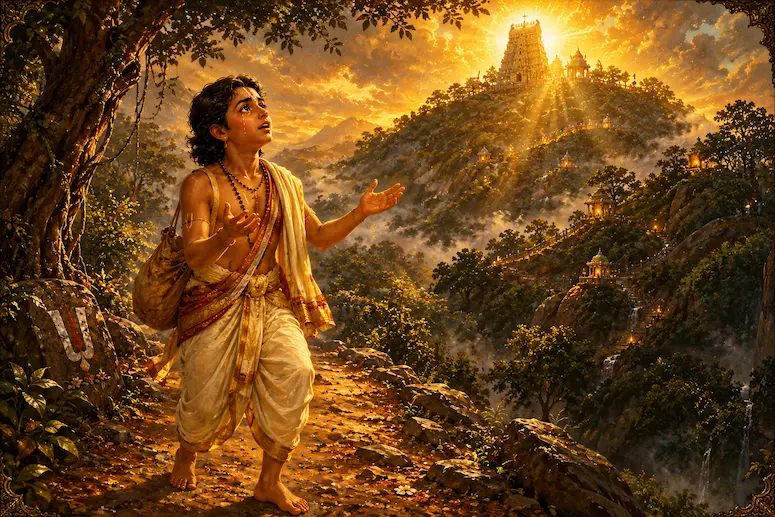
This was the year 1424.
Travel to Tirumala in those days was difficult. Pilgrims walked through forests, crossed rough terrain, and climbed steep hills on foot. Yet for Annamaya, every step carried him closer to the One he had loved since childhood.
The journey to Tirumala in those days was nothing like the road-accessible pilgrimage of today. Annamaya walked on foot through forests, hills, and rough terrain.
Following tradition, he first offered prayers at the temple of Goddess Gangamma, considered the sister of Lord Venkateswara, praying for inner cleanliness before approaching the Lord. Her sacred purpose is to slay the demons within the devotee: anger, greed, desire, and hatred. He then paid homage at sacred sites along the route before beginning the ascent of the Seven Hills.
Then Annamaya climbed. The 12 to 13 kilometer ascent through the Seven Hills.
When the hills finally came into view, something inside him recognized them immediately. This was no ordinary landscape. He recognized it as a soul recognizes home. He had heard these hills described since childhood. But now he stood in them. And immediately, spontaneously, a song arose from his heart:
"This is the land where even celestial gods take on the form of animals and roam freely. This is Vaikunta on earth."
Exhausted from the 100 kilometers on foot journey, he eventually collapsed into a deep sleep upon the hillside.
According to tradition, Goddess Padmavati, consort of Lord Venkateswara and also known as Alamelu Manga, appeared to him in a dream. She came to him as a mother comes to a tried child. She nursed him. She removed all his exhaustion and blessed him.
When he awoke, overwhelmed with gratitude, he composed the Venkateswara Shatakam, one hundred verses addressed to Goddess Alamelu Manga, each one ending with the name of Lord Venkateswara. This was his first major devotional work. A hundred verses of thanksgiving for a dream in which a goddess wiped away his tiredness.
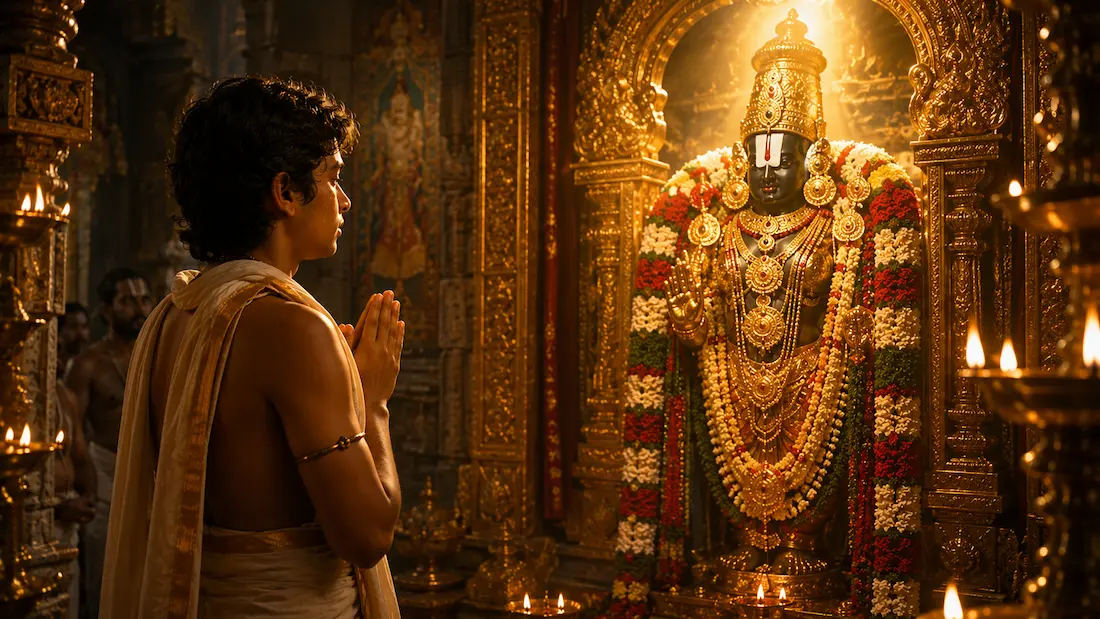
The Darshan And the Divine Instruction That Defined His Life
When Annamaya finally entered the great sanctum of Tirumala and received darshan of Lord Venkateswara, he experienced what he had been born to experience. All his spiritual practices, all his childhood impressions, and all his longing suddenly found their goal and purpose. He felt as if everything in his life until that moment had been preparation for this single instant.
He stood before the Lord and simply kept looking. For a moment, nothing else existed. Not the pilgrims around him. Not the temple. Not the years behind him. Only the Lord.
And then the Lord spoke, not to the crowd, not to the priests, but to this sixteen-year-old boy from Tallapaka who had walked 100 kilometers, climbed the hills, and fallen asleep from exhaustion on a cliff.
"I want you to write one bhajan every day of your life."
Swami Mukundananda reflects on this divine instruction with profound insight: to write one bhajan every day means you must keep God in your head. Otherwise, how will you write it? A poet who composes one devotional song every single day, think about the level of God-consciousness that must be sustained inside him. This was not a creative assignment. It was a prescription for unbroken divine remembrance. It was a life sentence of love.
Annamaya said yes. And he kept his word. Every single day, for the rest of his 96 years.
Receiving the Garland : The Lord’s Public Acknowledgment
On his second day at Tirumala, Annamaya came for afternoon darshan, only to find the temple curtains closed. The Lord was resting after the Rajabhoga offering, and darshan was not available.
For most pilgrims, this would have been a minor inconvenience. For Annamaya, it was devastating. He felt as if the Lord had withdrawn Himself, as if the Beloved had turned away. He stood before the closed curtains and wept. In that anguish of separation, he began reciting the Venkateswara Shatakam he had just composed on the hillside.
As he recited, something extraordinary happened. All of a sudden, the curtains opened. And the garland adorning Lord Venkateswara fell from the deity's neck to the floor.
The priests who witnessed the moment were astonished.
The Lord could not step down from the sanctum to embrace a devotee. But He could let His garland fall.
It was the Lord's way of saying: I hear you. I see you. You are Mine. The priests acknowledged Annamaya as a devotee bearing the special blessing of Venkateswara Bhagavan.
Subsequently, he began residing in Tirumala.
Life on the Sacred Hills: A Festival Without End
Life in Tirumala transformed him.
In the mornings, he participated in the Suprabhatam, the famous early morning awakening of the Lord. During the day, the Kalyana Mahotsavam, the divine wedding of Venkateswara and Padmavati, was celebrated. At noon came the Rajabhoga offering. At night came the Shayanotsavam, when the Lord was ceremonially put to rest.
Annamaya's days were woven entirely from these divine rhythms. He composed for each occasion, for each time of day, for each festival, and for each mood of the Lord. His life and the Lord's life in the temple became inseparable.
It was during this period that he met his guru, Ghana Vishnu, a saint of Tirumala. Under his guidance, Annamaya formally entered the Sri Vaishnav tradition and received initiation. From that point onward, he became more widely known as Annamacharya.
The young pilgrim who had arrived searching for the Lord had found both his spiritual home and his life's work.
|
What Swami Mukundananda Says About Bhav Annamacharya sings: “Your bhav creates your destiny. You create the bhav toward the land of the Seven Hills and see it as Vaikunta. You create the bhav toward the divine Yamuna and see it as sacred.” Jagadguru Kripaluji Maharaj taught: “God does not reside in wood or in stone — but in the love-filled heart. With that love, you see Him in the deity, and He actually exists there — not 99.9% but 100% for His devotees.” Annamacharya’s entire life was proof of this teaching. |
Called Back to the World: How He Transformed It
News of Annamacharya's life in Tirumala eventually reached his parents.
Narayasuri and Lakambamba came to the sacred hills and searched until they found their son. His mother pleaded with him to return home. When her efforts failed, she turned to his guru, Ghana Vishnu. Moved by her distress, the guru advised Annamacharya to accompany his parents back to Tallapaka. He obeyed.
Soon afterward, his family arranged his marriage to two sisters, Tirumalamamba and Akkalamamba.
At first glance, this might seem like a departure from the path of devotion. Instead, it deepened it. Annamacharya did not see household life as separate from spiritual life. He saw the Divine reflected within it.
When husband and wife argued, his mind would fly to the divine quarrels between Lord Venkateswara and Goddess Padmavati, and he would compose a bhajan of the Lord patiently saying, "Tolerate, tolerate, it is all right." When his mother-in-law and daughter-in-law experienced domestic friction, he saw in it the relationship between Lakshmi, the mother, and Saraswati, Brahma's wife and the daughter-in-law, and composed a bhajan of their divine exchange. When small toddlers played at his feet, he thought of Sri Krishna's childhood leelas and wrote bhajans about them.
Each ordinary moment became material for devotion. Each experience became a song.
Swami Mukundananda often teaches that bhakti does not require abandoning the world. It requires changing the way we see it. Annamacharya embodied that principle naturally. Family life did not distract him from God. It continually reminded him of God.
The world was his scripture. Every ordinary moment became a doorway to the Divine.
The Imprisonment and the Chains That Broke
During this period, a king of the region, Salva Narasimha Raya, predecessor to the great Krishnadevaraya of the Vijayanagara Empire, became a friend and disciple of Annamacharya.
But a king's mind can carry shadows even amid spiritual association. One day, Salva Narasimha Raya asked Annamacharya to compose a bhajan praising the king and his queen.
Annamacharya's response came, as all his responses did, through a song. In it, he addressed his own mind:
"O my mind, are you going to write a bhajan about a king? Are you going to be seduced by the temptation of wealth? Or is your voice, your vani, reserved for glorifying your Lord alone?"
It was a direct refusal. A public declaration of devotional fidelity. The king could not tolerate the insult. Annamacharya was imprisoned, and iron chains were locked around him.
In the prison, he prayed. He sang. He composed.
And one day, by divine grace, by the intervention of the Lord who would not allow His devotee to suffer for love of Him, the iron chains simply broke apart.
The event left a profound impression on the king, whose reverence for Annamacharya only deepened afterward.
For Annamacharya, however, the incident served as a reminder of how easily worldly power can become a distraction. He gradually withdrew from public life and returned to the Seven Hills, where he spent the remainder of his years immersed in worship, song, and remembrance of Lord Venkateswara.
|
Did You Know? The copper plates containing Annamacharya’s sankeertanas were preserved in the vaults of the Tirumala temple for centuries. When they were rediscovered in 1922, it was considered one of the most significant literary and spiritual finds of the 20th century in South India. The recovered inscriptions run into thousands of sankeertanas, each one a heartbeat of devotion. |
Annamacharya: A Lineage of Devotion
Annamacharya's devotion did not end with him. His son, Pedda Tirumalacharya, and his grandson, Chinna Tirumalacharya, became celebrated poets and servants of Lord Venkateswara in their own right. Over time, the Tallapaka family became closely associated with devotional service at Tirumala and played an important role in preserving and extending Annamacharya's spiritual legacy.
The family's contribution stands as a testament to the enduring power of bhakti. What began as one devotee's love for the Lord became a tradition that continued across generations.
What is remarkable is that his domestic life never diminished his devotion; it deepened it. Swami Mukundananda teaches that true bhakti does not require abandoning the world; it requires transforming one's vision so that everything in it becomes a reminder of the Beloved. Annamacharya embodied this completely. His wife was Lakshmi, his children were the Lord's gifts, his home was a temple, and his daily life was an unbroken act of worship.
The Nectar Within the Songs: Annamacharya’s Devotional Moods
The enduring power of Annamacharya's compositions lies not only in their poetic beauty, but in the depth of feeling that animates them. His songs are alive with bhav, the devotional emotion that transforms poetry into prayer.
The bhakti tradition describes several devotional relationships through which the soul approaches God. Annamacharya explored them all with remarkable freedom, moving between moods as effortlessly as a master musician moves between ragas.
Swami Mukundananda highlights a striking fact: nearly 70 percent of Annamacharya's compositions express Madhurya Bhav, the mood of intimate divine love. For a saint of such spiritual realization, that predominance is revealing. It suggests that the highest reaches of devotion ultimately culminate in love.
His songs are more than compositions. They are invitations into lived spiritual experience.
Let us enter a few of those sacred worlds.
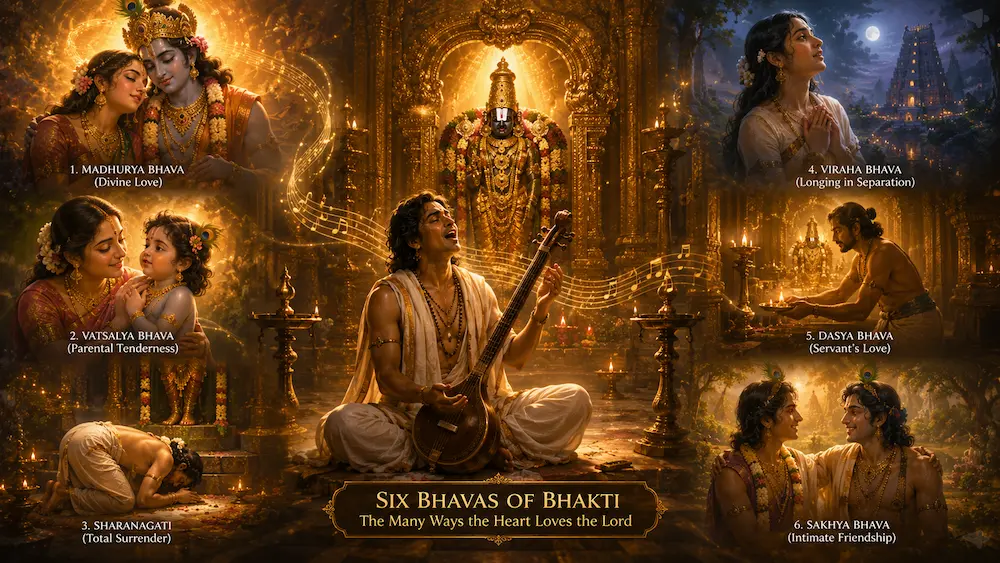
Madhurya Bhav: The Sweetness That Maddens the Heart
Madhurya Bhav is the devotional mood in which the soul approaches God as the Beloved. It is the mood that dominates Annamacharya's work, accounting for nearly seventy percent of his compositions. It is the most intense, most intimate, and most transformative of all spiritual moods.
For Annamacharya, Lord Venkateswara was not a distant deity. He was the supreme Beloved, beautiful beyond description, desirable beyond all desire, and yet graciously present on the hills of Tirumala for the sake of His devotees.
One of the finest examples of this mood appears in Nigama Nigamantha. In the song, Annamacharya marvels at the Lord's paradoxical nature. The Supreme Being worshipped by celestial beings is also the playful butter thief who steals the hearts of His devotees.
"Navanita Chora Sri Narayana"
O Narayana, stealer of butter.
This is the heart of Madhurya Bhav. The Lord remains fully divine, yet becomes irresistibly lovable, approachable, and emotionally captivating.
Swami Mukundananda often explains that the sweetest devotion arises when the devotee can appreciate both God's greatness and His tenderness at the same time. Annamacharya's songs embody that balance.
The mood deepens further in Ksheerabdhi Kanyakaku Sriman Narayanudaku, his celebrated composition describing the divine union of Lord Venkateswara and Padmavati.
"Ksheerabdhi Kanyakaku Sriman Narayanudaku"
To the daughter of the Ocean of Milk, to Sri Narayana...
Here, Annamacharya writes with extraordinary intimacy, describing the beauty, grace, and presence of the divine couple. Yet beneath the imagery lies something deeper: the longing of the devotee who yearns for complete union with the Beloved. Later scholars sometimes hesitated to translate such passages literally, fearing that readers might miss the sanctity beneath the imagery. But for Annamacharya, there was nothing more sacred than this love. He described the Lord adorning Himself, the fragrance of His form, the sound of His anklets upon the marble floor, and the way the night seemed to hold its breath in reverence as the divine couple rested.
That longing is one of the defining features of Madhurya Bhav. Love draws the soul toward God, while simultaneously making it aware of the distance that remains.
Sweetness and longing coexist. Joy and yearning become one. One feels the ache of being outside the door of that chamber, the sweetness-laced pain of the devotee who longs for that closeness and knows it will come, eventually, when the ego is fully surrendered.
Vatsalya Bhav: The Tenderness That Melts the Universe
Vatsalya Bhav is the mood of parental love, in which the devotee relates to God as a beloved child. In the Vaishnav tradition, Yashoda's love for child Krishna stands as its highest expression. Annamacharya brought that same tenderness to his relationship with Lord Venkateswara.
His celebrated lullaby Jo Achyutananda remains one of his most beloved compositions. In it, the devotee rocks the Lord to sleep with the affection of a mother soothing her child.
"Jo Achyutananda Jo Jo Mukunda"
Sleep peacefully, O Achyuta, O Mukunda.
-From Jo Achyutananda
He speaks of the Lord's small feet, His curling hair, the way His lips part in sleep, and the sound of His breathing in the dark of the temple. Yet in these same songs, he also reveals a profound truth that tender God who allows Himself to be rocked to sleep is the same Lord who holds all creation in His palm.
Swami Mukundananda often emphasizes this paradox of bhakti. The Infinite allows Himself to become intimate. The Supreme becomes approachable through love.
For Annamacharya, this mood was deeply personal. The children he saw in everyday life reminded him of Krishna's childhood pastimes, and those impressions naturally flowed into his poetry.
Reading these songs, one is struck less by theology than by affection. They remind us that devotion is not always expressed through awe or reverence. Sometimes it takes the form of a parent quietly watching over a sleeping child. One feels the ache of tenderness. The mother who truly understands what she holds in her arms trembles not with fear, but with a love that has no language.
Sharanagatam: Total Surrender, The Most Beautiful Helplessness
If Madhurya Bhav is love reaching toward God, Sharanagati is love falling at His feet. It is the mood of complete surrender, the moment the devotee stops bargaining, stops relying on personal merit, and seeks refuge in divine grace alone.
Annamacharya returned to this mood again and again in his compositions. He often described himself as unworthy, a sinner, a fool, a soul with nothing to offer except his dependence on the Lord. Yet these prayers are not marked by despair. They are marked by trust. It was the joyful, liberating recognition that none of his unworthiness matters before the Lord's infinite compassion. He writes with the abandon of a child who has no reputation to protect before a parent who has already forgiven everything.
In one sankeertana he asks:
"What sin have I not committed? What good deed have I done? Nothing. But You, O Lord, uplift the fallen. So here I am. Do with me what You will."
The power of this prayer lies in its honesty. It does not present accomplishments or spiritual achievements. It arrives empty-handed and relies entirely on the Lord's compassion.
Swami Mukundananda often teaches that the devotee who approaches God with complete dependence is dearer to Him than one who relies solely on knowledge or personal effort. Annamacharya embodied that spirit.
"Venkatesa Vinnapamu Vinnavaadi"
O Venkateswara, hear this prayer of one who has nothing left but You.
This teaching resonates at the core of Swami Mukundananda's bhakti approach: God's grace is not earned by qualification. It is received by surrender. Annamacharya's songs remind us that the Lord does not wait for perfection. He responds to sincerity, humility, and the willingness to place oneself completely in His hands. Annamacharya gave permission to every ordinary person, not just the scholar and not just the sannyasi, to love the Lord as they are. Not as they might someday become. Exactly as they are, right now.
Viraha Bhav: The Ecstasy of Divine Longing
Viraha is the mood of separation from the Beloved. In the bhakti tradition, it is not viewed as a failure of devotion but as one of its highest expressions. Longing reveals the depth of love.
When you miss someone deeply, it means they matter. When you ache for God's presence, it means He has already become central to your life.
Annamacharya understood this mood profoundly. After receiving initial darshan of Lord Venkateswara, his entire life became an alternation between the bliss of presence and the agony of separation. He would ascend Tirumala and weep at the sight of the Lord. He would descend and weep at the distance. His sankeertanas in this mood have a quality of aching that pierces the heart of even a causal reader.
In one song, he writes:
"Dol dol mani doluvu..."
Swinging, swinging, my heart swings in your absence like a child's cradle left empty.
In another celebrated composition, Annamacharya imagines himself as a woman in a village who has heard news of the Lord from a traveling devotee. She rushes to the window and scans the road ahead. She sees only dust, distance, and the ordinary world. Yet she cannot stop looking. Love, once awakened, does not know how to turn away.
This is viraha. Not tragedy. Transformation.
Swami Mukundananda teaches that spiritual longing has immense power because it gathers the mind and heart around a single object: God. In that state, worldly desires lose their grip, distractions fade, and the soul becomes wholly directed toward the Divine.
The longing itself becomes a form of union.
The distance begins to close.
Dasya and Sakhya: The Servant and the Friend
Annamacharya also expressed devotion through Dasya Bhav, the mood of loving service. He saw himself as the servant of Lord Venkateswara, not out of obligation, but out of affection. In his songs, even the simplest acts of service, sweeping the temple floor, carrying water, or arranging flowers, become sacred because they are offered to God. Annamacharya depicts himself as someone who has no agenda, no ambition, and no destination other than the satisfaction of his Master.
Alongside this mood of service was Sakhya Bhav, the mood of friendship. In these compositions, Annamacharya speaks to the Lord with remarkable intimacy. The distance between devotee and deity softens, replaced by the trust and ease of a cherished friendship.
Swami Mukundananda often teaches that the value of an offering lies not in its scale but in the love behind it. Annamacharya's life embodied that truth. Whether serving the Lord as a humble attendant or speaking to Him as a trusted friend, his devotion transformed ordinary acts into expressions of divine love.
Songs That Crossed Centuries: His Most Celebrated Compositions'
Of the 14,000 of sankeertanas recovered and published attributed to Annamacharya, a handful have remained especially beloved across generations. Together they reveal the breadth of his devotional vision: unity, love, longing, surrender, celebration, and complete dependence upon the Lord.
Each song opens a different window into his spiritual world.
1. Brahmam Okate: The Great Unifying Vision
Among Annamacharya's most celebrated compositions, Brahmam Okate proclaims the unity of all existence in the one Supreme Reality.
"Brahmam Okate, Parabrahmam Okate"
The Supreme Reality is One.
Rather than presenting philosophy as an abstract concept, Annamacharya expresses it through simple and memorable images. Just as rivers eventually merge into the same ocean and many lamps are lit by the same fire, all beings ultimately rest in the same Divine source. Every being you encounter is the same Supreme Reality wearing a different costume. To see this is not to become detached from the world. It is to fall in love with everything in it, because everything in it is Him.
Swami Mukundananda teaches that spiritual wisdom begins with seeing the same divine presence in all. Brahmam Okate transforms that teaching into song, making a profound truth accessible to everyone.
2. Jo Achyutananda: The Lullaby That Rocked the Universe
Among Annamacharya's most beloved compositions, Jo Achyutananda captures the essence of Vatsalya Bhav, the love of a devotee for God as a child.
In this gentle lullaby, the Lord of the universe is no longer distant or awe-inspiring. He is a child being rocked to sleep. The Infinite becomes intimate. The Supreme becomes approachable.
For generations, devotees have cherished the song for its extraordinary tenderness. It reminds us of a central truth of bhakti: the God who sustains creation also allows Himself to be loved with the affection of a parent.
What remains is not philosophy, but love.
3. Adigo Alladigo Sri Hari Vasamu: The Vision of Sacred Hills
Adigo Alladigo Sri Hari Vasamu is among Annamacharya's earliest and most beloved compositions. Tradition holds that he sang it spontaneously upon first beholding the Seven Hills of Tirumala.
"Adigo Alladigo Sri Hari Vasamu"
Behold! There lies the sacred abode of Lord Hari.
From Adigo Alladigo
The song is more than a description of a landscape. It is the response of a devotee who sees the Lord's presence reflected in the land itself. For Annamacharya, the hills of Tirumala were not merely geography. They were sacred ground, alive with remembrance of Lord Venkateswara.
The mood of the composition is one of awe, gratitude, and longing. The devotee sees the hills and knows that the Beloved is near.
Swami Mukundananda teaches that advanced devotees learn to see the Divine where others see only the ordinary. In this song, Annamacharya transforms a view of distant hills into an act of worship.
His contribution to Tirumala was profound. Through songs such as Adigo Alladigo, he helped generations of devotees see the sacred landscape not merely as a pilgrimage destination, but as a living expression of the Lord's presence.
Annamacharya’s contribution to Tirumala is comparable to what the six Goswamis of Vrindavan did for that holy dhama — by glorifying every stone, every hill, every stream, he helped billions of people cultivate their bhakti through this sacred land.
4. Vinaro Bhagyamu Vishnu Katha: The Spiritual Fortune of Hearing
Vinaro Bhagyamu Vishnu Katha is a joyful celebration of shravanam, the devotional practice of hearing the glories of Lord Vishnu.
"Vinaro Bhagyamu Vishnu Katha"
Listen! What great fortune, the stories of Lord Vishnu!
-From Vinaro Bhagyamu
The song radiates enthusiasm and gratitude. Annamacharya presents the opportunity to hear the Lord's names, pastimes, and glories as one of life's greatest blessings.
Swami Mukundananda frequently teaches that hearing and remembering God purifies the mind and plants seeds of divine love. Annamacharya conveys the same truth, not through philosophy, but through celebration.
He does not persuade the listener to engage in spiritual practice. He makes the practice itself irresistible.
5. Oka Maru Cheppe: Say It Just Once
In Oka Maru Cheppe, Annamacharya gives voice to one of the deepest longings in the devotional tradition: the desire to be personally acknowledged by the Lord.
The devotee asks for neither liberation nor material blessings. He asks for only one thing: that the Lord speak his name.
The simplicity of the request is what gives it such power. In the Vaishnava tradition, to be recognized by God is itself a form of grace. The devotee longs not merely to see the Lord, but to be known by Him.
The song's emotional appeal is universal. Every human being understands the desire to be seen, remembered, and cherished by someone they love. Annamacharya takes that familiar longing and directs it toward the Divine.
The result is a prayer of remarkable tenderness, one that captures the essence of Viraha Bhava: the soul yearning for a response from its Beloved.
6. Ksheerabdhi Kanyakaku: The Wedding of Heaven
Ksheerabdhi Kanyakaku celebrates the divine wedding of Lord Venkateswara and Goddess Padmavati, one of the most beloved themes in Annamacharya's devotional poetry.
The composition is filled with reverence, joy, and admiration for the divine couple. Through vivid imagery and affectionate detail, Annamacharya invites listeners to witness a sacred union that symbolizes the harmony of the Divine and His eternal Shakti.
More than a description of a celestial wedding, the song expresses the devotee's longing to participate in the Lord's divine pastimes. It reflects a central theme of bhakti: that the highest spiritual fulfillment lies not in escape from the world, but in loving participation in God's eternal relationship with His devotees.
For generations, the composition has remained a cherished reminder of the beauty, joy, and intimacy at the heart of devotional life.
7. Emito Neeve: You Are Everything
In Emito Neeve, Annamacharya addresses the Lord through a series of intimate declarations:
You are my father. You are my mother. You are my friend. You are my wealth. You are my refuge. You are my joy. You are my very breath.
With each line, the relationship deepens. The devotee no longer sees God as one source of comfort among many. The Lord becomes the center of life itself, the source from which every other relationship and blessing derives its meaning.
Swami Mukundananda often describes mature bhakti in similar terms: when God is no longer one important thing among many important things, but the only thing. He becomes the axis around which life turns.
Emito Neeve gives voice to that realization. It is the song of a soul that has discovered its ultimate refuge and sees the Lord everywhere it turns.
The Eternal Echo: Annamacharya's Spiritual Legacy
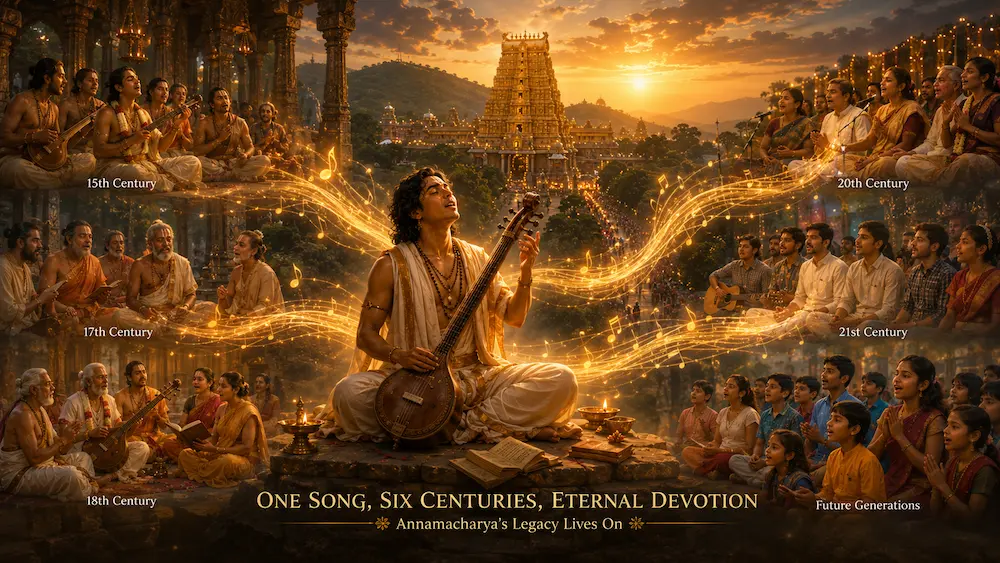
Six hundred years have passed since Annamacharya first climbed the hills of Tirumala with a heart on fire.
The hills are still there. The Lord is still there. And the songs are still there, continuing to inspire devotees centuries after they were first sung.
What explains their enduring power? Why do compositions written in the fifteenth century still move modern listeners?
He Made God Accessible
Annamacharya composed primarily in Telugu, the language of the people, at a time when much of devotional expression was confined to Sanskrit and accessible mainly to scholars. Through his songs, Lord Venkateswara moved from the realm of theological abstraction into everyday life, into the village, the home, the heart of a mother, and the service of a devotee sweeping the temple floor.
This was not a simplification of spirituality. It was one of bhakti's central insights: that the infinite God willingly makes Himself accessible to the heart that loves Him.
By expressing profound spiritual truths in language ordinary people could sing, remember, and cherish, Annamacharya helped make devotion a lived experience rather than the preserve of a learned few.
That same principle is at the heart of the Śrī Venteśwara Prāṇa Pratiṣṭhā Mahotsavam at Radha Krishna Temple, Allen, TX (July 1–5, 2026). For years, our community’s hearts traveled to Tirupati. Now, through the same devotional impulse that moved Annamacharya six centuries ago, Lord Balaji is coming closer — to our homes, our children, and our community in North Texas. His accessibility is not a new blessing. It is the very nature of the Lord, expressed in every age through the love of His devotees.
He Showed That Art Is Worship
For Annamacharya, there was no separation between artistic beauty and spiritual devotion. His compositions were not merely songs about God. They were offerings to God.
A gifted poet and musician, he carefully matched melody to mood, choosing ragas that deepened the emotional experience of each composition. Songs of longing, surrender, celebration, and divine love were each given a musical form suited to their devotional purpose.
His influence extended far beyond his own lifetime. By helping shape the foundations of Telugu devotional music, he paved the way for later giants of the Carnatic tradition, including Tyagaraja, Muthuswami Dikshitar, and Syama Sastri.
Yet Annamacharya never viewed his work as a means of artistic recognition. Tradition holds that he composed for the Lord's ears alone. The audience was secondary. The offering was everything.
His life stands as a reminder that art reaches its highest purpose when it becomes an expression of devotion.
He Taught That Love Does Not Require Perfection
One of the most enduring lessons of Annamacharya's life is that devotion begins with sincerity, not perfection.
In many of his compositions, he presents himself not as an accomplished saint, but as a flawed soul dependent on the Lord's mercy. He does not rely on spiritual achievements or personal merit. He relies on love.
This teaching resonates deeply with Swami Mukundananda's emphasis that God looks first at the heart. Social status, learning, and outward accomplishments are secondary to the sincerity of one's devotion.
Annamacharya's songs offer a message of hope to every seeker: you do not need to become extraordinary before turning toward God. You can approach Him as you are, with all your limitations, doubts, and imperfections.
The Lord does not wait for perfection.
He responds to love.
The Secret of 32,000 Bhajans: One Every Day
People often ask how Annamacharya composed 32,000 bhajans.
The mathematical answer is straightforward: after receiving Lord Venkateswara's instruction at Tirumala, he composed roughly one devotional song every day for the next eighty years.
The spiritual answer is more revealing.
Swami Mukundananda points out that a person cannot write a bhajan every day unless God remains a living presence in the mind every day. For Annamacharya, composing was not merely an artistic discipline. It was a practice of continual remembrance.
Each morning began with the same offering: before the day ended, a song would be given to the Lord.
That daily commitment shaped his consciousness. The songs did not arise from occasional inspiration. They flowed from a life centered on devotion.
This is the real secret behind the 32,000 sankeertanas. Not extraordinary talent alone, but extraordinary constancy. Day after day, year after year, Annamacharya returned his mind to the Lord.
And there was always another song to sing.
Tradition holds that these compositions were created for the Lord's ears alone. After his passing, many disappeared from public memory for centuries. Then, in 1922, copper plates containing thousands of sankeertanas were rediscovered in Tirumala. Additional plates later surfaced at Ahobilam and Srirangam. Decades of scholarly work eventually led to the publication of the Tallapaka Sahitya, preserving thousands of compositions for future generations.
For centuries the songs lay hidden.
Then they began to sing again.
What Annamacharya's Life Teaches Us: How We Can Walk His Path
It is easy to admire a saint from a distance.
The more important question is: what do we do with his example?
Most of us are not fifteenth-century poet-saints. We have jobs, families, responsibilities, and a constant stream of distractions competing for our attention. Yet the central challenge of spiritual life remains the same: how do we keep our hearts turned toward God amid the demands of everyday living?
Swami Mukundananda teaches that bhakti is not a historical relic. It is a living path, one that each generation must discover anew within its own circumstances.
Annamacharya's life offers several practical lessons for anyone seeking to deepen their relationship with the Divine.
1. Start With Longing
Annamacharya did not begin with spiritual achievement. He began with longing.
He longed for the Lord with the urgency of a thirsty person seeking water. His devotion did not arise from intellectual curiosity or philosophical speculation. It arose from a deep desire for something beyond the fleeting satisfactions of the world.
That same longing is often the beginning of every spiritual journey. If there is a part of you that senses there must be something more, something deeper, something lasting, then the journey has already begun.
Do not ignore that longing.
Nourish it. Follow it. Let it draw you closer to God.
2. Give Your Best to the Lord
Annamacharya's gift was poetry and music. Rather than using those gifts solely for personal recognition, he offered them in service to Lord Venkateswara.
His example invites an important question: what is my gift, and how am I using it?
Not everyone is a poet or musician. Your offering may be your work, your time, your attention, your skills, or your daily acts of service. What matters is not the form of the offering, but the sincerity behind it.
One of Annamacharya's enduring lessons is that devotion should receive our best, not merely what remains after everything else has claimed our energy.
Offer the Lord your finest effort, not your leftovers.
3. Make the Name Your Constant Companion
Annamacharya's compositions are filled with the names and forms of Lord Venkateswara. The name of God was not merely a spiritual practice for him. It became the language of his heart.
Swami Mukundananda teaches that repetition of the divine name is among the most powerful spiritual practices available in this age. Through constant remembrance, the mind gradually turns away from distraction and toward God.
Annamacharya's life illustrates this principle beautifully. His songs flowed naturally because his thoughts continually returned to the Lord.
The lesson is simple: begin your day with God's name. End your day with God's name. And throughout the day, return to it whenever you can.
What we remember repeatedly shapes what we become.
4. Find the Lord in the Ordinary
Annamacharya was not a renunciant. He was a householder with a family, responsibilities, and the ordinary rhythms of daily life. Yet he continually found reminders of the Divine in the world around him.
His lullabies to the Lord were inspired by the children he saw and loved. His songs about divine service reflected the simple acts that filled everyday life. For Annamacharya, the ordinary was never separate from the sacred.
The lesson is both simple and profound: you do not have to stand before the deity at Tirumala to remember Lord Venkateswara. You can remember Him in your work, your family, your responsibilities, and the small acts of care that shape each day.
Bhakti begins with a change of vision.
The world remains the same, but the heart learns to see God within it.
5. Surrender the Outcome
Perhaps the deepest lesson in Annamacharya's life is the one found throughout his songs of Sharanagati: surrender.
He understood that God's grace cannot be forced, earned, or controlled. The devotee's role is not to manipulate the journey, but to approach the Lord with trust, humility, and an open heart.
Swami Mukundananda often teaches that one of the greatest challenges on the spiritual path is relinquishing the belief that we are fully in charge of our own progress. We can make the effort. We can cultivate devotion. But grace arrives in its own time.
As he beautifully puts it, we plant the seeds of love and God sends the rain.
Our task is not to manufacture grace.
Our task is to remain open to receiving it.
6. Let Your Emotions Lead You Toward God
One of Annamacharya's greatest contributions was his demonstration that every emotion can become a pathway to the Divine.
Love became Madhurya Bhava. Tenderness became Vatsalya Bhava. Longing became Viraha. Humility became Sharanagati. Service became Dasya. Friendship became Sakhya.
He did not suppress his emotions. He sanctified them.
Modern life often teaches us to numb, distract, or compartmentalize our deepest feelings. Annamacharya teaches the opposite. The emotions that draw us toward the world can, when properly directed, draw us toward God.
The goal is not to become less human.
The goal is to allow our humanity to become a vehicle for devotion.
7. Live in a Way That Outlives You
More than six centuries after his birth, Annamacharya's songs continue to inspire seekers around the world. His influence did not endure because he sought fame. It endured because he poured himself completely into something greater than himself.
Every life leaves a legacy. The question is what kind.
Annamacharya reminds us that the most enduring legacy is not wealth, status, or recognition. It is the love we cultivate, the lives we touch, and the devotion we leave behind.
A life offered to God continues to bear fruit long after the body is gone.
Call To Action
|
🙏 Join the Historic Prāṇa Pratiṣṭhā — July 1–5, 2026 · Allen, Texas As we reflect on Annamacharya’s extraordinary life of devotion to Lord Venkateswara, a once-in-a-generation opportunity stands before our community: the Śrī Venkateśwara Prāṇa Pratiṣṭhā Mahotsavam at Radha Krishna Temple, Allen, TX. For five sacred days, learned priests will perform the full Agamic consecration through which the divine life of Lord Balaji will be invoked into His new home in North Texas — the same Vedic tradition, the same Brahmotsavam spirit, the same Lord who inspired Annamacharya’s 32,000 songs. Your family’s names can be chanted into the sacred fire. Those who participate accumulate immeasurable Punya — blessing generations to come. Register your family · Sponsor a ritual · Volunteer your seva → Radha Krishna Temple · 1450 N. Watters Road, Allen, TX 75013 |
- Watch Swami Mukundananda's Full Discourse
Hear the full story in Swami Mukundananda's own words with the devotional depth and rasa that no written account can fully capture.
- Swami Mukundananda explores this kind of transformative devotion in depth in his book Nourish Your Soul: Inspiration from the Lives of Great Saints — which draws on the lives of saints like Annamacharya to illuminate how ordinary people can cultivate extraordinary love for God. It is an ideal companion to the stories told here.
A Closing Meditation: Standing at the Threshold
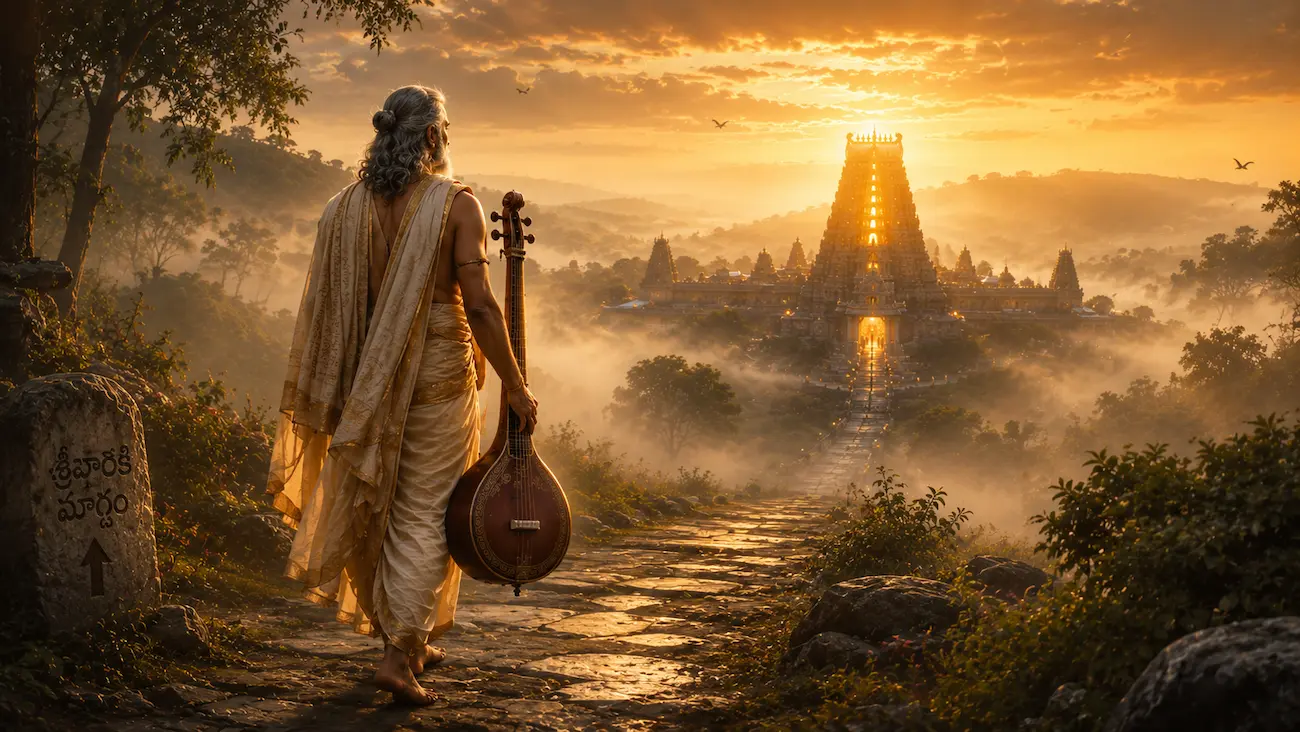
Close your eyes for a moment and imagine this.
It is early morning on the hills of Tirumala. Mist hangs over the sacred slopes. The world below is beginning another ordinary day, but here something else is unfolding.
An old man walks toward the temple. He has walked this path thousands of times. His feet know every stone. His heart knows every prayer. In his hands he carries no flowers, no offerings, no possessions. He carries only his voice and the love that gives it life.
He stops before the great doors of the temple. He closes his eyes.
And a song begins.
It rises from somewhere deeper than memory, deeper than habit, deeper than the self. It drifts into the morning air and enters the sanctum where Lord Venkateswara stands, waiting as He always has, for the love of His devotee.
The Lord listens.
The garland stirs.
And for a single timeless moment, there is no distance between the singer and the One being sung to.
This was Annamacharya's life.
Not merely a life of music, but a life transformed into an offering.
And perhaps that is the deepest lesson he leaves behind. We may not share his gifts, his circumstances, or his destiny. But we can share his intention: to offer whatever we have, however small it may seem, to the Lord.
Annamacharya did not simply sing about God.
He became a song of devotion.
That is the invitation his life still extends to us today.
Frequently Asked Questions
Q1. Who was Annamacharya and why is he called the Mystic Poet of Lord Venkateswara?
Annamacharya (1408–1503 CE) was a Telugu saint-poet and lifelong devotee of Lord Venkateswara of Tirumala. He composed more than 32,000 sankeertanas and is regarded as one of the greatest figures in India's bhakti tradition.
He is called the Mystic Poet of Lord Venkateswara because his songs flowed from deep spiritual experience and devotion rather than literary skill alone. Through them, he expressed love, longing, surrender, and intimate communion with the Lord.
Q2. What is the significance of the divine instruction to "write one bhajan every day"?
According to tradition, Lord Venkateswara instructed Annamacharya to compose one bhajan every day after his first darshan at Tirumala. Swami Mukundananda explains that this was a practice of constant remembrance.
For nearly eighty years, Annamacharya followed this instruction, producing over 32,000 compositions. The true significance lies not in the number of songs, but in the God-centered consciousness that inspired them.
Q3. What are the six devotional bhavas in Annamacharya's poetry, and which was most predominant?
Annamacharya's songs express six devotional moods: Madhurya (divine love), Vatsalya (parental affection), Sharanagati (surrender), Viraha (longing in separation), Dasya (service), and Sakhya (friendship).
Among these, Madhurya Bhav was the most prominent, accounting for about 70% of his compositions. Through this mood, he related to God as the Beloved, making divine love the central theme of his devotional poetry.
Q4. How were Annamacharya's compositions rediscovered after being lost for 450 years?
In 1922, copper plates containing Annamacharya's compositions were discovered near the Tirumala shrine. Additional plates were later found at Ahobilam and Srirangam.
After decades of research and preservation, the Tirumala Tirupati Devasthanams published 29 volumes of Tallapaka Sahitya in 1992, preserving approximately 14,000 sankeertanas. Many devotees view this rediscovery as a providential gift to future generations.
Q5. How can I connect with Annamacharya's teachings in my own daily life?
Begin with simple acts of remembrance: prayer, chanting, listening to bhajans, or reflecting on the Lord's qualities each day. Listening to Annamacharya's sankeertanas can also help cultivate devotion, even if you do not understand Telugu.
Most importantly, follow his example by finding God in everyday life and offering whatever you do with sincerity and love. As Annamacharya's life teaches, it is not the size of the offering that matters, but the devotion behind it.
Q6. How can I participate in the Prana Pratishtha of Lord Venkateswara in Dallas?
The historic Śrī Venteśwara Prāṇa Pratiṣṭhā Mahotsavam takes place July 1–5, 2026 at Radha Krishna Temple in Allen, Texas. Register your family for free, sponsor a ritual or seva, offer sacred bricks, or volunteer. Full details and registration at radhakrishnatemple.net/sri-venkateswara-swamy-prana-pratistha-in-dallas.