
A Complete Guide to Devotion, Discipline, and Inner Transformation
Introduction
There are certain observances in the Hindu tradition that are not merely rituals to be performed and completed, but living, breathing expressions of faith that carry layers of meaning far beyond their outward form. Vat Savitri Vrat is one such sacred observance; one that has been practiced for generations with deep reverence, especially by married women, yet whose spiritual depth extends far beyond its traditional framing. It is a vrat that invites not only discipline of action, but refinement of thought, purification of emotion, and strengthening of inner conviction.
In today’s world, where life often moves at an unrelenting pace and spiritual practices are sometimes reduced to checklists, the opportunity to observe a vrat like this with awareness becomes even more valuable. Vat Savitri Vrat offers a pause, a sacred interruption in the flow of routine, where one can reflect on the nature of relationships, the strength of devotion, and the deeper meaning of commitment. It is not simply about praying for the longevity of a spouse; it is about cultivating the qualities that sustain love itself: patience, sacrifice, faith, wisdom, and inner steadiness.
When approached through the lens of the teachings of Swami Mukundananda and the spiritual framework of JKYog, this vrat transforms from a traditional observance into a powerful tool for inner growth. It becomes a day where devotion is not limited to ritual actions, but expands into a state of consciousness; one that can gently begin to reshape how we think, feel, and relate to the world around us.
The Story Behind Vat Savitri Vrat

At the heart of Vat Savitri Vrat lies one of the most inspiring narratives in Hindu tradition: the story of Savitri and Satyavan. This story is not merely a tale from ancient scriptures; it is a profound exploration of human strength, spiritual intelligence, and unwavering devotion in the face of destiny itself. Savitri, a woman of extraordinary virtue and determination, chose Satyavan as her husband despite knowing that he was destined to die within a year. Her choice was not driven by ignorance, but by a deep inner conviction and clarity that transcended fear.
When the foretold day arrived and Satyavan passed away, Savitri did not succumb to grief or helplessness. Instead, she followed Yama, the god of death, with calm courage and remarkable composure. What followed was not a confrontation, but a dialogue; one marked by humility, wisdom, and unwavering faith. Through her words and her presence, Savitri gradually moved Yama, who granted her boons one by one. With great intelligence, she ultimately secured the return of her husband’s life.
This story carries layers of meaning that extend far beyond its literal interpretation. It is not only about a wife’s devotion, but about the power of steadfast faith, the importance of spiritual clarity, and the grace that flows when one aligns with dharma even in the most challenging circumstances. Savitri’s strength was not emotional stubbornness; it was rooted in spiritual understanding. Her victory was not over death alone, but over fear, doubt, and limitation.
When is Vat Savitri Vrat in 2026?
Vat Savitri Vrat is observed on the Amavasya (new moon day) in the lunar month of Jyeshtha, which typically falls between May and June. This alignment with Amavasya is significant, as the new moon symbolizes introspection, renewal, and the quiet turning inward of awareness.
In 2026, Vat Savitri Vrat falls on May 15, 2026 (Saturday).
(As with all lunar observances, it is advisable to confirm timings with a local panchang based on your region.)
The timing itself carries symbolic meaning. The new moon represents a moment when external light is minimal, encouraging the seeker to rely on inner illumination. In the same way, this vrat invites us to look beyond external rituals and connect with the deeper essence of devotion within.
The Purported Benefits of Vat Savitri Vrat

Vat Savitri Vrat is traditionally observed with the belief that it brings profound blessings into one’s life, particularly in the realm of relationships, longevity, and spiritual merit. While its outer intention is often described as praying for the long life and well-being of one’s husband, the deeper benefits of this vrat extend far beyond a single outcome. When practiced with sincerity, awareness, and devotion, it becomes a transformative discipline that touches multiple dimensions of life: physical, emotional, mental, and spiritual.
One of the most commonly acknowledged benefits is the strengthening of marital harmony and emotional connection. The story of Savitri is not simply about preserving life; it is about sustaining love through faith, patience, and unwavering commitment. By reflecting on her example, practitioners are encouraged to cultivate qualities such as understanding, resilience, and selflessness within their own relationships. Over time, these qualities naturally create greater stability and harmony.
Another significant benefit lies in the development of inner strength and clarity. Observing the vrat requires discipline, whether through fasting, prayer, or mindful restraint. This discipline gradually builds willpower and emotional steadiness. It teaches the practitioner how to remain centered even when faced with discomfort, whether physical or mental. As Swami Mukundananda often explains, true growth begins when we learn to guide the mind rather than be governed by it. Practices like fasting and focused prayer help cultivate this inner mastery.
Spiritually, the vrat is believed to purify past karmas and increase one’s spiritual merit. While this may be understood traditionally as attracting blessings, it can also be viewed as a process of inner refinement. When the mind is engaged in devotion, gratitude, and remembrance of God, negative tendencies gradually weaken. In their place, qualities such as compassion, humility, and faith begin to grow. This inner purification is perhaps one of the most lasting benefits of the observance.
Vat Savitri Vrat also encourages a shift from external dependence to inner anchoring. By engaging in prayer, reflection, and scriptural study, practitioners begin to recognize that true security does not come from controlling circumstances, but from strengthening their connection with the Divine. This shift reduces anxiety and fosters a deeper sense of peace. The ritual becomes not just a prayer for protection, but a journey toward spiritual stability.
Additionally, the vrat provides an opportunity to cultivate gratitude and awareness. Taking time to pause, reflect, and consciously engage in devotion helps break the pattern of mechanical living. It allows one to recognize the blessings already present in life: relationships, health, opportunities, and spiritual guidance. This perspective shift alone can bring a sense of fulfillment that extends well beyond the day of the vrat.
Shree Krishna also explains this in Chapter 12 of the Bhagavad Gita:
श्रेयो हि ज्ञानमभ्यासाज्ज्ञानाद्ध्यानं विशिष्यते |
ध्यानात्कर्मफलत्यागस्त्यागाच्छान्तिरनन्तरम् || 12||
śhreyo hi jñānam abhyāsāj jñānād dhyānaṁ viśhiṣhyate
dhyānāt karma-phala-tyāgas tyāgāch chhāntir anantaram
BG 12.12: Better than mechanical practice is knowledge; better than knowledge is meditation. Better than meditation is renunciation of the fruits of actions, for peace immediately follows such renunciation.
Many people are at the level of mechanical practice. They perform the rituals enjoined by their religious creed, but do not engage their mind in God. When they purchase a new house or a new car, they call the Pundit to perform the pūjā (worship) ceremony. And while the Pundit performs the pūjā, they sit and talk in the other room or sip a cup of tea. For them, devotion is nothing more than performing the empty ritual. It is often performed by way of ceremonial habits that have been passed on from parents and elders. Performing rituals mechanically is not a bad thing, for after all, something is better than nothing. At least such people are externally engaging in devotion.
However, Shree Krishna says that higher than mechanical practice is the cultivation of spiritual knowledge. Knowledge bestows the understanding that the goal of life is God-realization and not material progress. One who is versed in knowledge goes beyond the empty rituals and develops the desire to purify the mind.
The Deeper Meaning of the Vat Tree

The banyan tree, or Vat tree, is central to this observance, and its symbolism is both profound and multidimensional. Unlike ordinary trees, the banyan grows in a way that seems almost eternal: its branches extend outward, its roots descend from above, and it appears to sustain itself indefinitely. This unique structure has long been seen as a representation of longevity, stability, and the continuity of life.
In the context of Vat Savitri Vrat, the tree symbolizes not only long life but also the strength and resilience required to sustain relationships. Its roots remind us of the importance of grounding, its branches of expansion, and its enduring nature of commitment. When devotees circumambulate the tree and tie threads around it, they are not merely performing a ritual; they are symbolically reaffirming their desire for stability, continuity, and spiritual anchoring in their lives.
When observing this vrat at home, even if a physical banyan tree is not present, this symbolism can be internalized. The “tree” becomes a representation of your own inner stability: the part of you that remains steady amidst change.
In Chapter 15 of the Bhagavad Gita, Shree Krishna also makes reference to how the human form is similar to the aśhvatth tree. While in the human form the soul performs karmas, which is the trunk of the tree, and its branches (śhākhās) extend both upward (ūrddhva) and downward (adhaḥ). Based on how the soul performed in its past and present forms it is reborn. If it led a virtuous life, when reborn, it moves to the upward branches which denote the celestial abodes of the gandharvas, devatās, etc. In case, a soul was involved in sinful acts, in the next birth, it gets degraded to the downwards branches, which are for the nether regions and animal species.
अधश्चोर्ध्वं प्रसृतास्तस्य शाखा
गुणप्रवृद्धा विषयप्रवाला: |
अधश्च मूलान्यनुसन्ततानि
कर्मानुबन्धीनि मनुष्यलोके || 2||
adhaśh chordhvaṁ prasṛitās tasya śhākhā
guṇa-pravṛiddhā viṣhaya-pravālāḥ
adhaśh cha mūlāny anusantatāni
karmānubandhīni manuṣhya-loke
BG 15.2: The branches of the tree extend upward and downward, nourished by the three guṇas, with the objects of the senses as tender buds. The roots of the tree hang downward, causing the flow of karma in the human form. Below, its roots branch out causing (karmic) actions in the world of humans.
How to Observe Vat Savitri Vrat at Home
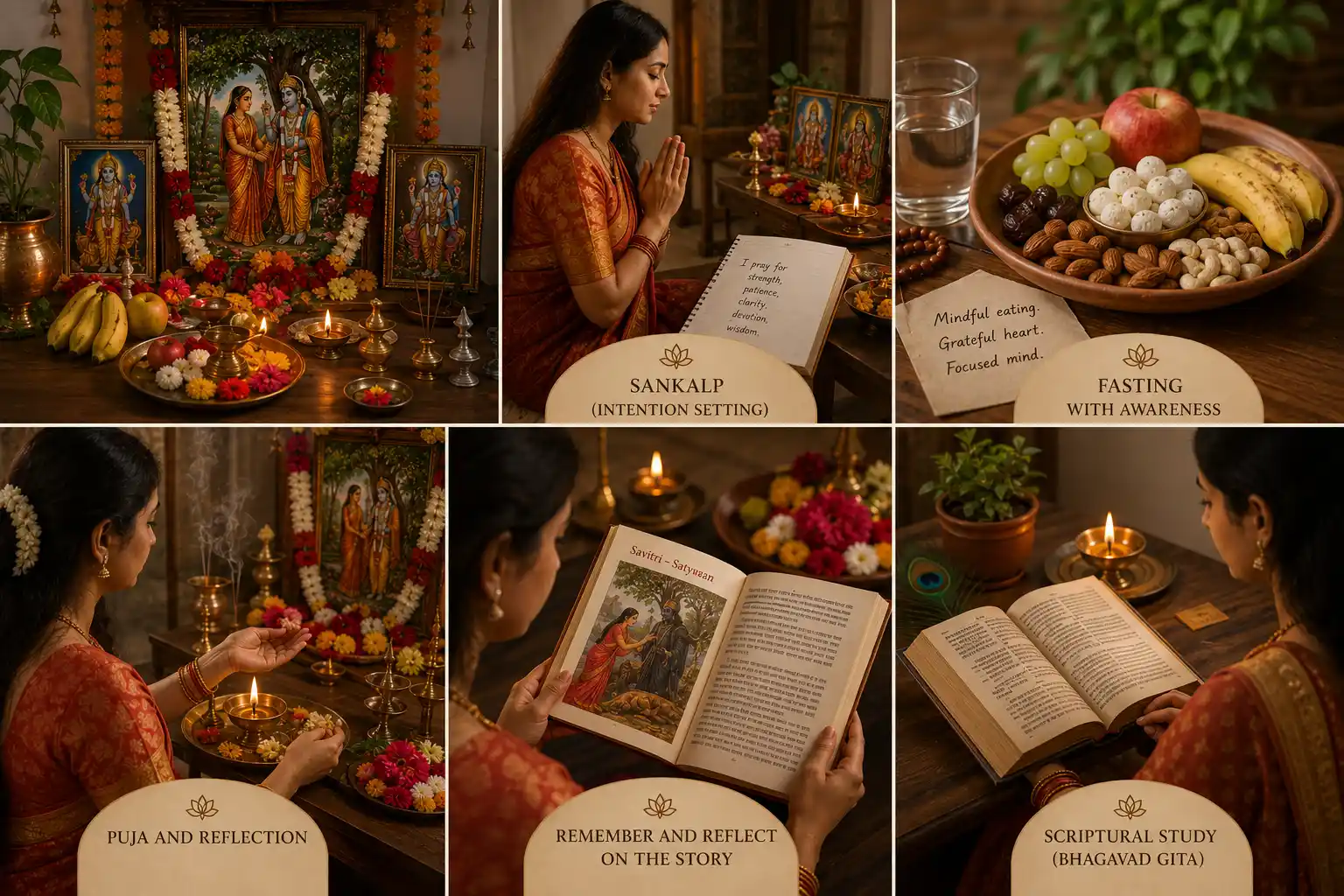
In modern times, many devotees may not have access to traditional settings such as temple premises or banyan trees. However, the beauty of this vrat lies in its adaptability. With sincerity and awareness, it can be observed meaningfully within the home.
Preparing the Sacred Space
Begin by creating a calm and clean environment that feels conducive to prayer and reflection. This could be a small corner of your home transformed into a temporary altar. Place an image or murti of the Divine: whether Lord Vishnu, Savitri-Satyavan, or Radha Krishna, along with a lamp, flowers, and simple offerings. The intention is not to create grandeur, but to create presence.
This space becomes more than a physical arrangement; it becomes a focal point for your awareness. It is where the external world gently fades into the background and the inner journey begins.
Sankalp (Intention Setting)
Every meaningful spiritual practice begins with intention. Before starting the vrat, take a moment to sit quietly and form a clear sankalp. Rather than limiting this intention to specific outcomes, expand it into a prayer for inner qualities—strength, patience, clarity, devotion, and wisdom.
Swami Mukundananda often emphasizes that the quality of our inner intention determines the depth of our spiritual experience. When the sankalp is sincere, even simple actions become powerful.
Fasting with Awareness
Fasting is an integral part of Vat Savitri Vrat, but it is often misunderstood as mere physical restraint. In reality, fasting is a tool for disciplining the mind and redirecting attention inward. It is not about punishment, but about refinement.
Depending on your capacity, you may choose a full fast, a fruit-based diet, or simple sattvic meals. The key is mindfulness. Eat with awareness, maintain moderation, and use the reduction in physical indulgence as an opportunity to increase spiritual focus.
Puja and Reflection
Perform the puja with calmness and attention. Offer water, flowers, and prayers while remembering the story of Savitri. If possible, read or listen to the katha associated with the vrat. Allow the narrative to become more than a story; let it become a reflection of qualities you wish to cultivate within yourself.
Scriptural Study
Engaging with sacred wisdom is one of the most powerful ways to deepen any vrat. Reading even a few verses from the Bhagavad Gita can provide insight and clarity that elevates the entire observance. Rather than reading mechanically, take time to reflect on how the teachings apply to your life.
Integrating the Teachings of Swami Mukundananda
To truly experience the depth of Vat Savitri Vrat, it is essential to go beyond external rituals and cultivate inner practices that align with devotion. Swami Mukundananda’s teachings provide a practical and accessible path for doing so.
Meditation and Inner Focus
Through practices like Roopdhyan meditation, the mind is gently trained to focus on the divine form, reducing distraction and increasing emotional stability.
Living with Awareness
Spirituality is not confined to a single day. Practising the presence of God throughout the day transforms routine actions into meaningful offerings.
Gratitude and Emotional Balance
Gratitude shifts the mind from restlessness to contentment. Maintaining awareness of blessings—both small and large—creates a sense of inner abundance.
Chanting and Devotion
Kirtan and mantra chanting engage both the mind and heart. Even a few minutes of sincere chanting can uplift the entire day.
Satsang and Association
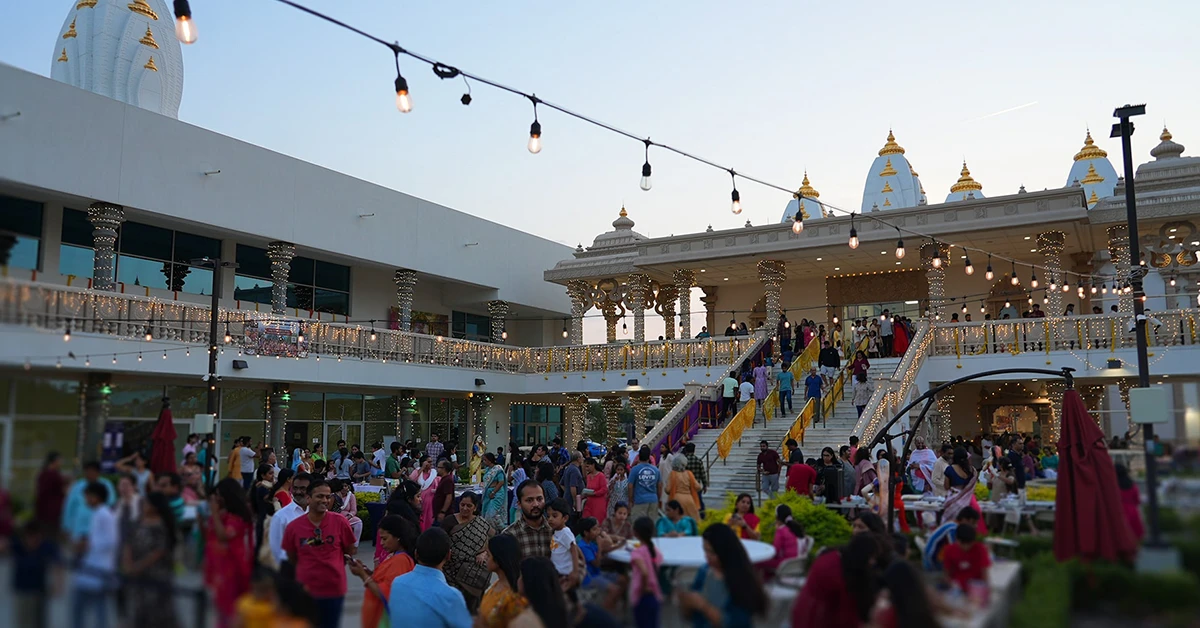
Spiritual growth is strengthened through association. Listening to discourses, engaging with like-minded seekers, and participating in community practices creates support and inspiration.

Relationships Beyond Ritual
Vat Savitri Vrat invites us to reflect not only on marital relationships but on the nature of connection itself. It reminds us that lasting relationships are built not on expectation, but on understanding, patience, and shared growth.
When relationships are rooted in spirituality, they become more resilient. They move beyond transactional dynamics and become spaces for mutual evolution.
Common Mistakes to Avoid
One of the most common mistakes is focusing exclusively on external ritual while neglecting inner transformation. Another is comparing one’s practice with others, which can create unnecessary pressure or distraction.
Spiritual growth is deeply personal. It is shaped by sincerity, not by comparison.
A Simple Daily Flow for the Vrat
Morning begins with prayer, intention, and meditation. The day continues with awareness, reflection, and restraint. Evening concludes with puja, gratitude, and offering.
The structure is simple, but its impact can be profound when practiced with attention.
Final Reflection
From a broader perspective, the benefits of Vat Savitri Vrat are not limited to those who observe it traditionally. Anyone who approaches it with sincerity can experience its deeper impact. The external rituals serve as a framework, but the real transformation happens internally, through the refinement of thought, the softening of the heart, and the strengthening of one’s connection with God.
Ultimately, the greatest benefit of Vat Savitri Vrat is not something that can be measured externally. It is the quiet transformation that takes place within—the development of faith that does not waver easily, devotion that does not depend on circumstances, and a sense of inner completeness that grows steadily over time.
Vat Savitri Vrat is not merely a ritual to be observed; it is an opportunity to reconnect with deeper truths about life, love, and devotion. It reminds us that strength does not come from external circumstances, but from inner clarity. It shows us that faith is not passive: it is active, courageous, and transformative.
As Swami Mukundananda teaches, spirituality is not separate from life: it is the way we live life. When practiced with sincerity, even a single day like this can leave a lasting impression.
Call to Action
This Vat Savitri Vrat, take a step beyond ritual. Bring awareness into your practice, depth into your devotion, and sincerity into your intention. Begin where you are, and allow this sacred observance to guide you inward.
FAQs
1. Can Vat Savitri Vrat be observed meaningfully at home without a banyan tree?
Yes, Vat Savitri Vrat can absolutely be observed at home in a deeply meaningful way, even if you do not have access to a banyan (Vat) tree. While the tree holds symbolic importance, representing longevity, stability, and eternal life, the essence of the vrat lies in devotion, intention, and inner awareness rather than physical location. At home, you can create a sacred space with an image or murti of the Divine and mentally invoke the presence of the Vat tree during your prayers. Visualization itself is a powerful spiritual tool, as emphasized in practices like Roopdhyan meditation. When the mind is focused with sincerity, the symbolic meaning of the ritual remains intact. Ultimately, what matters most is not where the vrat is performed, but the feeling with which it is observed.
2. Is fasting necessary, and what if I am unable to fast strictly?
Fasting is traditionally a part of Vat Savitri Vrat, but it should be understood as a means to support spiritual awareness rather than an obligation that causes distress. The purpose of fasting is to develop discipline, reduce distraction, and redirect attention toward devotion. If a strict fast is not physically suitable, one may opt for a lighter approach such as fruits and milk, or a simple sattvic diet. The teachings of Swami Mukundananda emphasize balance and sincerity over rigid austerity. It is better to practice a moderate form of fasting with a calm and focused mind than to strain the body and lose inner awareness. The essence of the vrat lies in mindful restraint, not physical hardship.
3. Is Vat Savitri Vrat only for married women, or can others observe it?
While Vat Savitri Vrat is traditionally observed by married women for the well-being and longevity of their husbands, its deeper spiritual teachings are universal and can be embraced by anyone. The story of Savitri represents qualities such as unwavering faith, inner strength, clarity of thought, and devotion to dharma: qualities that are valuable for every seeker, regardless of marital status. Anyone who wishes to cultivate these virtues can observe the vrat in their own way, focusing on spiritual growth rather than social definition. When viewed through a broader lens, the vrat becomes a day of reflection on commitment—not only in relationships, but in one’s connection with truth, values, and the Divine.
4. What is the deeper spiritual significance of Vat Savitri Vrat beyond rituals?
Beyond its rituals, Vat Savitri Vrat is a powerful reminder of the inner qualities required to navigate life with strength and grace. The story of Savitri illustrates that true devotion is not passive. It is active, courageous, and guided by wisdom. Spiritually, the vrat encourages practitioners to develop steadiness of mind, clarity of purpose, and faith that remains firm even in challenging circumstances. It also highlights the importance of aligning with dharma, rather than reacting impulsively to situations. When approached with awareness, the vrat becomes a practice of inner refinement, by helping reduce ego, strengthen patience, and deepen one’s connection with God. In this sense, the rituals serve as a doorway, but the transformation happens within.
5. How can I integrate the essence of Vat Savitri Vrat into daily life after the day is over?
The true value of any spiritual observance lies in how it influences everyday life. Vat Savitri Vrat can become a starting point for ongoing inner growth if its essence is carried forward beyond the day itself. This can be done by incorporating small but consistent practices into daily life, such as spending a few minutes in meditation, maintaining gratitude, practicing awareness in actions, and engaging in regular chanting or scriptural reading like the Bhagavad Gita. It also means consciously nurturing relationships with patience and understanding, rather than expectation. As Swami Mukundananda teaches, spirituality is not meant to remain confined to specific days or rituals; it is meant to become a way of living. By taking even a few elements of the vrat and integrating them into your routine, you allow its impact to extend far beyond a single observance and gradually shape your inner life in a lasting way.