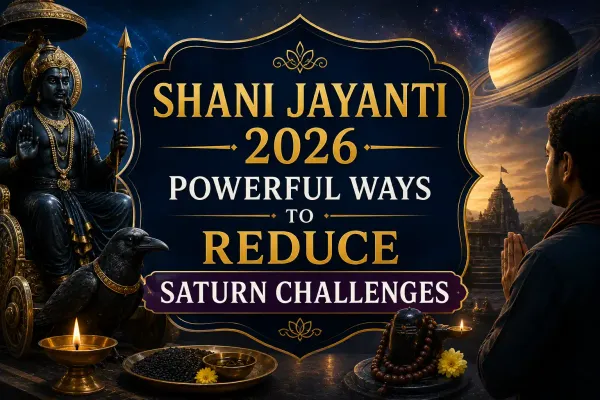
1. Introduction: The Day the Righteous Judge Took Divine Birth
When is Shani Jayanti in 2026?
Mark this date in your spiritual calendar with reverence, not fear: Saturday, May 16, 2026.
The sacred Amavasya Tithi (new moon day) of the Vaisakha month begins at 05:11 AM on May 16 and ends at 01:30 AM on May 17. According to Vedic timekeeping, the period when this Tithi overlaps with the sunrise and the Saturday (Shanivara) is considered the most auspicious for observing Shani Jayanti – the appearance day of Lord Shani Dev, the divine son of Surya Dev (the Sun God) and Chhaya Devi (the Shadow Goddess).
But before we speak of rituals, mantras, or remedies, let us first cleanse our understanding. In the West, and even among some modern Hindus, Shani Dev is often misunderstood as a “malefic planet” – a cosmic punisher who delights in suffering. Nothing could be further from the truth.
Shani Dev is not a lump of rock floating in space. He is a jiva – an eternal, conscious being – empowered by the Supreme Lord Shri Krishna to execute divine justice. He is a Maharaja (great king) in the celestial administration, a bhakta (devotee) of Sri Hari and Shiva, and a guru (teacher) who uses the language of consequences to guide us back to our true nature: eternal servitors of Krishna.
As Swami Mukundananda ji, teaches: The material world is a purification center, not a pleasure resort. Shani Dev is one of the most efficient officers in that center. He does not create your karma; he merely reflects it back to you with perfect, impersonal compassion.
On Shani Jayanti, we do not worship Shani to appease him in a transactional sense. We honor him to thank him for his service, to understand his lessons, and to redirect our devotion toward the ultimate shelter: Shri Krishna, of whom Shani Dev is a faithful servant.
2. Shani Dev in Vedic Culture: The Slow Walker Who Teaches Patience
In Vedic cosmology, the Navagrahas (nine celestial influencers) are not planets in the modern astronomical sense. They are devas (divine beings) with distinct personalities, consorts, vehicles, and duties. They are part of the created universe – not the Creator.
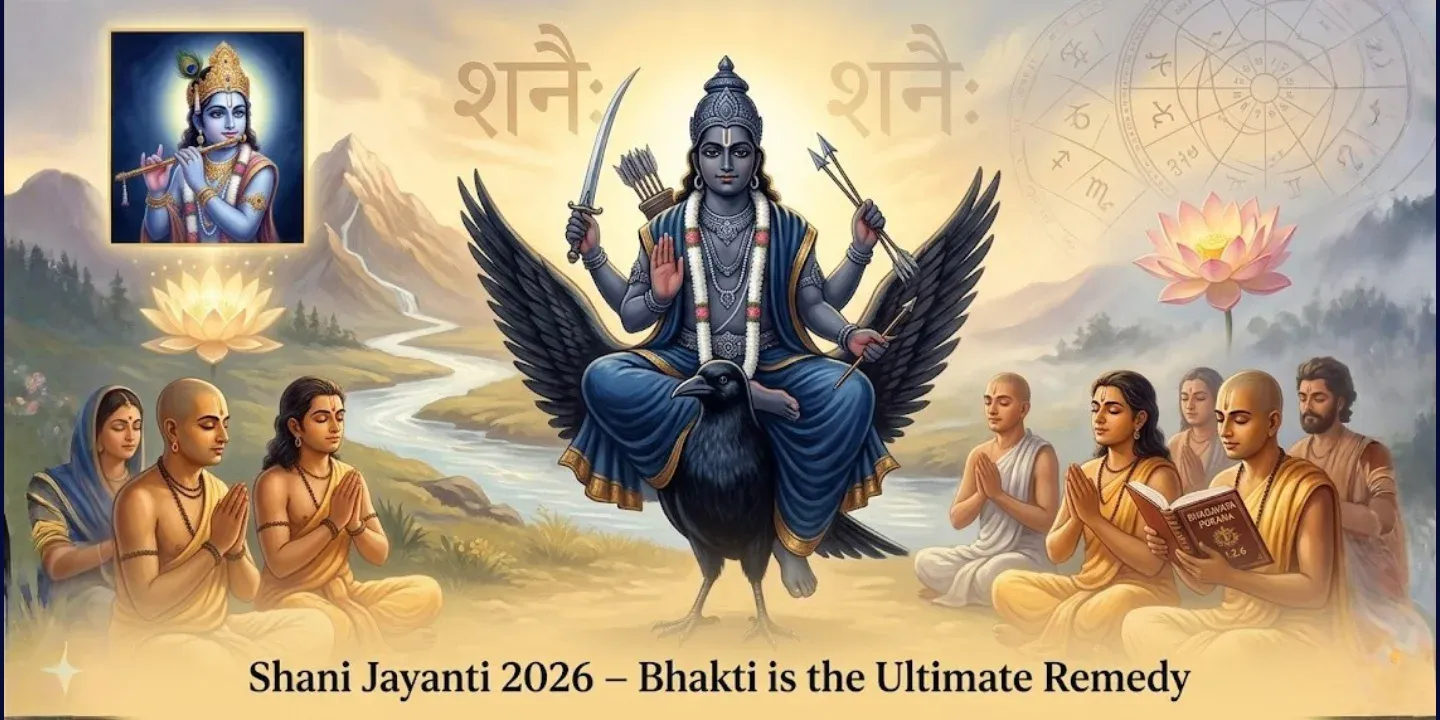
Shani’s name comes from the Sanskrit root Shanaih (शनैः), meaning “slowly” or “gradually.” Why? Because Shani’s effects are rarely instantaneous. Like the erosion of a mountain by a gentle river, Shani’s lessons unfold over years – the famous Sade Sati lasting seven and a half years, or the Dhaiya of two and a half years. He teaches us that karma is patient, that justice is thorough, and that real change requires time.
Shani is depicted as dark-complexioned, clothed in blue or black, riding a crow or a vulture. He holds arrows, a sword, and sometimes a staff. But do not mistake this imagery for violence. In Vedic symbolism:
- Dark color = formless, all-absorbing, impartial. He does not judge by your status, wealth, or beauty – only by your actions.
- Crow vehicle = the ability to see what is hidden, to find sustenance even in discarded things. Shani sees your hidden motives.
- Iron weapons = the sharp, unyielding nature of truth. Truth hurts only when we are attached to falsehood.
Subordinating Jyotisha to Bhakti Shastra
Here is where many seekers go astray. They run from astrologer to astrologer, trembling at charts and dashas. They forget that Jyotisha Shastra (the science of light) is valid only as a subordinate scripture. The supreme authority is Bhakti Shastra – the teachings of devotion.
As the Bhagavata Purana (1.2.6) declares:
Sa vai puṁsāṁ paro dharmo yato bhaktir adhokṣaje
—“The highest dharma is that by which one attains unalloyed devotion unto the Supreme Lord.”
If astrology says one thing, but your sadhana (devotional practice) and guru say another, follow Bhakti. Shani Dev himself bows before the holy name of Krishna. The Brahma Samhita (5.44) confirms: Sṛṣṭi-sthiti-pralaya-sādhana-śaktir ekā – all planetary beings are merely instruments of Krishna’s will.
Thus, when we discuss Shani Jayanti, we do so with reverence for the devata (deity) but with our eyes fixed on the Parameshvara (Supreme Lord).
3. How Shani Impacts Life: The Karmic Audit, Not a Curse
You have heard the terms: Sade Sati, Dhaiya, Shani Dasha. Let us demystify them.
Sade Sati (“seven and a half”) occurs when Shani transits the 12th, 1st, and 2nd houses from your natal Moon – roughly 7.5 years. Dhaiya (“two and a half”) occurs when Shani transits the 4th or 8th from the Moon. Shani Dasha is a planetary period of up to 19 years.
During these times, a person may experience:
- Obstacles in work or daily routines
- Delays in expected outcomes
- Health issues (chronic, slow-developing)
- Financial pressures
- Strained relationships
- A feeling of being “stuck” or isolated
Now, how does a Vedic scholar interpret this? Not as a curse, but as a karmic audit.
Analogy: Life is an Exam, Shani is the Honest Teacher
Imagine you are a student. Your teacher (Shani) does not hate you. He hands you a graded paper. If you made mistakes, you receive corrections. If you cheated, you are exposed. If you studied well, you are praised. The same teacher who gives a low grade also teaches you how to improve. He is not your enemy; he is the guardian of academic integrity.

Shani’s obstacles are purifying corrections. They are not random misfortunes. They are surgical interventions to remove the tumors of ego, greed, dishonesty, and cruelty from your heart.
Consider these examples:
| Symptom | Karmic Lesson |
|---|---|
| Chronic delays | You have been impatient with others. |
| Loss of status | You used position to harm or exploit. |
| Health issues | You neglected the body as a temple of God. |
| Isolation | You need introspection, not external validation. |
| Financial struggle | You misused resources or hoarded without charity. |
Shani does not create new karma. He merely activates the prarabdha (already ripening) karma at the appropriate cosmic time. He is like a mirror – if you see a disfigured reflection, do you break the mirror? No. You wash your face.
Thus, Shani’s impact is neutral justice. It can be positive, negative, or mixed, depending entirely on your past and present actions. Those who have lived with integrity, discipline, and service to saints receive Shani’s blessings as promotion, respect, and inner peace even during Sade Sati.
4. Shani is NOT Evil – He is the Just Judge
Let us state this clearly, for the sake of all confused souls:
There is no evil deity in the Vedic tradition.
Shani is not “bad” or “malevolent.” He is tamasic in guna (quality of inertia/discipline) but not demonic. In fact, Shani is a graha (seizer) only in the sense that he seizes the results of your karma for your own evolution.
A beautiful saying from the scriptures, paraphrased: “Shani reveals your darkness so you can heal it. He does not create darkness.”
If you are walking in a room full of obstacles, and someone suddenly turns on a bright light, you might wince and stumble. That is Shani. The light is not the problem – the messy room of your unaddressed karma is.
Shani also gives excellent results when your karma is positive:
- He grants ayush (longevity) and sthirata (stability).
- He bestows vairagya (dispassion) and viveka (discernment).
- He leads people toward renunciation, service, and spiritual practice.
- In many lives, he gives immense wealth, authority, and reputation – especially to those who work hard without deceit.
The great king Vikramaditya was said to be favored by Shani. So was Lord Hanuman. So is anyone who walks the path of truth.
Never pray to Shani with a begging, fearful heart. Approach him as a student approaches a strict but loving professor: “Please, O Shanideva, show me where I have erred, and grant me the strength to correct myself. I do not ask you to cancel my karma – I ask you to help me learn from it.”
5. Shani in the Lives of Shri Ram & Shri Krishna: The Supreme Example
No discourse on Shani is complete without remembering how the Lord Himself interacted with karmic law.
Shri Ram: Accepting Exile as Dharma, Not as Bad Luck
When Lord Ram was exiled to the forest for fourteen years, many astrologers might have pointed to Shani’s influence on His chart. But did Ram lament? Did He blame planets? No. He said: “Pitru vakya paripalanam” – “I am fulfilling my father’s command.” He saw the exile not as suffering, but as dharma (righteous duty). Because His consciousness was always fixed on the Supreme (Himself, but as an exemplar for us), even a “hardship” became a lila (divine play).
Lesson for us: Attitude is more powerful than planetary transit. If you accept difficulties as God’s arrangement, Shani’s sting disappears.
Shri Krishna: The Presence that Nullifies All Grahas
Here is the supreme secret, taught by Jagadguru Kripalu Parishat and Swami Mukundananda ji: The Supreme Lord Krishna is completely independent of all grahas.
The Brahma Samhita (5.44) states: Īśvaraḥ paramaḥ kṛṣṇaḥ sac-cid-ānanda-vigrahaḥ – “Krishna is the Supreme Lord, of eternal bliss and knowledge.” He is not bound by time, space, or causation. The planets revolve around Him, not He around them.
When Draupadi was disrobed, no graha could stop it – because it was karma. But when she cried out “Govinda!”, Krishna protected her. His protection overrides any planetary decree, if you have surrendered.
Thus, the ultimate remedy for Shani’s affliction is not a gem or a ritual – it is surrender to Shri Krishna. As Swami Mukundananda ji says: “When you have a direct connection with the CEO, you don’t fear the department managers.”
Shani is a manager. Krishna is the Owner.
6. Shani as a Devotee: The Hanuman Legend and Kashi Vishwanath
Now we come to a beautiful, healing truth: Shani Dev is himself a devotee. He does not want your terror; he wants your spiritual growth.
Kashi Vishwanath Temple, Varanasi
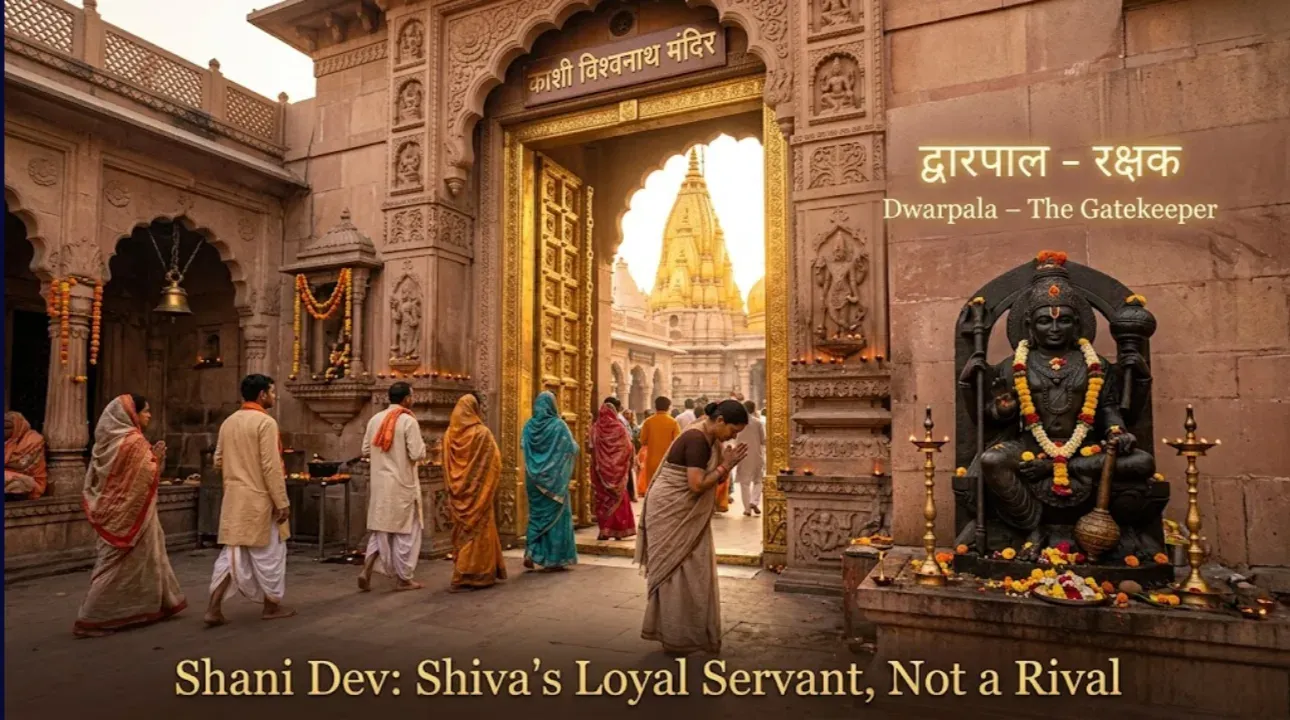
In the famous Kashi Vishwanath temple, the deity of Shani Dev is placed outside the main sanctum, facing the entrance. Why? Because Shani acts as a dwarpala (gatekeeper). He tests those who enter. He ensures that only those with genuine devotion and purified intentions approach Lord Shiva. He is not a rival to Shiva – he is Shiva’s loyal servant.
The Legend of Hanuman and Shani
According to the Parashara Samhita and popular lore, when the mighty Hanuman went to Lanka to rescue Sita, Shani attempted to block his path. Hanuman simply trapped Shani under his tail. Shani, realizing Hanuman’s divine might as an incarnation of Shiva and servant of Ram, begged for release. Hanuman freed him on one condition: That Shani would never afflict any devotee who remembers Hanuman.
Thus, the Hanuman Chalisa contains the powerful line:
“Sankat kate mite sab peera, jo sumirai Hanumat bala veera.”
(All troubles cease and pains vanish, for one who remembers the mighty Hanuman.)
Even more directly, another verse says: Shani deva ne mujhe dara bhayau – but in context, it is declared that Hanuman protects his devotees from Shani’s harsh effects.
What does this mean for you?
Recite the Hanuman Chalisa daily – especially on Saturdays. This is not “black magic removal.” It is devotion to a pure servant of God. Hanuman has no ego; he only serves Ram. When you serve Hanuman, you serve the Lord. And when the Lord is pleased, Shani Dev bows down.
7. Do NOT Misinterpret Shani: Remove These 3 Superstitions
As a Vedic scholar aligned with Jagadguru Kripalu Parishat, I must strongly warn against certain distortions that have crept into popular culture.
Superstition 1: Offer Alcohol, Meat, or Black Magic to Shani
Never. Never. Shani is a deva, not a tantric entity. He accepts only satvik offerings: black sesame seeds (tila), black urad dal, iron items, mustard oil, blue flowers, and incense. Alcohol and meat are tamasic and will only deepen your karmic entanglement. Any “priest” who asks you to offer such things is acting against the Vedas.
Superstition 2: Blame Shani for Your Own Laziness
“Oh, I am suffering because Shani is angry.” No. You are suffering because you lied, cheated, procrastinated, or hurt others. Shani is the messenger, not the cause. As Swami Mukundananda says: “Don’t blame the mirror for your wrinkles.”
Superstition 3: Shani Can Be Bribed
You cannot “pay off” Shani with coconuts and money. He is not a corrupt official. If you donate oil or sesame with a transactional mindset (“I give this, so remove my problem”), you will receive little benefit. Donate instead as seva (selfless service) – with gratitude that you have the opportunity to serve, regardless of outcome.
The Right Attitude: Respect Shani as a divine teacher. Thank him for revealing your weaknesses. Ask him for the strength to improve. And never stop chanting the holy names of Krishna.
8. Devotion & Remedies (Shani Veda): A Practical Guide for Shani Jayanti 2026
On Saturday, May 16, 2026, follow these bhakti-aligned practices. None of these are “shortcuts.” They are aids to focus your mind on God.
A. Highest Remedy: Bhakti (Devotion)
The Padma Purana declares: Harer nama harer nama harer namaiva kevalam – “In this age, only the holy name of the Lord is effective.”
Therefore, the single best remedy for any Shani affliction is to intensify your bhakti:
- Chant Hare Krishna Maha Mantra 16 rounds (or as many as possible).
- Read Bhagavad Gita Chapter 2 (the yoga of knowledge) and Chapter 12 (devotion).
- Associate with devotees. Sing kirtan.

B. Mantras for Shani (With Correct Pronunciation)
- Moola Mantra (Seed Mantra):
Om Sham Shanicharaya Namah
(ॐ शं शनैश्चराय नमः)
Chant 108 times on Shani Jayanti. - Shani Stotra from Dasharatha:
The Dasharatha Shani Stotra is powerful because it was composed by King Dasharatha (Ram’s father) to pacify Shani. Recite it once or thrice. - Hanuman Chalisa:
Recite it 1, 3, or 7 times.
C. Seva (Charity as Service, Not Bribe)
On Shani Jayanti, after bathing and offering prayers, donate the following items to needy people or to a temple (not as a transaction, but as Ishwararpanam – an offering to God):
- Black sesame seeds (tila) – symbolizes letting go of karmic seeds.
- Mustard oil – to soothe Shani’s perceived “heat” (represents cooling of ego).
- Iron – small iron items, nails, or a horseshoe – represents strength.
- Black cloth – for a poor person or a cow shelter.
- Urad dal (black gram) – to a crow or a poor person.
Do this without announcing your name or expecting results. Do it as sadhana.
D. Discipline and Truthfulness: The Hidden Remedies
No mantra works without achar (conduct). On Shani Jayanti, take a vow:
- I will speak no lies for one week.
- I will not exploit anyone’s labor or vulnerability.
- I will wake before sunrise and meditate on Krishna.
- I will serve my parents and elders without complaint.
This pleases Shani more than any ritual.
E. Simple Ritual for Shani Jayanti (30 minutes)
- Wake early, bathe (add a few drops of mustard oil to water if possible).
- Wear blue, black, or dark blue.
- Face west (Shani’s direction) or north (Kailash direction).
- Light a lamp (sesame oil or ghee) before a picture of Shani Dev. Also keep a picture of Shri Krishna or your Ishta Devata.
- Offer blue flowers, black sesame, and a piece of iron.
- Chant Om Sham Shanicharaya Namah 108 times.
- Recite Hanuman Chalisa.
- Read the story of Shani’s birth from Surya Purana or Brahma Vaivarta Purana.
- End with: “O Shani Dev, I honor you as a servant of Krishna. Please remove my karmic blindness and lead me to devotion. I accept your lessons with gratitude.”
- Donate something black to a needy person.
9. Deep Devotional Message: Shani is a Gatekeeper, Not the Goal
Let me close with a parable.
A traveler comes to a large palace. Outside the gate stands a fearsome guard – tall, dark, holding a staff. The traveler is terrified. He offers the guard money, flattery, and sacrifices. But the guard says: “I do not want your gifts. I only ask: Why do you wish to enter?”
The traveler says: “I want to meet the King.”
The guard smiles. “Then walk past me. I was never blocking you – I was testing your intention. Those who try to bribe me or run from me have not understood. Those who calmly state their desire for the King – they enter freely.”
Shani Dev is that guard. The King is Shri Krishna.
If you spend your life running from Shani – changing gemstones, performing exorcisms, blaming stars – you will never reach the King. But if you respectfully acknowledge Shani, learn his lessons, and then walk past him with your eyes on Krishna, Shani himself will salute you and step aside.
Remember this golden principle:
“If you don’t like the reflection, change the face – don’t break the mirror.”
Shani is the mirror. The face is your karma and heart. The face is changed by bhakti, satsang (association with saints), and seva.
Final Vow for Shani Jayanti 2026
On this sacred Amavasya, I invite you to write down (or mentally record) this vow:
“From this Shani Jayanti onward, I will not fear difficulties. I will accept them as divine corrections. I will intensify my chanting of the Hare Krishna Maha Mantra. I will speak truth. I will serve without expectation. I will remember that Shani Dev is my teacher, and Shri Krishna is my ultimate refuge.”
Closing Prayer
Om Namo Bhagavate Vasudevaya.
O Lord Krishna, Lord of the Universe, You who move the sun and stars by Your glance alone.
O Shani Dev, faithful servant of the Supreme, who administers karma without partiality.
Remove from us not our difficulties, but our ignorance.
Remove from us not our karma, but our desire to sin.
Lead us by the hand – through Sade Sati, through delays, through losses – lead us to the cool shade of the lotus feet of Shri Radha and Krishna.
There, where no graha enters, where no shadow falls, where love alone reigns.
May we serve, may we love, may we surrender.
Om Namo Bhagavate Vasudevaya.
Shani Jayanti ki hardik shubhkamnayein.
May the grace of Shani Dev be upon you – not as worldly comfort, but as spiritual awakening.
Jai Shri Krishna. Jai Shri Radhe.
❓ Frequently Asked Questions (FAQs)
Q1: Is Shani Dev "evil" or "malevolent"?
Not at all. Shani Dev is a just divine teacher, not a tormentor. He administers karmic results with perfect impartiality. No Vedic deity is evil. He reveals your hidden weaknesses so you can heal them through devotion.
Q2: Will chanting mantras remove all my problems?
Mantras purify consciousness, but the ultimate remedy is bhakti (devotion) to Shri Krishna. Use mantras as tools to focus the mind, not as magic spells. Surrender to God—that is the real solution.
Q3: Can I offer alcohol or meat to Shani Dev?
Never. Shani accepts only satvik offerings: black sesame, mustard oil, blue flowers, and iron. Tamasic offerings deepen karmic entanglement.
Q4: How do I know if Shani is "testing" me?
When you face delays, obstacles, or isolation, ask honestly: "What past action of mine might this reflect?" Then correct the root cause, not the symptom.
📢 Connect with Swamiji's Divine Teachings
Dear seeker, this path of devotion cannot be walked alone. You need authentic guidance from a realized saint. Swami Mukundananda ji, a direct disciple of Jagadguru Shri Kripalu Ji Maharaj, offers profound Vedic wisdom perfectly tailored for modern life.
Start your spiritual journey today:
🔗 Official Website: https://swamimukundananda.org/
📺 YouTube (English): https://www.youtube.com/@swamimukundananda
📺 YouTube (Hindi): https://www.youtube.com/@SwamiMukundanandaHindi
Explore free courses, powerful kirtans, Gita wisdom, and mind-management techniques. Subscribe now and transform your life through bhakti. Jai Shri Krishna!