Inspiration - RKT Newsletter
March 2026

E-Newsletter
March 2026



Quote
समोऽहं सर्वभूतेषु न मे द्वेष्योऽस्ति न प्रिय: | ये भजन्ति तु मां भक्त्या मयि ते तेषु चाप्यहम् || 29||
samo ’ham sarva-bhuteshu na me dveshyo ’sti na priyah ye bhajanti tu mam bhaktya mayi te teshu chapyaham
I am equally disposed to all living beings; I am neither inimical nor partial to anyone. But the devotees who worship Me with love reside in Me and I reside in them ( Bhagavad Gita 9.29 )
From the Editor’s Desk
In a world filled with constant noise and competing influences, it is easy to overlook the quiet inner voice that gently guides us toward wiser choices. Yet many moments of growth begin when we pause long enough to listen to the calm conviction within that encourages honesty, compassion, courage, and balance.
The theme of this issue, “Using Intuition to Drive Personal Transformation,” invites readers of all ages to reflect on this inner guidance. It begins with children learning to recognize their small, still voice that guides the sense of right and wrong. Then teens learn to distinguish authentic inner convictions from the powerful pull of social media and peer expectations. And adults rediscover the wisdom within by learning to listen more carefully to the signals of the mind, heart, and body amid the busyness of daily life.
Across every stage of life, this inner guide can help us to move from confusion to clarity, from reaction to reflection, and from external pressure to thoughtful choice. When we learn to honor that quiet voice within, it becomes a powerful ally on the path of personal growth and well-being.
Bhakti Ras
Using Intuition to Drive Personal Transformation
Most of us have experienced moments when a quiet inner prompt encourages us to do something noble, like forgiving someone who hurt us, helping another person in need, or spending time in prayer instead of pursuing distractions. These moments are subtle, yet powerful. They seem to arise from somewhere deeper than our ordinary thoughts.
Yet, just as often, we ignore these inner signals. The mind becomes content with comfort, ego, or fear, and the moment passes. Later, we sometimes realize that the small voice we ignored was guiding us toward something higher.
In spiritual life, this inner prompting can become a powerful force for transformation. The Bhagavad Gita teaches us that human beings possess both a restless mind and a higher faculty of discernment. When the mind becomes purified through devotion and spiritual knowledge, this higher faculty begins to guide our thoughts and actions more clearly. In other words, what we often call intuition becomes more reliable when it is shaped by wisdom and devotion.
As the mind becomes calmer and the intellect becomes clearer, we begin to recognize the subtle guidance within us that leads toward higher choices, deeper devotion, and meaningful transformation.
When Spiritual Wisdom Becomes Inner Guidance
Many people think of spiritual knowledge as something we study only to gain information. But the purpose of true wisdom is not merely intellectual understanding, but inner transformation. The Vedic tradition describes a beautiful process through which knowledge gradually becomes part of our inner awareness. This process unfolds in three stages:
- Shravan – Listening to spiritual wisdom through scriptures and the teachings of enlightened spiritual masters (the Guru).
- Manan – Reflecting upon these teachings and thinking deeply about their meaning.
- Nididhyasan – Internalizing the wisdom so deeply that it becomes part of our natural thinking.
In the beginning, spiritual teachings may feel like ideas we are trying to remember. But as we hear them repeatedly in satsang and reflect upon them sincerely, they begin to shape our perspective. Gradually, something remarkable happens. The teachings no longer feel like external instructions, but they begin to arise within us spontaneously. For example, when someone speaks harshly to us, our first instinct may be to respond with anger. But if we have deeply reflected on spiritual teachings about compassion and humility, another voice may quietly arise within us: “Respond calmly. Do not allow anger to control you.”

That gentle reminder is a sign that wisdom has begun to take root in the mind. Similarly, when faced with a choice between selfish comfort and helping someone else, a subtle inner prompting may guide us toward service. Over time, these small moments accumulate, gradually shaping our character. What begins as intellectual knowledge slowly becomes inner guidance.
In this way, spiritual wisdom transforms from something we learn into something we live. It becomes a quiet compass directing our actions toward higher ideals.=
Devotion Purifies the Heart and Strengthens Intuition
While knowledge is important, the path of bhakti teaches that transformation occurs most deeply through devotion. The human mind is influenced by countless impressions formed through past experiences, desires, and habits. These impressions often create restlessness and confusion. When the mind is clouded in this way, it becomes difficult to recognize the voice of deeper wisdom.
Bhakti practices gradually purify the heart and quiet these inner disturbances. As the heart becomes purified, our inner perception becomes clearer. We begin to recognize which thoughts uplift us and which ones pull us away from our higher goals.
Several devotional practices help strengthen this inner clarity.
- Satsang plays a vital role in shaping our thinking. When we regularly listen to spiritual wisdom and associate with seekers who share similar aspirations, our priorities naturally shift. Ideas that once seemed distant gradually begin to feel natural and meaningful.
- Sadhana, or daily spiritual practice, also refines the mind. Prayer, chanting the divine names, meditation, and contemplation bring the mind inward and create moments of stillness. In those moments of quiet, the deeper voice within us becomes easier to hear.
- Seva, or selfless service, plays an equally important role. When we serve others without expecting recognition or reward, the ego slowly softens. This humility opens the heart and allows spiritual values to take deeper root.
- Finally, when the mind is detached from worldly knocks and is ready to surrender to God, it nurtures trust in divine guidance. Instead of trying to control every situation, we gradually learn to rely on the wisdom of God and the guidance of the Guru.

Through these practices, the heart becomes lighter, the mind becomes calmer, and the intellect becomes clearer. What once felt like confusion gradually transforms into quiet conviction. We begin to sense more clearly what actions bring peace and what actions create disturbance. That inner clarity is one of the gifts of devotion.
Recognizing the Difference Between Mind and True Intuition
One of the greatest challenges on the spiritual path is learning to distinguish between the impulses of the restless mind and the guidance of true intuition. The mind is naturally active. It reacts quickly to situations, often driven by emotions, desires, and fears. Because of this, the mind may push us toward choices that provide temporary pleasure but lead to long-term dissatisfaction.
True intuition feels different. While the mind is restless and impulsive, genuine intuition is calm and steady. It does not shout or create agitation. Instead, it appears as a quiet sense of clarity. Listen to this dialogue between the mind and intuition:
- The mind might say: Respond immediately. Defend your pride.
- But intuition might gently suggest: Pause. Respond with patience.
- The mind might say: Choose what is easiest or most comfortable.
- But intuition might whisper: Choose what helps you grow.
The mind is often influenced by ego and immediate desires, while intuition is aligned with wisdom and long-term well-being. One helpful way to understand this difference is to observe the quality of the inner voice. If a thought brings agitation, impatience, or pride, it is often coming from the restless mind. But if a thought brings calmness, humility, and clarity, it may be arising from deeper intuition. In spiritual life, developing this awareness is extremely valuable.
When we pause and reflect before reacting, we create space for higher wisdom to guide our response. Over time, this practice strengthens our ability to recognize the inner voice that encourages patience, kindness, discipline, and devotion.
Conclusion: Listen to the Voice That Leads Us Higher
Personal transformation rarely occurs in dramatic moments. More often, it unfolds quietly through many small choices made day after day. Each time we pause before reacting in anger, choose compassion over ego, or dedicate time to prayer despite a busy schedule, we are responding to the gentle guidance of our higher self.
Spiritual wisdom gives direction to our lives. Devotion purifies the heart. Together, they refine our inner awareness. Gradually, what once felt like occasional inspiration becomes a steady inner compass guiding our thoughts, words, and actions. As our devotion deepens, we begin to recognize that the quiet voice within us is not merely a product of our own thinking. It reflects the deeper wisdom that arises when the mind becomes aligned with divine values.
By listening to that inner guidance and acting upon it with sincerity, we allow intuition to become a powerful force for personal transformation, guiding us step by step toward a life filled with greater peace, devotion, and spiritual growth.
Bal-Mukund: Playground for Vedic Wisdom
The Label That Changed a Life
In the 1950s, there was a fifteen-year-old boy named Victor Serebriakoff in Austria whose teacher told him he was a dunce who would never amount to anything. Taking this as the absolute truth, Victor dropped out of school and spent the next seventeen years performing menial work as a laborer.

His life changed when he applied to the army. During recruitment, his IQ (Intelligence Quotient) was tested and found to exceed 161—the highest the scale could measure. Statistically, only about one in 10,000 people surpass that level of intelligence. For the first time, Victor realized that he was not a dunce, as he had been told, but a genius.
This powerful moment of self-awareness transformed his life trajectory. He stopped hauling timber and began writing books on the lumber industry. He later joined Mensa, the society for highly intelligent individuals. At the time, Mensa’s worldwide membership had dwindled to just four people. Victor stepped into a leadership role, serving as chairman for forty years, and helped grow it into a global institution.

Practical Wisdom:
- Victor believed he was a dunce because of what he had been told, and this belief shaped his life choices. Our beliefs strongly influence the direction of our lives. Instead of accepting others’ judgments, we should reflect, think independently, and use our energy to grow into our best selves.
- Victor was unaware of the genius within him until a moment of self-awareness changed everything. Similarly, we must learn to look beyond limited, external labels and recognize our true identity. We are not merely the body, but the eternal soul. By developing this deeper awareness and trusting our inner guidance, we can begin to recognize our unique strengths and move toward our highest potential.
Youth Insights
Listening to Your Inner Voice for Driving Transformation
For many students today, it can feel like everyone has an opinion about what we should do, how we should act, or even who we should be. Social media, trends, and peer expectations can make it difficult to tell whether our decisions come from our own values or from outside pressure. Learning to listen to our intuition—that quiet inner voice that guides us toward what feels right—can help us make choices that align with who we truly are.
Intuition does not usually appear as a loud voice or a sudden answer. Instead, it often shows up as a subtle sense of clarity, or even discomfort, when something does not feel right. While social media and peer pressure may push us to seek likes, approval, or validation, intuition encourages us to pause and reflect before reacting. Developing this awareness helps us move from relying on external approval to building confidence in our own judgment. Over time, this shift can lead to meaningful personal transformation.
Ways Students Can Strengthen Their Inner Guidance:
- Pause before reacting: Give yourself time to think before following trends or others’ opinions.
- Notice how choices feel: Pay attention to whether a decision leaves you feeling calm and confident or pressured and uncertain.
- Limit comparison: Constant comparison on social media can drown out your own voice.
- Reflect regularly: Take a few minutes to journal or think about the decisions you made during the day.
- Trust small decisions first: Building confidence in your intuition starts with everyday choices.

When we begin to rely more on inner conviction than external validation, we develop stronger self-awareness, confidence, and direction. With time and practice, this inner guidance becomes clearer, helping us make choices that support both personal growth and our higher values.
Holistic Health Tidbits
Using Intuition to Guide Health and Personal Transformation
Intuition can be understood as a direct, present-moment awareness that helps us recognize what is true and beneficial for our well-being. In yogic philosophy, the Manipura (Solar Plexus) and Ajna (Third Eye) chakras are associated with inner awareness, intuition, and our connection to both the self and the divine.
The mind and body do not operate as separate systems; they function as an integrated network of neural, hormonal, and muscular communication. Every thought produces a biochemical response, and every emotional state creates physiological effects. From this understanding emerges the concept of intuitive wellness—the practice of listening to the body’s internal signals as a guide for sustainable health.
Our nervous system is constantly gathering information. Fatigue, tension, hunger, motivation, and emotional shifts all serve as forms of biofeedback. Burnout rarely arrives without warning. When we override these signals in favor of rigid routines, misalignment can occur. Chronic dieting despite persistent hunger, overtraining through pain, or following wellness trends without considering our individual needs may create internal resistance. Over time, this disconnection can lead to new health challenges or worsen existing ones.
God has given us intuition as a means of recalibration, but accessing it requires intentional pauses and self-observation. Instead of asking, “What should I eat?” we might ask, “What would truly nourish me right now?” Rather than defaulting to a scheduled high-intensity workout, we can ask, “Does my body need intensity or restoration today?” These simple shifts cultivate awareness and strengthen the connection between our actions and our internal responses.
Consistent practice is essential for developing this awareness. As it deepens, our choices become less reactive and more aligned. Importantly, structure and intuition are not in conflict. Intuition helps us personalize how we apply knowledge. Two individuals may follow the same training program, yet one progresses more effectively by adjusting based on recovery signals. Similarly, nutritional guidance becomes most effective when adapted to individual digestion, energy patterns, and emotional responses to food.
In summary, developing intuition requires disciplined reflection. Practices such as journaling post-workout energy levels, noticing emotional patterns around eating, or performing brief body scans before sleep help reveal meaningful insights over time. Gradually, this awareness becomes a personal guide. True wellness begins not with external optimization, but with attentive and respectful listening to the body.
Reflection Questions
Bhakti Ras / Inspiration
- How can we learn to distinguish between the impulses of a restless mind and the calm guidance of wisdom-based intuition?
Bal-Mukund: Playground for Vedic Wisdom
- What inner shift helped Victor change the direction of his life, and what can we learn from it?
Youth Insights
- When facing an important decision, how can you pause and discern whether your choice is guided by your inner voice or by outside pressure?
Holistic Health Tidbits
- What signals is my body currently giving me, and how can I respond with greater awareness rather than habit?
Upcoming Events
We are very excited to share details regarding two upcoming events at the Radha Krishna Temple of Dallas, the official Headquarters of JKYog.
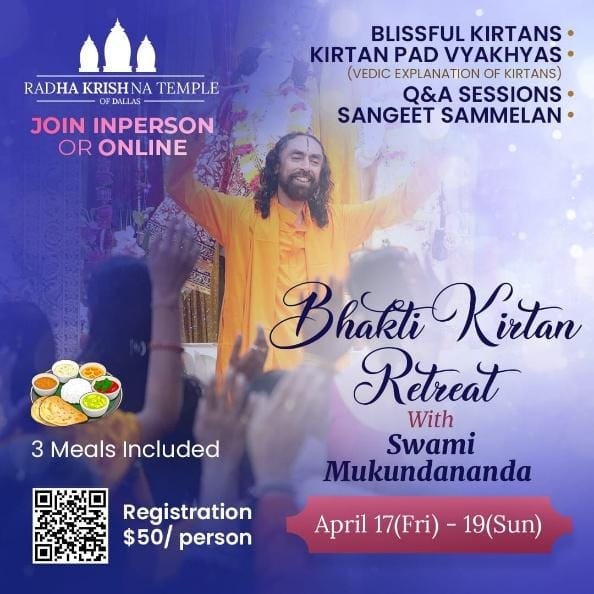
Bhakti Kirtan Retreat with Swami Mukundananda ji – April 17 to 19, 2026
Kirtan is the devotional chanting of the holy names, forms, pastimes, virtues, and abodes of God. The power of kirtans cannot be underestimated. Chanting enables us to attach the restless mind to God (as we are distracted by worldly affairs).
All Vedic scriptures and Bhakti Saints also recommend kirtan as a tool for evoking devotion and love for God, which purifies the heart. In Kaliyug, Kirtan is especially recommended as the highest/best form of Sadhana to purify the soul.
We have the most wonderful opportunity to participate in a 3-day Bhakti Kirtan Retreat with Swamiji. Take advantage of this opportunity to:
- Break free from the cacophony of modern life to find inner peace and fulfillment.
- Experience the harmony of music, chanting, and contemplation that captivates the mind and keeps it engaged. Each verse and melody offers a different facet of divine expression, keeping our practice fresh and vibrant.
- Embark on a journey of spiritual elevation as you listen to Swamiji’s responses to devotees’ questions and participate in fun activities.
- Above all, soak in the bliss of listening to Swamiji’s deeply divine and melodious kirtans and Pad Vyakhyas that will transport you to a realm not easily experienced in the humdrum of material existence.
Register: https://www.radhakrishnatemple.net/bhakti-kirtan-retreat
Hanuman Jayanti
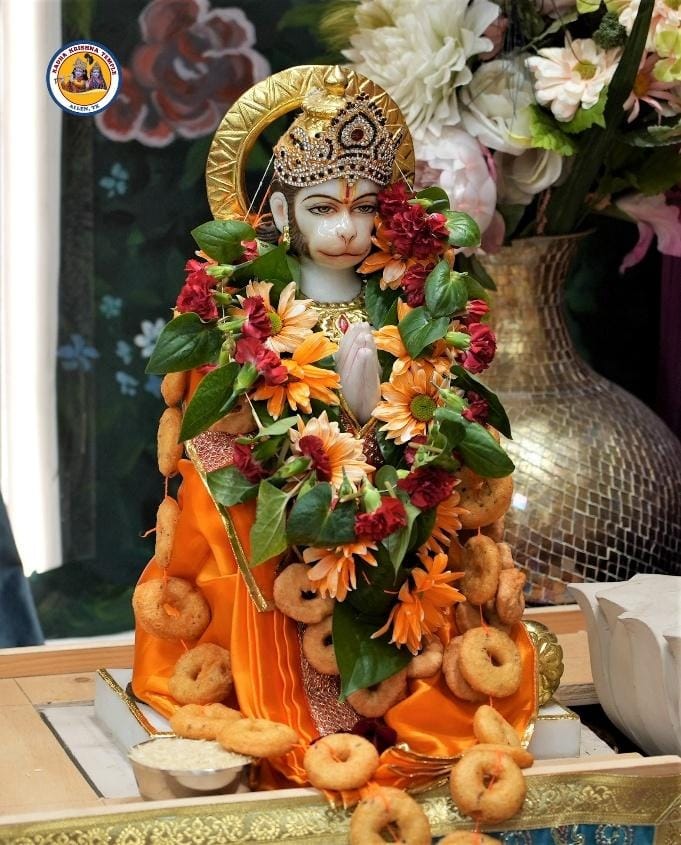
When we envision Hanuman ji, we see the ultimate embodiment of selfless devotion to Lord Ram. He is a powerhouse of superhuman strength and fearless courage, yet he consistently pairs his bravery with a brilliant intellect to overcome any obstacle.
Despite his immense power, he remains deeply humble and single-mindedly dedicated to his role as a divine servant. Great saints often highlight Hanuman ji’s life and pastimes as the gold standard for true service to the Almighty. Furthermore, sacred texts on spiritual wisdom frequently cite Hanuman ji’s perspective as the perfect model for maintaining a divine connection while showing compassion to all beings.
We invite the community to a grand celebration of Hanuman Jayanti on April 1st and April 4th, featuring sacred rituals, Hanuman Chalisa chanting, and special sevas. The event honors the strength and devotion of Lord Hanuman with a main pooja, Abhishek, and kirtans designed to invoke divine blessings.
Details: https://www.radhakrishnatemple.net/hanuman-jayanti