
Imagine waking up before the sun even breaches the horizon. The air is crisp, carrying the faint, earthy scent of fresh morning dew mixed with the sweet, intoxicating fragrance of jasmine and marigolds. Inside your home, there is a palpable buzz of quiet, joyful excitement. Today is not just another day on the calendar; today is Ugadi, the dawn of a brand-new era.
For millions of people originating from Karnataka, Telangana, and Andhra Pradesh, as well as the vibrant Indian diaspora spread across the globe, including the thriving community right here in Texas, Ugadi marks the glorious beginning of the Hindu New Year. As we approach Ugadi 2026, the anticipation within the community is building.
But what exactly are we celebrating? Is it merely a cultural festivity filled with delicious feasts, beautiful new silk clothes, and social gatherings? While those elements bring immense joy, Ugadi is far more profound. It is a deeply spiritual milestone, a cosmic reset button, and a golden opportunity to realign our wandering, turbulent minds with the Divine.
Whether you are celebrating from the quiet sanctuary of your own living room or joining the vibrant, devotional community at the Radha Krishna Temple in Dallas, this festival offers a chance for authentic inner transformation. To truly make the most of this 10-to-15 minute read, let us dive deep into the historical significance of Ugadi, the fascinating science behind why human beings biologically crave new beginnings, and how we can apply the timeless wisdom of the Bhagavad Gita and Swami Mukundananda to make this Ugadi our most spiritually uplifting year yet.
The Cosmic Genesis: Understanding the Roots of Ugadi
To understand the power of this day, we must look at the roots of the word itself. The Sanskrit word "Ugadi" (also spelled Yugadi) is a beautiful amalgamation of two distinct terms. Yuga translates to "era," "age," or "epoch," and Adi means "the beginning." Together, Ugadi literally translates to "the beginning of a new age."
According to ancient Vedic scriptures, this auspicious day carries immense mythological and cosmic weight. It is believed that Lord Brahma, the creator of the universe within the Hindu Trinity (Brahma, Vishnu, and Shiva), began His majestic, unfathomable work of creation on this exact day.
When we celebrate Ugadi, we are not just flipping a page on a paper calendar or marking the linear passage of time. We are honoring the very genesis of life itself. We are paying homage to the divine intelligence that orchestrated the cosmos.
In the Bhagavad Gita (8.17), Lord Krishna explains the staggering scale of cosmic time:
सहस्रयुगपर्यन्तमहर्यद्ब्रह्मणो विदु: |
रात्रिं युगसहस्रान्तां तेऽहोरात्रविदो जना: || 17||
sahasra-yuga-paryantam ahar yad brahmaṇo viduḥ
rātriṁ yuga-sahasrāntāṁ te ’ho-rātra-vido janāḥ
Bhagavad Gita 8.17: One day of Brahma (kalp) lasts a thousand cycles of the four ages (mahā yug) and his night also extends for the same span of time. The wise who know this understand the reality about day and night.
In his online commentary, Swami Mukundananda illuminates this mind-boggling concept: "One day of Brahma is equal to a thousand mahā-yugas... The duration of one mahā-yuga is 4.32 million human years... Such is the staggering scale of the universe." Ugadi reminds us of this grand cosmic cycle. It puts our petty daily worries into perspective. Astronomically, Ugadi aligns perfectly with the lunisolar calendar, falling on the Pratipada Tithi (the first lunar day) of the waxing moon in the vibrant month of Chaitra. Nature herself mirrors this cosmic renewal. Ugadi perfectly coincides with the vibrant onset of Vasant Ritu (Spring). After the harsh, dormant months of winter, the days grow longer, the earth thaws, and the world bursts forth with new, green life. The changing of the seasons is God’s living poetry, symbolizing hope, continuous growth, and the infinite possibilities of a fresh start.
The Science of "The Clean Slate": Psychology and Habit Formation
Have you ever wondered why we feel so incredibly motivated to set goals, meditate more, read scriptures, or practice kindness at the start of a New Year, but struggle to find that same burst of motivation on a random Tuesday in October?
The answer lies in a fascinating psychological phenomenon that behavioral scientists call the "Fresh Start Effect." A groundbreaking study conducted by researchers Dr. Katherine Milkman, Hengchen Dai, and Jason Riis, published in the journal Psychological Science, explored how human beings use time to motivate themselves. The researchers found that people are significantly more likely to tackle their goals immediately following what they categorized as a "Temporal Landmark." Temporal landmarks are distinct dates that stand in stark contrast to the unending, trivial stream of our daily lives. Just as physical landmarks help us navigate a geographical map, temporal landmarks like Ugadi, birthdays, anniversaries, or the first day of a new month can help us navigate the timeline of our lives.
According to this psychological research, temporal landmarks create a powerful psychological separation between our "past self" and our "current self." If you struggled with your spiritual practice, gave in to anger, ate unhealthy foods, or let your mind wander into negativity last year, Ugadi acts as a psychological boundary. It allows you to relegate those missteps, failures, and imperfections to the "old you." It opens up a pristine new "mental account," giving you the clean slate needed to build better habits.
Furthermore, we must look at how long it takes to actually solidify these new Ugadi resolutions. A widely cited study published in the European Journal of Social Psychology by Dr. Phillippa Lally and her team researched habit formation. They found that, contrary to the popular myth that it takes 21 days to form a habit, it actually takes an average of 66 daysfor a new behavior to become automatic.
This means the motivation you feel on Ugadi morning is just the spark; the real work lies in the sustained Abhyasa(practice) over the next two to three months. By consciously recognizing Ugadi as a powerful temporal landmark, we can harness this initial "Fresh Start Effect." We can leave behind the heavy baggage of past resentments, worldly anxieties, and spiritual laziness, and step confidently into the New Year with a rejuvenated mind, ready to put in the 66 days of focused effort to change our spiritual trajectory.
Ugadi 2026 and Gudi Padwa at the Radha Krishna Temple in Dallas


While you can undoubtedly harness the spiritual power of Ugadi anywhere in the world, there is an unparalleled magic in celebrating it amidst a community of devoted spiritual seekers. For the Indian diaspora in Texas, the Radha Krishna Temple (RKT) in Dallas serves as the perfect spiritual epicenter for this cosmic new beginning. You can celebrate Ugadi and Gudi Padwa on March 19th and 21st at the temple.
When you walk onto the pristine grounds of the Radha Krishna Temple during a major festival, you are immediately enveloped in an atmosphere of pure, unfiltered devotion. The magnificent white marble architecture glows warmly against the Texas sky, intricately carved with the stories of the divine. But the true beauty of the temple lies within the hearts of the devotees who gather there.
Celebrating Ugadi at RKT Dallas is a multi-sensory spiritual experience. It means surrounding yourself with high-vibrational, sattvic energy. It means participating in soul-stirring kirtans (devotional chanting) accompanied by the rhythmic beat of the mridangam and the sweet melodies of the harmonium, washing away the accumulated dust of the mind.
Moreover, Ugadi marks the first day of Chaitra Navratri, the vibrant nine-day festival dedicated to the worship of the Divine Mother, culminating in Ram Navami (the appearance day of Lord Ram). The temple becomes a hub of continuous spiritual activity. There are enriching spiritual discourses that water the seeds of divine knowledge within us. When hundreds of people come together with the shared, focused intention of spiritual renewal, the collective energy becomes a powerful catalyst for your own personal growth. You are no longer fighting the battles of the mind alone; you are uplifted by the Satsang (association of the truth).
While you can undoubtedly harness the spiritual power of Ugadi anywhere in the world, there is an unparalleled magic in celebrating it amidst a community of devoted spiritual seekers. For the Indian diaspora in Texas, the Radha Krishna Temple in Dallas serves as the perfect spiritual epicenter for this cosmic new beginning. You can celebrate Ugadi and Gudi Padwa on March 19th and 21st at the temple.
When you walk onto the pristine grounds of the Radha Krishna Temple during a major festival, you are immediately enveloped in an atmosphere of pure, unfiltered devotion. The magnificent white marble architecture glows warmly against the Texas sky, intricately carved with the stories of the divine. But the true beauty of the temple lies within the hearts of the devotees who gather there.
Celebrating Ugadi at the Radha Krishna Temple Dallas is a multi-sensory spiritual experience. It means surrounding yourself with high-vibrational, sattvic energy. It means participating in soul-stirring kirtans (devotional chanting) accompanied by the rhythmic beat of the mridangam and the sweet melodies of the harmonium, washing away the accumulated dust of the mind.
Merging seamlessly with these festivities is the celebration of Gudi Padwa, the Maharashtrian New Year. At the Radha Krishna Temple, this is marked by the hoisting of the Gudi, which is a vibrant silk cloth adorned with a silver or copper pot, neem leaves, and garlands. This "Banner of Victory" symbolizes the Brahmadhvaja, honoring the moment Lord Brahma began the creation of the universe. Just as the Ugadi Pachadi serves as a lesson in equanimity, the traditional Gudi Padwa offering of neem and jaggery reminds us to accept life’s bittersweet nature with a balanced mind. Together, these traditions create a unified tapestry of devotion that transcends regional boundaries.
The Ultimate Resolution: Mind Management and the Bhagavad Gita
As we set our Ugadi resolutions, it is easy to fall into the trap of focusing solely on the external: advancing in our corporate careers, improving our physical fitness, buying a new home, or gaining social status. While there is nothing inherently wrong with these pursuits, the true, eternal measure of a successful year lies in the state of our mind and our connection to the Supreme.
If we wish to make our Ugadi resolutions stick, we must anchor them in divine wisdom. Lord Krishna provides the ultimate, foolproof formula for turning every single day of the New Year into a profound act of devotion.
In the Bhagavad Gita (9.27), Shree Krishna instructs Arjuna:
यत्करोषि यदश्नासि यज्जुहोषि ददासि यत् |
यत्तपस्यसि कौन्तेय तत्कुरुष्व मदर्पणम् || 27||
yat karoṣhi yad aśhnāsi yaj juhoṣhi dadāsi yat
yat tapasyasi kaunteya tat kuruṣhva mad-arpaṇam
Bhagavad Gita 9.27: Whatever you do, whatever you eat, whatever you offer as oblation to the sacred fire, whatever you bestow as a gift, and whatever austerities you perform, O son of Kunti, do them as an offering to Me.
This single verse contains the power to completely transform your 2026. You do not need to abandon your family, quit your job, or retreat to a Himalayan cave to be a perfect devotee this year. You simply need to change the intention behind your everyday actions.
In his brilliant and deeply illuminating online commentary on this verse, Swami Mukundananda explains:
"Whatever social duties one may be engaged in, whatever vegetarian food one may be eating, whatever non-alcoholic beverages one may be drinking, whatever Vedic rites one may perform, whatever vows and austerities one may observe, should all be offered mentally to the Supreme Lord. Very often, people separate devotion from their daily life, and look on it as something that is only to be performed inside the temple room."
Swamiji continues by quoting the great Sage Narad, who defined bhakti (devotion) perfectly: "Devotion means offering your every activity to God, and feeling intense separation if ever you lose remembrance of Him." To drive the point home, Swamiji recalls the powerful words of Swami Vivekananda: "No work is secular. Everything is devotion and service."
This Ugadi, let your primary, foundational resolution be Arpanam: the mental act of continuous offering. When you cook dinner for your family, offer the food to Shree Krishna first. When you drive through Dallas traffic to get to work, offer your professional duties as a service to God. When you face an unexpected hardship, offer your patience and resilience to Him. By dedicating all your works to the Supreme, you metamorphose the mundane, ordinary activities of daily life into the highest divine service.
5 Sacred Traditions: How to Celebrate Ugadi 2026
If you are celebrating at home before heading to the Radha Krishna Temple for the evening festivities, here are five deeply meaningful, traditional practices to incorporate into your Ugadi morning. Each of these practices holds deep scientific, psychological, and spiritual significance.
1. Abhyanga Snanam (The Cleansing Oil Bath)
The Ugadi day begins long before sunrise with a sacred, ceremonial oil bath known as Abhyanga Snanam. Devotees massage their bodies with sesame oil before bathing. From an Ayurvedic perspective, this practice cools the body, improves blood circulation, and nourishes the skin. Spiritually, it represents washing away the misdeeds, negativity, and spiritual lethargy (Tamas) of the past year. It is a physical manifestation of the "clean slate," preparing the body and mind to receive divine grace.
2. Crafting Meaningful Rangoli and Torans
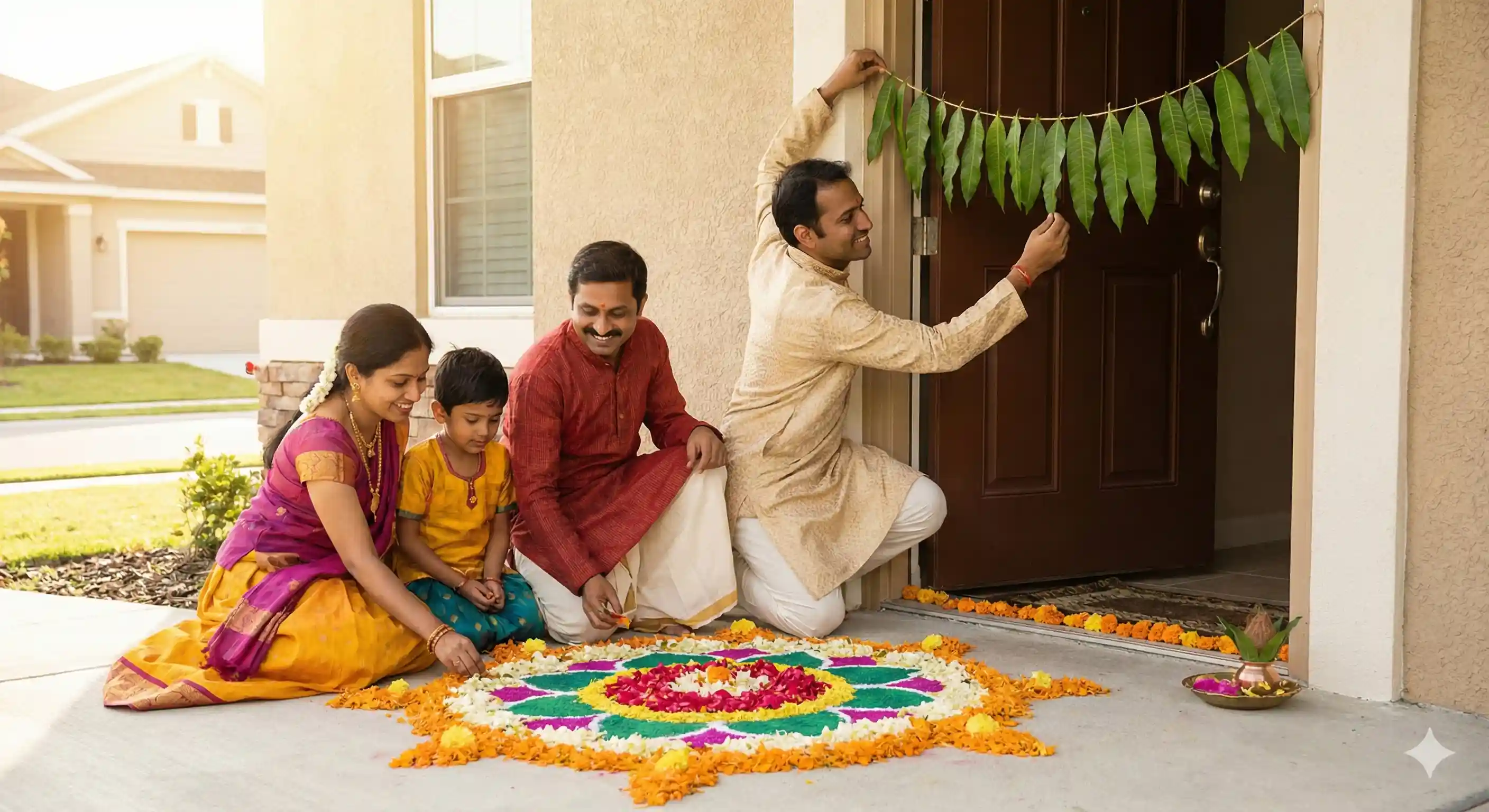
Homes are swept meticulously clean and purified. Devotees string together beautiful torans (garlands) made of fresh, green mango leaves to hang over their main doorways. Why mango leaves? Scientifically, mango leaves are known for their antibacterial properties and their ability to absorb carbon dioxide and release oxygen, purifying the air entering the home. Spiritually, it acts as a welcoming sign for prosperity and divine energy.
Intricate, colorful rangoli (or kolam) patterns are drawn at the entrance using rice flour and vibrant colored powders. This celebrates the vibrant creativity of the soul, feeds small insects (an act of hidden charity), and serves as an auspicious invitation to the goddess of fortune.
3. Setting Up the Pooja Area and Divine Offering
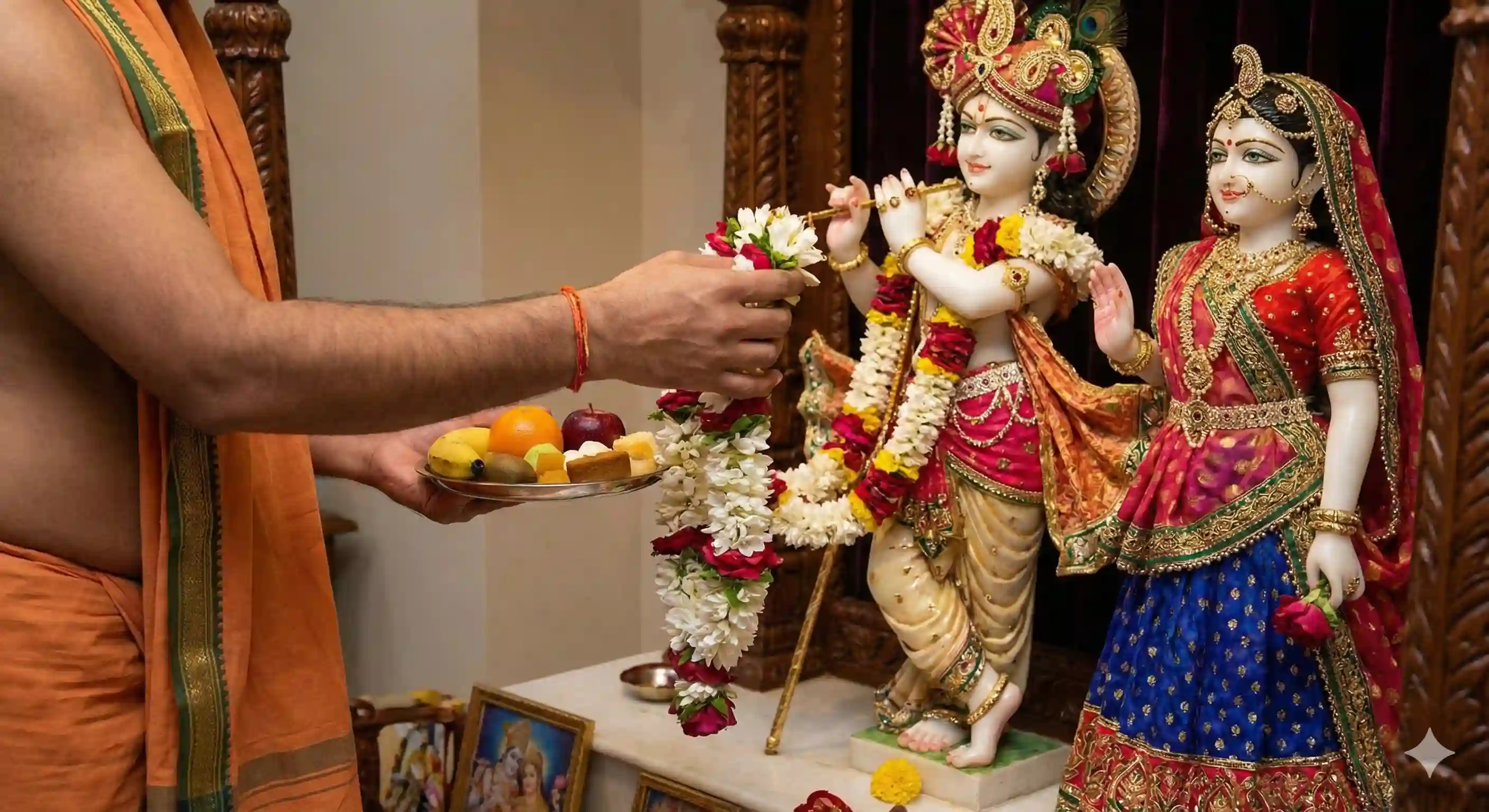
The home altar is beautifully adorned. Deities are bathed in sacred mantras (Abhisheka), dressed in fresh, vibrant clothes (Alankara), and offered beautiful spring flowers. The entire family gathers to perform the Mangalarathi, waving camphor and singing praises. The scent of sandalwood and incense creates a shield of positive, sattvic energy around the household, driving away negative vibrations.
4. Tasting the Universe: The Philosophy of Ugadi Pachadi
No Ugadi celebration is remotely complete without the iconic Ugadi Pachadi. This unique, traditional dish is an absolute marvel of ancient Indian wisdom, perfectly blending six distinct tastes (Shadruchu), each representing a different emotion or inevitable phase of human life:
· Sweet (Jaggery): Represents happiness, success, and joy.
· Sour (Tamarind): Represents the moments of disgust, cleverness, or unpleasantness we must navigate.
· Bitter (Neem Flowers): Represents sadness, grief, and difficulties, reminding us that tough times are a natural, medicinal part of growth.
· Astringent (Raw Mango): Represents surprises, new challenges, and sudden changes in life.
· Salty (Salt): Represents fear, the unknown, and the necessary preservation of life.
· Pungent/Spicy (Chili Powder or Pepper): Represents anger and fiery moments.
Consuming this dish is a profound philosophical practice. It is a physical vow to the universe that in the coming year, you will accept all of life's flavors, such as the joy, the sorrow, the surprises, and the anger with an equal, balanced mind.
This directly ties into another core teaching of the Bhagavad Gita (2.48), where Lord Krishna says: "samatvam yoga uchyate" (Equanimity is called Yoga). By eating the Ugadi Pachadi, we are practicing the yoga of equanimity, knowing that every "flavor" of life is ultimately the grace of God meant for our spiritual evolution.
5. Panchanga Sravanam (Listening to the Cosmic Calendar)
Later in the day, families and communities gather to listen to the Panchanga Sravanam, the reading of the new year's astrological almanac. Priests or elders read out the predictions for the coming year, covering everything from weather patterns and crop yields to political shifts and personal astrology.
While it is fascinating to hear these predictions, the underlying spiritual purpose is much deeper. Listening to the Panchang reminds us of the grand, interconnected web of the cosmos. It instills a sense of humility, reminding us that we are part of a massive, divine machinery, and that the ultimate controller of all destinies is the Supreme Lord. It encourages us to surrender our anxieties about the future at His lotus feet.

Frequently Asked Questions About Ugadi (FAQs)
1. What is the exact meaning of the word Ugadi? The word Ugadi is derived from two ancient Sanskrit words: "Yuga" meaning an age, era, or epoch, and "Adi" meaning the beginning. Therefore, Ugadi literally translates to "the beginning of a new age." It marks the start of the Hindu New Year for several states, particularly in southern India.
2. Why is the Ugadi Pachadi so important, and what does it symbolize? Ugadi Pachadi is a highly symbolic dish made with six distinct ingredients (jaggery, neem flowers, tamarind, raw mango, salt, and chili/pepper). Each ingredient represents a different human emotions, such as happiness, sadness, disgust, surprise, fear, and anger. Eating this mixture reminds us of the Bhagavad Gita's teaching of equanimity; we must accept all of life's experiences in the coming year with a calm, balanced, and surrendered mind.
3. How does Ugadi relate to Lord Brahma and creation? According to Vedic mythology and scriptures, Lord Brahma, the creator deity among the Hindu Trinity, began the majestic process of creating the universe on the exact day of Ugadi. Hence, it is celebrated not just as a calendar change, but as the dawn of cosmic creation itself.
4. What is the "Fresh Start Effect" mentioned in psychology, and how does it relate to Ugadi? The "Fresh Start Effect" is a well-documented psychological phenomenon where people experience a massive surge of motivation to pursue new goals following a "temporal landmark" (like a new year, a birthday, or a religious festival). It works by creating a psychological separation from past failures. Ugadi acts as this powerful temporal landmark, allowing individuals to feel like they are starting with a clean, unburdened slate for their spiritual and personal goals.
5. How can I meaningfully celebrate Ugadi spiritually if I don't live near a temple? You can celebrate a profoundly spiritual Ugadi from anywhere in the world! Wake up early for a cleansing oil bath (Abhyanga Snanam), clean your living space to invite sattvic energy, set up a small home altar, and most importantly, practice the teachings of Bhagavad Gita 9.27 by mentally offering everything you do that day: your meals, your professional work, and your thoughts directly to God.
Step Into Your Spiritual Fresh Start
Ugadi 2026 is your temporal landmark. It is your divine invitation to leave behind the heavy burdens of yesterday, purify your mind, and walk the luminous path of devotion. The journey of a thousand miles begins with a single, conscious step toward God.
Do not let this incredible burst of new year motivation fade away after 24 hours! Anchor your mind in divine wisdom, prepare yourself for the 66 days of practice needed to form lasting spiritual habits, and surround yourself with a community that supports your highest, most noble aspirations.
Here is how you can take action today to ensure this Ugadi changes your life:
1. Immerse Yourself in Daily Wisdom: Subscribe to Radha Krishna Temple of Dallas' YouTube channel and keep up with weekly satsangs and other live events.


2. Study the Ultimate Manual for Life: Dive deep into the complete, authoritative commentary of the Gita by visiting the Holy Bhagavad Gita website. Bookmark it as your go-to daily resource for navigating life's unexpected challenges.

3. Register & Celebrate Ugadi & Gudi Padwa: If you are in the Dallas/Fort Worth area, make this Ugadi absolutely unforgettable! Visit the Radha Krishna Temple of Dallas' and register for the event taking place on March 19th & 21st.
Make 2026 the year you master your mind and offer your heart entirely to the Supreme. Wishing you a profoundly blessed, joyous, and spiritually transformative Happy Ugadi!
Further Reading
 RKT Blog Team
 RKT-Blog
 RKT Blog Team