
The Spiritual Eminence of Tuesday in Hanumanji Worship: 🕉️🐚🪔Mythological Origins of Tuesday as Hanuman’s Sacred Day🌅🔥🔶
Within the vast corpus of Hindu mythology, Tuesday (Mangalvar) emerges as a day sanctified by the valor and divine service of Lord Hanuman, the quintessential embodiment of unwavering devotion (param bhakti) and righteous strength (dharma-bala). Scriptural traditions and oral puranic narratives associate Tuesday with Hanumanji’s ceaseless service to Lord Rama, particularly during the events of the Ramayana. It is believed that Hanumanji’s most formidable acts—his leap across the ocean to Lanka, the burning of Ravana’s citadel, and his decisive role in the war for dharma—were initiated or culminated on a Tuesday.
Over centuries, temple traditions and devotional lineages reinforced Tuesday as Hanumanji’s sacred day, observing it as a time when his grace is especially accessible. Devotees regard this day as spiritually charged, suitable for invoking Hanuman’s protective presence against fear, illness, and adversarial forces. Thus, Tuesday worship is not merely ritualistic but mytho-symbolic—honoring Hanumanji as the eternal servant-warrior who transcends time and circumstance.
💫Astrological Correlation Between Tuesday, Mars, and Lord Hanuman✨
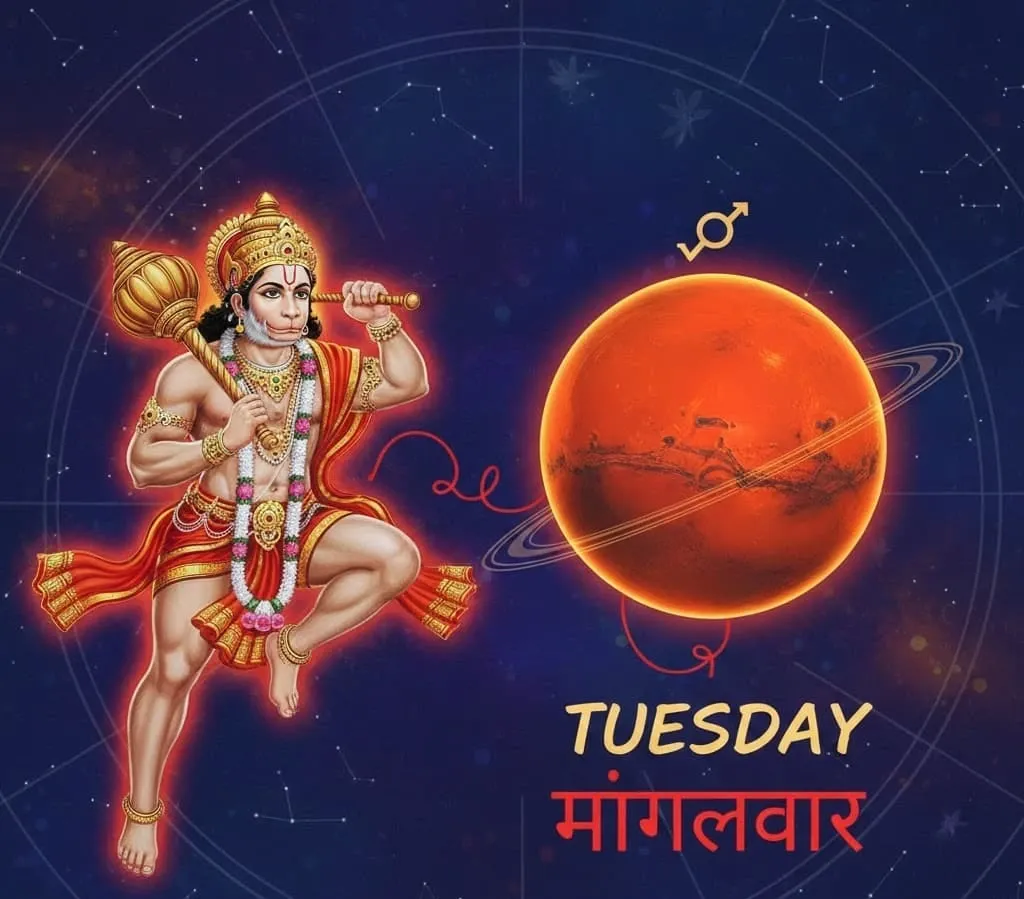
From the standpoint of Vedic astrology (Jyotisha), Tuesday is governed by Mars (Mangal)—the planetary force representing courage, energy, discipline, and righteous aggression. While Mars can manifest as volatility or conflict when afflicted, Lord Hanuman is revered as the deity who sublimates Martian energy into selfless service and spiritual strength.
Astrological scriptures often prescribe Tuesday Hanumanji worship as a remedial practice (upaaya) for mitigating adverse Mars placements, including Mangal Dosha, professional instability, impulsive behavior, and physical lethargy. Hanumanji’s mastery over Mars is symbolic: where Mars incites raw force, Hanumanji channels it into conscious action governed by wisdom and devotion. Chanting the Hanuman Chalisa on Tuesday is therefore regarded as an act of planetary harmonization, aligning the devotee’s inner energies with cosmic order.
✨Symbolism of Strength, Discipline, and Devotion 🙏
Tuesday Hanumanji worship encapsulates a triadic symbolism—strength (bala), discipline (niyama), and devotion (bhakti). Unlike brute power, Hanumanji’s strength is restrained, ethical, and purpose-driven. His life exemplifies disciplined obedience to divine will, rendering him an archetype for spiritual aspirants navigating the challenges of worldly existence.
Devotees who engage in Tuesday Hanumanji sadhana internalize these virtues, gradually cultivating emotional resilience, moral clarity, and unwavering faith. The observance becomes a weekly spiritual recalibration, reinforcing self-control over ego, fear, and inertia. In this sense, Tuesday is not simply a calendrical marker but a symbolic invitation to awaken one’s latent inner power through disciplined devotion.
Understanding the 🕉️Hanuman Chalisa: A Devotional and Philosophical Text
📖Historical Context and Authorship of the Hanuman Chalisa
The Hanuman Chalisa, a forty-verse hymn composed in Awadhi, is attributed to Goswami Tulsidas (16th century CE), one of the most profound Bhakti poets of medieval India. Emerging during a period of intense socio-religious transformation, the Chalisa was composed as a concise yet potent distillation of Hanumanji’s virtues, accessible to common devotees beyond rigid Sanskritic traditions.
According to hagiographical accounts, Tulsidasji composed the Chalisa during a phase of spiritual adversity, invoking Hanumanji as both protector and liberator. Its enduring popularity lies in its linguistic simplicity fused with metaphysical depth, enabling it to transcend sectarian boundaries and remain a cornerstone of Tuesday Hanumanji worship across generations.

Philosophical Themes Embedded in the Forty Verses
Beneath its devotional exterior, the Hanuman Chalisa is replete with profound philosophical insights. Central to its verses is the doctrine of self-effacement before divine will, exemplified by Hanumanji’s declaration of identity as a servant rather than an agent of power. The Chalisa articulates ideals of karma yoga, where action is performed without attachment, and jnana, reflected in Hanumanji’s supreme wisdom and discernment.
Recurring themes include liberation from fear, transcendence of ego, and the destruction of inner demons such as ignorance and doubt. By venerating Hanuman as both warrior and sage, the Chalisa presents a holistic spiritual paradigm—where strength is tempered by humility and knowledge is fulfilled through devotion.
☀️Tuesday Hanuman Chalisa Rituals: Prescribed Observances🌱
The Tuesday Hanuman Chalisa is not merely a devotional recitation but a disciplined sādhana governed by scriptural propriety, inner purity, and rhythmic consistency. Classical Hindu thought emphasizes that the efficacy of any spiritual practice (anuṣṭhāna) depends as much on the vidhi (method) as on bhāva (intent). Hence, observances performed on Tuesdays acquire transformative potency when aligned with prescribed ritual disciplines.
🌟Preparatory Disciplines: 🕉️Purity of Body, Mind, and Space🌟
Ritual preparation (pūrvāṅga karma) is foundational to Hanuman worship. The devotee is advised to begin the day with bodily purification through a bath, preferably before sunrise, symbolizing the removal of tāmasic inertia. Wearing clean, modest clothing—ideally in shades of red or saffron traditionally associated with Lord Hanuman—enhances ritual alignment.
Mental purity is cultivated through restraint of speech, conscious regulation of emotions and withdrawal from distractions. Scriptural traditions emphasize śuddha saṅkalpa—a clear and sincere intention—before commencing the Chalisa. The worship space should be sanctified by cleaning the altar, lighting a lamp (dīpa), and offering incense, creating a consecrated atmosphere conducive to mantra vibration.
🌠Correct Method of Recitation (Paath Vidhi)✅
The Hanuman Chalisa recitation method follows a structured devotional sequence. After invoking Lord Ganesha for obstacle removal, the devotee establishes focus by mentally visualizing Hanumanji as the embodiment of strength (bala), wisdom (buddhi), and devotion (bhakti). The Chalisa should ideally be recited aloud with steady rhythm and precise pronunciation, as sound (nāda) is considered the carrier of spiritual energy.
Seated posture (āsana), preferably facing east or north, stabilizes the body and mind. The recitation concludes with a moment of silent contemplation, allowing the mantric vibrations to integrate internally. Offering flowers, sindoor, or fruits after the recitation reinforces the devotional offering (upacāra).
🕉️Number of Recitations and Scriptural Interpretations💫
Scriptural traditions and devotional lineages offer varying interpretations regarding the number of Chalisa recitations. A single mindful recitation is considered sufficient for daily discipline, while three, seven, or eleven recitations on Tuesday are prescribed for intensified spiritual objectives. Some practitioners undertake anushthanas involving 108 recitations over multiple Tuesdays, symbolizing completeness and cosmic harmony.
These numerical disciplines are not mechanical mandates but symbolic frameworks that cultivate perseverance, concentration, and surrender. The underlying principle is constancy (niyama) rather than numerical excess, as sustained devotion yields deeper spiritual resonance.
🕒Auspicious Timings for Tuesday Hanuman Chalisa and Abhishek🙏
In Vedic cosmology, time (kāla) is a living force that modulates the efficacy of ritual acts. Selecting auspicious timings for Tuesday Hanuman Chalisa and Abhishek aligns the devotee’s effort with favorable cosmic currents, amplifying spiritual outcomes.
🌞Brahma Muhurta vs Evening Worship: Comparative Merits🕉️
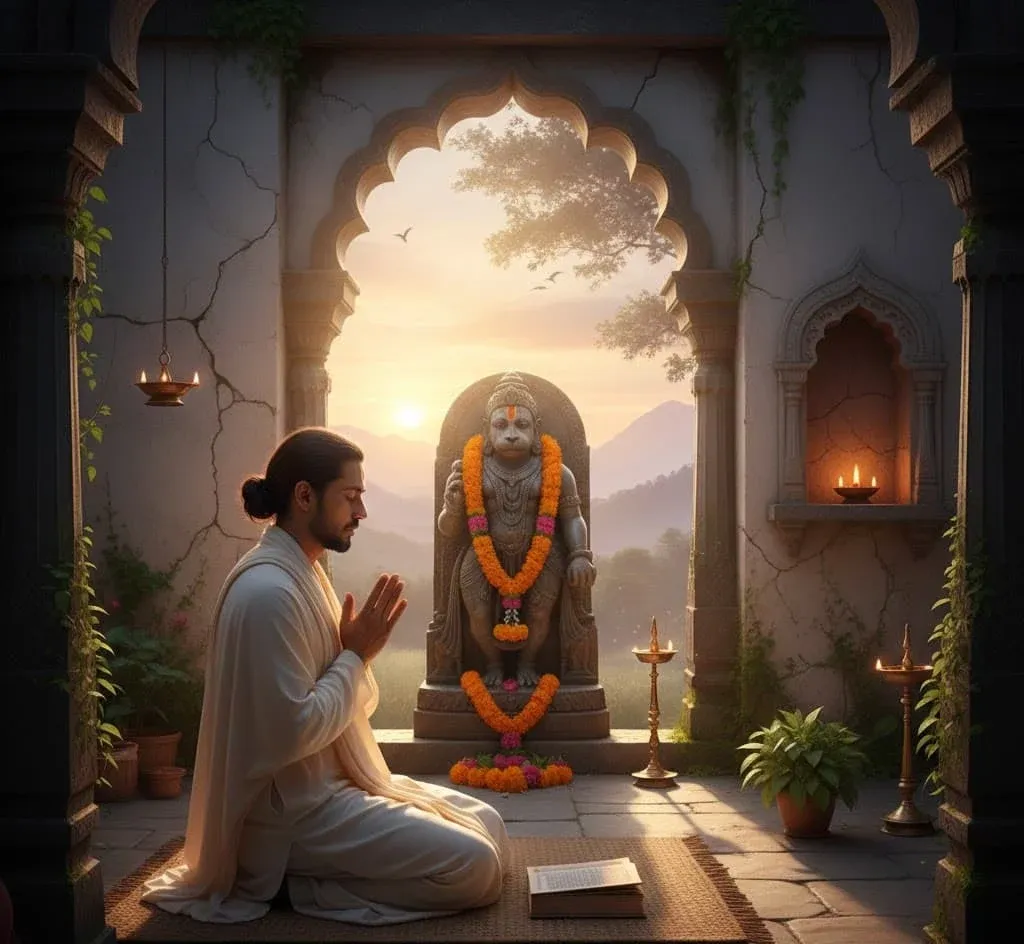
Brahma Muhurta, occurring approximately 90 minutes before sunrise, is extolled in scriptures as the most sattvic period of the day. Worship performed during this time benefits from heightened mental clarity, minimal external disturbances and optimal receptivity to mantra vibrations. For aspirants seeking discipline, self-mastery, and inner strength, early morning Chalisa recitation is particularly efficacious.
Evening worship, especially after sunset, holds its own spiritual merit. Tuesdays evenings are traditionally associated with protection from negative energies and planetary afflictions. For householders balancing worldly duties, evening Hanuman worship serves as a restorative spiritual anchor, harmonizing accumulated stress and karmic impressions.
🕉️Abhishek: Ritual Procedure and Sacred Materials🪔
Hanumanji Abhishek occupies a distinctive place within the corpus of Vaishnava and Shaiva-influenced devotional practices, representing a synthesis of ritual purity (śuddhi), symbolic offering (upacāra), and intense bhakti. Performed with reverence—especially on Tuesdays—it is believed to awaken the protective, transformative, and obstacle-removing energies of Lord Hanuman.
🐚Scriptural References to Abhishekam Divine Worship🐚
Although Lord Hanumanji is primarily revered through stotra-pāṭha, nāma-smaraṇa, and sevā, scriptural traditions do attest to the ritual of Abhishekam in his worship. References appear implicitly in the Skanda Purāṇa, Brahmāṇḍa Purāṇa, and regional Āgamic traditions, where Hanumanji is worshipped as Rudrāvatāra—a manifestation of Shiva’s dynamic energy.
In South Indian temple traditions, particularly those following Vaikhānasa and Pāñcarātra Āgamas, Abhishekam to Hanumanji is prescribed as a means of invoking bala (strength), rakṣā (protection), and graha-śānti (planetary pacification). The act of ritual bathing symbolizes the dissolution of ego, impurities, and accumulated karmic residues, allowing the devotee to align with Hanumanji’s unwavering devotion to Dharma and Rāma.
🪔Types of Abhishek (Milk, Sindoor, Ghee, Honey, Panchamrit)🐚
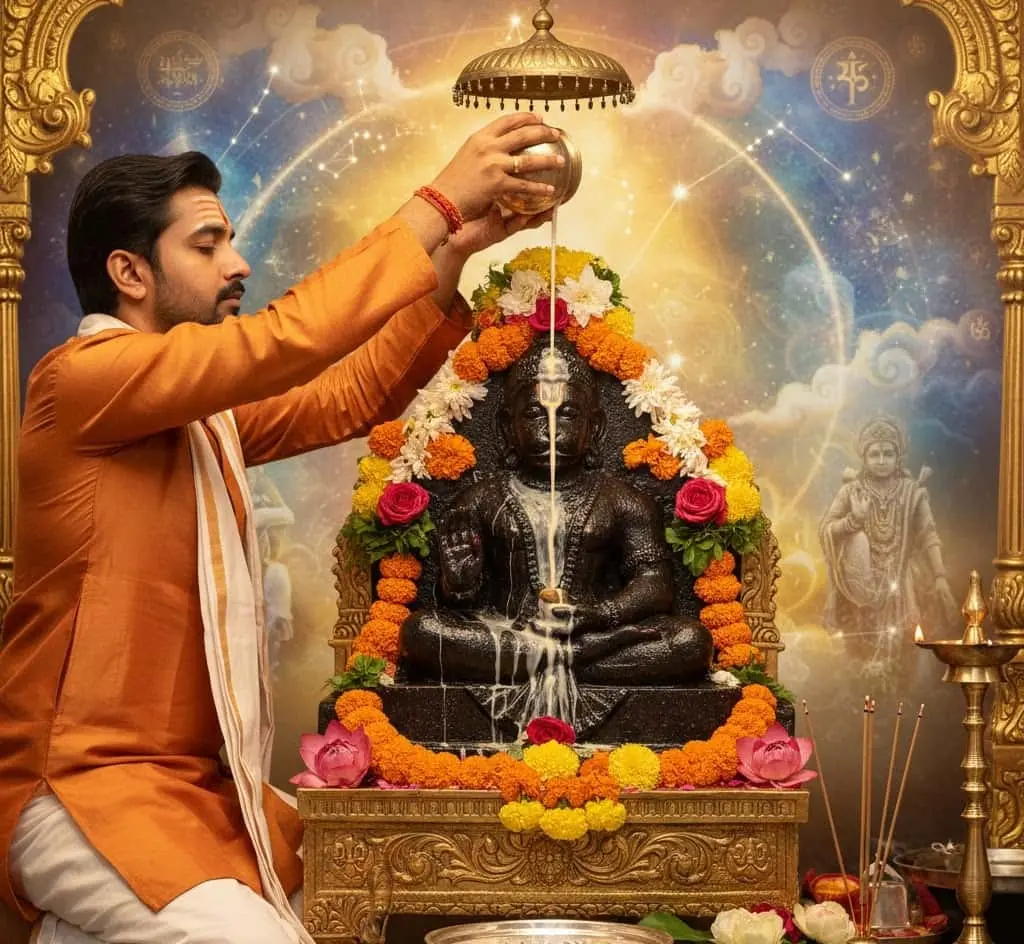
Each substance used in Hanumanji Abhishek carries metaphysical and symbolic significance, transforming the ritual into a multilayered spiritual act:
- Milk (Kṣīra Abhishek)
Symbolizing purity and sattva, milk Abhishek is believed to calm mental turbulence and enhance emotional balance. It is particularly recommended for devotees seeking relief from anxiety and instability. - Sindoor (Vermilion) Abhishek
Unique to Hanuman worship, sindoor represents vīrya (vital force), courage, and unwavering service. Scripturally associated with Hanumanji’s supreme devotion to Lord Rāma, sindoor Abhishek is said to strengthen resolve, remove fear, and bestow victory over adversities. - Ghee (Ghṛta Abhishek)
Ghee signifies sacrificial fire and spiritual nourishment. Its application is associated with longevity, clarity of intellect, and the burning of karmic impressions through divine grace. - Honey (Madhu Abhishek)
Honey embodies harmony and sweetness in speech and relationships. It is offered to invoke balance in personal and professional life while cultivating compassion and humility. - Panchamrit Abhishek
A sacred blend of milk, curd, ghee, honey, and sugar, Panchamrit represents the five elements purified into divine nectar. This Abhishek is believed to facilitate holistic well-being—physical, mental, and spiritual.
🔶Mantras and Sankalpa During Abhishek🔶
The efficacy of Abhishek is magnified when performed with mantra-japa and a clearly articulated sankalpa (intentional resolve). Before commencing the ritual, the devotee mentally affirms the purpose—be it spiritual growth, removal of obstacles, or planetary appeasement.
Commonly recited mantras include:
- “Om Namo Bhagavate Hanumate Namah”
- “Om Hanumate Rudrātmane Namah”
- Hanuman Chalisa or Bajrang Baan
The sankalpa should be expressed with humility and surrender, recognizing Hanumanj not merely as a granter of boons but as a guru of disciplined devotion. Conscious repetition of mantras during Abhishek transforms the ritual from an external act into an inner spiritual consecration.
🪔🐚Spiritual, Psychological, and Karmic Benefits of Tuesday Hanuman Worship🐚🪔
Tuesday worship of Lord Hanuman through Chalisa recitation, Abhishek, and fasting offers holistic benefits:
- Cultivates fearlessness, willpower, and mental clarity by stabilizing emotions and strengthening focus
- Removes obstacles and negative energies, as Hanumanji is revered as Sankata Mochana
- Creates spiritual protection against psychic disturbances and fear-based patterns
- Acts as an astrological remedy for Mangal Dosha, Shani Sade Sati, and adverse planetary periods
- Harmonizes Mars and Saturn energies, enabling courage, discipline, and resilience during karmic challenges
🌱Hanuman Chalisa as a Vedic Remedy (Upaaya) in Astrology🌱
In Vedic astrology, an Upaaya is not a superstitious corrective but a conscious realignment of human will with cosmic law (R̥ta). The Hanuman Chalisa functions as a powerful astrological remedy because Lord Hanuman transcends planetary bondage while simultaneously governing the very forces that bind human destiny—strength (Bala), courage (Veerya), and disciplined action (Karma Yoga).
Unlike gemstone or mechanical remedies, Hanuman worship is transformative; it refines the devotee’s inner constitution, thereby altering how planetary influences manifest in lived experience.
🔥Devotion to Hanumanji for🔥Mangal Dosha and Career Stability🔥
Mangal (Mars) represents energy, ambition, conflict, and execution. When afflicted, it results in Mangal Dosha, leading to aggression, impulsive decisions, professional instability, and strained authority dynamics.
Lord Hanuman is considered the highest spiritual expression of Mars energy—where raw force is sublimated into selfless service. Regular recitation of the Hanuman Chalisa on Tuesdays acts as a Mars-pacifying discipline, channeling excess aggression into focused perseverance.
From a career perspective:
- Hanuman worship strengthens decision-making clarity
- Reduces conflicts with superiors and colleagues
- Enhances stamina, leadership endurance, and ethical assertiveness
- Supports professions requiring courage, discipline, and responsibility (administration, defense, engineering, entrepreneurship)
Thus, Hanuman Chalisa becomes not merely a remedy for Mangal Dosha but a career-stabilizing sadhana grounded in inner mastery rather than external control.

🎇🔶Relevance in Shani Sade Sati and Mahadasha🎇🔶
During Sade Sati or Shani Mahadasha, individuals often experience prolonged karmic testing—delays, burdens, isolation, and existential questioning. Shani does not punish; he demands maturity, humility, and endurance.
Lord Hanuman is uniquely positioned as the only deity explicitly praised for his mastery over fear, suffering, and servitude—the very domains governed by Saturn.
The Hanuman Chalisa repeatedly affirms:
- Freedom from fear (Bhaya binu hoye na preeti)
- Protection from unseen afflictions
- Strength to endure adversity without moral collapse
Astrologically, chanting during Saturn-dominant periods:
- Reduces psychological heaviness and despair
- Cultivates patience and inner detachment
- Converts karmic pressure into disciplined growth
Hence, Hanuman worship does not negate Shani’s lessons; it empowers the devotee to pass them with dignity and wisdom.
🌅🌈Chanting as a Form of Sound Therapy and Energetic Alignment🐚🪔
Beyond devotion and astrology, the Hanuman Chalisa operates as a sonic instrument of subtle-body recalibration. Each verse carries rhythmic meters (Chaupai and Doha) that harmonize the Nadi system and stabilize erratic pranic flows.
From an energetic standpoint:
- The Chalisa activates the Manipura Chakra, the seat of willpower
- Regulates Mars-dominant heat in the nervous system
- Builds mental resilience against fear-based conditioning
Regular chanting functions as sound therapy, aligning intention (Sankalpa), breath (Prana), and consciousness (Chitta). This alignment gradually weakens planetary afflictions by strengthening the individual beyond their influence.
🐚🪔Observing Tuesday Vrat (Fast) Alongside Hanuman Worship 🥥🌱
Tuesday fasting (Mangal Vrat) is not an act of denial but a discipline of conscious restraint. When combined with Hanuman worship, it amplifies both astrological efficacy and spiritual merit by purifying intention and conserving vital energy.
Scriptural Guidelines for Tuesday Fasting
Traditional texts and regional Smriti traditions prescribe Tuesday fasting as:
- A sunrise-to-sunset observance
- Dedicated to Lord Hanuman or Mars
- Accompanied by prayer, silence moderation, and ethical vigilance
The fast may be:
- Nirjala (water-only) for advanced practitioners
- Phalahar (fruits, milk, jaggery) for householders
The emphasis is not austerity alone, but voluntary discipline infused with devotion.
🥥🌱Dietary Discipline and Ethical Conduct
Food, in Vedic thought, is condensed consciousness. On Tuesdays:
- Avoid tamasic foods (alcohol, meat, onion, garlic)
- Prefer sattvic nourishment
- Maintain restraint in speech, anger, and sensory indulgence
Equally critical is ethical fasting:
- Truthfulness in speech
- Control over aggression
- Acts of service or charity, especially towards the weak
Without ethical alignment, fasting remains physiological; with it, the vrat becomes spiritually catalytic.
🐚🪔Integration of Vrat, Chalisa, and Abhishek for Enhanced Merit
When Tuesday Vrat, Hanuman Chalisa recitation, and Hanuman Abhishek are integrated, they create a threefold spiritual circuit:
- Vrat disciplines the body
- Chalisa purifies the mind
- Abhishek sanctifies intention and surrender
This integrated observance accelerates:
- Removal of karmic obstacles
- Planetary pacification
- Inner fortitude and grace under pressure
Such synergy transforms ritual into sadhana—a lived spiritual process.
Common Mistakes and Misconceptions in Hanuman Worship
- Ignoring auspicious timings such as Rahu Kaal
- Performing Abhishek without intention or sankalpa
- Neglecting cleanliness, mental focus, and inner purity
- Engaging in mechanical or hurried chanting focused only on numbers
- Failing to understand or feel the meaning of the Hanuman Chalisa
- Overemphasizing bhakti without discipline or procedure without devotion
Call to Action (CTA)
Q1. Seeking relief from Mangal Dosha or career instability?
A. Schedule a personalized Tuesday Hanuman Puja and Chalisa Sadhana guided by Vedic principles.
Q2. Want structured discipline for Sade Sati or Shani Mahadasha?
A. Join our 21-Tuesday Hanuman Sadhana Program designed for karmic endurance and clarity.
Q3. Unsure how to correctly observe Hanuman Abhishek and Vrat?
A. Download our step-by-step Hanuman Worship & Fasting Guide.
Q4. Looking for astrologically aligned remedies instead of generic rituals?
A. Consult our Vedic astrologer for Hanuman-based planetary upaayas.
Q5. Want to deepen devotion beyond rituals?
A. Enroll in our Hanuman Sadhana learning series for inner mastery.
FAQs
1. Is Hanuman Chalisa an effective astrological remedy?
Yes. It functions as a Vedic upaaya by strengthening inner discipline, thereby reducing planetary afflictions.
2. Does Hanuman worship help during Sade Sati?
It enhances patience, courage, and psychological resilience—key virtues demanded during Saturn’s trials.
3. Is Tuesday fasting compulsory for Hanuman worship?
No, but fasting amplifies focus, self-restraint, and spiritual receptivity.
4. Can Hanuman Chalisa improve career stability?
Yes. By harmonizing Mars energy, it supports decisive action and conflict management.
5. How long does it take to see results from Hanuman sadhana?
Effects are gradual and cumulative, depending on consistency, sincerity, and ethical conduct.
👉 Watch this inspiring talk on YouTube where Swami Mukundanandji beautifully explains the divine pastimes of Shree Hanumaji and reveals timeless lessons from his life. In this video, you’ll discover powerful guidance on how to face life’s challenges with courage, faith, and devotion — just as Hanuman did. Let his unwavering strength and love for Lord Rama motivate you to rise above obstacles and transform your inner life. Don’t miss this chance to deepen your spiritual understanding and uplift your heart! 🙏✨