
Inspiration - RKT Newsletter
June 2025
Quote
श्रीभगवानुवाच | कालोऽस्मि लोकक्षयकृत्प्रवृद्धो लोकान्समाहर्तुमिह प्रवृत्त: | ऋतेऽपि त्वां न भविष्यन्ति सर्वे येऽवस्थिता: प्रत्यनीकेषु योधा: || 32||
shri-bhagavan uvacha kalo ’smi loka-kshaya-krit pravriddho lokan samahartum iha pravrittah rite ’pi tvam na bhavishyanti sarve ye ’vasthitah pratyanikeshu yodhah
The Supreme Lord said: I am mighty Time, the source of destruction that comes forth to annihilate the worlds. Even without your participation, the warriors arrayed in the opposing army shall cease to exist. ( Bhagavad Gita 11.32 )
From the Editor’s Desk
As we move through the various seasons of life — youth and aging, health and illness, joy and trial — one quiet teacher always accompanies us: Time. Unlike other teachers, Time offers no lectures or books, yet its lessons are profound, far-reaching, and deeply personal. Time gradually reveals what urgency conceals — that life’s greatest treasures often unfold not in haste, but in reflection and ripening.
This issue reflects on how Time shapes our physical well-being, our values, and our spiritual understanding. Ultimately, as the sages remind us, Time does not merely pass — it purifies, matures, and points us toward the Eternal that lies beyond it.
Bhakti Ras
4 Profound Ways Time Heals and Transforms Us
In life, some of the deepest lessons do not reveal themselves immediately. When we experience pain, loss, betrayal, or suffering, that moment is all-consuming. It is difficult to step back and see any higher purpose when grief floods the mind.
At such times, the mind clings to a comfortable narrative: Why me? Why this? Why now? But time has a secret power. As it silently rolls forward, emotions begin to soften and the sharp edges of pain lose their sting. And as the heart settles, something remarkable happens — we start seeing the hidden dimensions or wisdom from our experience, which were invisible amidst the storm.
With time, what once appeared purely tragic may reveal itself as a doorway to wisdom, humility, inner strength, and divine grace. In this way, time becomes not only a healer but a profound spiritual teacher. It transforms our wounds into windows of self-realization, and our obstacles into pathways toward God.
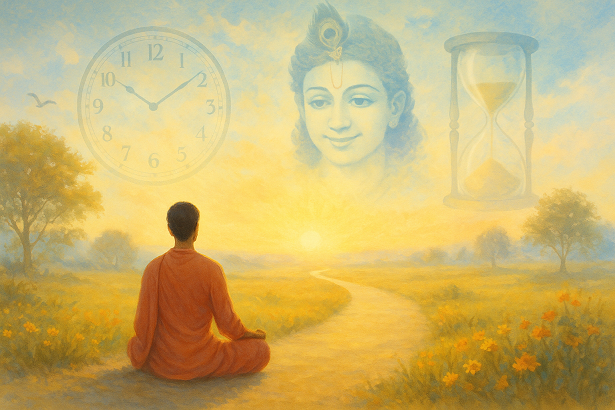
How does Time Heal and Transform Us?
1. Time Softens the Pain and Reveals Hidden Wisdom
When we suffer, it feels permanent. The grief of losing a loved one, the sting of failure, or the pain of injustice can seem unbearable in the moment. We wish to run away from our worldly duties and nurse the shattered heart or ego. Some even contemplate prematurely renouncing the world. But as days turn to weeks, and weeks into months, the intensity slowly fades. Not because we forget, but because our perspective broadens. We remember spiritual teachings about the importance of fulfilling our duties and responsibilities, akin to what Shree Krishna told Arjun:
दु:खमित्येव यत्कर्म कायक्लेशभयात्यजेत् | स कृत्वा राजसं त्यागं नैव त्यागफलं लभेत् || 8||
duhkham ity eva yat karma kaya-klesha-bhayat tyajet sa kritva rajasam tyagam naiva tyaga-phalam labhet
To give up prescribed duties because they are troublesome or cause bodily discomfort is renunciation in the mode of passion. Such renunciation is never beneficial or elevating.
(
Bhagavad Gita 18.8 )
Time allows us to digest our experiences. The mind begins to perceive layers of meaning and insight that could not be accessed while emotions dominated. We may realize that a painful ending led to new beginnings, or that loss taught us to appreciate what remains. This ripening of wisdom is one of time’s greatest gifts.
Often, our greatest suffering comes from resisting life as it presents itself. Time gently wears away this resistance, inviting us toward surrender, not out of helplessness, but out of wisdom. We come to see that behind every event, there operates a higher intelligence far beyond our understanding.
Saint Meerabai, whose heart belonged to Krishna since her early childhood, faced years of opposition and hardship after being married in a Rajasthani royal family. Yet, her unwavering devotion to Shree Krishna remained untouched, as her soul had already surrendered fully to her beloved Giridhar Gopal long before the trials began.

Time teaches that peace is not found in controlling life, but in yielding to God’s perfect orchestration of the external world. Time transforms the experiential knowledge into wisdom that becomes part of our spiritual maturity.
2. Time Offers the Gift of Perspective
Over time, when we contemplate the meaning and purpose of our suffering, we often realize that what seemed devastating at the time was, in fact, a part of a much larger divine arrangement. Time creates emotional distance, and distance creates clarity. We are no longer trapped in the small frame of the present event; we begin to see how the pieces fit into life’s larger puzzle.
For example, in the Mahabharat, after losing the game of dice, when the Pandavas were asked to go into exile, initially, they were devastated. Then, time revealed that the exile not only purified them, preparing them to rule justly in the future, but more importantly, Shree Krishna visited them often, as did Draupadi’s father and brothers. Then one day, even Ved Vyas visited them, giving profound advice to Yudhishtir about the imminent war and how to win it.

The takeaway is that time broadens our narrow vision, helping us see that every trial contains the seed of future growth.
3. Time Facilitates the Resolution of Karmic Actions
Frequently, suffering is the unfolding of past karma. What appears as random misfortune could be the resolution of karmic debts that the soul carries forward across lifetimes. Time serves as the great stage upon which these karmic plays are enacted and completed. For example, the story of Gajendra Moksh, noted in the Bhagavata Purana (Canto 8, Skandha 8, Chapters 2 to 4), shows the consequences when one is overcome with pride, but also how beautifully God facilitates the resolution of karmic actions and reactions of souls.
In his previous life, Gajendra was a king named Indradyumna, a great devotee of Lord Vishnu. However, one time, when he was engaged in his worship, Rishi Agastya visited him. Rather than welcoming the sage with respect, Indradyumna disregarded him. Offended by this disrespect, the sage cursed him to be reborn as an elephant, trapped in the darkness of ignorance.
Indradyumna was born as an elephant and lived in total oblivion of his past spiritual pursuits. As destiny would have it, one time when bathing in a river, a crocodile got hold of his foot and would not let go, no matter how hard he struggled. The crocodile was in an advantageous position of being in its natural habitat.
At the moment of sheer misery, he was graced with the knowledge of his past life and began to call out to Lord Vishu with total surrender. God arrived on Garuda and used His chakra to split open the crocodile's mouth, freeing the elephant. The crocodile was, in fact, a Gandharva named Hu-Hu, who was also released from a curse placed upon him by Sage Devala through the Lord’s divine touch.
The takeaway from this story is that both Indradyumna (i.e., Gajendra) and Hu-Hu (the crocodile) were suffering the results of their past actions. Their current suffering was the result of prarabdha karm, the portion of past karma that has begun to bear fruit in the present life. Despite their karmic debts, both were liberated through Lord Vishnu’s intervention.
This story resolves the problem of karmic actions by showing that while karm governs the material world, sincere surrender and divine grace have the power to liberate souls from its binding effects.
4. Time Guides Us Toward the Eternal Beyond Time
Perhaps the highest function of time is to awaken us to its own limitations. It teaches that all worldly things—both joys and sorrows—are transient and ephemeral. But behind this ever-changing flow lies something unchanging: the eternal Self.
The beautiful story of Nachiketa and Yamaraj ji (from the Kathopanishad), teaches us an important lesson.
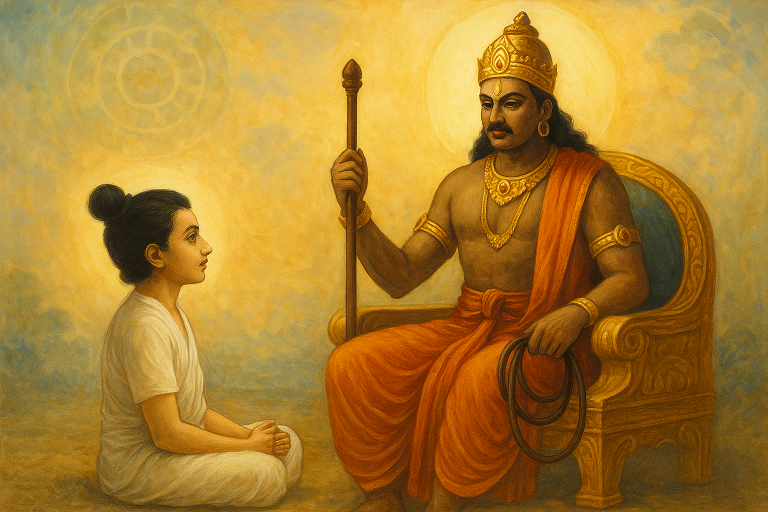
Young Nachiketa was sent to the house of Yamaraj, the celestial god of death, by his father. For three days, Yamaraj was absent, and Nachiketa waited patiently. When Yamaraj returned, pleased with Nachiketa’s steadfastness, he offered him three boons. For his third boon, Nachiketa asked the most profound question, "What happens after death? Does the soul exist beyond the body?"
Yamaraj first tried to dissuade him by offering him wealth, pleasures, long life — all time-bound pleasures. But Nachiketa refused. He said, “Keep your chariots, your music, and your riches, O Yamaraj. They all perish with time. I seek only the truth that is beyond birth and death.” Seeing Nachiketa’s purity and deep spiritual maturity, Yamaraj revealed the supreme secret. He said, “The Atman is unborn, eternal, beyond time. It was never born, nor shall it die. It is not slain when the body is slain.”
Here, the takeaway is that time serves its ultimate purpose. All worldly pleasures, being under the domain of time, are temporary. But the wise seeker, like Nachiketa, recognizes that beyond the passing experiences of time, there is something timeless – the eternal soul.
Conclusion: The Compassion of Time
Time, often feared as the destroyer, is in truth one of God’s most compassionate instruments. It softens pain, widens vision, dissolves resistance, fulfills karm, and points us toward eternity. If we walk with time patiently, reflectively, and spiritually, every wound can become a doorway to wisdom, and every loss a preparation for divine union.
"In God’s time, even wounds become wings."
Bal-Mukund: Playground for Vedic Wisdom
The Girl Who Never Gave Up

Liz Murray grew up in an environment of chaos and hardship. She was born in the Bronx, one of the most violent regions of New York City. Her parents were addicted to drugs and regularly used intravenous injections; a reality Liz saw throughout her childhood. At nine, she saw her parents selling her sister’s coat to buy drugs and had to work at a gas station to help support the family. Despite the struggles and addictions of her parents, they loved Liz.
At fifteen, after her mother died of AIDS and her father entered a shelter, Liz made a life-changing decision not to follow the same path. She took up a job and enrolled herself at the Humanities Preparatory Academy in Manhattan. To make up for lost years, Liz took double the usual number of classes during the day. At night, she had no home and would sleep on subway trains.

During a school trip, she set her sights on Harvard. She applied to Harvard and the New York Times Foundation for a scholarship, and both interviews fell on the same day. She went for the New York Times interview and requested that it be postponed, but it was denied. Liz chose Harvard, foregoing the scholarship interview. She was eventually rewarded as she was accepted to Harvard and received the scholarship. The Foundation Chairman called her accomplishments extraordinary, noting she completed a four-year program in two years and topped a class of 156 students.
Practical wisdom:
- Liz grew up facing hardship due to her parents’ drug addiction. Those past experiences taught her that the choices one makes shape the future. By choosing not to follow the same path as her parents, she focused on rebuilding her life through education. By valuing her time and using it wisely, she completed a four-year program in just two years. In the same way, spiritual seekers must recognize that human birth is rare, appreciate the value of the present moment, and make conscious choices in the present that will lead toward God-realization in the future.
- Liz showed remarkable patience, resilience, and perseverance by taking double the number of classes during the day while spending nights on subway trains due to homelessness. She knew catching up on lost time from her past would not be easy, yet she stayed committed to her goal. Like Liz, spiritual seekers must cultivate resilience, patience, and persistence on their journey toward God realization, knowing spiritual growth takes time and steady effort.
Youth Insights
Time - The Silent Teacher
We often think of teachers as people who speak to us, give us instructions, or stand at the front of a classroom. But time teaches in quieter ways – no instructions, no reminders, just small lessons that build up over the days, weeks, and years. Still, its lessons are some of the most powerful we've encountered.
Waiting Teaches Us More Than We Think
Time teaches patience by making us wait. Whether we’re waiting for exam results, recovering from a hard moment with a friend, or healing from disappointment, we begin to realize that rushing doesn’t make things better, but trusting the process does.
Looking Back Makes Things Clearer

Time also teaches tolerance. As students, we meet so many different people, and we click with some instantly, while others test our limits. But over time, we learn that people grow, change, and surprise us. Time helps us look beyond first impressions and remember that even we aren’t who we were just a year ago.
Hindsight makes time a wise guide. Looking back, we often see why something didn’t work out, why a challenge was necessary, or how a painful moment made us stronger. It reminds us not to panic when things don’t go according to plan. The future always brings clarity, if not now, then eventually.
How We Can Use Time Smarter
Here are a few small ways we try to make time our ally:
- Pause before reacting. When something frustrates us, we should take a moment to reflect before reacting. Time gives us perspective, but only if we give it space.
- Reflect weekly. Taking just five minutes on Sundays to journal about what we learned that week helps us see growth over time.
- Practice delayed gratification. Whether it’s saving up for something or resisting the urge to rush through a task, we should learn to enjoy the process, not just the reward.
- Be present. Instead of worrying about the future or regretting the past, we should focus on being fully here. In class, at lunch with friends, or during puja, now is where life is happening.
Trust the unfolding. If something is confusing or hard right now, let's remind ourselves: “Time will show me the meaning later.”
Time Is Always Teaching
Even when we don’t notice it, time shapes us. It helps us grow, become wiser, and stay grounded. If we learn to pay attention, time becomes more than just hours and days, it becomes one of our best teachers.
Holistic Health Tidbits
Time as Medicine: How Patience Nourishes Body and Mind
We think we can conquer or manipulate time. When approached with awareness, however, time becomes one of our most profound teachers, guiding us toward better physical and mental health. Let us examine the lessons we can learn from time, some of which have also been noted in previous sections.
- Time teaches us patience. For example, a broken bone needs weeks to mend, or a grieving heart needs months, even years, to reconcile loss. By honoring the natural rhythm of time, we begin to trust the growth process. We stop rushing toward results and start appreciating transformation's subtle, quiet progress.
- Time brings clarity. In moments of crisis or stress, everything may feel overwhelming. But with time, perspective returns. What once seemed like an unbearable burden becomes a steppingstone toward wisdom. This way, time supports mental health by softening our edges and allowing resilience to emerge.
- Consistency over time is essential for physical wellness. One workout will not build strength, and one healthy meal will not change our biology. But small, sustained efforts—walking daily, meditating for a few minutes, eating mindfully—accumulate vitality. Time shows us that discipline is about persistence.
- Time encourages presence for mental stability. When we live too far ahead in the future or dwell too long in the past, anxiety and regret can take hold. But being present—entirely in the “now”—restores balance to the nervous system and reconnects us to the sacredness of each moment. Mindfulness teaches us to meet time as it is without resistance.
- Gratitude deepens with time. As we age, we recognize the impermanence of all things. This awareness is sobering and beautiful. It awakens appreciation for our bodies, the breath that sustains us, and our relationships.
- Time brings humility. We cannot control everything, but we can choose how we show up. When we honor time as wise teachers, we open ourselves to a more integrated and peaceful health experience in both body and mind.

To use time wisely, we must avoid quick fixes, such as fad diets, miracle pills, or telling ourselves we can have our cake and eat it too. We must also eliminate overconfidence in our mortality and how much time we must correct our habits.
Some actions we can take today are:
- Challenge Assumptions: Question the validity of our thoughts and beliefs about time.
- Seek Diverse Perspectives: Consider different viewpoints and sources of information, such as lectures from Swami Mukundananda.
- Embrace Cognitive Flexibility: Be open to changing habits when presented with new evidence.
- Engage in Emotional Processing: Take time to reflect on feelings and experiences.
- Seek Support: Talk to a friend or counselor about suggestions for improvement.
Reflection Questions
Bhakti Ras / Inspiration
- Why do we say that time is a healer? Provide an example to illustrate.
- What is the profound message from the Mahabharata when the Pandavas were exiled after losing the game of dice?
- What is the primary takeaway from the story of Nachiketa and Yamaraj ji?
Bal-Mukund: Playground for Vedic Wisdom
- What lesson did Liz learn from her past regarding the impact of choices?
Youth Insights
- Think of a moment in your life that didn’t make sense at the time but makes more sense now. What did time teach you through that experience?
Holistic Health Tidbits
- How can we maximize the time we spend toward achieving our wellness goals?
Upcoming Events
The upcoming month of July will be the most auspicious of all at the Radha Krishna Temple of Dallas (Allen) because we will celebrate an amazing event in the divine presence of Swami Mukundananda ji.
JKYog’s Spiritual Retreat and Family Camp
This is truly a life-transformational and the most awaited event of the year. Participants have the opportunity for one-to-one interaction with Swamiji for an entire week and engage in the most devotional, fun, and transformational week of their lives.
- Dates: July 4 to 10, 2025
- Venue: Radha Krishna Temple of Dallas, Allen, Texas
- Details: https://www.radhakrishnatemple.net/spiritual-retreat-family-camp
Here are the most amazing activities of this retreat:
- Divine discourses by Swamiji on the Narad Bhakti
- Guided meditations by Swamiji that will touch your soul
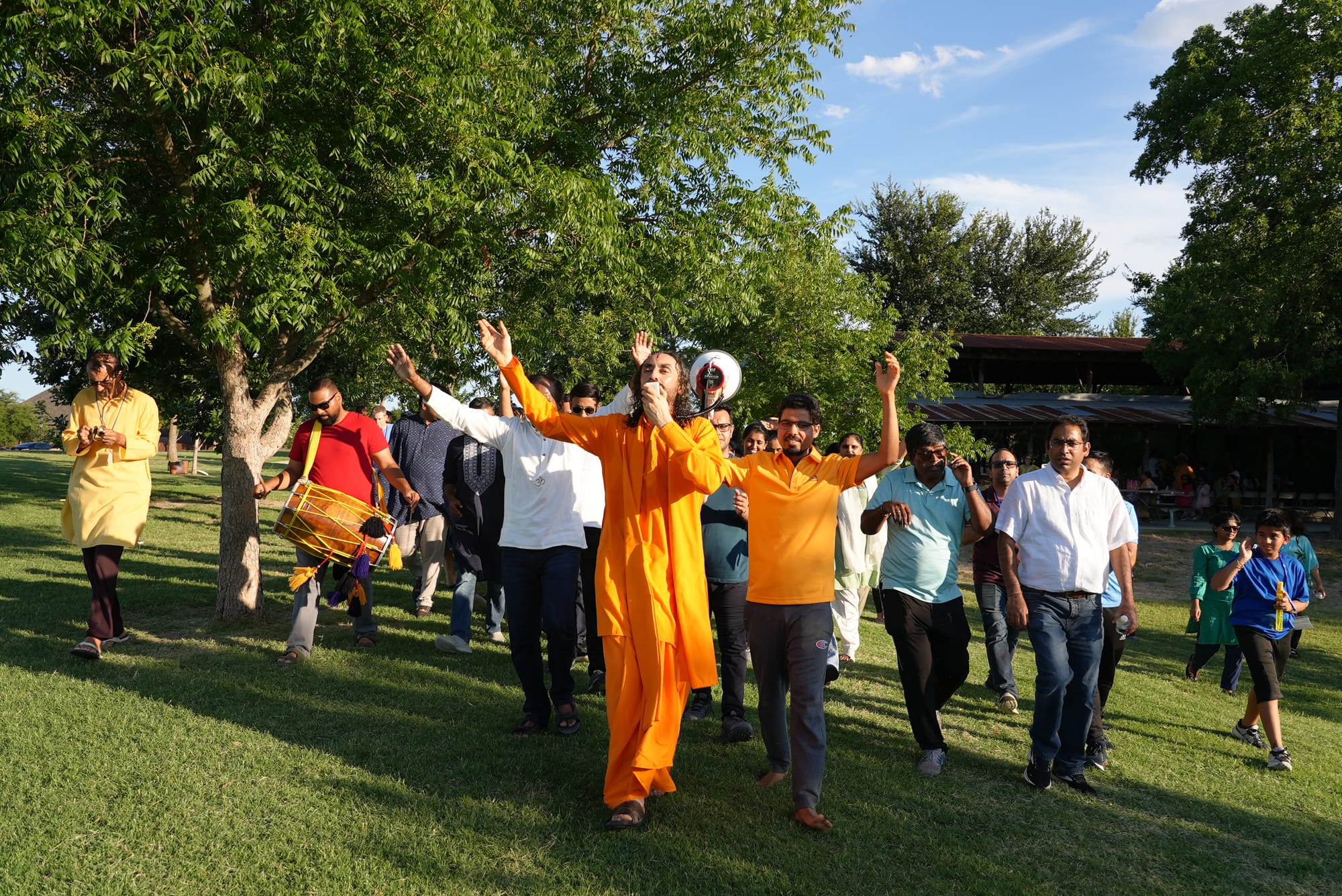
- Parikrama or picnic with Swamiji and fellow devotees in a local park
- Various festival celebrations, including Nauka Vihar and Sita Ram Vivah
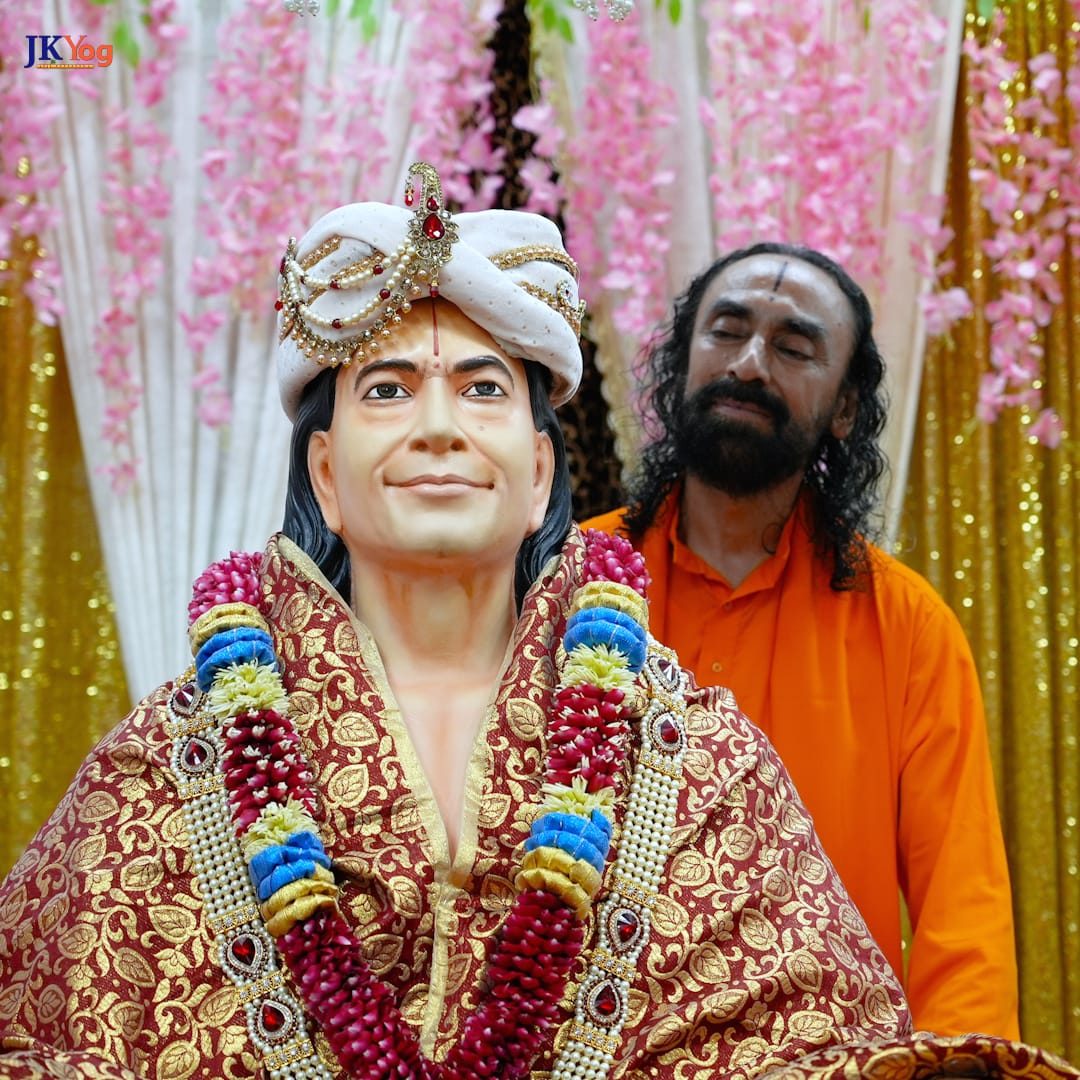
- Very special Guru Purnima celebration on July 10th with Chhapan Bhog and Abhishek for Shree Maharajji
- Parallel sessions for children (Bal-Mukund) and youth (Youth Club)
- Q/A sessions with Swamiji to satisfy your intellectual curiosity
- Interactive activities for the family (everyone together)
- Mehfil to showcase your unique talent
- JKYog Idol competition
Relish some sweet memories from last year’s Family Camp.

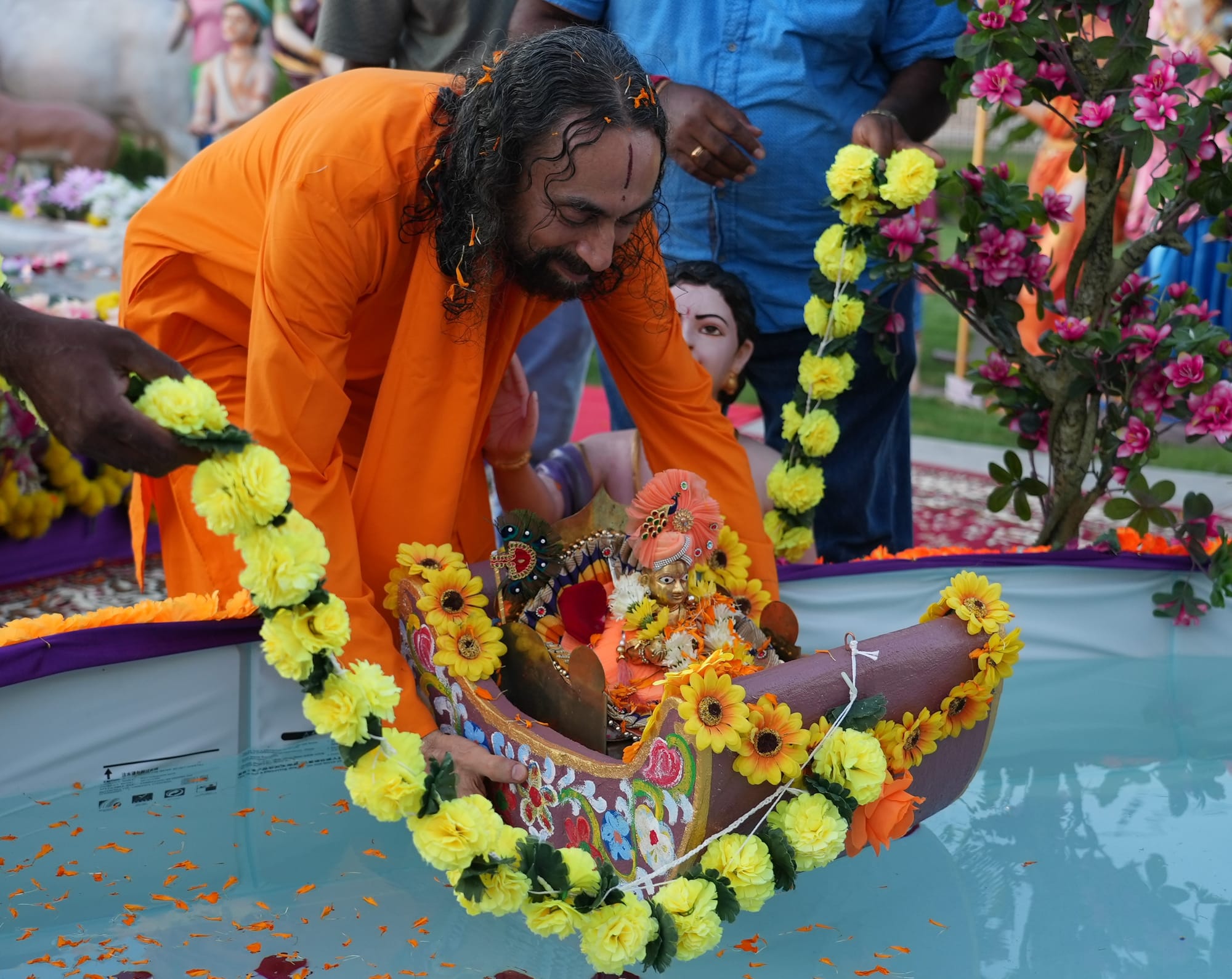
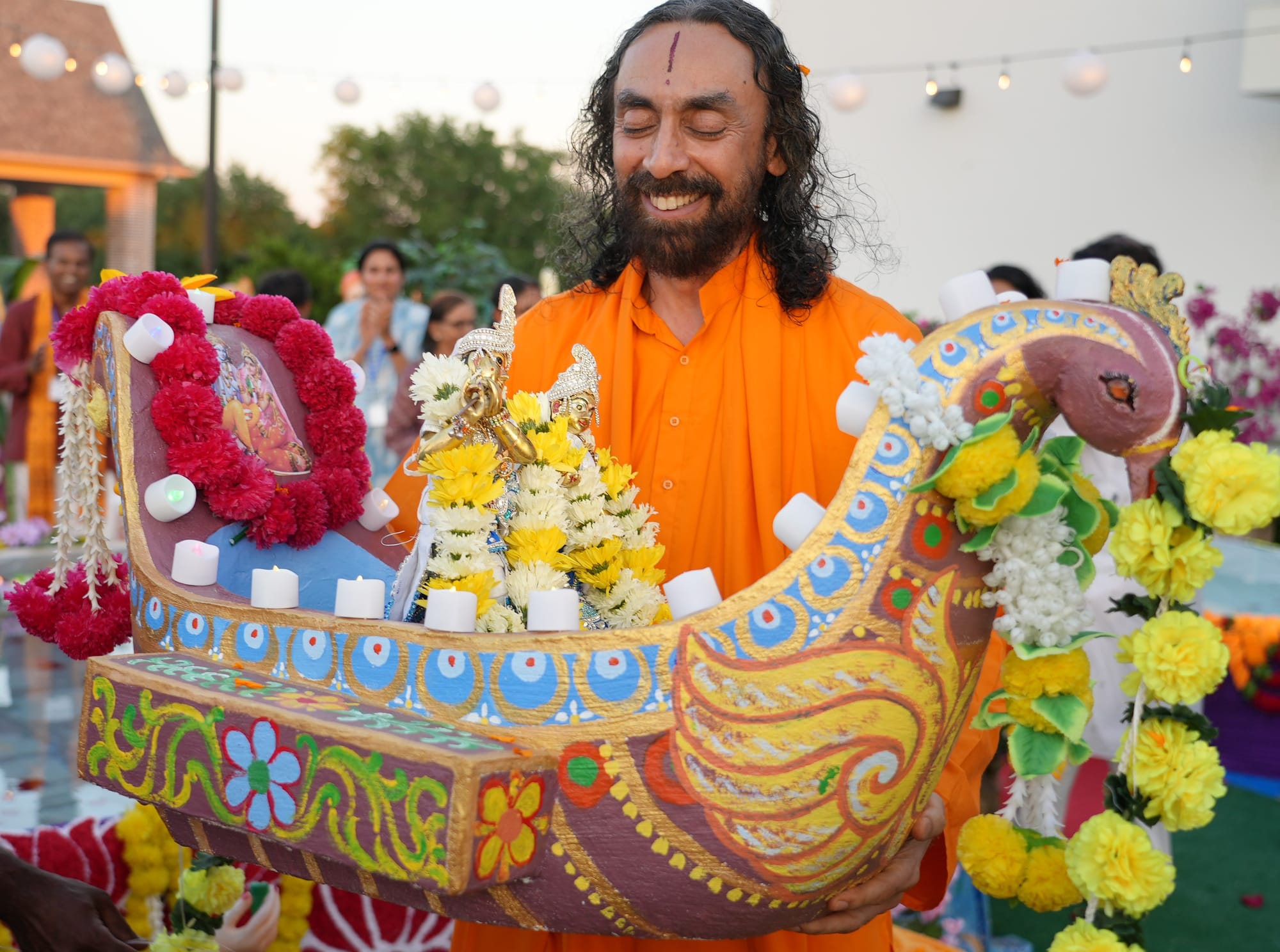

Memories from last year’s Family Camp