
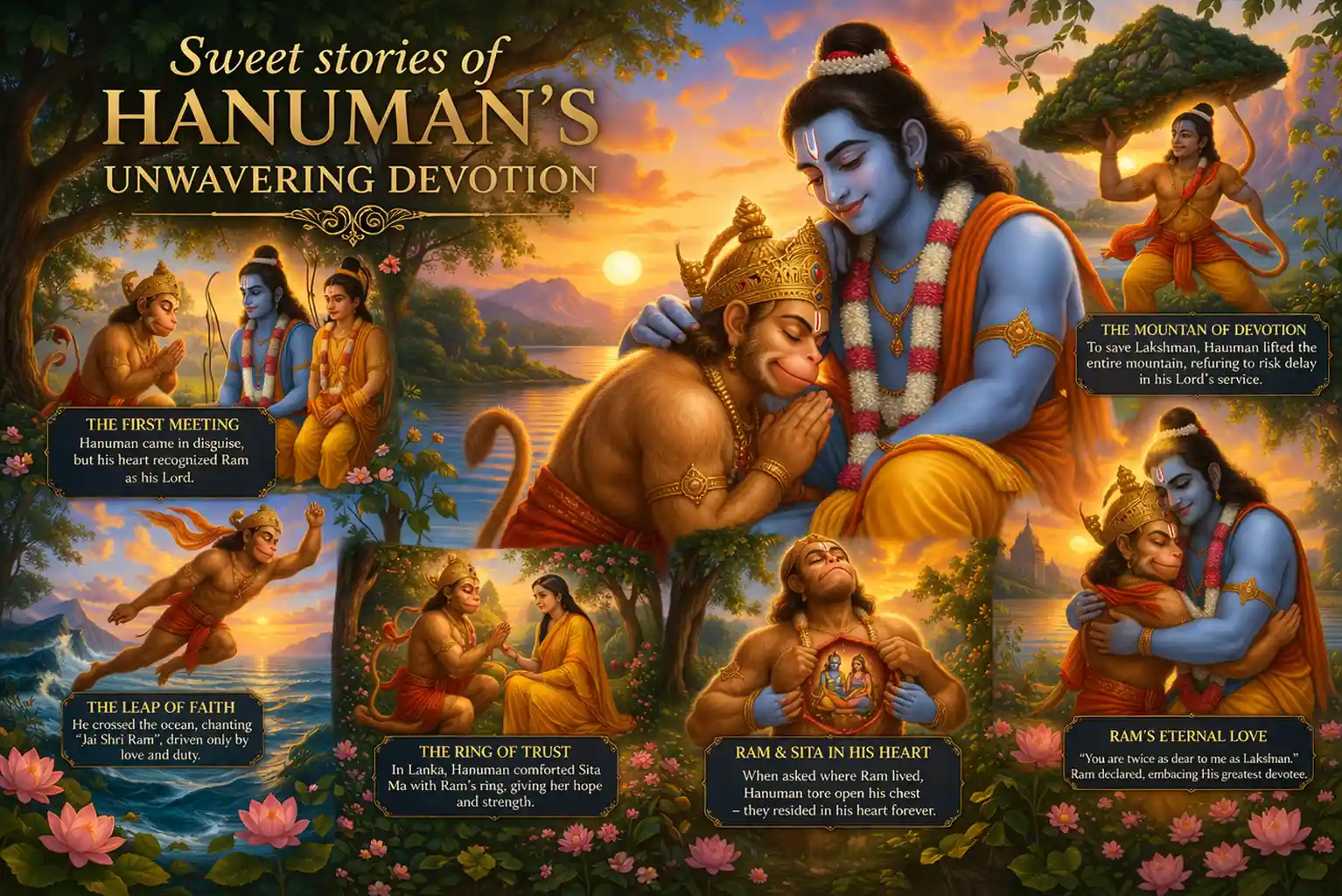
“राम काज कीन्हें बिनु मोहि कहाँ विश्राम” - “Without completing Lord Ram’s work, how can I take rest?” This powerful declaration from the Ramcharitmanas perfectly captures the heart of Lord Hanuman’s devotion. As Swami Mukundananda explains, Hanuman did not seek reward, recognition, or even liberation - his only joy was in serving Lord Ram. This selfless spirit of service defines the highest form of bhakti.
In the vast tapestry of Vedic lore, few figures command as much love, awe, and reverence as Lord Hanuman. He is the quintessence of "Bhakti" (devotion), a celestial being whose entire existence is a testament to the power of selfless service. Known as the highest form of Lord Shiva, or Rudra, Hanuman’s journey is not merely one of physical strength but of a profound spiritual awakening that continues to inspire millions. To understand Hanuman is to understand the "Sacred Bond"—a relationship between the devotee and the Divine that transcends time, space, and ego. Through these sweet stories, as explained by Swami Mukundananda, drawn from sacred scriptures and inspiring devotional narrations, we witness the beauty of Hanuman’s pure love. His devotion was so selfless, so unwavering, that Lord Ram Himself declared Hanuman to be “twice as dear” to Him as even His own brother. These stories reveal how the highest form of bhakti is not knowledge, power, or status - but loving service offered with complete surrender.
The sweetness of Hanuman’s devotion lies in its simplicity. He did not seek liberation. He did not desire power. He did not even want recognition. His only aspiration was service. In a world filled with ambition and self-centeredness, Hanuman’s life shines like a beacon of selfless love.
"Hanuman did not think, 'This is difficult.'
He only thought, 'This is Lord Ram's work.'"
Let us journey through some of the most touching and sweet stories of Lord Hanuman’s unwavering devotion.
The Divine Encounter: A Meeting of Souls on Rishyamukha Mountain
The story of Hanuman’s unwavering devotion begins with a legendary first meeting, a moment of "Lila" (divine play) that set the stage for the redemption of many. At the time, Lord Ram and His brother Lakshman were wandering the forests in a heart-wrenching search for the kidnapped Sita. Their path led them toward the Rishyamukha mountain, the refuge of the exiled monkey-king Sugriva. Sugriva, however, was a man - or rather, a Vanara - paralyzed by fear. He lived on this specific mountain because a sage’s curse prevented his powerful brother, King Bali, from entering the area. When Sugriva spotted two radiant warriors approaching, his mind, clouded by anxiety, assumed they were assassins sent by Bali. To investigate, he turned to his most trusted minister and friend: Hanuman.
The Disguise and the Awakening
To approach the strangers without revealing their location, Hanuman assumed the disguise of a Brahmin priest (Vipra). He approached Ram and Lakshman with scholarly inquiries, questioning their identity to discern if they posed a threat to the exiled king. This encounter highlights a fascinating aspect of the Divine: why did the greatest devotee and the Supreme Lord not recognize each other instantly?
"Divine play is a veil where the Lord and His devotee hide their glory, only so the world may witness the sweetness of their reunion."
While Hanuman initially approached them as a stranger, Swamiji explain that this was a deliberate act of "Maya" (divine illusion). It was a "Lila" where both the devotee and the Lord hid their true identities to allow the sacred partnership to unfold in a way that would serve the greater cosmic purpose. The moment Lord Ram revealed His true identity, the veil of Maya lifted. Hanuman experienced a profound spiritual awakening. He shed his Brahmin disguise, fell at the feet of Lord Ram, and surrendered his entire being. In this moment, the "Patit Pavan"-the purifier of the fallen—showed His true nature. Despite Sugriva being described as a "bhogi" (one who indulges in worldly pleasures) and a "runaway," Ram’s grace was such that He was willing to accept anyone who sought "Sharanaagati" (refuge)
"The Lord is 'Patit Pavan'-the purifier of the fallen; He does not weigh your past flaws or worldly status, but only the sincerity of your surrender."
A Feat of Strength and Brotherhood
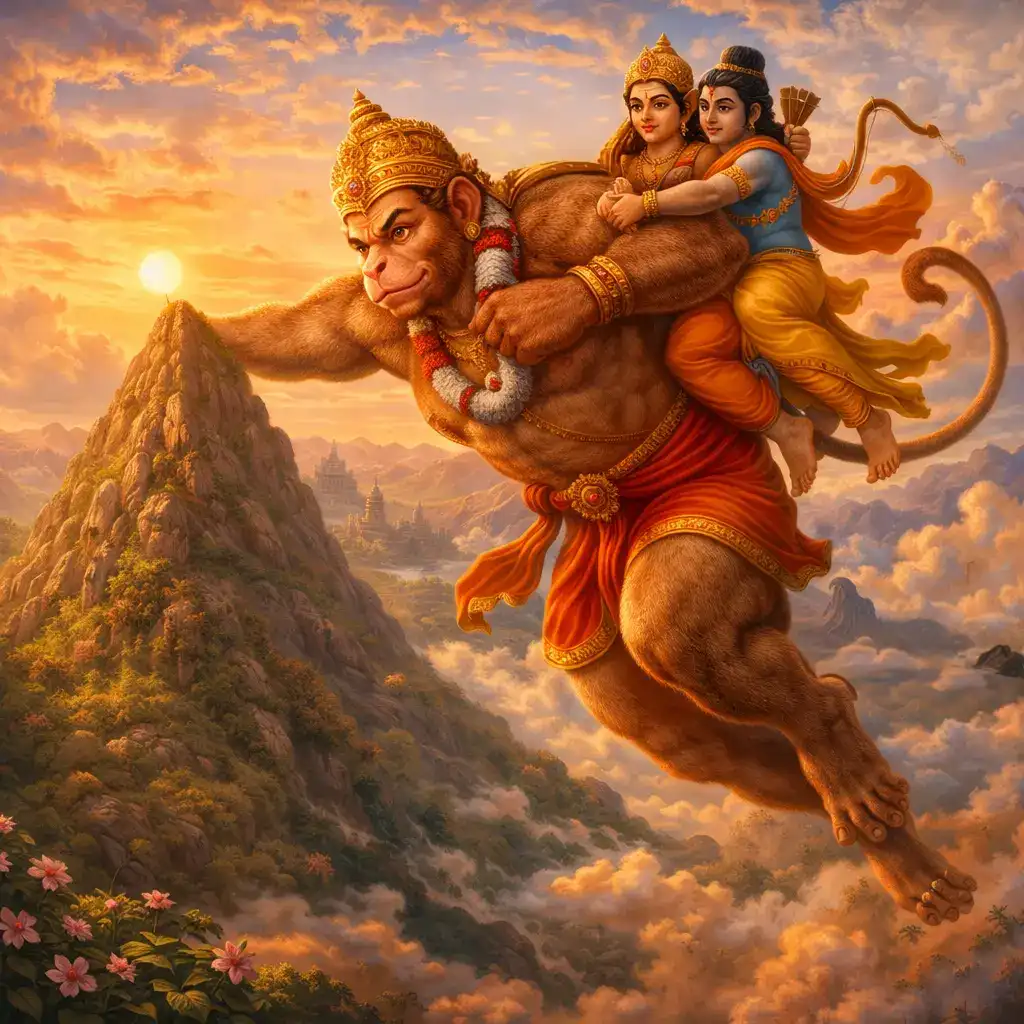
To formalize the alliance between Ram and Sugriva, Hanuman demonstrated his immense power and humility. In a single, magnificent leap, he expanded his physical form and carried both Ram and Lakshman on his back to the mountain summit. This act was particularly significant for Lakshman. As an avatar of Shesha, the celestial serpent who supports the weight of the entire Earth, Lakshman was not easily impressed by strength. However, when Hanuman lifted him with such ease, Lakshman realized the true magnitude of Hanuman’s power. Hanuman then acted as the ultimate mediator, lighting a sacred fire and introducing the two parties, establishing a friendship that would change the course of history. It was during this time that Ram, moved by Hanuman’s spirit, declared that Hanuman was "twice as dear" to Him as Lakshman himself.
"To be 'twice as dear' to the Lord is not a reward for strength, but a reflection of a heart that has dissolved its ego entirely into His service."
The Ultimate Proof: Searching for Ram in Every Atom
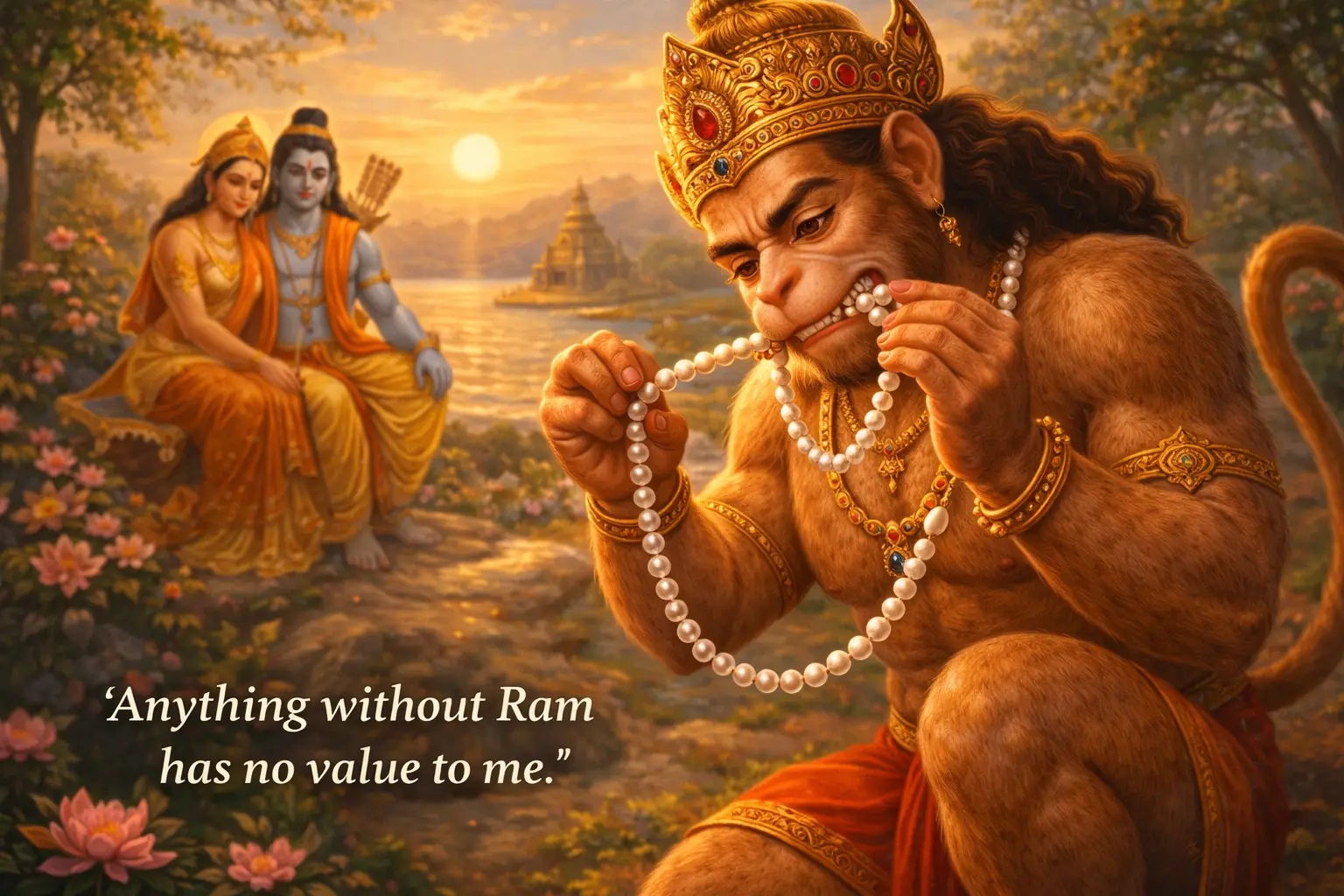
One of the most cherished stories of Hanuman’s devotion takes place after the great war of Lanka, during a time of celebration and gratitude. Mother Sita, the embodiment of grace, was distributing gifts to those who had served in the quest to reclaim her. To Hanuman, she presented a "Mala"—a magnificent necklace of precious beads. What followed shocked the entire royal court. Instead of wearing the necklace with pride, Hanuman took a bead, cracked it open with his teeth, peered inside, and then threw it away. He repeated this with bead after bead, systematically destroying the priceless gift .
"If an object does not reflect the radiance of the Divine, it is but a hollow shell, no matter how much the world values its glitter."
The onlookers were horrified, accusing Hanuman of being disrespectful and ungrateful toward Mother Sita. But Hanuman’s reasoning was simple and profound: he was searching for the image of Lord Ram inside the beads. He explained to the skeptics that if Lord Ram was not present in an object, that object held absolutely no value to him, regardless of its worldly worth
The pearl necklace story beautifully expresses Hanuman’s devotion. He valued nothing without Ram.
This teaching is summarized in this sweet line:
"Anything without Ram has no value to me."
Hanuman’s heart was completely absorbed in Ram. Wealth, beauty, and recognition meant nothing without devotion.
The Tearing of the Heart
The critics, however, were not easily silenced. They challenged Hanuman’s own logic, asking, "If you discard everything that does not contain Ram, then what about your own body? Do you carry Ram and Sita within your own heart?" .In a supreme act of faith that remains one of the most iconic images in spiritual history, Hanuman did not use words to respond. Instead, he reached for his chest and literally tore it apart. To the amazement and silence of the entire assembly, the images of Lord Ram and Mother Sita were found to be literally installed inside his heart. This gruesome yet beautiful act proved that Hanuman’s entire existence—every fiber of his being—was centered solely on his devotion to them.
"True devotion is not found in the words we speak, but in the sacred images we install within the very sanctuary of our hearts."
The Humbling of the Proud: Hanuman as Krishna’s Instrument
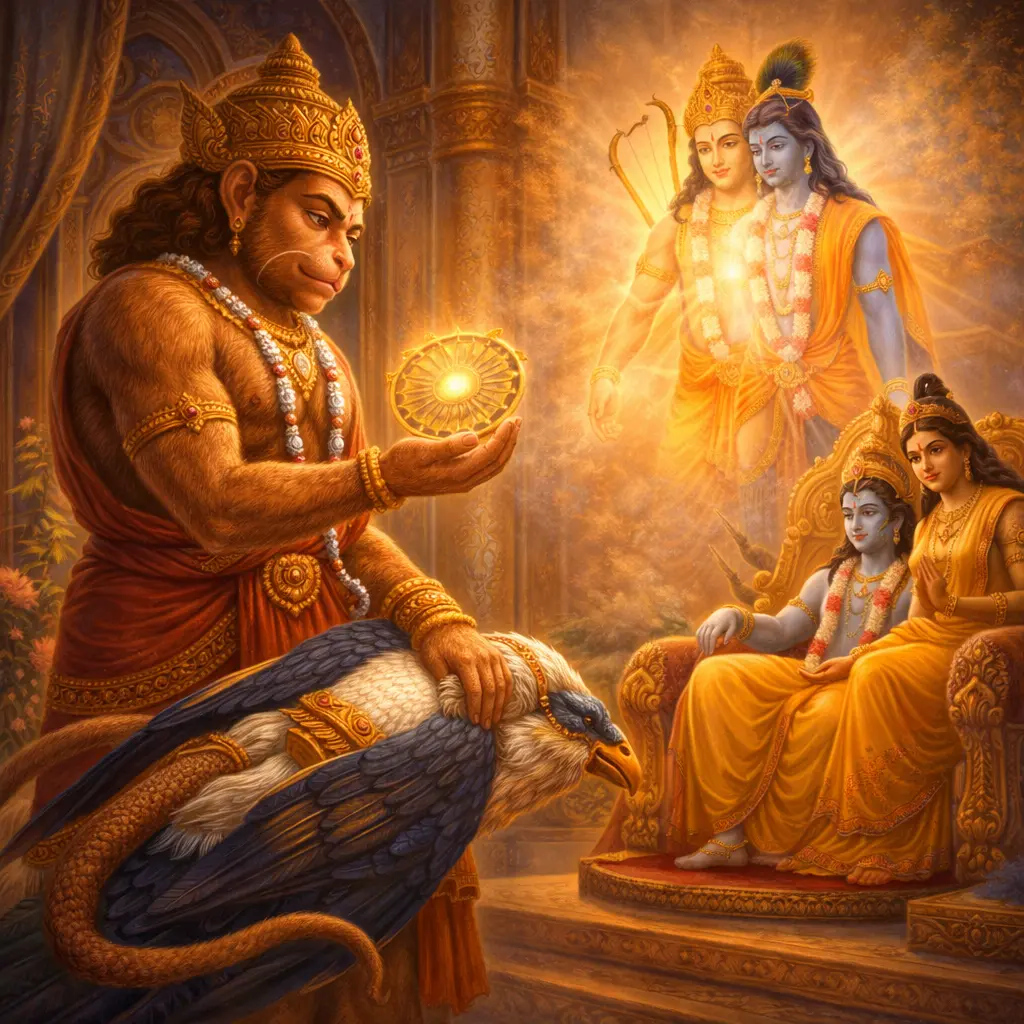
The sweetness of Hanuman’s devotion is often shown through his immense humility, a trait so powerful that Lord Krishna once used it to perform a "spiritual surgery" on His closest associates. "When God lances the boil of our pride, it is not an act of cruelty, but the compassionate surgery of a Mother ensuring our spiritual health." In Dwarka, three individuals had become trapped in their own ego: Satyabhama (Krishna’s consort), Garuda (His vehicle), and the Sudarshan Chakra (His weapon).
- Satyabhama was proud of her unmatched physical beauty.
- Garuda was proud of his incredible speed, believing no one could fly faster.
- The Sudarshan Chakra was proud of its invincibility and radiance, believing it could outshine the sun.
- Krishna, as a compassionate "mother" figure, decided to "lance the boil" of their pride for their own spiritual health. He summoned Hanuman to Dwarka to teach them a lesson in true devotion.
Speed vs. Devotion:
The Race with Garuda
Krishna sent Garuda to summon Hanuman. At first, Hanuman ignored the messenger, stating he had nothing to do with "Dwarkadhish" (the King of Dwarka). However, the moment Garuda mentioned that "Sita and Ram" were calling for him, Hanuman was instantly ready to depart .Arrogant in his own speed, Garuda offered Hanuman a ride on his back. In response, Hanuman quietly tied Garuda in his tail and threw him with such force that the mighty bird landed as far away as the Pacific Ocean. Hanuman, possessing "Manojavam" (speed like the mind or the wind), arrived at Krishna’s court long before Garuda could even recover
Power vs. Ease:
The Sudarshan’s Defeat
As Hanuman approached the gates of Dwarka, the Sudarshan Chakra tried to block his entry, asserting its power as the Lord’s guardian. Hanuman did not engage in a grand battle. Instead, he treated the most powerful weapon in the universe like a "rotating top," casually picking it up and stowing it in his mouth to deal with later. The Chakra’s pride in its invincibility was completely shattered by Hanuman’s effortless dismissal
Beauty vs. Radiance:
The "Maidservant" Comment
To teach a profound lesson in humility, Krishna assumed the form of Lord Ram and asked Satyabhama to sit beside Him, disguised as Mother Sita. Determined to appear divine, Satyabhama spent hours adorning herself with elaborate jewelry and makeup, trying to imitate Sita’s natural grace.
When Hanuman entered the palace, he immediately bowed to Krishna, recognizing his beloved Lord Ram. But when his eyes fell upon Satyabhama, he looked puzzled and innocently asked, “My Lord, who is this maidservant sitting beside you?”
This simple, honest question shattered Satyabhama’s pride. Hanuman, who knew only the pure radiance of the real Mother Sita, could not be deceived by outward beauty. Through this moment, Krishna revealed a timeless truth: even the greatest qualities—beauty, speed, and power—fade before the brilliance of humility and pure devotion.
"In the presence of true grace, even the most powerful weapons are but toys, and the most celebrated beauty is but a maidservant to the radiance of the soul."
A Modern Miracle: The Immovable Seat in Mumbai
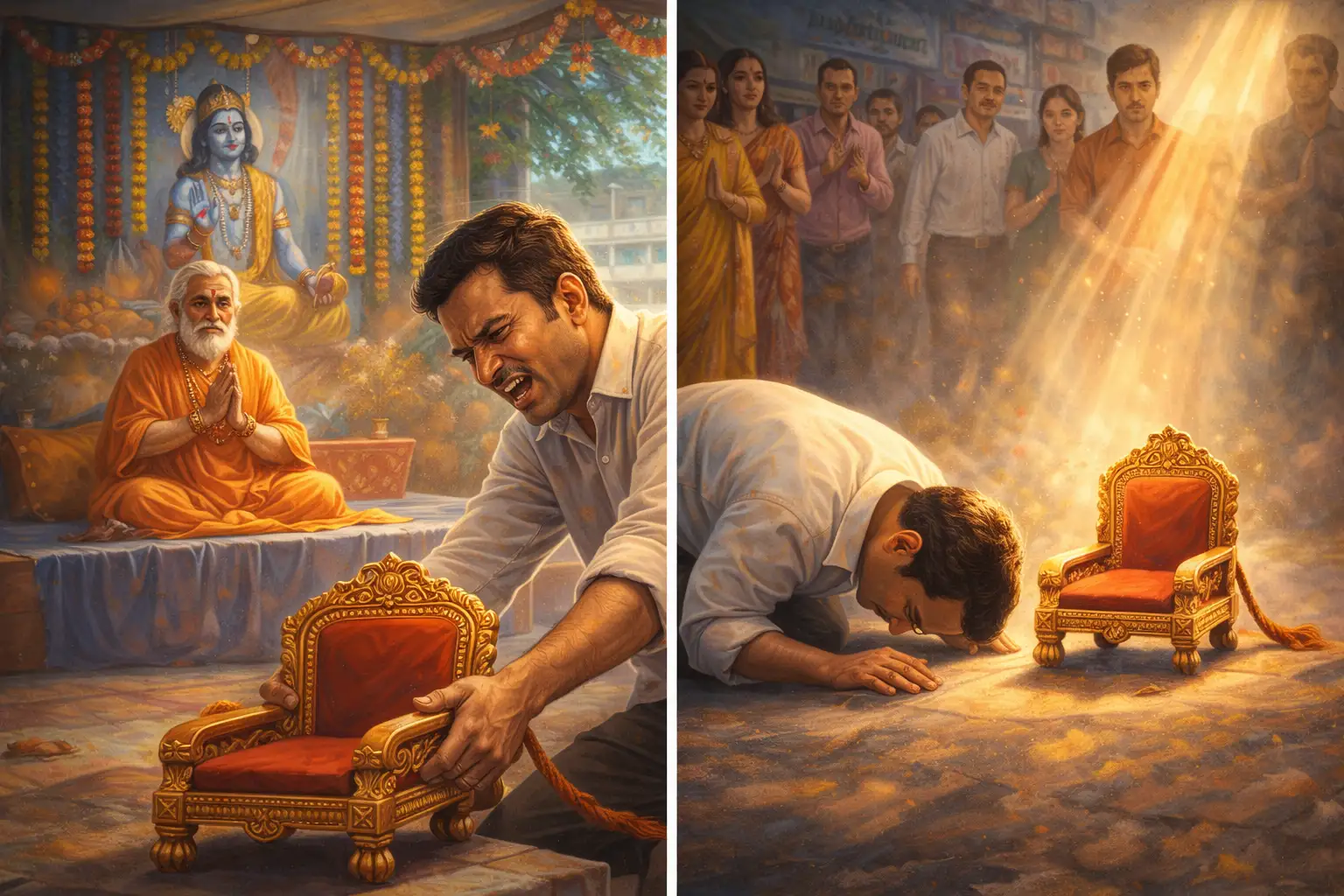
Lest we think these stories are confined to ancient times. Swamiji recounts a remarkable event in a commercial area of Mumbai, during a "Ram Katha" (narration of Lord Ram’s life).It is a long-standing tradition to place a special "asan" (seat) for Hanuman during these narrations, as it is believed he loves the stories of Ram so much that he attends every session in some form. At the end of a three-day event, a local advocate challenged this practice, calling the ritual "jokery" and demanding proof that Hanuman was actually present on the seat
The priest, deeply hurt by the skepticism, spent the entire night in prayer. The following day, he invited the advocate to move the small, light seat. Despite the advocate’s physical strength and best efforts, the seat remained completely immovable, as if anchored by the weight of the universe. The advocate, humbled and defeated, offered his "pranam" (respects) to the invisible presence of the Great Devotee
"Speed and power are but shadows; the only force that truly moves the universe—and makes even a simple seat immovable—is a heart that beats for the Lord."
The story of Lord Hanuman lifting an entire mountain
The story of Lord Hanuman lifting an entire mountain to save Lakshman is perhaps the most iconic illustration of devotion that knows no bounds. As beautifully explained by Swami Mukundananda Ji, this episode represents the transition from physical strength to complete spiritual surrender — where love for the Lord becomes greater than one’s own abilities.
The Impossible Task: Love Beyond Strength
During the climactic war in Lanka, Lakshman was struck by a powerful weapon and fell unconscious, appearing almost lifeless. The only hope for his survival was the rare Sanjivani herb, which grew on a specific peak of the distant Himalayan mountain, Dronagiri. Lord Ram turned to Hanuman, knowing that only his speed, strength, and devotion could accomplish this impossible task.
Hanuman, known for his Manojavam — speed like the wind — immediately set off toward the Himalayas. However, upon reaching the mountain, he faced a serious dilemma. He could not identify the exact herb among the many glowing medicinal plants. Time was running out, and Lakshman’s life hung in the balance.
At that moment, Hanuman did not rely on knowledge, nor did he hesitate in confusion. Instead, driven purely by devotion and urgency to serve Lord Ram, he performed an extraordinary act. Rather than risk delay, Hanuman lifted the entire mountain and carried it back to the battlefield.
This remarkable act demonstrated that Hanuman’s devotion went beyond physical strength. His love for Lord Ram and concern for Lakshman transformed an impossible situation into a divine miracle. Through this story, as Swami Mukundananda Ji emphasizes, Hanuman teaches that when devotion is complete, obstacles disappear and even the impossible becomes possible.
Hanuman’s Identity — “I Am Your Servant”
Once Lord Ram asked Hanuman a profound question: “How do you see me?”
Hanuman replied in three beautiful ways:
“When I think I am the body, I am your servant.
When I think I am the soul, I am a part of you.
When I understand the truth, you and I are one.”
This answer reveals Hanuman’s spiritual greatness. He had realized the highest truth — unity with God. Yet despite that realization, he chose to remain a servant.
Why?
Because serving God gave him greater joy than becoming God.
This is the sweetness of Hanuman’s devotion. He preferred love over liberation. He preferred service over enlightenment. He preferred humility over greatness.
The Ocean Leap — Power of Remembering Ram
When Sita was abducted, Hanuman was chosen to cross the vast ocean and find her. The distance was enormous. The task seemed impossible. But Hanuman did not depend on his strength.
Instead, he remembered Lord Ram.
As he prepared to leap, he chanted Ram’s name. Instantly, his body expanded with divine power. With a single leap, he crossed the ocean.
This story teaches a profound truth — Hanuman’s power came from devotion.
Whenever he remembered Ram, he became limitless.
Whenever he forgot himself, he discovered his strength.
Devotion transformed him from a humble servant into an unstoppable force.
"When Hanuman forgot himself, he became weak.
When he remembered Lord Ram, he became limitless."
The Sweet Story of Mainak Mountain
As Hanuman flew across the ocean, the mountain Mainak rose from the water and offered him rest. The mountain said, “Please sit for a moment. You are performing divine service. Allow me to serve you.”
Hanuman gently touched the mountain and replied with folded hands:
“I cannot rest until Ram’s work is complete.”
This moment is extremely sweet. Hanuman was polite. He was grateful. But his mind remained fixed on Ram’s mission. Comfort had no value compared to service.
This shows Hanuman’s unwavering focus. Devotion made him tireless. His only priority was Ram’s work.
Hanuman Meets Sita — Sweetness of Compassion
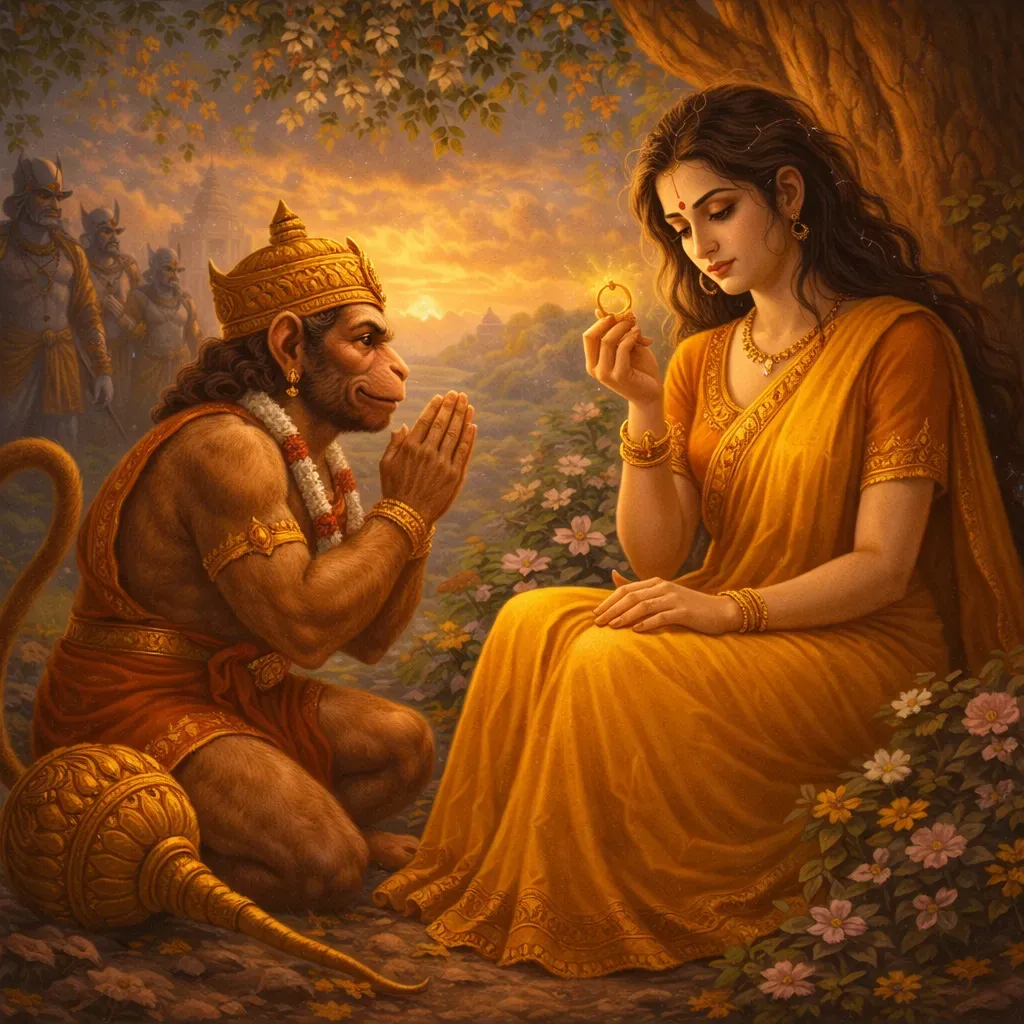
When Hanuman finally reached Lanka, he found Sita sitting in Ashok Vatika, surrounded by demons. She was filled with sorrow. Her heart longed for Ram.
Hanuman did not appear immediately. He first sat on a tree and began softly chanting Ram’s glories. Hearing Ram’s name, Sita looked up with hope.
Then Hanuman gently dropped Ram’s ring before her. She picked it up and instantly recognized it. Tears filled her eyes.
Hanuman then appeared with folded hands and spoke sweet words:
“Mother, Lord Ram will come soon. He has sent me to find you.”
Hanuman spoke with humility and compassion. Though he was powerful enough to destroy Lanka, he behaved like a gentle messenger.
This is the sweetness of devotion — power combined with humility.
The Sweet Meeting with Vibhishan
While searching in Lanka, Hanuman met Vibhishan, Ravana’s brother. Unlike others in Lanka, Vibhishan was devoted to Ram. When Hanuman heard Ram’s name in Lanka, he immediately felt joy.
The moment Hanuman and Vibhishan met, they embraced like old friends. Neither had met before, yet their shared devotion created instant love.
This story shows that devotees naturally connect. Devotion dissolves differences. Hanuman recognized devotion wherever he saw it.
This sweetness of spiritual friendship is a beautiful aspect of Hanuman’s nature.
Hanuman Burns Lanka — Yet Remains Humble
After delivering Ram’s message, Hanuman allowed himself to be captured. Ravana ordered his tail to be set on fire. Hanuman used this opportunity to burn Lanka.
He jumped from building to building, setting the city ablaze. Yet after burning Lanka, Hanuman became worried.
He wondered, “Did I accidentally harm Sita?”
This thought shows his compassion. Even after displaying immense power, his heart remained gentle. He rushed back to confirm Sita’s safety.
Devotion makes strength compassionate. Hanuman never used power for ego — only for service.
Hanuman Refuses Liberation
After victory, Lord Ram rewarded everyone. When Ram turned to Hanuman, he asked, “What do you want?”
Hanuman folded his hands and replied:
“My Lord, I do not want liberation.
I do not want heaven.
I only want to serve you forever.”
This is one of the sweetest moments in devotional literature. Most seekers long for liberation. Hanuman rejected it.
He chose eternal service.
For Hanuman, being near Ram was greater than freedom itself.
Hanuman’s Humility After Praise
After Hanuman returned from Lanka, everyone praised him. They glorified his strength, courage, and intelligence.
Hanuman immediately folded his hands and said:
“All this happened by Ram’s grace. I did nothing.”
This humility makes Hanuman even more lovable. He performed impossible tasks, yet never claimed credit.
True devotion removes ego. Hanuman always gave credit to Ram.
What Makes Hanuman’s Devotion Unique
Hanuman’s devotion has special qualities:
Selfless — he asked for nothing
Humble — he never showed pride
Fearless — devotion gave him courage
Constant — he remembered Ram always
Joyful — service was his happiness
These qualities make Hanuman the ideal devotee.
Spiritual Essence of These Sweet Stories of Lord Hanuman
(Teachings inspired by Swami Mukundananda)
The sweet stories of Lord Hanuman are not merely historical narratives from the Ramayan; they are profound spiritual teachings that reveal the highest ideal of devotion. As Swami Mukundananda explains, Hanuman’s life demonstrates that true bhakti is not measured by rituals, knowledge, or austerity, but by selfless love and complete surrender to God.
The essence of these stories lies in Hanuman’s unwavering focus on Lord Ram. Whether crossing the ocean, meeting Sita in Ashok Vatika, refusing rest from Mainak Mountain, or bringing the Sanjeevani herb, Hanuman never acted for personal glory. Every action was performed solely for the pleasure of his Lord. This teaches that when devotion becomes pure, life itself transforms into service.
Another important spiritual lesson is humility. Despite possessing immense strength and divine powers, Hanuman never took credit for his achievements. After returning from Lanka, he attributed everything to Lord Ram’s grace. Swami Mukundananda emphasizes that this humility is the hallmark of true devotion. The ego dissolves when the heart becomes absorbed in God, and the devotee begins to see himself only as an instrument.
These stories also highlight the power of remembrance. Hanuman’s strength expanded whenever he remembered Lord Ram. When he prepared to leap across the ocean, he did not rely on his own ability. He invoked Ram’s name, and devotion awakened his hidden potential. The teaching here is that divine remembrance connects the soul to unlimited strength.
The episode of Mainak Mountain reveals another dimension of devotion — single-pointed determination. Hanuman politely refused rest because he could not delay Ram’s work. This reflects the mindset of a true devotee: comfort becomes secondary, and service becomes the priority. Love makes sacrifice natural and joyful.
Hanuman’s meeting with Vibhishan illustrates the sweetness of satsang. Devotees naturally recognize one another because their hearts are aligned in devotion. Swami Mukundananda teaches that spiritual association strengthens faith and deepens love for God. Just as Hanuman rejoiced upon hearing Ram’s name in Lanka, the devotee feels joy in the company of those who remember God.
Perhaps the deepest essence of these stories is Hanuman’s selfless love. He did not seek liberation, heaven, or recognition. His only prayer was to remain in service. This reflects the highest stage of devotion, where the devotee desires nothing except the opportunity to serve. Swami Mukundananda explains that such love binds even God. Lord Ram Himself declared Hanuman to be extremely dear because of this pure devotion.
Another powerful lesson from these stories is that devotion transforms ordinary abilities into divine instruments. Hanuman was strong and intelligent, but it was his love for Ram that made him extraordinary. When actions are performed for God, they acquire divine significance. Even the impossible becomes possible.
The stories also reveal that devotion removes fear. Hanuman entered Lanka fearlessly, confronted demons, and carried a mountain — all because his heart was fixed on Ram. When the devotee depends on God, courage naturally arises. Faith replaces anxiety, and surrender replaces doubt.
Above all, these stories teach that devotion is expressed through loving service. Hanuman did not meditate in isolation or seek personal enlightenment. He served tirelessly. His joy was in fulfilling Ram’s mission. Swami Mukundananda emphasizes that the highest spirituality is not withdrawal from the world but dedicating every action to God.
Thus, the spiritual essence of these sweet stories is simple yet profound:
True devotion is selfless love expressed through humble service, constant remembrance, and complete surrender. Hanuman’s life shows that when the heart belongs entirely to God, the devotee becomes fearless, humble, and infinitely strong. Such devotion not only transforms the devotee but also wins the heart of the Supreme Lord.
Conclusion
Lord Hanuman’s unwavering devotion is one of the sweetest expressions of divine love. His life is filled with touching moments of humility, courage, compassion, and surrender.
He crossed oceans for Ram.
He carried mountains for Ram.
He burned Lanka for Ram.
He lived eternally for Ram.
Yet through all this, he remained a humble servant.
Hanuman shows us that true devotion is not about knowledge or power. It is about love. When love becomes pure, service becomes natural. When service becomes natural, devotion becomes complete.
May Hanuman’s sweetness inspire our hearts.
May his humility guide our actions.
May his devotion awaken our love for God.
And may we learn to say, like Hanuman:
“I do not want anything.
I only want to serve.”
Call TO Action
✨ Let Hanuman’s Unwavering Devotion Awaken Your Heart
Immerse yourself in these sweet and powerful stories of Lord Hanuman — from consoling Mother Sita to miracles that reveal his boundless love for Lord Ram. Let his humility inspire your actions, his faith strengthen your spirit, and his devotion guide your life.
🙏 Read. Reflect. Feel the sweetness of pure bhakti.
📿 Share this with family and friends to spread the love of Lord Ram.
💛 May Hanuman bless your heart with unwavering devotion today.
✨ FAQs — Hanuman’s Unwavering Devotion ✨
❓ Why is Hanuman considered the symbol of devotion?
👉 Because he lived only to serve Lord Ram selflessly.
❓ What shows Hanuman’s pure love for Ram?
👉 He valued nothing without Ram — not even pearls.
❓ Did Hanuman seek liberation?
👉 No. He chose eternal service over liberation.
❓ Why did Hanuman meet Mother Sita?
👉 To deliver Ram’s message and give her hope.
❓ What is Hanuman’s greatest teaching?
👉 True devotion means love without expectation.