The Blind Saint Who Saw Everything: A Foreword for Your Heart
Before we begin this sacred journey, close your eyes for just a moment. Feel the weight of your own eyelids. Now imagine that darkness, not for a second, but for a lifetime. Imagine never seeing the face of your mother, the colors of a sunset, or the smile of a child. Would you curse God or cling to Him?
Surdas Ji did not just cling. He danced. He sang. He conquered the Lord of the Universe with nothing but the raw, unfiltered emotion of a heart that had nowhere to go except towards Krishna.
This is not a biography. This is a love story. The love story between a blind poet and his Dark Beloved.
The Uddhav Connection That Will Give You Goosebumps
The great saint Nabhadas Ji, in his holy text Bhaktamal, reveals a secret so profound that it changes everything you think you know about Surdas Ji.
Surdas Ji was none other than Uddhav Ji himself.
Let that sink in.
Uddhav was not just any friend of Krishna. He was Krishna's parama antaranga sakha, His most intimate confidant, His cousin, His advisor, and the minister of Dwaraka. When Krishna lived in Mathura, Uddhav was by His side. But here is where the story becomes heart-shattering.
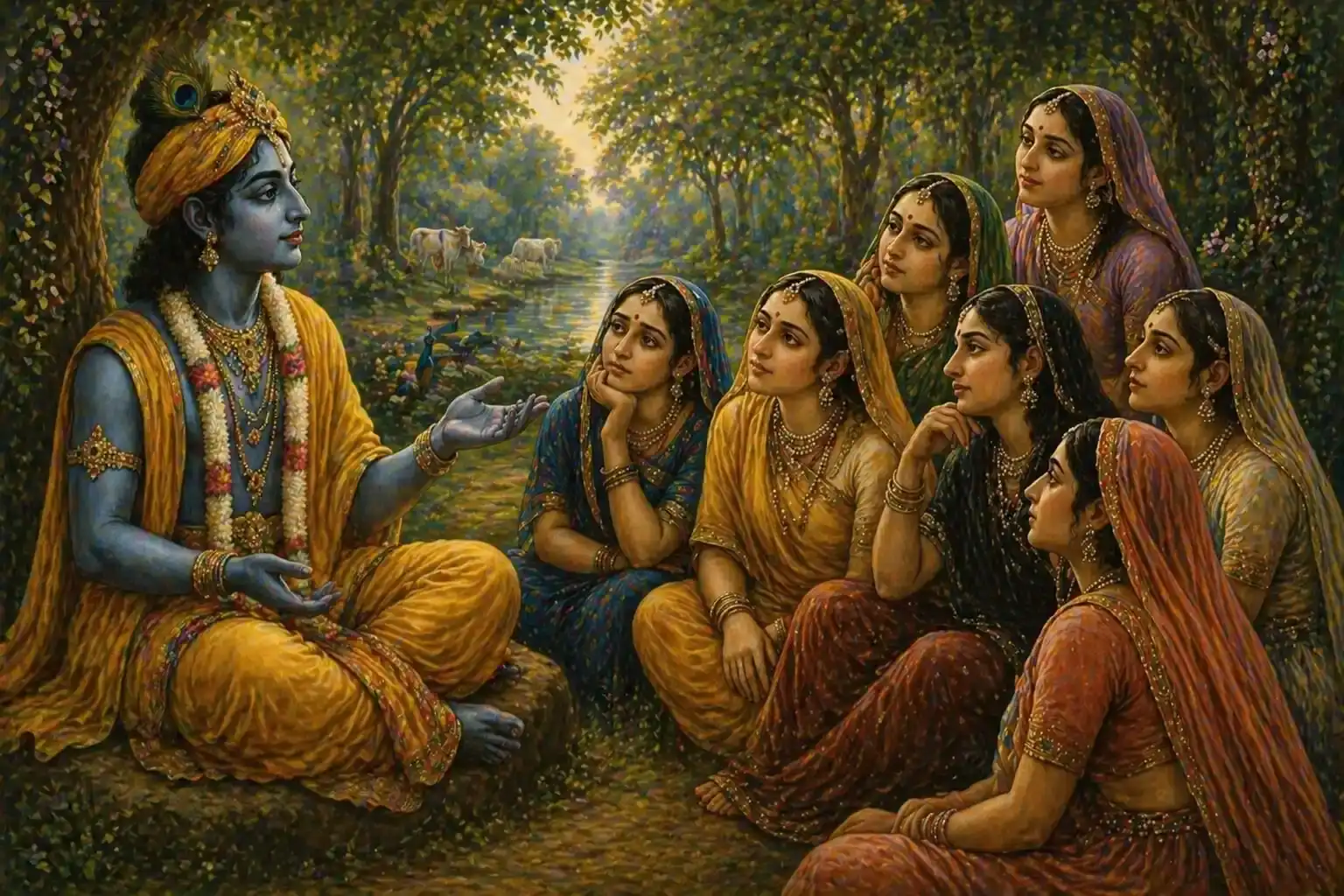
Lord Krishna once confessed to Uddhav: "Udho, mohe Braj bisrat nahi." (O Uddhav, I cannot forget Braj. I cannot forget the Gopis. I cannot forget the love they poured upon me.)
Uddhav, seeing his Lord's anguish, was himself transformed. Krishna sent Uddhav to the Gopis of Vrindavan to teach them the path of Gyan (knowledge). But what happened next is the greatest role reversal in spiritual history.
The Gopis, who were simple village milkmaids with no scriptural learning, looked at Uddhav, who was dressed like Krishna and shone with a similar radiance. For a moment, they thought he was their Shyam. But then their pure love discerned the truth. They said, "If you were truly Shyam Sundar, you would not stand here so calmly. You would have run to embrace us by now. You are someone else."
And then, these apparently unlettered Gopis proceeded to teach Uddhav, the disciple of the great sage Brihaspati himself: the true meaning of Prem Bhakti (loving devotion). They showed him that knowledge without love is like a lamp without oil.
Uddhav was humbled. He was shattered. He was reborn. He returned to Krishna and fell at His feet, saying:
"Shyam Sundar, you are so merciless! You left these divine souls and came to Mathura. But I beg you, grant me a boon. In my next life, let me be born as a blade of grass in Vrindavan. Let me be trampled under the dust of the feet of these Gopis, so that I may receive even a particle of their divine love."
Krishna, moved beyond measure, embraced Uddhav and said:
"Your wish will be fulfilled. In Kaliyuga, you will be born. You will be blind to the world, but your inner eye will see My leelas in all their glory. And you will sing. You will sing songs that will make the whole world weep in devotion. Your name will be Surdas."
And that is the secret. Surdas was not a blind man who learned to love. He was the embodiment of a love so pure that it chose blindness just to feel the dust of Vrindavan.
A Birth Unwelcome: The Pain That Became the Purpose
The Inauspicious Child Who Was Destined for Divinity
In the village of Sihi, near present-day Faridabad, in a poor Saraswat Brahmin family, a child was born. But instead of celebration, there was silence. Then whispers. Then rejection.
The child was blind.
In those times, in that culture, a blind child was often seen as a curse, a punishment for past sins. The family looked at the infant Surdas and said, "An amangal (inauspicious) child has come to us."
His own parents neglected him. While other children were fed with love, he was fed as a duty. While others were coddled and kissed, he was left in a corner. The physical pain of neglect in his childhood was immense. But here is the divine alchemy that saints speak of: that very suffering became the chisel that sculpted his soul.
Because he was ignored by the world, he turned inward. Because he could not see the beauty of creation, he craved the Creator. Because human love failed him, he sought Divine Love with an intensity that a person with everything could never understand.
His father, however, was a learned man and a master of music. Young Surdas, with his sharp intellect and burning inner thirst, absorbed music and scripture like a parched earth drinking the first rain. The jnana chakshu (the eye of knowledge) within him was already opening.
The Two Gold Coins That Changed Everything
Poverty is a cruel guest. It does not knock; it breaks down the door. Surdas's family was starving. One day, someone took pity on his father and gave him two gold coins. Imagine the relief! For one night, there was hope.
The father brought the coins home. The family went to sleep dreaming of bread and dignity. But in the night, two rats came and carried the coins away.
The next morning, the wailing began. It was not just the loss of money; it was the death of their last hope. And in their grief, they needed a scapegoat. Their eyes fell on the blind boy.
"You are the inauspicious one! Because of you, this calamity has fallen upon us!" they screamed. And they began to beat him.
Can you feel the injustice? A child being beaten for something he did not do. Most of us would have erupted in anger, in self-pity, in bitterness. But Surdas; this young, blind soul; did something extraordinary.
He calmly said, "Stop beating me. I will tell you where the coins are."
The family stopped. "Tell us!"
"On one condition," Surdas said. "After I tell you, you must give me permission to leave this house forever."
Blinded by their greed for the gold, they agreed. Surdas told them where the rats had hidden the coins. They found them. And then they begged him to stay. "No, no, son! We were wrong! Stay with us!"
But Surdas's heart had already taken flight. He said, "If I stay, the coins will disappear again." It was a ruse, a gentle lie to escape without drama. Then he spoke the words that define a true vairagi (one detached from the world):
"The One who takes care of every living being in this universe, He will take care of me."
He walked out. A blind boy, no older than twelve, with no money, no guide, no plan. Only a heart full of faith and a name on his lips: Shyam.
The Wanderer's Years: When God Tests Before He Blesses
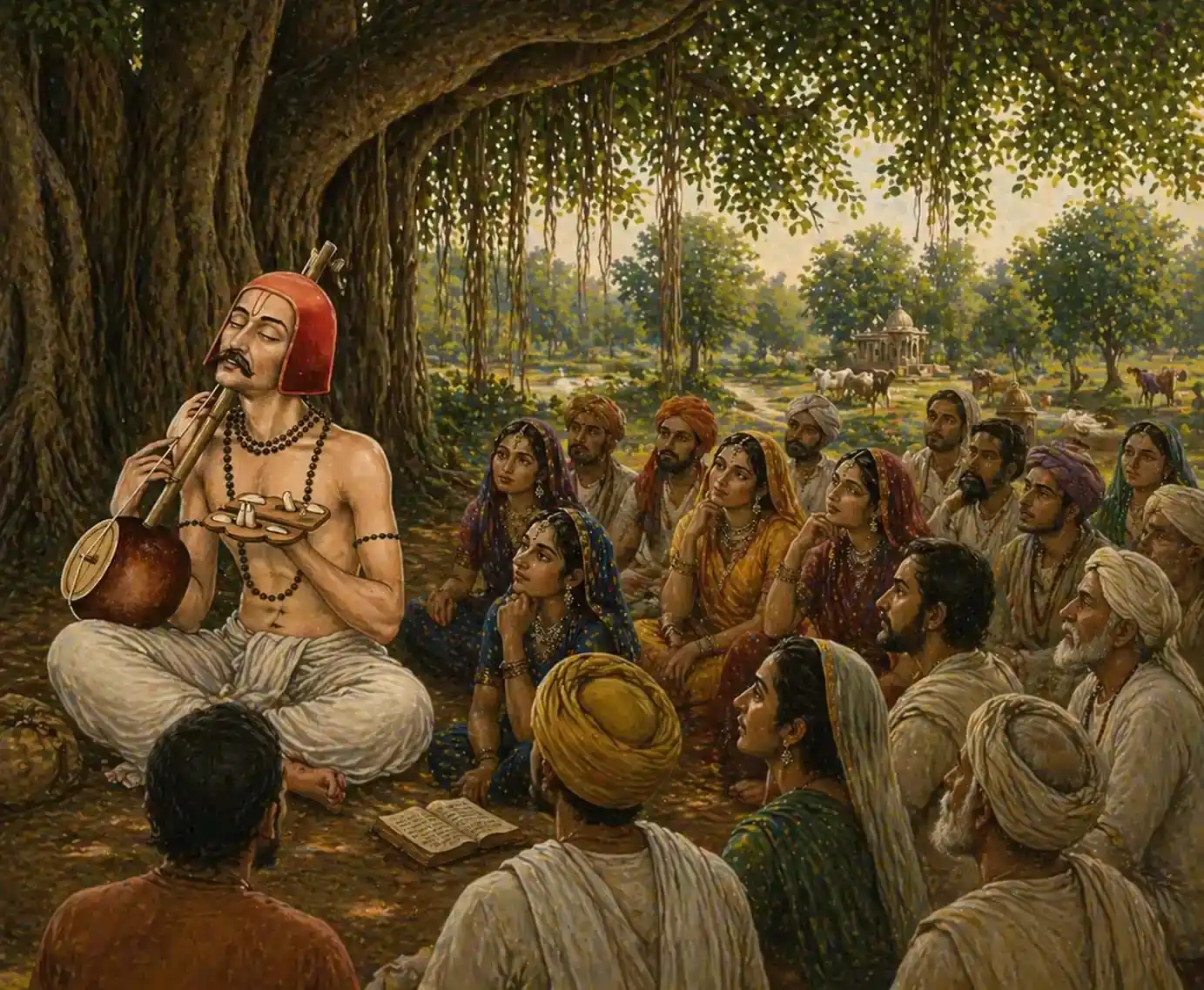
Surdas walked to a nearby village, about fifteen kilometers from his home. He sat under a banyan tree. And he began to sing.
He sang of a love he had never seen but somehow knew. He sang of a Dark One he could not see but could feel in every beat of his heart. His voice was not just musical; it was possessed. It carried the weight of a thousand lifetimes of longing.
The villagers, drawn by the haunting sweetness of his bhajans, would come. They would listen. And they would cry. They didn't know why they were crying; they just knew that something in this blind boy's voice was touching a place in their hearts that had been asleep for a very long time.
They fed him. They cared for him. A kind farmer, whose lost cow Surdas had miraculously located through his inner vision, arranged for him to get a daily offering of milk.
For twelve years, this continued. He sang. They listened. His fame grew. But deep inside, a restlessness began to stir.
Is this all? he asked himself. Am I here just to be a village singer? I left my home not to escape poverty, but to find God. Where is the fire? Where is the madness of divine love?
He realized the truth that every serious seeker must face: Without a Guru, even the most sincere devotion lacks direction.
The Guru's Call: When the Disciple Finds the Master
He moved to Mathura, to Vishram Ghat, the sacred banks where Lord Krishna is said to have rested after killing Kansa. For another twelve years, he sang there. The crowds grew larger. But the restlessness grew louder.
Then he heard the news: The great saint Sri Vallabhacharya, the founder of the Pushtimarg (the path of grace), was coming to a nearby village with his followers.
"I must go," Surdas declared.
People laughed. "You are blind! How will you see him? What will you do with a Guru you cannot see?"
And Surdas, with the wisdom of a realized soul, replied:
"I cannot see him. But he can see me. And that is enough."
He went. He sat in the gathering, unseen and unknown. But the moment Vallabhacharya's eyes swept across the crowd, they stopped. They fixed on this blind figure, radiating an aura of pure longing.
"Who is that?" the great Acharya asked. "Bring him to me."
The Audition That Opened the Heavens
Vallabhacharya said, "I hear that you sing. Sing for me."
Surdas Ji, with tears already streaming down his face, sang:
"Gareebani hoon ke gayak, Shyam…"
(I am just a singer of my own poverty, O Shyam…)
He sang of his unworthiness, his blindness, his nothingness. And then he sang:
"Hamare Prabhu, aavan chit na dharo…"
(O my Lord, please do not hold my faults in Your mind…)
Vallabhacharya listened, his own eyes moist. But he wanted to test the depth of this blind poet. "Surdas," he said, "why do you only sing of your own faults and your own pain? Why do you not sing the glories of God?"
Surdas Ji bowed his head and said, "Maharaj, how can I sing of His glories? I have never seen His leelas. I have never seen His form. I am blind. I do not know His beauty. How can I praise what I have never witnessed?"
This answer was Vallabhacharya's final test, and Surdas had passed with flying colors. Here was a man who did not pretend. He did not fake devotion. He was raw, honest, and utterly humble.
"Come," the Guru said. "Take a bath in the Yamuna. And then come with me."
The Moment the Blind Man Saw Everything
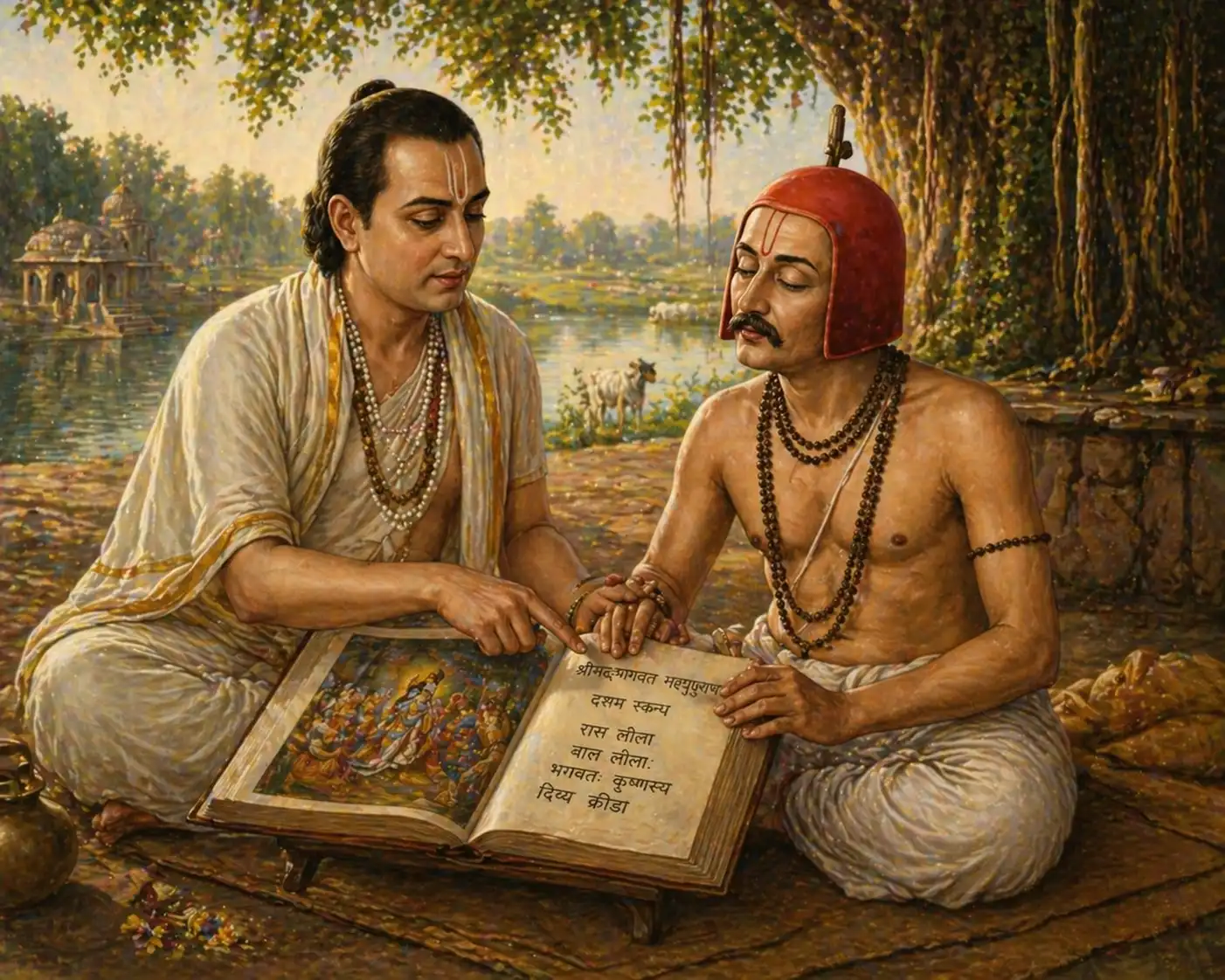
After bathing, Vallabhacharya took Surdas Ji to a quiet place. He placed Surdas's hand on the Srimad Bhagavatam. And he began to read the tenth canto: the rasa leela, the childhood pastimes, the divine play of Lord Krishna.
And then it happened.
As the Guru read, Surdas's inner eye, the eye that had been waiting for this very moment, burst open. He began to see.
"Maharaj!" he cried out. "I see it! I see Nandotsav! The whole village of Gokul is celebrating! The lamps are lit! The women are singing! I see Mother Yashoda holding a newborn baby in her arms. He is so dark, so beautiful! His little toes are like pearls!"
Vallabhacharya continued to read. Surdas continued to see.
"Maharaj! Now He is crawling! Now He is stealing butter! Now He is going to the forest with His cows! Now He is playing His flute! Now the Gopis are leaving their homes to dance with Him under the full moon!"
For hours, this went on. The Guru read the words of the Bhagavatam. And the disciple saw the sakshat (direct) leela of the Lord. Vallabhacharya did not give Surdas physical sight. He gave him something infinitely greater: divya chakshu: the divine vision that sees past the illusion of matter and into the eternal play of spirit.
From that day on, Surdas Ji was no longer blind. He saw more than any person with two working eyes has ever seen. He saw Krishna.
The Service of Love: Surdas Ji in the Court of Shrinath Ji
The Golden Glass: When God Became a Servant
Vallabhacharya initiated Surdas Ji as one of the Ashtachap, the eight great poet-saints of the Pushtimarg. He then sent him to the village of Parasauli, near Govardhan Hill, to serve in the temple of Shrinath Ji, the child form of Krishna.
Every day, Surdas would come to the temple. He would sit before the deity, and he would sing. His bhajans were not compositions; they were conversations. He would scold Krishna. He would beg Krishna. He would laugh with Krishna. He would cry for Krishna. The deity, they say, would listen.
One day, a young boy named Gopal was assigned to serve Surdas Ji his meal. The boy served the food and then, distracted by his own childish whims, wandered away. A morsel of food got stuck in Surdas Ji's throat. He couldn't breathe. He called out, "Gopal! Gopal! Water!"
But the boy was gone.
Just as Surdas Ji felt his life slipping away, he felt a gentle hand on his back. Someone placed a golden cup of cool water to his lips. "Drink, Baba," a sweet voice said.
He drank. The morsel dislodged. He breathed. "Thank you, my child," he said, assuming it was the boy Gopal who had returned. The person left.
The next morning, there was chaos in the temple. "The Lord's golden drinking cup! It's missing! Who has stolen the cup of Shrinath Ji?"
The priests searched everywhere. The devotees panicked. Finally, someone found it, sitting next to Surdas Ji's cot.
"Surdas Ji! Where did this come from?"
And then Surdas understood. His body began to tremble. Tears poured from his unseeing eyes like a dam breaking. He fell to the ground and cried out:
"It was not Gopal. It was my Gopala! The Lord of the Universe, the Creator of a million galaxies, left His throne of lotus petals, picked up a golden cup with His own hands, and came to give water to this worthless, blind servant! What love is this? What mercy is this? How can I ever repay You, Shyam?"
From that day, Surdas did not just sing to Krishna. He sang for Krishna. And Krishna, they say, would stop everything to listen.
The Test of Naked Faith: "Dekhi Ri Hari Nangam Nanga"
The priests and the sons of Vallabhacharya sometimes doubted. "Does Surdas really see the Lord? Or does someone describe the Shringar (decoration) to him before he sings?"
To test him, they planned something. One day, they decided to dress Shrinath Ji in nothing. No clothes. No jewels. No flowers. Just the bare, dark, beautiful form of the child God.
Then they called Surdas Ji to sing.
The curtain opened. The assembly watched, holding their breath. What would the blind poet sing when there was no decoration to describe?
Surdas Ji sat for a moment. A gentle smile spread across his face. And then, with the joy of a mother seeing her newborn baby, he began to sing:
"Dekhi ri hari nangam nanga…"
(Look, O my mind! Look at Hari, naked and pure!)
He sang not of what was missing, but of what was present. He sang of the natural beauty of Krishna's form, more beautiful than any silk or jewel. He sang:
"His limbs are adorned with the forest dust, and yet they shine brighter than a million gods of love. His smile, His mischief, His naked innocence what decoration could ever compare?"
The doubters fell silent. They fell at his feet. They understood: Surdas Ji did not need anyone to tell him what the Lord was wearing. He saw the Lord as he was, beyond all coverings, beyond all illusions. His vision was direct, personal, and constant.
The Challenge to the Almighty: When Love Conquers God
The Doha That Shook the Heavens
One evening, Surdas Ji was walking back to his hut after a satsang at a devotee's home. He carried his staff (lathiya) and walked slowly, feeling the path with his feet. Suddenly, there was a deep pit right in front of him. One more step, and he would have fallen in.
Lord Krishna, who cannot bear to see his devotee suffer, appeared instantly. He took the form of a small boy. "Baba!" the boy said, grabbing Surdas's staff. "Let me guide you. I will take you home."
Surdas held one end of the staff. The boy held the other. They walked together. And Surdas, his heart overflowing with affection for this sweet-voiced child, asked, "Beta (son), what is your name?"
The boy, playing his divine game, replied, "Baba, my parents forgot to give me a name. Call me whatever you like."
"I will call you Gopala, the cowherd boy," Surdas said.
They walked a little further. And then Surdas's inner eye, which could never be fooled, saw the truth. The sweetness of the voice. The touch of the hand. The divine fragrance. He knew.
This is not a village boy. This is my Shyam.
He stopped. And then, with the audacity that only nishkam prema (selfless love) can give, he challenged the Lord Himself. He sang:
"Haath chhudaye jaat ho, nirbal jaani ke mohi.
Hriday te jab jaaiye, mard bad tab hoi."
(You run away, thinking I am weak. Anyone can pull their hand away from a weak old man. The day you can run away from my heart, then I will call you a real man.)
Krishna stopped. He turned. He looked at his devotee. And for the first time, perhaps, the omnipotent Lord realized that He had met His match.
Surdas was saying: "You are God. You are omnipotent. You have conquered death, demons, and the entire universe. But can you conquer my love? Can you leave my heart? I dare you to try. Because my heart is not a cage; it is a sanctuary of love. And once you have entered, even you cannot leave."
This is the supreme secret that Surdas Ji revealed in that moment. A selfish lover is afraid of losing the beloved. But a true devotee has made the beloved a prisoner of his love. God is ajit (unconquerable) by power, by knowledge, by yoga. But God is jita (conquered) by love.
Krishna smiled. He did not run. He stayed. He always stays when love invites.
The Vision of the Divine Couple: When Radha Rani Came Calling
The Sound of the Anklets
Krishna, so impressed by Surdas's love, went to Radha Rani and said, "You must meet my devotee. He is something else. He sings of us with a passion that even I cannot match."
Radha Rani, curious and compassionate, decided to visit Surdas Ji. She came, not in her full divine splendor, but veiled, walking softly. But the bells on her anklets, those sacred payals that dance only for Krishna, could not be silenced.
Surdas Ji was singing his bhajan: "Radhe Govind, Radhe Shyam…" when suddenly, his ears caught a sound he had never heard before. It was not the crude jingle of earthly metal. It was a symphony of divine harmonics, a sound that seemed to make the very atoms of the universe vibrate with joy.
He stopped singing. His heart began to race.
That sound. It can only belong to one person. My Radha has come.
He knew that if he tried to grab Krishna, Krishna would slip away. He was too quick, too mischievous. But Radha was mercy incarnate. She would not run.
So Surdas Ji made his move. In a flash, he dropped his manjeera (cymbals), lunged forward, and caught hold of something. It was not Radha's foot. It was her anklet. It had come off in his hand.
"Baba! What are you doing?" Radha Rani's voice, sweeter than a million flutes, filled the air. "I have to go to the spring festival! My Shringar (decoration) is incomplete without this anklet. Please return it."
Surdas Ji held the anklet to his heart and said, "Maata, how do I know this is really yours? I am blind. There could be five women standing here, and any one of them could claim this anklet. If you want it back, you must show yourself to me. You must give me your darshan."
Krishna, standing nearby, began to laugh. He had been outsmarted. He stepped forward and said, "Baba, you have won. We surrender."
And then, for the first and only time in his life, Surdas Ji saw with his physical eyes. The curtain of matter parted. And standing before him, in all their eternal, infinite, indescribable beauty, were Yugal Sarkar; Radha and Krishna.
For five minutes, time stopped. Surdas did not speak. He did not sing. He just looked. He drank them in with every pore of his being. Tears of pure, undiluted prema flowed from his eyes; the same eyes that had never seen the sun or the moon, but were now seeing the source of all light.
The Boon of Blindness
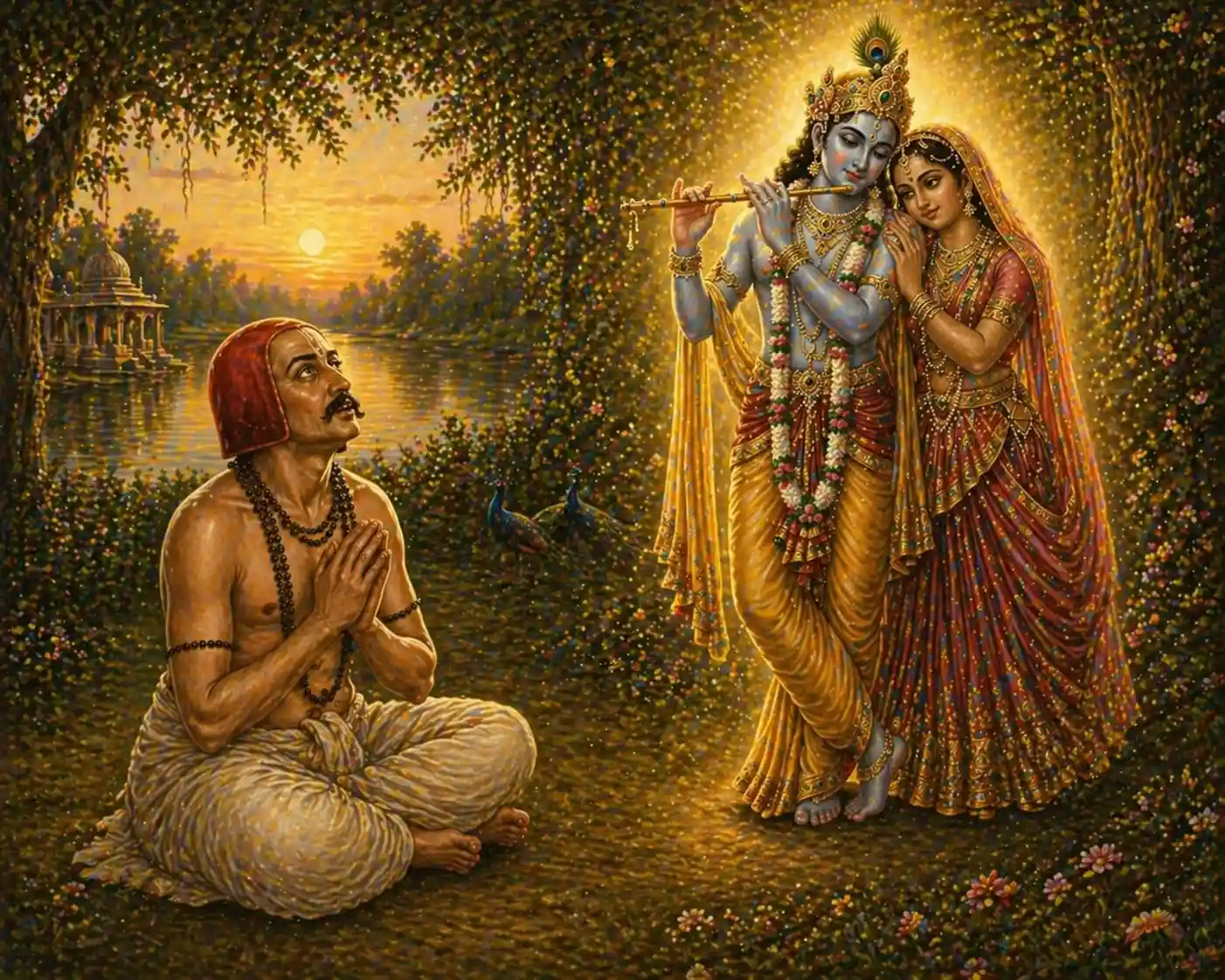
Krishna said, "Baba, we are pleased. Ask for anything. Wealth, salvation, liberation, the highest heaven: it is yours."
And Surdas, the mad lover, the intoxicated devotee, the blind poet who had just seen everything he ever wanted to see, replied:
"Maharaj, make me blind again."
Krishna was stunned. "Baba, I just gave you your eyesight. You want me to take it away?"
Surdas Ji fell at the Lord's feet and said:
"O Shyam, I was born blind. I have never seen this world. I don't know what a tree looks like. I don't know what a mountain looks like. I don't know the face of my own mother. The first thing I have ever seen with these eyes is You and Radha Rani. And I want it to be the last thing I ever see. Please take this eyesight away. Let me not see the ugliness of this world. Let me not be distracted by forms that fade. Let only Your image remain imprinted on my soul forever."*
Krishna, with tears in His own lotus eyes, granted the boon. Surdas Ji became physically blind once more. But his inner vision- his prema netra (eyes of love)- remained open, brighter than a thousand suns, forever fixed on the divine couple.
This is the essence of Bhakti. It does not ask for comfort. It does not ask for pleasure. It asks only for more love, even if that love comes wrapped in the cloak of apparent darkness.
The Signature of the Divine: Why Some Poems Say "Soor Shyam"
When God Became the Ghostwriter
Surdas Ji had made a solemn sankalp (vow). He would compose 125,000 divine padas (verses) in praise of his beloved Shyam.
But a human body, even one inhabited by a saint, has its limits. He was now over 100 years old. He had composed only 5,000 padas. His body was tired. His time was approaching.
Lord Krishna appeared to him one night and said, "Baba, your time has come. I have come to take you home."
Surdas Ji looked up and said, "But my sankalp, Lord! I vowed to compose 125,000 padas. I have only written 5,000. How can I come with you?"
Krishna smiled, that smile that creates universes and dissolves them in a moment. He said:
"You do not have the strength to write anymore, but I do. Rest now, my devotee. I will write for you."
And the tradition lovingly tells us that Lord Shyam Sundar Himself took up the pen and composed the remaining verses.
This is why, in the vast ocean of Surdas Ji's poetry, some padas end with the signature "Sur": the poet himself. But many others end with the signature "Soor Shyam", indicating that it was Shyam Sundar Himself who wrote them through the hands, through the heart, of His beloved devotee.
When you read a poem signed "Soor Shyam," you are not just reading the words of a saint. You are reading the words of God, dictated by love itself.
The Test of Emperor Akbar: Truth Floats, Lies Sink
When the great Mughal Emperor Akbar heard of Surdas Ji's fame, he wanted to collect all of his authentic works. But by then, many lesser poets and imposters had attached Surdas's name to their own mediocre verses. The court was flooded with 250,000 poems, many of them fake.
How to separate the gold from the dust?
Akbar, in his wisdom, ordered all the manuscripts to be thrown into a river. "Let the water be the judge," he said. "If the poems are truly inspired by the Divine, the Divine will protect them."
The manuscripts were thrown into the water. And a miracle occurred that no one could deny.
200,000 poems floated on the surface of the water.
The false ones sank. The true ones, the ones carrying the vibration of Surdas's love, the ones written by "Sur" and "Soor Shyam", refused to drown. They floated like lotuses on the sacred waters, a testament to the power of truth, the buoyancy of bhakti.
To this day, 200,000 padas of Surdas Ji are available to us. Each one is a doorway. Each one is a meeting point. Each one is an invitation to fall in love with the Dark One.
The Final Leela: The Passing of a Lover
The Last Song for the Guru
As Surdas Ji lay on his cot, knowing that his time had come, his disciples gathered around him. They wept. They had never known a world without his songs.
"Maharaj," they said, "you have sung thousands of padas for Radha and Krishna. You have sung for the Gopis, for the pastimes of Vrindavan. But you have never sung a single pada for your Guru, Sri Vallabhacharya. Will you leave without thanking the one who gave you divine sight?"
Surdas Ji's old, blind eyes filled with tears, but not tears of sadness. Tears of gratitude. He lifted his hands and sang his final composition:
"Shri Vallabha nakha chandra chhata binu, sab jag mahi andhera…"
(Without the radiant light shining from the moon-like nails of my Guru, Sri Vallabhacharya's lotus feet, the entire world is in utter darkness…)
He honored his Guru. And then, he asked to be turned around. He wanted his feet to point away from Vrindavan and his head to point towards the sacred land of Braj.
"Lay me down so that my head rests in the dust of Vrindavan," he said. "Let me leave this body while bowing to my Beloved's land."
They turned him. He lay on his stomach, his face towards the soil that Krishna had danced upon, that Radha had walked upon, that the Gopis had watered with their tears of love.
And with the name "Shyam… Shyam…" on his lips, Surdas Ji left his mortal body.
He did not die. He went home. He went to the place where the flute plays eternally, where the rasa leela never ends, where love is the only currency and the only law.
What Surdas Ji Teaches You and Me Today
Your Greatest Weakness Is Your Greatest Strength
Surdas was blind. The world called him cursed. But his blindness was not a punishment; it was a gift. Because he could not see the world, he saw God.
What is the "blindness" in your life? A failed marriage? A chronic illness? A financial ruin? A child who has gone astray?
Stop calling it a curse. Start calling it your sadhana (spiritual practice). It is the very thing that can turn you inward. It is the wall that blocks the noise of the world so you can hear the whisper of the Divine.
Love Is More Powerful Than Knowledge
Uddhav, the great scholar, was humbled by the illiterate Gopis. Surdas, the blind poet, conquered the Lord of the Universe. Why? Because they had one thing that scholars and yogis often lack: prema.
You do not need a PhD in philosophy to love God. You do not need to master the Vedas to melt His heart. You just need to cry for Him. You just need to sing for Him. You just need to long for Him with every fiber of your being.
God Is a Prisoner of Your Love
The greatest teaching of Surdas Ji is this: You can conquer God.
Not with power. Not with intelligence. Not with renunciation. With love.
When you love without condition, without expectation, without selfishness, you become the master of the Master of the Universe. He cannot leave you. He cannot refuse you. He becomes your servant, your child, your slave.
This is not blasphemy. This is the highest truth of Bhakti Yoga. As Surdas showed us, the devotee can challenge God and win.
A Final Invitation to Your Heart
Dear reader, you have now walked through the life of Surdas Ji. You have seen his rejection, his wandering, his finding of the Guru, his service, his challenges, his visions, and his final, triumphant departure.
But this blog is not just a story. It is an invitation.
Close your eyes right now. Feel the darkness behind your lids. That was Surdas's entire world. But within that darkness, he saw the most brilliant light.
Now, open your eyes. Look at your own life with new vision. See your problems as your path. See your pain as your prayer. See your longing as your greatest asset.
Surdas is not gone. He lives in every note of every bhajan sung in Vrindavan. He lives in the heart of every devotee who cries for Krishna. And he lives, waiting patiently, in the sacred space between your heartbeats.
The next time you feel low, the next time you feel that life has been unfair, the next time you complain about what you don't have, remember the blind poet who had nothing and yet possessed everything.
And sing. Just sing. Sing to your Shyam. He is listening. He has always been listening.
Bolo: Vrindavan Vihari Lal ki Jai!
Bolo: Shri Mahaprabhu Vallabhacharya ki Jai!
Bolo: Sant Shiromani Surdas Ji ki Jai!
"Prema ke ati adhikari, Surdas andha phirai…
(Surdas, though blind, is supremely wealthy with love…)
Shyam bina nahi jaane dooja, Krishna charnan man ramai."
(He knows no one but Shyam, his mind forever absorbed in Krishna's lotus feet.)
Radhe Radhe!
Written with folded hands and a heart full of devotion, inspired by the sacred teachings of Swami Mukundananda Ji. May Surdas Ji's love awaken the sleeping bhakti in all of us.
Further Resources: