
The Quiet Hunger: When the Soul Begins to Remember
There comes a moment in many lives that arrives without warning. It does not come during a crisis, nor does it emerge from tragedy or failure. Instead, it appears quietly in the spaces between life's activities—in the stillness of an early morning, during a solitary drive home after a long day, or in those rare moments when the mind finally grows silent and there is nothing left to accomplish.
Outwardly, everything may seem fine. Responsibilities have been fulfilled, goals have been achieved, and loved ones have been cared for. Yet beneath the surface, a subtle feeling arises that is difficult to explain. It is not unhappiness, nor is it ingratitude. Rather, it is the growing awareness that something deeper is missing, something that worldly success alone cannot provide.
The ancient sages of India recognized this feeling and regarded it not as a problem but as a blessing. They understood that when the soul begins to question whether there is more to life than achievement, comfort, and recognition, it has taken the first step toward spiritual awakening. Swami Mukundananda explains that this longing is known in the scriptures as mumukshutva—the sincere desire for spiritual fulfillment and God-realization. Far from being a sign of dissatisfaction, it is evidence that the soul is beginning to remember its true nature and its eternal relationship with the Divine.

The Sacred Resolve of Nitya Seva
Once this longing awakens, a natural question follows: How can spiritual aspiration become part of everyday life?
The Vedic tradition offers a beautiful answer through the concept of Nitya Seva Sankalpam. The phrase combines three Sanskrit words: nitya, meaning constant or eternal; seva, meaning loving service; and sankalpam, meaning a sacred resolve. Together they describe a conscious commitment to remain connected to God through ongoing acts of devotion and service.
At its heart, Nitya Seva is not merely about making donations or supporting a religious institution. It is about transforming ordinary aspects of life into expressions of gratitude. It is the recognition that everything we possess—our abilities, opportunities, resources, and even our desire to serve—ultimately comes from God. Offering a portion back in service becomes an act of remembrance, a way of acknowledging the Divine source behind every blessing.
Lessons from the Great Souls
To illustrate the spirit of genuine seva, the blog draws upon several timeless examples from the Vedic tradition.
The first is the story of Nachiketa, the young seeker from the Katha Upanishad. When his father performed a sacrifice, he outwardly appeared generous but secretly offered only old and worthless cows. Nachiketa perceived that the external ritual lacked true sincerity. When he questioned his father repeatedly, he was angrily told that he would be given to Yama, the lord of death. Remarkably, Nachiketa accepted the words without fear and journeyed to Yama's abode.
When offered boons by Yama, Nachiketa did not ask for wealth, power, or worldly success. Instead, he sought knowledge of the soul and the mystery of what lies beyond death. His story demonstrates that spiritual greatness is measured not by what one gives away but by the sincerity behind the offering. His father gave what he no longer valued, while Nachiketa offered himself completely in pursuit of truth.
The lesson is profound. The scriptures repeatedly emphasize that God does not measure the size of an offering. He measures the devotion behind it. A simple gift offered with love carries greater spiritual value than a grand contribution made for recognition or prestige. Genuine seva begins in the heart long before it reaches the hand.

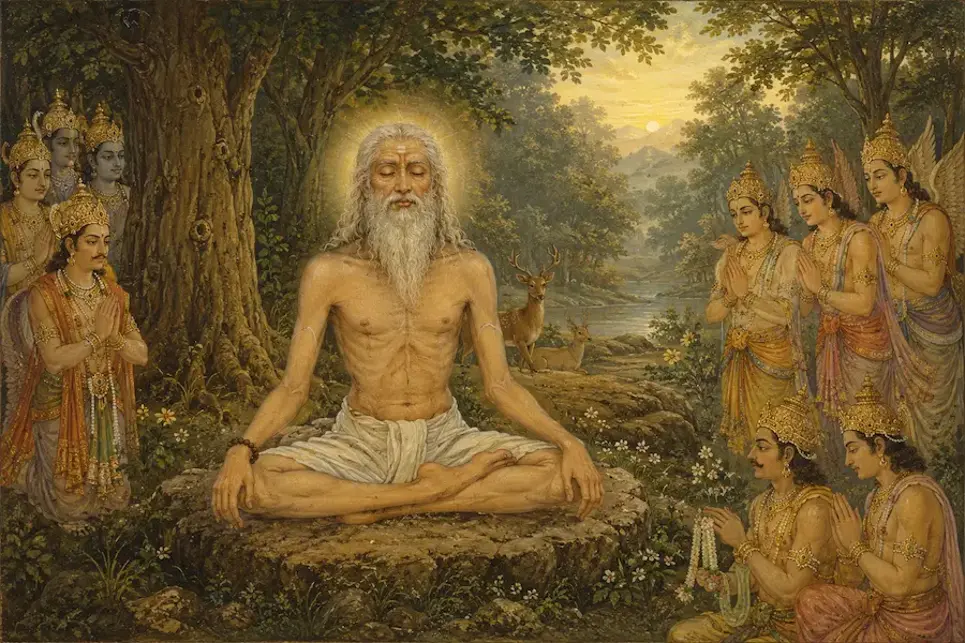
Another powerful example comes from the story of Sage Dadhichi, who willingly surrendered his very body for the welfare of the world. When the celestial beings required a weapon fashioned from his bones to defeat a destructive force threatening creation, Dadhichi did not hesitate. Recognizing that everything ultimately belongs to God, he offered himself completely. His sacrifice was not experienced as loss but as an expression of gratitude and surrender.
The blog emphasizes that this perspective changes our entire relationship with service. When we believe something belongs solely to us, giving feels difficult. When we understand that everything is already God's gift, offering it back becomes natural and joyful.
Why God Allows Us to Serve
One of the most beautiful teachings highlighted in the article is the idea that God does not need our service. Being infinite and complete, He lacks nothing. Yet He lovingly invites us to participate in His mission.
Swami Mukundananda often explains this through the analogy of a mother cooking with her child. The mother does not need the child's help, yet she welcomes the child's participation because it strengthens the bond between them. Similarly, God allows us to serve not because He requires assistance but because service purifies our hearts, reduces ego, deepens gratitude, and strengthens our love for Him.
When this understanding takes root, giving ceases to feel like a sacrifice. It becomes a privilege. A contribution becomes an opportunity. A donation becomes devotion.
Hanuman and the Identity of Service
The blog next turns to Hanuman, perhaps the greatest exemplar of devotion in the Hindu tradition.
Hanuman's greatness did not lie merely in his extraordinary strength or heroic deeds. His true greatness arose from his identity. He saw himself only as the servant of Lord Ram. Even after accomplishing feats that no one else could perform, he desired neither recognition nor reward. When offered a boon, he asked only for the opportunity to continue serving.
This spirit of service reveals a deeper dimension of bhakti. Spiritual maturity is not measured by what we do for God but by how deeply we understand that we belong to Him. Most people define themselves through careers, achievements, possessions, and social status. Hanuman defined himself solely through his relationship with the Divine.
This servant mentality transforms devotion from an occasional activity into a way of life. Instead of constantly asking, "What can I receive?" the devotee begins asking, "How may I serve?" It is this shift that Nitya Seva Sankalpam seeks to cultivate.
The Gopis and Unbroken Devotion
If Hanuman represents service as identity, the Gopis of Vrindavan reveal service as pure love.
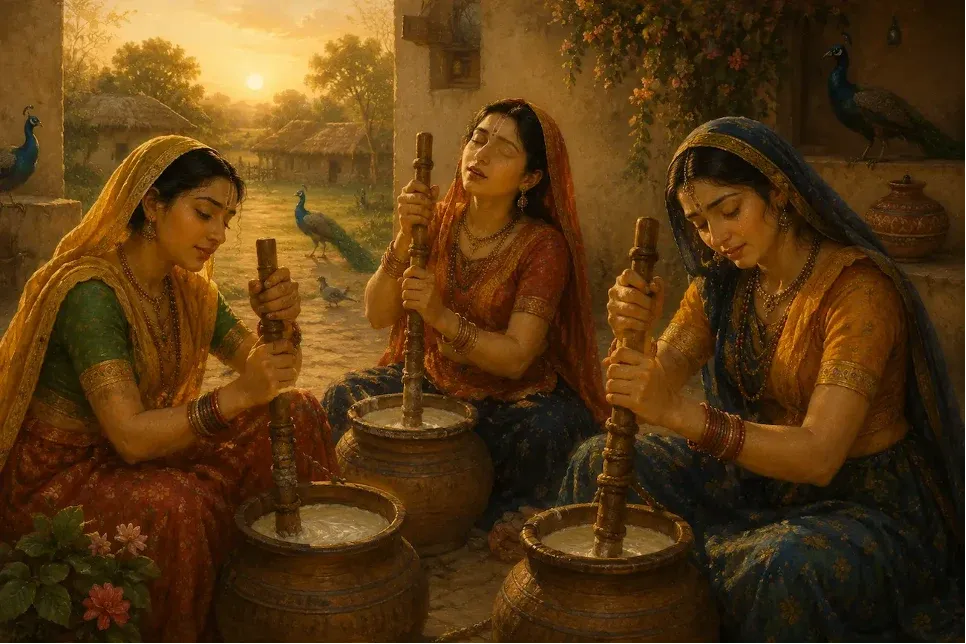
The Gopis did not live extraordinary outward lives. They carried out ordinary household duties, cared for families, and performed daily tasks. Yet every action was infused with remembrance of Krishna. Whether churning butter, drawing water, or preparing meals, their hearts remained fixed upon Him.
The Srimad Bhagavatam records Krishna declaring that He could never repay their spotless devotion, even within the lifetime of Brahma. What moved the Lord was not a single heroic act but their uninterrupted love.
This teaching reveals an essential principle of spiritual life: consistency matters. Just as a river gradually shapes stone through persistence, the soul is transformed through steady devotion maintained over time. Nitya Seva Sankalpam reflects this principle by encouraging a regular, ongoing connection with God rather than occasional bursts of enthusiasm.
Bhakti as Practical Spirituality
A recurring theme throughout the blog is that spirituality is not separate from everyday life. Many people imagine devotion as something reserved for temples, pilgrimages, or meditation retreats. Swami Mukundananda teaches a different vision.
Bhakti is practical spirituality.
It does not require abandoning worldly responsibilities. Instead, it transforms them. Work becomes an opportunity to practice integrity. Family life becomes an opportunity to cultivate selflessness. Success becomes a reason for gratitude. Resources become instruments of service. Daily activities become offerings to God.
In this way, Nitya Seva Sankalpam becomes more than a financial commitment. It becomes a spiritual discipline that gradually sanctifies ordinary life.
The Three Divine Graces
The blog also highlights a teaching from Swami Mukundananda regarding three rare blessings required for spiritual advancement.
The first is a human birth, which provides the unique ability to consciously pursue God-realization. The second is spiritual longing, the inner hunger that awakens the desire to seek something beyond temporary pleasures. The third is the guidance of a genuine Guru, who illuminates the path and transforms aspiration into meaningful progress.
When these three blessings converge, a soul stands at a sacred crossroads. The opportunity for transformation becomes available, but it must be embraced through conscious effort and commitment.
Becoming a Profitable Servant of God
One of the article's most memorable teachings is the concept of becoming a profitable servant of God.
In worldly life, a profitable servant seeks to advance the interests of the one he serves. Similarly, a devotee continually asks how time, talents, resources, and opportunities can be used more effectively in God's service. Yet genuine service remains rooted in humility. The devotee never thinks, "Look how much I have done." Instead, he thinks, "How merciful God has been to allow me to participate."
This balance of enthusiasm and humility forms the essence of mature devotion.
The Temple as a Crossing Place
The final sections of the blog bring these teachings into a contemporary setting through the example of the Radha Krishna Temple of Dallas.
The temple is described not merely as a building but as a tirtha: a sacred crossing place where the ordinary and the divine meet. It serves as a sanctuary for families, seekers, students, professionals, and anyone searching for a deeper connection with God. Through daily worship, scriptural education, youth programs, festivals, and community service, the temple becomes a living expression of devotion.
Supporting such a mission through Nitya Seva Sankalpam allows devotees to participate in this ongoing spiritual work. Every lamp lit, every class taught, every visitor welcomed, and every prayer offered becomes a shared act of devotion sustained by the collective service of the community.
The Meaning of a Sacred Resolve
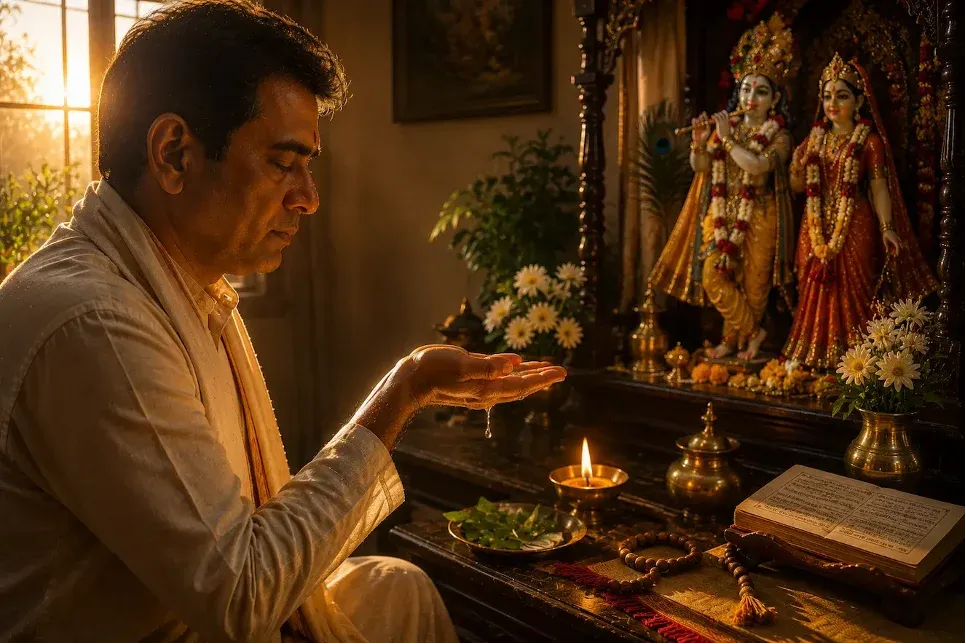
The blog concludes by returning to the deeper meaning of sankalpam. In the Vedic tradition, a sankalp is not a casual intention but a sacred commitment witnessed by God and by one's own conscience. It represents a deliberate choice to align life more closely with divine purpose.
Nitya Seva Sankalpam is therefore presented not as a fundraising initiative but as an invitation to cultivate a lifelong relationship with God through gratitude, humility, and loving service. Month after month, the devotee renews the simple yet profound resolve to remember the Divine and to offer back a portion of what has been received through grace.
Conclusion
At its deepest level, The Quiet Hunger is a meditation on the soul's longing for something eternal. It reminds us that the subtle emptiness many people experience is not a sign of failure but a sacred invitation. The longing itself is grace. It is the soul awakening to its true purpose.
Through the examples of Nachiketa's sincerity, Dadhichi's surrender, Hanuman's service, and the Gopis' unwavering love, the blog demonstrates that devotion is not measured by grand gestures but by the consciousness behind them. Genuine seva arises from gratitude, deepens through consistency, and ultimately becomes an expression of love.
Nitya Seva Sankalpam offers a practical way to nurture that love. It transforms resources into remembrance, giving into gratitude, and ordinary life into an ongoing act of worship. In doing so, it answers the soul's quiet hunger: not by offering more of the world, but by reconnecting us with the One for whom the soul has always been searching.
Call To Action
Take Your Sacred Resolve:
Become a monthly donor: Take the Nitya Seva Sankalpam.
Let a portion of what God has entrusted to you return to God’s service, month after month, for as long as you are given this extraordinary human life.
▸ With its three rare graces.
▸ With its limited and precious time.
▸ With its longing to love and to serve
Swami Mukundananda teaches that the greatest success in life is not measured by what we accumulate but by how much we grow in love for God. Nitya Seva Sankalpam is a simple yet profound way of nurturing that love.
Month after month, it transforms gratitude into action. Remembrance into service. Resources into devotion. And ordinary life into a sacred offering. Not because God needs what we give. But because He lovingly grants us the privilege of serving Him.
Key Takeaways
| Bhakti is Active Service | The root bhaj means to serve. Nam (remembrance) without Karma (action) is structurally incomplete. |
| Radical Ownership | The Isha Upanishad confirms all creation is owned by the Lord. Giving is simply recognizing this fact. |
| Consciousness Over Quantity | Sincerity outweighs scale. The Taittiriya Upanishad commands giving with deep faith, modesty, and empathy. |
| The Power of Nitya | Divine love requires unbroken constancy. True seva continues through ordinary life, not just formal rituals. |
| Claiming Your Inheritance | Service is the eternal birthright of the soul. Supporting a temple claims your spiritual fortune. |
| Giving is Receiving | God is Purna (complete) and needs nothing. An opportunity to serve is a grace, not a transaction. |
| Sankalp Reshapes the Giver | Regular, intentional giving acts as a spiritual discipline. It dissolves attachment and deepens gratitude. |
Frequently Asked Questions
1. What exactly is Nitya Seva Sankalpam and how is it different from a regular donation?
A regular donation is a single act of generosity. A Nitya Seva Sankalpam is a sacred resolve, a monthly commitment that transforms giving from an occasional impulse into a living spiritual practice. Each month the offering goes out, it becomes a conscious act of remembrance. Over time the regularity itself becomes seva bhav, the disposition of a soul that has decided to be a participant in Radha-Krishna’s mission rather than a visitor.
2. Does the amount matter? What if I can only give a small amount?
Shri Krishna says in the Bhagavad Gita (9.26), that whoever offers Him with devotion a leaf, a flower, a fruit, or water, that offering of love from a pure heart He accepts. Sudama’s beaten rice was the most precious thing Krishna ate in Dwaraka. The Taittiriya Upanishad says: give according to your means. There is no minimum. There is only sincerity and faith.
3. I already volunteer at the temple. Do I need to also give financially?
Bhakti does not keep score. You are already offering your time, energy, and presence, which is a profound form of seva. If a financial commitment arises naturally from your heart and feels aligned with your situation, it can beautifully complement what you already do. Nothing in the tradition asks you to give more than you can offer freely and joyfully.
4. I am going through a difficult financial period. Should I wait?
There is no virtue in sacrifice that creates genuine hardship. If circumstances are stretched, even a small symbolic amount offered with full faith and love carries its own sincerity. Or hold the sankalp in your heart with the intention to formalize it when you are able. The Lord who sees every heart receives the intention as much as the act.
5. How do I keep this commitment spiritually alive and not just automatic?
When the monthly transfer goes out, pause for thirty seconds. Say inwardly:
I give this with faith.
I am being given the opportunity to serve.
This was never mine: It is returning to where it always belonged.