When Did "Stress" Become the New Normal? 😰
Take a deep breath. Just one conscious breath.
If you are reading this, you are likely carrying weight you were never meant to bear alone. The deadline that keeps you up at night. The exam result that feels like life or death. The endless cycle of cooking and caring that nobody notices. The inbox that never hits zero. The mind that never shuts off.
Welcome🙏 to the new normal. Stress 😨has become the wallpaper of our lives.
Whether you are a student pulling all-nighters, terrified of disappointing your parents. A professional navigating office politics while meeting impossible deadlines. Or a homemaker managing the invisible mental load of an entire household. The story is the same. We are all working. But we are not at peace.
We have tried everything. Meditation apps. Weekend detoxes. Yet the worry returns every Monday morning.
But what if the solution isn't to work less? What if the solution is to change how we work?
There is an ancient science that offers exactly this. It is called Karma Yoga. It is not about sitting in a cave chanting. It is about showing up to your life with such inner shift that stress cannot touch you. It is the art of working without worry.
As explained by the revered teacher Swami Mukundananda, Karma Yoga is a psychological and spiritual strategy for peak performance with zero anxiety. Its source is the timeless manual for human life: The Bhagavad Gita.
Let us explore how.
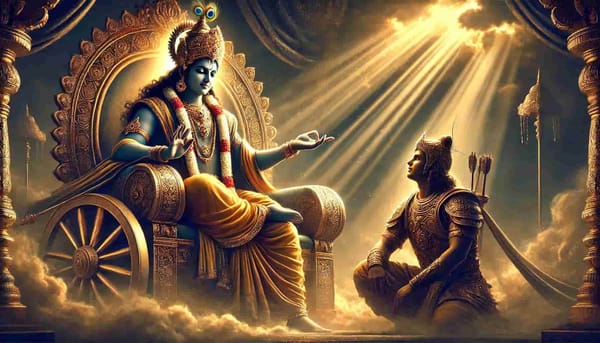
The Battlefield of Modern Life: Arjuna's Stress is Our Stress ⚔️
Imagine standing in a war, weapons slipping from your hands, mind spinning, legs refusing to move. Everyone you love stands on opposite sides. Your heart is torn.
This was Arjuna, 5000 years ago, on the battlefield of Kurukshetra.
Now look at your life. The boardroom meeting where you must prove yourself. The family expectations pulling you in different directions. The fear of failure that paralyzes you before you begin.
Arjuna's symptoms are our symptoms:
- Physical and Mental Paralysis: Having so much to do, you do nothing.
- Emotional Turmoil: Being so attached to outcomes that their slightest shift destroys your peace.
- Moral Dilemma: Should I prioritize career or family? Speak up or stay quiet?

Arjuna collapsed under this weight and spoke these words to Krishna:
📜 Verse 1: Bhagavad Gita 1.30
न च शक्नोम्यवस्थातुं भ्रमतीव च मे मन: |
निमित्तानि च पश्यामि विपरीतानि केशव || na cha śhaknomy avasthātuṁ bhramatīva cha me manaḥ
nimittāni cha paśhyāmi viparītāni keśhava
Translation:
I am unable to hold myself steady any longer. O Krishna, killer of the Keshi demon, I only see omens of misfortune.
Application:
Here Arjun has addressed Shree Krishna as Keśhava, killer of a demon called Keshi. Yet, for Arjun the thought of killing his own relatives troubled him to such an extent that, his body started to tremble. He was unable to even hold his magnificent bow Gāṇḍīv, which could emit sounds that petrified even the most powerful enemies. Arjun had become so disillusioned that superstition started gripping him. He could only see bad omens indicating severe devastation. Thus, he felt it would be a sin to engage in such a battle.
Why the Bhagavad Gita is Your Ultimate Life Manual 📖
- We live in a world of AI and instant gratification. Why does a 5000-year-old conversation matter?
- Because human problems have not changed. We still want happiness but create suffering. We seek peace but chase chaos.
The Gita addresses the fundamental human condition: the conflict between our desires, duties, and inner peace. It speaks to the soul, not the designation.
As Swami Mukundananda teaches, the Gita is for the "busy person." The person with deadlines and responsibilities.
It is not only a text to be worshipped. It is a manual to be lived.

📜 Verse 2: Bhagavad Gita 2.47 (The Core of Karma Yoga)
कर्मण्येवाधिकारस्ते मा फलेषु कदाचन |
मा कर्मफलहेतुर्भूर्मा ते सङ्गोऽस्त्वकर्मणि || karmaṇy-evādhikāras te mā phaleṣhu kadāchana
mā karma-phala-hetur bhūr mā te saṅgo ’stvakarmaṇi
Translation:
You have a right to perform your prescribed duties, but you are not entitled to the fruits of your actions. Never consider yourself to be the cause of the results of your activities, nor be attached to inaction.
Deep Dive:
This verse is often misunderstood as "work hard and don't care." But that is indifference, not detachment.
Swami Mukundananda explains: This verse shifts your focus from output to input. You control your effort, sincerity, and skillfully. You do not control the outcome. The market can crash. The examiner can have a bad day.
When you attach your peace to the result, you hand your happiness to factors outside your control. That is anxiety. When you focus on the quality of your action, your mind becomes calm. And when the mind is calm, performance improves. Detachment from results actually leads to better results.
Karma Yoga Demystified: Working Without Worry 🛠️
Definition:
Karma Yoga is keeping your mind connected to the Supreme while your hands are busy in daily duties. It is renouncing the anxiety attached to action, not action itself.
The Myth:
We hear "just focus on your work." But hardworking people are often the most stressed. They work, but they also worry.
A Karma Yogi works hard yet remains peaceful. The difference is not in the quantity of work, but in the consciousness behind it.
The Three Pillars of Karma Yoga
1. Samatva (Equanimity):
Treating success and failure with equal vision. You feel joy or disappointment, but these feelings do not disturb your inner core. You remain steady while the weather of life changes.
2. Svadharma (Duty):
Doing what is required by your nature and circumstances. The fish should not try to climb a tree. When you do your own duty, you are in flow. When you do another's, you are in stress.
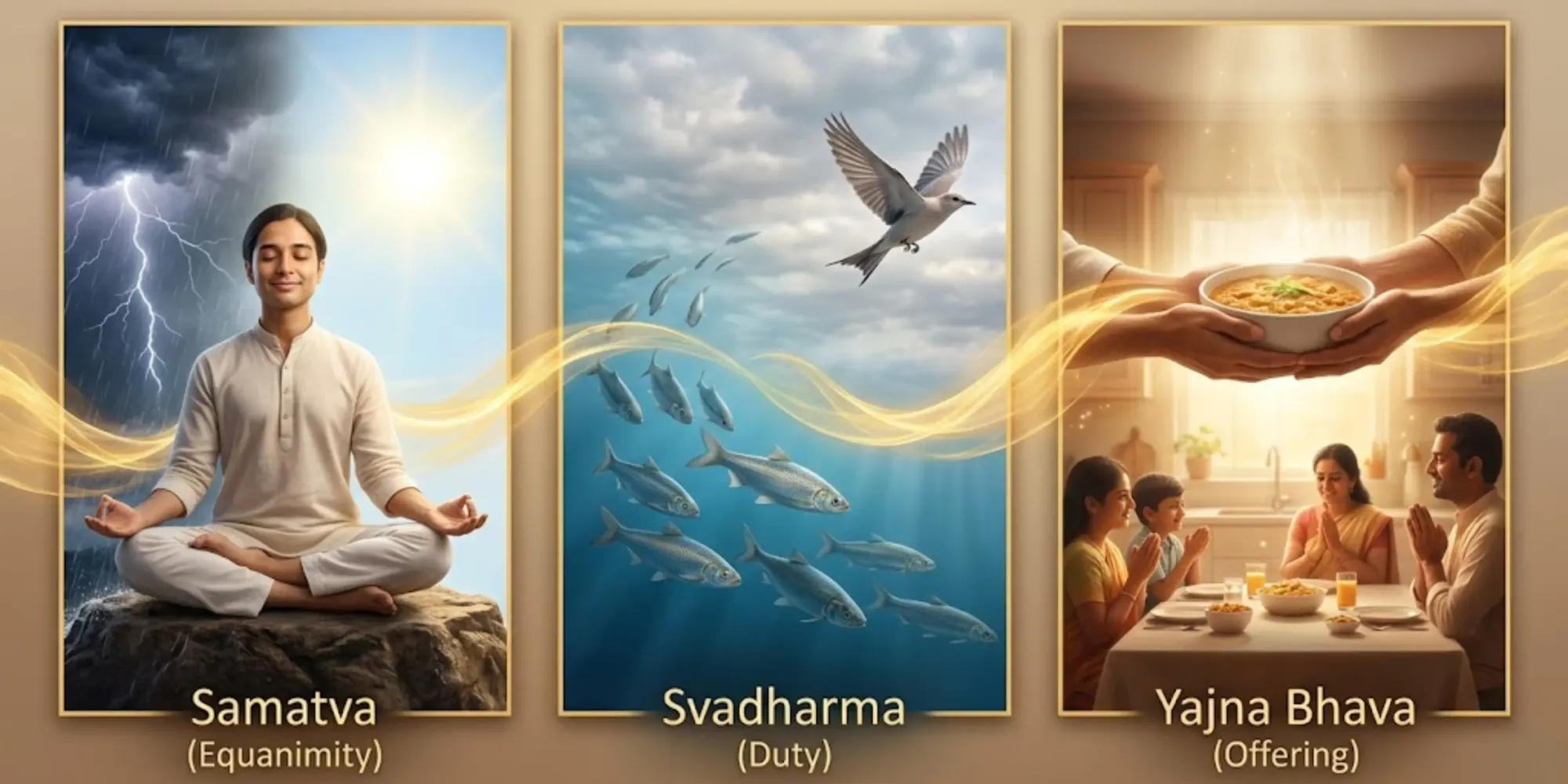
3. Yajna Bhava (Offering):
Offering your work's results to a higher purpose. When you cook for family with love, it is worship. When you work to serve your team, it is sacrifice. This purifies the mind.
The Mind: Your Best Friend or Worst Enemy 🧠
- Where does stress live? Not in your boss or your to-do list. Stress lives in your mind's reaction.
- Two people face the same situation. One crumbles. One rises. The difference is the mind.
- The mind is naturally restless. It jumps from past regret to future anxiety, ruining the present.
📜 Verse 3: Bhagavad Gita 6.5
उद्धरेदात्मनात्मानं नात्मानमवसादयेत् |
आत्मैव ह्यात्मनो बन्धुरात्मैव रिपुरात्मन: ||
uddhared ātmanātmānaṁ nātmānam avasādayet
ātmaiva hy ātmano bandhur ātmaiva ripur ātmanaḥ
Translation:
"Elevate yourself through the power of your mind, and not degrade yourself, for the mind can be the friend and also the enemy of the self."
Explanation:
We are responsible for our own spiritual elevation or fall; saints and gurus show the way, but we must walk the path ourselves. 🌟 Our biggest enemy is not outside—it is our own uncontrolled mind, which can either be our greatest friend or worst adversary. 🧠
The mind operates at four levels mind (thoughts), intellect (decision), chitta (attachment), and ego (identification).
To elevate ourselves, we must use the higher mind (intellect) to control the lower mind (thoughts and attachments). 🙏 If we have failed to reach God-realization despite meeting saints in past lifetimes, the problem was not lack of guidance but our reluctance to follow it. ✨ By accepting responsibility for where we are, we gain confidence that we can also elevate ourselves through our efforts. 🕉️
How to Apply Karma Yoga Right Now 🚀
Strategy 1: Focus on the "Doing," Not the "Getting"
Most work for the "getting." The grade. The promotion. The money.
Shift this. Work for the "doing."
- The Student: Study for knowledge, not just results. You control preparation, not the question paper.
- The Professional: Work for excellence, not just the paycheck. Put your soul into the project.
When happiness depends on "getting," you are always insecure. When happiness comes from "doing," you are always fulfilled.
Strategy 2: Redefine Failure
Fear of failure is a huge stress source. But what if failure is feedback?
Attached to result? Failure crushes you.
Attached to effort? Failure teaches you.
📜 Verse 4: Bhagavad Gita 2.48
योगस्थ: कुरु कर्माणि सङ्गं त्यक्त्वा धनञ्जय |
सिद्ध्यसिद्ध्यो: समो भूत्वा समत्वं योग उच्यते ||
yoga-sthaḥ kuru karmāṇi saṅgaṁ tyaktvā dhanañjaya
siddhy-asiddhyoḥ samo bhūtvā samatvaṁ yoga ucyate
Translation:
BG 2.48: Be steadfast in the performance of your duty, O Arjun, abandoning attachment to success and failure. Such equanimity is called Yog.
Shree Krishna calls that profound equanimity "Yog"—union with the Divine—because it allows us to accept all circumstances with serenity. This peace comes from knowing we control our efforts, not the results, which we dedicate to God. When outcomes differ from our expectations, we accept them calmly as divine will. Life's ocean will always have waves of success and failure beyond our control. If we fight every wave, misery is endless. But when we surrender to God's will while giving our best effort, we attain true Yog.
Karma Yoga for Everyone 🌍
Karma Yoga requires no external change. No need to quit your job. Just shift your internal attitude.
For the Student 📚
Study with focus and integrity. Leave result anxiety to God. You give your best to preparation. You hand over the outcome. This removes exam fear.
For the Professional 💼
Practice ethical leadership and service. Use your position to serve your team, not feed your ego. When you work to serve, criticism doesn't shatter you.
For the Homemaker 🏠
This is highest worship. Performing mundane tasks with love as offering transforms home into temple. See the divine in family. Every act becomes sacred.
📜 Verse 5: Bhagavad Gita 3.35
श्रेयान्स्वधर्मो विगुण: परधर्मात्स्वनुष्ठितात् |
स्वधर्मे निधनं श्रेय: परधर्मो भयावह: || śreyān sva-dharmo viguṇaḥ para-dharmāt sv-anuṣṭhitāt
sva-dharme nidhanaṁ śreyaḥ para-dharmo bhayāvahaḥ
Explanation::
Shri Krishna explains that," It is far better to perform one’s natural prescribed duty, though tinged with faults, than to perform another’s prescribed duty, though perfectly. In fact, it is preferable to die in the discharge of one’s duty, than to follow the path of another, which is fraught with danger."

The Power of Offering Your Work 🙏
The Swami Mukundananda Ji's Principle:
When we cook food and offer it to God first, it becomes prasad—sanctified. We eat not as enjoyers but as humble recipients.
Same applies to work. Offer actions to a higher power before "enjoying" results. Work becomes sanctified. Anxiety dissolves. You are just an instrument.
How to Do It:
Start your day with silent sincerity:
"I offer my thoughts, words, and actions today. Let me be an instrument. The results are yours. My effort is my offering."
This shifts burden from your shoulders. Suddenly, you are free.
📜 Verse 6: Bhagavad Gita 9.27
यत्करोषि यदश्नासि यज्जुहोषि ददासि यत् |
यत्तपस्यसि कौन्तेय तत्कुरुष्व मदर्पणम् || yat karoṣi yad aśnāsi yaj juhoṣi dadāsi yat
yat tapasyasi kaunteya tat kuruṣva mad-arpaṇam
Translation:
Shri Krishna explain Aurjun, "Whatever you do, whatever you eat, whatever you offer as oblation to the sacred fire, whatever you bestow as a gift, and whatever austerities you perform, O son of Kunti, do them as an offering to Me."
Explanation:
Devotion means offering your every activity to God, and feeling intense separation if ever you lose remembrance of Him. When works are dedicated and mentally delivered to God, it is called arpaṇam. Such an attitude metamorphoses the mundane activities of material life into divine service of God. Swami Vivekananda expressed this attitude toward work when he declared: “No work is secular. Everything is devotion and service. Having stated that all works should be offered to Him, Shree Krishna now lists the benefits of doing so.
Overcoming "I Don't Have Time to Pray" ⏳
Common objection: "I have deadlines. Children. Responsibilities. No time to meditate."
The Illusion:
Spirituality is separate from work. You must close laptop to connect with God. Meditation happens only on cushion.
The Solution:
Karma Yoga destroys this. Your work is meditation. Office is temple. Kitchen is altar. You don't need time for spirituality. You need to bring spirituality to your time.
📜 Verse 7: Bhagavad Gita 6.17
युक्ताहारविहारस्य युक्तचेष्टस्य कर्मसु |
युक्तस्वप्नावबोधस्य योगो भवति दु:खहा || yuktāhāra-vihārasya yukta-ceṣṭasya karmasu
yukta-svapnāvabodhasya yogo bhavati duḥkha-hā
Translation:
"Shree Krishna Explains that those who are temperate in eating and recreation, balanced in work, and regulated in sleep, can mitigate all sorrows by practicing Yog."
Explanation:
Shree Krishna extends offering beyond objects to include all our actions. Whether performing duties, eating, drinking, or observing vows, we should mentally offer everything to the Supreme Lord. Many people confine devotion to temple walls, separating it from daily life. But true devotion is not restricted to sacred spaces. It must flow through every moment of our existence.
From "What Will Happen?" to "What Can I Do Now?" ✨
We began with stress. With weight on shoulders. With haunting questions:
What if I fail? What if they reject me? What if it doesn't work out?
We end with a different question:
What can I do now? And can I do it with my whole heart?
This is Karma Yoga's shift. From victim of future to master of present. From worrying about results to reveling in effort. From stress to peace.
The Gita doesn't promise life without challenges. It promises a steady mind through them. It doesn't remove the battlefield. It gives armor of wisdom.
The Final Promise:
Practice Karma Yoga. You won't just become a better worker. You'll become calmer, happier. Relationships improve because you stop expecting and start offering. Health improves because stress stops poisoning your body. Work improves because calm mind is creative mind.
When weight returns, when worry creeps back, remember Krishna's assurance:
📜 Verse 8: Bhagavad Gita 18.66
सर्वधर्मान्परित्यज्य मामेकं शरणं व्रज |
अहं त्वां सर्वपापेभ्यो मोक्षयिष्यामि मा शुच: || sarva-dharmān parityajya mām ekaṁ śaraṇaṁ vraja
ahaṁ tvāṁ sarva-pāpebhyo mokṣayiṣyāmi mā śucaḥ
Translation:
"Shri Krishna instructs Aurjun to Abandon all varieties of religion and just surrender unto Me. I shall deliver you from all sinful reactions. Do not fear."
Explanation:
Shree Krishna initially guided Arjun to perform his material duty as a warrior while simultaneously engaging his mind in devotion, which is the path of Karma Yog. However, He now elevates the instruction by revealing that one may renounce all material duties entirely and simply surrender to God, which is the path of Karma Sanyās. This apparent contradiction is resolved by understanding that there are two kinds of dharma: material dharma based on bodily identification, and spiritual dharma based on soul identification. When one fully embraces spiritual dharma through loving devotion to God, they are automatically released from all material obligations, just as watering a tree's root nourishes every branch. Therefore, renouncing material dharma for spiritual dharma is not a sin but the highest attainment. Ultimately, Shree Krishna reveals that Arjun should fight not because it is his duty as a warrior, but simply because God desires it.
Final Thought:
Surrender the worry. Pick up the work. That is the path of Karma Yoga.
The battlefield remains. Deadlines won't disappear. Responsibilities won't vanish. But you will be different. You will work. Without worry.
🙏 Frequently Asked Questions
Q: Do I need to be religious to practice Karma Yoga?
A: Not at all. Karma Yoga is a universal science of action. Whether you call it God, Universe, or Higher Self, the principle remains the same: focus on effort, release attachment to results.
Q: Won't detachment from results make me less motivated?
A: Actually, the opposite happens. When fear of failure disappears, you work with complete freedom and creativity. True motivation comes from loving the process, not craving the outcome.
Q: How do I start practicing Karma Yoga daily?
A: Begin each morning by offering your day's work mentally. Throughout the day, pause before important tasks and remind yourself: "I control my effort, not the result."
Q: Can Karma Yoga help with anxiety and overthinking?
A: Absolutely. Most anxiety comes from obsessing over future outcomes. Karma Yoga anchors you in present action, where peace naturally resides.
Q: Is it possible to practice this while working in a competitive environment?
A: Yes. Competition exists outside; equanimity exists inside. You can give 100% effort while remaining undisturbed by others' performance.
🎯 3 Simple Ways to Apply Karma Yoga Starting Today
1. Morning Offering Ritual 🌅
Before you check your phone, take 30 seconds to mentally offer your day's work to a higher purpose. Simply say: "I offer my thoughts, words, and actions today. The results are yours. My effort is my offering."
2. The Effort-Outcome Check-In 🔄
Throughout your day, pause and ask yourself: "Am I focused on what I control (my effort) or what I don't control (the outcome)?" Each time you catch yourself worrying about results, gently return your attention to the present moment and the quality of your work.
3. Evening Surrender Practice 🌙
Before sleeping, reflect on your day. Consciously hand over every success, failure, worry, and unfinished task to the Divine. Trust that whatever happened was for your highest growth. Surrender everything. Sleep in peace.