
Who Was Guru Ravidas? A Bhakti Saint Beyond Caste and Status
Can a soul become so pure that the holy Ganga herself rises to meet it?
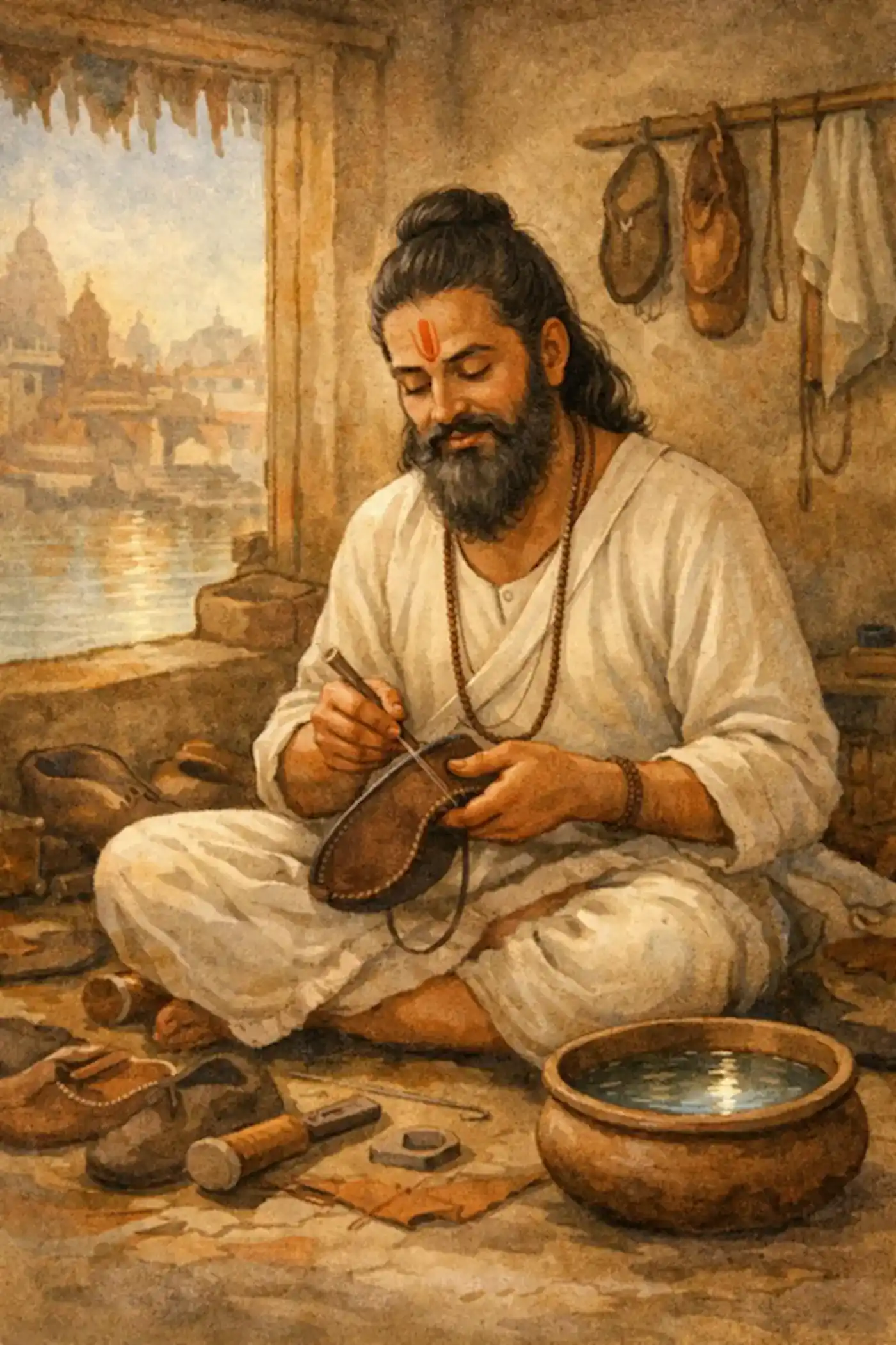
In the warmth of a single, humble heartbeat, the heavy lines of caste, creed, and status begin to soften. Long ago, in the narrow lanes of Kashi, a saint-poet sat quietly mending shoes. His hands were covered in leather, but his heart was drenched in the Divine.
While others searched for God in distant temples and ritual baths, Guru Ravidas revealed a deeper truth. Ultimate Reality is not found by going somewhere else. It is revealed by purifying what already holds Him.
He lived by a simple yet unsettling principle:
“Man changa toh kathauti mein Ganga.”
If the mind is pure, the Ganges flows even in a humble vessel.
In that single line, centuries of spiritual hierarchy quietly dissolved.
Guru Ravidas Jayanti 2026: Date, Tithi, and Spiritual Significance
As we approach the 649th Guru Ravidas Jayanti on February 1, 2026, observed on the full moon of Magh Purnima, his voice continues to guide us toward Begumpura, the “City Without Sorrow,” where no one is high or low, where dignity and equality are natural, and where love is the only language spoken.
Whether you are a seeker of inner peace, a student of history, someone longing to taste divine love, or someone quietly yearning for a more just world, the life of Sant Ravidas offers more than admiration. It offers orientation.
This is not merely a biography. It is a quiet blueprint for the soul.
Let us now step into the miraculous life, the revolutionary wisdom, and the living legacy of the saint who showed us that when the heart is pure, the Ganga herself rises to meet us wherever we stand.
Born into Exclusion, Rooted in Grace: Early Life of Guru Ravidas
To understand the revolutionary nature of Guru Ravidas’s spiritual journey, we must first understand the world he was born into.
Medieval India was governed by a rigid caste hierarchy in which birth dictated occupation, opportunity, and spiritual access. From within this structure of exclusion, Ravidas’s message of unwavering equality did not arise as theory. It emerged as lived truth.
Guru Ravidas was born in Seer Goverdhanpur, near Varanasi, with his birth year often cited as 1377 CE. He belonged to a family of leather workers, a community historically labeled “untouchable” and relegated to the bottom of the social ladder. From an early age, he experienced humiliation and caste-based exclusion, including restricted access to temples and basic human dignity.
Yet Ravidas did not internalize society’s verdict. He transformed his occupation into devotion and his marginalization into spiritual authority.
As he later sang:
“Jaati-paat poochhe nahi koi, Hari ko bhaje so Hari ka hoi.”
God does not ask one’s caste. One who remembers Him belongs to Him.
Spiritual Legends and Devotional Traditions of Guru Ravidas
The Divine “Curse” That Carried Grace
According to tradition, Ravidas’s birth itself carried a deeper story.
In a previous life, he is said to have been a learned Brahmin disciple in the lineage of Swami Ramananda. He was disciplined, devoted, and well-versed in scripture. Yet, one rainy afternoon, a single act of compassion, choosing to ensure his Guru did not go hungry, altered his destiny.
He accepted food ingredients from a merchant, unaware that they carried the desperate prayer of a leatherworker longing for a child. To society, this was impurity. To grace, it was alignment. Because the offering was considered “impure,” the disciple was cursed to be reborn into that very family.
But his was no fall from grace. It was grace in disguise.
The “curse” fulfilled a prayer, preserved devotion, and allowed divine love to demonstrate a radical truth: the essence of bhakti does not change with birth.
What was once mastered through scripture would now be expressed through the heart.
An Infant Who Would Not Forget
The signs of carried-over consciousness appeared immediately. As an infant, Ravidas refused his mother’s milk for three days, absorbed in a depth that did not yet belong to the world.
It took the arrival of Swami Ramananda himself to break the silence. He took the infant into his lap and whispered the divine name. Yet, even then, the child resisted. Only after initiating the parents into devotion did the infant accept nourishment. From the beginning, Ravidas’s life carried a quiet insistence that grace must uplift everyone it touches.
He did not come to escape the world. He came to sanctify it from within.
When Generosity Exceeded Social Rules
As Ravidas grew, compassion flowed from him without calculation. He gave freely, even when resources were scarce. For a struggling household, this generosity felt dangerous.
Eventually, his father, bound by the heavy anxieties of daily life, asked Ravidas to leave his home.
Without resentment, he bowed and settled near the ghats of Kashi, earning his livelihood as a cobbler. To the world, he was merely mending worn leather. To Ravidas, he was weaving a continuous prayer. Each stitch was an offering.
From this space emerged his famous declaration of intimacy:
“Prabhu ji, tum chandan hum paani, Jaki ang-ang baas samani.”
You are sandalwood, I am water.
Wherever you touch me, I carry your fragrance."
The Test of Wealth and Weightlessness
Drawn by this unadorned love, the Divine decided to test his detachment. Appearing as a wandering sadhu, the Lord offered him the legendary Paaras [the philosopher’s stone], the stone that turns iron into gold. Ravidas barely looked up. When the sadhu turned his tools into gold to prove the stone’s power, Ravidas felt only irritation. His honest livelihood had been disrupted. He looked at the miraculous stone and responded with a soul-stirring couplet:
“Pāras more hari ko nāmoon, Patthar soan mohi nāhian kāmoon”
My Hari’s name is my true philosopher’s stone; I have no use for this ordinary stone.
He told the visitor to leave the stone in the thatch of his roof, where it lay forgotten and untouched.
Even when the five gold coins began appearing daily at the feet of his Shaligram, Ravidas recoiled. He lifted them with tongs as if they were scorpions and cast them into the Ganga. He did not fear poverty; he feared the weight of attachment.
Only when God revealed that abundance was meant for service did Ravidas accept it, allowing resources to flow outward without attachment.
True renunciation, he showed, is not withdrawal from the world, but freedom within it.
Guru Ravidas and the Bhakti Movement’s Message of Equality
Ravidas wore the tilak and janeu, the sacred thread openly, not in protest, but in truth. His presence unsettled orthodoxy because it exposed a contradiction: devotion without permission. He did not wear them to provoke; he wore them because his devotion had erased the idea that God could belong to anyone exclusively.
“Ek matti sab ghat sirje”
All bodies are formed the same clay.
Therefore, how can one human be superior to another?
At a time when society was deeply fragmented by the caste system, Guru Ravidas championed the revolutionary message of social equality. He taught that all souls are divine and eternal fragments of God, and therefore, no one is inherently superior or inferior. He boldly challenged caste-based discrimination with his direct and powerful words:
“Jaati paati puchhe nahi koi, hari ko bhaje so hari ka hoi”
No one’s caste matters; one who worships God belongs to God.
The Shaligram Test
The orthodox pandits of Kashi grew envious of Ravidas’s widespread fame, seeing it as a threat to their priestly authority. They complained to the King of Kashi that a low-caste shoemaker was destroying their religion by worshipping a sacred Shaligram stone. Summoned to the royal court, Ravidas was challenged to prove his devotion. The pandits placed a Shaligram on an altar between them and Ravidas, declaring that whoever could make the stone move was the true worshipper. They began chanting complex Vedic mantras with great pride, but the stone remained static.
When it was Ravidas’s turn, he confessed his lack of knowledge of scriptures. Instead, he simply began singing a soul-stirring bhajan with pure, childlike faith. With tears in his eyes and surrendered heart, he called out:
“Aisi lal tujh binu kaun karai.”
O Beloved, who else but You would show such mercy?
Pulled by his genuine, heartfelt love, the Shaligram miraculously rolled into his lap. God Himself had pronounced the verdict: He is won by love, not by ritualistic knowledge.
When a Kathauti Held a River
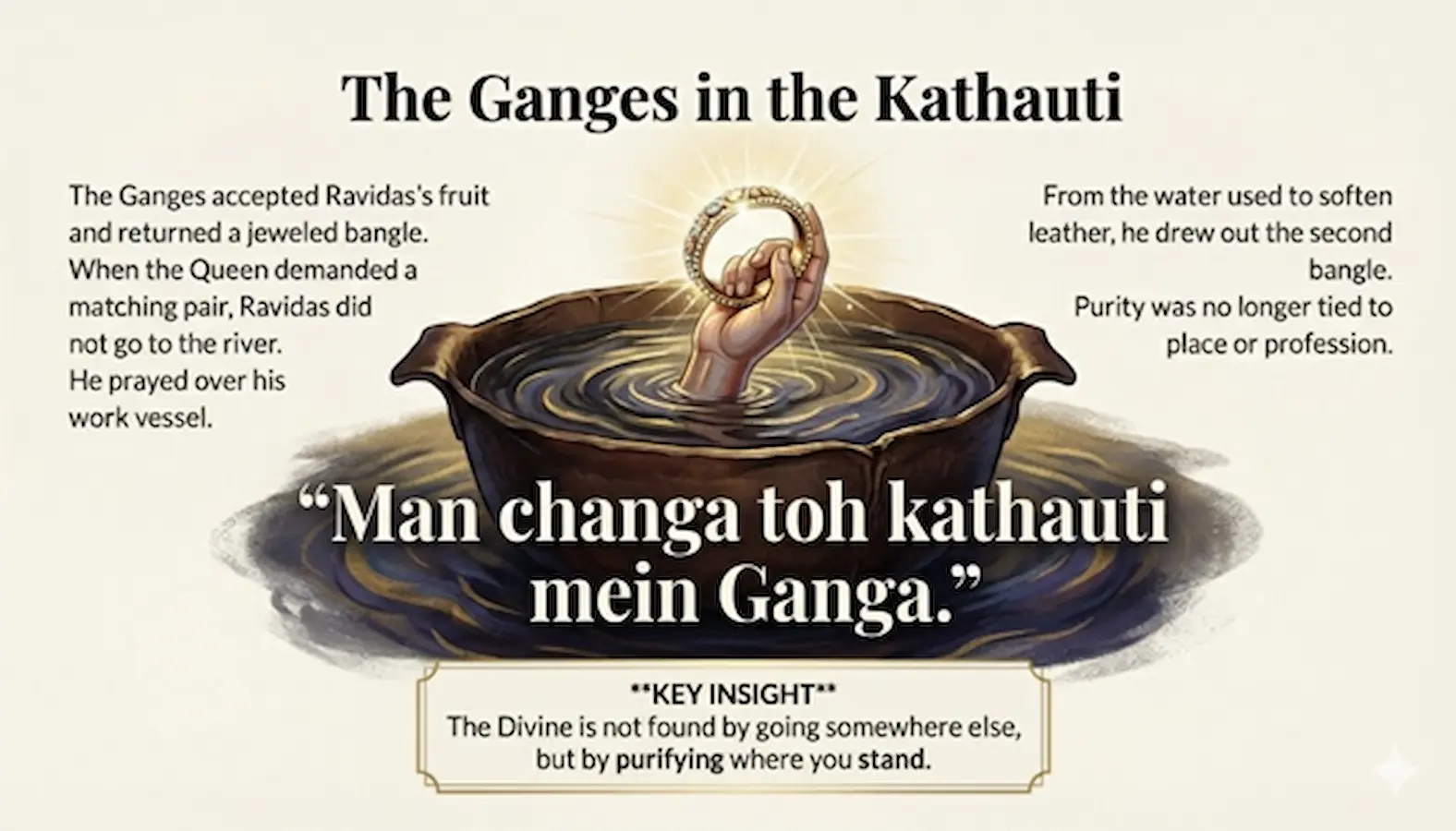
A priest in Kashi repeatedly urged Ravidas to join him for a holy dip in the Ganga. Ravidas politely refused and replied with his now-famous line, “Man changa to kathauti mein Ganga.” As the priest insisted, Ravidas gave him two bananas to offer to Mother Ganga on his behalf.
At the river, when the priest made the offering, a divine hand emerged from the water and accepted the bananas. The priest was shocked, but before he could recover, the hand appeared again and offered a magnificent golden bracelet as a gift for Ravidas.
Overcome by greed, the priest sold the beautiful bangle to a jeweler instead. The ornament eventually reached the queen, who was so captivated that she demanded her husband, the king, procure a matching one. Unable to create such a divine piece, the jeweler led the king back to the priest, whose deceit was exposed.
The priest confessed his guilt to Ravidas and begged him to repeat the miracle. Ravidas simply uttered his famous proverb again, took a tumbler of water from his cobbler’s pot, and prayed. Amazingly, an identical bracelet manifested from the humble vessel. This story beautifully illustrates that God is pleased by pure intention alone and that for a purified mind, divinity is present everywhere.
Guru Ravidas and Meera Bai: A Guru-Disciple Bond Beyond Barriers
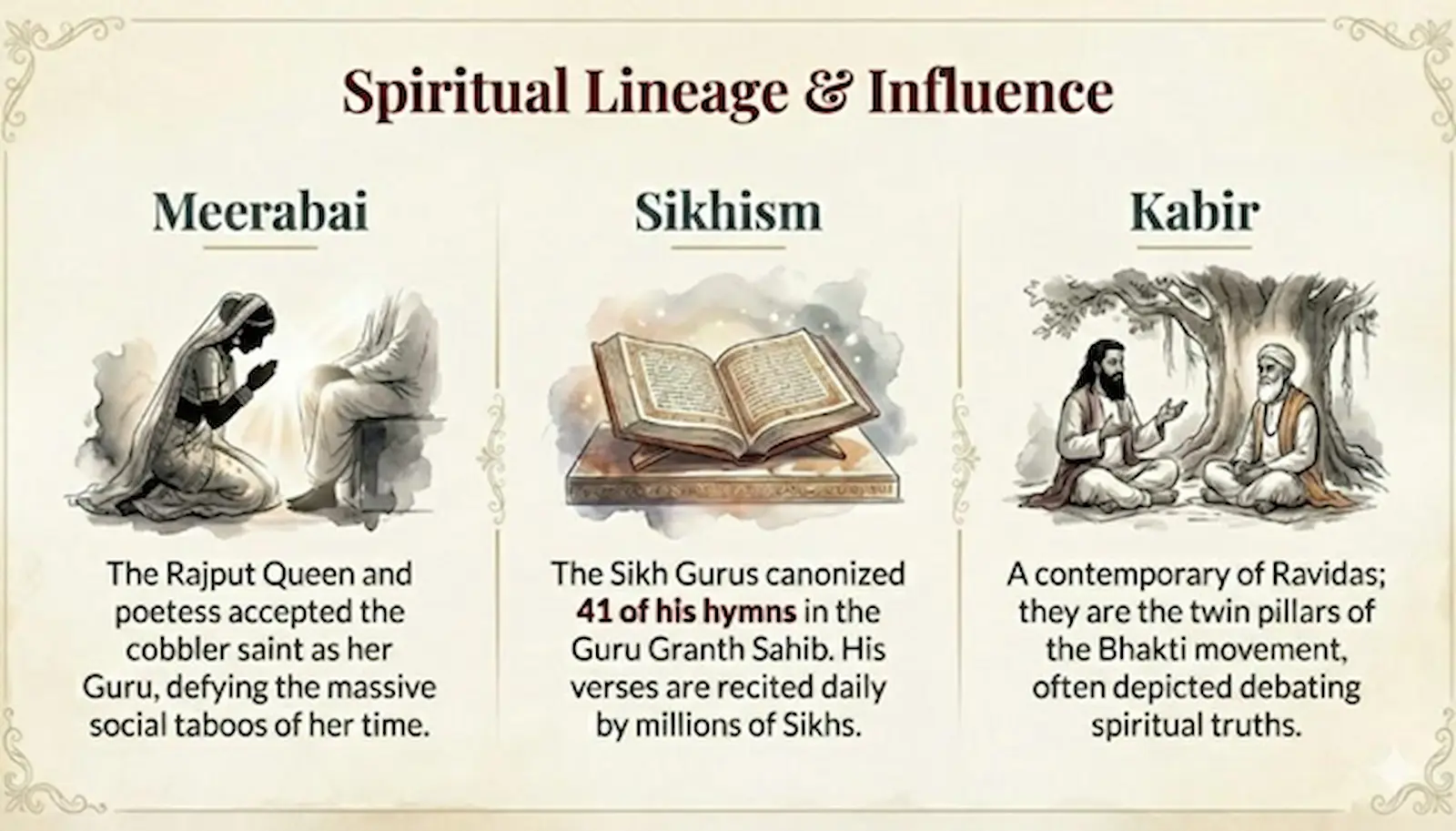
Among those drawn to Guru Ravidas was Meera Bai. A princess who bowed before a cobbler, she recognized truth instinctively.
Her verse still echoes:
“Guru milyo Ravidas ji, Dini jñān ki guṭakī.”
I found my guru in Ravidas, who placed the pill of true wisdom upon my tongue.
This wisdom was not abstract knowledge. It was transformative. Meera describes how divine love pierced her carefully guarded heart:
“Chot lagi nij nam Hari ki, mhare hivare khataki.”
Struck by the arrow of Hari’s name, my heart could no longer rest.
Through Ravidas, Meera learned that bhakti is not an ornament to be worn but a wound that never heals. A sweetness that unsettles. A love that refuses to stay contained.
Guru Ravidas in the Guru Granth Sahib
Forty-one of Ravidas’s hymns appear in the Guru Granth Sahib, the eternal Guru of the Sikh tradition. These verses affirm a shared spiritual vision rooted in inner purity, direct experience, and equality. This inclusion stands as one of the highest validations of his spiritual authority and the timeless appeal of his philosophy.
Begumpura: Guru Ravidas’s Vision of a Society Without Sorrow
Begumpura, which translates to “the city without sorrow, “was not escapism. It was ethical imagination.
In his hymns, he envisioned an ideal society free from fear, sorrow, taxes, and discrimination. In Begumpura, there are no hierarchies of caste or class; all citizens are equal and live in harmony. This was not just a poetic dream but a revolutionary social vision that exposed the injustices of his time and offered an aspirational goal for humanity.
How Guru Ravidas Jayanti Is Celebrated today
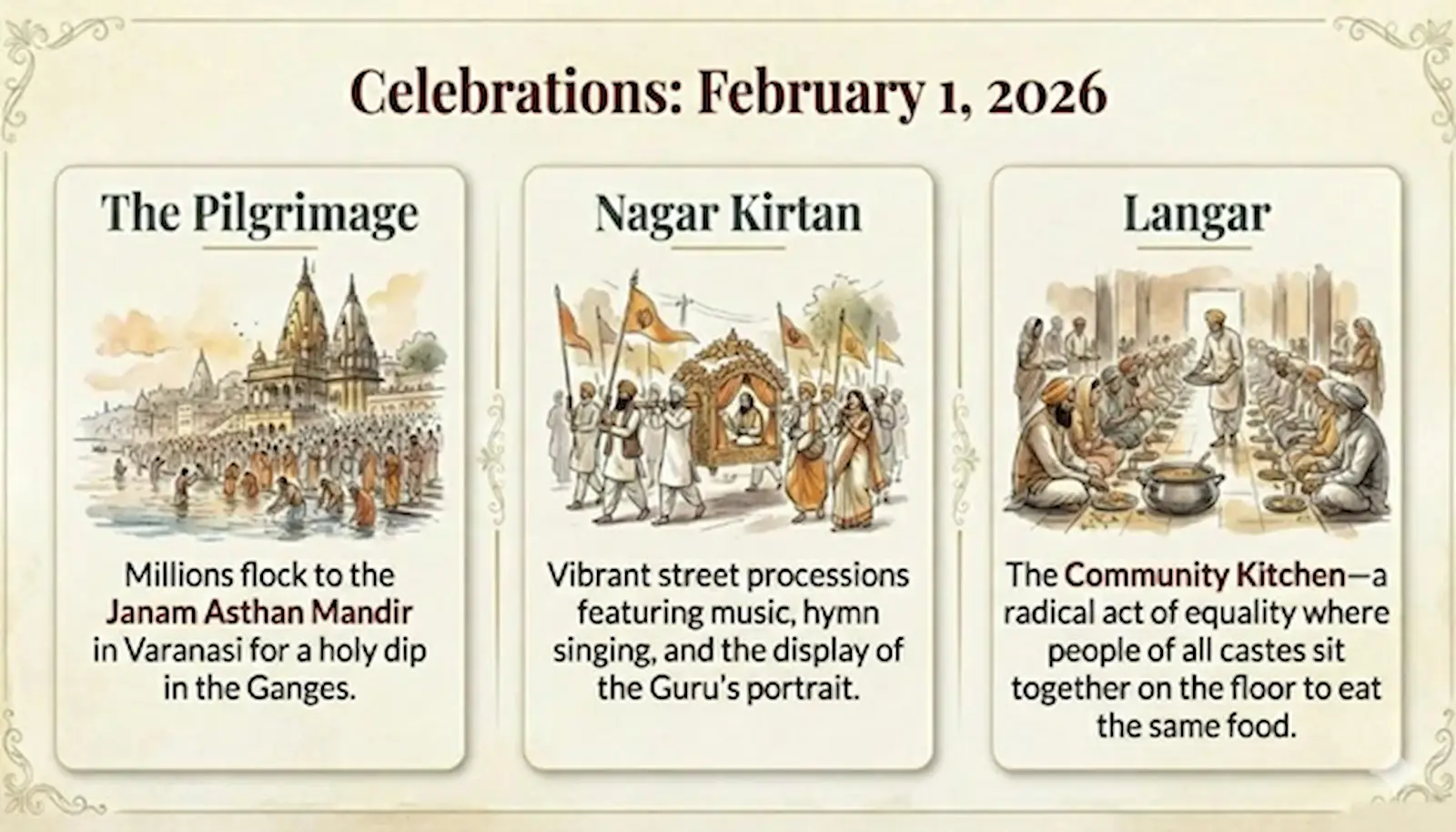
Celebrated across North India and globally, Guru Ravidas Jayanti is marked by processions [Nagar kirtan], bhajans, satsangs, langar, and seva.
But its truest celebration happens quietly, wherever someone chooses integrity over convenience, equality over comfort, and love over inherited prejudice.
Relevance of Guru Ravidas’s Teachings in Modern Life
Swami Mukundanandaji often reminds us that God responds to surrender, not outer form. Ravidas lived this truth completely.
Guru Ravidas did not chase holiness through ritual perfection. He offered his heart completely, and grace followed him into the smallest corners of daily life. He did not abandon his work to remember God, nor did he use spirituality to escape responsibility.
As Guru Ravidas himself declared:
“Karni bajh na hove mukti.”
Liberation does not come without right action.
His bhakti flowed through honest labor, fearless faith, and an unwavering sense of humility. Because his heart was pure, even a kathauti became sacred.
This is the invitation Guru Ravidas extends to us even today. We need not wait for ideal circumstances, perfect discipline, or holy destinations. Wherever we are placed, that is where devotion must begin. When the mind is purified through remembrance and love, grace does not remain distant. It comes forward to meet us.
Begumpura is not built elsewhere. It is built wherever such hearts gather. Where ego dissolves, where compassion shapes action, and where God is remembered not just in prayer, but in conduct.
As we celebrate Guru Ravidas Jayanti, we are not merely honoring a saint of the past. We are being asked a living question, the same one that opened this story:
Can a soul become so pure that the Ganga herself rises to meet it?
Sant Ravidas answered with his life.
Now, the answer waits in ours.

Call to Action
If Sant Ravidas’s life and teachings have resonated with you, here are a few ways to continue that reflection:
- Watch Swami Mukundanandaji’s video on Guru Ravidas to understand his spiritual wisdom.
- Consider subscribing to Swami Mukundanandaji’s YouTube Channel.
- Read more about Guru Ravidas's life and philosophy:
- Read more blogs on RKT Blog’s article.
- Mukundananda, S. (2024). Nourish Your Soul: Inspirations from and Lives of Great Saints. Rupa Publications Pvt Ltd: New Delhi, India.
Frequently Asked Questions
1. When is Guru Ravidas Jayanti celebrated in 2026?
It falls on February 1, 2026, coinciding with the full moon of Magh Purnima.
2. What is the significance of “Man changa toh kathauti mein Ganga”?
It means that when the heart is pure, even a humble vessel reflects the Divine, emphasizing inner purity over rituals.
3. How is Guru Ravidas Jayanti observed today?
Devotees celebrate with bhajans, satsangs, processions, langars, and acts of seva, reflecting his teachings of equality and devotion.
4. How are Ravidas’s teachings relevant today?
They inspire spiritual equality, selfless service, and inner purity, offering guidance in addressing casteism, discrimination, and inequality.
5. Where can I learn more about his hymns and teachings?
Forty-one of his hymns are preserved in the Guru Granth Sahib, and further explanations can be found in spiritual discourses like Swami Mukundananda’s teachings.