
E-Newsletter
February 2026



Quote
तमेव शरणं गच्छ सर्वभावेन भारत | तत्प्रसादात्परां शान्तिं स्थानं प्राप्स्यसि शाश्वतम् || 62||
tam eva sharanam gachchha sarva-bhavena bharata tat-prasadat param shantim sthanam prapsyasi shashvatam
Surrender exclusively unto Him with your whole being, O Bharat. By His grace, you will attain perfect peace and the eternal abode. ( Bhagavad Gita 18.62 )
From the Editor’s Desk
Grace occupies a central place in devotion. It is the causeless compassion of God, flowing from divine love rather than human qualification. Without it, the bound soul would remain indefinitely confined within the precise yet relentless Law of Karma. With it, transcendence becomes possible.
This issue of RKT’s Monthly Newsletter, Inspiration, explores the sacred paradox at the heart of spiritual life: If grace cannot be earned, why do scriptures repeatedly command effort, discipline, surrender, and devotion? Let us examine the relationship between karma and grace, justice and mercy, and striving and surrender.
Bhakti Ras
Grace is often spoken of casually, as though it were an unexpected stroke of fortune or a pleasant turn of circumstances. Yet in the language of devotion, grace carries a far deeper meaning. It is neither luck, reward, nor favoritism bestowed upon a chosen few. Grace is the causeless compassion of God.
To call grace causeless is to acknowledge that it is not bestowed based on our worthiness. It does not originate in our effort, purity, or accumulated merit. It originates in the Divine. It is an expression of God’s unconditional love toward the soul. Divine grace is not something we can demand or claim; it is a gift that descends out of God’s pure compassion. Without that compassion, the bound soul would remain entangled indefinitely in ignorance and karmic bondage.
The Bhagavad Gita offers a glimpse into this mystery in verse 10.11, where Shree Krishna declares, “Out of compassion for them, I, who dwell within their hearts, destroy the darkness born of ignorance, with the luminous lamp of knowledge.” The initiative here belongs entirely to the Lord. He does not say that the soul eradicates its own ignorance by sheer strength. Rather, He intervenes. He illuminates. He dispels darkness out of compassion.

And yet, the same Scripture repeatedly urges discipline, self-effort, surrender, devotion, and inquiry. This produces a contradiction. If grace is causeless and sovereign, why strive at all? If everything depends on divine compassion, what role does human effort truly play?
The answer lies not in diminishing effort, but in understanding its proper place.
Grace and Karma: Justice and Compassion
To appreciate grace fully, we must first understand the law from which it rescues us. The universe operates under the precise governance of karma. Every action produces a corresponding reaction. The law is impartial, exact, and unyielding. In the realm of karma, nothing is overlooked, and nothing is arbitrarily forgiven. What we sow, we reap.
The Bhagavad Gita acknowledges the complexity and inevitability of action. In 4.17, Shree Krishna speaks of the intricacies of karma, akarma, and vikarma, indicating that even wise individuals struggle to understand its workings. The soul, bound by ignorance and propelled by desire, continues to act and thereby continues to accumulate consequences. Left to karma alone, this cycle would extend indefinitely.
Here, the necessity of grace becomes evident. If spiritual destiny were governed solely by justice, the soul would remain perpetually confined within its own past actions. No amount of limited effort could fully exhaust the infinite backlog of karmic impressions. The ladder of self-effort, though necessary, cannot by itself reach the Infinite.
Grace introduces a higher principle. It does not negate justice, but it transcends it. This is not mechanical causation, but a compassionate intervention. Grace operates where karma would otherwise bind. It is not earned through karmic accumulation; rather, it is bestowed through divine mercy. Without grace, spiritual evolution would be confined to gradual moral refinement. With grace, transformation becomes possible at depths unreachable by human strength alone.
This is why God-realization eventually depends not on human achievement, but on divine compassion. Effort prepares. Grace liberates.
The Paradox of Effort: Why Strive for the Unearnable?
Once grace is understood as causeless compassion, the paradox intensifies. If liberation from karmic bondage depends upon divine intervention, why do scriptures so insistently command action? We learn from the Bhagavad Gita that Shree Krishna instructed Arjun to perform his prescribed duty, affirming that action was superior to inaction. He encouraged him to elevate himself through a disciplined mind. Spiritual life demands responsibility, vigilance, and sustained effort. The key lies in recognizing that effort does not generate grace. It prepares the heart to receive it.
Imagine rain falling abundantly across a landscape. The rain does not discriminate; it descends upon all surfaces alike. Yet only an open vessel can collect it. If the vessel is inverted, the rain flows around it without entering. The absence of water in the vessel is not due to the absence of rain, but due to the vessel’s orientation. Similarly, divine grace flows continuously. The obstacle lies not in divine reluctance, but in human resistance. Ego, attachment, pride, and self-reliance invert the vessel of the heart. Spiritual practices gradually turn it upright.
When we engage in devotion, we are not purchasing grace. We soften resistance. When we perform seva, we are not earning divine favor but loosening the grip of selfishness. When we meditate, chant, or study, we are not accumulating spiritual currency. We are refining perception.

There is also another dimension. Grace does not violate freedom. God does not impose realization upon the unwilling soul. Our effort is the expression of consent. It is our way of turning toward the Divine, of signaling readiness. In this sense, effort is not causation, but cooperation. The danger arises when effort subtly transforms into entitlement. A seeker may practice sadhana and/or offer seva intensely and then wonder why extraordinary experiences have not occurred. Beneath the surface lies the assumption that spiritual labor obligates divine response.
Grace descends most freely where entitlement dissolves. When practice becomes offering rather than bargaining, the heart becomes transparent. In that transparency, grace is not forced. It is recognized.
How to Cultivate Receptivity to Grace
If grace cannot be earned or manufactured, we can certainly cultivate receptivity to it. The inner work of bhakti lies precisely at this point.
Receptivity begins with humility. Humility creates spiritual permeability. Pride, by contrast, hardens the interior world. The ego seeks credit, control, and recognition. Grace enters where such rigidity softens. When we acknowledge our dependence upon the Divine, the heart opens. In that openness, divine compassion finds space to operate.
Closely related to humility is gratitude. Gratitude trains perception. A mind accustomed to complaint rarely recognizes grace. A grateful mind begins to notice the subtle ways in which life is being guided, protected, and sustained. The opportunity to engage in satsang, the inclination toward spiritual inquiry, the strength to endure difficulty without collapse, and the clarity that arises after confusion are all quiet expressions of grace. The more we acknowledge them, the more sensitive we become to their presence. Gratitude does not cause grace, but it sharpens awareness of it.
Surrender deepens this receptivity further. When God invites surrender, He does not ask for passivity. He asks for trust. Surrender is not abandonment of responsibility; it is relinquishment of egoic ownership. The surrendered heart continues to act, serve, and strive, but inwardly releases the illusion of control. It understands that outcomes rest in divine wisdom. Such surrender lightens the inner burden, and anxiety diminishes. Faith stabilizes the mind. In that atmosphere, grace is beautifully recognized.
Devotional practice also refines receptivity. Practices such as Roop Dhyan meditation, chanting the holy names, scriptural study, and seva are not techniques to compel mystical experiences, but to orient consciousness toward the Divine. The mind that repeatedly contemplates God gradually becomes less entangled in worldly agitation. As distraction decreases, sensitivity increases. Grace, which may have always been present, becomes perceptible.
There is also an important inner shift that must occur. We must cease evaluating grace solely by visible outcomes. Sometimes grace manifests as success. At other times, it manifests as restraint. There are moments when doors open effortlessly, and moments when they close firmly. The ego labels one as a blessing and the other as an obstacle. Yet from a spiritual perspective, both may be expressions of divine compassion. The closed door may protect us from consequences we do not foresee. The delayed answer may cultivate patience and faith. The apparent setback may dissolve pride.
When receptivity deepens, the seeker begins to trust this hidden wisdom. Grace is no longer measured by comfort alone. It is recognized in growth.
Living in the Flow of Grace
What does life look like when one truly accepts that grace is primary and effort is preparatory?
First, the anxiety surrounding spiritual progress diminishes. Instead of constantly measuring experiences, comparing states, or questioning one’s advancement, the seeker rests in trust. Effort continues, perhaps even more sincerely than before, but it is no longer strained by demand. Practice becomes an offering. Discipline becomes devotion. The heart works diligently, yet peacefully.
Second, success no longer inflates the ego. When achievements arise, whether worldly or spiritual, they are recognized as expressions of divine support. The devotee understands that intelligence, opportunity, and strength are themselves gifts. This awareness protects them from arrogance. Gratitude replaces pride.
Similarly, failure does not devastate. Challenges are interpreted not as abandonment, but as part of a larger, compassionate design. The knowledge that God preserves what His devotees have and supplies what they lack results in trust, where the seeker continues forward without despair (Bhagavad Gita 9.22).

Living in grace also transforms relationships. When one experiences divine compassion inwardly, one becomes more compassionate outwardly. Harshness softens. Judgment reduces. Patience increases. Having recognized how much one depends upon divine mercy, one becomes less eager to condemn others. Grace received becomes grace extended. Gradually, the seeker begins to perceive life as permeated by divine compassion. Not every event is pleasant, but every event becomes meaningful. Not every prayer is answered as requested, but every prayer is heard. The current of grace flows beneath both clarity and confusion, both gain and loss.
In this realization, the paradox resolves itself. We continue to strive because striving purifies us. We surrender because surrender aligns us. Yet we know that the decisive movement belongs to God. The final lifting beyond ignorance, beyond karmic entanglement, beyond the limitations of the mind, comes through His compassion alone.
Grace remains unearnable. That truth protects humility. Effort remains indispensable. That truth preserves responsibility. Between these two stands the path of bhakti, where the soul works wholeheartedly while depending entirely on divine mercy.
Grace does not wait at the finish line as a prize. It walks beside us from the beginning. And when the heart finally sees this, gratitude replaces striving, surrender deepens naturally, and the soul rests in the gentle certainty that it was never alone.
Bal-Mukund: Playground for Vedic Wisdom
The Coins of Devotion
Once there was a disciple named Aruni, who studied under Guru Ayodhaumya. When Aruni’s education was complete, Guru Ayodhaumya instructed him to go into the world and do good. Aruni asked his Guru how he could repay him. Guru Ayodhaumya explained that the wisdom he had shared was divine and could never be repaid with material gifts. However, Aruni insisted. Seeing his persistence, Guru Ayodhaumya asked for 14,000 gold coins. Aruni came from a modest background and did not have the resources, but he did not lose hope. He decided to seek help from King Raghu, who was renowned for his generosity.

Meanwhile, King Raghu performed the Vishwajit Yagya, during which he gave away all his wealth and went out in simple, worn clothes to beg for alms. While sitting under a tree, he overheard some citizens praising the king’s generosity, unaware that he was the king himself. Unable to tolerate such praise, King Raghu interrupted them, saying that the king had not truly given anything in charity and that they should ask him directly.
When Aruni arrived, he found the king in an empty palace. King Raghu asked how he could help, and Aruni explained that he needed 14,000 gold coins for his Guru. King Raghu promised to provide them and asked Aruni to return in a few days. His ministers informed him that nothing remained in the treasury. Determined to fulfill his promise, King Raghu resolved to challenge Kuber, the celestial god of wealth.
Sage Narad informed Kuber that King Raghu, who had once conquered Indra, was preparing to confront him. Kuber asked what mistake he had made, and Sage Narad explained that King Raghu required the gold coins for Aruni. Understanding the urgency, Kuber sent a shower of gold coins. Soon after, the ministers informed the king that the treasure chest was full. King Raghu then summoned Aruni and presented him with the wealth.

Practical Wisdom:
- King Raghu reminded the citizens that one enters the world with nothing. True service to God is not about pride in what one gives, but about humility and the understanding that one can always give more.
- Kuber helped King Raghu when he needed the gold coins most. King Raghu’s devotion and surrender unlocked the assistance he required. Free from pride, he understood that true service to God requires humility. By cultivating this attitude, one can attract divine grace and align more closely with the will of God.
Youth Insights
Effort, Surrender, and the Gift of Grace
In a world that constantly measures us by grades, awards, followers, and achievements, it is easy to believe that everything must be earned. We work for recognition. We compete for success. We strive for approval. But grace is different. Grace is not something we can demand or deserve. Grace is something we receive. Through murti pooja and daily devotion, and weekly sadhana, we slowly learn how to open ourselves to that unearnable gift.
As students, we are accustomed to earning outcomes. If we study hard, we expect good results. If we practice, we expect improvement. But grace operates beyond transactions. It teaches us humility. When we stand before the murti, we are reminded that not everything in life is controlled by effort alone. There is something higher – something compassionate – that supports us even when we fall short.

Here are a few ways murti pooja can help us understand and live with grace:
- Show up consistently: Grace grows in routine. Even a short daily prayer builds discipline and steadiness.
- Practice humility: Accept that you will not always feel perfectly focused. Offer your effort sincerely anyway.
- Stay mindful: Gently bring your attention back when it drifts. Each return strengthens inner awareness.
- Balance effort and surrender: Work hard in school and life and release the need to control every outcome.
- Let devotion guide your day: Carry the calm and gratitude from prayer into your actions and decisions.
Grace is powerful because it cannot be forced. It flows into a heart that is steady, balanced, and devoted. Through murti pooja, students can learn that while achievement depends on effort, peace depends on surrender. In learning to balance both, we grow not only academically, but spiritually.
Holistic Health Tidbits
Cultivating Grace for Our Well-Being
Grace is not achieved, accumulated, or deserved. It is given freely by the will of God. Health and wellness can be a response, a reverent participation, and a practice that makes one more receptive to grace. To cultivate a relationship conducive to receiving grace from the Supreme, we must shift our approach to one grounded in humility and devotion.

Begin with Right Order: Grace First, Always
Grace precedes effort, morality, discipline, and health behaviors. Instead of self-improvement, our first posture is surrender. “I do not become healthy so God will love me. I care for this body because I am already loved.” Any attempt to earn grace collapses into spiritual ego and becomes a spiritualized form of control.
Reframe the Body: From Project to Gift
Modern wellness culture (and often our own perceptions) treats the body as a problem to be optimized. A grace-centered view treats the body as a received gift entrusted to us. Optimization asks: “How can I improve myself?” Stewardship asks: “How can I honor what I’ve been given?” Health practices shift from vanity or fear toward gratitude and reverence. This is the difference between self-justification and embodied thanksgiving.
Practice Health as Ritual Participation
When detached from grace, wellness becomes self-focused. When grounded in grace, it becomes participatory – an effort that points beyond itself.
For example:
- Eating becomes an act of attentiveness rather than restriction.
- Movement becomes prayer-in-motion rather than punishment or dread.
- Rest becomes obedience rather than indulgence.
In this way, grace is received through elevated and intentional practice.
Accept Limits as Learning
Grace is often revealed most clearly where control fails. Illness, aging, fatigue, injury, and inconsistency are not spiritual failures. These are reminders of our human condition. We cannot perfect ourselves. We cannot maintain total control. We are contingent, dependent, and finite. If we allow these realities to soften us rather than harden us, we encounter grace not in strength, but in surrendered vulnerability.
Let Wellness Increase Capacity, Not Merit
Grace does not increase because we are healthier. That mindset can quietly foster pride. However, health can increase our capacity to notice, receive, and respond to grace. A regulated nervous system makes prayer more accessible, compassion more available, and humility more sustainable.
In Summary
We do not earn the unearnable grace of God through health and wellness. Instead, we:
- Receive grace first
- Care for the body as a grateful response
- Use wellness to deepen awareness, not self-worth
- Allow limits to keep us humble
- Let practices open us to God, not replace Him
Reflection Questions
Bhakti Ras / Inspiration
- Reflect on the moments in your life that you recognize as expressions of God’s grace. Make an inventory of all things in your life that you recognize as the grace of God. Review the list and contemplate the mindset you held when you experienced divine grace. What inner posture (e.g. humility, surrender, gratitude) allowed you to perceive that grace, and what did it teach you?
Bal-Mukund: Playground for Vedic Wisdom
- What attitude did King Raghu embody in his service and generosity, and how can you cultivate that same humility and surrender in your own actions?
Youth Insights
- In what area of your life can you practice balancing sincere effort with peaceful surrender to divine grace?
Holistic Health Tidbits
- In what area of your health or well-being might you be invited to shift from striving for control to surrendering in trust?
Upcoming Events
We are delighted to share some details about the exciting upcoming events in the month of March at the Radha Krishna Temple of Dallas, the official Headquarters of JKYog.
Holika Dahan & Phoolon ki Holi with Radha Krishna
The Radha Krishna Temple’s preparation for the lovely Holi festival is underway!

- Dates: March 1, 2, and 7, 2026 (Check website for times)
- Details: https://www.radhakrishnatemple.net/festival-of-holi-in-dallas
Festival Highlights include:
- Holi Special Sunday Satsang
- Satyanarayan Katha & Pooja
- Devotional Kirtan
- Holika Dahan
- Phoolon Ki Holi
- Cultural Program
- Holi Mela
For all the events and festivals, register for poojas ahead of time for maximum benefit. Seva and sponsorship opportunities are available to enable us to offer the most devotional experience to all devotees. Do not miss this wonderful opportunity! Join us with your family and friends.
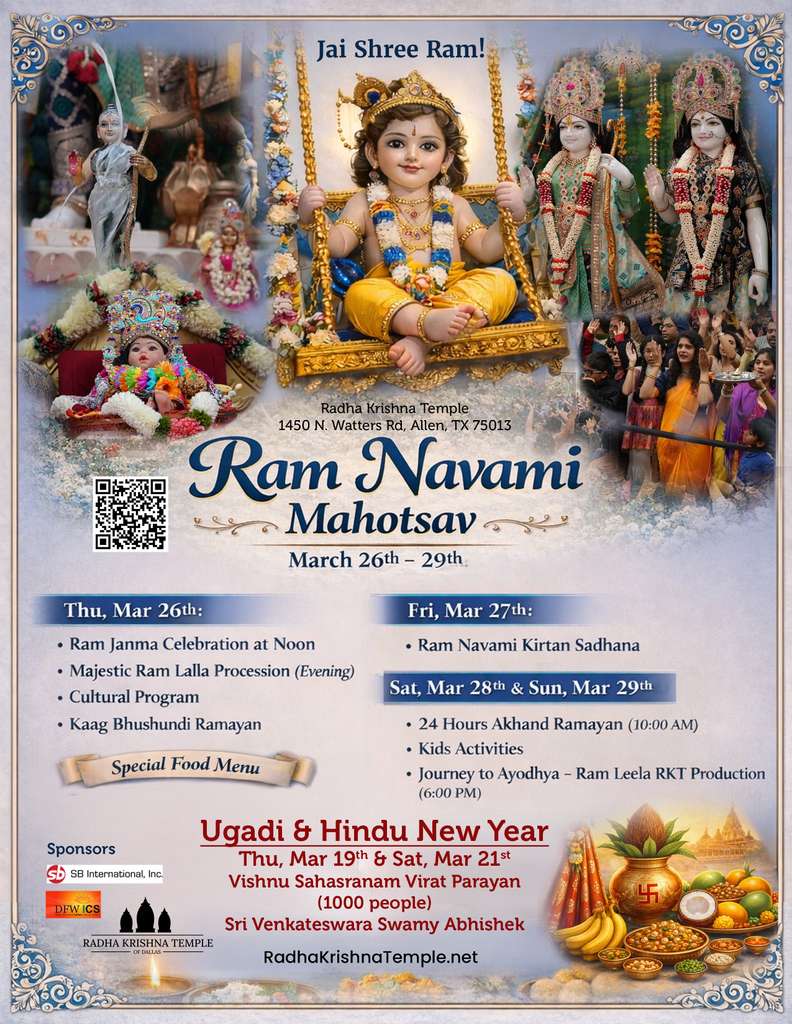
Ugadi, Gudi Padwa, Chitra Navratri, and Hindu New Year
Ugadi, Gudi Padwa, and Cheti Chand fall on the first day of Shukla Paksha or the first day of the new moon as per the Hindu calendar. As per the Western calendar, these festivals usually fall in March or April. Each festival is celebrated in a unique way as per the regions of India from where they are celebrated.
Ugadi is celebrated by the people of Karnataka, Andhra Pradesh, and Telangana. They celebrate spring by stringing mango leaves into a toran and placing it at the entrance of their homes. In Maharashtra and the Konkani region, people use a wooden stick, the top of which is covered in a bright red or orange cloth, and strings of garlands made of neem and mango leaves. They also put bright-colored flowers and sugar. A pot is placed on top to complete the Gudi.
- Dates: March 19 to 29, 2026
- Details: Stay Tuned for Details
Ram Navami
Celebration of Ram Navami reminds us of all the beautiful metaphors and leelas that evoke deep devotional sentiments. To quote Swamiji, “Listening to the Ram Katha is like the Kalpavriksh that provides cool shade to weary travelers, or like Lake Mansarover where the Paramhans take a dip in the cool and soothing waters of divine knowledge.” Inspire yourself with these leelas and other festivities.
- Dates: March 26, 2026
- Details: Stay Tuned for Details