Introduction: Is Destiny Fixed or Can It Be Transformed?
Many of us at some point have pondered the idea of destiny. Are our lives pre-written by the stars? Are we bound by the karmas of past lives with no room to rewrite the script?
This question isn’t just philosophical—it touches the very heart of how we live, suffer, and hope. In the Bhagavad Gita, Shree Krishna offers a vision of life that combines both the influence of past karm and the power of present effort. According to Swami Mukundananda, a respected spiritual teacher and scholar, while destiny may set the stage, how we act determines the performance.
In this blog, we’ll explore how you can transform your destiny and dissolve the burden of past karm, using the timeless wisdom of the Bhagavad Gita—guided by the illuminating teachings of Swami Mukundananda.
1. A Tortoise and a Choice: Your Destiny Is in Your Hands

Swamiji begins one of his talks with a striking story about a boy named Dinesh. Desperate to know his fate, Dinesh visited every astrologer and palmist he could find. Finally, a famed diviner offered to reveal his destiny through a peculiar ritual. He placed a tortoise between two chalk circles—one black (symbolizing misfortune) and one white (symbolizing a bright future). Whichever circle the tortoise entered would signify Dinesh’s fate.
The tortoise inched closer and closer to the black circle. In a moment of fear and defiance, Dinesh picked up the tortoise and placed it in the white circle. Outraged, the diviner asked why he interfered with destiny.
Dinesh calmly replied, “What do you expect me to do—just watch while this tortoise ruins my future?”
That’s when he realized: his destiny was in his own hands.
The story beautifully illustrates the core message of this blog. We are not powerless victims of fate. We can, through right action and divine alignment, change the trajectory of our lives.
2. Destiny vs. Free Will: The Core Question

Many people argue that certain things are determined at birth—our lifespan (ayu), karm (actions), wealth (dhan), education (vidya), and even the nature and timing of death (mrityu). Scriptures do mention these as aspects influenced by past karm, also known as prārabdha karm. This is the portion of our karma that God allots us to experience in the present life.
But that’s not the full story.
Swamiji teaches that along with prārabdha karm, we also possess kriyāmāṇa karm—our current actions born of free will. These present actions are not bound by past fate. They are choices we make now, and they have the power to shape not only our future in this life but also our future births.
To explain this, Swamiji uses the metaphor of a card game. The hand you're dealt is fixed (prārabdha), but how you play those cards is up to you (kriyāmāṇa). A skilled player can win with a weak hand, and a poor player can lose even with good cards.
This means that although we may begin life under certain limitations, our self-effort (purushārtha) can completely transform what’s ahead.
3. The Three Types of Karm Explained
Swamiji breaks karm down into three distinct categories:
- Sanchit Karm: The vast stockpile of karm accumulated over countless lifetimes.
- Prārabdh Karm: The specific portion of sanchit that manifests as destiny in our current life.
- Kriyāmāṇ Karm: The actions we perform now, using our free will.
Our destiny is simply the result of past free will, just as today’s actions will shape our future outcomes.
Swamiji highlights a crucial insight: If our past choices created our present, then our present choices can shape our future. And that puts the steering wheel of life back into our hands.
4. Gita’s Declaration of Free Will

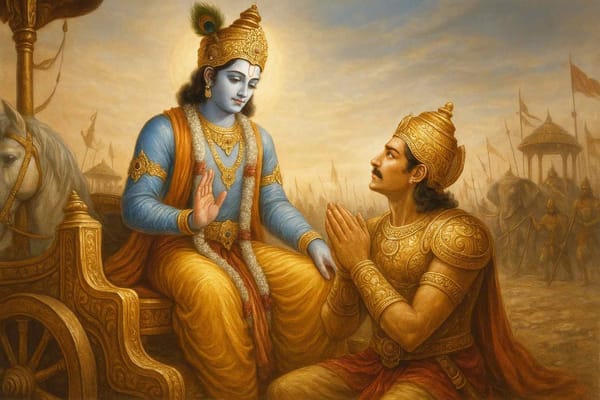
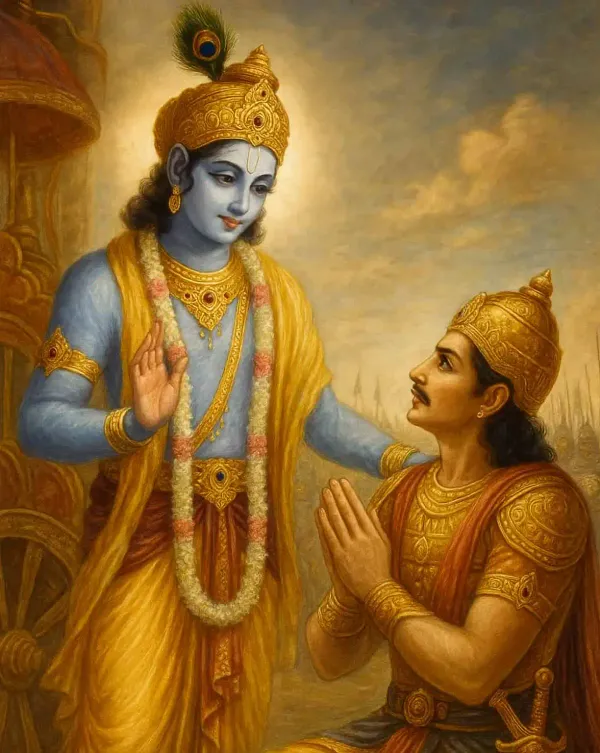
Shree Krishna doesn’t ask Arjun to blindly obey Him. In fact, He concludes His teachings with a powerful affirmation of Arjun’s autonomy.
Bhagavad Gita 18.63
iti te jñānam ākhyātaṁ guhyād guhyataraṁ mayā
vimṛiśhyaitad aśheṣheṇa yathechchhasi tathā kuru
👉 Read this verse
“Thus, I have explained to you this knowledge that is more secret than all secrets. Ponder over it deeply, and then do as you wish.”
This verse is a celebration of free will. Shree Krishna doesn’t impose a decision. He invites introspection and personal choice. Swamiji explains that our ability to choose—even within constraints—is God’s greatest gift to the soul. Without choice, there is no freedom, no growth, and no true devotion.
Even love, Swamiji says, requires freedom. A robot can be programmed to obey, but it can never love. Likewise, God gave us free will not as a burden, but as a means to love Him freely and rise beyond destiny.
5. Clearing Bad Karm: The Power of Devotion

Can bad karmas be completely erased? According to the Bhagavad Gita and Swamiji’s commentary, yes—but not by effort alone. The catalyst that burns the burden of sins is devotion (bhakti).
To illustrate this, Swamiji shares a moving story from the Narad Puran—the tale of King Sumit and his wife Satyamati, who were reborn as highly evolved beings despite their deeply sinful past lives. As criminals, they stole from others, looted temples, and indulged in vices. But in their final years, they sincerely served a temple—cleaning it, offering food, and expressing devotion in their own broken way.
At the time of death, Yamdūtas (agents of the god of death) came to claim them. But Vishnudūtas (messengers of Lord Vishnu) intervened and declared that their devotion had burned away lifetimes of sinful karm—just as a spark of fire can reduce a haystack to ashes.
This echoes a famous metaphor from the Bhagavatam: A small flame can destroy a mountain of dry grass. Similarly, even a little true devotion can destroy massive stockpiles of karmic debt.
The message is powerful: Bhakti purifies, liberates, and transforms.
6. The Futility of Obsessing Over Destiny
In today’s age, people spend large sums consulting astrologers and numerologists in an attempt to decode their destiny. Swamiji warns against this obsession.
In Kali Yug, he says, there are no astrologers accurate enough to read the full map of your karmas. Even if they were, what would knowing your destiny change?
- If they predict something bad, you’ll start worrying unnecessarily.
- If they predict something good, you might become complacent.
Either way, you’ll lose your motivation for sincere effort.
Instead of trying to peek into the unknown, Swamiji advises focusing on what is in your hands now—your effort, your attitude, your devotion. Destiny is real, but it does not have the final word.
7. Climbing the Hill: An Uplifting Analogy

Swamiji compares difficult phases in life to cycling uphill. When the terrain becomes steep, you don’t stop pedaling—you push harder. Likewise, when bad prārabdh shows up, don’t surrender to despair. Increase your effort, grow your devotion, and continue forward.
Eventually, the uphill will give way to downhill ease—and then to level ground. Destiny fluctuates, but effort remains a constant tool to navigate it.
8. Stories of Real Transformation
Swamiji shares two compelling stories of real-life karma transformation:
1. Chris Havens – From Prisoner to Mathematician

Chris Havens was serving a 25-year sentence for murder. Despite his bleak surroundings, he realized that while his body was imprisoned, his mind and will were free. He chose to devote himself to learning mathematics. Starting from scratch, he studied problem after problem, eventually attracting the attention of scholars worldwide. He later led a mathematical research team and launched a nonprofit to teach math to inmates across America.
Chris didn’t erase his past, but through sincere effort, he rewrote his future. His story proves that self-effort, even in the worst circumstances, can lead to purpose and redemption.
2. King Sumit and Satyamati – From Sinners to Saints

As shared earlier, King Sumit and his wife, in their previous lives as temple outcasts, devoted themselves to God late in life. Despite their earlier sins, their bhakti was so sincere that it neutralized their karmic burden. Their story reminds us that no one is beyond redemption, and that devotion can overwrite even the darkest past.
9. The Gita’s Prescription for Rewriting Destiny
The Gita doesn’t deny karm or destiny—it puts them in proper context. Destiny is the result of past karmas. But at every moment, you are generating new karmas through your current choices. What you think, speak, and do today will become tomorrow’s destiny.
Shree Krishna empowers us not by shielding us from hardship, but by showing us our divine potential. Every moment is a fresh chance to choose wisely, act sincerely, and love unconditionally.
Final Thoughts: Karma Is Not a Life Sentence
Yes, your life may include karm you cannot escape. But that karm is not your prison—it's your teacher. Through action, effort, and devotion, you can transform even the harshest destiny into a stepping stone toward spiritual elevation.
As Swamiji puts it: “You may be born with poor prārabdh, but with sincere purushārth, you can completely change your life.”
The Gita gives us this liberating truth: We are not powerless victims of fate. We are co-creators of our destiny.
Call to Action: Take Control of Your Spiritual Life
If you feel inspired to transform your karma and live with higher purpose, take these two powerful steps:
🎥 Subscribe to Swami Mukundananda on YouTube for weekly insights, meditations, and in-depth Gita wisdom:
👉 Swami Mukundananda YouTube Channel
📖 Start reading the Bhagavad Gita—not just for philosophy, but as a guide to real life. Explore verse-by-verse meanings and commentary:
👉 Read the Bhagavad Gita Online
You have the freedom. You have the choice. Now use it to change your destiny—and uplift your soul.