
Tuesday, April 14, 2026
✦ THE QUESTION THAT HAS ALWAYS BEEN WAITING FOR YOU
You are already living inside a miracle. You just forgot to notice.
Right now, as you read these words, the same sun that ripens Punjab's wheat fields is giving you every breath you take. The same divine intelligence that turns a seed into a harvest is sustaining every beat of your heart. The same God who has been whispering through festivals, seasons, and sacred scripture for thousands of years is whispering to you, today, through this one.
Baisakhi is not a festival you attend. It is a recognition you make.
Swami Mukundananda Ji illuminates this with characteristic precision: God has not left us alone in this vast creation. He has given us sacred time — festivals, Sankrantis, solstices — as divine appointments. They are moments in the cosmic calendar when the call to turn toward Him grows louder, the veil grows thinner, and the heart, if it chooses, can travel farther in one day than it might in a hundred ordinary ones.
April 14, 2026 is one such appointment. This blog will prepare you to keep it with understanding, with devotion, and with the practical tools to make this Baisakhi the most spiritually alive day of your year.
✦ WHAT IS BAISAKHI? THE FESTIVAL THAT HOLDS MANY WORLDS
Baisakhi — also spelled Vaisakhi — is one of the most luminous, multi-dimensional festivals of the Indian subcontinent. On the surface, it is a harvest festival. Beneath the surface, it is a Solar New Year, a spiritual revolution, a historical milestone, and seen through the lens of Bhakti Yog — a concentrated day of divine communion available to every soul willing to participate.
It falls on the first day of the Hindu month of Vaisakh, marking the Sun's triumphant entry into Aries, the ancient cosmic event called Mesh Sankranti. Unlike most Indian festivals that follow the lunar calendar, Baisakhi is anchored to the sun, arriving on April 13 or 14 every single year, as faithful as the spring itself.
The very name reveals its cosmic depth. 'Baisakhi' traces to Vaisakh, which derives from the nakshatra Vishakha a star cluster in the night sky. This festival is literally named after the stars. Even in its name, Baisakhi whispers: your celebrations are threaded into the fabric of the cosmos itself, beloved.
For Punjab's farming communities, Baisakhi is exuberant thanksgiving — the rabi crops, especially wheat, are harvested, and gratitude fills the air as richly as the scent of fresh grain. For the Sikh community, it carries the weight of a world-changing moment in 1699. For Hindus, it is the Solar New Year — a threshold crossing, a fresh beginning. And for the bhakt walking the path of Bhakti Yog, every one of these layers is a doorway into the same truth: all abundance comes from God, and the only worthy response is love.
✦ BAISAKHI 2026: THE DATE AND ITS COSMIC SIGNIFICANCE
Baisakhi 2026 falls on Tuesday, April 14, 2026.
In the ancient Vedic understanding of time, a Sankranti — the Sun's passage from one zodiac sign to another — is not merely an astronomical event. It is a moment when the entire cosmos realigns, when the energy of creation shifts, and when spiritual practice performed on that day carries extraordinary potency. This is why temples across India observe special prayers on every Sankranti.
Mesh Sankranti — the Sun entering Aries, the zodiac's first sign — is the most auspicious of all. It is the cosmic new year, the year's own fresh start. And Swamiji teaches, drawing from the Bhagavad Gita, that these sacred cycles exist not by accident but by divine design. The Lord Himself speaks to this in His instructions on the wheel of creation:
"O Parth, those who do not accept their responsibility in the cycle of sacrifice established by the Vedas are sinful. They live only for the delight of their senses; indeed their lives are in vain."
— Bhagavad Gita, Chapter 3, Verse 16
Swamiji teaches that this verse is an invitation. The 'wheel of creation' Shree Krishna describes encompasses the sacred festivals and seasons through which humanity participates consciously in divine order. To observe Baisakhi with a full, aware heart is to turn the wheel with God rather than against it. It is to say, in action: I know where all of this comes from.
This same solar transition lights up the entire subcontinent under different names — Pohela Boishakh in Bengal, Vishu in Kerala, Puthandu in Tamil Nadu, Bihu in Assam, Baisakhi across Punjab. Different languages, different dances, one cosmic heartbeat.
✦ THE HISTORY OF BAISAKHI: FROM ANCIENT SOIL TO ETERNAL SKY
Ancient Roots: When the Earth Was the Temple
Long before any scripture codified its meaning, the people of Punjab, a land whose very name sings 'five rivers' — gathered every spring to celebrate the harvest. The rabi season's wheat swayed golden and heavy under the April sun. Communities emerged from winter's withdrawal into joyful, communal thanksgiving. This was Baisakhi in its most elemental form: earth offering abundance, the human heart offering gratitude and in that sacred exchange, a divine conversation as old as civilization itself.
Historically, Vaisakhi fairs were north India's greatest annual gathering points drawing merchants, pilgrims, farmers, saints, and seekers from hundreds of miles around. Long before any single tradition claimed it as its own, Baisakhi belonged to the soul of a people who understood, in their bones, that life is a gift and gratitude is the only honest response.
The Khalsa Is Born: April 13, 1699 — A Day That Shook Heaven
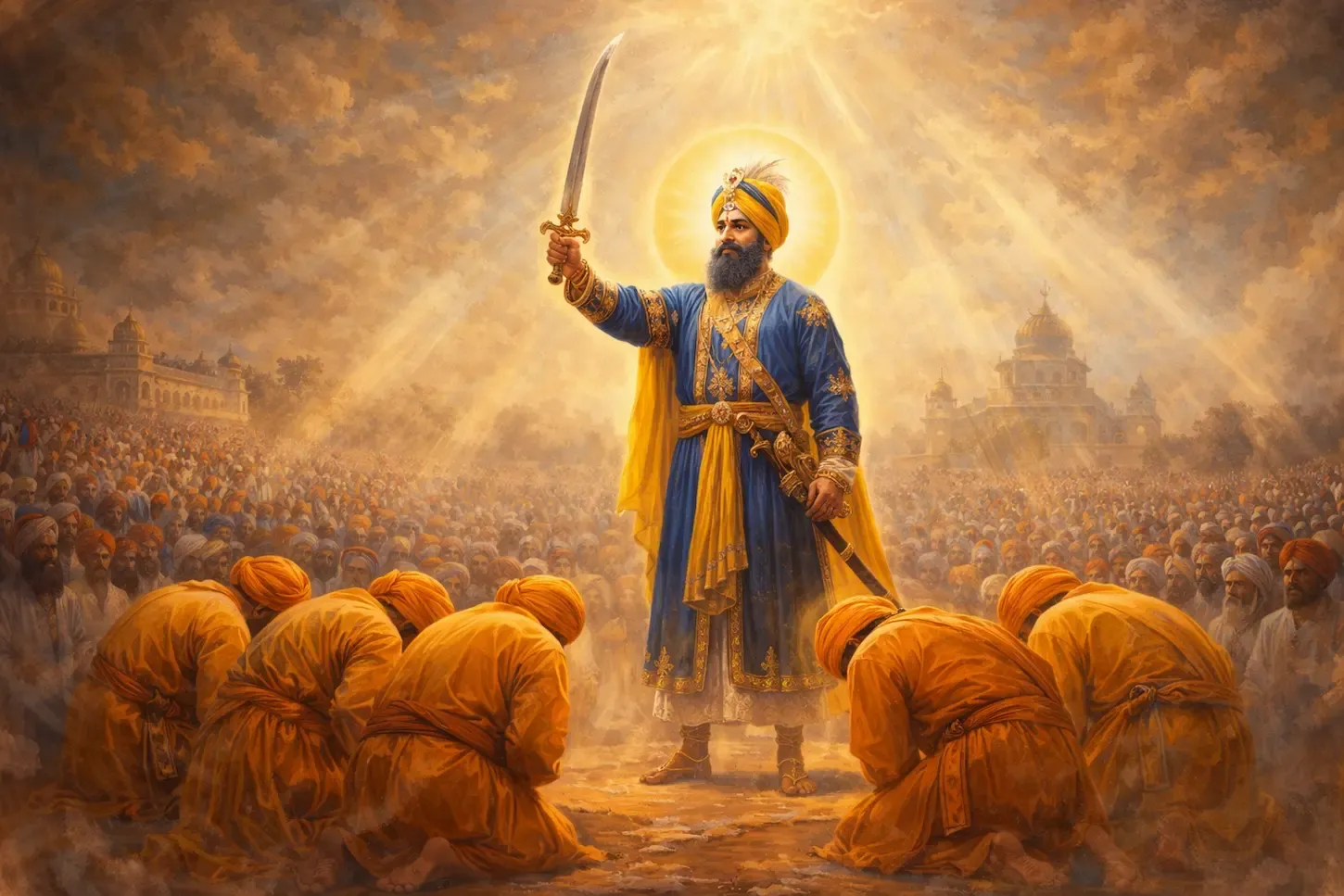
The Baisakhi of 1699 was unlike any that had come before and its reverberations have never stopped. At Anandpur Sahib, Guru Gobind Singh Ji, the tenth Sikh Guru, stood before a congregation of thousands on that sacred spring morning. Then his voice rang across the assembled multitude like a celestial bell:
'Is there anyone here who is willing to lay down their life for Dharma?'
The silence that followed was not empty. It was trembling. And then it broke. One by one, five souls rose — the Panj Pyaare, the Five Beloved Ones. The Guru did not take their lives. He gave them new ones. He baptized each with Amrit — the nectar of initiation and founded the Khalsa: a community of initiated Sikhs bound by five symbols of faith, steel spirit, and an unbreakable covenant of righteousness, equality, and fearless love.
Swamiji teaches that this moment is among the most perfect illustrations of saranagati — the Bhakti Yog principle of complete surrender to the Divine Will — that history has recorded. The Panj Pyaare did not bargain. They did not calculate their loss. They offered themselves entirely. And the Divine, through the Guru, accepted and returned them transformed. This is the sacred paradox that Swamiji illuminates again and again: the soul that releases its grip on the small self discovers, in that very release, the infinite Self it had always been searching for.
"Abandon all varieties of dharmas and simply surrender unto Me alone. I shall liberate you from all sinful reactions; do not fear."
— Bhagavad Gita, Chapter 18, Verse 66
Swamiji identifies this as the crown jewel of the Bhagavad Gita, the Lord's most intimate instruction to humanity. The Panj Pyaare enacted it in flesh and bone on Baisakhi day, 1699. Surrender is not passivity. As Swamiji consistently teaches, surrender is the most active, most courageous, most intelligent choice a soul can make because it replaces the ego's small plan with God's infinite one.
Baisakhi in Hindu Dharma: Mesh Sankranti and the Ganga's Descent
In Hindu tradition, Baisakhi carries an equally ancient and sacred heritage. Celebrated as Mesh Sankranti — the Solar New Year — it is one of the most auspicious days in the Vedic calendar for prayer, charity, pilgrimage, and fresh spiritual resolve. Ancient texts record that Ganga Devi herself descended to earth on this day, making the ritual of bathing in sacred rivers an age-old Baisakhi practice. The outer act of immersion in holy water mirrors the inner aspiration every seeker carries: to emerge cleaner, lighter, closer to the Divine.
In 1875, the great sage Swami Dayanand Saraswati chose this sacred date to found the Arya Samaj — a movement dedicated to restoring humanity's relationship with the eternal Vedic wisdom. Baisakhi has always been a day that births spiritual revolutions.
✦ THE TRADITIONS OF BAISAKHI: WHEN THE WHOLE WORLD BECOMES A TEMPLE
Baisakhi does not ask you to watch from a distance. It asks you to enter with your dancing feet, your singing voice, your working hands, your bowing head. Every tradition of Baisakhi is, in the Bhakti Yog understanding, a different form of the same prayer: I offer this to You. Here is how the festival invites the whole self into worship:
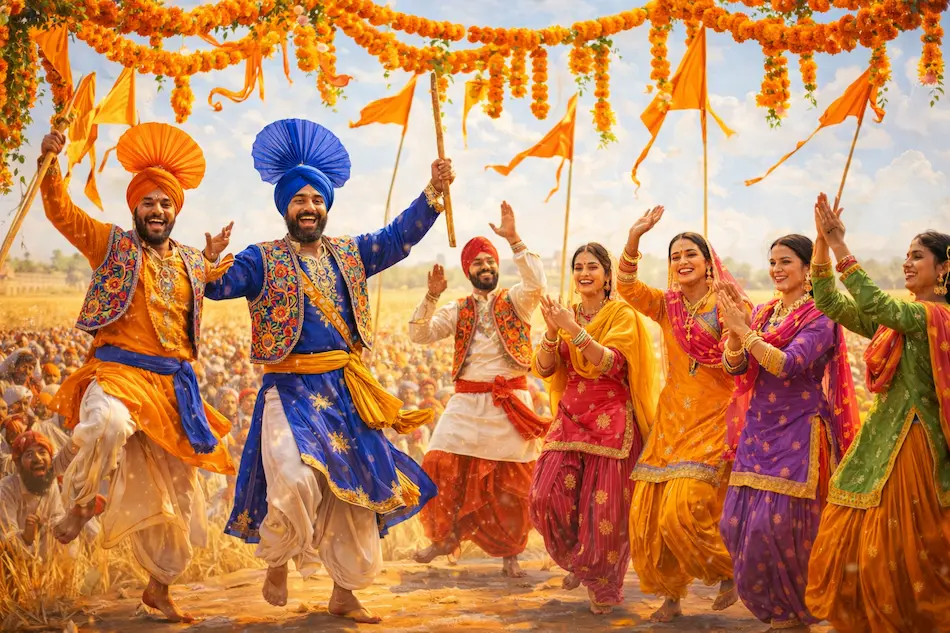
Bhangra and Gidda — Gratitude That Cannot Stay Still
Bhangra — the thunderous, earth-shaking dance of Punjabi men — and Gidda — the graceful, lyrical dance of Punjabi women — are not cultural performance. They are embodied gratitude. Every Bhangra leap is a prayer. Every Gidda clap is an offering. The dhol's heartbeat is the pulse of the Divine made audible.
Nagar Kirtan — When the Entire Town Becomes a Temple
The Nagar Kirtan — the sacred procession through the streets where the Guru Granth Sahib is carried in profound reverence and hymns are sung in community is among the most spiritually potent of all Baisakhi traditions.
Awat Pauni — The Secret That Turns Labor into Liberation
In the tradition of Awat Pauni, communities harvest crops together — singing folk songs, sweating side by side, serving without thought of personal gain. This is the Bhagavad Gita's karma yog lived rather than studied. The third chapter of the Gita contains its most liberating teaching on action:
"Work must be done as a yajna to the Supreme Lord; otherwise, work causes bondage in this material world. Therefore, O son of Kunti, for the satisfaction of God, perform your prescribed duties, without being attached to the results."
— Bhagavad Gita, Chapter 3, Verse 9
Swamiji teaches that this single verse contains the entire philosophy of karma yog. The sickle swung in Awat Pauni, when offered to God with this understanding, is no longer labor — it is yajna, a sacred fire. Baisakhi gives every hand and every heart the opportunity to discover this truth directly.
Langar — Where Equality Becomes Edible
The langar — the community kitchen that serves free meals to every being, regardless of caste, creed, or status is perhaps the most radical spiritual act of Baisakhi. Swamiji grounds this practice in one of the Bhagavad Gita's deepest insights: the Divine dwells within every being as the Paramatma — the Supreme Self present in all hearts. To serve another human being with genuine love is therefore to serve God Himself. This is not charity. This is the lived recognition of divine omnipresence. Baisakhi's langar makes that recognition warm, fragrant, and communal.
Sacred Bathing — The Outer Act, the Inner Aspiration
On Baisakhi, Hindus traditionally take a sacred dip in holy rivers — the Ganga, the Yamuna, or any water body held dear by their tradition. Ancient scripture holds that Ganga Devi descended to earth on this very day, charging the sacred waters with extraordinary purifying grace. The outer act of bathing is, in the Vedic understanding, a symbol of and preparation for the inner act every true seeker longs for: to be washed clean of ego, of the residue of past action, of the smallness that separates the soul from God and to emerge from the water renewed, luminous, more fully alive to the Divine.
BAISAKHI AS LIVING BHAKTI YOG
What sets this understanding of Baisakhi apart from every other account you will find is this: Swami Mukundananda Ji does not teach festivals as cultural obligations or sentimental replays of tradition. He reveals them, through the living lens of the Bhagavad Gita, as concentrated spiritual laboratories — days when the environment itself conspires to help the sincere seeker turn toward God.
Three Bhakti Yog principles, as taught by Swamiji, illuminate Baisakhi with particular brilliance:
Kritagyata — Gratitude as the First Gate of Bhakti
Swamiji teaches that gratitude is not a feeling that arises when circumstances happen to be pleasant. It is a deliberate practice of the intellect: the ongoing choice to recognize every breath, every sunrise, every grain of wheat as grace given freely by God. The Lord makes the foundation of this practice explicit:
"I am the origin of all creation. Everything proceeds from Me. The wise who know this perfectly worship Me with great faith and devotion."
— Bhagavad Gita, Chapter 10, Verse 8
Swamiji teaches that this verse is the foundation of all genuine gratitude. When the intellect truly internalizes that God is the source of every harvest, of every breath, every relationship, every moment of beauty, gratitude ceases to be optional. It becomes the only honest, natural response of a lucid mind. Baisakhi is the festival that makes this realization communal, sensory, and jubilant. The farmer who folds his hands over the harvested field and the devotee who folds their hands in the temple are performing the identical sacred act.
Saranagati — Surrender as the Highest Offering
The story of the Panj Pyaare is the story of saranagati enacted in human history. Complete, unconditional surrender to the Divine Will. When Guru Gobind Singh Ji called, those five souls did not negotiate. They did not pause to calculate their loss. They surrendered entirely and in that surrender, they were not destroyed. They were transfigured.
Surrender is not weakness. It is the strongest act the soul can perform — because it requires releasing the ego's grip on outcomes and trusting completely in God's infinite wisdom and love. The Panj Pyaare did this with their bodies. We are called to do it with our minds.
Karma Yog — Every Action as Sacred Yajna
The Bhagavad Gita's most transformative teaching breathes through every Baisakhi tradition. Swamiji consistently grounds this in the Gita's teaching that any action — from the grandest ritual to the most humble labor — becomes sacred yajna when offered to God without ego or attachment to personal results. The intention with which an action is performed determines its spiritual consequence. Baisakhi gives us an entire day to practice this art: to dance as an offering, to serve as an offering, to sing as an offering, to eat as an offering — until the boundary between worship and daily life dissolves entirely.
✦ WHY BAISAKHI 2026 MATTERS MORE THAN EVER
We live in an age of extraordinary speed and extraordinary forgetting. We scroll past sunsets and rush past harvests. We accumulate more and appreciate less. We have made ourselves busier than any generation before us and, in the same movement, lonelier and more spiritually hollow.
Baisakhi is a divine interruption. It asks us, with the gentleness of a wheat stalk bending in the April breeze and the force of a cosmic law, to stop.
For the Indian and Hindu diaspora living in the United States, festivals like Baisakhi are not nostalgia. They are living transmissions of the most enduring values of Vedic civilization — Satsang (sacred community), seva (selfless service), kritagyata (gratitude), and bhakti (devoted love). They are the bridges our children will walk across into their own spiritual identity and the anchors that keep us rooted when the storms of modern life threaten to sweep us away.
Swamiji's foundational teaching that the quality of the mind determines the quality of life finds its most beautiful annual proof in Baisakhi: a festival engineered, centuries before the field of neuroscience existed, to elevate the mind through gratitude, music, community, scripture, and selfless action. All pathways, as Swamiji teaches, that lead to the one destination every soul was always seeking: God.
✦ YOUR BAISAKHI 2026 SADHANA: SEVEN PRACTICES FOR APRIL 14TH

Swami Mukundananda Ji consistently teaches that inspiration must flow into action. 'A lamp without oil gives no light,' he reminds us. 'Reflection without practice gives no transformation.' Here, then, are seven practical steps for making April 14, 2026 the most spiritually alive day of your year:
Step 1: Begin with Gratitude Before Your First Word — 2–5 minutes
Upon waking on April 14th, before reaching for your phone, sit still. For just two minutes, let your first conscious act be gratitude. Say aloud or in your heart: 'This day, this breath, this harvest of a life — all is Your grace.' Swamiji teaches that the first thought of the morning shapes the entire arc of the day's consciousness. When gratitude is the first offering, every hour that follows becomes a form of worship.
Step 2: Recite Bhagavad Gita 10.8 and Practice Viveka — 10 minutes
Read BG 10.8 slowly: 'Aham sarvasya prabhavo...' Then sit in quiet reflection and ask yourself honestly: In my life right now, what three gifts am I failing to recognize as divine grace? Write them down. Swamiji teaches that this kind of clear, honest self-inquiry is itself a form of bhakti. The mind that learns to see God's hand in what it previously called 'luck' or 'coincidence' is a mind being transformed.
Step 3: Perform One Act of Conscious Seva Before Noon — 30 minutes or more
Swamiji teaches that seva — selfless service offered consciously to God purifies the ego faster than almost any other practice, because it directly contradicts the ego's fundamental habit: treating the self as the center of all action. On Baisakhi, choose one act of service before noon: cook a meal for someone in need, donate to a food bank, visit an elderly neighbor, volunteer. Perform it silently saying: 'This action is my offering to You, Lord, in this person.' This is karma yog in practice, not in theory.
Step 4: Sing or Listen to Kirtan for 15 Uninterrupted Minutes — 15 minutes
On Baisakhi, set aside 15 full minutes to sing divine names, or to sit with complete attention and listen to kirtan — no multitasking, no phone nearby. Notice the state of your mind before you begin, and notice it again after. The difference is not imagination. It is the real, measurable effect of sacred sound on the quality of consciousness exactly what Swamiji describes in his teachings on mental purification.
Step 5: Practice the Saranagati Contemplation — 10 minutes
Sit quietly. Identify one area of your life where you are gripping with anxiety — a result you desperately want but cannot control. Place it consciously before God and say: 'This outcome I release to You. I will do my best, with full effort and full love. The results are Yours.' Repeat three times slowly, and mean it. This is not resignation. This is saranagati — the highest form of spiritual intelligence, repeated daily until it becomes the mind's natural resting state.
Step 6: Turn a Shared Meal into Satsang — With family or friends
The langar tradition teaches that shared food is sacred. On Baisakhi, share a meal with family or friends and at the table, invite each person to share one moment from the past year when God's grace arrived unexpectedly in their life.
Step 7: Close the Day with the Bhakt's Review — 5–10 minutes
Before sleeping, sit for five minutes and review the day not from the ego's perspective — what went well or poorly for you — but from the bhakt's perspective: where did God's grace show up? Where did you accept His invitation, and where did you miss it? Thank Him specifically, not generally. Swamiji teaches that specific gratitude penetrates far deeper than vague thankfulness — it is the difference between acknowledging someone's presence and truly seeing them. Then offer the entire day back to Him, and sleep in surrender.
Do not wait for a perfect spiritual life before you begin practicing. Begin exactly where you are, with what you have, on the day the Divine has given you. Baisakhi is that day. It is not about becoming more spiritual. It is about recognizing that you already live inside grace — and choosing, today, to know it.
Call To Action
Come on April 14th for darshan at the Radha Krishna Temple of Dallas, sit in the kirtan hall, offer a prayer, and let the sacred atmosphere do what no blog ever can. The Divine is always present and at the Radha Krishna Temple, the entire environment reminds you of that at every step.
Radha Krishna Temple of Dallas | 1450 North Watters Road, Allen, Texas 75013
Check the latest events and plan your visit at:

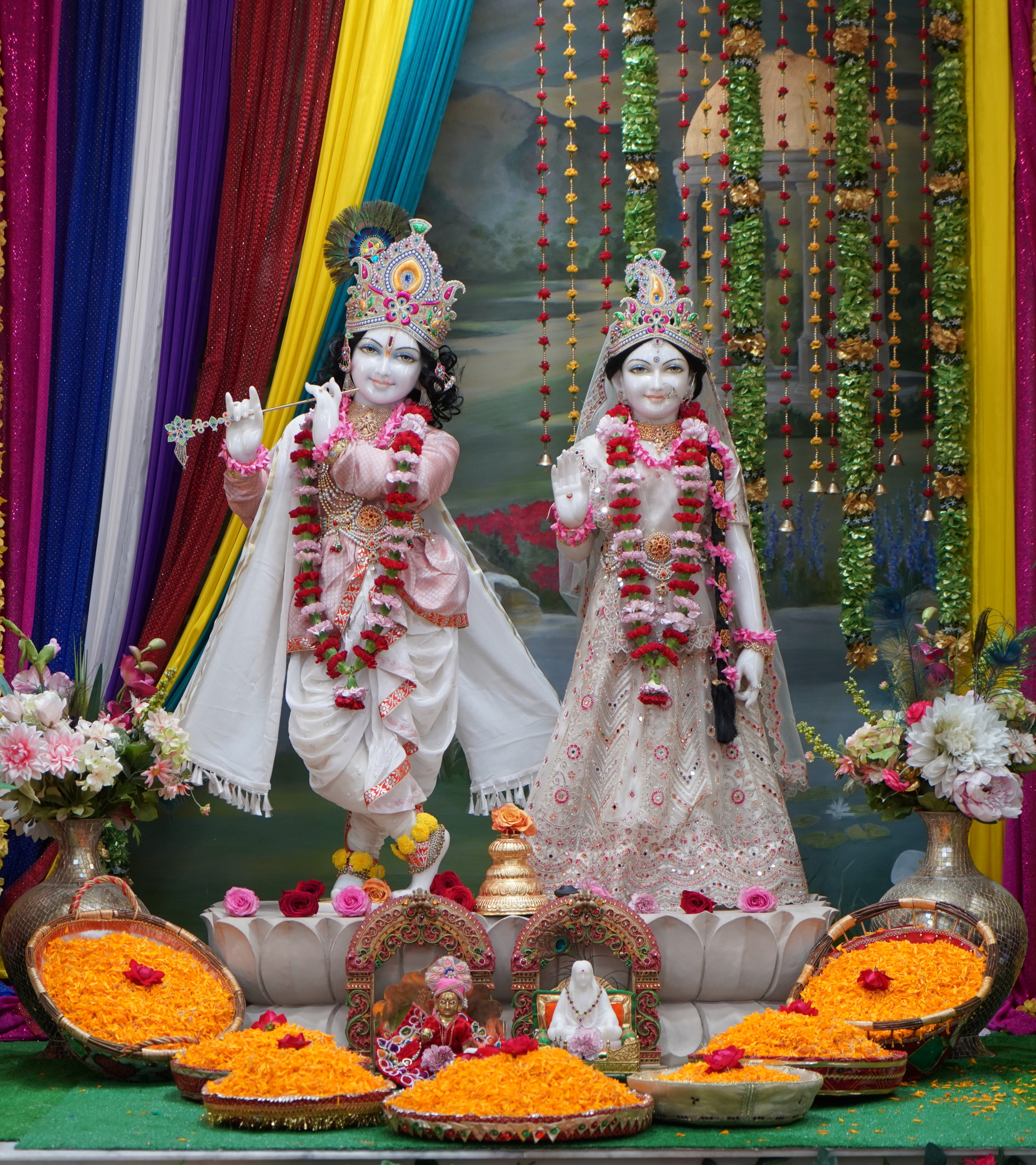
www.radhakrishnatemple.net
✦ FREQUENTLY ASKED QUESTIONS — BAISAKHI 2026
Q. Why is Baisakhi considered a powerful day for spiritual practice?
Baisakhi marks a Sankranti, when the Sun enters Aries, making it a highly auspicious time in Vedic tradition. Spiritual practices like prayer, seva, and kirtan performed on this day are believed to carry greater impact, helping elevate the mind and deepen devotion.
Q. What are the most common ways people celebrate Baisakhi?
Baisakhi is celebrated with harvest festivities, Bhangra and Gidda dances, Nagar Kirtans, visits to temples and gurdwaras, and community meals like langar. It is both a joyful cultural celebration and a deeply spiritual occasion.
Q. What is the significance of the harvest in Baisakhi?
The harvest symbolizes the fruits of effort and divine grace. It reminds us that while we work, the results ultimately come from a higher source, encouraging gratitude and humility.
Q. What is the deeper message of Baisakhi for modern life?
Baisakhi reminds us to pause, reflect, and reconnect with gratitude. In a fast-paced world, it teaches that true fulfillment comes not from constant activity, but from recognizing grace, serving others, and aligning daily life with a higher purpose.
Q. Can non-Indians or beginners celebrate Baisakhi meaningfully?
Yes. Baisakhi is universal in its message. Anyone can celebrate by practicing gratitude, doing an act of service, spending time in reflection, or learning about its traditions and spiritual meaning.
✦ YOU HAVE ALWAYS BEEN THE FIELD
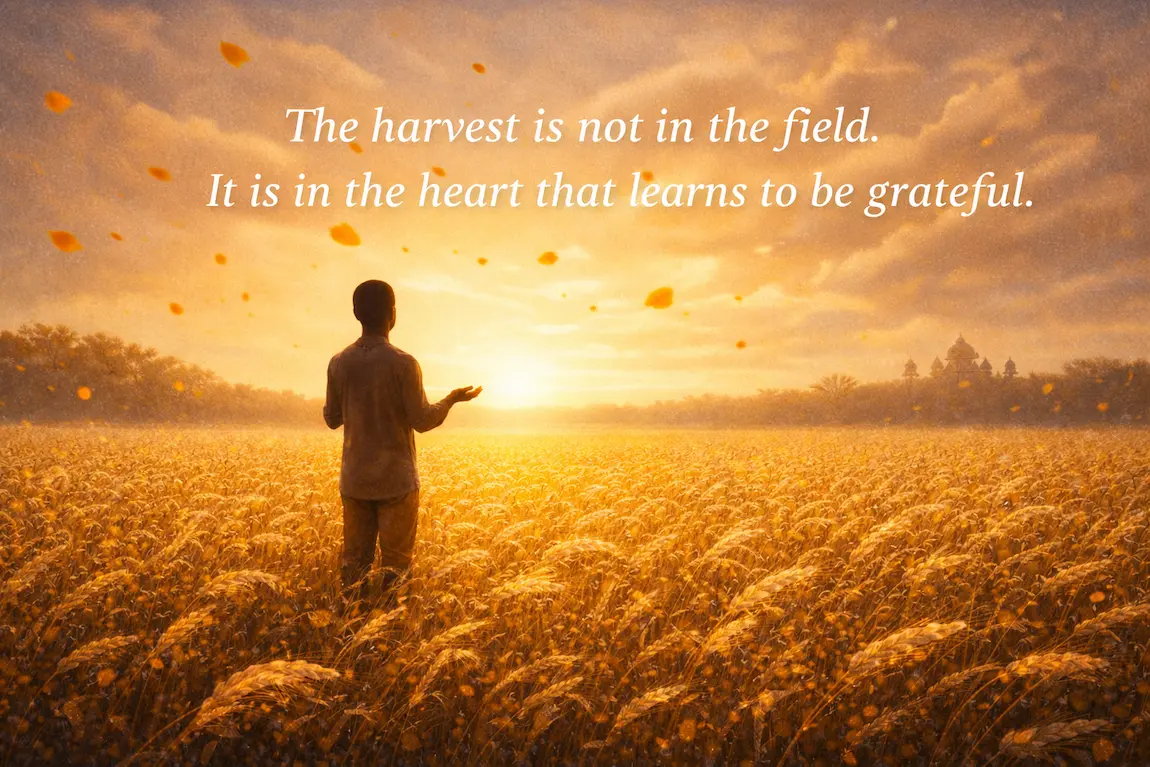
Here is the truth that Baisakhi has been trying to tell you since the first wheat field ripened in Punjab's ancient spring:
You are not searching for the Divine. You never were. The Divine has been searching for you and finding you, again and again, in every harvest, every sunrise, every moment of grace you almost missed. Baisakhi is simply the day when the whisper becomes a song and the song becomes a celebration loud enough to finally break through.
Swami Mukundananda ji teaches that the great teaching of the Bhagavad Gita is not merely intellectual — it is transformational. When BG 10.8 says 'I am the source of all creation; from Me everything flows,' it is not asking for your academic agreement. It is asking for your life's orientation. It is asking whether, on the morning of April 14, 2026, you will wake up and finally — fully — act as if that is true.
Act as if every grain of wheat in the field is a word in a love letter. Act as if the dhol's heartbeat is the heartbeat of the universe calling you home. Act as if the person you serve in the langar line is, in some inexplicable and beautiful way, the very God you have been longing for. Act as if surrender is not loss but the greatest discovery possible. Act as if this one day — this April 14th — is the threshold you step across into the life your soul has always known it was meant to live.
The wheat is golden. The sun is rising. The door is open.
Come home.