

The Invisible Script of Destiny
The interview was a disaster.
At least, that was how the young man narrated it to himself as he stepped out of the glass building and into the pale afternoon light. The elevator ride down had been painfully silent. The polished chrome walls reflected back a face he no longer trusted. His palms were still damp. His throat felt tight. Every answer he had given in that room replayed in fragments—half-finished sentences, awkward pauses, and one moment when the interviewer looked down to make a note and his heart dropped as if judgment had already been passed.
By the time the building doors closed behind him, the verdict in his mind was complete.
“I knew it,” he muttered inwardly. “I’m just not good enough.”
But what he did not realize was this:
The disaster had not begun in that interview room.
It had begun years earlier.
Perhaps when a teacher once looked disappointed and said, “You have potential, but you just don’t seem leadership material.”
Perhaps when a parent, exhausted and frustrated, compared him with someone else.
Perhaps when he stood in front of a class, forgot his line, and heard laughter.
Perhaps in one of those moments that seemed small to the world but enormous to the heart.
That day, he thought he was walking away from an unsuccessful interview.
In truth, he was walking back into a prison he had been living in for years.
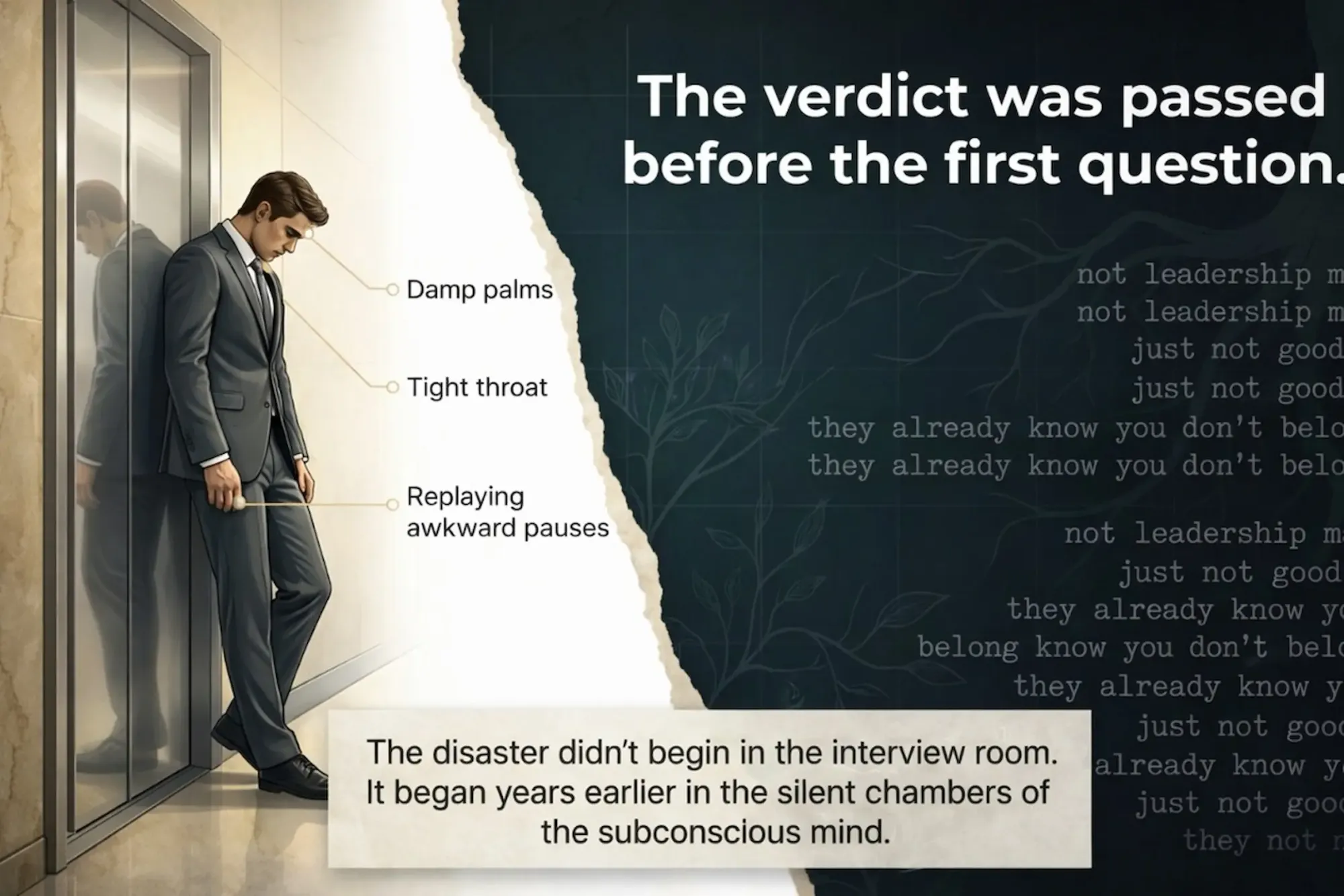
We call it life. But very often, what we call life is simply the replay of a script written long ago in the silent chambers of the subconscious mind. In many ways, how beliefs shape your life begins with the silent programming stored in the subconscious mind.
Until that script is brought into the light, the subconscious mind beliefs we carry continue writing our reactions, our limits, our fears, and even our destiny.
The Ghost Within Our Subconscious Mind
We spend much of life focusing on externals.
We refine our résumés.
We analyze opportunities.
We network, plan, optimize, calculate, and prepare.
All of that has its place.
But the teachings of Swami Mukundananda ji point us toward a deeper truth: the most decisive factor in our lives is often not outside us at all. It is the unseen programming within us.
Beliefs are powerful forces in personality. The subconscious mind beliefs we carry quietly determine how we interpret circumstances, how we evaluate events, how we respond to challenges and decide what is possible for our future. The subconscious carries memories, impressions, fears, grudges, and emotional residues from the past, and these stored impressions quietly influence conscious thought and behavior.
That is why two people can face the same setback and emerge with completely different futures.
One sees a challenge and thinks, “This will teach me.”
Another sees the same challenge and thinks, “This proves I was never enough.”
Same event.
Different script.
Different life.
A helpful way to understand this is through the metaphor of the captain and the current.
The conscious mind is like the captain of a ship. It is the part of you that sets goals, analyzes data, and makes New Year’s resolutions. It turns the wheel with intention.
But the subconscious mind is the powerful ocean current beneath the ship.
If the captain steers north toward success but the current beneath the surface pulls south toward self-doubt, the ship will eventually drift.
Willpower, while noble, is often insufficient for lasting change because it is a surface-level force battling a deep-water current.
Until we address the ghosts within the mind, we are not fully living.
We are simply being lived by our past.
The conscious mind says, “I want to change.”
The subconscious mind whispers, “But this is who you are.”
And the old current wins again.
The young man outside the interview room thought he was struggling with nerves.
In truth, he was struggling with ghosts.
The ghost of a teacher’s frown.
The ghost of a parent’s sigh.
The ghost of a forgotten humiliation.
The ghost of a sentence repeated so often that it hardened into identity.
These are not merely memories.
They are beliefs.
And beliefs are among the most powerful architects of human life.
The Storehouse Beneath the Surface
To change your life, you must understand the terrain of your own mind.
Most people treat the mind as if it were a single, simple thing.
It is not.
Swami Mukundananda ji frequently teaches that true mind management begins by understanding the structure of the inner system. Only then can we stop fighting symptoms and begin transforming the roots.
The subconscious mind acts like a vast memory bank, a storehouse of impressions that influence attitudes, thoughts, and behavior.
He also teaches that the quality of the mind dictates the quality of life, and that the mind can become either our enemy or our ally depending on how it is trained.
Think of a tree during a storm.
You see branches shaking violently.
You see leaves being torn away.
You may notice that one tree bears healthy fruit while another struggles.
But you cannot see the roots.
Yet the roots determine everything.
In human life, our visible traits—our confidence, habits, emotional reactions, resilience, fears, and relationships—are like branches.
The subconscious is the root system. Just as roots determine the health of a tree, subconscious mind beliefs determine the direction of our lives.
If those roots are nourished with courage, discipline, hope, and truth, the tree can withstand storms.
If those roots are diseased with shame, fear, helplessness, and inherited defeat, the tree may wither even under bright sunlight.
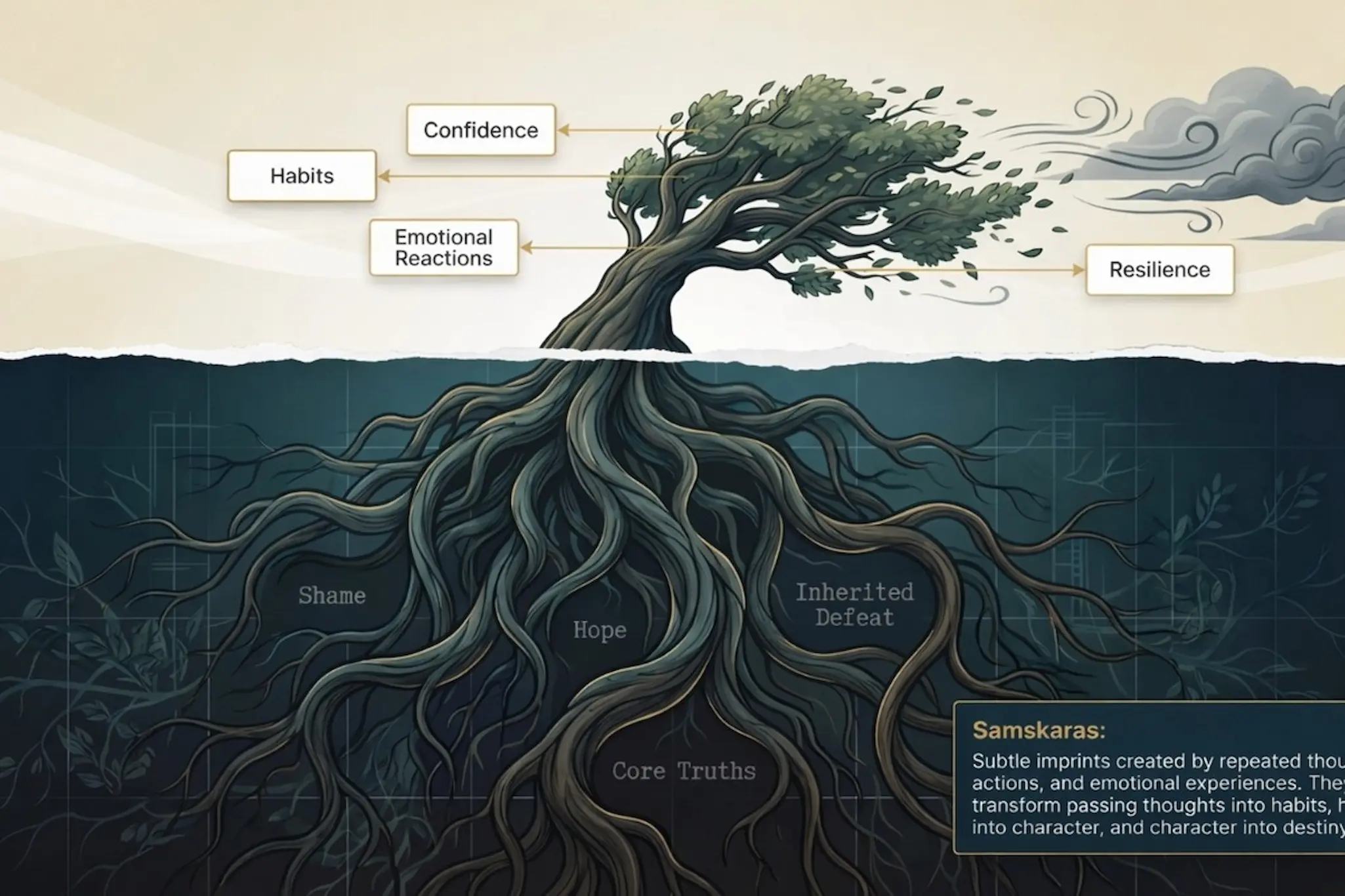
In Sanskrit philosophy, these deep impressions are called samskaras—subtle imprints created by repeated thoughts, actions, and emotional experiences.
They shape our perceptions.
They influence our reactions.
They transform passing thoughts into habits, habits into character, and character into destiny.
And that is why your life often reflects not just what has happened to you—but what your subconscious has concluded about those experiences.
How the Script Gets Written
Most of us did not consciously choose the beliefs now shaping our lives.
We absorbed them.
A child hears, “You’re brilliant,” and confidence begins to grow.
Another child hears, “Why are you always like this?” and shame takes root.
A student fails once and concludes, “I’m not a math person.”
A teenager experiences rejection and concludes, “I’m not lovable.”
A young adult struggles publicly and decides, “I should stay small.”
The subconscious does not always question whether these conclusions are true.
It simply records repetition, emotion, and meaning.
Over time, these impressions harden into beliefs. This is the beginning of how beliefs shape your life, often long before we are even aware of them.
Swami Mukundananda ji emphasizes that what we think about repeatedly becomes our nature, and that negative self-talk can seep into the subconscious while positive affirmations and disciplined thought can begin to reprogram it.
Three major forces shape these inner scripts:
Childhood conditioning
Childhood is the most impressionable stage of life because the intellect has not yet developed strong filters.
Words sink directly into the subconscious.
Words become walls.
Words become wings.
When a child repeatedly hears, “You’re brilliant,” “You’re special,” or “You have a gift,” - Encouragement creates confidence.
Conversely, phrases like “You’re lazy,” “You’ll never change,” or “People like us don’t do things like that” - Criticism can quietly build invisible limits.
Repeated thoughts
A single thought carries little power.
But repeated thoughts carve grooves in the mind.
Swami Mukundananda ji describes this process as the formation of mental grooves.
Imagine water flowing over stone.
One drop does nothing.
But a stream flowing day after day can carve a canyon through rock.
This is how a passing thought evolves into identity:
“I messed that up.”
Then again:
“I always mess things up.”
Eventually:
“I am the kind of person who ruins things.”
A thought becomes a belief.
And a belief becomes the lens through which life is interpreted.
The Power of Suggestion: The Story of Dinesh
Swami Mukundananda ji illustrates the power of belief through a fascinating story.
One Monday morning, a man named Dinesh arrived at work feeling completely healthy.
As he walked into the office, the receptionist looked concerned and asked, “Dinesh, are you feeling alright? You look a little pale.”
He laughed it off.
But soon another colleague approached him.
“You look exhausted today. Did you sleep at all last night?”
Now he began to wonder.
A third colleague soon commented, “You don’t look well today.”
By this time something strange began happening.
Dinesh suddenly felt warm.
He loosened his collar.
When a fourth colleague said with alarm, “You look terrible—you should go home,” Dinesh was convinced he was sick.
By lunchtime he had a headache, felt weak, and went home to rest.
Later that evening his friends confessed.
It had all been a prank.
Dinesh had been perfectly healthy.
What made him feel sick was not a virus.
It was a belief.
Repeated suggestion convinced his subconscious mind that something was wrong, and his body responded accordingly.
The subconscious mind does not always distinguish between objective reality and repeated suggestion.
If negative messages are repeated often enough, the mind begins to accept them as truth.
And once the subconscious mind accepts a belief, it begins shaping our thoughts, emotions, and even our physical experiences accordingly.
Emotional Experiences
Emotionally intense experiences create powerful impressions.
A public humiliation.
A painful betrayal.
A massive loss.
A huge failure.
These events can plant deep seeds within the subconscious.
Picture a girl giving a classroom presentation.
She forgets her lines.
A classmate laughs.
Her face burns with embarrassment.
The teacher moves on. The class forgets.
But her subconscious does not.
Years later, she declines promotions that require public speaking.
She calls it preference.
Her subconscious calls it survival.
Somewhere in the city, the young man from the interview sits alone in a café.
His coffee has gone cold.
The interview questions replay again and again.
But beneath them, another sentence echoes:
“You’re not leadership material.”
The voice does not belong to the interviewer.
It belongs to a teacher he had years ago.
And for the first time, he begins to wonder whether that sentence has been quietly writing his life.
The Elephant and the Thin Rope
The tragedy of limiting beliefs is that they rarely appear as cages.
They disguise themselves as “common sense.”
“Don’t hope—you’ll only be disappointed.”
“Stay small. It’s safer.”
There is a reason the elephant illustrates this perfectly.
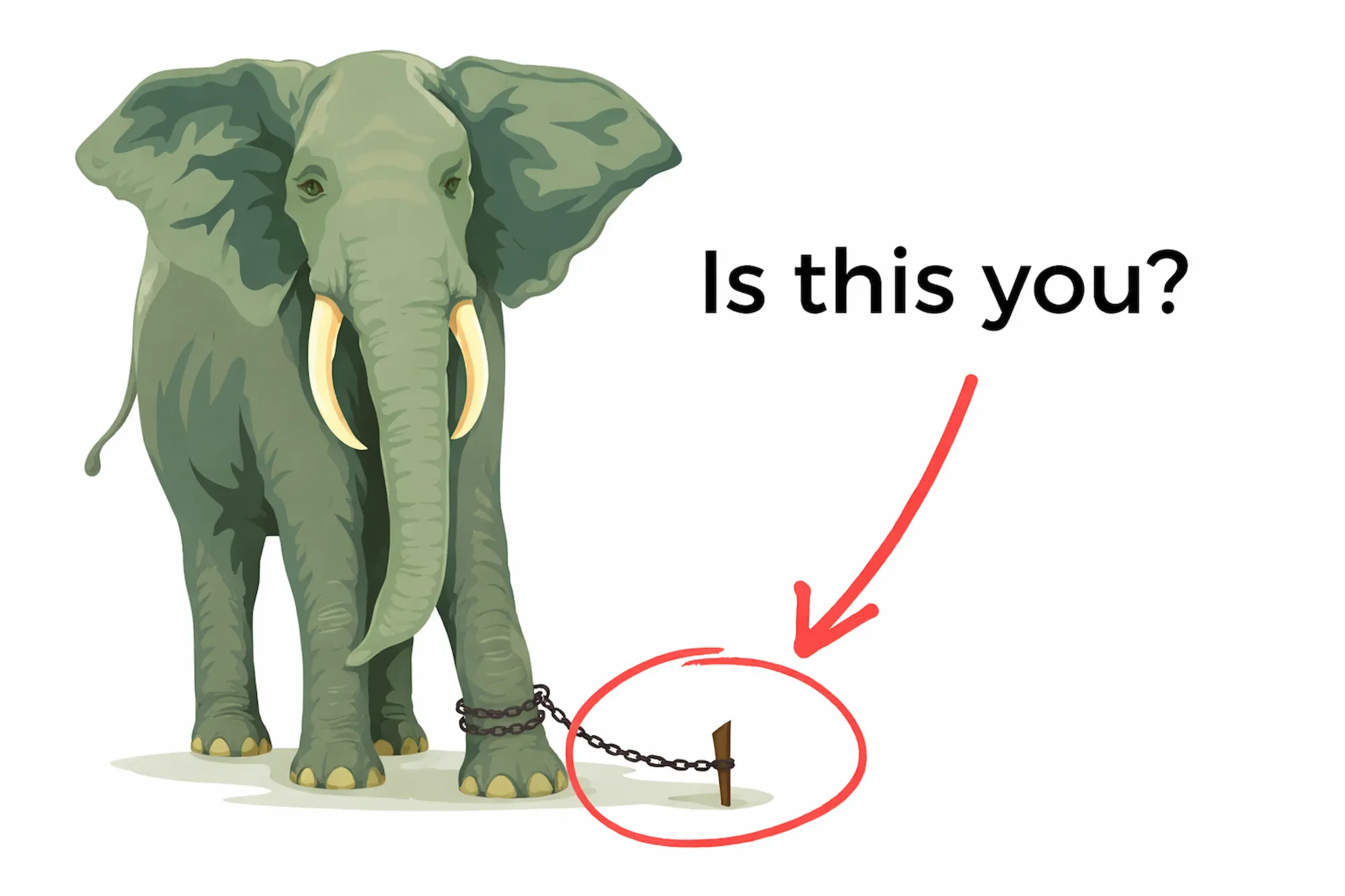
When the elephant is young, it is tied with a strong chain.
It struggles but cannot break free.
Eventually it stops trying.
Years later the elephant grows powerful enough to uproot trees.
But now it is tied with only a thin rope.
The elephant does not move.
Not because the rope is strong.
Because the belief is.
Human beings often live the same way.
Many of the limits we accept are simply subconscious mind beliefs that were formed long ago but never questioned.
The Loop That Builds a Life
Beliefs shape behavior.
Behavior shapes results.
Results reinforce beliefs.
This loop quietly builds a life.
Imagine a man who believes, “I’m bad at business.”
Because he believes it, he hesitates.
Because he hesitates, he avoids risk.
Because he avoids risk, he gains little experience.
Because he gains little experience, his results remain weak.
Then he says, “See? I was right.”
That is not fate.
That is belief becoming behavior, behavior becoming evidence, evidence becoming reinforced identity.
But the opposite loop also exists.
A person who believes, “I can learn,” behaves differently.
They ask more questions.
They persist longer.
They recover faster.
They interpret setbacks as information rather than as condemnation.
And over time, life answers their belief differently.
The Good News: The Script Can Be Rewritten
Here is the turning point.
The subconscious is powerful.
But it is not permanent.
It was programmed.
Which means it can be reprogrammed.
Swami Mukundananda ji teaches that we are not helpless victims of our thoughts. The mind can be transformed through knowledge, right practice, discipline, and grace. Meditation helps cleanse the subconscious, develop resolve, control the mind, and cultivate positive traits.
This means your current inner script is not the final word on your destiny.
You can interrupt it.
You can question it.
You can weaken it.
You can replace it.
But this requires more than inspiration. It requires method.
The Five Pillars of Transformation
These five practices help retrain the mind and gradually reshape the subconscious mind beliefs that influence our actions.
1 Awareness
Observe your inner dialogue.
You cannot change what you do not notice.
Pay attention to the automatic sentences that arise when life becomes difficult.
Write the thoughts down.
Very often, you will discover that the voice in your head is not truly your own. It is a teacher’s voice. A parent’s voice. A wound’s voice. A frightened younger self pretending to be wisdom.
2 Replacement
Replace limiting beliefs with higher truths.
Instead of, “I always fail,” try, “I am learning through every attempt.”
Instead of, “I’m not good enough,” try, “My conditioning is not the measure of my worth.”
Instead of, “It is too late,” try, “The next faithful step still matters.”
The subconscious learns through repetition. What was wired through repetition must often be unwired the same way.
3 Visualization
Mentally rehearse courage and calmness.
Visualize yourself speaking calmly.
Responding steadily.
Remaining grounded under pressure.
Acting with dignity.
Walking toward your duty instead of away from it.
4 Meditation
Quiet the mind and observe thoughts without identifying with them.
Swami Mukundananda ji teaches that meditation as a means of cleansing the subconscious, stabilizing the mind, and changing thought patterns at the source.
5 Consistent Action
Create new evidence through small courageous steps.
The Sacred Alchemy: Shravan, Manan, Nididhyasan
While psychological tools like awareness, visualization, and disciplined action are powerful, Swami Mukundananda ji reminds us that lasting transformation ultimately rests within a deeper spiritual framework.
In that framework, the mind is not the highest authority within us.
The soul—the Ātman—is.
The mind may store impressions, fears, and beliefs formed through years of experience. But the soul is always greater than the mind. Because of this deeper spiritual identity, every person carries within them the capacity to rise above conditioning and rewrite the script of their life.
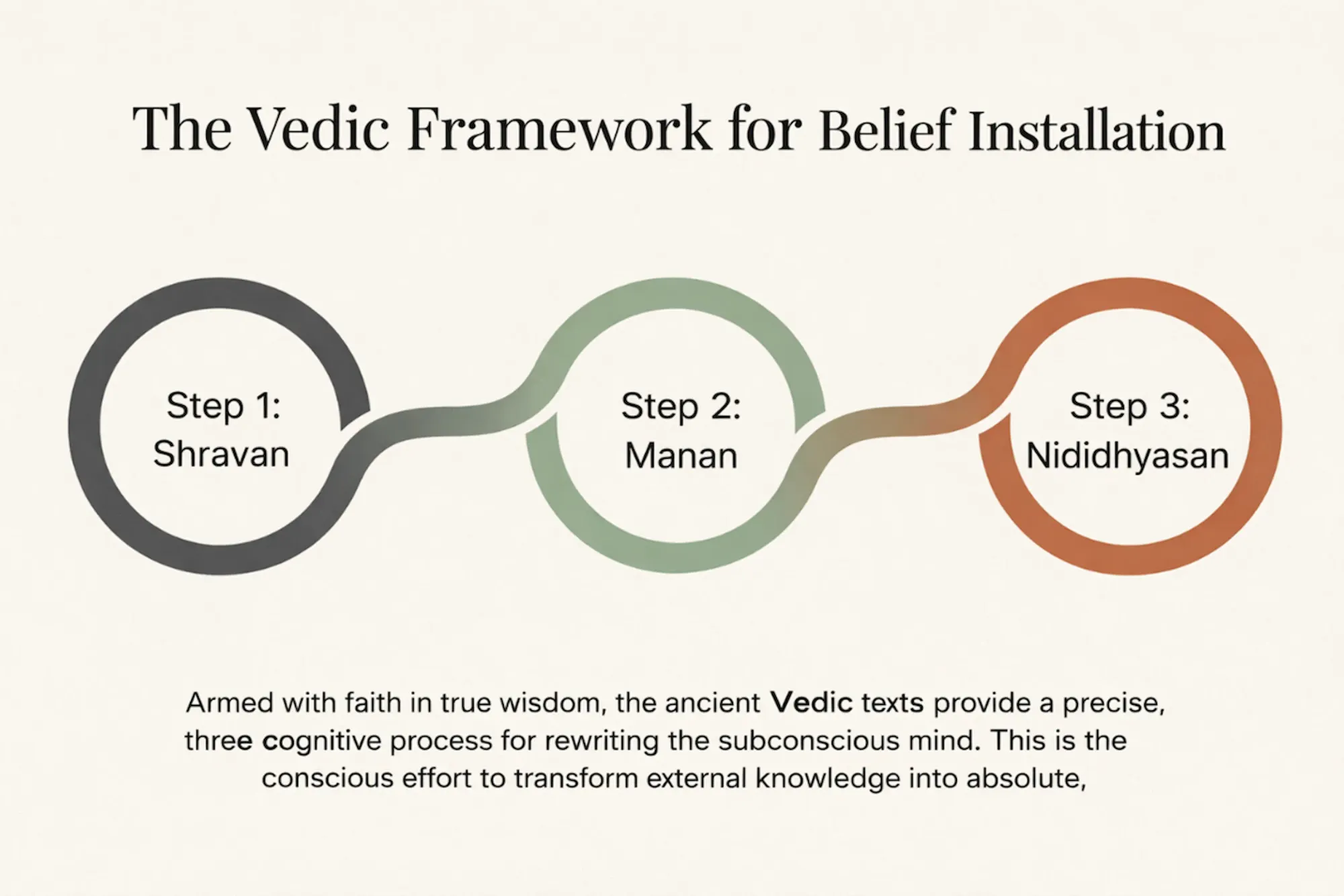
To accomplish this, the ancient wisdom tradition describes a powerful three-step process often called the sacred alchemy of inner transformation:
Shravan — Hearing wisdom
Swami Mukundananda ji often emphasizes that the mind becomes what it repeatedly hears. Just as repeated negative suggestions can weaken the mind, repeated exposure to wisdom strengthens it.
A powerful illustration of this principle comes from history.
For centuries, humanity believed the Earth was flat. This belief was accepted as obvious truth. No amount of willpower could change it.
Then knowledge arrived.
Astronomers and explorers revealed the truth that the Earth is round. Once the intellect truly understood this reality, the old belief collapsed instantly. People did not need to fight the idea of a flat Earth anymore; it simply disappeared.
That is the power of Shravan.
When the intellect encounters genuine truth, old misconceptions begin to dissolve.
Manan — Contemplating wisdom
Swami Mukundananda ji says Manan is the process of reflecting on wisdom again and again turning it over in the mind, examining it from different angles, allowing it to slowly reshape the grooves of thought.
This is why spiritual wisdom is not meant to be heard once and forgotten.
It must be reflected upon.
Internalized.
Revisited until the intellect begins to accept it as reality.
Over time, contemplation replaces old mental habits with new inner clarity.
Nididhyasan — Firm Conviction
This is the moment when the intellect stops merely entertaining an idea and finally declares with faith:
“This is my reality.”
Here, knowledge is no longer theoretical.
It becomes belief.
And belief shapes behavior.
This transformation—from knowledge to conviction—is the moment when inner change truly begins to influence outward life.
The Lady and the Monster
A simple story illustrates this truth.
A woman repeatedly dreamed that a terrifying monster was chasing her through a dark landscape. Night after night the dream returned, and the monster pursued her relentlessly. One night she finally reached the edge of a canyon. There was nowhere left to run.
Terrified, she turned and cried, “What are you going to do to me?”
The monster paused and replied calmly,
“That is your choice. After all, you are the one creating the dream.”
The lesson is profound. Many of the fears that chase us in life are sustained by the subconscious stories we have accepted without questioning them. We feel hunted by anxiety, imprisoned by the past, and limited by beliefs we assume are permanent.
But through Shravan (hearing truth), Manan (reflecting on it), and Nididhyasan (living it), the mind gradually aligns with a deeper reality.
We are not prisoners of a poorly trained mind.
We can retrain it, refine it, and replace old scripts with higher truths.
And in doing so, we rediscover our infinite potential as children of God.
The Second Interview
One year later, the young man sits in another hallway.
His palms are still damp.
But his inner world has changed.
When the old voice whispers,
“You’re not good enough,”
he simply smiles.
“That was the old script,” he thinks.
“Today I am writing a new one.”
The door opens.
He stands.
He does not just enter the room.
He arrives.
The Seeds of Tomorrow
Every thought you repeat plants a seed.
Over time, these seeds grow into the subconscious mind beliefs that determine how we see ourselves and the world.
Some seeds become courage.
Some become fear.
Some become discipline.
Some become helplessness.
Some become hope.
Some become destiny.
The subconscious is always listening.
So, ask yourself carefully:
What have I been rehearsing?
What story have I been telling myself?
What sentence have I mistaken for identity?
What old rope have I mistaken for a chain?
Because your future is not shaped only by goals, plans, and circumstances.
It is shaped by the beliefs beneath them.
Change the script, and the life begins to change.
Not instantly.
Not magically.
But deeply.
Truly.
From the roots outward.
When we understand how beliefs shape your life, we begin to realize that true transformation starts inside the mind.
Key Takeaways
· Your subconscious mind stores impressions, repeated thoughts, and emotional residues that quietly influence how you think, feel, and act.
· Beliefs shape behavior. Behavior shapes outcomes. Outcomes reinforce beliefs.
· Many life limitations are not reflections of actual inability, but reflections of old conditioning.
· Repeated self-talk matters. What the mind hears often, it begins to treat as truth.
· Awareness, replacement of false inner narratives, visualization, meditation, and consistent action are practical tools for rewiring the subconscious.
In Swami Mukundananda ji’s teaching, the mind can become either your enemy or your ally, and it can be trained through knowledge, discipline, and spiritual practice.
Call to Action
If this insight resonated with you, explore the full teaching from Swami Mukundananda on the power of the subconscious mind.
Watch the full talk here:
FAQ
What is the subconscious mind?
It is the deeper layer of the mind that stores impressions, memories, emotional residues, habits, and repeated thought patterns that influence present behavior and perception.
How do beliefs shape life outcomes?
Beliefs influence interpretation, action, confidence, persistence, and emotional response. Over time, they become self-reinforcing patterns that shape results.
Can limiting beliefs really be changed?
Yes. Swami Mukundananda ji’s teachings and related official resources emphasize that the mind is trainable through right knowledge, repetition, meditation, discipline, and grace.
Why do repeated thoughts become so powerful?
Because repetition creates grooves in the mind. The subconscious absorbs repeated thought patterns and begins to treat them as reality or identity.
What is the first practical step toward transformation?
Awareness. Notice the automatic inner script running during failure, criticism, fear, and opportunity. What you can notice, you can begin to change.
How do subconscious mind beliefs affect success?
Subconscious mind beliefs influence confidence, decision-making, persistence, and emotional reactions. When positive beliefs are reinforced through knowledge and practice, they can dramatically change how a person approaches challenges and opportunities.