1. The Gateway to the Soul: Understanding Meditation through JKYog
In the modern landscape of wellness, meditation is often marketed as a tool for stress relief or a brief escape from the chaos of daily life. However, for World Meditation Day 2025, Swami Mukundanandji and the JKYog philosophy invite us to look deeper. From this perspective, meditation is not merely a relaxation technique; it is the fundamental art of mind management.
The mind is a double-edged sword. As Swamiji often explains, the same mind that creates our greatest anxieties has the potential to become our most faithful friend. While most global practices emphasize the "silence" or the "emptying" of the mind, JKYog teaches a more transformative approach. Silence, if left empty, is often just a temporary pause before the next storm. True inner peace is found when we fill that silence with the divine presence.
From a Stormy Mind to a Sublime Mind
Most of us live with a "stormy mind"—a state characterized by a constant whirlwind of desires, fears, and worldly attachments. World Meditation Day 2025 serves as a global invitation to transition into a "sublime mind." This transition involves three key shifts according to JKYog teachings:
- Active Engagement: Instead of trying to suppress thoughts (which often makes them stronger), we redirect them toward a higher, divine consciousness.
- Purification of Intellect: Meditation is the process of convincing the intellect of its true nature, allowing it to govern the mind with wisdom rather than impulse.
- The Power of Devotion: By integrating Bhakti (devotion) into meditation, the practice becomes effortless. When the heart is anchored in the divine, the mind naturally detaches from worldly distractions.
As we explore sacred spaces for inner peace this year, remember that the most sacred space of all is the one you cultivate within. JKYog provides the roadmap to ensure that your meditation isn't just a 20-minute ritual, but a lifelong state of grace and mental mastery.
2. Roopdhyan: Transforming Your Heart into a Sacred Space

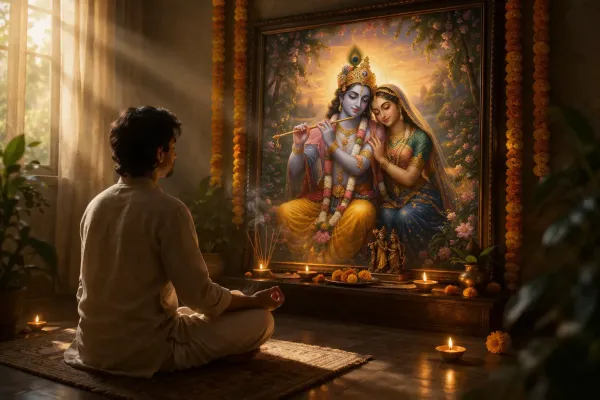
While the world is filled with breathtaking temples and serene ashrams, Swami Mukundanandanji offers a profound realization: the most sacred space for meditation isn't a geographical location, but the landscape of your own heart. Through the practice of Roopdhyan, you can build a portable sanctuary that remains untouched by the chaos of the external world.
The Science of a Restless Mind
Swamiji often explains that the human mind is inherently restless. By its very nature, it requires an object to latch onto. If we do not consciously provide it with a sublime object of focus, it will naturally drift toward worldly anxieties, material desires, or past regrets.
Standard meditation often focuses on "emptying the mind," but Swamiji teaches that for most, an empty mind quickly becomes a playground for Maya. This is where Roopdhyan—the meditation on the divine form of God—becomes a transformative tool.
Creating the Inner Sanctuary
Roopdhyan is the practice of visualizing the enchanting form, attributes, and pastimes of Radha Krishna. Swamiji emphasizes that since God is all-pure, meditating on His form purifies the mind.
- Visualize the Divine: Close your eyes and picture the lotus-like eyes of Shree Krishna or the compassionate smile of Radha Rani.
- Engage the Senses: Don’t just "see" them; try to hear the melody of the flute or feel the softness of the Divine Mother’s grace.
- A Portable Peace: The beauty of this practice is that it transcends physical boundaries. Whether you are in a crowded subway or a quiet room, once you have cultivated the image of the Divine within your consciousness, you carry that "sacred space" with you.
Why It Works
By shifting our focus from the material to the Divine, we engage in Bhakti Yoga. As Swamiji beautifully narrates, when the mind is anchored in the beauty of God, worldly attractions begin to lose their grip. You no longer need to travel to find peace; you simply step inside your heart, where the Divine awaits.
Highlight the core teaching of Roopdhyan (meditation on the form of God). Swamiji often explains that the mind needs an object to latch onto; by visualizing the divine beauty of Radha Krishna, we create a "sacred space" within our own consciousness that we can carry anywhere.
3. The Sanctified Vibrations of JKYog Ashrams and Centers

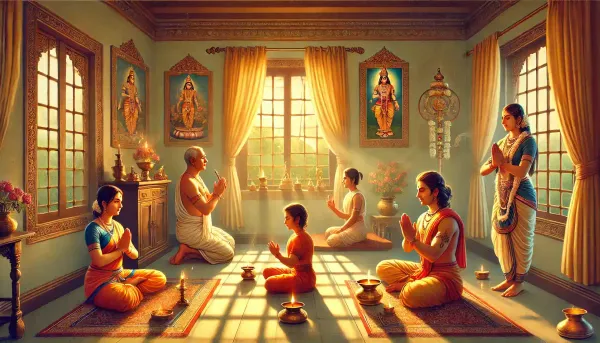
When seeking a place to commemorate World Meditation Day 2025, the environment plays a pivotal role in the depth of one's experience. Swami Mukundananda teaches that while God is omnipresent, His energy is more palpably felt in "Sacred Spaces"—locations where the atmosphere is intentionally charged with spiritual practice. The JKYog ashrams and centers, such as the magnificent Radha Krishna Temple of Dallas and the serene JKYog Bhakti Ashram in Odisha, India, serve as these divine conduits for inner peace.
A Tapestry of Devotional Vibrations
These centers are not merely buildings; they are spiritual powerhouses. Every corner of the Radha Krishna Temple of Dallas, for instance, is steeped in the "Yoga of Sound." Through constant kirtan (devotional chanting), the physical space absorbs the sacred names of the Divine. As Swamiji explains, when the tongue vibrates with divine sound and the ears absorb those frequencies, the mind naturally begins to dwell on God. For a seeker, meditating in a hall where thousands have chanted "Radhey" creates a "spiritual slipstream," making it significantly easier to quiet the mental chatter and dive deep into Roopdhyan (meditation on the divine form).
The Synergy of Seva and Silence
Furthermore, these spaces are sanctified by the spirit of seva (selfless service). Whether it is the charitable medical work at the JKYog Bhakti Ashram or the community volunteering in Dallas, the energy of selfless giving purifies the environment. Swami Mukundananda emphasizes that a heart engaged in service becomes a fertile ground for meditation.
On World Meditation Day, these sacred spaces offer a unique synergy:
- Sanctified Energy: The accumulated vibrations of years of prayer and meditation act as a catalyst for your own practice.
- Holistic Environment: From the tranquil meditation gardens to the resonance of the prayer halls, every element is designed to pull the senses inward.
- Collective Consciousness: Meditating in the company of like-minded seekers (Satsang) amplifies individual focus, turning a solitary practice into a powerful collective journey toward the Divine.
By choosing to spend World Meditation Day at a JKYog center, you immerse yourself in an environment where the "noise" of the world is replaced by a living current of divine love, providing the ultimate sanctuary for your soul.
Discuss physical locations like the Radha Krishna Temple of Dallas or the JKYog Bhakti Ashram in India. Explain how these "Sacred Spaces" are charged with the vibrations of kirtan and seva, making them the ideal environment for seekers to deepen their practice on World Meditation Day.
4. Shrimad Bhagavatam: The Ripened Fruit of Meditation
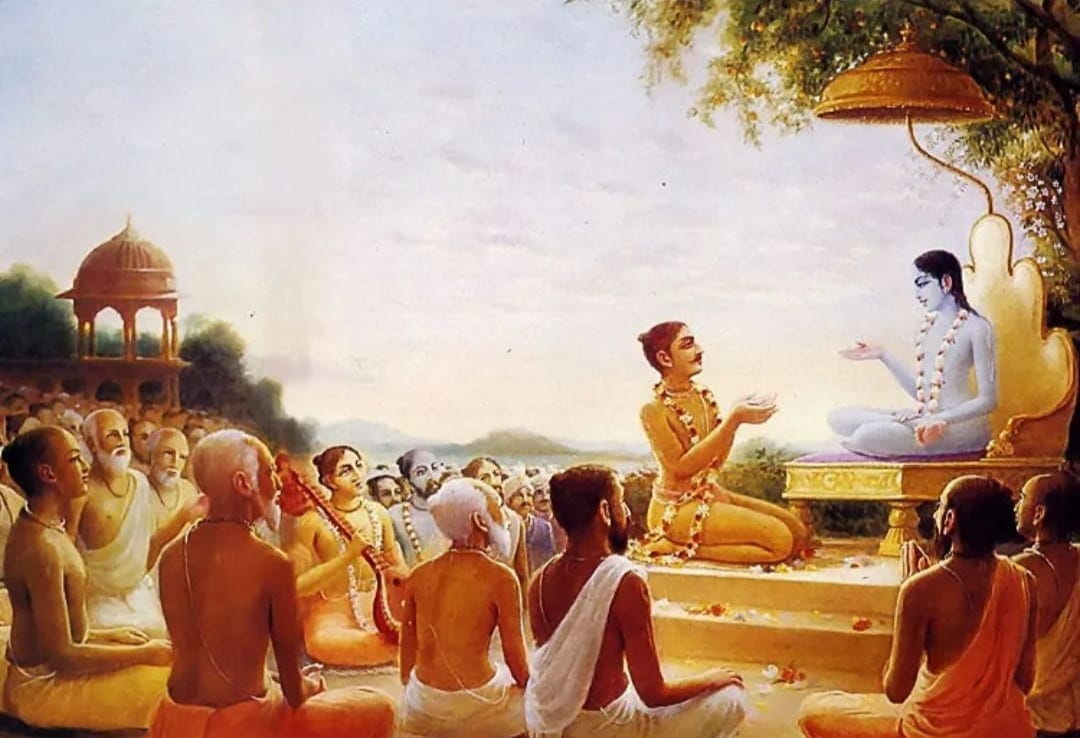
In the quest for inner peace, many practitioners treat meditation as a mental exercise to "empty" the mind. However, Swami Mukundananda often explains that the mind cannot remain empty for long; its nature is to be attached to something. The Shrimad Bhagavatam, known as the Mahapurana, offers the ultimate "sacred space" for meditation by providing a divine object for our thoughts: the Leelas (divine pastimes) of Shree Krishna.
The Ripened Fruit of the Vedic Tree
The Bhagavatam is uniquely described as the nigama-kalpa-taror galitaṁ phalam—the ripened fruit of the desire tree of Vedic knowledge. Just as a tree exists to eventually produce a sweet fruit, the entire body of Vedic wisdom (including yoga, dhyana, and austerities) exists to lead the soul to the sweetness of the Bhagavatam.
While other scriptures provide the "rules" of spirituality, the Bhagavatam provides the "relish." Swamiji emphasizes that meditation becomes effortless when it is fueled by love. Instead of a cold struggle to concentrate, the Bhagavatam invites us to absorb our senses and mind in the enchanting beauty and virtues of the Lord.
Lessons from Sage Shukadev and King Parikshit
The context of the Bhagavatam is itself a masterclass in meditation. King Parikshit, facing certain death in seven days, sought the highest path to liberation. Sage Shukadev Goswami did not advise him to sit in a forest and focus on his breath; rather, he submerged the King’s mind in the glories of God.
This reveals a profound truth: True meditation is the absorption of the mind in the Divine. When the mind is saturated with the pastimes of Shree Krishna, the fear of death and the anxieties of the material world naturally dissolve.
Key Shlokas for Inner Peace and Devotion
To deepen your blog's impact, here are two pivotal verses from the Bhagavatam that define the success of meditation:
1. The Definition of Supreme Devotion
This verse highlights that the highest meditation is that which is selfless and constant.
Sanskrit: स वै पुंसां परो धर्मो यतो भक्तिरधोक्षजे । अहैतुक्यप्रतिहता ययात्मा सम्प्रसीदति ॥ १.२.६ ॥
Transliteration: sa vai puṁsāṁ paro dharmo yato bhaktir adhokṣaje ahaituky apratihatā yayātmā samprasīdati (SB 1.2.6)
Meaning: The supreme occupation (dharma) for all humanity is that by which men can attain to loving devotional service unto the transcendent Lord. Such devotional service must be unmotivated (ahaituki) and uninterrupted (apratihata) to completely satisfy the soul.
2. Meditation as the Remedy for Fear
This verse explains how meditation on the Lord grants "Abhaya" or fearlessness.
Sanskrit: तस्माद्भारत सर्वात्मा भगवानीश्वरो हरि: । श्रोतव्य: कीर्तितव्यश्च स्मर्तव्यश्चेच्छताभयम् ॥ २.१.५ ॥
Transliteration: tasmād bhārata sarvātmā bhagavān īśvaro hariḥ śrotavyaḥ kīrtitavyaś ca smartavyaś cecchatābhayam (SB 2.1.5)
Meaning: O descendant of Bharata, one who desires to be free from all miseries must hear about, glorify, and also remember the Personality of Godhead, who is the Supersoul, the controller, and the savior from all miseries.
Culminating in Nishkam Bhakti
As Swami Mukundananda teaches, the goal of meditation is not just a quiet mind, but a purified heart. When we meditate on the Bhagavatam, we move from Sakam Bhakti (devotion for material gain) to Nishkam Bhakti (selfless love).
In this state, peace is no longer dependent on external circumstances. Whether we are in a quiet temple or the chaos of a city, the mind remains anchored in the Divine. On World Meditation Day 2025, let the Shrimad Bhagavatam be your internal sacred space—the place where meditation meets devotion, and where the soul finds its eternal rest.
5. Brahma Muhurta: The Sacred Timing for Inner Stillness

To truly honor World Meditation Day, Swami Mukundananda suggests we look not just at where we meditate, but when. Swamiji often refers to Brahma Muhurta—the period approximately two hours before sunrise—as the "Time of God." While the world offers many sacred geographical locations, the most profound "sacred space" is actually a window in time that opens daily for everyone, regardless of where they are on the globe.
The Science of Sattva
According to Swamiji’s teachings, the atmosphere during Brahma Muhurta is predominantly sattvic (pure and harmonious). As the rest of the world sleeps, the frantic, turbulent energies of rajas (passion/activity) and tamas (inertia/darkness) are at their lowest.
The air is charged with a unique serenity, and the environment is free from the mental "noise" of millions of people thinking, planning, and worrying. By waking during this period, you align your internal rhythm with the subtle vibrations of the universe, making it significantly easier to achieve a state of deep dhyana (meditation).
The Mind as a Blank Slate
Swamiji beautifully explains that upon waking in these pre-dawn hours, the mind is like a blank slate. It has not yet been cluttered by the day’s emails, chores, or social interactions. In this pristine state, the subconscious is exceptionally receptive.
"At this hour, the mind is naturally calm," Swamiji teaches. "It is the ideal time to imprint divine thoughts upon the intellect."
When you meditate during Brahma Muhurta, the spiritual seeds you plant—whether through Roopdhyan (meditation on the form of God) or the chanting of Holy Names—take root much deeper than they would during the chaotic hours of the afternoon.
6. From Solitude to Satsang: The Power of Collective Meditation
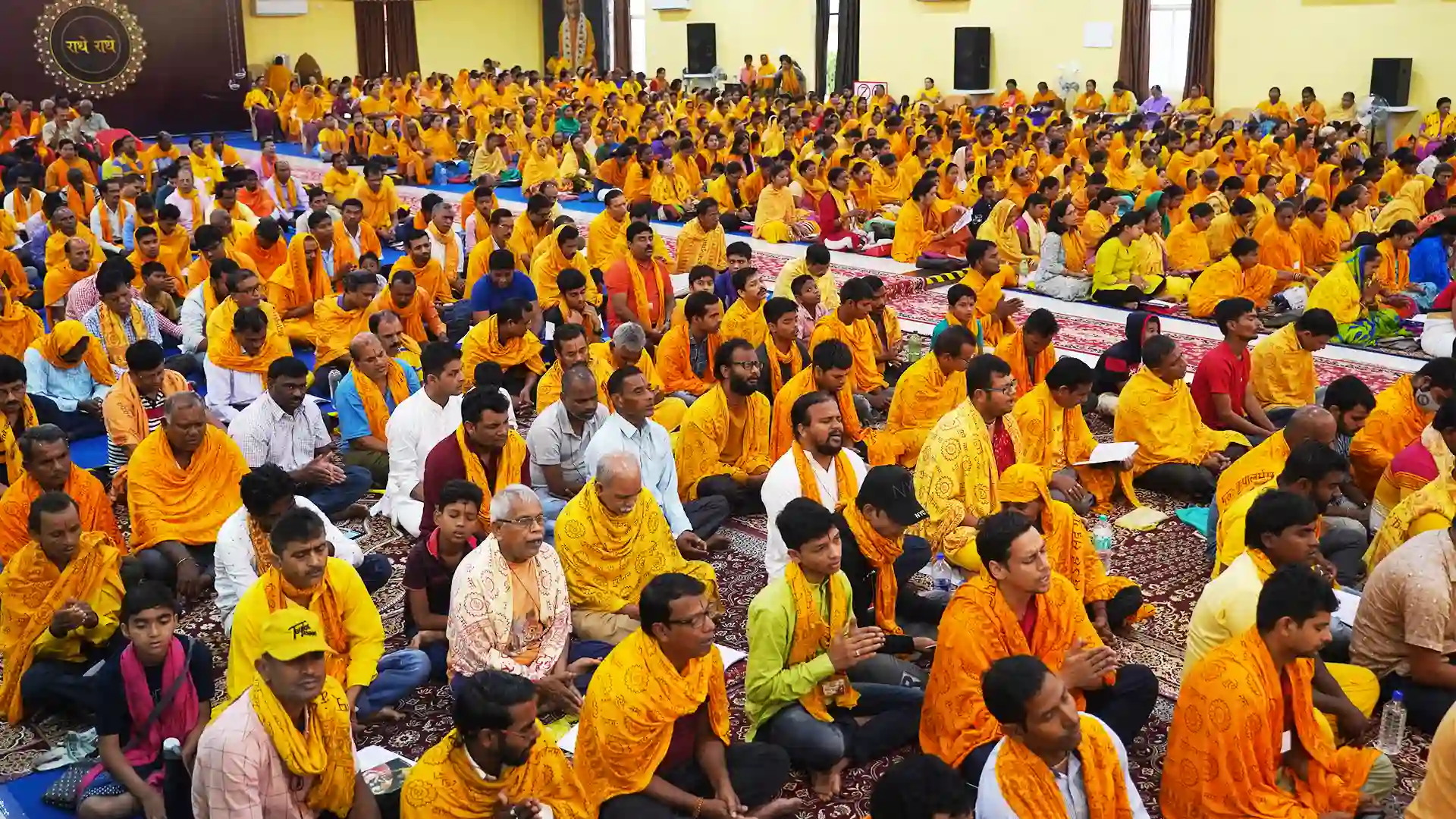
While we often envision meditation as a solitary journey—a silent retreat into the depths of one’s own mind—Swami Mukundananda teaches us that the path to inner peace is significantly accelerated when we walk it together. This World Meditation Day, as you seek out sacred spaces, consider the profound spiritual science behind Satsang, or the "company of the truth."
The Science of "Borrowed Strength"
In his teachings, Swamiji often addresses a common struggle: the "monkey mind." When we sit alone, our thoughts frequently drift toward worldly anxieties, making the climb toward stillness feel steep and exhausting. However, when we join a collective of seekers, we tap into a reservoir of borrowed strength.
Just as a single stick is easily broken but a bundle remains resilient, our individual focus is fortified by the shared intention of the group. In a collective setting, the discipline of those around you acts as a silent support system, gently pulling your wandering mind back to the center whenever it begins to stray.
Amplifying the Spiritual Vibration
There is a tangible energetic shift that occurs during group meditation. Swami Mukundananda explains that when multiple souls align their consciousness toward the Divine simultaneously, the spiritual vibration of the space is exponentially amplified.
- Shared Energy: The atmosphere becomes "charged," making it easier for even beginners to experience deeper states of tranquility that might take years to achieve in isolation.
- The Power of Sankalpa: On a global observance like World Meditation Day, millions of people hold a shared Sankalpa (intention) for peace. Being part of a physical or virtual Satsang allows you to plug into this global grid of positivity.
Transitioning from "Me" to "We"
Satsang serves as an antidote to the ego. In solitude, we can sometimes become hyper-focused on our own progress or frustrations. In the company of the truth, we realize we are part of a larger spiritual family. This sense of belonging fosters humility and devotion (Bhakti), which Swamiji emphasizes as the most potent fuel for any meditative practice.
This May 21st, don’t just close your eyes in your room. Seek out a local center, a temple, or a community gathering. By moving from solitude to Satsang, you aren't just meditating; you are immersing yourself in a spiritual current that carries you toward the Divine much faster than you could ever swim alone.
7. Integrating Peace into the Marketplace: Meditation Beyond the Mat

Many seekers believe that inner peace is a fragile state, one that can only be preserved in the hushed silence of an ashram or the comfort of a meditation mat. However, Swami Mukundananda teaches that the true test of our spiritual practice is not how deep our silence is when we are alone, but how steady our mind remains in the "marketplace" of life—amidst the deadlines, the noise, and the social pressures of the world.
The Mind as the Ultimate Sacred Space
According to the JKYog philosophy, we exist in two worlds simultaneously: the external world of people and objects, and the internal world of our thoughts and emotions. While we cannot always control our external environment, we have the sovereign power to govern our internal landscape.
As Swamiji often explains, the ultimate "sacred space" isn't a physical location like a temple or a mountain peak; it is a purified mind. When the mind is anchored in the Divine, every location becomes a cathedral. Meditation is not an escape from reality, but a training ground to develop a "meditative poise" that we carry with us into our daily chores.
The Philosophy of "Working for God"
The secret to integrating peace into the marketplace lies in the practice of Karma Yoga, or the art of working for God. JKYog emphasizes that we do not need to renounce our worldly duties to find peace; rather, we must renounce the attachment to the results.
"Hands to work, mind to God." — This simple yet profound maxim summarizes the essence of spiritualizing our professional and personal lives.
By shifting our perspective—from working for a paycheck, status, or ego to working as an offering to the Supreme—we transform mundane labor into a sacred ritual. This shift in bhav (devotional sentiment) protects the mind from the anxieties of success and failure, allowing us to remain "yog-yukt" (united with God) even while navigating a busy boardroom or a crowded street. When your mind becomes a sanctuary of peace, you no longer seek an "inner retreat"—you carry it with you, wherever you go.
Frequently Asked Questions (FAQ)
- How does JKYog differ from secular mindfulness?
- Secular techniques often focus on "emptying" the mind, which can leave it vulnerable to future stress.
- JKYog teaches Roopdhyan, which involves attaching the mind to the all-pure form of God, providing a positive and purifying object of focus.
- How do I start practicing Roopdhyan as a beginner?
- Choose a quiet time, preferably Brahma Muhurta (pre-dawn).
- Close your eyes and visualize a divine form, such as the compassionate smile of Radha Rani or Shree Krishna.
- Engage your senses—hear the flute or feel the divine grace—focusing on the bhav (devotional sentiment).
- Why is meditating at a JKYog Ashram beneficial?
- These spaces are "spiritually charged" by years of continuous kirtan and seva.
- The collective energy of Satsang (spiritual company) makes it easier for beginners to quiet their minds and dive deeper into devotion.
- Can I stay peaceful while working a high-pressure job?
- Yes, through the practice of Karma Yoga (working for the pleasure of God).
- By detaching from the ego and the results of your work, you maintain an internal "meditative poise" even in busy environments.
- Is Brahma Muhurta the only time I can meditate?
- While this time is ideal due to its sattvic (pure) vibrations, meditation is beneficial at any hour.
- The goal is to eventually make every breath a form of meditation, though morning practice sets the strongest foundation.
Take the Next Step: Your Journey to Mental Mastery
- Make a Sacred Resolve (Sankalpa): Don’t let this day pass as a one-time observance. Commit to a daily practice of at least 15 minutes to cultivate long-term inner peace.
- Connect with a Global Community:
- Visit in Person: Attend programs at the Radha Krishna Temple of Dallas or your local JKYog center.
- Join Online: Participate in virtual Satsangs and global meditations to benefit from "borrowed strength."
- Deepen Your Intellectual Foundation:
- Read Swami Mukundananda’s books, such as 7 Mindsets for Success, Happiness and Fulfilment.
- Watch Swamiji’s discourses on the Bhagavad Gita to convince your intellect of your true spiritual nature.
- Utilize Digital Tools:
- Download the JKYog App for access to guided meditations, kirtans, and daily wisdom.
- Use these resources to keep your mind anchored in the Divine throughout your workday.
- Transform Your Work into Worship: Apply the principles of Karma Yoga tomorrow morning. Offer your efforts to the Divine and watch your workplace anxiety transform into spiritual growth.