The Science of Inner Alignment
Where movement calms the nervous system, meditation steadies the mind, and Prem—Divine Love—quietly becomes real.
The Workout Delusion: Why Dallas Is Getting Fitter but Not Healthier
In the high-velocity, performance-driven landscape of the Dallas–Fort Worth metroplex, a peculiar and quiet crisis has taken root: the era of high-functioning exhaustion.
From the glass towers of North Dallas to the corporate corridors of Plano and Frisco, we are surrounded by a culture of relentless self-optimization. We track our steps with surgical precision, count macros and calories like financial assets, and attend high-intensity workouts with the determination of professionals pursuing quarterly goals. Yet beneath this visible commitment to health lies an uncomfortable truth.
Many people are fitter than ever but not calmer. Stronger but not steadier. Busier but not more fulfilled.
Yet for many, the “self-care” industry has become one more obligation—a new item on a crowded calendar—leading to what we can call the Workout Delusion:
The belief that physical exhaustion is a valid proxy for wellness.
We leave studios with stronger shoulders but the same internal friction. We see a leaner silhouette but still feel heavy inside. We can hold a plank for two minutes—but cannot hold peace for two minutes. That’s the paradox: we are improving our bodies while our inner world stays overworked, overstimulated, and often quietly lonely.
Without this internal grounding, even the most disciplined routine becomes another source of strain.
Swami Mukundanandaji teaches that lasting wellness is not a cosmetic upgrade. It is inner stability—a nervous system that knows how to settle, an intellect that can guide a restless mind, and a heart that has found a sanctuary in which to rest. Without this internal grounding, even a “healthy lifestyle” can become a sophisticated form of burnout.
And here’s the deeper issue: the environments we turn to for wellness often replicate the same stressors we’re trying to escape—noise, competition, comparison, performance. Many gyms and studios in the DFW area are designed to stimulate you, not settle you.
That’s why the Radha Krishna Temple of Dallas (RKT) in Allen, Texas feels different—not because it’s “better” in a marketing sense, but because it offers something most wellness spaces don’t:
An inner architecture for transformation.
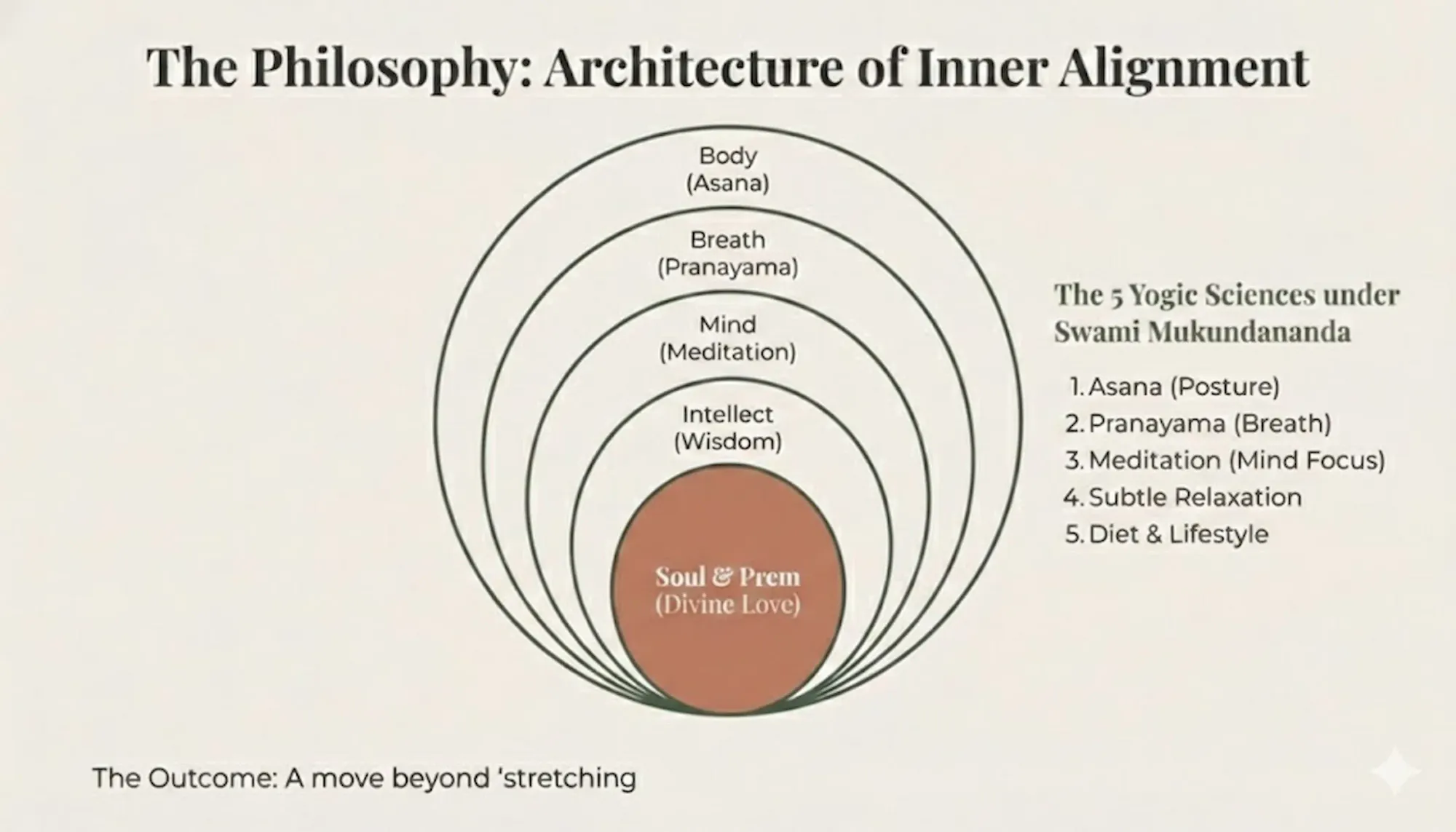
At Radha Krishna Temple of Dallas, yoga is returned to its original sacred definition: Yog—union. Under the guidance of Swami Mukundanandaji, movement is not an end in itself. It is a vehicle for integrating body, mind, intellect, and soul—a weekly return to alignment.
⭐ What You’ll Gain From Weekly Yoga & Meditation at Radha Krishna Temple of Dallas
- A calmer, steadier mind (less reactivity, more clarity)
- Better sleep and deeper relaxation
- Healthier stress response (nervous system reset)
- Improved posture, flexibility, and energy
- A devotional atmosphere that softens the heart
- Community (Satsang) that makes consistency natural
- A weekly “reset point” that changes how you live Monday–Saturday
⭐ Who This Is For
- professionals overwhelmed by constant mental noise
- beginners who feel intimidated by gym culture
- people seeking calm rather than performance
- anyone craving a weekly emotional reset
1) The Sedentary Crisis: “Sitting Is the New Smoking” Is Also a Spiritual Problem
The human body was designed for motion, yet the modern DFW professional landscape rewards a profound and dangerous stillness. We sit at desks in Plano, sit in traffic on the North Texas Tollway, sit in back-to-back meetings in Frisco, and sit again at home to “recover.”
Medical research increasingly refers to this pattern with a striking phrase: “sitting is the new smoking.”
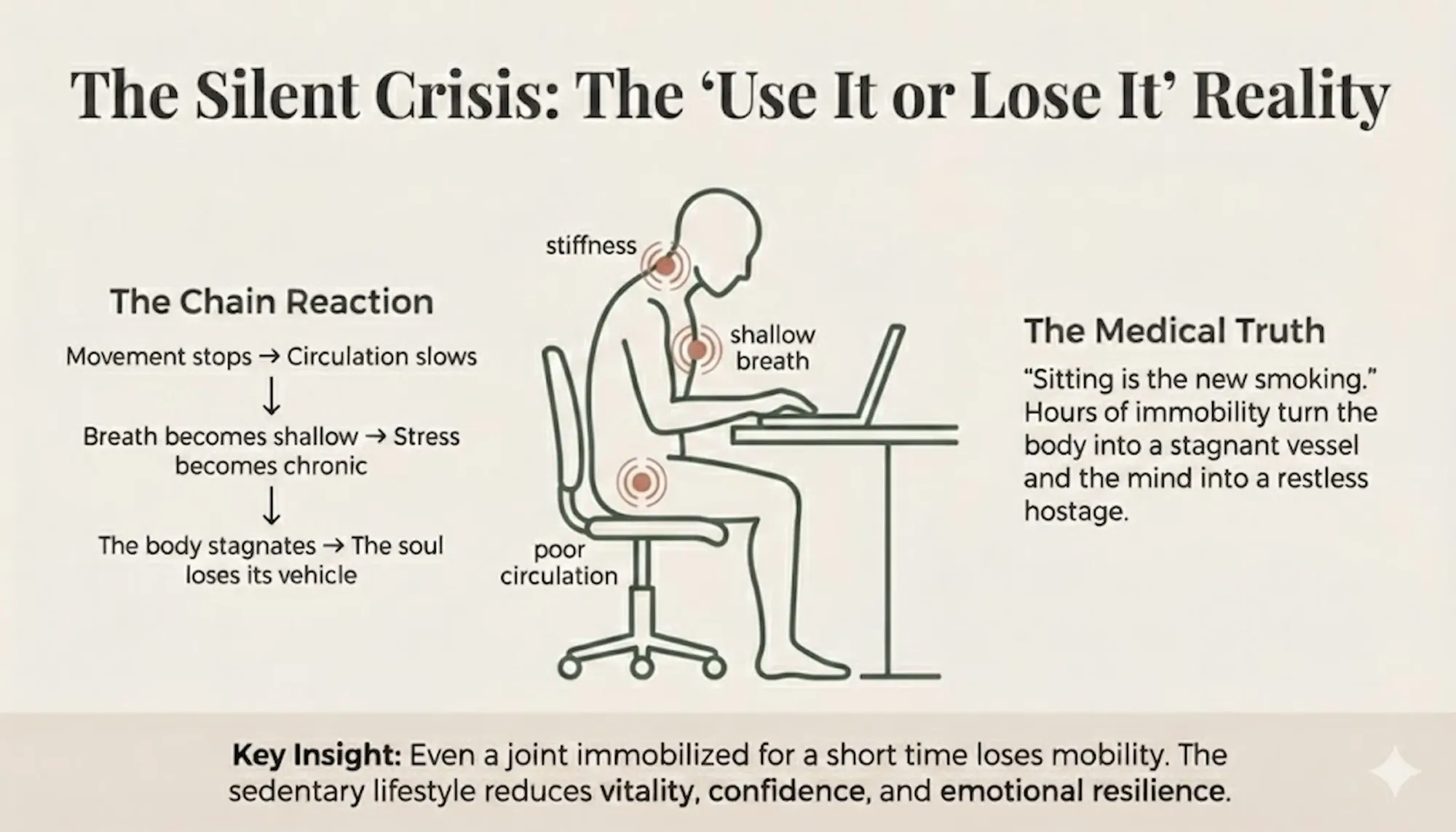
This chronic immobility isn’t merely a physical inconvenience. It becomes a systemic erosion:
- joints stiffen
- circulation slows
- shortens muscles
- weakens posture
- breath becomes shallow
- energy drops
- stress becomes default
- emotional resilience declines
And the mind mirrors the body. When the body becomes stagnant, the mind often becomes restless like a loop that never stops scanning, predicting, replaying. Over time, the body becomes a container for fatigue rather than vitality.
Swami Mukundanandaji reminds us that the body is a sacred instrument, a vehicle for dharma through which we fulfill our responsibilities, purpose, capacity to serve others and grow spiritually. When we neglect the instrument, we lose more than mobility; it is a disruption of life’s deeper alignment.
Weekly yoga is therefore not just “fitness.” It is maintenance of the vehicle—physical, emotional, and spiritual.
Why yoga works as an antidote?
Yoga provides the antidote through intentional movement, breath awareness, and mental focus.
The Prem Yoga at Radha Krishna Temple of Dallas approach is comprehensive:
- joint mobilization (not just hips—everything from “eyes to toes”)
- spinal alignment (supporting nerve function and posture)
- improves circulation
- breathwork (regulating the stress response)
- twists and compressions (stimulating internal organs and circulation)
- mindful movement (retraining the mind to stay present)
But the biggest shift is psychological: showing up weekly sends your subconscious a message stronger than any motivational quote:
“I am taking care of myself.”
That single message builds self-trust—an essential medicine in a world that constantly drains it.
Swami Mukundanandaji teaches that the body may tire from activity, but the soul tires from disconnection. Yoga restores that connection.
2) The 90/10 Truth: Why Mind Matters More Than Muscles
Swami Mukundanandaji often emphasizes a powerful reframe - yoga is 90% mental and 10% physical.
That does not mean the body is unimportant. It means the body is not the final goal.
In modern wellness culture, physical IQ is celebrated: strength, flexibility, endurance. But JKYog brings attention to Spiritual IQ—the ability to govern the mind, soften the ego, and live from inner stability.
Because what truly determines your quality of life is not your biceps. It is:
- how you respond under stress.
- how quickly you recover emotionally.
- how stable your mind remains during uncertainty.
- how much peace you carry into your relationships.
- how deeply you sleep.
- how gently you speak.
Weekly yoga and meditation at Radha Krishna Temple at Dallas is built to cultivate this inner mastery—not as ideology, but as lived practice.
3) Mastering the Monkey Mind: Yoga as Mind Management
The Bhagavad Gita describes the mind as “restless like the wind.” That line hits home in a world of constant notifications and constant expectations.
Even if your life is objectively “good,” the mind can remain a restless hostage—replaying emails, anticipating conflict, chewing on fear, reliving regret.
At Radha Krishna Temple of Dallas, yoga is practiced as a Science of Mind Management, not just physical exercise. Swami Mukundanandaji explains that true transformation comes when we learn to guide the mind rather than fight it.
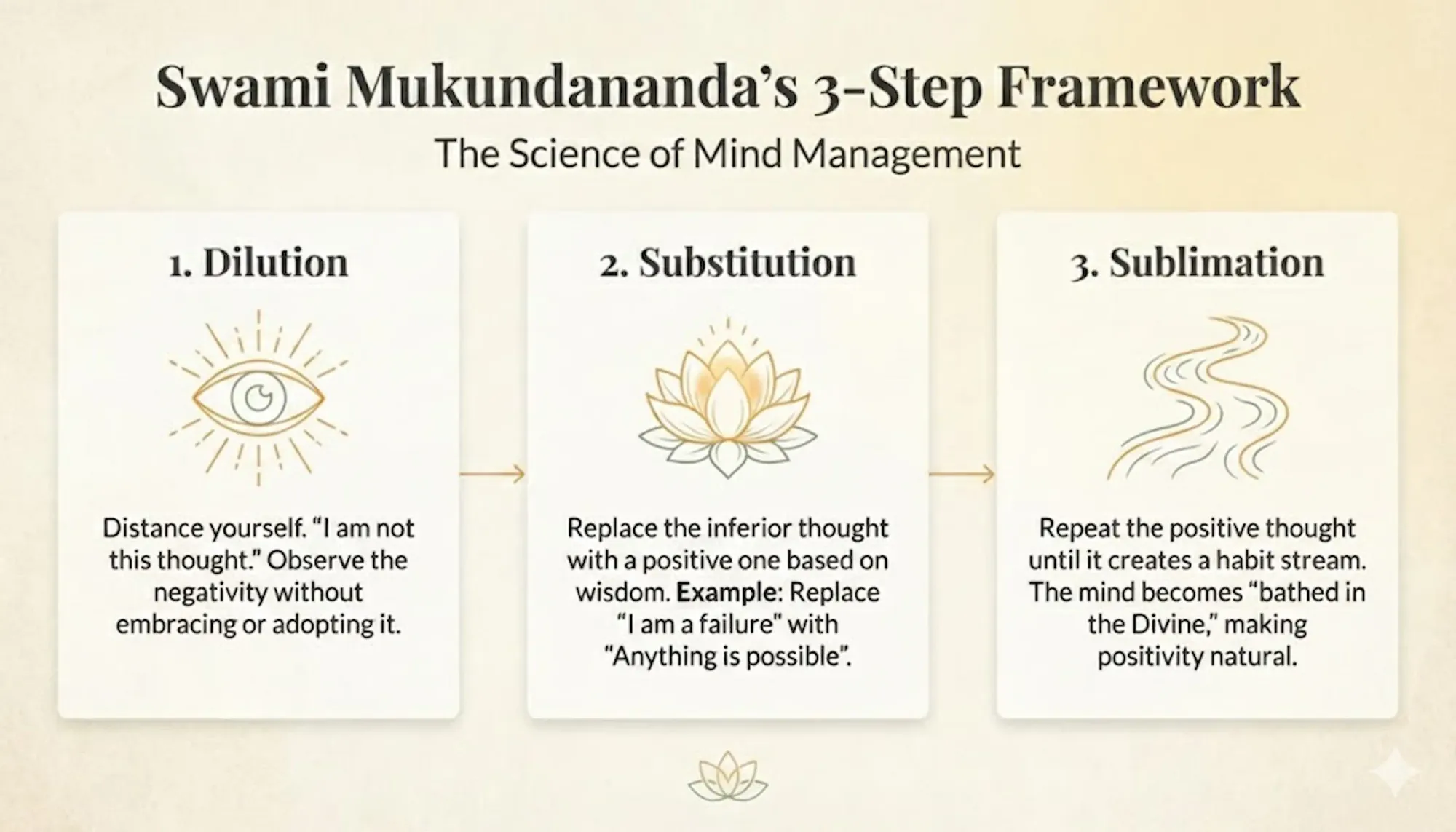
This approach follows a three-step psychological framework:
Step 1: Dilution
When a negative thought arises, our instinct is to engage it:
“Why am I anxious?” “What if this goes wrong?”
But engagement fuels the thought.
Dilution means witnessing without feeding:
“My mind is producing noise.”
You become the observer—not the prisoner.
Step 2: Substitution
The mind cannot remain empty. If you remove one thought, another will rush in. So, the intellect must replace inferior thoughts with higher ones:
- “I can’t handle this” → “I have handled challenges before.”
- “I’m failing” → “This is feedback, not identity.”
Step 3: Sublimation
Ultimately the mind needs a higher anchor - something sublime. In JKYog, devotion is not separate from psychology; it is the stabilizer. When the mind is turned toward gratitude, divine remembrance, or higher meaning, it stops chewing on fear.
This process gradually retrains the mind to settle. Instead of reacting automatically to stress, practitioners learn to respond consciously. Over time, this shift affects work performance, relationships, and emotional health.
This is why meditation (especially Roop Dhyan) is so central: it gives the mind an object that elevates rather than agitates.
4) The Temple Environment as “Wellness Technology”
Environment shapes experience. A typical gym environment is designed for stimulation—noise, mirrors, performance, comparison.
A temple environment offers something quieter and more supportive.
At the Radha Krishna Temple of Dallas, the atmosphere itself becomes part of the practice:
- softer soundscape
- non-competitive energy
- reverence and quiet
- a natural inward turning
This matters because your nervous system is always reading the room. The temple space helps the system move out of defense mode. It invites an exhale from the identity you’ve been gripping all week.
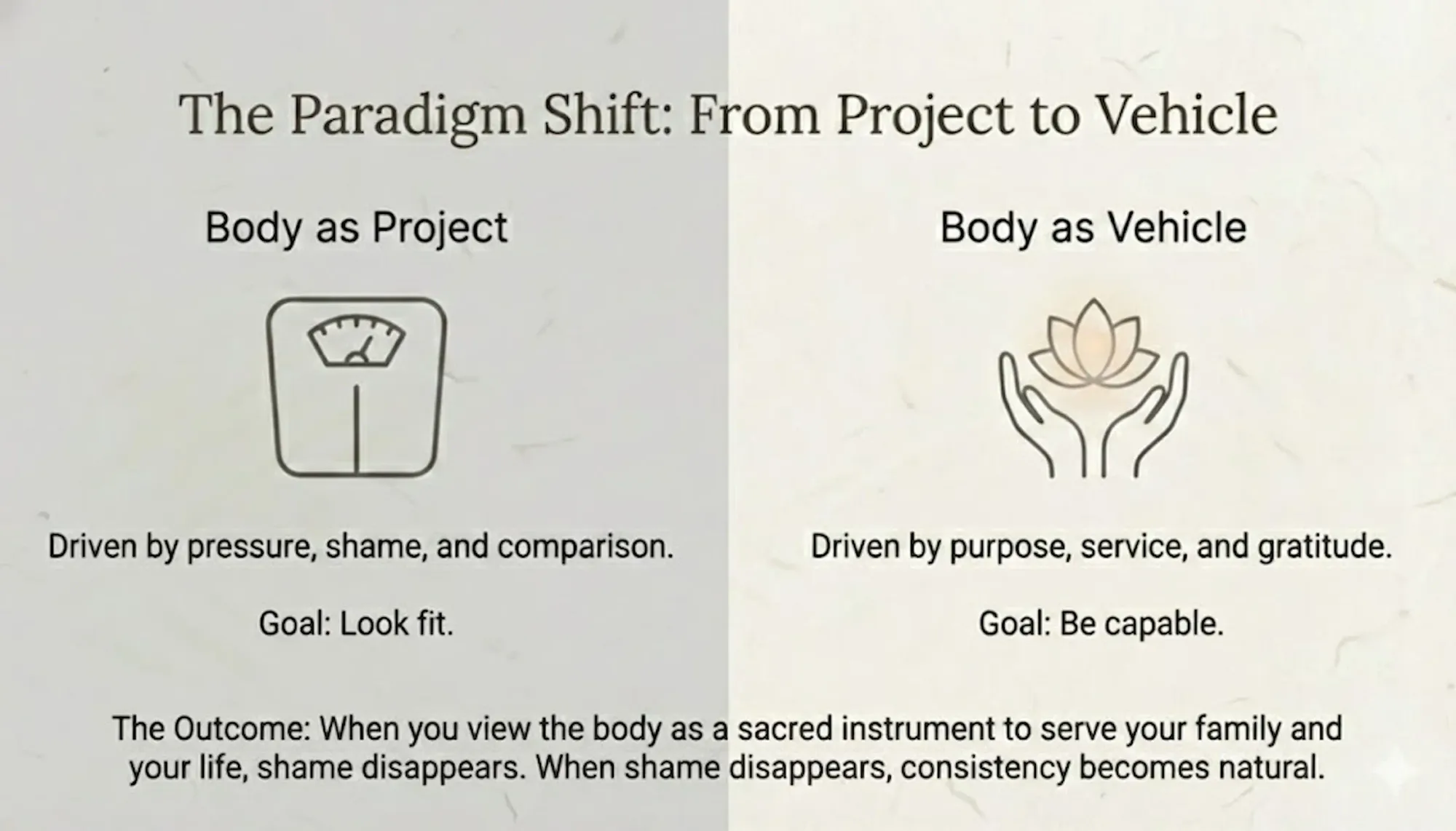
Body-purpose, not body-image
In a sacred setting, the body is not treated like a project to fix. It is treated like a vessel to honor—so you can live well, serve well, love well, and fulfill your duties with steadiness.
When the focus shifts from appearance to purpose:
- shame dissolves
- consistency becomes natural
- comparison loses power
- peace becomes more available
5) Prem Yoga: What Makes This Path Different
“Prem” is the Sanskrit word for Divine Love—selfless, unconditional, ever-increasing love. Swami Mukundanandaji teaches that the deepest longing of the human heart is not for more achievement, but for this eternal love.
When Prem is infused into yoga, the intention shifts. Instead of practicing to improve appearance or performance, we practice to connect, heal, and grow. Movement becomes meaningful, meditation becomes personal, and consistency becomes natural.
This is why many people find that the practice feels different here
- yoga stops being mechanical exercise
- it becomes healing
- it becomes inspiration
- it becomes inner awakening
Yoga means union—union of body, mind, heart, and soul with God. When you practice with that sankalp (intention), the mat becomes more than a mat. It becomes a place where your inner world is reorganized.
6) Prem Yoga Academy: A Deeper Learning Pathway
Prem Yoga Academy (PYA) was founded by Swami Mukundanandaji in 2020 to serve as a vibrant hub for the yoga community in the US and worldwide, giving practitioners access to the deeper teachings of Prem Yoga.
For those who feel called to go deeper—whether for personal growth or teaching—Prem Yoga Academy offers ongoing resources and support. Graduates of the Prem Yoga Teacher Training (PYTT) benefit from continued guidance to deepen their practice and transition into teaching with authenticity and depth.
This matters because yoga is not just something you “attend.” Over time, it becomes something you live.
7) Meditation, Mantra, and Kirtan: Why the Heart Needs Sound
Many traditions describe creation as beginning with vibration. The Vedas speak of the primordial vibration as OM—the essence underlying creation.
Chanting and kirtan are not entertainment; they are inner alignment through sound. Kirtan opens the flow of inner sentiment, softens the heart, and focuses the senses on the highest subjects.
In our age of distraction, Swami Mukundanandaji has said kirtan is among the easiest paths to:
- purify the mind
- soften the heart
- connect to God
- transform oneself
If yoga trains the body and mind, kirtan nourishes the heart—the place where real healing begins.
8) Community as Medicine: A Form of Healing
Most wellness journeys fail in isolation. Not because people are lazy—because life is heavy. Community strengthens consistency.
Satsang means “association with truth”—the company of those who are moving toward inner clarity. In Satsang, the mind naturally becomes calmer. The heart opens. The nervous system relaxes.
Practicing alongside others who value calm and clarity creates accountability and belonging. Over time, the weekly rhythm becomes something people look forward to rather than something they push themselves to do.
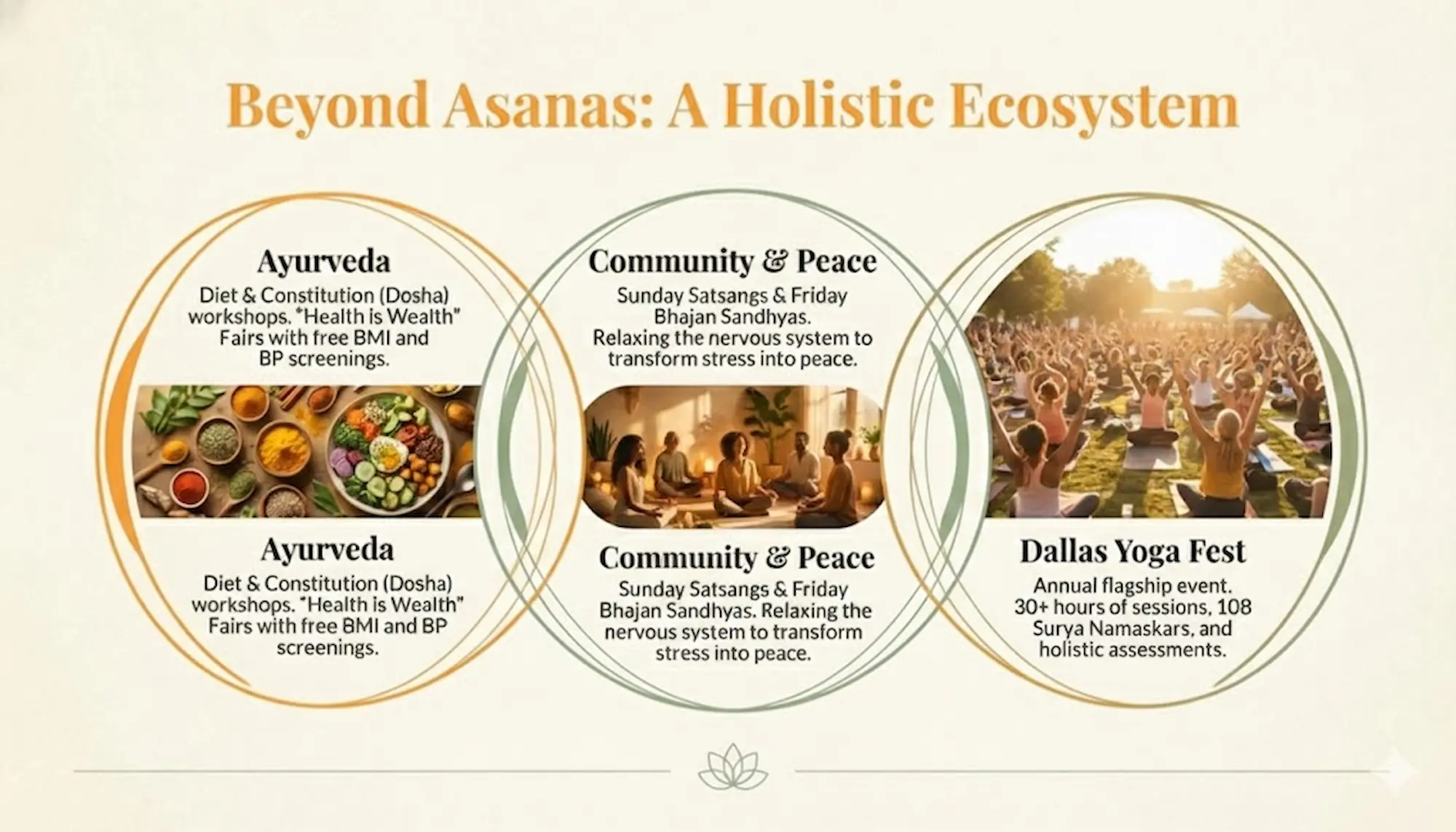
Large community initiatives such as Dallas Yoga Fest and the Health is Wealth Fair further reinforce this idea: wellness is not just personal — it is shared.
This is why Radha Krishna Temple of Dallas is not only a place to practice yoga. It’s a place to belong.
When wellness becomes communal, it becomes sustainable.
9) The Weekly Blueprint for Inner Alignment: How to Begin
You don’t need a dramatic reinvention. You need a steady point of return.
For residents across Allen, Plano, Frisco, and the wider DFW area, the temple offers simple entry points into this journey.
Best entry point
Free Sunday Community Yoga (9:00 AM – 10:00 AM CST)
A weekly reset available in-person and online (Zoom)
Prem Yoga Membership
Introductory month for deeper consistency and practice.
Purnima Healing Sessions
Restorative full-moon sessions with Yin Yoga, Yoga Nidra, and sound healing.
Location
1450 N. Watters Rd, Allen, TX 75013
Convenient for Plano, Frisco, McKinney, North Dallas, and across DFW.
What changes over time (realistic milestones)
Transformation rarely happens overnight. Instead, it unfolds gradually.
- 1 week: calmer, lighter, more present after the weekly reset
- 3 weeks: improved sleep, posture, breath depth
- 6 weeks: softer stress reactions; more responding, less reacting
- 12 weeks: yoga becomes identity—practice shifts from fixing yourself to honoring the instrument
This is when yoga shifts from something you do to something that supports who you are.
Key Takeaways
- Wellness without inner stability becomes burnout in disguise.
- Yoga is 90% mind: the real transformation is emotional regulation and mental mastery.
- The temple environment supports the nervous system in ways typical gyms can’t.
- Prem Yoga infuses practice with Divine Love, turning mechanics into meaning.
- Satsang and kirtan nourish the heart—often the missing piece in modern wellness.
- A weekly reset is more powerful than occasional intensity.
The Turning Point
If your routine keeps you functioning but not fulfilled, perhaps the missing element is not effort but alignment.
True wellness is defined not by how intense your workouts are, but by how steady you feel in daily life — how you breathe in traffic, how you speak under pressure, how peacefully you sleep at night.
A single weekly reset in a spiritually grounded environment can initiate a deeper transformation than years of isolated effort.
You do not need a dramatic reinvention.
You only need a steady point of return.
Attend a Sunday session.
Visit once.
Notice how you feel.
Let the experience speak for itself.
If your life feels full but not peaceful, this may be the simplest step toward changing that.
Call to Action
If your life feels full but not peaceful, this may be the simplest step toward changing that.
You can explore classes and programs here:
Radha Krishna Temple of Dallas Yoga & Meditation
https://www.radhakrishnatemple.net/yoga
FAQ
1) Do I need to be Hindu to attend?
No. Yoga, breathwork, and meditation are universal practices. The environment is welcoming to all backgrounds.
2) Is this beginner-friendly?
Yes. The Sunday community session is accessible to beginners, with guidance for safe practice. Many participants start with no prior experience.
3) What should I bring?
A yoga mat, water bottle, and comfortable modest clothing suitable for movement.
4) Are there online options?
Yes. Some sessions, including the Sunday offering, are available via Zoom.
5) Where is the temple located?
1450 N. Watters Rd, Allen, TX 75013—easy access from Plano, Frisco, McKinney, and across DFW.
Related Blogs that you may be interested
 RKT Blog Team
 RKT Blog Team
 RKT Blog Team