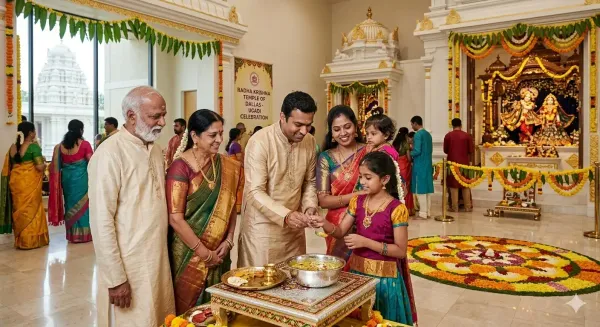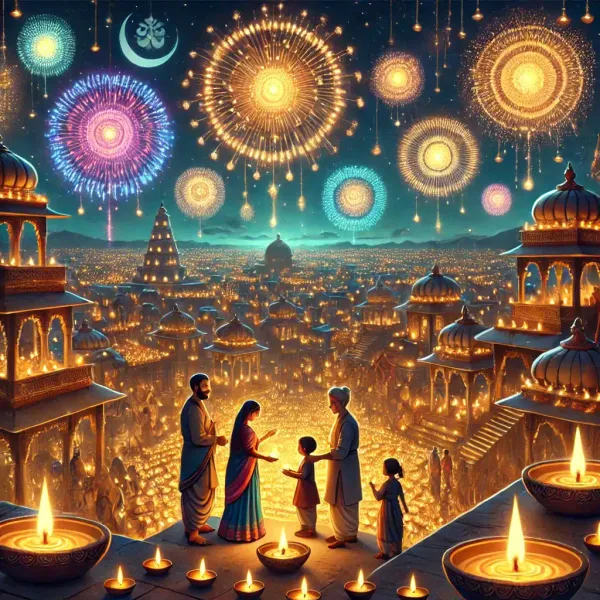
This piece covers one of the main messages of Diwali from Swami Mukundananda. It is a reflection on Lord Rama, Inner Illumination, and the Correct Way to Celebrate the Festival of Lights.
Diwali, the festival of lights, is one of the most joyous occasions in Indian culture. It fills our homes with the scent of incense, the sound of laughter, and the warm glow of countless diyas flickering in the night. Beyond the celebrations, sweets, and fireworks lies a profound spiritual message that has echoed across millennia.
Swami Mukundananda invites us to revisit the true essence of Diwali, not merely as a ritualistic or cultural event, but as a moment of awakening. Drawing from the Ramayana, the Bhagavad Gita, and the Upanishads, Swamiji reminds us that the real Diwali is not an external celebration but an inner transformation.
The Origin of Diwali: A Celebration of Reunion
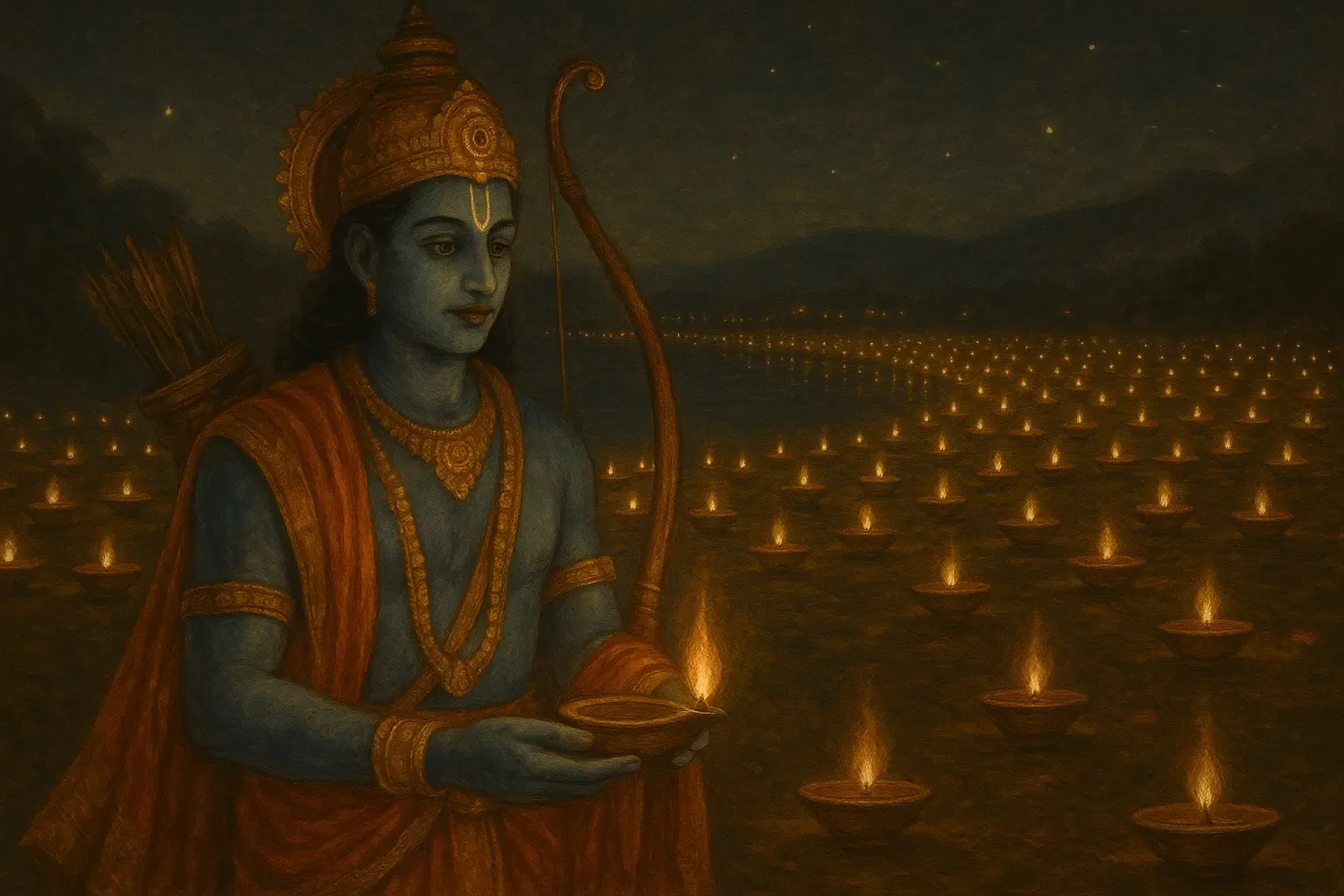
The word Diwali originates from the Sanskrit Deepavali, meaning “a row of lights.” The tradition of illumination dates back to the time of Lord Ram, the embodiment of righteousness (Dharma).
When Ram was exiled from Ayodhya due to the intrigues of Queen Kaikeyi, the entire city was plunged into sorrow. For fourteen long years, the people waited in hope, their hearts yearning for their Lord’s return. When that day finally arrived and Lord Ram, Mother Sita, and Lakshman returned to Ayodhya after vanquishing Ravan, the citizens celebrated with unbridled joy. They lit lamps across every street, every home, every heart, to welcome the light of righteousness back into their lives.
That moment, according to Swamiji, is the true spirit of Diwali: the celebration of divine reunion.
Swamiji explains that when the Ayodhyavasis lit lamps to welcome Lord Ram back, they were celebrating the return of God into their lives. In the same way, Diwali calls us to bring the Lord back into our hearts.
Just as Ayodhya rejoiced when illuminated by Rama’s presence, so too must we light the lamps of devotion within, dispelling the darkness of ego, greed, and ignorance that separate us from our divine essence.
The Mistake We Often Make on Diwali
Swamiji cautions that while we take great joy in the outward festivities, such as decorating homes, exchanging gifts, and bursting fireworks, we often neglect the inner purpose of Diwali. The mistake is not in celebration itself, but in forgetting why we celebrate.
He advises us to do all the customary things, but let us make this Diwali one that nourishes us spiritually, uplifts us ethically, and transforms our souls eternally.
The lights and lamps symbolize knowledge and wisdom, but their true significance is lost if they do not lead us to the inner light — the realization of our divine nature.
Light and Darkness: Symbols of Knowledge and Ignorance
Throughout world traditions, light has been a symbol of truth, awareness, and knowledge. Darkness, on the other hand, represents ignorance, which is the absence of true vision. However, what is light to one may be darkness to another.
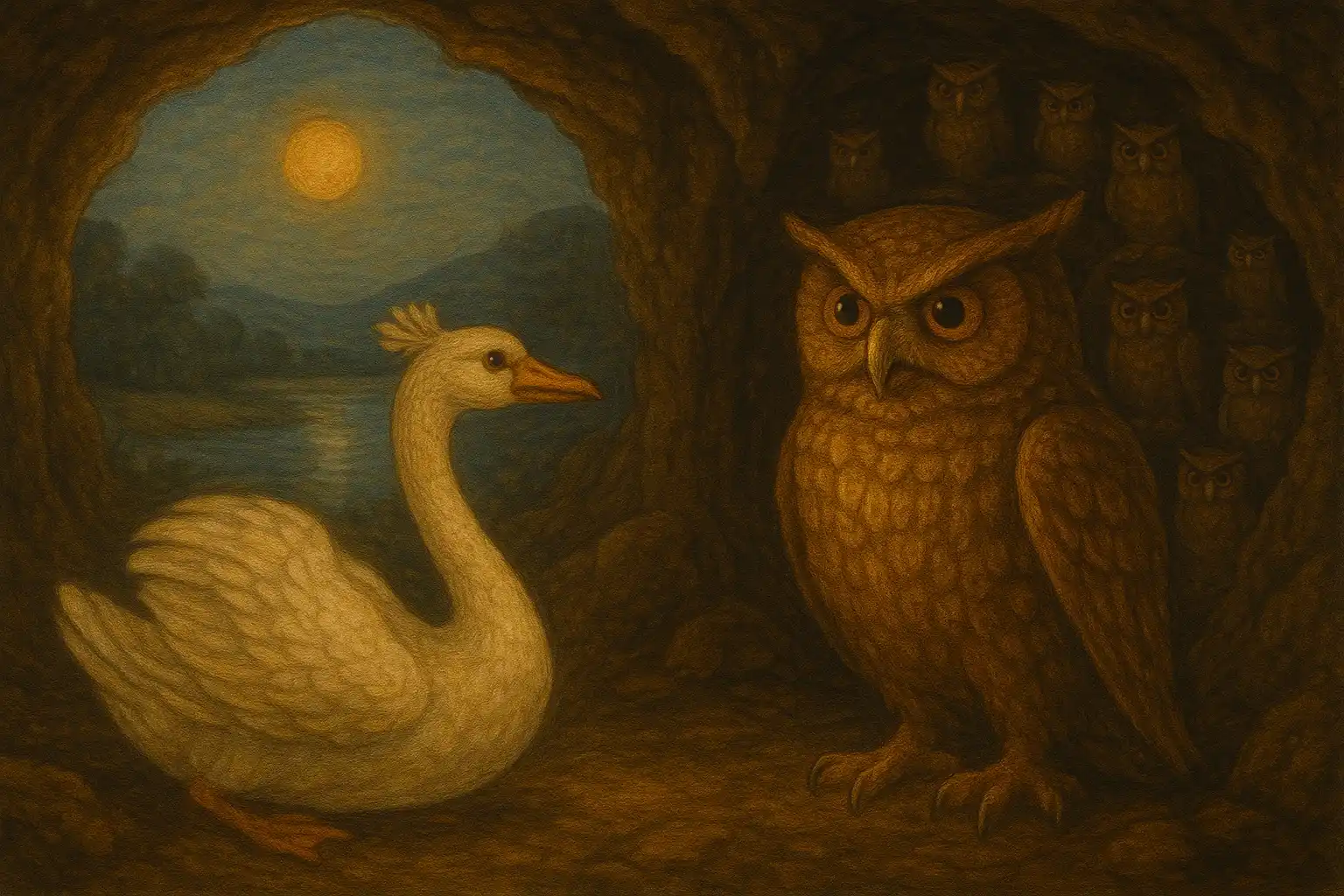
Swamiji beautifully illustrates this through an allegory of the swan and the owl:
One day, a swan and an owl argued about whether it was day or night. The owl, unable to bear the brightness of the sun, declared that it was nighttime because it could not see. The swan laughed, saying it was midday, but the owl insisted otherwise. Frustrated, the owl dragged the swan into a dark cave full of other owls, who ridiculed the swan for claiming it was day.
The moral of this story is that perception is not the same as truth.
For the owl, daylight is blindness; for the swan, it is clarity. Likewise, ignorance blinds the worldly mind, while the same world appears illuminated to one who is spiritually awakened.
In the Bhagavad Gita 2.69, Shree Krishna declares: What all beings consider as day is the night of ignorance for the wise, and what all creatures see as night is the day for the introspective sage.
Shree Krishna has used day and night figuratively here. People often confuse the meaning of this verse by taking the words literally. Let us try and understand the true meaning of Shree Krishna’s words. Those who are in mundane consciousness look to material enjoyment as the real purpose of life. They consider the opportunity for worldly pleasures as the success of life, or “day,” and deprivation from sense pleasures as darkness, or “night.” On the other hand, those who have become wise with divine knowledge, see sense enjoyment as harmful for the soul, and hence view it as “night.” They consider refraining from the objects of the senses as elevating to the soul, and hence look on it as “day.” Using those connotations of the words, Shree Krishna states that what is night for the sage is day for the worldly-minded people, and vice versa.
To the ignorant, the spiritual life appears dark and meaningless. To the wise, the world of material attachments, that of greed and pride, is the real darkness.
The Dream of the World: Tulsidas and the Sleep of Ignorance
Swamiji quotes the work of the poet-saint Goswami Tulsidas, who wrote in the Ramcharitmanas:
“Mohan nisha sabaso vana hara”
“All souls are sleeping in the night of illusion (moh), dreaming endless dreams.”
In that slumber, we dream of being great managers, artists, politicians, or scholars, but these are dreams of the ego, not the wakefulness of the soul. The enlightened person, Swamiji explains, is one who has awakened from this dream, detached from worldly allurements, and turned towards the light of truth.
The Parable of the Man in the Forest: The Trap of Worldly Illusion
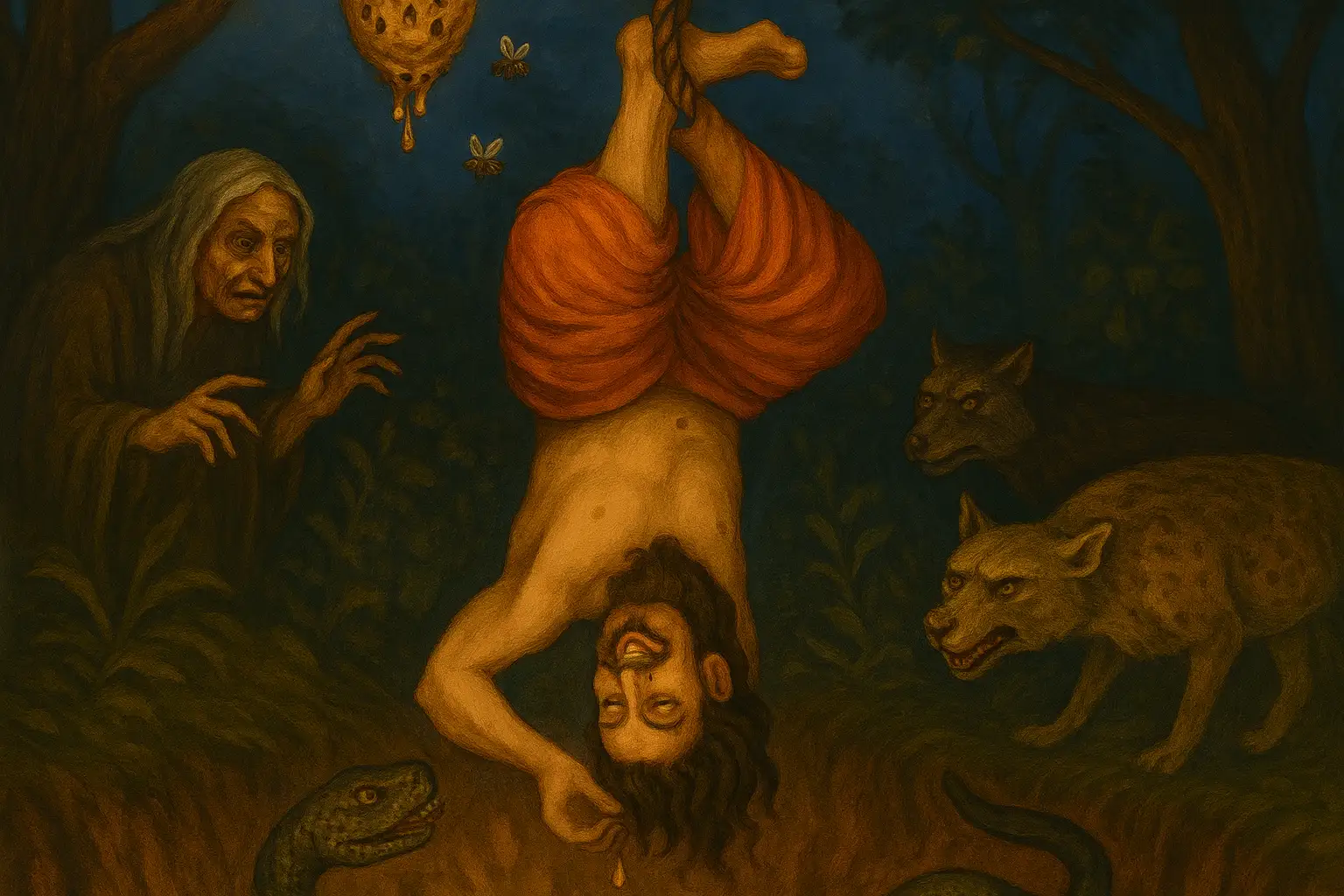
To reveal the human condition, Swamiji often shares this profound parable.
A man once wandered into a dense forest. As night fell, he realized he was lost. Strange creatures, such as wolves and hyenas, emerged, forcing him to run deeper into the jungle. Suddenly, an old witch appeared, calling out to embrace him. Terrified, he fled again, only to fall into a pit.
Hanging upside down by a vine, he noticed a snake waiting below, ready to bite him. Above, two mice, one black and one white, began gnawing at the vine. Meanwhile, bees stung his face, and a beehive dripped a few drops of sweet honey into his mouth. Despite his peril, the man smiled, savoring the honey.
Swamiji explains that this is the story of every human being in this world.
- The forest represents the material world, full of dangers and uncertainties.
- The wild animals are diseases and life’s struggles.
- The witch symbolizes old age.
- The snake is death, inevitable and ever waiting.
- The two mice, day and night, are constantly shortening our lifespan.
- The bees represent endless desires and mental agitation.
- And the drops of honey represent the fleeting pleasures of the senses, which keep us distracted from our perilous reality.
We, too, hang upside down in this precarious world, chasing after the sweetness of temporary joys while forgetting the ultimate truth of our existence.
Swamiji advises us that this is the state of ignorance, and Diwali reminds us to awaken from it.
The Upanishadic Prayer: From Darkness to Light
To transcend this darkness, Swamiji encourages us to recite and understand the timeless Sanskrit prayer from the Brihadaranyaka Upanishad:
“Asato mā sad gamaya,
Tamaso mā jyotir gamaya,
Mrityor mā amritam gamaya,
Om Shanti Shanti Shanti.”
Meaning:
O Lord, lead me from untruth to truth, from darkness to light, from death to immortality.
This is the true essence of Diwali, which is not merely a night of fireworks, but a call for inner awakening. The lamps we light symbolize this very journey, from ignorance to wisdom, from forgetfulness to remembrance, from mortality to eternal consciousness.
Why We Suffer: Forgetfulness of God
Swamiji points out that the root cause of human suffering is forgetfulness of the Divine. The Shvetashvatara Upanishad of the Yajur Ved explains that Maya, the material energy, envelops us in darkness because we have turned our backs to God, the supreme light.
Like Ayodhya without Ram, our hearts too become barren when separated from divine presence. Diwali, therefore, is the time to turn around and to face the light once again.
“When we turn our attention back to God,” Swamiji says, “the darkness of ignorance disappears on its own, just as the night vanishes when the sun rises.”
The Correct Way to Celebrate Diwali
Swamiji emphasizes that Diwali should be joyous and cultural, embodying a celebration that unites families and communities, but with a higher purpose. A festival must, of course, be fun, but it must also be elevating.”
Thus, beyond the external festivities, Diwali is an invitation to:
- Cleanse the mind, just as we clean our homes. Remove the dust of negative thoughts, resentment, and ego.
- Light the inner lamp of faith, gratitude, and knowledge.
- Offer our actions to God, transforming daily work into divine worship.
- Serve others selflessly, for service is the flame that sustains the light of devotion.
When we do this, every act, be it cooking, working or speaking, becomes an offering to the Divine.
The Diwali of Devotion: Bringing God into Every Moment
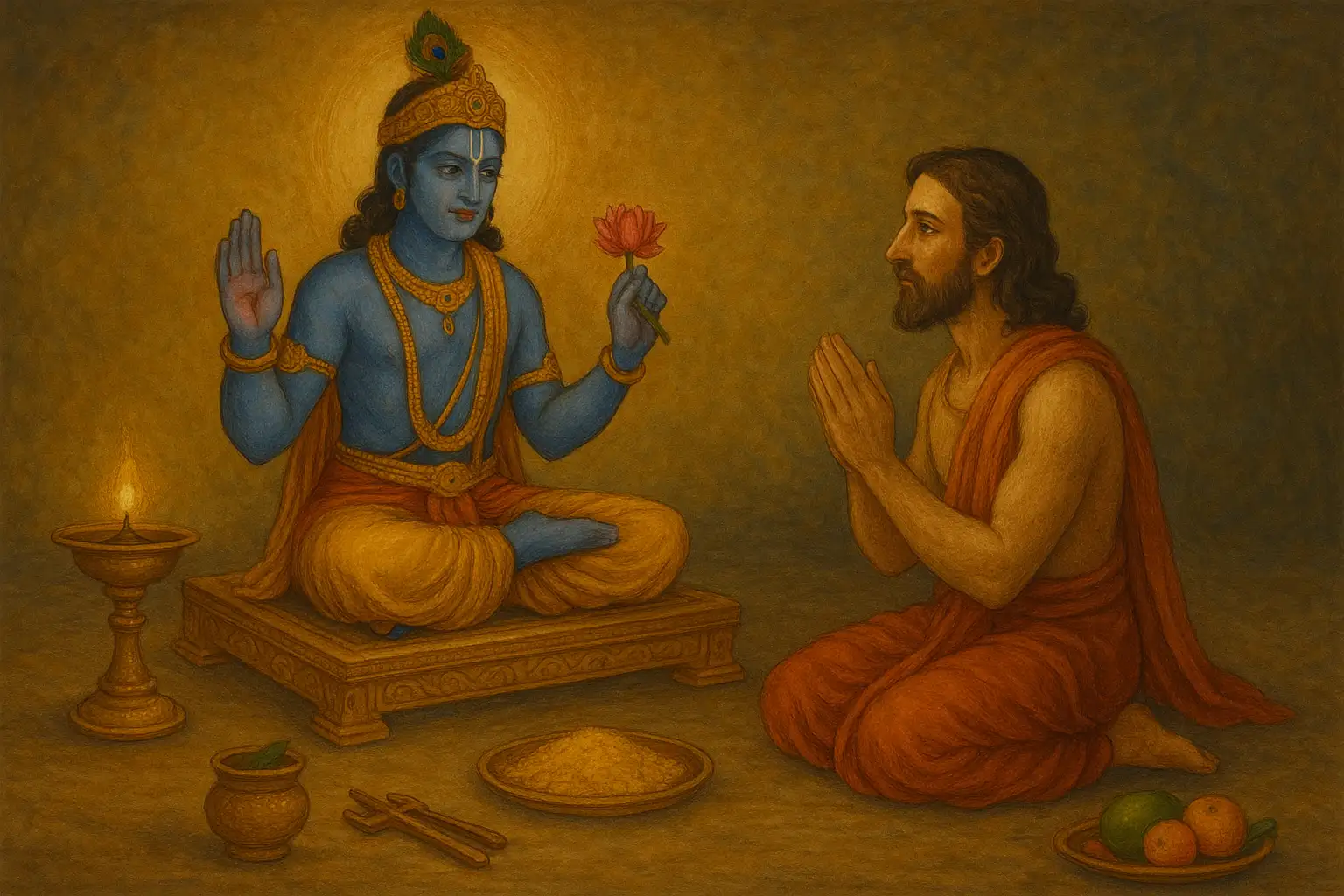
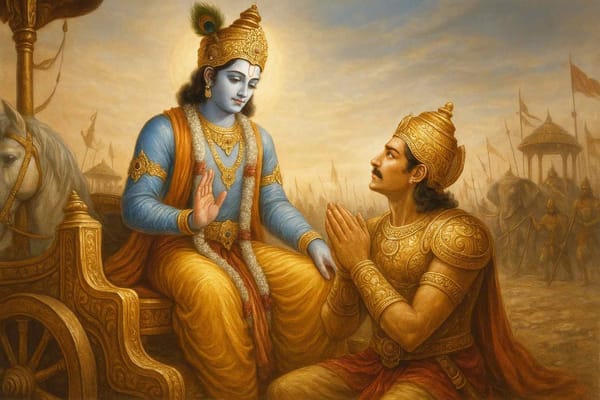
In the Bhagavad Gita (9.27), Shree Krishna gives Arjuna a simple formula for divine living: Whatever you do, whatever you eat, whatever you offer as oblation to the sacred fire, whatever you bestow as a gift, and whatever austerities you perform, O son of Kunti, do them as an offering to Me.
Swamiji explains that when this principle becomes our way of life, every day becomes a Diwali. Each moment becomes an act of worship, and every action radiates inner light. When we bring God into our lives, we discover the bliss we were always searching for; the divine knowledge and perfect love that alone can satisfy the heart.
Diwali and the Journey Within
The outward lamps of Diwali are reflections of the five inner sheaths (koshas) that comprise the human personality: the physical, energy, mental, intellectual, and bliss sheaths. When the mind is purified and illuminated with wisdom, these layers harmonize, revealing the divine light within the Anandamaya Kosh, the sheath of bliss.
Lighting the diyas in our homes is a ritual reminder to ignite this same brilliance in the heart, to restore harmony among the layers of our being, from the physical to the spiritual.
This, Swamiji teaches, is the highest form of celebration — where illumination is not limited to lamps, but extends to consciousness itself.
The Festival as a Cultural Bridge
Swamiji also highlights that festivals like Diwali preserve the living spirit of our culture. They are not merely occasions of joy but vessels of heritage, connecting us to our ancestors, values, and divine ideals.
When we celebrate Diwali with understanding, it becomes not just a social gathering but a spiritual pilgrimage, one that begins in the home and culminates in the heart.
Let our children not just remember Diwali for fireworks and sweets, but for its lessons of compassion, selflessness, and faith.
Turning Daily Life into Divine Life
Spirituality, Swamiji often reminds, is not confined to the temple or meditation room. Its true purpose is to infuse our daily actions with divine remembrance.
The lighting of lamps, the sharing of sweets, the worship of Goddess Lakshmi, all are symbolic acts. Lakshmi represents not just material wealth but the prosperity of the soul, which is purity, faith, and contentment.
When we approach life itself as an act of devotion, when every breath is a remembrance of God, we no longer wait for festivals. Life itself becomes a continuous celebration.
Conclusion: From Outer Light to Inner Radiance
As the night of Diwali unfolds, the world glows with countless lamps. But the true Diwali dawns when we light the lamp within, and our hearts become radiant with divine love and understanding.
“Bring the Lord into your heart,” says Swamiji. “Unite your consciousness with Him in a spirit of loving surrender.”
Let this Diwali not end with the extinguishing of lamps, but begin with the kindling of awareness. Let it not remain a festival of lights outside, but become a festival of enlightenment within.
When we remember the Divine in every act, every thought, every moment, then every day becomes a Diwali.
Frequently Asked Questions (FAQs)
1. What is the spiritual meaning of Diwali according to Swami Mukundananda?
Swami Mukundananda explains that Diwali symbolizes the return of divine light. Just as the people of Ayodhya welcomed Lord Rama, we must welcome God back into our hearts. The festival reminds us to replace ignorance with wisdom and ego with love.
2. What mistake do people often make when celebrating Diwali?
We focus too much on external celebrations such as lights, sweets, and social events, and forget the inner purpose. Swamiji urges us to also purify the mind, practice gratitude, and connect with the Divine, which makes Diwali truly meaningful.
3. How can we bring the spiritual message of Diwali into daily life?
By practicing devotion in every action, as Lord Krishna teaches in the Bhagavad Gita: “Whatever you do, do it as an offering unto Me.” When we live with divine remembrance, every day becomes a Diwali.
4. What does the lighting of diyas signify spiritually?
The diya symbolizes the light of knowledge and truth. Lighting a lamp represents dispelling ignorance and awakening the divine consciousness within. The outer lamps remind us to illuminate our inner world.
5. How can Diwali help us overcome material attachment and suffering?
Swamiji explains that suffering stems from forgetfulness of God. When we turn toward the Divine, the darkness of ignorance dissolves. Diwali is a time to redirect our consciousness to the light of devotion and wisdom.
Call to Action
✨ Light your inner lamp this Diwali! ✨
Join the festivities at the Radha Krishna Temple of Allen, Texas, and celebrate Diwali not only with lights and joy, but with inner reflection, prayer, and transformation. More details and registration available at: https://www.radhakrishnatemple.net/diwali-mela-dallas
💛 Experience the real Deepavali: the victory of truth, wisdom, and divine love, through JKYog’s online sessions, discourses, and programs that bring ancient wisdom to modern life.
👉 Visit www.jkyog.org to explore upcoming events, guided meditations, and Swamiji’s wisdom series on living with light, purpose, and peace.
References:
Swami Mukundananda. Bhagavad Gita: The Song of God – Commentary by Swami Mukundananda. JKYog, 2022.