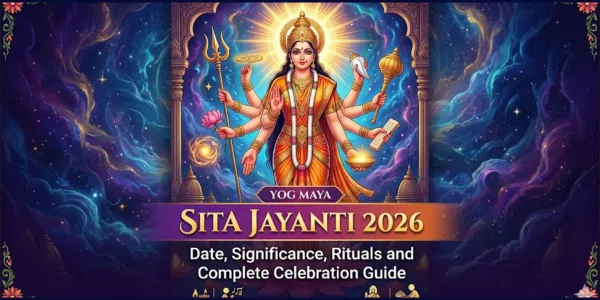
Sita Jayanti 2026 is not just a celebration – it is a doorway into one of the most powerful spiritual lives ever lived.
Who Is Mother Sita? Meaning of Sita Jayanti Explained
There are birthdays and then there are cosmic arrivals.
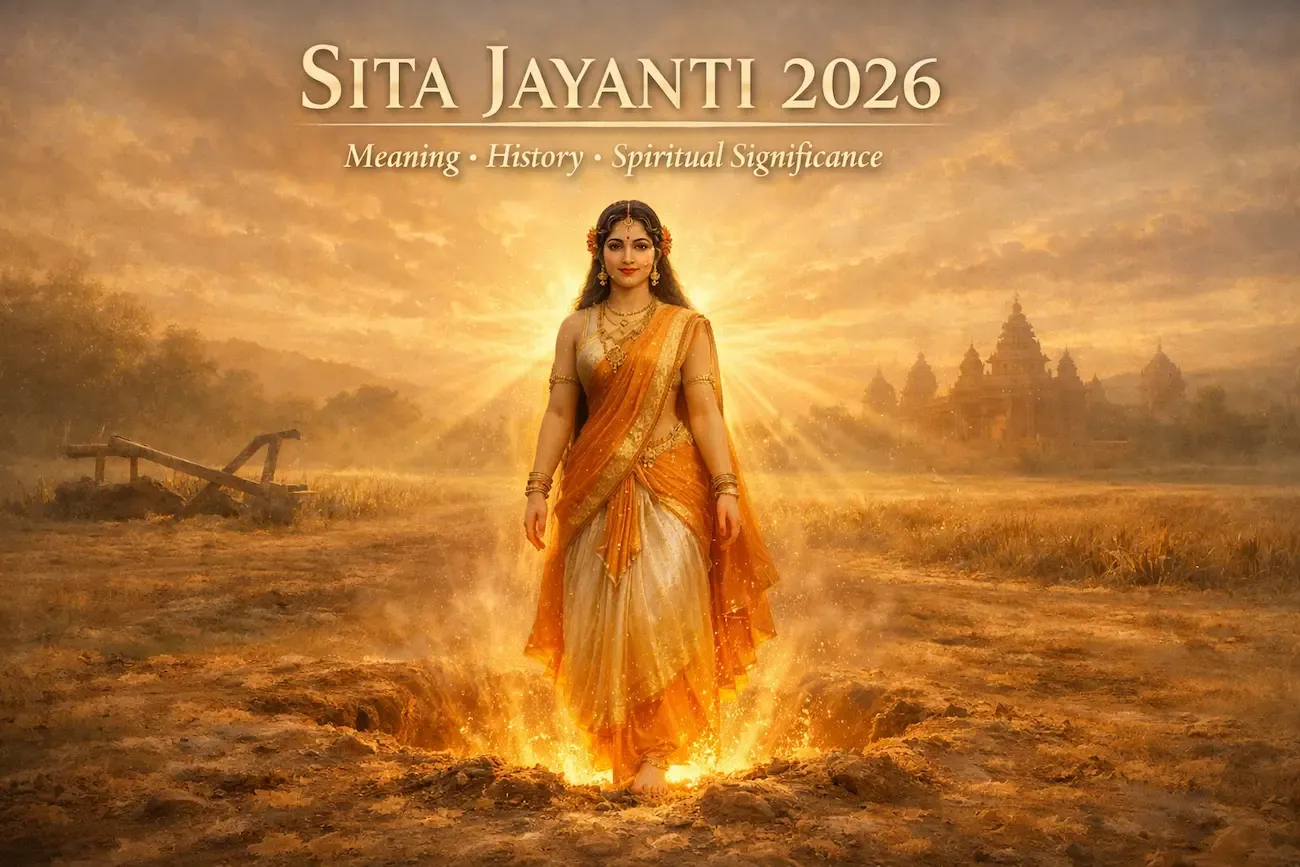
On a quiet afternoon in the fields of ancient Mithila, King Janak’s plough struck something unexpected. The earth opened. From it emerged a golden casket. Inside lay a child – so luminous, so inexplicably serene, beyond explanation.
And in that moment, a philosopher-king wept without knowing why.
He named her Sita — she who comes from the furrow, born of the Earth itself.
To understand Mother Sita is to understand her origins: She is Sunaina-suta (daughter of Queen Sunaina) and Janak-suta, discovered by King Janak in a golden furrow as he plowed the earth to end a devastating twelve-year famine in Mithila. As Bhumija (born of the earth), her essence is foundational unyielding, generative, and possessed of a moral sovereignty that dictates the flow of destiny.
In popular imagination she is shown as a weepy, helpless woman a symbol of patient suffering. Maharshi Valmiki, who wrote Ramayan at the very time these events unfolded, paints a picture that surpasses all of these versions. His Sita is an icon of courage, intelligence, dharmic resolve, and love so complete it shook the three worlds.
“Sita’s character is built on a bedrock of self-respect, courage, patience, and faith. She is the ‘Shakti’ the essential power that drives the narrative forward through her conscious decisions.”
The greatest injustice done to Mother Sita is not by Lord Ram, not by Ayodhya, but by how we have chosen to see her. When we see her only as a victim, or reduce her to so-called feminine virtues, we miss everything. She was far, far greater than that. This blog, written in the spirit of Bhakti as illumined by Swami Mukundananda Ji, will walk you through the actual incidents of her life and let her show you herself.
"If sovereignty over the three worlds were placed on one side of the scale, and Sita on the other, the scale would surely tip on Sita’s side."
- Hanuman, Valmiki Ramayan
Sita Jayanti 2026 Date, Tithi & Madhyahna Muhurat
Sita Jayanti 2026 will be observed on Friday, April 24, 2026, in Dallas, based on the Hindu Panchang.
The Navami Tithi, Shukla Paksha, Vaishakha Maas begins at 8:51 AM on April 24 and ends at 7:57 AM on April 25, making April 24 the most appropriate day for observance.
The most auspicious Madhyahna Muhurat (12:06 PM – 2:45 PM) marks the divine appearance period of Mother Sita.
Enter her story not merely as a reader, but as a seeker and let her life do to you what fire could not do to her.
Sita Navami Significance: 7 Choices That Changed the World
Mother Sita's life was not a series of unfortunate events. It was a sequence of deliberate, world-shaping acts of conscious will — each one made with full awareness of the cost, with full intelligence and freedom. As a child, she had effortlessly lifted the massive Shiva Dhanush — the celestial bow that no king in the assembled court could move revealing that her strength was never a matter of muscle, but of spirit. That early sign was the prelude to seven sovereign choices that would bend the course of history.
1. Exile Over Comfort: The Power of Devotional Choice
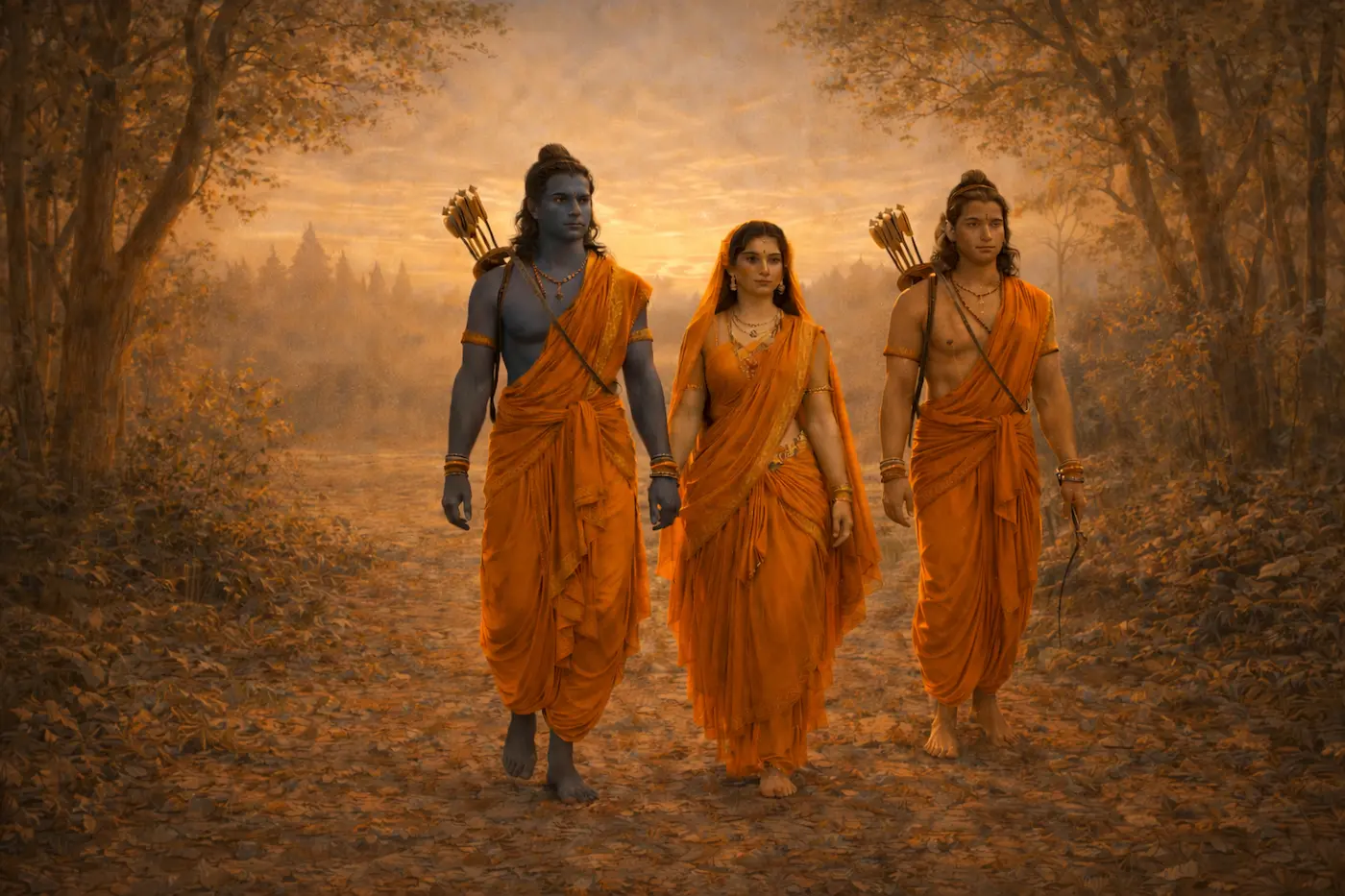
The first incident that truly reveals Mother Sita's character is what she did on the day Lord Ram's world collapsed.
When Mother Kaikeyi's demands reached Lord Ram exile for fourteen years, and Bharat crowned in his place, the palace shook. King Dasharath collapsed in shock. Mother Kausalya wailed. Lakshman raged. Only Lord Ram accepted it with perfect equanimity, because he was Dharmadnya — one who knows dharma and always follows it, whatever the cost.
When Lord Ram returned and Mother Sita saw his face, she trembled. She asked immediately. He told her everything and then counseled her gently to stay behind in Ayodhya, to care for the family, to be safe.
Mother Sita looked at him with affectionate exasperation and said his words were not worthy of being spoken and not worth listening to either. She did not cry. She did not curse Mother Kaikeyi. She did not ask why me. Her response was the same as Lord Ram's uphold dharma, hold no bitterness. But she had one strong objection: Lord Ram was treating her as separate from himself. A husband and wife share one destiny. Whatever was asked of Lord Ram was automatically asked of her.
Heaven is where we are together. Hell is being without you. Whatever difficulties the forest holds I will gladly accept them only to be with you.
- Sita, Valmiki Ramayan, Ayodhya Kanda.
Mother Sita was not required to go. That was never Mother Kaikeyi's demand. She was a princess of Mithila, a daughter-in-law of the Solar dynasty. She could have remained in comfort and complete honor. She chose with full awareness of the cost, with full intelligence and freedom — to go into fourteen years of hardship.
This is not submission. This is sovereign devotion. This is love chosen with full awareness. The first and defining act of a free soul choosing love over comfort with her eyes fully open.
And life in the forest was not unbroken tragedy. Valmiki shows us a Mother Sita who was curious, bubbly, even playful hiding in the forest just to make Lord Ram search for her. Lord Ram told her in Chitrakoot: 'For me, being here with you is more delightful than living in Ayodhya.' Their partnership was real, joyful, and mutual. She was not shy of disagreeing with him either — when Lord Ram promised the forest sages he would fight Ravan's demons; Mother Sita told him plainly she was not sure that was wise. A man who holds a weapon is naturally inclined to use it. This was not timidity. It was thoughtful, intelligent counsel from an equal.
2. Dharma Over Fear: Honoring the Sacred Law
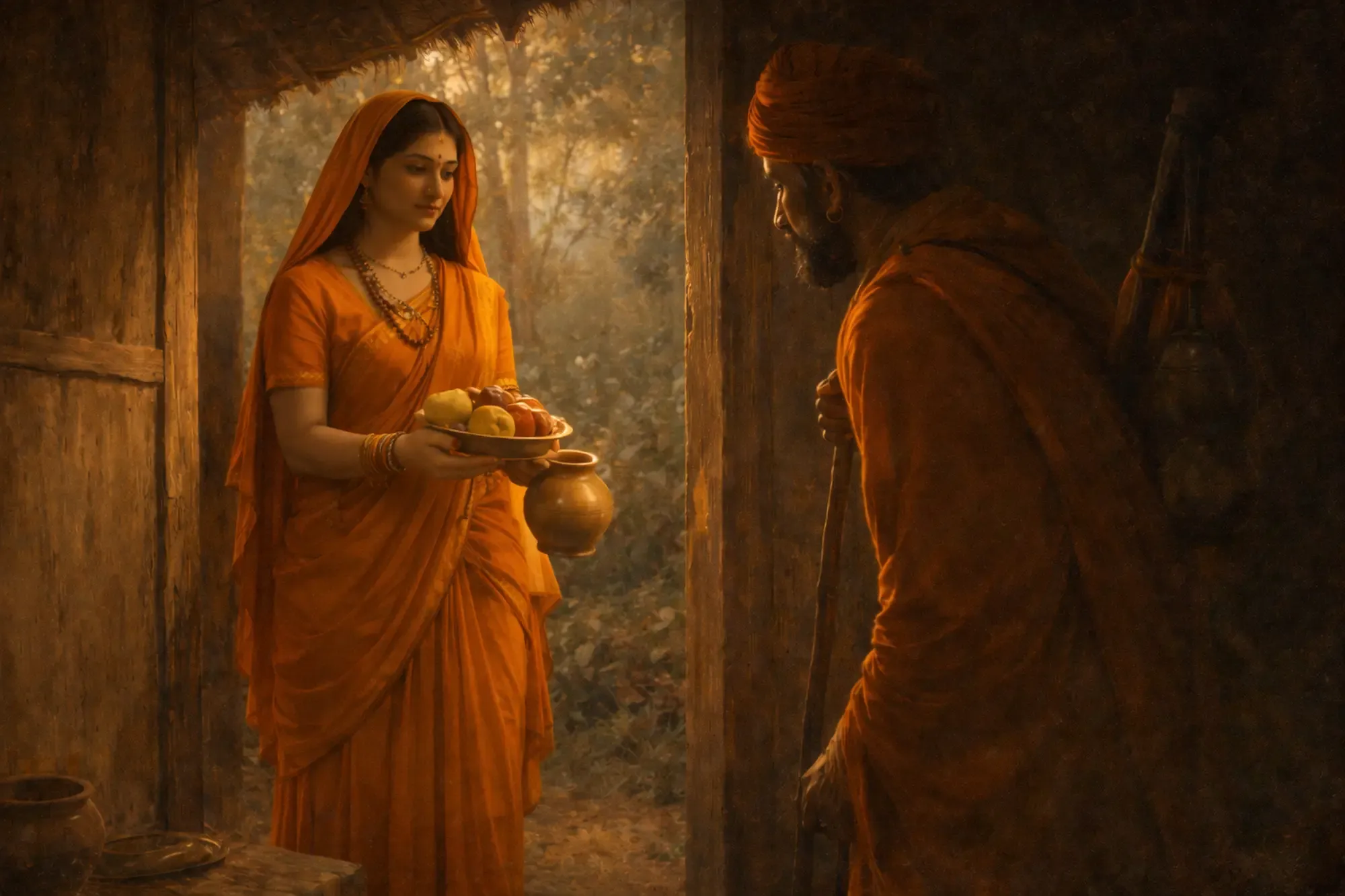
Thirteen years of forest life had passed. Lord Ram, Lakshman, and Mother Sita were living at Panchavati near the Godavari river. It was here that the universe arranged its next test, not of Mother Sita's faith, but of her moral sovereignty.
A wandering monk appeared at the hermitage. He was courteous. His robes were saffron. His manner was composed. Nothing visible betrayed the darkness beneath the disguise. Mother Sita had just sent Lakshman away in response to what she believed were their cries for help from Lord Ram. She was alone.
And yet, she welcomed him. She offered him water, fruits, and a seat. This was Atithi Dharma, the ancient sacred law of hospitality: a guest who arrives at your threshold must be received with honor, regardless of your personal circumstances. To refuse would have been adharma.
In that moment, Mother Sita faced what is perhaps the most subtle test in the entire Ramayan: the collision between self-preservation and sacred duty. Every instinct may have warned her. Still, she chose dharma over fear.
This was not a lapse in judgment. This was the self-determined honoring of a higher moral law and it became the very catalyst that drew the cosmic confrontation with adharma into the open. The universe needed Ravan's darkness to be fully exposed before it could be destroyed. Mother Sita's act of dharmic courage was the flame that lit that reckoning.
3. Abduction & Awareness: A Mind That Never Broke
When Ravan seized Mother Sita by force, she did not go silently. Even as she was being carried through the skies toward Lanka terrified, screaming for Lord Ram and Lakshman — she was already thinking.
She dropped her anklet into the forest below. She quietly unwrapped some of her jewelry, bundled it in a piece of cloth, and dropped it near a group of vanaras on a hilltop. Ravan did not notice. She was planting evidence trails for Lord Ram in real time, while being forcibly abducted. This is not helplessness. This is awareness in motion.
Even as Ravan carried her away, she taunted him with biting sarcasm — telling him his great courage was on full display in how he had tricked Lord Ram away and stolen her like a thief in the night. She told him to wait just a moment, if he was really so brave, and face Lord Ram and Lakshman.
4. Ashok Vatika: Integrity Under Extreme Adversity
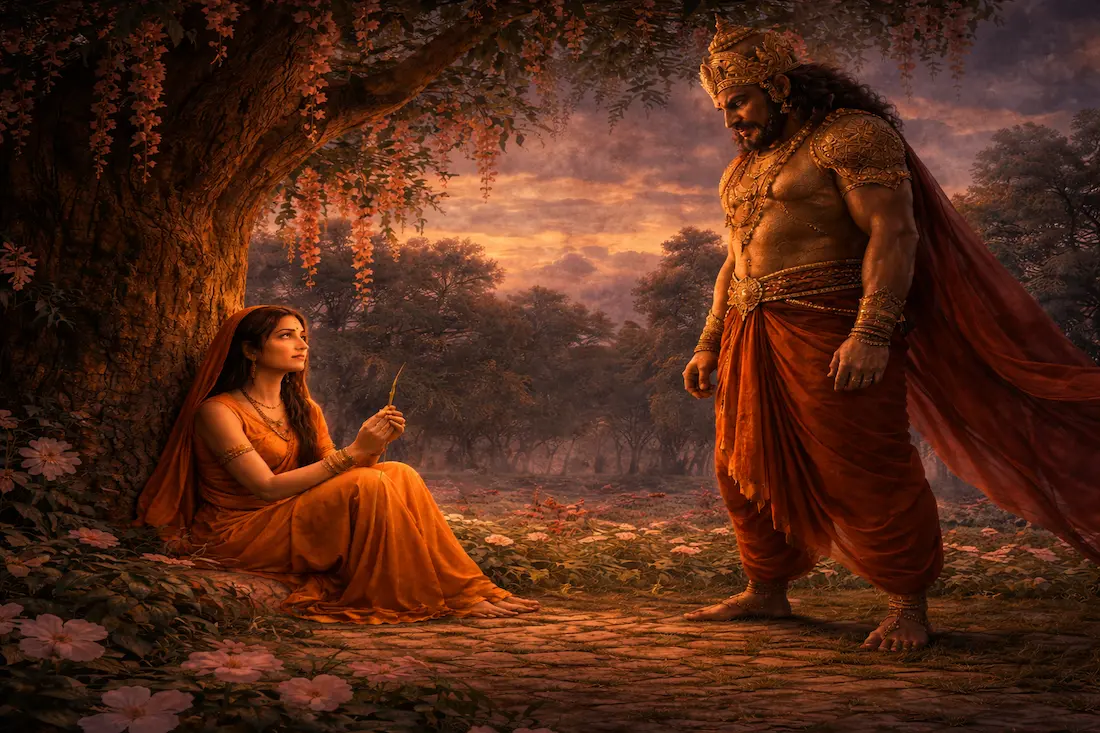
In the Ashok Vatika, the most opulent prison ever built, Mother Sita endured ten months of sustained assault. Ravan came repeatedly threatening, flattering, begging, once falling at her feet. He offered her the queenship of Lanka, wealth beyond imagination, the devotion of the most powerful king alive. He threatened to cook her for breakfast when she refused. The rakshasis tortured her psychologically with relentless menace.
Her clothes became old and dirty. Her body grew thin. She barely slept. And her answer, every single time, was: no.
She placed a blade of grass between herself and Ravan. Not as a magical barrier — there is no Lakshman Rekha in Valmiki's Ramayan. It was a gesture of dharma: the tiniest fragment of righteousness as a visible boundary between herself and evil. In that single image — Mother Sita, exhausted, a blade of grass in her hand, facing the most powerful king in creation — Valmiki gives us one of the most luminous images in world literature.
She told Ravan clearly: you can take this body. But you can never have me. Even I have no interest in this body. It is not me.
And then came his cruelest blow. Ravan appeared with what seemed to be Lord Ram's severed head an illusion and told her Lord Ram was dead. Mother Sita collapsed with grief. She asked Ravan to kill her too and place her beside him. But even believing Lord Ram was gone, believing no one was coming, with no hope and no escape her answer to Ravan was still: no. Not once did her inner world surrender.
This is the supreme teaching of Bhakti made visible in a human life. Not devotion that holds steady when God is present and life is kind. Devotion that does not negotiate with darkness even when the light appears permanently extinguished.
5. Hanuman’s Arrival: Wisdom in Crisis
When Hanuman arrived, Mother Sita tested him carefully before trusting him. She asked him to describe Lord Ram's physical appearance, detail by detail, before she opened her heart. When he offered to carry her home on his back, she declined not from weakness, but from dharmic intelligence: Lord Ram must come for me. Ravan's defeat must be Lord Ram's public victory over adharma, accomplished completely, in the sight of the world. Even in captivity, she was thinking beyond herself.
As Hanuman prepared to leave, even in her desperate state, she remembered to send her regards to Lakshman, praising his quiet loyalty. And after he left, when Sarama — a friendly rakshasi — offered to carry a message to Lord Ram, Mother Sita said: what I need more is for you to find out what Ravan is planning with his ministers. She was, even in the immediate aftermath of the fake-head illusion, still thinking tactically. Still useful. Still acting.
6. Agni Pravesh: A Divine Declaration, Not a Test
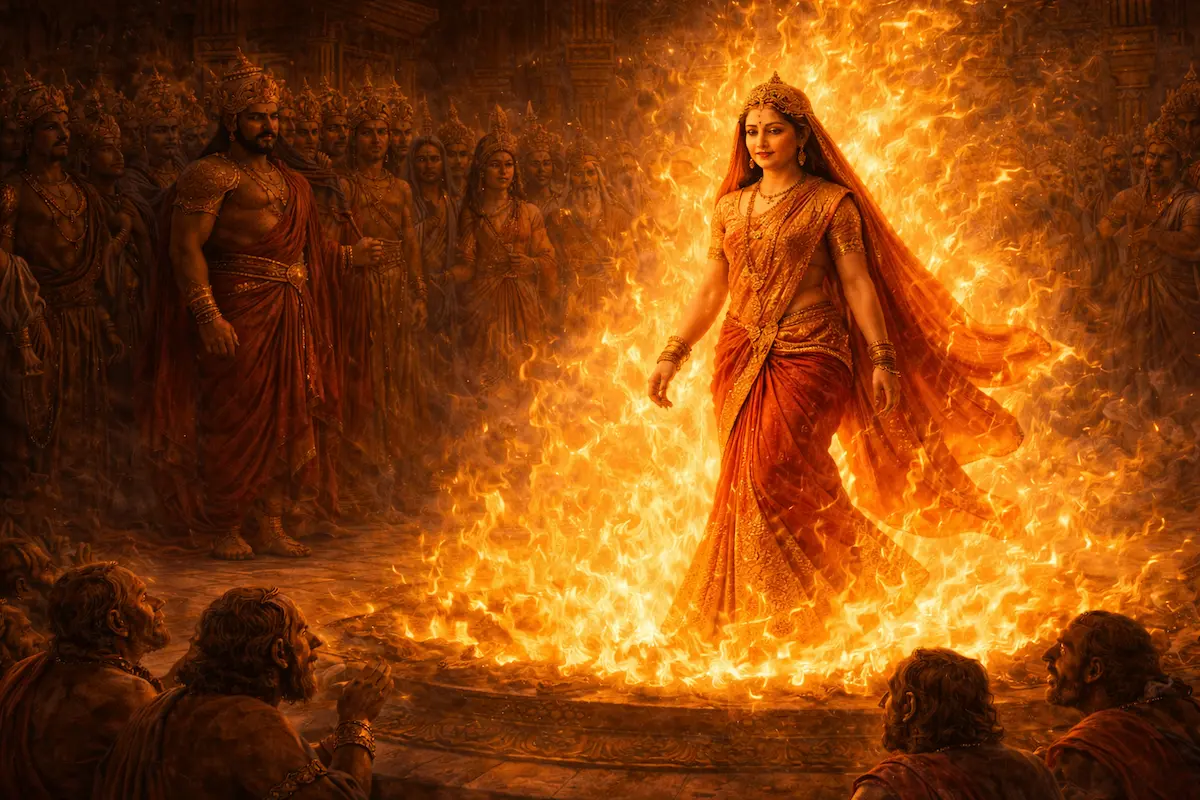
After the war. After Ravan lay dead. When Lord Ram and Mother Sita finally stood before each other — Lord Ram said something that stunned everyone present.
He told her he had not fought the war for her, but for the honor of his dynasty. He told her there was now a doubt about her character. He said he could not bear to look at her. He told her she was free to go to whoever she wished.
This is not doubt. This is divine strategy.
Lord Ram had staged every detail. He made sure Mother Sita entered dressed as a queen, not a destitute captive. He insisted the crowd of vanaras and rakshasas not be pushed back — let them all stay, let them all hear. Then he spoke the words a small-minded, ordinary person might think. The crowd rose. They spoke up for Mother Sita publicly. They acknowledged her greatness. This was precisely the outcome Lord Ram needed: not his word as her husband, but the world's word as her witnesses.
Lakshman, who had no idea what Lord Ram was doing, was furious. He looked at Lord Ram with open anger. And Valmiki writes: Lord Ram made a gesture. Lakshman understood I know what I am doing, go along. Lakshman prepared the fire.
Mother Sita herself chose to walk in. Lord Ram never asked her to. She turned to Lakshman and said: I will not live with this baseless controversy. Prepare the fire. It was her decision, her declaration, her sovereign act.
When she emerged untouched and Agni himself testified to her purity, Lord Ram said simply: I always knew. I know Sita completely. I know she never thought of anyone else for a single moment. But I needed the world to hear it from a higher authority than me.
Lord Ram did not doubt Mother Sita. He was fighting against the very mindset that doubts the victim. How ironic that for centuries we have accused Lord Ram of the exact thing he was speaking out against.
- Based on Valmiki Ramayan, Yuddha Kanda.
The Agni Pravesh is not the story of a husband testing his wife. It is the story of a king protecting his queen's reputation before the world — and a queen choosing fire over the shadow of a lie.
7. Final Return: The Highest Form of Surrender [Samarpan]
The main text of Valmiki's Ramayan ends with Lord Ram's coronation and the beginning of Ram Rajya — years of glorious, joyful rule. This is Valmiki's iti haasa — this is how it happened. The second banishment belongs to the Uttarakanda, a later addition that many scholars distinguish from the core text.
And yet, from the perspective of Bhakti as illumined by Swami Mukundananda Ji, the living tradition has always carried this passage because the teaching it holds is unparalleled anywhere in the world's spiritual literature. We include it not as established history, but as the lila's deepest offering to the seeking heart.
Mother Sita was pregnant. The war was won. The kingdom was restored. And then a washerman's remark questioning her character reached Lord Ram's ears. Lord Ram, bound by the dharma of a king whose every action must be beyond reproach, made the most agonizing decision of his life. He sent Mother Sita away. Into the forest. Alone.
The man who had moved heaven and earth to find her. Who had said he could not live for a single moment without Mother Sita. That man sent her away. Not because he doubted her never that. But because he was a king before he was a husband, and dharma demanded a sacrifice no human heart should ever have to make.
Mother Sita went. Without cursing Ayodhya. Without cursing Lord Ram. She went into the forest, carrying his children within her, and she lived with the same dignity, the same dharmic resolve, the same sovereign stillness that had defined every moment of her life. She gave birth to Luv and Kush in Valmiki's ashram. She raised them herself two princes who would grow up to sing the Ramayan in their own father's court.
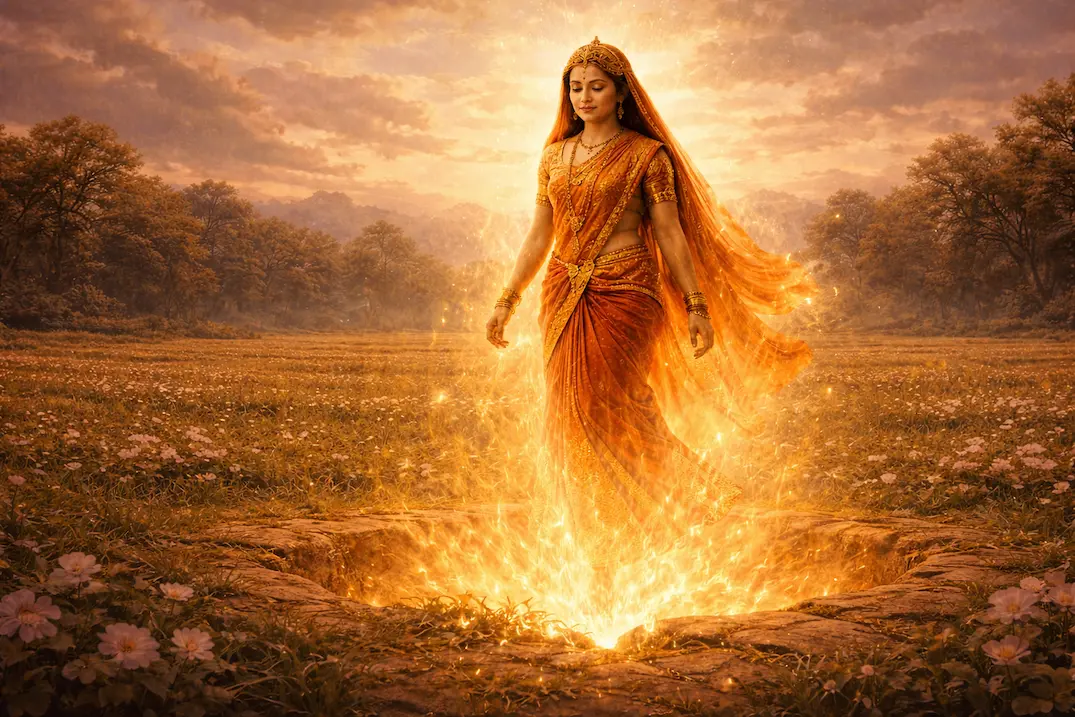
When Lord Ram finally called her back and asked her to once again prove her innocence before the assembly Mother Sita said no. Not in rage. Not in bitterness. With the calm, final, utterly sovereign decision of a soul that has given everything and now makes her last and greatest offering. She said: if I have always been devoted to Lord Ram in action, word, and thought may the Earth, my mother, receive me.
The Earth opened. And Mother Sita returned to the place from which she had come.
This is samarpan surrender so complete that even the beloved is surrendered. She did not return to the Earth because the world failed her. She returned because her divine role was complete. She had shown the world everything it needed to see. And then she went home.
Swami Mukundananda Ji teaches that viraha — the fire of separation from the beloved — is more elevating than even the bliss of union. In that fire, the ego burns away until only love remains. Mother Sita lived this teaching not once but repeatedly. Each separation refined her. Each fire purified — not her purity, which was never in question, but the world's capacity to witness the absolute.
And Lord Ram? He never remarried. For every ritual that required a wife's presence beside him, he placed a golden image of Mother Sita. He carried her in his heart until the end of his days. Their love needed no physical presence to remain eternal.
Lessons from Mother Sita: Timeless Virtues For Every Seeker
These are not abstract qualities. Each one is a specific moment in her life — a real fire she walked through. And each carries a teaching that belongs not only to the past but to every seeker alive today.
01 Inner Strength [Swayam Nirnaya Shakti]
At every turning point she acted with full awareness and complete freedom. She chose the forest. She chose to face Ravan. She chose the fire. She chose the Earth. Her devotion was never compulsion — it was the highest exercise of a free soul's inner authority.
02 Unshakeable Faith [Atal Nishtha]
For ten months, Ravan tried everything. He threatened, flattered, begged, and finally presented what seemed to be Lord Ram’s severed head. Even when she believed Lord Ram was dead, her answer to evil was: no. Her values were not conditional on circumstances. They were the very substance of her soul. This is not hope, which is uncertain. This is certainty rooted so deeply in God that no circumstance can reach it.
03 Discernment [Vivek]
She left evidence trails during her own abduction. She tested Hanuman before trusting him. She refused his rescue offer for dharmic reasons. She asked Sarama to spy on Ravan's plans while still in shock from the fake-head illusion. The outer world’s most powerful king with the greatest army and the most magnificent kingdom in creation could not touch the one thing that mattered: her soul. Bhakti does not make you passive. It makes you more fully alive.
04 Sacred Sacrifice [Tyaga & Viraha]
Swami Mukundananda Ji teaches that viraha — the fire of separation — is more elevating than union itself. In that fire, the ego burns away until only love remains. Mother Sita lived this truth with a completeness rarely seen in human history, sacrificing comfort, safety, reunion, and finally even her life with Lord Ram — not from compulsion, but from love. The second banishment was not defeat. It was samarpan offering even the beloved into the hands of the Divine will. There is a world of difference between a soul that breaks and a soul that surrenders. Mother Sita never broke.
05 Forgiveness [Kshama]
She stopped Hanuman from punishing the rakshasis who had tormented her for months. She forgave Ayodhya. She held nothing against those who questioned her. She saw even her deepest wounds as the prasad of the Divine will. This is not weakness. This is the fierce, clear-eyed strength of a soul that has truly surrendered. A soul that sees God’s hand even in the storm that appears to be against it.
06 Total Surrender [Samarpan]
The crown of all virtues. Pregnant, alone, exiled by the man whose love was the axis of her life — she went without bitterness, without breaking, without bargaining. Because her surrender was not to Lord Ram the person but to the Divine will that moves through all things, including the unbearable ones. This is the heart of Bhakti. This is the heart of Mother Sita.
07 The Power of the Inner World
Ravan had the greatest army and the most magnificent kingdom in creation. He could not touch what truly mattered. The outer world’s most powerful king was completely helpless before the inner world’s most complete devotee. Facing adversity without breaking is not a feminine ideal. It is a human ideal. Mother Sita belongs to every seeker — man or woman, young or old — who wants to know what the soul looks like at its absolute highest.
08 Her Life Is a Flame to Carry
As Swami Mukundananda Ji illumines, her life is not a story to admire from a distance. Every choice she made — the forest, the blade of grass, the fire, the Earth — is a path whose first step is available to every seeker in every moment. She does not ask you to match her suffering. She asks you to match her certainty. That God is real. That love is the highest power. That the soul, fully surrendered, is indestructible.
How to Celebrate Sita Jayanti — April 24, 2026 [Simple Bhakti Practices]
Swami Mukundananda Ji teaches that the bridge between the seeker and the divine personality is bhav — genuine feeling of the heart. On this Sita Navami, approach the day not merely as ritual but as a living encounter with her presence.
♥ Rise before sunrise. Bathe and light a ghee lamp before images of Shri Ram and Sita Mata with love, not merely ritual.
♥ Madhyahna Muhurat (12:06 PM – 2:45 PM). Offer yellow flowers, sandalwood paste, and fruits to the deities during this most auspicious window.
♥ Chant Shri Janaki Ramabhyam Namah 108 times on a mala — with full heart-attention on her form and qualities.
♥ Read the Sundara Kanda — especially Sita in the Ashok Vatika and her meeting with Hanuman — and feel what she felt.
♥ Choose one virtue of Sita Mata and consciously practice it all day: surrender, patience, forgiveness, or unshakeable faith.
♥ Perform a selfless act as an offering to Mata Sita — feed someone, serve without expectation, give something you value.
Spiritual Meaning of Mother Sita & Lord Ram: The Soul and the Divine
The Ramayan is not merely a story — it is a mirror. And Mother Sita is its most uncompromising reflection. Two shlokas anchor the teaching her life embodies:
रामो विग्रहवान् धर्मः
Rāmo vigrahāvān dharmaḥ
“Ram is Dharma embodied in human form.”
- Valmiki Ramayana, Aranya Kanda 37.13
If Lord Ram is Dharma embodied, then Mother Sita who never wavered from him for a single moment of thought, word, or action is the living proof that the soul's deepest nature is already aligned with Dharma. Her fidelity was not obligation. It was recognition: she knew who Lord Ram was, and she knew who she was. Their union is the union of the individual soul and the Divine which is the entire purpose of human life in Bhakti.
Sita Jayanti Reflection: She Still Lives in Your Heart
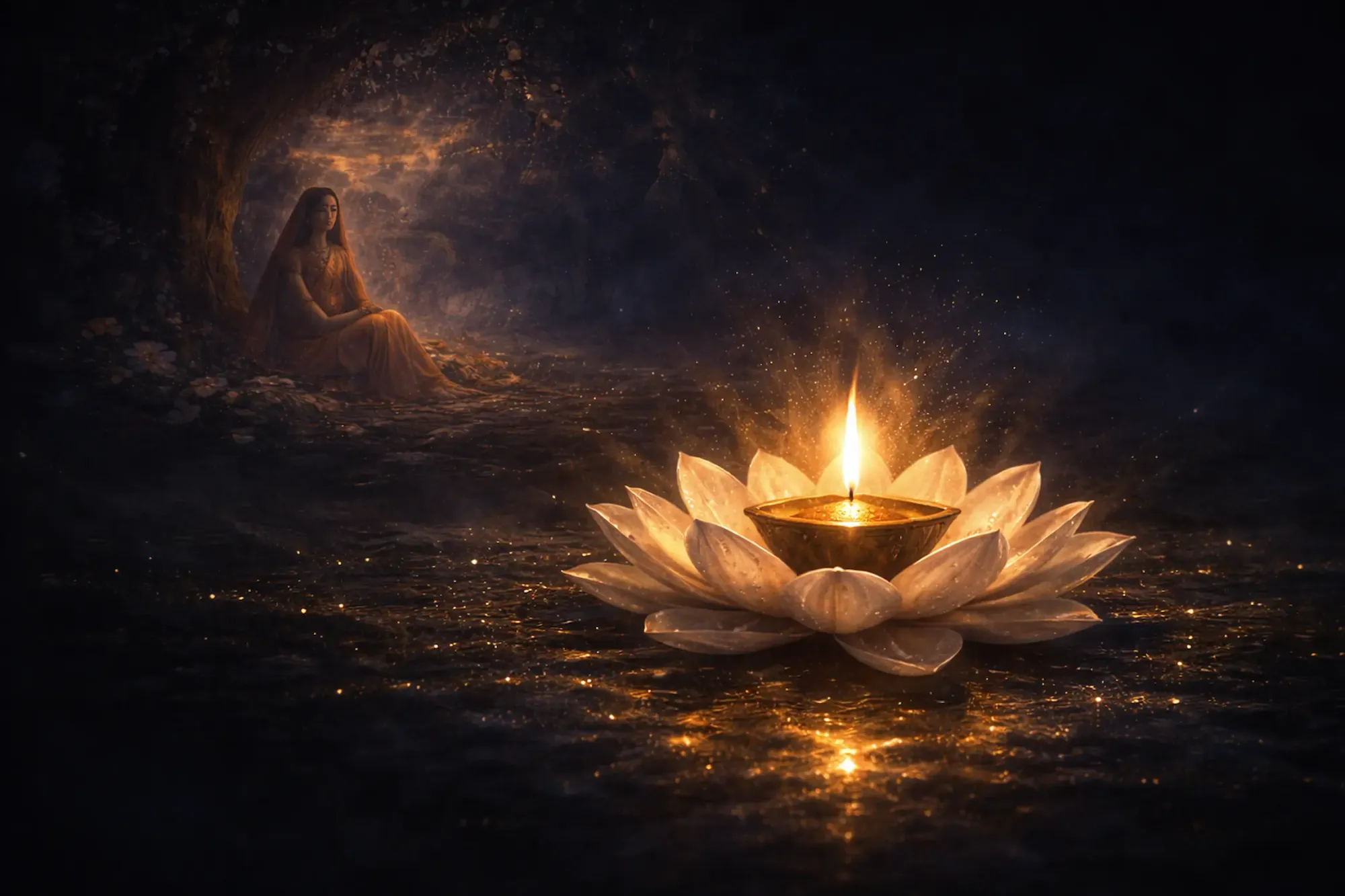
In a world that mistakes noise for truth and speed for progress, Mother Sita stands as the eternal counter-testimony. Serene. Sovereign. Indestructible.
She did not conquer kingdoms. She loved completely, without reservation, without the asterisk of conditions. And in doing so, she demonstrated something no philosopher has ever proved by any other means: that the soul, fully surrendered to the Divine, is the most powerful force in the universe. More powerful than Ravan's army. More powerful than fire. More powerful than exile, separation, and the silence of God himself.
Swami Mukundananda Ji teaches that the entire purpose of every human life is divine love the kind Mother Sita did not merely teach but was.
The next time life asks something unbearable of you remember her in the Ashok Vatika. Thin, barely sleeping, a blade of grass in her hand, surrounded by monsters, waiting for a God who had not yet come. And still sovereign. Still unbroken. Still certain.
She is waiting still in that quiet, sacred place within you that has never forgotten Lord Ram, that holds its blade of grass against all of life's Ravans. Go there. Sit with her. Let her teach you how to love. Her life is not a story to admire from a distance. It is a flame to carry.
♥ Jai Siya Ram ♥
Call To Action
🌸 Celebrate Sita Navami 2026 in Dallas — April 24
There are moments when reading is not enough.
This is one of them.
Come, step into the living presence of Mother Sita at the Radha Krishna Temple of Dallas on Friday, April 24, 2026.
✨ Witness the sacred Ram–Sita Abhishek
✨ Let your heart melt in kirtans and bhajans
✨ Take darshan that stills the restless mind
✨ Sit among devotees whose only language is love
This is not just a celebration.
It is a return.
A return to simplicity.
A return to surrender.
A return to the part of your heart
that has never stopped loving God.
Devotees from Plano, Frisco, Allen, McKinney, Richardson, Irving, Dallas, and beyond are warmly invited.
Celebrate Sita Jayanti 2026 in Dallas

.webp)
Final Invitation
Do not just read about Sita.
Come, sit in her presence.
Come, feel her strength.
Come, celebrate her.
Sita Jayanti 2026 FAQs
Q1. What is the difference between Sita Jayanti and Sita Navami?
Both names refer to the same sacred occasion.
"Navami" refers to the ninth day of Shukla Paksha in Vaishakha month on the Hindu lunar calendar. "Jayanti" means birth celebration. The terms are used interchangeably across traditions. In 2026, Sita Navami is observed on April 24 in Dallas, as the Navami Tithi prevails during the Madhyahna period on this day.
Q2. Did Lord Ram doubt Mother Sita and ask her to walk into fire to test her?
Lord Ram never doubted Mother Sita. His words were a staged response to public perception.
Valmiki's narration is clear: He made sure she entered dressed as a queen, kept the crowd present as witnesses, then spoke what a small-minded person might think prompting the assembly to publicly affirm her purity. Lord Ram then confirmed He had always known her character completely. Mother Sita herself chose to walk into the fire by her own conscious will. How ironic that we have accused Lord Ram of the exact mindset He was in fact speaking out against.
Q3. Is the second banishment from Valmiki's original Ramayan?
The core Ramayan ends with Ram Rajya. The second banishment is from the Uttarakanda.
Many scholars consider the Uttarakanda a later addition to the main text. We include it not as established historical record but because, from the perspective of Bhakti as illumined by Swami Mukundananda Ji, the teaching it carries of viraha, sacrifice, and absolute samarpan is rarely paralleled in world spiritual literature and belongs to every seeker's understanding of Mother Sita's complete legacy.
Q4. Why did Mother Sita refuse Hanuman's offer to carry her back to Lord Ram?
She understood that Ravan's defeat needed to be Lord Ram's complete, public victory over adharma.
A quiet escape would have circumvented that. His insult to dharma required a full, open reckoning in the sight of all three worlds. She willingly extended her own suffering so that righteousness could triumph definitively for all beings. This is tyaga at its most elevated — sacrifice not for oneself, but for the highest good of the world.
Q5. How can a modern seeker genuinely connect with Mother Sita beyond ritual?
Swami Mukundananda Ji teaches that the bridge is bhav — genuine feeling of the heart.
On Sita Jayanti morning, sit quietly and bring to mind one specific moment that moves you most: beneath the Ashok tree with a blade of grass; walking calmly into the fire; blessing Hanuman as he left Lanka. Sit with that image. Feel what she felt. Even five minutes of this sincere remembrance will do more for your spiritual life than hours of mechanical ritual. She is not far. She is as close as your love for her.
♥ Jai Siya Ram