
The Goddess of the Cold Hearth: Unlocking the Mystical Secrets of Sheetala Ashtami 2026
The Morning the Stoves Fell Silent
Imagine walking into a traditional Indian household on the morning of March 11, 2026.
Usually, the kitchen would be alive with the rhythmic hiss of the pressure cooker, the sharp, waking aroma of mustard seeds crackling in hot oil, and the comforting clinking of metal utensils against the iron stove. But today, the hearth is cold. The chimney’s breath is held. A heavy, sacred silence hangs where the warmth of morning tea should be brewing.
This is the morning of Sheetala Ashtami, known affectionately across many parts of India as Basoda.
On this day, the most fundamental law of the Indian kitchen is suspended: no fire may be lit. The stove, usually the beating heart of family life, remains untouched. Instead, families eat food prepared the night before.
At first glance, this may appear like an old tradition or superstition. But in truth, Sheetala Ashtami represents a profound pause in the rhythm of life.
In a culture that celebrates fresh, piping-hot meals as the ultimate expressions of love and care, the voluntary choice to eat basi (cold) food from the night before becomes a spiritual discipline, an act of humility and alignment with nature’s seasonal rhythms.
Swami Mukundananda ji reminds us that sacred observances are meant to purify the mind. Swamiji explains that when we voluntarily restrain our senses, even in something as simple as food, we weaken the tyranny of desire and strengthen our connection with the Divine. Sheetala Ashtami beautifully embodies this principle.
This day marks what our ancestors understood as a “healing window”, a transitional moment when winter fades and the first heat of summer begins to emerge. During this seasonal shift, the body becomes extremely vulnerable to fevers, infections, and imbalances.
Sheetala Ashtami is the ritualized recognition of this shift, a day where we surrender our internal and external fires to the cooling grace of Sheetala Mata, seeking her protection against the fevers of the coming year.
The Celestial Calendar: Sheetala Ashtami 2026 Date and Timings
Sheetala Ashtami in 2026 will be observed according to the following sacred timings:
|
Event |
Date |
Temporal Window / Details |
|
Sheetala Saptami [Preparation] |
Tuesday, March 10, 2026 |
The day to cook the Basoda Bhog |
|
Sheetala Ashtami [Basoda] |
Wednesday, March 11, 2026 |
The primary day of worship and cold meals. |
|
Puja Muhurat |
March 11, 2026 |
6:36 AM to 6:32 PM |
|
Muhurat Duration |
|
11 Hours 53 Minutes |
|
Ashtami Tithi Begins |
March 11, 2026 |
4:23 AM |
|
Ashtami Tithi Ends |
March 12, 2026 |
5:23 AM |
The observance of Sheetala Ashtami 2026 focuses on three core intentions:
Disease Prevention
Traditionally, devotees pray for protection from seasonal illnesses, specifically heat borne illnesses such as smallpox, measles, chickenpox, and fevers that historically surged during seasonal transitions.
Internal Purification
Eating cooling foods helps balance the body’s internal heat as summer approaches. Swami Mukundananda ji emphasizes that the primary goal of any Vrat [fast] is to strengthen the intellect’s control over the senses. As Swamiji often says, “To grow spiritually, we must learn to be the master of our mind, not its slave.” Sheetala Ashtami is a practical workshop in this mental mastery.
Spiritual Discipline
Following ancestral rituals cultivates humility and gratitude for the wisdom passed down through generations.
Meet Sheetala Mata: The Goddess of Cooling and Healing
According to the Skanda Purana, Sheetala Mata is the divine force that restores balance when disease spreads across the world.
Her presence represents the cooling energy of the Divine Mother, who protects humanity from epidemics and fevers. As a form of Durga (Shakti), she embodies the nurturing yet powerful aspect of the feminine divine that heals both body and mind.
When the demon Jwarasura, the embodiment of fever and disease, unleashed several different types of poxes and malignant fevers upon the world, causing a global heat that threatened to incinerate humanity. The Divine Mother manifested as Sheetala to restore balance. In a great cosmic battle, she decapitated the demon’s ego with the help of Batuk Bhairava [a fierce form of Lord Shiva], and Jwarasura, realizing the cooling superiority of the Goddess, surrendered. Moved by his eventual regret, she transformed the demon into her donkey, making him her humble vehicle [vahana] and a symbol of disease brought under divine control. This transformation is a powerful metaphor: the very energy that causes disease, when disciplined and guided by the Divine, becomes the vehicle for healing and service.
The Iconography and Spiritual Anatomy of Sheetala Mata
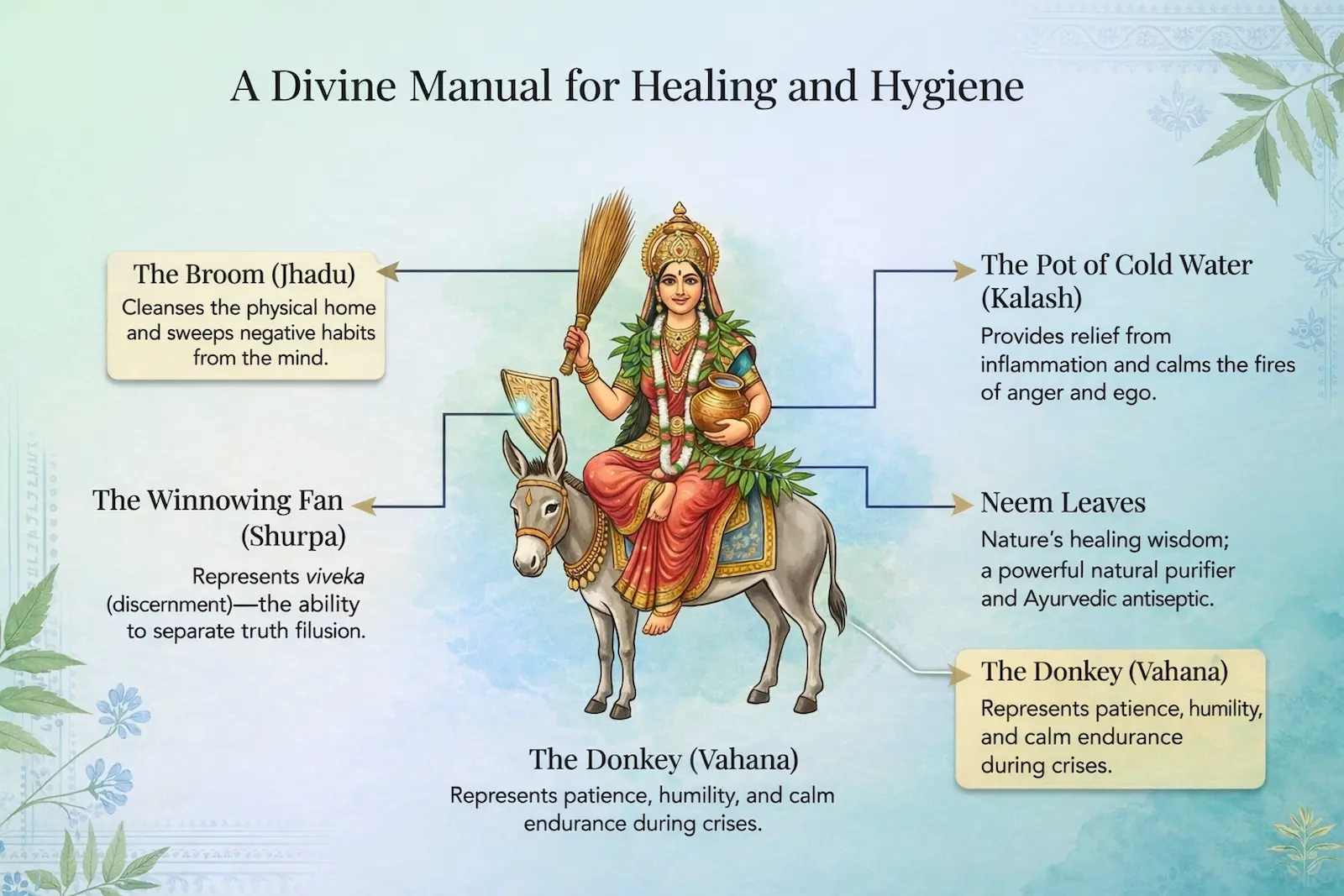
The image of Sheetala Mata is rich with symbolic meaning. Each element in her form carries a spiritual lesson. She is a technical manual for hygiene and spiritual resilience disguised in divine form.
The Broom (Jhadu)
The broom represents the cleansing of both the physical and spiritual environment. Just as dust must be swept away from a home, negative habits and impurities must be removed from the mind.
The Pot of Cold Water (Kalash)
The pot symbolizes relief from fever and inflammation. It reminds us that calmness and compassion cool the fires of anger, ego, and stress.
The Winnowing Fan (Shurpa)
This tool separates grain from chaff. Spiritually, it represents viveka, the power of discernment, the ability to separate truth from illusion.
Neem Leaves
Neem has long been recognized for its medicinal properties. In Ayurveda, it is considered a powerful natural purifier and antiseptic. The goddess wearing neem leaves symbolizes nature’s healing wisdom.
The Donkey (Vahana)
The donkey represents patience, humility, and endurance. In times of crisis, calm perseverance—not panic—is the path to healing.
The Heart of the Devotion: The Legend of the Daughters-in-Law
A well-known Vrat Katha associated with Sheetala Ashtami tells the story of two daughters-in-law who disobeyed the sacred rule of the festival.
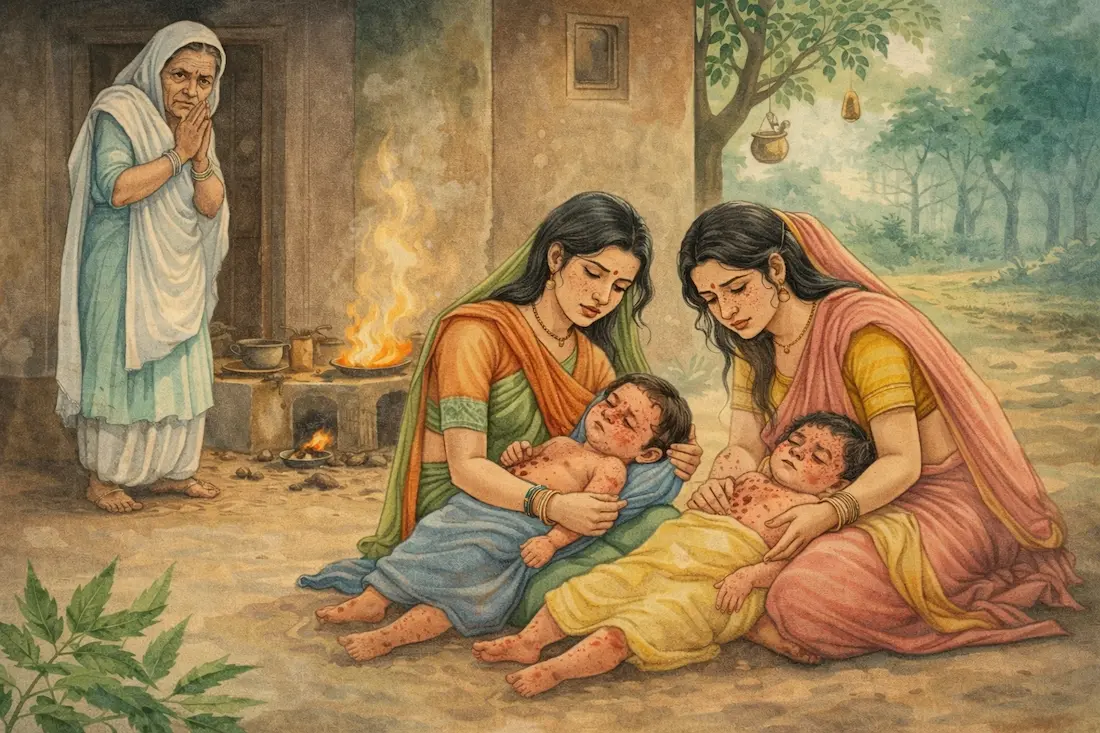
As the month of Chaitra arrived, the old woman who lived with her two daughters-in-law, prepared for the Basoda rituals, emphasizing that no fire must be lit on the sacred morning of the Ashtami. However, the two younger women, having recently given birth to sons, feared that consuming cold food would dry their milk or make their infants ill.
Despite being instructed not to light a fire, they secretly cooked fresh, steaming rotis and warm vegetables, consuming them in the shadows while pretending to honor the “Cold Hearth” ritual.
When the goddess perceived their lack of faith, their children fell ill with intense fever. Heartbroken and realizing the magnitude of their error, the women confessed to the old woman. Furious and grieved, she exiled them into the forest, telling them they were not to return until the Goddess herself showed mercy. Their journey was a spiritual wandering in the wilderness of their own guilt.
Reflecting on the legend of the daughters-in-law, Swami Mukundananda ji teaches that “partial surrender is no surrender at all.” The tragedy in the story stems from the heat of ego the belief that our modern logic is superior to the Parampara [tradition] of the sages. Swamiji reminds us that when we align our will with the Divine Will, we move from a state of Ashanti [restlessness] to Sheetal [coolness/peace].
In the forest, they encountered two sisters, Ori and Sheetala, sitting beneath a massive tree, distressed by an unbearable infestation of lice. Despite their own crushing grief, the daughters-in-law knelt beside them. For hours, they meticulously removed the lice, offering a selfless act of service [Seva] that quieted their own troubled minds.
Relieved and satisfied, the sisters blessed them: “May your laps be filled with the joy you have given us.” When the women revealed their tragedy, the sister named Sheetala revealed her divine form. She reprimanded them not for the food itself, but for the lack of discipline and the arrogance of believing they knew better than the ancient rhythms of the earth. Upon their sincere repentance, she breathed the cool breath of life back into their sons.
The story highlights an important spiritual lesson.
Swami Mukundananda ji teaches that scriptures are not arbitrary restrictions but compassionate guidelines that help align human life with divine harmony. When we ignore these rhythms out of impatience or ego, suffering arises. But sincere repentance and humility can restore divine grace. Swamiji teaches that Nishkam Karm – selfless action without expectation, is the fastest way to attract Divine Grace. It was this act of humility, more than the ritual itself, that moved Sheetala Mata to restore their children to life.
The Five Sacred Disciplines of Sheetala Ashtami
Devotees observe several important restrictions on this day:
- No Lighting the Stove – The kitchen fire remains extinguished. Allowing the household heat to settle.
- No Freshly Cooked Food – Only food prepared the previous day is consumed. Forces the digestive Agni to rest.
- No Hot Baths – Cooling baths are preferred. Cold water is used to keep the skin resilient against seasonal rashes.
- No Spicy Foods – Avoid foods that increase internal heat [Pitta], which can exacerbate fevers.
- No Anger or Conflict – Emotional calmness is considered essential. Mental agitation is seen as mental heat, violating the spirit of the cooling one.
Surprising Spiritual Insights of Sheetala Ashtami
Cooling the Fire of the Mind
Beyond physical health, this festival also teaches emotional balance.
Swami Mukundananda ji explains that anger, jealousy, and greed generate “mental heat” that disturbs both the body and the soul. By practicing calmness and restraint, devotees invite divine healing energy into their lives.
The Donkey as a Symbol of Stability
In our fast-paced modern world filled with stress and burnout, the humble donkey reminds us of the value of steady patience and grounded living.
The Sacredness of Basi Food
Eating food prepared the previous day encourages detachment and mindfulness, reminding us that nourishment ultimately comes from divine grace, not sensory indulgence.
Hygiene as Worship
The broom and neem leaves symbolize the sacred duty of maintaining cleanliness. In the Vedic tradition, cleanliness is considered a form of devotion. Swami Mukundananda ji emphasizes that cleanliness is a dual concept involving both external and internal purity. He teaches that while external cleanliness supports physical health and discipline, it is internal purity – the cleansing of the mind and heart – that ultimately leads to God-realization.
Charity and Community Care
Sharing food with the poor and seeking blessings from elders reminds us that health is not merely individual – it is a collective blessing.
The Sacred Menu of Basoda
Food for the festival is prepared on Sheetala Saptami (March 10, 2026), for once the sun sets on Saptami, the fire must not be lit again until after the Ashtami Puja. The menu items are chosen for their stability and cooling properties.
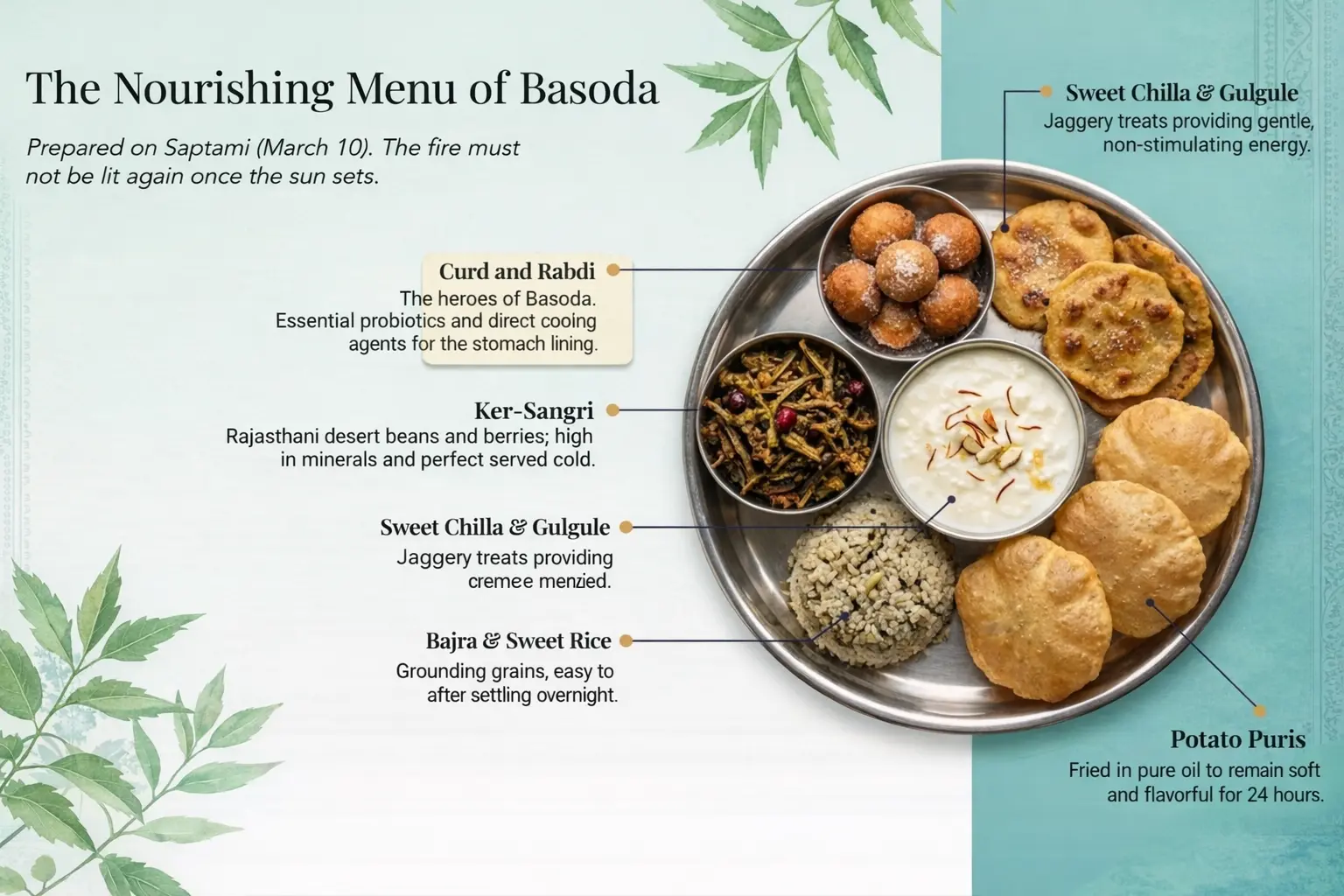
Common offerings include:
- Sweet Chilla and Gulgule: These jaggery based treats are shelf stable and provide gentle energy without over stimulating the system.
- Ker-Sangri: A Rajasthani desert staple. These beans and berries are high in minerals and perfectly suited for consumption when cold.
- Rabdi and Curd: Essential probiotics. Curd, in particular, is the hero of the Basoda menu, acting as a direct cooling agent for the stomach lining.
- Bajra [Millet] and Sweet Rice: Grains that are grounding and easy to digest when they have settled overnight.
- Potato Puris: Fried in pure oil, these remain soft and flavorful even after twenty four hours.
The Golden Rule: Do not light a fire, turn on a stove, or even heat water on March 11, 2026. The grace of the day is found in the cold.
Step-by-Step Puja Vidhi for Sheetala Ashtami
- Wake during Brahma Muhurat between 3:30 AM and 5:30 AM. This is the hour when the cooling energy of the moon is at its peak.
- Bathe using cool water. If possible, add a few drops of Ganga Jal or Neem-infused water to align with the Goddess’s elemental nature.
- Wear clean traditional clothing, preferably in shades of orange or yellow, symbolizing the energy of the rising sun held in check by the cooling ritual.
- Prepare two plates: one for bhog and one for ritual offerings.
- Plate 1 {Bhog}: Curd, roti, sweet rice, and the pre-prepared Basoda items.
- Plate 2 {Ritual}: An unlit lamp made of flour [lighting it is forbidden, as it introduces heat into the cold ritual], Mehndi, Kumkum, a coin, and a pot of cold water.
- Offer water and curd to a Neem tree. This acknowledges the tree as a terrestrial form of the Goddess’s healing power.
- Recite the Sheetalashtak and listen to the Vrat Katha.
- Seek blessings from elders and distribute prasad to those in need.
Regional Celebrations Across India
Rajasthan
Grand fairs , such as the one at the Sheetla Mata Shakti Dham, see thousands of devotees arriving in colorful processions. Here, the offering of Ker-Sangri and Gulgule is a massive community event.
Gujarat
Known as Shitala Satam, the rituals often parallel those of the Krishna Janmashtami period, but the core essence the honoring of the cooling mother and the avoidance of the stove is strictly maintained.
Madhya Pradesh
Ancient Sheetala temples become centers of devotion, with large gatherings and folk songs and community feasts of cold food.
A Cooling Thought for the Soul
Sheetala Ashtami is far more than a ritual about cold food or extinguished stoves.
It is a profound reminder that true health arises when we live in harmony with nature, discipline, and divine wisdom.
When the hearth falls silent for a day, the soul begins to listen again.
By honoring Sheetala Mata, we do not merely seek protection from physical disease, we also cool the inner fires of ego, anxiety, and restlessness.
In the quiet grace of this sacred day, we rediscover that sometimes the greatest healing begins with stillness, humility, and devotion.

CALL TO ACTION
Insights from Swami Mukundananda ji: The Yoga of Cooling
· Mind over Matter: Use the day to observe your cravings. When the mind demands hot tea, observe that demand without reacting. This is the cooling of the Vrittis [thought-waves].
· The Power of Intention: It’s not about the temperature of the food; it's about the Bhav [devotional intent]. Eating cold food with a heart full of gratitude is more powerful than any complex ritual performed with a heavy heart.
· Health as a Tool: Swamiji teaches that the body is a temple for the soul. Maintaining its health through seasonal shifts like Basoda is an act of stewardship for the Divine.


Frequently Asked Questions
1. When is Sheetala Ashtami in 2026?
Sheetala Ashtami in 2026 will be observed on Wednesday, March 11, 2026. The Ashtami Tithi begins at 4:23 AM on March 11 and ends at 5:23 AM on March 12.
2. Why do devotees eat cold food on Sheetala Ashtami?
Devotees eat basi (previously prepared) food to symbolize the cooling of internal and external heat. According to traditional belief, this practice helps balance the body during the seasonal transition from winter to summer and honors the cooling energy of Sheetala Mata, the goddess of healing.
3. What foods are eaten during Basoda on Sheetala Ashtami?
Common foods prepared the day before include:
- sweet chilla
- gulgule (jaggery sweets)
- curd and rabdi
- bajra roti
- sweet rice
- potato puris
These foods are chosen because they remain safe and flavorful even after being stored overnight.
4. What is the significance of Sheetala Mata?
Sheetala Mata is revered as the goddess who protects devotees from diseases and epidemics. In the Skanda Purana, she is described as the divine force who controls fevers, infections, and seasonal illnesses, restoring balance and health to the world.
5. What are the main rules followed on Sheetala Ashtami?
The primary disciplines observed on Sheetala Ashtami include:
- not lighting the stove
- eating only food prepared the previous day
- avoiding spicy or heating foods
- bathing in cool water
- maintaining emotional calmness and avoiding anger
These practices symbolize the cooling of both the body and the mind.