
What is a Sattvic Lifestyle and Why Does It Matter?
In our modern world, we are constantly bombarded with stimuli with endless notifications, processed foods, stressful commutes, and a relentless pressure to achieve more. We often find ourselves asking, "Why is there so much noise outside, and even more inside?" We chase peace, yet it remains elusive, always seeming to be just around the next corner.
What if the secret to lasting peace wasn't about changing your circumstances, but about changing the very quality of your being? This is the promise of the Sattvic lifestyle, a timeless concept rooted in the profound wisdom of the Bhagavad Gita.
The word Sattva means "pure essence," "harmony," or "truth." A Sattvic lifestyle, therefore, is a way of living that cultivates these very qualities. It's not a set of rigid rules, but a conscious choice to purify our thoughts, our actions, and our very existence. According to the wisdom shared by Swami Mukundananda, the essence of all spirituality is the purification of the mind. When the mind is pure, it becomes a clear mirror, reflecting the peace and joy that are already our true nature.
Beyond Diet: Defining Sattva (Goodness)
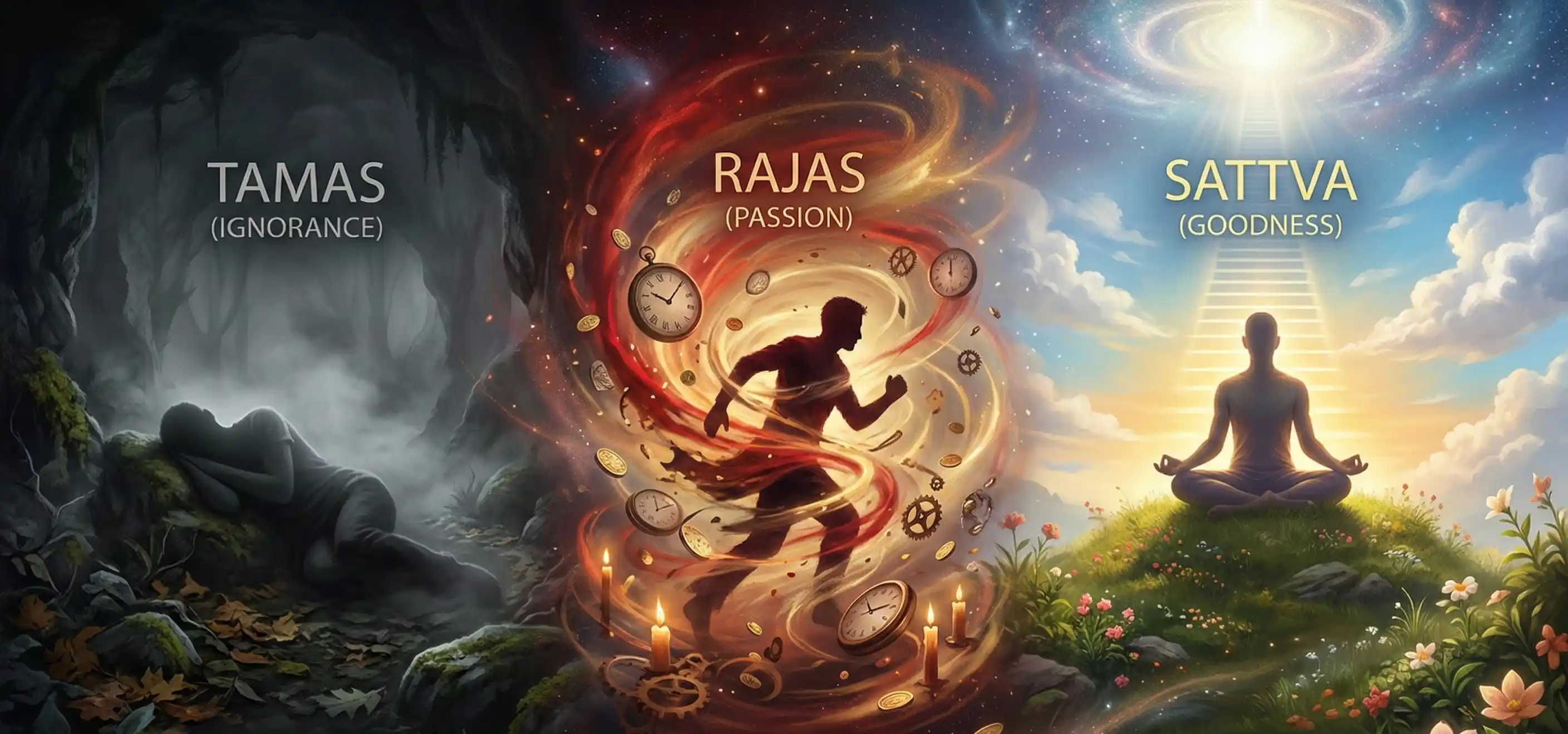
To understand the Sattvic lifestyle, we must first understand the three Gunas, or modes of material nature, as explained in the Gita . These are the three fundamental forces that bind us: Sattva (goodness), Rajas (passion), and Tamas (ignorance).
- Tamas is the mode of darkness, laziness, and delusion. It keeps us asleep, both literally and metaphorically.
- Rajas is the mode of passion, characterised by frantic activity, driven by endless desires for sense gratification. It keeps us in a perpetual state of striving and dissatisfaction.
- Sattva is the mode of goodness, represe balance, clarity, and wisdom. It is lighter than the others and illuminates the consciousness, allowing us to see things as they truly are.
The End Goal: Why Choose Goodness?
While the ultimate goal, as Swami Mukundananda explains, is to transcend all three Gunas entirely and return to our pure, spiritual state, cultivating Sattva is the essential first step. It's like climbing a ladder; you cannot reach the top floor without first stepping on the rungs of goodness. A Sattvic lifestyle creates a mind that is steady, focused, and pure—a fit instrument for self-realization and deep, loving devotion. It transforms us from being reactive puppets of our environment into peaceful, proactive masters of our own destiny.
The Cornerstone of Purity: The Sattvic Diet (Sattvic Aahara)
The most tangible and immediate way to begin a Sattvic lifestyle is through what we eat. The Bhagavad Gita makes a direct connection between the food we consume and the quality of our consciousness. You are not just what you eat; you are what you digest—mentally, emotionally, and spiritually.
Gita Verse 17.8: Defining the Food of the Good
Lord Krishna describes the Sattvic diet with beautiful clarity in the Bhagavad Gita:
Persons in the mode of goodness prefer foods that promote life span, and increase virtue, strength, health, happiness, and satisfaction. Such foods are juicy, succulent, nourishing, and naturally tasteful. (Bhagavad Gita 17.8)
As Swami Mukundananda explains, that foods in the mode of goodness like grains, pulses, fruits, vegetables, and milk—promote longevity, health, virtue, and spiritual growth. further Swamiji adds that vegetarianism brings mental clarity, compassion, and aligns with humanity's highest destiny. He particularly emphasizes that killing the cow, who provides milk like a mother, is an insensitive and ungrateful act contrary to spiritual culture.
What to Eat: A Practical Sattvic Food List
Adopting a Sattvic diet is surprisingly simple. Focus on fresh, wholesome, and natural foods:
- Fresh Fruits & Vegetables: Ripe, juicy, and in-season. 🍎🥬
- Whole Grains: Rice, wheat, oats, and barley that are unprocessed and full of life-giving energy. 🌾
- Legumes: Moong dal, lentils, and chickpeas for sustainable protein.
- Nuts, Seeds & Dairy: Fresh nuts, seeds, and especially milk, yogurt, and ghee from a well-cared-for cow, considered nourishing for the subtle tissues of the brain. 🥛
What to Avoid: Identifying Rajasic and Tamasic Foods
To make the mind calm and clear, the Gita recommends limiting:
- Rajasic Foods: These are overly spicy, sour, dry, or salty. Think onions, garlic, chili, coffee, and tea. They overstimulate the senses and lead to a restless, passionate mind. 🔥
- Tamasic Foods: These are stale, overcooked, processed, leftover, or spoiled. Meat, fish, eggs, and alcohol also fall into this category. They promote lethargy, confusion, and ignorance. ⚫
The Art of Mindful Eating: Food as Prasadam
A key teaching from Swami Mukundananda is the concept of offering food to the Divine before eating. This simple act of gratitude transforms the entire experience. When we offer our food with love and devotion, it becomes sanctified, or Prasad. It is no longer just a plate of vegetables; it is a gift from God, received with humility and reverence. This practice elevates a biological necessity into a profound spiritual act, infusing every morsel with peace and positivity.
Beyond the Plate: Sattvic Actions and Daily Routine
A Sattvic life is not just about what we put on our plate; it's about how we move through the world. It's about infusing our actions and our daily schedule with the same quality of purity and harmony.
Gita Verse 17.11: Selfless Action (Yajna)
The Gita defines Sattvic action with laser-like precision:
Sacrifice that is performed according to scriptural injunctions without expectation of rewards, with the firm conviction of the mind that it is a matter of duty, is of the nature of goodness. (Bhagavad Gita 17.11)
This is the heart of Karma Yoga. As Swami Mukundananda explains,The nature of yajña also corresponds to the three guṇas. Shree Krishna begins by explaining the type of sacrifice in the mode of goodness. Aphala-ākāṅkṣhibhiḥ means that the sacrifice should be performed without expectation of any reward. Vidhi driṣhṭaḥ means that it must be done according to the injunctions of the Vedic scriptures. Yaṣhṭavyam evaiti means that it must be performed only for the sake of worship of the Lord, as required by the scriptures. When yajña is performed in this manner, it is classified in the mode of goodness.
Living in Harmony with Nature: The Power of Routine
A Sattvic lifestyle encourages a daily routine, or Dinacharya, that aligns with the rhythms of nature. This includes:
- Waking up early during the Brahma Muhurta (about an hour and a half before sunrise), the most peaceful time of day for meditation. 🌅
- Maintaining regular meal times.
- Working with full dedication but without anxiety about the results.
Work as Worship: Performing Duty with Detachment
Imagine working not for a paycheck, a promotion, or praise, but as an offering. When we see our job, our household chores, or our creative projects as a service to the Divine, the quality of our work transforms. It becomes more focused, more loving, and less stressful. This is practical spirituality at its finest. It's about turning every action into a prayer.
The Austerity of Words: Cultivating Sattvic Speech
Have you ever noticed how some words can drain your energy, while others can lift your spirit? Our speech is a direct reflection of the state of our mind. The Gita offers a profound checklist for communicating in a way that purifies the heart and soothes the soul.
Gita Verse 17.15: The Four Gates of Speech
Lord Krishna describes the austerity of speech:
"Austenity of speech consists in speaking words that are truthful, pleasant, beneficial, and that do not agitate the mind of others, as well as in regularly reciting the Vedic scriptures." (Bhagavad Gita 17.15)
Austerity of speech is speaking words that are truthful, unoffending, pleasing, and beneficial for the listener. The practice of the recitation of Vedic mantras is also included in the austerities of speech. The progenitor, Manu, says: “Speak the truth in such a way that it is pleasing to others. Do not speak the truth in a manner injurious to others. Never speak untruth, though it may be pleasant. This is the eternal path of morality and dharma.”
This verse is a powerful filter for our communication. Before we speak, we can ask ourselves these four questions:
- Is it true? (Satya)
- Is it pleasant? (Priya)
- Is it beneficial? (Hitam)
- Does it agitate others? (If yes, don't say it.)

A Practical Guide to Mindful Communication
Swami Mukundananda beautifully illustrates that people are imperfect because they are under the influence of the three Gunas. When we understand that others may act out of anger, greed, or pride because they are conditioned by Maya (illusion), it becomes easier to be empathetic and forgiving. Sattvic speech naturally avoids gossip, harsh criticism, and words that divide. It chooses instead to build bridges, offer encouragement, and speak with kindness.
The Value of Silence (Mauna)
In a world of constant noise, silence is a powerful form of mental austerity. Observing periods of silence, even for a few minutes each day, helps us to turn the mind inward, listen to the voice of our conscience, and recharge our spiritual batteries. It is in the silence that we often hear the clearest answers.
Mastering the Mind: Sattvic Thoughts and Emotions
Ultimately, the battleground for a Sattvic life is within. The mind can be our greatest friend or our vilest enemy. The Gita provides the ultimate guide to winning this inner battle.
Gita Verse 17.16: The Qualities of a Serene Mind
Lord Krishna outlines the qualities of mental austerity:
Serenity of thought, gentleness, silence, self-control, and purity of purpose—all these are declared as austerity of the mind. (Bhagavad Gita 17.16)
Swami Mukundananda explains, that mastering the mind through thought austerity is the highest spiritual practice, for the mind determines our consciousness and destiny. Just as a garden must be cultivated with noble thoughts while weeding out negativity, every thought we harbor shapes our character, personality, and external reality. By consciously choosing positive thoughts over negative emotions like anger and hatred, we forge our future and allow divine grace to manifest within our hearts. 🙏💫✨
Practical Tools for Mental Purity
Swami Mukundananda, in his seminal work "The Science of Mind Management," explains that the mind is like a fertile field; our cultivation determines whether it yields thorns or exquisite flowers. Here’s how to cultivate Sattvic thoughts:
- Contentment (Santosha): True contentment is not the fulfillment of desires, but the absence of the need for anything else to be happy. It's an inside job.
- Compassion (Ahimsa): This is non-violence in thought, word, and deed. It means wishing well for all beings, even those who may have wronged us. Swamiji teaches that hatred and bitterness do not destroy others; they silently destroy our own karma and affect our future. Letting go is an act of self-love.
- Self-Control: This is not repression, but the wise redirection of the mind. When the mind runs towards harmful things, the empowered intellect must step in and guide it towards the sublime.

The Process of Empowering the Intellect
How do we make the intellect strong enough to control the mind? Swami Mukundananda provides a clear, three-step process:
- Shravan (Hearing): Regularly reading or listening to divine knowledge from scriptures like the Bhagavad Gita and from self-realized masters.
- Manan (Contemplation): Deeply reflecting on what you have heard, until it becomes a part of your own understanding.
- Nididhyasan (Resolution): Developing firm, unshakable convictions based on that knowledge. When the intellect is illumined with divine wisdom, it can easily say "no" to the mind's harmful whims and "yes" to what is truly beneficial. This is the essence of mind management.
Sattvic Rest: The Quality of Sleep and Wakefulness

In our fast-paced culture, sleep is often seen as a waste of time. But the Gita teaches that the quality of our rest is just as important as the quality of our activity.
Gita Verse 6.17: The Path to Balanced Rest
Lord Krishna advises a balanced approach to life:
"Those who are temperate in eating and recreation, balanced in work, and regulated in sleep, can mitigate all sorrows by practicing Yog. (Bhagavad Gita 6.17)
Yog (union with God) is the opposite of bhog (sensual indulgence), which leads to rog (disease). Shree Krishna teaches that by practicing moderation in all bodily activities, we become free from physical and mental sorrows. Gautam Buddha later echoed this wisdom through the golden middle path—the village women's song about tightening instrument strings just enough, not too much, became his enlightenment lesson. Benjamin Franklin also practiced this principle, making "Temperance: Eat not to dullness; drink not to elevation" the first virtue in his character-building diary. True spiritual progress requires balancing austerity with bodily care, avoiding both extreme indulgence and severe asceticism
Waking Up Sattvic: Morning Routine and Gratitude
The quality of our sleep determines the quality of our wakefulness. A Sattvic evening routine sets the stage for a peaceful night:
- Disconnect from electronic devices at least an hour before bed.
- Read a few verses from a sacred text.
- Chant or listen to calming devotional music.
- Practice gratitude, mentally thanking God for the day and surrendering any worries.
When we sleep with a peaceful, grateful heart, we wake up with a clear, energized mind, ready to greet the new day as a fresh opportunity for spiritual growth.
Conclusion: Your Journey to a Sattvic Life
The Sattvic lifestyle is not a destination; it's a beautiful, transformative journey. It's about consciously choosing, moment by moment, to align ourselves with truth, purity, and love.
The Golden Chain: How Sattva Leads to Freedom
While Sattva itself is a material quality, it is described as a "golden chain" that uplifts the soul. It purifies our samskaras (mental impressions) and prepares the ground for the highest spiritual realization—the state of pure, unconditional love for the Divine.
Frequently Asked Questions About the Sattvic Lifestyle
1. Is a Sattvic diet strictly vegetarian?
Yes, a Sattvic diet is fundamentally vegetarian and includes dairy. As Bhagavad Gita 17.8 states, Sattvic foods "increase life, purify existence, and give strength, health, and happiness." These include fresh fruits, vegetables, whole grains, legumes, nuts, seeds, and dairy.
According to Swami Mukundananda, meat, fish, eggs, and alcohol promote tamas (ignorance) and agitate the mind. The principle is simple: to cultivate a peaceful mind, we must consume peaceful foods.
2. Can I practice it without being religious?
Absolutely. While rooted in Vedic wisdom, the principles are universal—fresh food, balanced routine, kind speech, and contentment.
As Swami Mukundananda explains, the essence is mind purification. Whether you call it mindfulness or emotional intelligence, the practices remain the same. The benefits—calmer mind, better health, harmonious relationships—are for everyone.
3. How long until I see results?
Results vary, but many feel positive shifts within weeks.
Swami Mukundananda emphasizes steady effort over quick fixes. You may feel lighter within days of cleaner eating. Within weeks, better sleep emerges. Mental changes unfold gradually as the mind purifies.
As Gita 6.17 teaches, balance in eating, sleeping, and recreation mitigates all pains. Be patient; every small choice builds momentum.
4. What if I can't give up coffee or garlic completely?
Perfection isn't the goal—progress is.
Swami Mukundananda teaches to start where you are. Reduce coffee gradually. Try one Sattvic meal weekly without onions or garlic. The Gunas are cultivated over time. Every small step purifies the mind. Celebrate small victories! 🎉
5. How does it help with anger and stress?
A Sattvic lifestyle addresses the root causes of anger and stress.
Swami Mukundananda explains that anger arises when desires are frustrated. Sattvic living calms the senses and reduces desires:
- Sattvic diet steadies the mind 🥗
- Kind speech prevents conflicts 🗣️❤️
- Morning meditation builds resilience 🌅
- Contentment removes constant striving ✨
A Sattvic mind pauses before reacting, choosing wisdom over outburst. This is the peace the Gita promises. 🙏
A Call to Action: Start Small, Stay Consistent
You don't have to change your entire life overnight. The path of practical spirituality is about steady, consistent effort. As Swami Mukundananda encourages us, start by implementing just one Sattvic habit today:
- Eat one pure, mindful meal. 🥗
- Speak one kind, truthful, and beneficial sentence. 💬
- Pause for five minutes before reacting in anger. 🧘♂️
- Spend just ten minutes reading a BHAGWAT GITA-SONG OF GOD BY SWAMI MUKUNDANANDJI. 📖
Remember Swamiji's powerful teaching on surrender: align your will with the Divine, trust that you are protected, and maintain an attitude of gratitude. When we walk this path with sincerity, the grace of the Divine is always there to guide us, purify us, and fill our lives with a peace that the world can neither give nor take away.
May your journey toward a Sattvic life be filled with joy, clarity, and boundless love. 🙏✨❤️