Rama Navami is one of the most revered festivals in the Hindu calendar, celebrating the appearance of Lord Ram, the embodiment of righteousness, compassion, and divine leadership. While most people are familiar with the broad narrative — King Dashrath performing a yajna, the birth of four princes, and the celebration in Ayodhya — there are deeper, lesser-known spiritual dimensions to Lord Ram’s birth that reveal profound insights about divine incarnation, destiny, and the role of devotion.
This “untold” story expands beyond a historical event and unfolds as a cosmic celebration. It highlights how divine will, guru guidance, spiritual yearning, and the readiness of the world all converged for the descent of the Supreme. When examined carefully, the birth of Lord Ram becomes not just a festival — but a spiritual blueprint for inviting divinity into our own hearts.
The Prosperous Kingdom, Yet an Incomplete Joy
Ayodhya, under King Dashrath, was a kingdom of unparalleled prosperity. The citizens were happy, righteousness prevailed, and governance reflected dharma. King Dashrath belonged to the illustrious Suryavansh lineage and ruled with compassion and wisdom. Yet, despite all material and spiritual prosperity, there was one absence: he had no heir.
Interestingly, the lack of an heir did not initially trouble King Dashrath. He was content serving his kingdom and fulfilling his responsibilities. The concern arose through divine orchestration. Guru Vashishtha and Arundhati recognized that the lineage required continuation and that a greater divine purpose awaited. Through a thoughtful and subtle interaction, the desire for a child was awakened in King Dashrath, ultimately setting the stage for divine incarnation.
This moment reveals an important spiritual lesson: divine events often begin quietly. They start with a subtle shift in consciousness — a desire, a question, or an awakening. The desire for a child in King Dashrath’s heart was not merely personal; it was divinely inspired.
The Role of Guru in Inviting Divinity
The untold dimension of Lord Ram’s birth emphasizes the central role of the Guru. King Dashrath did not attempt rituals on his own. Instead, he approached Guru Vashishtha for guidance. The Guru revealed that the divine had already promised to appear in the Raghu lineage. This indicates that Lord Ram’s birth was preordained, not accidental.
The Guru then recommended the performance of a sacred yajna, to be conducted by the highly qualified sage Shringi Rishi. This yajna was not merely ritualistic, but a cosmic invocation. At the conclusion of the sacrifice, Agnidev himself manifested and presented the divine prasadam to King Dashrath, instructing him to distribute it among his queens.
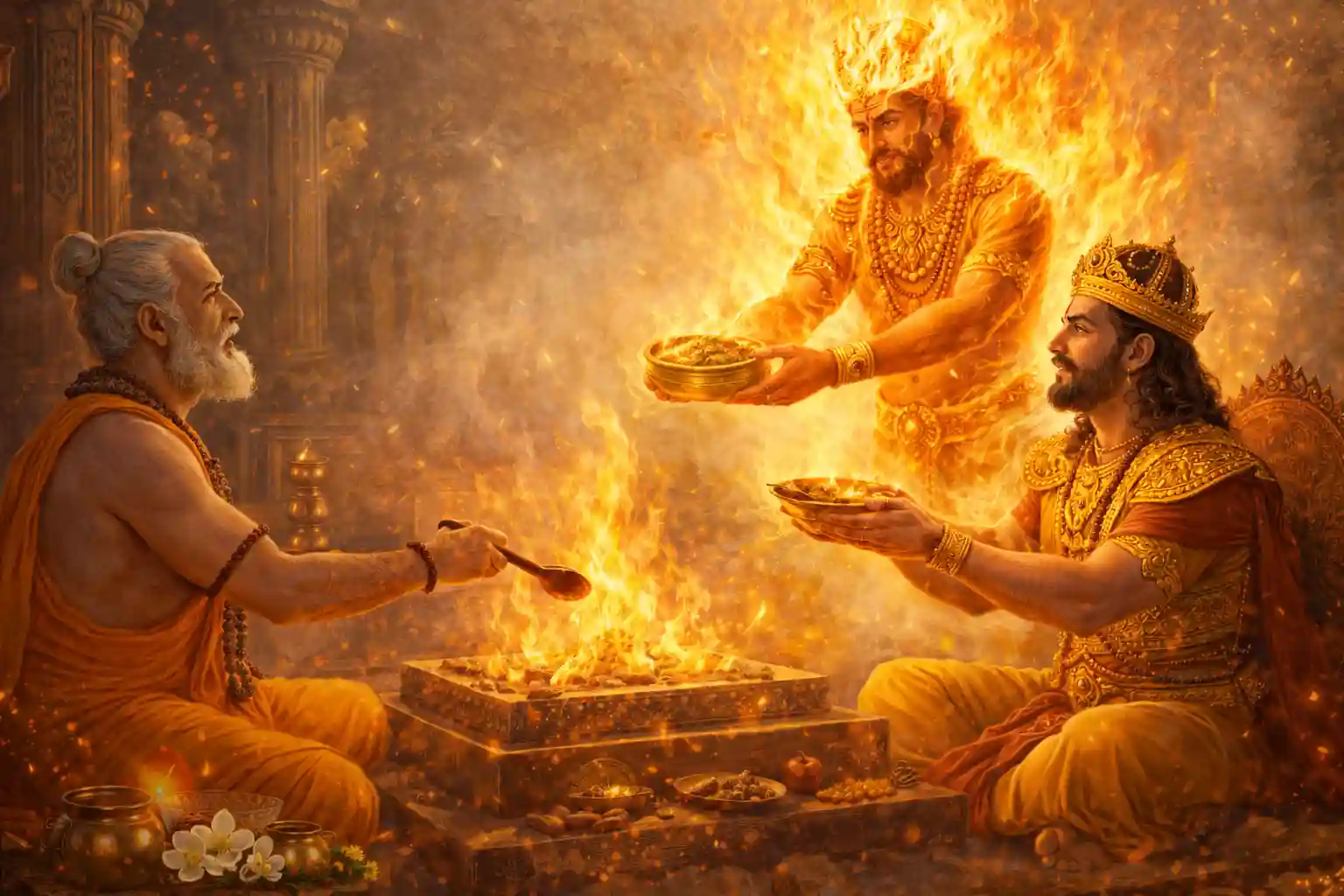
This episode carries deep symbolism:
- The Guru guides the soul toward divine grace
- Yajna represents purification and surrender
- Divine prasadam symbolizes grace beyond human effort
- Distribution among queens reflects divine expansion into multiple forms
Soon after, the queens conceived, and the entire kingdom began waiting in anticipation.
Cosmic Excitement Before the Divine Birth
As time progressed, the atmosphere itself began changing. Saints and sages sensed that something extraordinary was about to happen. They gathered near the river Sarayu, awaiting the divine descent. Even nature responded, as the Sarayu river swelled, not due to rain, but due to joy.
This poetic description reveals that the birth of Lord Ram was not merely a royal event — it was cosmic. The universe itself celebrated. The sages, nature, celestial beings, and divine forces aligned to witness the incarnation.
Such descriptions indicate that divine appearance is not limited to physical birth. It is a universal event. When divinity manifests, all levels of creation respond.
The Divine Timing: Navami Tithi at Midday
The ninth day (Navami) of the bright fortnight in the month of Chaitra arrived. The sun rose, and celestial beings gathered silently. There was a divine decision that the incarnation should remain subtle — not publicly announced — because only spiritually qualified souls recognize divine presence.
As midday approached, extraordinary signs appeared:
- A gentle cool breeze began blowing
- Sacred fires intensified
- Brahmins engaged in midday prayers
- Spiritual energy filled the atmosphere
- Nature became still and expectant
At the precise moment of midday, when Surya reached its peak, the divine incarnation took place.
The timing is deeply symbolic. Midday represents illumination — the peak of awareness. Lord Ram’s birth at this moment signifies the arrival of supreme consciousness in the world.
The Most Untold Moment: The Four-Armed Manifestation
One of the least-discussed aspects of Lord Ram’s birth is the manner in which he appeared. According to the narrative, Lord Ram did not first appear as a helpless infant. Instead, he manifested in his divine four-armed form before Queen Kaushalya.
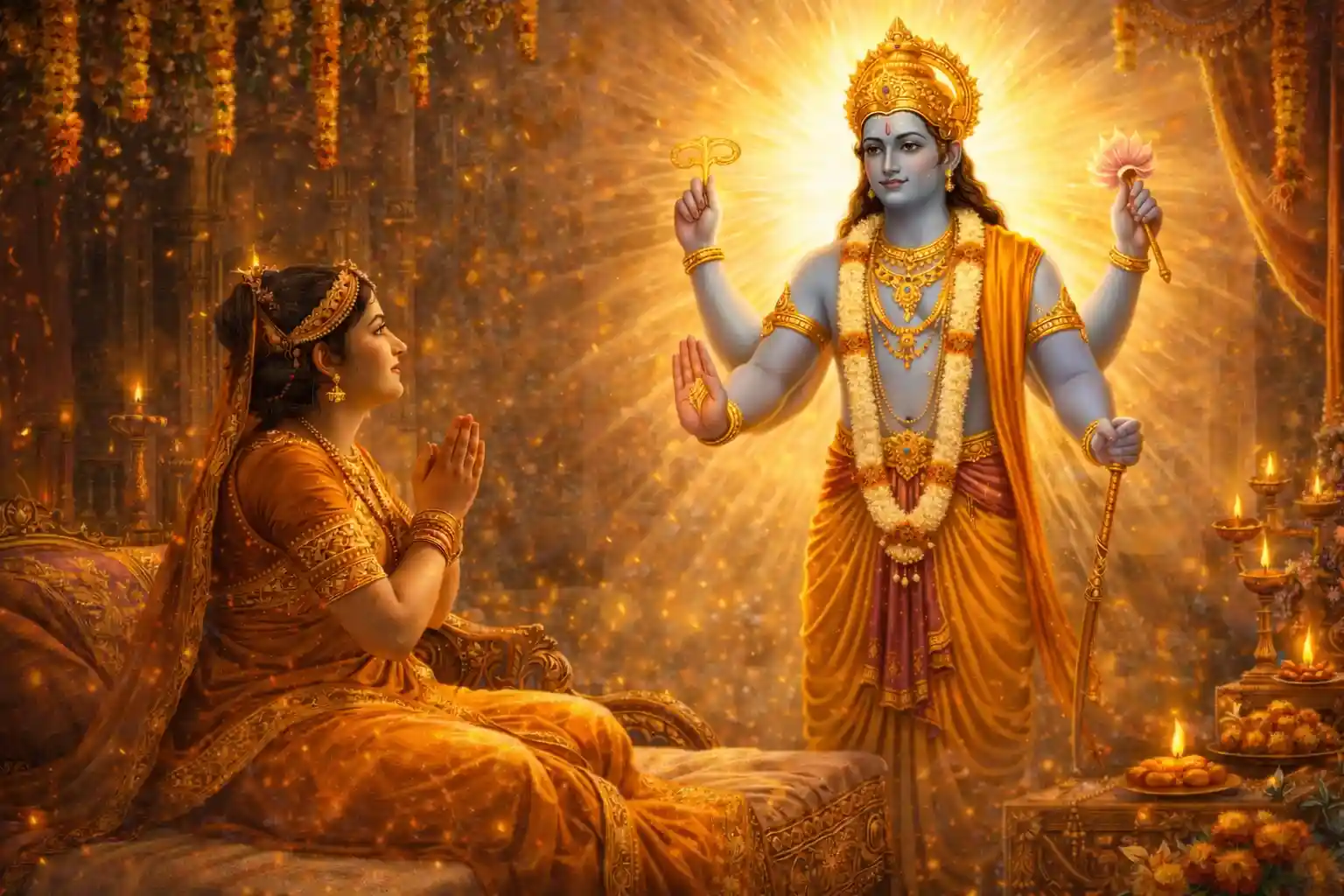
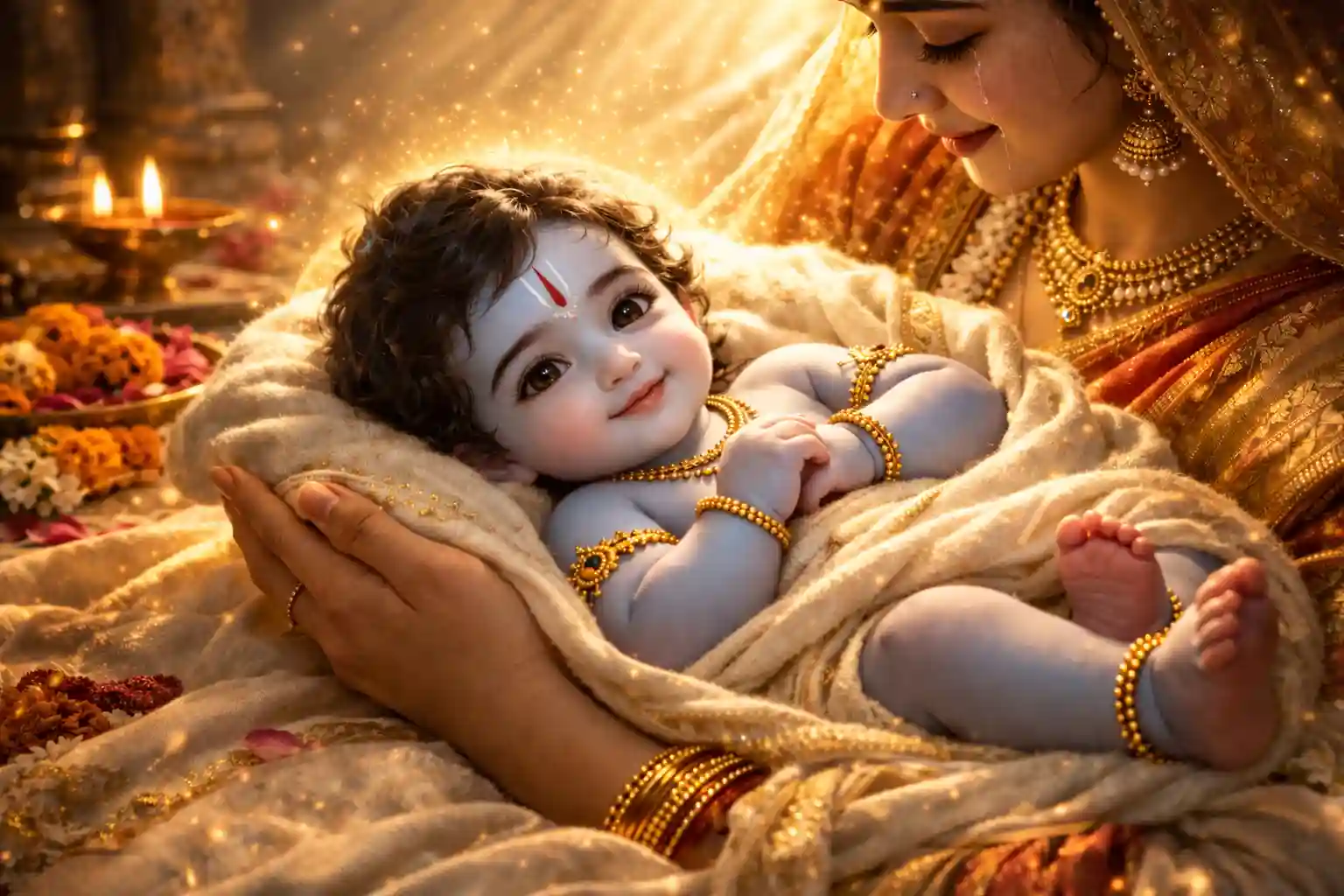
This form confirmed his identity as the Supreme Lord. Kaushalya was overwhelmed. She expressed that she desired to experience him as her child, not as the Lord. In response, the divine form transformed into a human baby.
This transformation is spiritually profound. It shows:
- God chooses intimacy over grandeur
- Divine chooses relationship over reverence
- Love supersedes awe
- Bhakti invites God into human roles
Lord Ram willingly accepted human limitations so that devotees could relate to him. This is why he is known as Maryada Purushottam — the ideal human.
King Dashrath’s Overwhelming Joy
When King Dashrath learned that Kaushalya had given birth, his joy knew no bounds. He rushed to see the child. The kingdom erupted in celebration. Ayodhya rejoiced, not knowing fully that the Supreme Lord had arrived among them.
The celebration marked the beginning of one of the greatest divine pastimes in history — the life of Lord Ram.
The Spiritual Symbolism of Lord Ram’s Birth
The untold story of Rama Navami reveals multiple layers of symbolism:
1. King Dashrath Represents the Human Mind
Despite prosperity, the mind feels incomplete without divine presence.
2. Guru Awakens Divine Longing
Without guidance, spiritual aspiration may never arise.
3. Yajna Represents Inner Purification
Divine grace follows surrender and discipline.
4. Divine Appears When World is Ready
Spiritual readiness invites divine incarnation.
5. Four-Armed Form Represents Divine Reality
Infant form represents loving accessibility.
6. Midday Birth Represents Enlightenment
Divinity shines at the peak of awareness.
Lessons from the Untold Story
The birth of Lord Ram teaches that divinity enters life when:
- There is humility
- Guru guidance is accepted
- Desire for righteousness exists
- Spiritual practices are performed
- Ego is surrendered
- Love is present
This story transforms Rama Navami from a festival into a personal spiritual journey.
Connecting Rama Navami to Swami Mukundananda’s Teachings
Swami Mukundananda’s teachings emphasize devotion combined with knowledge and surrender. The untold story of Lord Ram’s birth perfectly aligns with these principles.
First, the awakening of desire in King Dashrath illustrates the beginning of spiritual life — longing for divine connection. Swami Mukundananda often emphasizes that spiritual progress begins when the soul feels incomplete without God. King Dashrath’s transformation mirrors this awakening.
Second, the role of Guru Vashishtha highlights the importance of guru guidance. Swami Mukundananda repeatedly teaches that the Guru helps channel our efforts in the right direction. Without the Guru, King Dashrath would never have performed the yajna that led to divine grace.
Third, the yajna represents disciplined spiritual practice. Swami Mukundananda emphasizes that devotion must be supported by effort — chanting, meditation, service, and surrender. The yajna symbolizes this combined approach.
Fourth, the manifestation of the divine in a four-armed form and then as a child reflects a key teaching: God is both supreme and accessible. Swami Mukundananda teaches that while God is infinite, He allows Himself to be bound by love. Lord Ram choosing to appear as a child exemplifies divine compassion.
Finally, the celebration in Ayodhya represents inner transformation. When God appears in the heart, joy naturally spreads. Swami Mukundananda teaches that devotion leads to peace, happiness, and fulfillment — just as Ayodhya blossomed upon Lord Ram’s birth.
Thus, Rama Navami is not only a historical celebration but also an invitation to bring Lord Ram into our hearts through devotion, discipline, and Guru guidance.
How to Celebrate Rama Navami Spiritually
To honor the deeper meaning of Rama Navami:
- Chant the name of Lord Ram
- Read Ramayana passages
- Meditate at midday
- Practice compassion and dharma
- Serve others selflessly
- Listen to spiritual discourses
- Reflect on divine qualities
These practices transform celebration into realization.
Key Takeaways
- Lord Ram’s birth was a divinely orchestrated cosmic event
- Guru guidance played a crucial role in inviting divine grace
- The yajna symbolized surrender and spiritual discipline
- Nature and sages anticipated the divine incarnation
- Lord Ram first appeared in his four-armed divine form
- He chose to become a child out of love for devotees
- The birth occurred at midday, symbolizing enlightenment
- Rama Navami represents divine descent into the human heart
- Swami Mukundananda’s teachings align with the story’s spiritual lessons
- Devotion, humility, and guidance invite God into our lives
Frequently Asked Questions (FAQ)
1. Why is Rama Navami celebrated at midday?
Lord Ram is believed to have appeared at noon, when the sun was at its peak. This symbolizes divine illumination and the rise of righteousness.
2. What is the untold aspect of Lord Ram’s birth?
The lesser-known detail is that Lord Ram first manifested in his divine four-armed form before transforming into a baby at Kaushalya’s request.
3. What role did Guru Vashishtha play?
He guided King Dashrath to perform the yajna that ultimately led to the divine incarnation.
4. Why did sages gather before Lord Ram’s birth?
Spiritually realized beings sensed the upcoming divine descent and came to witness it.
5. What does the yajna symbolize spiritually?
It represents purification, surrender, and disciplined devotion.
6. Why did Lord Ram take a human form?
To establish dharma and demonstrate ideal human conduct.
7. What is the significance of Sarayu river overflowing?
It symbolized nature rejoicing in anticipation of the divine birth.
8. How is Rama Navami relevant today?
It reminds us to invite divine virtues into our lives — truth, compassion, courage, and devotion.
9. How does this relate to Swami Mukundananda’s teachings?
It emphasizes Guru guidance, devotion, surrender, and divine grace — core principles taught by him.
10. What is the best way to celebrate Rama Navami?
Through devotion, chanting, reading Ramayana, and listening to spiritual discourses.
Call to Action — Watch Swami Mukundananda on the Untold Birth Story of Lord Ram
To deepen your understanding of the spiritual significance of Rama Navami and the untold story of Lord Ram’s birth, watch Swami Mukundananda’s enlightening discourse on this topic.
👉 Watch here:
This discourse beautifully explains the divine orchestration behind Lord Ram’s appearance and how we can apply these teachings in our own lives.
Subscribe to Swami Mukundananda’s YouTube Channel
Stay connected with powerful spiritual wisdom, festival insights, and practical devotion teachings.
By subscribing, you will receive:
- Festival special discourses
- Ramayana insights
- Bhagavad Gita wisdom
- Meditation guidance
- Devotion practices
- Spiritual Q&A sessions
Celebrate Rama Navami not just as a festival — but as the birth of divine consciousness within your heart.