Filing a Divine Petition Against Modern Stress
Do you ever feel like you are losing a court case against your own life?
In the modern world—what the Vedic scriptures call Kali Yuga (the Age of Ignorance)—we are constantly “served notices” by invisible litigants: anxiety, chronic stress, comparison, broken relationships, distraction, and a restless mind. We try to argue our way out with logic and material effort. Yet as Swami Mukundanandaji often teaches, the real “opposing counsel” is not outside—it is our own ego and Maya, the force that keeps the soul forgetful of its divine identity.
Now here is the astonishing legal loophole for the soul:
Over 400 years ago, Goswami Tulsidas faced a crisis that mirrors modern burnout. Tradition describes that Kali Yuga began to harass him—mentally and physically—until he sought refuge at the feet of Lord Hanuman. Lord Hanuman’s advice was not casual. It was procedural:
“Write a petition. Document your suffering. File it in the Court of Lord Rama.”
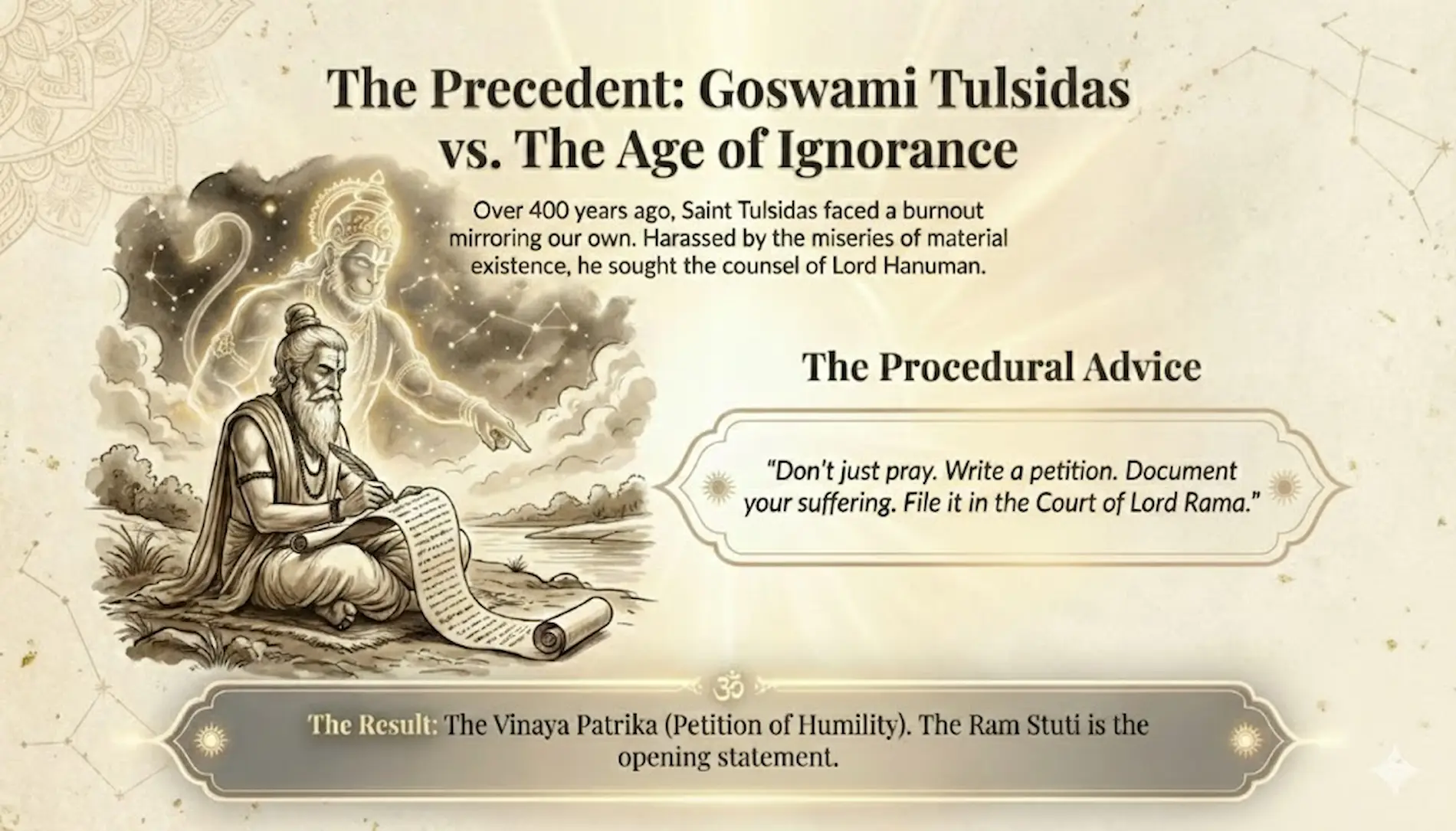
Tulsidas didn’t merely pray—he drafted the Vinaya Patrika (Petition of Humility), a formal devotional “case file” seeking relief from the miseries of material existence. The crown jewel of that petition—the opening statement of the lawsuit—is Shri Ramchandra Kripalu Bhajman, popularly known as the Ram Stuti.
In this blog, we will explore the Ram Stuti lyrics, meaning, and spiritual significance through Swami Mukundanandaji’s teachings—so you can file your own Affidavit of Devotion and reclaim inner peace.
According to Swamiji, the Ram Stuti is also a powerful meditative tool for Roop Dhyan (meditation on the divine form): these verses do not merely describe Lord Rama—they help you see Him, feel His compassion, and anchor your mind in divine beauty.
What You Will Learn in This Blog
- The legal-document framework of Ram Stuti as a Divine Petition.
- The Ram Stuti lyrics with meaning (Exhibit A).
- The spiritual significance of each clause: compassion, beauty, protection, authority, and residency in the heart.
- How to practice Roop Dhyan using Ram Stuti.
- A daily method to “file” the petition for calm, clarity, and devotion.
Section 1: The Divine Litigation—Why We Need a Petition
To understand the Ram Stuti, we must first understand the “lawsuit” that gave birth to it.
Most people treat prayer as a casual request.
Tulsidas treated it like a formal necessity.
Look at the modern case file of the mind:
- Stress about the future
- Regret about the past
- Comparison in the present
Swami Mukundanandaji teaches that the deepest struggle is not external—it is Maya, the internal force that keeps us restless even when life looks “successful.” We have conquered distance and technology, yet we often cannot control our inner world. The ancient diagnosis still stands.
Bhakti: The Legal Contract Between Soul and Divine
Bhakti is often misunderstood as emotion alone. But in the Ram Stuti framework, Bhakti becomes a binding sacred contract:
- Consideration (what the soul offers): ego, stubbornness, worldly attachment, “I can manage it myself.”
- Divine Obligation (what the Lord promises): Once the “Affidavit of Devotion” is signed with sincerity, the Lord becomes contractually “bound” by His own promise in the Bhagavad Gita [9.22]: “Yoga-kṣhemaṁ vahāmyaham”: I carry what My devotee lacks and preserve what they have.
The Courtroom of the Soul
In this spiritual courtroom, the Ram Stuti is your Affidavit of Devotion. When you recite these verses, you are presenting “evidence” of your surrender to the highest authority.
- Petitioner: You (the restless soul seeking relief)
- Defendant: ego, fear, and worldly distraction
- Lead Advocate: Lord Hanuman (presenting your case)
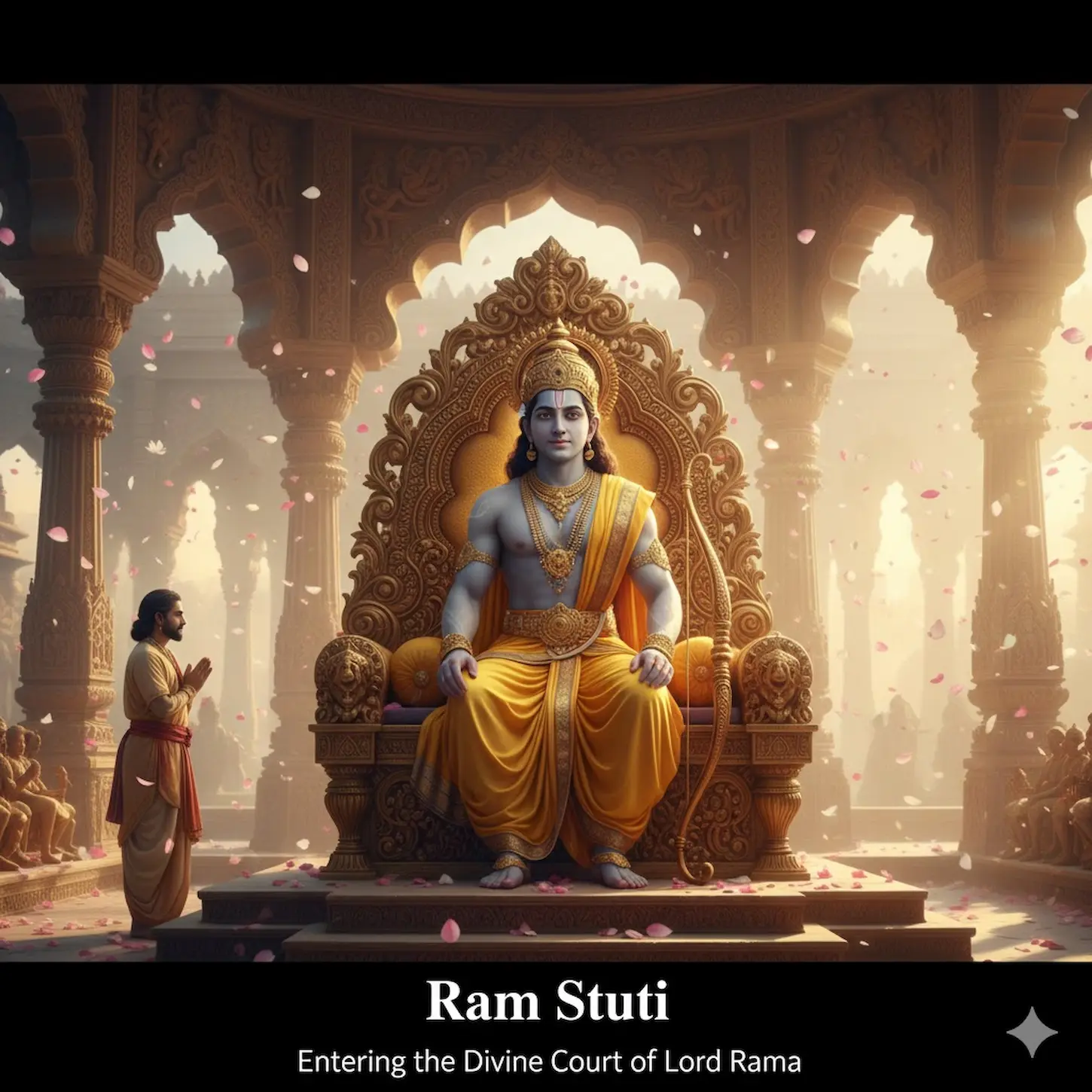
- Supreme Judge: Lord Rama, Maryada Purushottam (the epitome of righteousness and perfection)
Swami Mukundanandaji often explains: as long as we rely only on our intellect, God remains a “silent witness.” But when we admit helplessness, when we file our paperwork, admitting we cannot win the case against our own mind, Divine Grace begins to intervene.
Section 2: The Lyrics—Exhibit A (The Text of the Divine Petition)
To file your Affidavit of Devotion, you must first understand the specific clauses of the contract you are signing. Presented here as Exhibit A, the Ram Stuti contains five core stanzas from the Vinaya Patrika.
Below are the Ram Stuti lyrics with meaning, so you can experience both the Sanskrit vibration (your verbal signature) and the English meaning (your inner conviction).
Exhibit A: The Formal Clauses
Clause 1: Invocation of Compassionate Grace
Shrī Rāmachandra kripālu bhaju man, harana bhava-bhaya dārunam
Navakanja-lochana, kanja-mukh, kara-kanja, pada-kanjārunam
Meaning: O my mind! Worship the compassionate Lord Ramachandra, who destroys the terrible fear of worldly existence. His eyes are like freshly bloomed lotuses, his face like a lotus, and his hands and feet resemble red lotuses.
Clause 2: Revelation of Divine Beauty
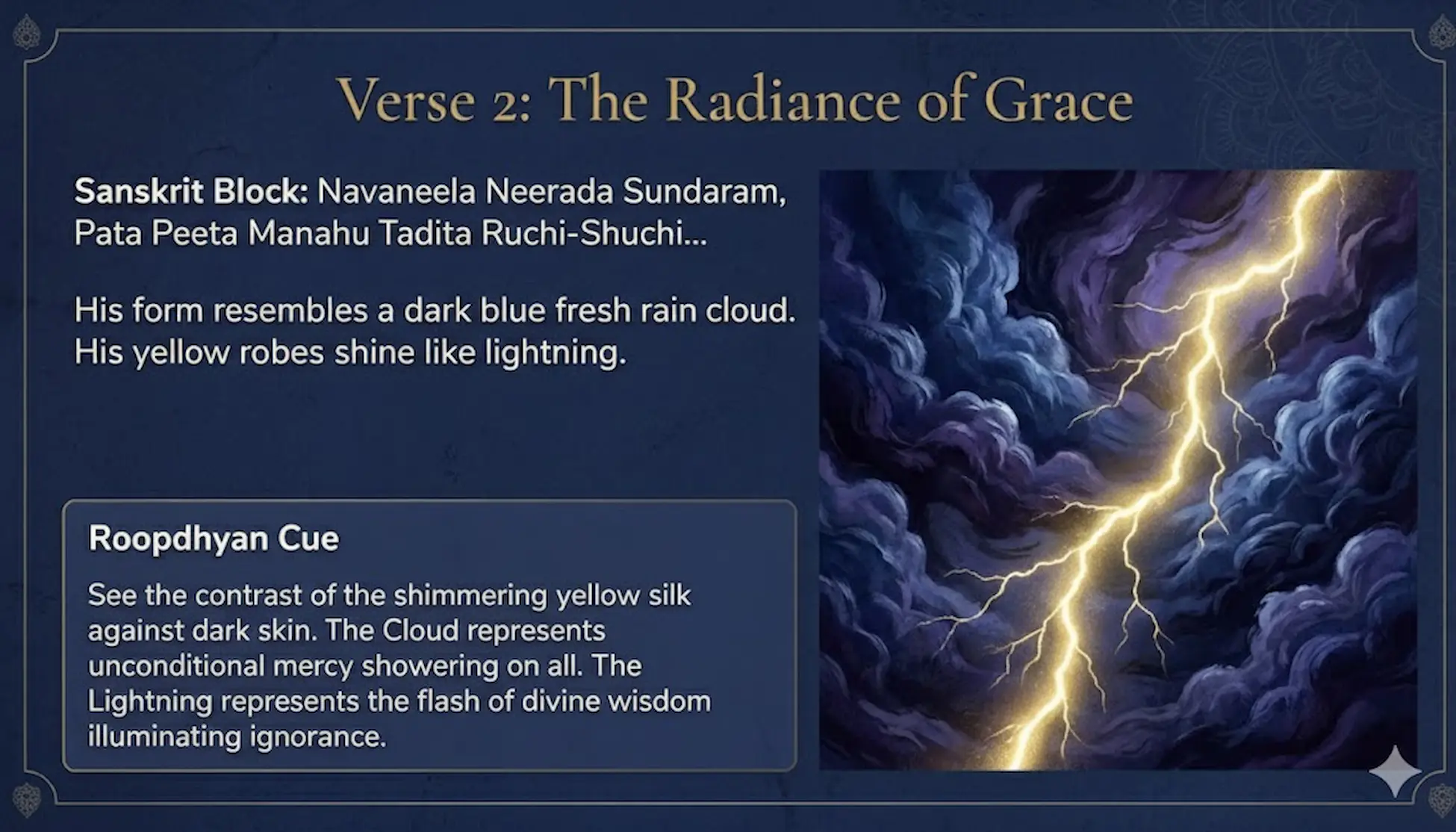
Kandarp aganit amit chavi, nav nīl nīraja sundaram
Pata pīt mānahu tadit ruchi-shuchi, navmi Janak sutā-varam
Meaning: His beauty surpasses countless forms of Kamadeva [Cupids] and resembles a newly formed dark blue rain cloud. Clad in yellow garments shining like lightning, I bow to the pure Lord Rama, the beloved husband of Janaka’s daughter Sita.
Clause 3: Promise of Divine Protection
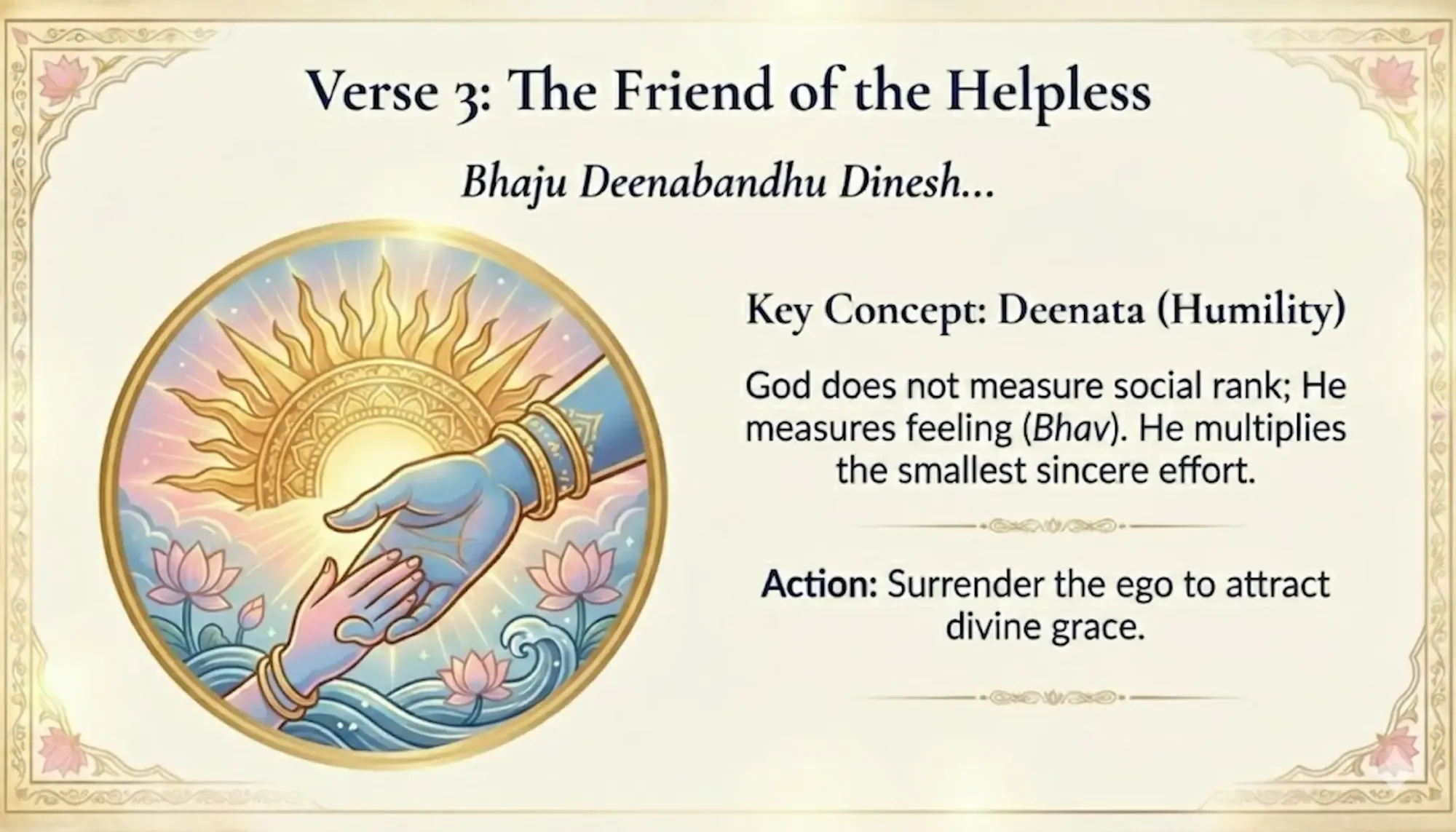
Bhaju dīnbandhu dinesh, dānav-daitya-vansh-nikandanam
Raghunand ānand-kand, Koshal-chand Dasharath-nandanam
Meaning: O mind, worship Rama, the friend of the helpless, the light of the world, and the destroyer of demonic forces. He is the joy of the Raghu dynasty, the source of bliss, the moon of Kosala, and the son of King Dasharatha.
Clause 4: Manifestation of Divine Authority
Sira mukut kundal tilak chāru, udāru ang vibhūshanam
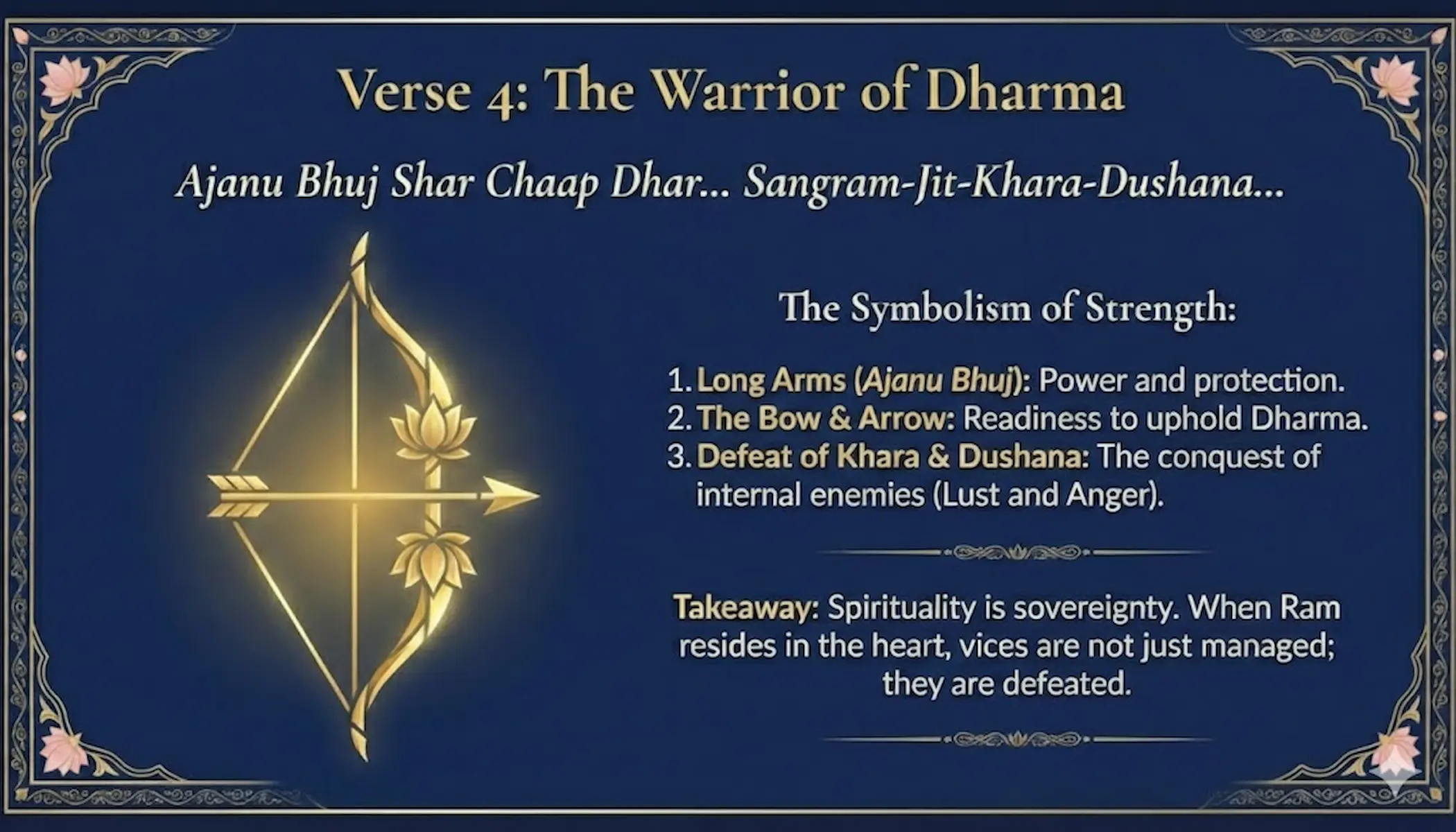
Ājānu-bhuja shar-chāp-dhar, jit-khara-dūshana-vibhūshanam
Meaning: He wears a crown on his head, earrings, a beautiful tilak on his forehead, and ornaments adorning his noble body. With arms reaching his knees, holding bow and arrows, he defeated Khara and Dushana in battle.
Clause 5: The Heart’s Final Prayer for Residency
Iti vadati Tulsīdās, Shankar Shesh muni man ranjanam
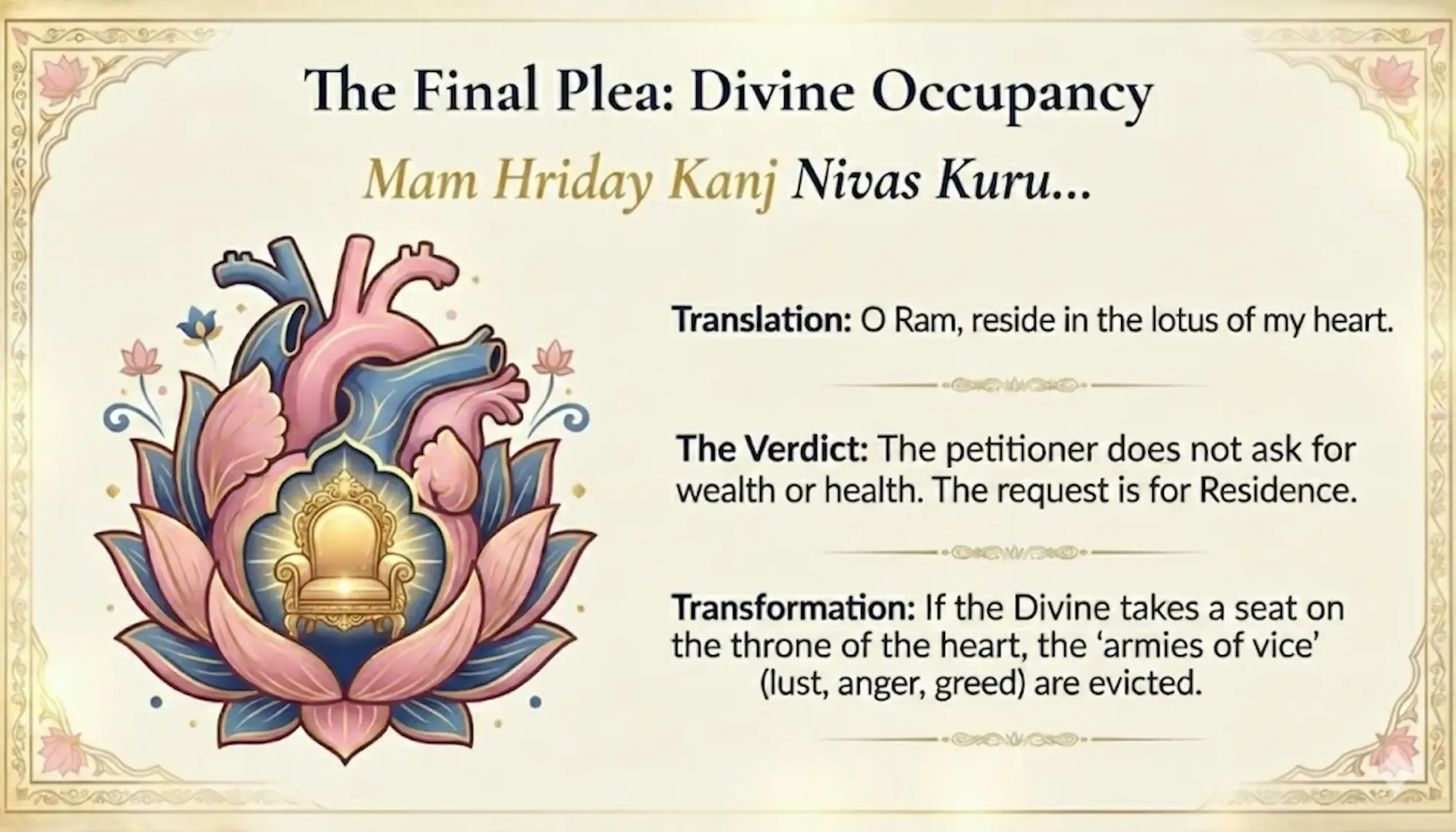
Mama hriday-kanj nivās kuru, kāmādi khal-dal-ganjanam
Meaning: Thus says Tulsidas, whose verses delight Lord Shiva, Sheshnag, and great sages. O Lord Rama, reside in the lotus of my heart and destroy the evils born of desire.
These five clauses together form the heart of the Ram Stuti lyrics, meaning, and spiritual significance—guiding the mind from fear to surrender, and from description to meditation.
Section 3: Clause 1—Establishing the Jurisdiction of Grace
The Plea:
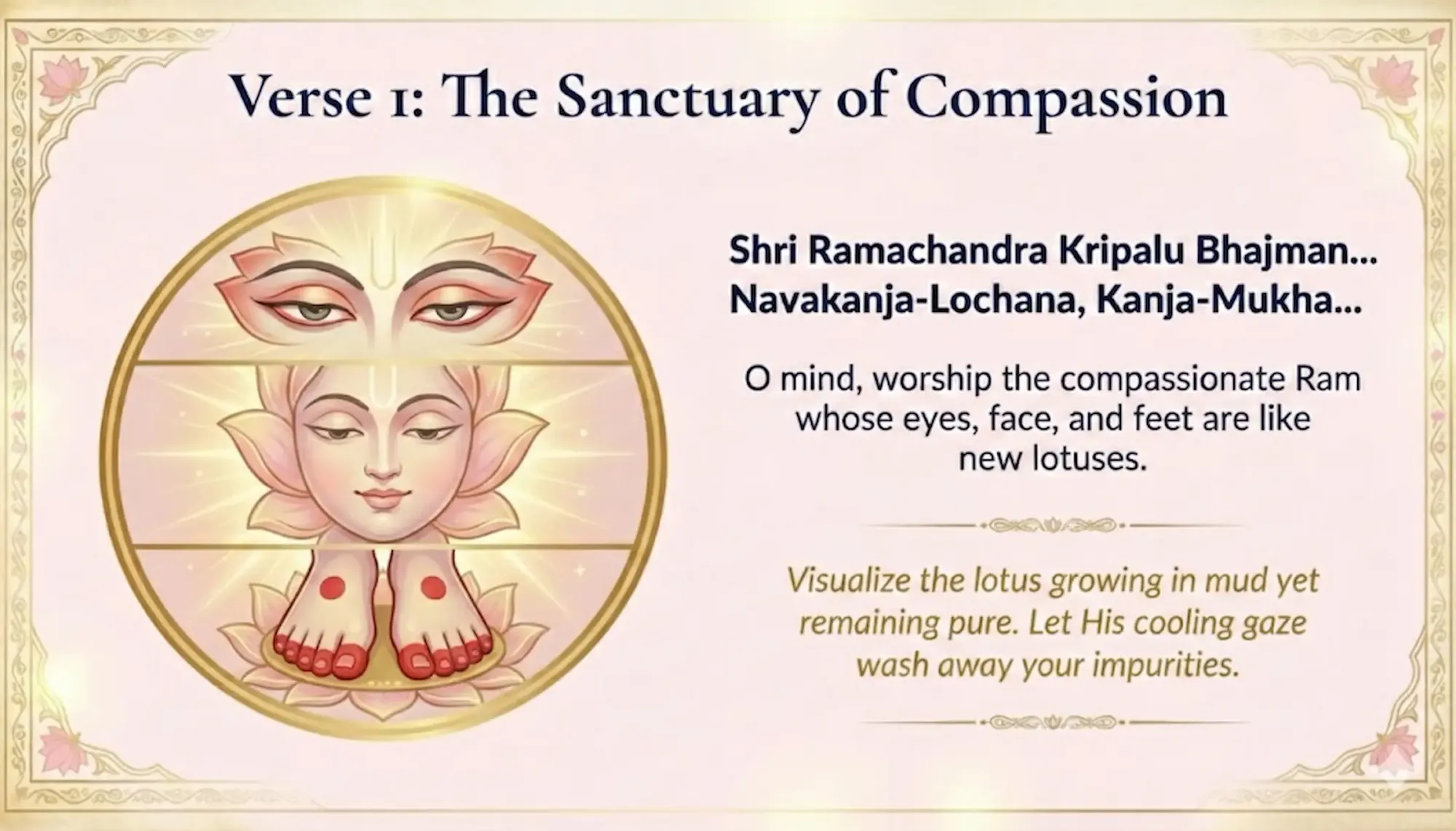
Shrī Rāmachandra kripālu bhaju man, harana bhava-bhaya dārunam
Navakanja-lochana, kanja-mukh, kara-kanja, pada-kanjārunam
The Meaning:
“O my mind! Worship the compassionate Lord Ramachandra, who destroys the terrible fear of worldly existence. His eyes are like freshly bloomed lotuses, his face like a lotus, and his hands and feet resemble red lotuses.”
This opening line of the Ram Stuti’s lyrics carries a profound teaching: it establishes that divine compassion—not human effort—is the true foundation of inner peace.
Why “Kripalu” (Compassionate) is the Lead Argument
Tulsidas does not approach Lord Rama as a strict King or a punishing Judge.
He approaches Him as Kripalu—compassion itself. In the “Court of Bhakti,” Tulisdas argues that the Lord’s compassion is higher than the Law of Karma.
He is addressing his own “legal team” – his mind [bhaju man] – telling it to stop litigating past mistakes and focus on the Judge’s mercy.
In this moment, we move from fear to surrender.
Swami Mukundanandaji often explains that the mind does not transform through abstract concepts alone. It transforms through emotional association. This is why we must invoke stories where Lord Rama’s compassion is visible and undeniable through the scriptures:
- Kevat: Lord Rama accepts the simple boatman with warmth, not status.
- Ahalya: Lord Rama restores dignity where society erased it.
- Shabari: Lord Rama accepts love, not social rank—Bhav is the true offering.
- Bharat: Lord Rama embraces without resentment—compassion that holds no grudge.
The subconscious absorbs images far more deeply than ideas. When we hear of Ahalya restored, Shabari accepted, or Kevat embraced, the mind forms a conclusion:
“If God accepted them, He can accept me.”
This shift is subtle but powerful. Instead of approaching God with guilt or hesitation, the devotee begins to approach with trust.
Haran Bhavbhay Darunam—An Injunction Against Terror
Modern fear feels legal: “What if I fail?” “What if I lose?” “What if I’m not enough?” Darun is that inner terror. Swami Mukundanandaji brings this to a practical level: where the mind goes, your life follows.
Lord Rama may not erase every external wave instantly, but the petition seeks something deeper: the removal of internal panic. When the fear dissolves, the soul acts with clarity.
Roop Dhyan Begins Here: The Lotus Evidence
Tulsidas describes Lord Rama’s eyes, face, hands, and feet as Navakanja - fresh lotuses. Swamiji explains this as mental displacement: you do not win by fighting thoughts; you win by replacing them with a higher, sweeter vision.
· Fixing the Wandering Advocate: Our mind is like a lawyer jumping from one worry to another. Focusing on the Arunam [the reddish morning sun hue] of Lord Rama’s feet acts as an anchor. In Sanskrit aesthetics, this reddish tint symbolizes the Lord walking toward the devotee – the color of active compassion.
Mini practice:
Visualize Rama’s lotus eyes looking at you with patient compassion. Let the mind “feel” what it is like to be seen by grace.
Section 4: Clause 2 & Clause 3—Visual ID and Safety Precedent
Clause 2: The Visual ID—Why Beauty is a Spiritual Strategy
The Plea:
Kandarp aganit amit chavi, nav nīl nīraja sundaram
Pata pīt mānahu tadit ruchi-shuchi, naumi Janak sutā-varam
The Meaning:
"His beauty surpasses countless forms of Kamadeva [Cupids] and resembles a newly formed dark blue rain cloud. Clad in yellow garments shining like lighting, I bow to the pure Lord Rama, the beloved husband of Janaka’s daughter Sita."
This verse of the Ram Stuti carries deep spiritual significance, because it reveals how divine beauty itself becomes a meditation method.
Why focus on physical beauty in a spiritual petition?
Swami Mukundanandaji explains that the mind is Sakar—it is naturally designed to attach itself to names, forms, and attributes. If you try to meditate on a formless void, the mind usually drifts back to its worries.
Why Divine Beauty Works as a Meditation Anchor
In modern meditation circles, people are often told to “clear the mind.”
But Swami Mukundanandaji repeatedly explains that this approach is incomplete. The mind cannot remain empty for long — it naturally seeks something to hold onto.
Tulsidas solves this problem brilliantly.
Instead of asking the mind to detach from the world first, he gives it something more captivating than the world. By presenting Lord Rama’s beauty as greater than Kandarp (Cupid), he provides a replacement for the mind’s strongest attraction — desire itself.
By visualizing the Nav Neel Neeraj (blue-cloud complexion), you displace the gray clouds of anxiety with divine serenity.
This is why Roop-Dhyan is so effective. The mind does not feel deprived; it feels redirected.
The Restorative Raincloud: A raincloud brings relief to a parched land. In the heat of modern life—where we are burned by competition and comparison—the blue form of Lord Rama acts as a Spiritual Coolant.
• Lightning in the Cloud: The yellow robes (Pata Pit) are compared to lightning. This represents the suddenness of Grace. One moment you are in the dark; the next, a flash of Lord Rama's presence illuminates your internal courtroom.
Where previously the mind clung to worries, comparisons, or sensory pleasures, it now begins to rest in divine form, color, expression, and compassion.
Gradually, meditation stops feeling like effort and starts feeling like homecoming.
And once the mind tastes that stillness, it begins to return there naturally — just as a traveler returns to the place where they felt most at peace.
Having established Rama’s beauty as the meditation anchor, Tulsidas now establishes His protection as the devotee’s security.
Clause 3: The Safety Clause—Protection That Uproots Inner Demons
The Plea:
Bhaju dīnbandhu dinesh, dānav-daitya-vansh-nikandanam
Raghunand ānand-kand, Koshal-chand Dasharath-nandanam
The Meaning:
“O mind, worship Rama, the friend of the helpless, the light of the world, and the destroyer of demonic forces. He is the joy of the Raghu dynasty, the source of bliss, the moon of Kosala, and the son of King Dasharatha.”
In our spiritual litigation, this is our Legal Precedent. Tulsidas identifies the Judge's track record through two powerful titles:
1. “Deenbandhu” — The Judge Who Runs Toward the Helpless
Swami Mukundanandaji teaches that God has a "weakness" for the humble. In our affidavit, we don't present our worldly achievements.
• The Ego Trap: If you approach God as a "CEO" or a "PhD," you are relying on your ego—the very defendant in this case.
• The Contractual Obligation: When you go as a Deen (one who is spiritually needy), the Lord is contractually obligated to become your Bandhu (Friend). He specifically prioritizes those who have no one else.
2. “Dinesh” — The Sun of Justice
Calling Lord Rama Dinesh (The Sun) provides three guarantees:
• Intolerance for Oppression: Just as the sun allows no darkness to remain, Lord Rama allows no injustice to stand.
• Clarity: He provides the light that removes the darkness of confusion.
• Protection: He provides the strength to keep your life aligned with Dharma.
Tulsidas calls Him dānav-daitya-vansh-nikandanam—the one who uproots the lineage of demons. Swamiji explains that these "demons" are our deep-seated samskaras (tendencies]: anger: anger, pride, greed, addiction, and deep patterns that produce stress.
By citing this, we are telling the Judge: "You destroyed the demons of history; now destroy the demons in my subconscious." We are asking for the permanent uprooting of the hidden roots of our stress.
Section 5: Clause 4—The Enforcement Power (Authority in Action) [Stanza 4]
The Plea:
Sira mukut kundal tilak chāru, udāru ang vibhūshanam
Ājānu-bhuja shar-chāp-dhar, jit-khara-dūshana-vibhūshanam
The Meaning:
"He wears a crown on his head, earrings, a beautiful tilak on his forehead, and ornaments adorning his noble body. With arms reaching his knees, holding bow and arrows, he defeated Khara and Dushana in battle.”
This verse of the Ram Stuti carries powerful spiritual significance, because it reveals not only Lord Rama’s beauty, but His authority to transform the devotee’s inner life.
Clause 4 proves the Judge has enforcement power.
Regalia of Authority
A modern judge’s robe symbolizes state power. Here, Lord Rama’s crown [Mukut] and ornaments [Kundal – Earrings] declare: He is not a mediator—He is the Supreme Sovereign.
Swami Mukundanandaji teaches in his book 7 Mindsets for Success that for the mind to surrender, it must recognize a power greater than itself. When we contemplate this Sovereign Judge, the ego—the primary “defendant” in our internal case— finally agrees to step down and accept a higher divine decree.
Earrings: The Divine Art of Listening
Tulsidas highlights the earrings—why? Because a just judge must listen. Swamiji teaches Shravanam (listening) is the doorway of devotion. In a world where we often feel unheard by society or family, Ram Stuti gives reassurance: your plea is heard in the Divine Court.
Tilak: The Seal of Righteousness and Wisdom
The tilak symbolizes righteous perception. Swamiji’s teachings emphasize that we usually see the world through the distorted lens of our own desires. The Tilak represents the unbiased vision of the Divine Judge. When we meditate on this seal, we are asking the Lord to grant us that same clarity – the ability to see our challenges not as disasters, but as opportunities for growth.
Bow and Arrow: A Permanent Injunction
Every court order requires enforcement by police. Lord Rama’s weapons—the Shar-chāp (Bow and Arrow)—represent the destruction of our internal enemies: Kama (lust), Krodha (anger), and Lobha (greed).
When you recite this stanza, you are formally authorizing the Supreme Judge to use His divine power to clear out the negativity in your subconscious mind. You are admitting that you cannot police your own thoughts alone. You are filing for a permanent injunction against the habits that quietly rob you of your peace.
Lord Rama — serene protector, standing in divine strength and compassion.
Lord Rama with bow in forest, symbolizing protection and inner victory.
Ājānu-bhuja: The Long Reach of Divine Grace
One of the most profound terms in this Affidavit is Ājānu-bhuja -arms that reach the knees. Physically, this represents a Mahapurush (a great soul); spiritually, it signifies the reach of Grace.
Swami Mukundanandaji teaches that no matter how deep you have fallen into the pit of modern stress or past mistakes, the Lord’s arms are long enough to reach you in your darkest hour and pull you out. There is no corner of your life beyond His protection.
This stanza therefore does not only describe Rama’s appearance; it explains how divine protection actually operates in the devotee’s life.
The Result
Just as a modern court uses the power of the state to enforce its rulings, Lord Rama uses His divine power not only to judge your case, but to enforce lasting peace within your heart.
Section 6: Clause 5—Final Verdict and the Occupancy Decree
Now we reach the climax of the petition. After establishing the Jurisdiction, the Form, and the Enforcement Power, Tulsidas makes his Final Prayer. This is the "settlement" every seeker is truly after.
This final verse of the Ram Stuti carries its deepest spiritual significance, because it reveals that devotion’s ultimate goal is not temporary relief, but permanent divine presence.
The Plea:
Iti vadati Tulsīdās, Shankar Shesh muni man ranjanam
Mama hriday-kanj nivās kuru, kāmādi khal-dal-ganjanam
The Meaning:
“Thus says Tulsidas, whose verses delight Lord Shiva, Sheshnag, and great sages. O Lord Rama, reside in the lotus of my heart and destroy the evils born of desire.”
Now comes the climax: not a temporary settlement, but permanent residency.
Nivās Kuru—The Residency Permit
In worldly litigation, you might settle for a one-time payment. But in the Affidavit of Devotion, Tulsidas asks for something much larger: Permanent Residency (Nivās kuru).
Swami Mukundanandaji explains that the heart is like a house. Currently, that house is occupied by “illegal squatters” — the Kāmādi (lust, anger, and greed). These are the Khal-dal (the gang of villains) mentioned in the verse. You cannot evict these villains by your own strength; they are too well-entrenched.
The Final Decree: By inviting the Supreme Judge to live in the Lotus of the Heart, you are effectively handing over the keys. Once the Lord occupies the heart, the gang of villains has no legal standing to remain. They flee because they cannot coexist with Divine Light.
Where God resides, restlessness loses its home.
Shankar–Shesh–Muni: Expert Witness Testimony
Tulsidas cites three “Expert Witnesses”: Shiva [the greatest ascetic], the serpent Shesha, and sages [muni]—highest authorities—finding joy in Lord Rama alone.
If the highest beings in the universe find their joy exclusively in Lord Rama, then our search for joy in smaller things — like social media validation — is a legal error. We are seeking settlements in a small-claims court when we could have the Infinite Wealth of the Supreme Court.
Signature Line: “Iti vadati Tulsidas”
Tulsidas signs the petition—and invites you to sign yours.
Swami Mukundanandaji teaches that Grace is proportional to the sincerity of the signature. When you chant these final lines, you are putting your soul’s seal on the request for Divine Residency.
You aren’t just visiting God; you are asking Him to take full possession of your life.
This is the true verdict of the Ram Stuti — not that life suddenly becomes easy, but that your heart gains a permanent resident who transforms how you live it.
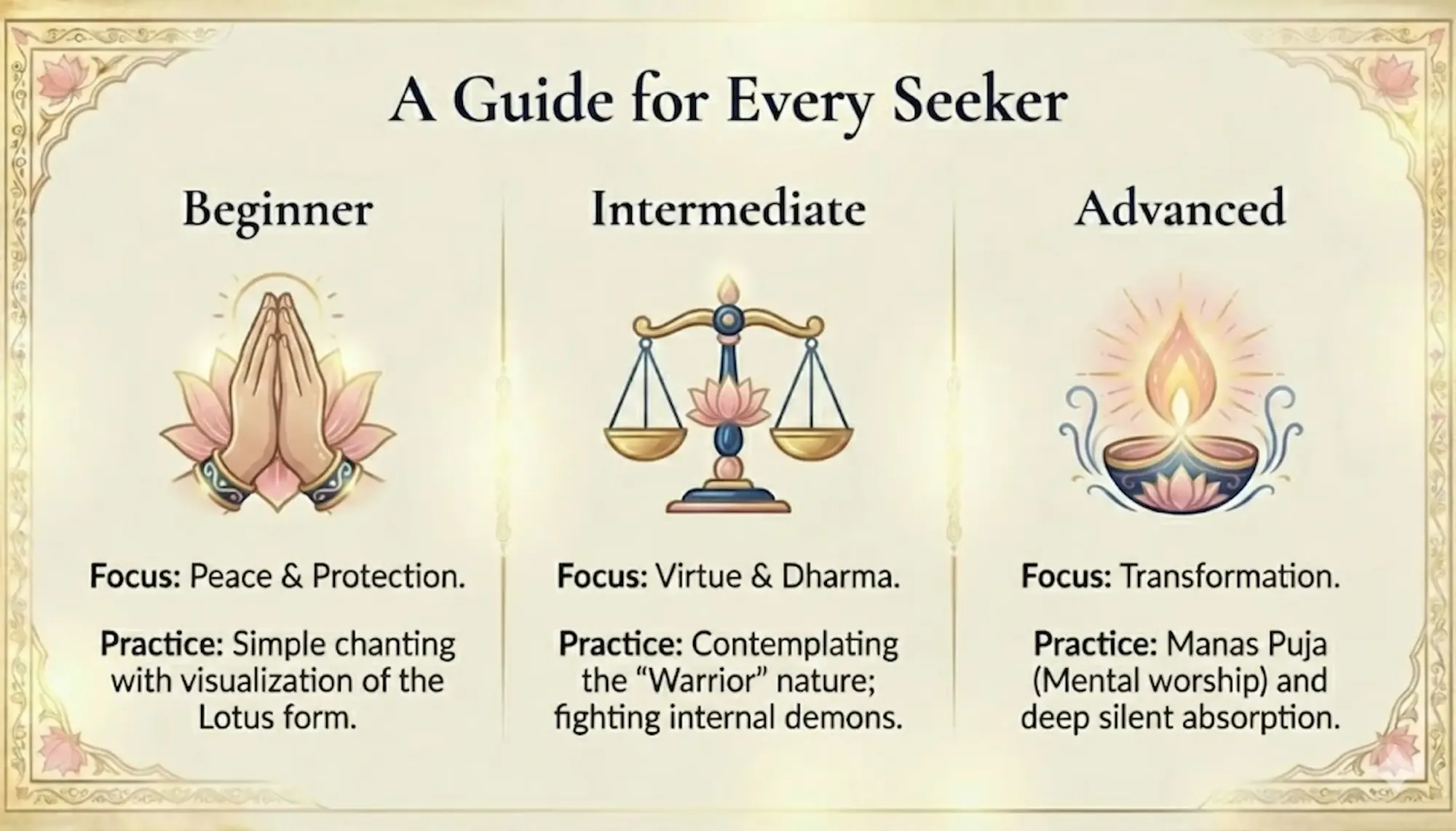
Section 7: How to “File” Your Petition Daily
To turn the Ram Stuti’s meaning into lived experience, move from reading to Sadhana.
1. Time of Filing (Brahma Muhurta: 4–6 AM): This is when the atmosphere is Sattvic [pure] and the “Opposing Counsel” [worldliness] distractions are asleep.
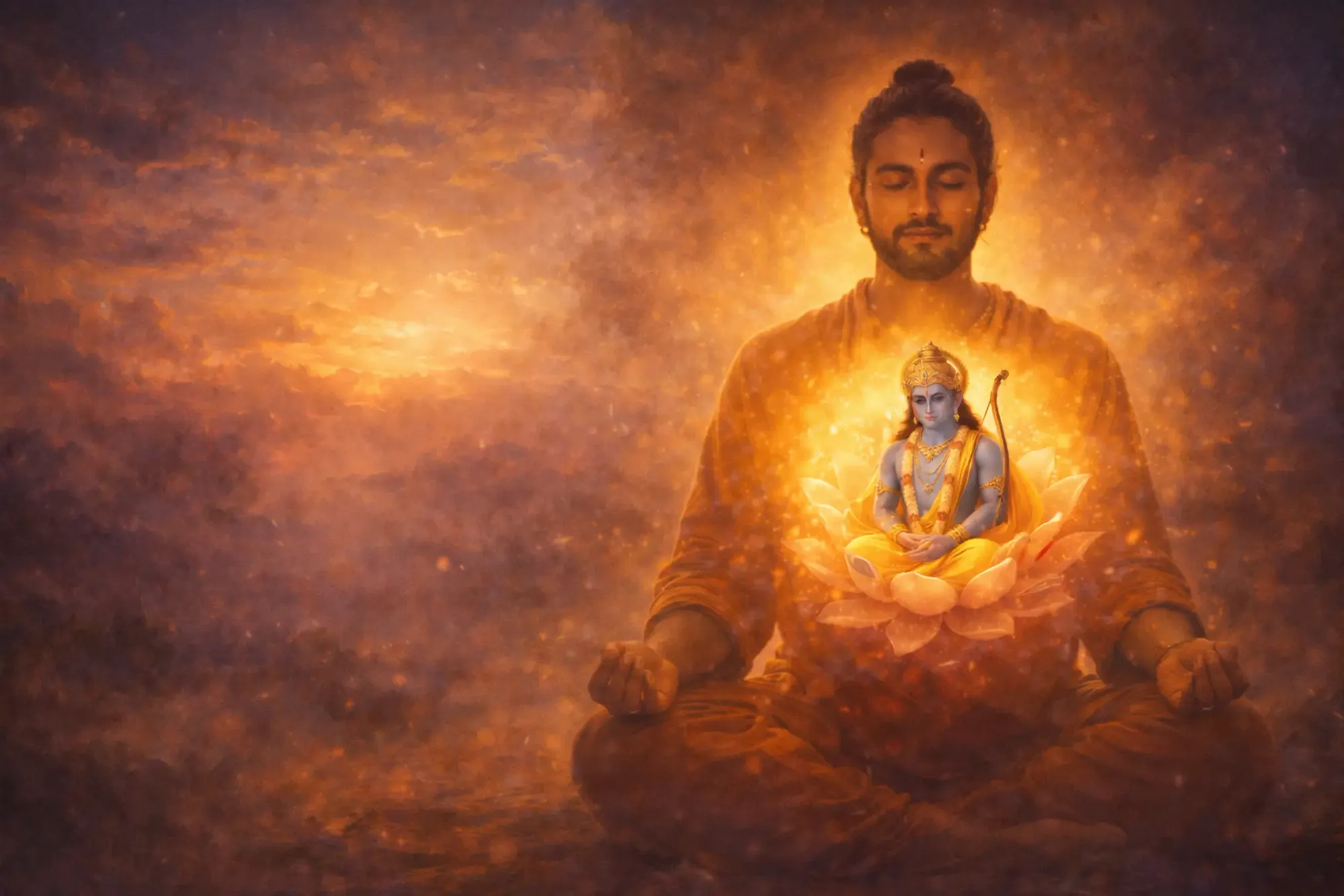
2. Inner Courtroom (Roop Dhyan): Visualize Lord Rama’s form—blue cloud skin, lightning gold robes beside you and looking at you with compassion.
3. Sincere Signature: “Lord, I have filed my petition. I leave the results to Your grace.” Practice Nishkam Karma—do your duty without anxiety.
Try this one-week test: chant daily for seven days. Watch your reactions soften. Notice your breath slow during stress. Observe your mind returning to Rama’s compassionate form.
When the Ram Stuti becomes part of daily life, it acts like a reset button.
Not dramatic. Not sudden. But steady.
And over time, that steadiness becomes the difference between a mind that is constantly reacting… and a heart that remains quietly rooted in grace.
Conclusion: The Verdict is Peace
The Ram Stuti is not merely a 400-year-old hymn.
It is a living legal document of devotion.
Through Tulsidas’s wisdom and Swami Mukundanandaji’s teachings, we learn a simple truth: peace comes not from controlling life, but from surrendering it to divine guidance.
By filing your “Affidavit of Devotion” every day, you shift the burden of your life from your own weak shoulders to the infinite strength of Lord Rama.
This is why the Ram Stuti’s lyrics, meaning, and spiritual significance remain timeless — not just as poetry, but as a living guide for the restless modern heart.
Chant once. Sit once. Offer once.
You may not notice the change the first day.
But chant daily, and slowly the inner courtroom begins to quiet.
The arguments soften.
The fear loosens.
The heart feels less alone.
The petition has already been written.
The Judge is already compassionate.
Only one thing remains – your signature.
The court is now in session.
Are you ready to sign your case?
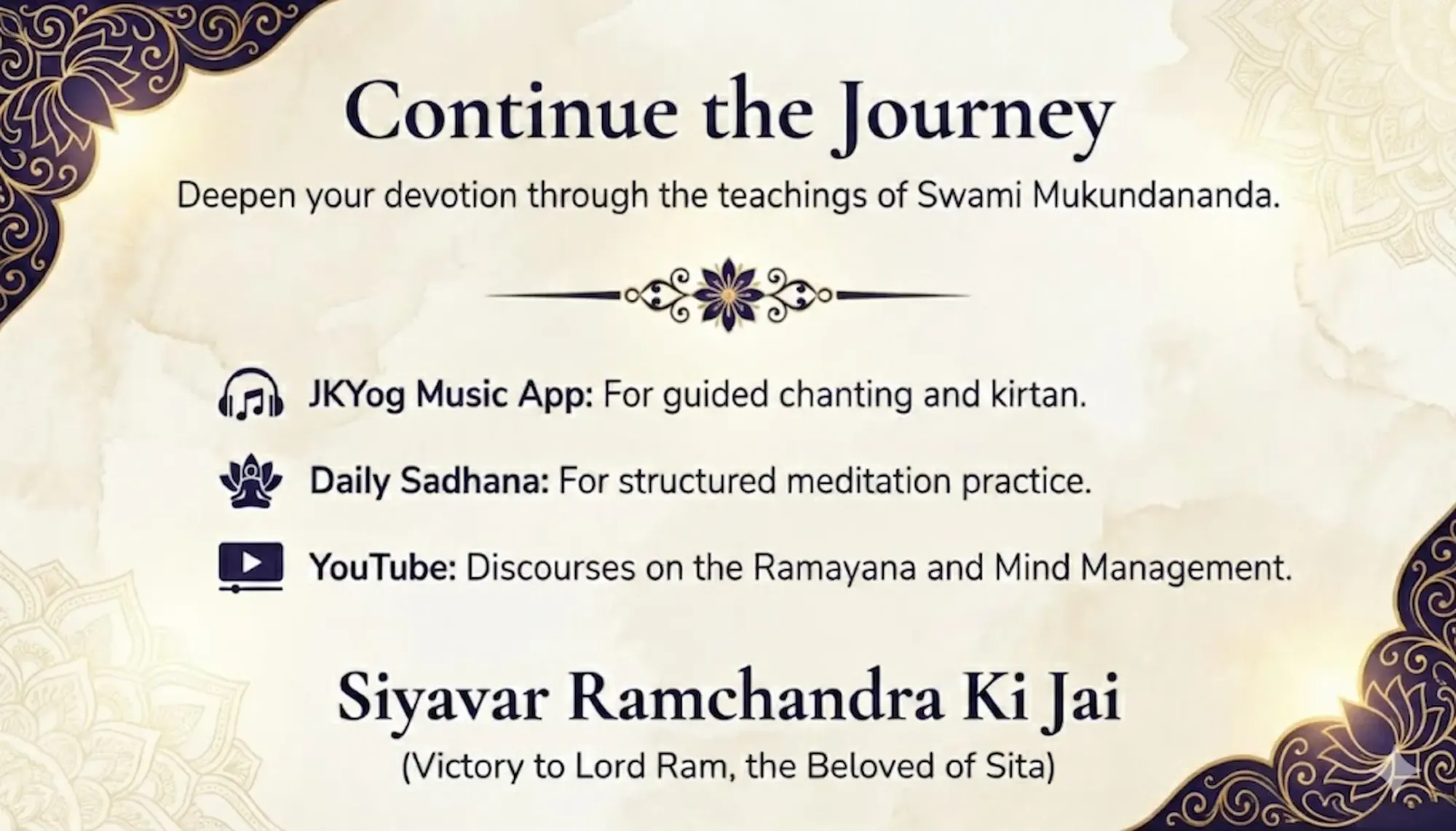
CALL TO ACTION: Further Your Case: Recommended Resources
If this exploration of Ram Stuti lyrics, meaning, and spiritual significance touched your heart, don’t let it fade.
👉 Subscribe to Swami Mukundanandaji’s YouTube channel and continue this journey one day at a time.
Frequently Asked Questions
1) What is Ram Stuti (Shri Ramchandra Kripalu Bhajman)?
Ram Stuti is a devotional hymn composed by Goswami Tulsidas in the Vinaya Patrika, glorifying Lord Rama’s compassion, beauty, and protection.
2) What is the meaning of Shri Ramchandra Kripalu Bhajman?
It means: “O mind, worship the compassionate Lord Rama who removes the fear of worldly existence.”
3) What are the benefits of chanting Ram Stuti daily?
Daily chanting helps reduce stress, increase devotion, calm the mind, and strengthen meditation through Roop Dhyan.
4) How should I chant Ram Stuti for best results?
Chant with focus and devotion, preferably in the morning, while visualizing Lord Rama’s divine form.
5) Can beginners chant Ram Stuti without knowing Sanskrit?
Yes. Bhav (devotional feeling) matters more than perfect pronunciation. You can learn gradually.