
Discover the true meaning of surrender to God and how divine grace can transform your life. Learn Swami Mukundananda’s six pillars of spiritual surrender, practical mind-management tools, and why joining a spiritual community like JKYog accelerates your growth.
Introduction: Why Surrender to God Is the Ultimate Mind Management Strategy
In every era, humanity has sought answers to the same essential questions:
How do I find peace? How do I overcome fear? How do I rise above my karma and mental limitations?
Modern psychology emphasizes mind management, emotional regulation, and resilience. Yet these frameworks address only part of the human experience. The ancient spiritual sciences—especially those taught by Swami Mukundananda and JKYog—explain that true freedom comes when the mind aligns with the Divine Will.
Scriptures declare:
“As long as you are not surrendered to Me, the law of karma applies. When you surrender, My grace burns lifetimes of past karmas.”
This principle isn’t metaphorical; it’s an advanced spiritual truth. Surrender to God is the technology through which grace overrides karma.
But what exactly is surrender? And how can modern seekers apply it practically?
Let’s explore the six pillars of spiritual surrender—a complete roadmap to aligning your life with divine intention.
I. What Is Surrender to God?

Definition:
Surrender to God means aligning your thoughts, desires, actions, and identity with the Divine Will. It is an inner state of consciousness—not a ritual, external mark, or mechanical practice.
According to Swami Mukundananda, spiritual surrender is:
● A scientific process
● A psychological transformation
● A devotional state
● A magnet for divine grace
Rituals can support devotion, but true surrender happens in the mind, where ego dissolves and the soul accepts God as the supreme guide.
II. The Six Pillars of Spiritual Surrender (Swami Mukundananda’s Teachings)
These six principles form the heart of surrender. They offer a step-by-step method for spiritual alignment, karmic purification, and emotional mastery.
1. Align With God’s Will (Anukulyasya Sankalpah)

Meaning:
Choose only those desires that align with God’s wishes.
This is the first step in “how to surrender to God.” When your inner will mirrors divine will, life flows smoothly. Resistance evaporates because you stop fighting reality.
Mirabai beautifully expressed this surrender:
“If Krishna wants me to laugh, I will laugh. If He wants me to cry, I will cry.”
Modern Relevance
Alignment reduces stress, anxiety, and mental friction. It enhances emotional resilience—key themes in both psychology and spirituality.
2. Avoid What Is Against God’s Will (Pratikulyasya Varjanam)
If the first principle is about embracing the right desires, this one is about avoiding the wrong ones.
How do you know what God wants?
● Through scriptures
● Guidance of the Guru
● Inner conscience
● Moral clarity
God never wants irresponsibility, harmful indulgence, or reckless pleasure-seeking.
When suffering arrives and we complain—“Why me?”—we move out of alignment.
The Bhagavatam reveals that patience, acceptance, and devotion make one eligible for divine inheritance.
This principle directly supports “overcoming karma” and “divine grace.”
3. Trust That God Protects You—Remove Fear

Fear is the greatest enemy of surrender.
The third pillar is the conviction: “God is protecting me at every moment.”
Like a child laughing while being swung above a well by a loving parent, the surrendered devotee trusts divine protection—even in life’s storms.
The naval captain’s story illustrates this perfectly:
He remained calm during a violent storm because he trusted God’s will just as his wife trusted him when he held a sword near her head.
4. Feel Constant Gratitude for Divine Grace
Gratitude is not optional in spirituality; it is essential.
We breathe oxygen only because divine intelligence designed a world where air is free. Plants transform mud into vegetables through a technology no university can replicate.
Everything is prasāda—a divine gift.
Psychological relevance
Studies show gratitude:
● Reduces anxiety
● Improves mental health
● Rewires the brain toward positivity
Gratitude increases our receptivity to spiritual grace.
5. Give Up the Sense of Ownership (Nirmamatva)
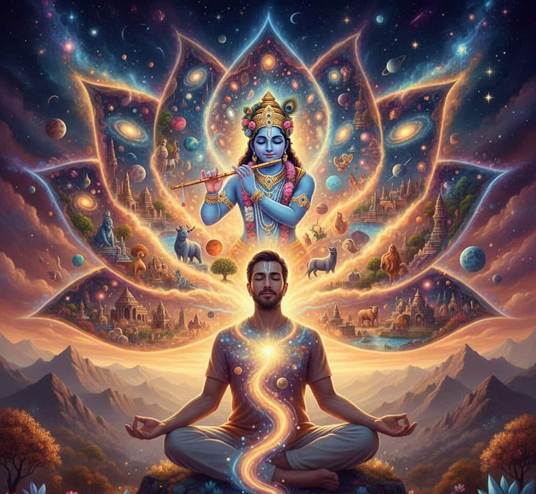
We cling to “my possessions,” “my achievements,” “my relationships.”
But every soul enters the world empty-handed and leaves the same way.
King Raghu’s story during the Vishwajit Yagya teaches that nothing ever truly belongs to us—everything belongs to God.
Modern interpretation:
This principle encourages minimalism, detachment, and ego-free living.
6. Renounce Even the Pride of Surrender
The final and most subtle point:
“Do the good deed—and let go of the pride of having done it.”
If you made progress, it was God’s grace.
If you developed devotion, it was God’s grace.
If you came onto the spiritual path, it was God’s grace.
This destroys the last traces of ego and keeps surrender pure.
This completes the sixfold framework for surrender—an advanced spiritual process that can uplift anyone regardless of background, profession, or stage of life.
III. Practical Techniques to Develop Surrender to God

Below are simple, proven tools based on Swami Mukundananda’s teachings for applying surrender in daily life.
1. Morning Intention Alignment
Affirm:
“May my thoughts, words, and desires align with Your will today.”
2. Daily Scriptural Study
Read a few verses of the Bhagavad Gita, Bhagavatam, or Swami Mukundananda’s books.
This builds clarity about God’s desires.
3. Trust-Building Journaling
Document moments when:
● Life protected you
● Unexpected good happened
● A crisis turned out well
This reinforces faith.
4. Gratitude Expansion Practice
List 10 blessings daily—spiritual, physical, emotional, or material.
5. Offering Mental Ownership to God
Before any task—cooking, working, speaking—mentally offer it:
“This belongs to You. I am Your instrument.”
6. Ego-Release Reflection
After accomplishments, remind yourself:
“The ability and opportunity came from divine grace.”
IV. The Role of Spiritual Community: Why JKYog Accelerates Your Growth
Search engines and seekers alike increasingly ask:
“How do I stay consistent on my spiritual journey?”
“Do I need a community for spiritual growth?”
The answer is yes.
Even the wisest aspirants benefit from satsang—a community rooted in truth.
A spiritual community such as JKYog offers:
● Accountability for daily practices
● Guidance from an authentic Guru
● Emotional encouragement
● Shared wisdom and experiences
● Higher motivation through collective devotion
Modern studies in behavioral psychology confirm that people grow faster and stay more consistent when part of a supportive, purpose-driven group.You do not walk alone when you walk with a spiritual family.
V. Conclusion: Surrender as the Path to Freedom, Peace & Divine Grace
Surrender is not a passive act—it is the ultimate act of intelligence.
It aligns human effort with divine wisdom.
When you practice the six pillars of spiritual surrender:
● Fear dissolves
● Mind becomes peaceful
● Ego softens
● Gratitude expands
● Karma is purified
● Grace awakens
Life becomes lighter, more meaningful, more joyful.And as countless practitioners have discovered, the journey becomes exponentially more powerful when walked within a spiritual community.
FAQs
1. What does it mean to surrender to God according to Swami Mukundananda?
Surrender to God means aligning your thoughts, desires, and actions with the Divine Will. According to Swami Mukundananda, true surrender is an inner state of consciousness—not an external ritual. It involves accepting God as the supreme guide, trusting His protection, and offering all results of your actions to Him with humility.
2. How can I practice surrender to God in daily life?
You can practice surrender by setting a daily intention to follow God’s will, studying scriptures for clarity, expressing gratitude for blessings, offering your actions mentally to the Divine, and releasing the pride of accomplishment. Small, consistent practices build the mindset of surrender over time.
3. How does surrender affect the law of karma?
Scriptures explain that until a person surrenders, the law of karma continues to operate fully. Once true surrender occurs, divine grace begins to override past karmic reactions. Grace can burn lifetimes of karmas, transforming the devotee’s spiritual journey and accelerating inner purification.
4. Why is trust an important part of spiritual surrender?
Trust removes fear, worry, and resistance. When you believe that God is protecting you—and that every event in your life is meant for your growth—you remain calm even in adversity. Trust is a core element of surrender because it reflects confidence in God’s wisdom and benevolence.
5. Why is joining a spiritual community like JKYog helpful for developing surrender?
A spiritual community provides guidance, accountability, and inspiration from like-minded seekers. JKYog offers satsang, teachings of Swami Mukundananda, structured practices, and supportive fellowship, all of which make it easier to stay consistent on the spiritual path and deepen surrender to God.
A Gentle Call-to-Action
If this wisdom resonates with you—if you feel inspired to deepen your surrender, strengthen your mind, and experience divine grace more fully—consider joining the JKYog spiritual community.
Not as a formality.
Not as a commitment.
But as a natural extension of your inner yearning.
A community grounded in authentic teachings, guided by a true Guru, and filled with sincere seekers can help you grow in ways you may never have imagined.
When the heart is ready, the next step becomes obvious.
Your journey of surrender—and the grace that follows—begins with a single step of openness.
May that step be today.
Reference
JKYog (2019, August 16). Shree Krishna knows what’s best for you — 6 Keys to Get You Through Life’s Uncertainties [Video].