
In every age, the Bhagavad Gita has found a way to speak to the human heart. Sometimes it speaks through deep philosophical inquiry; sometimes through quiet reflection in moments of doubt; and sometimes—most tenderly—through the voice of a child reciting a single shloka with sincerity. In such moments, the Gita does not merely instruct; it becomes alive, shaping thought, feeling, and character through sacred sound.
In the present time, when children grow up amidst constant noise, rapid stimulation, and competing influences, the practice of Gita shloka recitation offers something both rare and essential: inner stillness. It trains the tongue to articulate sacred syllables, but more importantly, it trains the mind to pause, to attend, and to listen deeply. Through this simple yet profound discipline, children begin to experience steadiness, humility, and a quiet connection with Shri Krishna that extends beyond words.
The Sanskriti 2026 Gita Contest at Radha Krishna Temple Dallas arises from this understanding. The contest itself is not the goal; it is a means supportive structure that encourages children to engage with the Gita earnestly, to practice with care, and to offer their learning as an act of devotion. What matters is not performance alone, but the inner process that unfolds through regular recitation and reflection.
Underlying this approach is the broader vision of JKYog, which views culture not as display, but as lived spiritual practice. Within this vision, sacred texts like the Bhagavad Gita are not reserved for later years; they are introduced early, when the heart is receptive and habits are forming. By encouraging children to engage with Krishna’s words through sound and discipline, JKYog affirms that true cultural grounding begins with inner values, not outward achievement.
This guide is offered in that spirit. It is not meant to create pressure or prescribe rigid methods, but to gently support parents, students, and teachers as they approach shloka recitation as seva, learning as sādhanā, and Sanskriti as a journey that quietly plants lasting samskāras in young hearts.

Gita Shloka Recitation — Purpose, Use, and Present Relevance
At the heart of this guide lies a simple yet profound conviction: Gita shloka recitation is not merely a cultural exercise, but a formative spiritual discipline, especially meaningful in the present age. The verses of the Bhagavad Gita were revealed not only to be studied intellectually, but to be heard, remembered, and lived. When children learn to recite these shlokas, they enter a relationship with sacred wisdom through sound, rhythm, and attentive presence.
Traditionally, shloka recitation has been one of the earliest ways in which wisdom was transmitted across generations. The child may not grasp every philosophical nuance at first, yet the sound itself begins its quiet work. Sacred syllables repeated with care shape attention, memory, and inner order. Over time, these verses become familiar companions—returning gently in moments of confusion, fear, or reflection.
In today’s world, this role of shloka recitation becomes even more significant. Children are constantly processing information, stimuli, and expectations from multiple directions. Amid such restlessness, the practice of recitation offers a counterbalance. It introduces rhythms where there is haste, focus where there is distraction, and steadiness where there is emotional fluctuation. The act of reciting a shloka slowly and clearly teaches the mind to remain with one thing, cultivating patience and presence without force.
Beyond cognitive benefits, shloka recitation carries a devotional dimension that distinguishes it from other forms of learning. Each verse of the Gita is a direct expression of Shri Krishna’s guidance. When children recite these words, they are not merely memorizing text; they are listening to Krishna’s voice and responding through disciplined effort. This subtle exchange nurtures bhāva—a feeling of reverence and personal connection that cannot be taught through explanation alone.
It is also important to recognize that shloka recitation is not intended to produce perfection or performance. Its deeper purpose lies in shaping character. Through regular practice, children learn self-regulation, perseverance, and humility. They experience the satisfaction of steady effort rather than instant results. Even mistakes become part of the learning process, teaching resilience and composure rather than discouragement.
Gita Shloka is a sacred learning of an offering, not performance; it cultivates steadiness and self-regulation and is a self experience of Krishna's presence by merely mastering the text.
For this reason, Gita shloka recitation holds a unique place among cultural and educational practices. It integrates sound discipline, mental focus, and devotional feeling in a way that prepares children not just for a contest, but for life itself. Whether or not a child continues formal recitation in later years, the inner habits formed through this practice—attention, reverence, and composure—remain.
Thus, this event is not an isolated but encourages Children to move forward and experience the quiet strength that arises when learning is offered as devotion rather than
JKYog’s Vision — Culture as Lived Bhakti
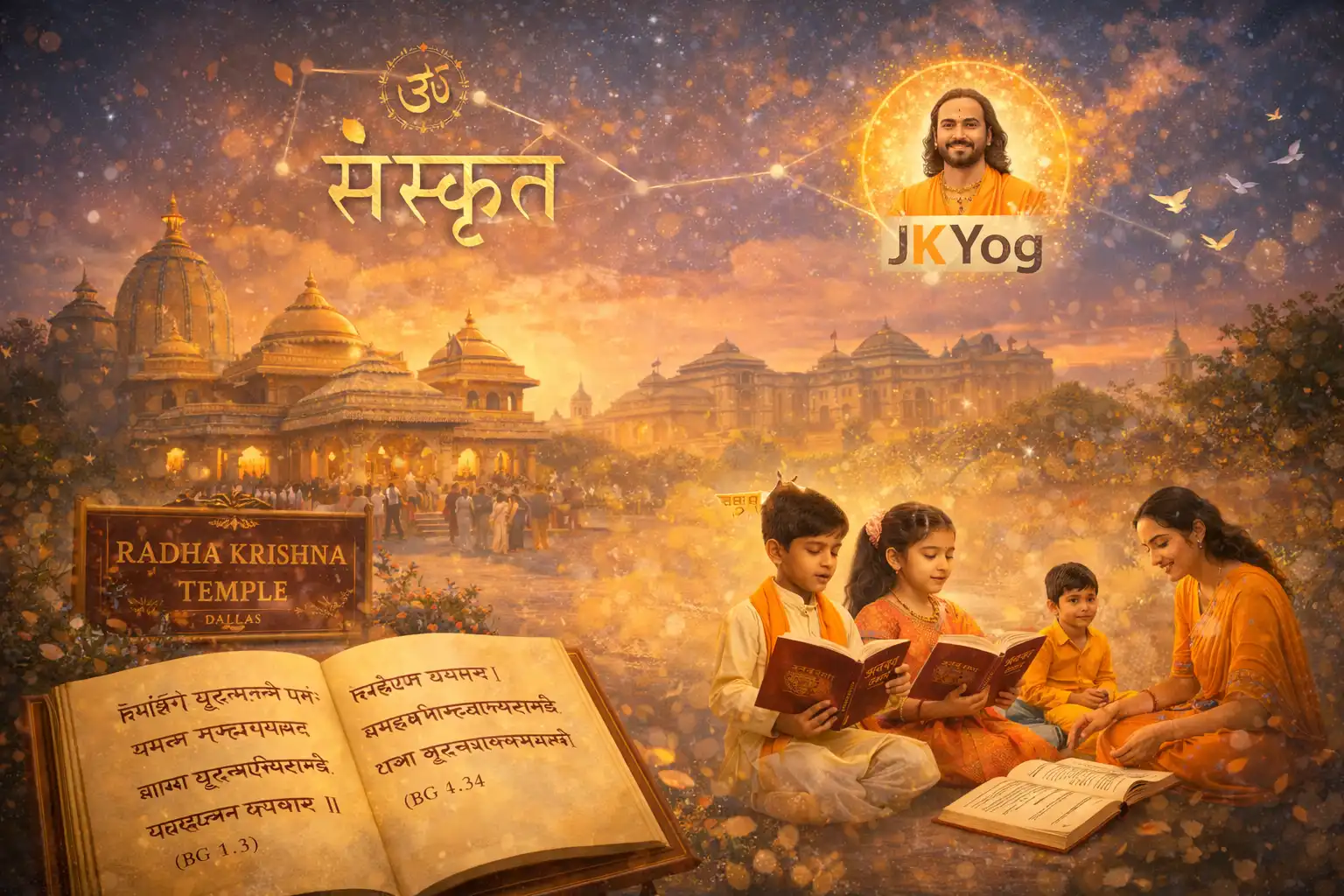
To understand why practices like Gita shloka recitation are given such care and prominence, it is helpful to glimpse the larger vision from which platforms like Sanskriti arise. Within the framework of JKYog, culture is not treated as a collection of art forms or inherited customs, but as a way of living devotion in everyday life. Learning, creativity, and discipline are seen as expressions of bhakti when they are oriented toward inner growth and self-awareness.
This vision places particular emphasis on childhood and youth. Early years are understood as a formative period when habits of attention, reflection, and values quietly take root. Rather than postponing spiritual engagement to later stages of life, JKYog encourages gentle, age-appropriate exposure to sacred wisdom—allowing children to grow up with familiarity, reverence, and ease rather than obligation. In this context, engaging with the Bhagavad Gita through recitation becomes a natural and compassionate entry point.
Across JKYog’s educational and cultural initiatives, a consistent theme emerges culture is meant to refine the heart, not merely display talent. Artistic expression, discipline, and learning are valued not for external validation alone, but for their capacity to nurture humility, steadiness, and devotion. When effort is guided by the right intent, even simple practices acquire depth and meaning.
This understanding is often reflected in the way spiritual guidance is offered—encouraging a way of learning that is both gentle and grounding:
- participation without pressure
- excellence without anxiety
- growth without comparison
- effort offered without attachment to outcome
The emphasis remains on sincerity of effort rather than outward recognition, and on inner transformation rather than visible achievement.
Within this philosophical landscape, platforms like Sanskriti emerge organically. They are not designed as competitive showcases in isolation, but as spaces where children can encounter culture as lived experiences supported, guided, and gently challenged. Gita shloka recitation finds a natural home here, as it embodies the very principles JKYog seeks to cultivate discipline rooted in devotion, learning infused with meaning, and effort offered as service.
Those who listen to Swami Mukundananda’s reflections at global Sanskriti gatherings may recognize this recurring message: when culture is anchored in devotion, it uplifts both the individual and the community. The purpose of such initiatives is not to produce performers, but to nurture balanced, grounded individuals who carry spiritual clarity into all aspects of life.
Seen through this lens, the emphasis on shloka recitation is neither incidental nor symbolic. It reflects a deliberate commitment to transmitting wisdom in a form that is accessible, formative, and enduring, ensuring that the essence of the Gita is not only understood, but quietly lived.
Sanskriti & Radha Krishna Temple — The Platform and the Sacred Ecosystem
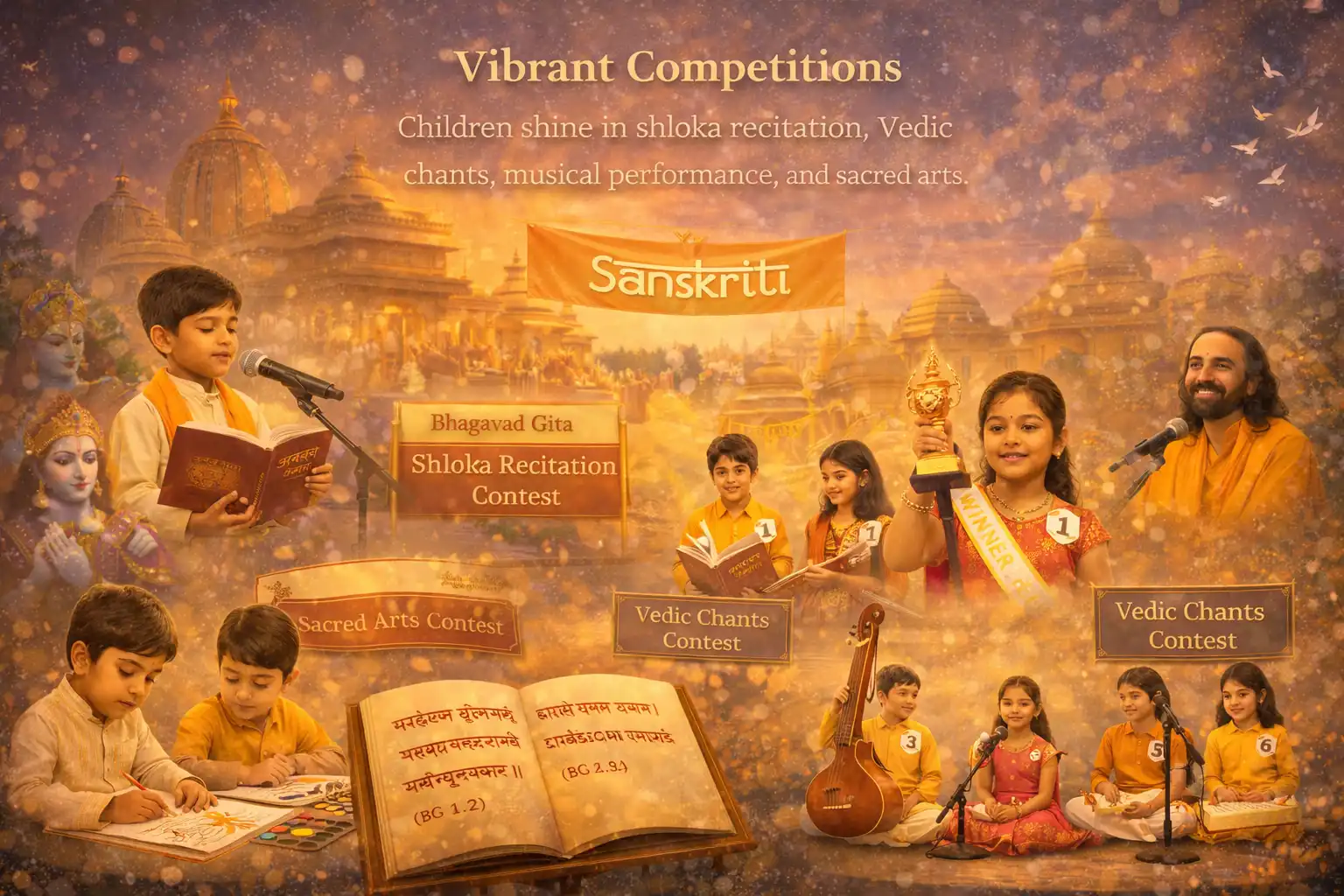
While the vision of cultural learning as lived bhakti provides the philosophical foundation, it is through Sanskriti that this vision becomes accessible and tangible for children and families. Sanskriti is not designed as an isolated competition, but as a carefully held space where learning, expression, and devotion can unfold together in a supportive environment.
At Radha Krishna Temple Dallas, Sanskriti has grown into a cherished annual tradition—one that invites children and youth to integrate creative expression with devotion while building confidence, discipline, and character. Within the temple’s atmosphere, participation itself becomes meaningful. Children step forward not merely to perform, but to offer what they have practiced with sincerity and care.
What distinguishes Sanskriti is the way encouragement is woven into every aspect of the experience. Recognition through medals and trophies honors effort and excellence, while certificates for all participants affirm that sincere participation itself has value. Such gestures gently reinforce that learning is not diminished by outcome, and that growth is measured as much by inner steadiness as by visible achievement.
The spirit of service is also naturally present. Proceeds from Sanskriti support the temple’s charitable activities, quietly reminding families that celebration and seva can coexist. Even shared moments beyond the stage—such as enjoying simple, sattvic, and wholesome food at the temple cafeteria—contribute to a sense of community and ease. Sanskriti thus becomes not just an event to attend, but a day lived within the temple’s rhythm.
For children, this environment matters deeply. Being surrounded by devotion, music, sacred images, and fellow learners normalizes spiritual engagement and removes any sense of strain. For parents, the temple setting offers reassurance that their child’s efforts are held within a space that values balance, humility, and care. Teachers and volunteers, too, become part of this ecosystem, guiding with patience and shared intent.
In this way, Sanskriti functions as a bridge between vision and practice. It provides a platform where the ideals of disciplined learning, devotional expression, and character formation are not abstract concepts, but lived experiences. Gita shloka recitation finds its natural place here supported by community, grounded in sacred space, and encouraged without pressure.
Seen as a whole, Sanskriti at Radha Krishna Temple is less about competition and more about continuity. It ensures that the values spoken of in philosophy are quietly transmitted through experience, allowing children to associate learning the Gita with joy, belonging, and inner growth.
Interlude: Practical Orientation for Families
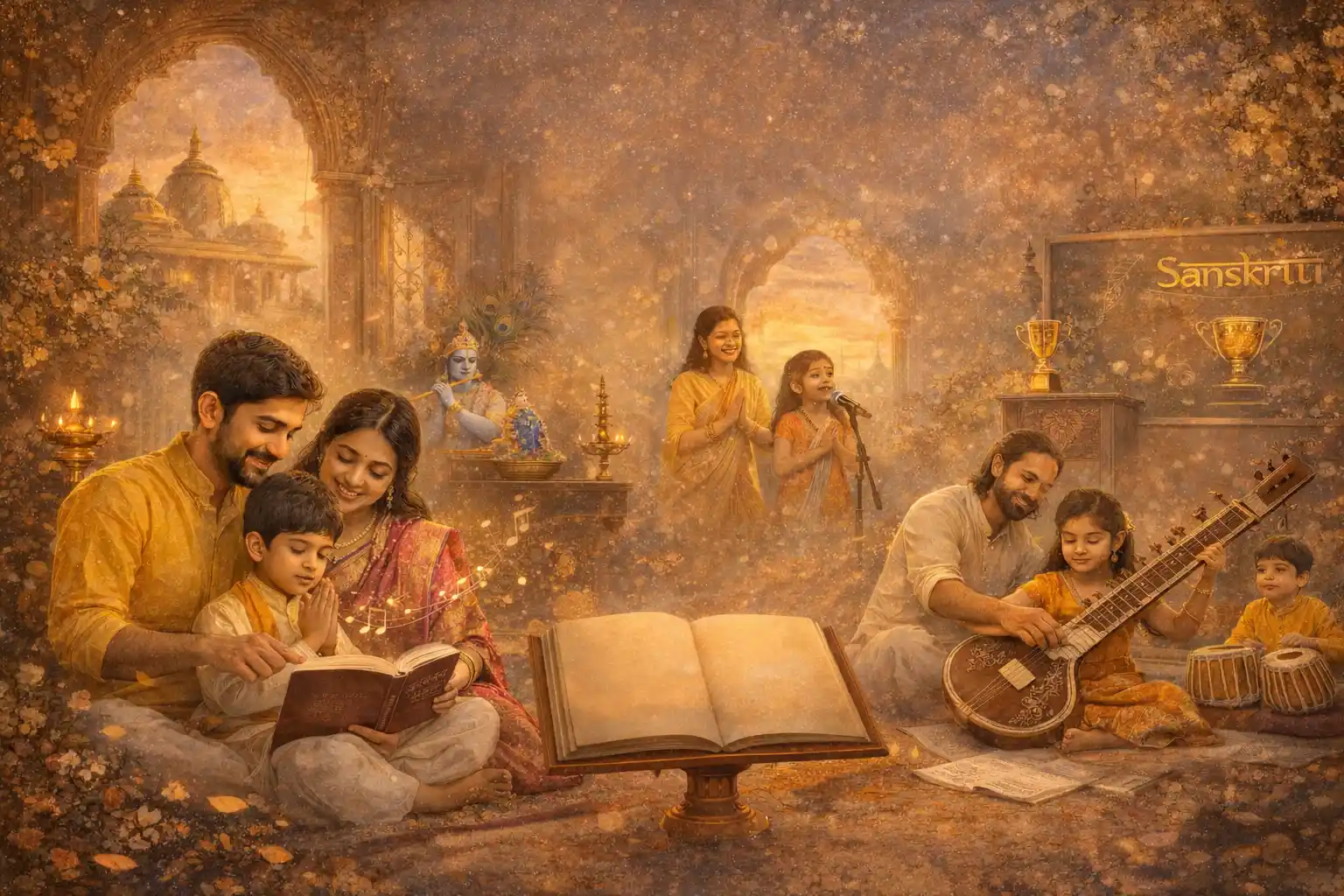
For families preparing to participate in Sanskriti 2026, a few practical details can be helpful for planning—while keeping the focus firmly on learning, devotion, and joyful participation. These details are offered here simply as orientation, so that logistical clarity supports, rather than distracts from, the deeper purpose of the event.
Table 1: Sanskriti 2026 — Key Dates & Schedule
|
Event |
Date / Timeframe |
Notes |
|
Sanskriti 2026 Contests |
January 23–25, 2026 |
Multiple on-stage and off-stage categories |
|
Walk-in / Off-stage Contests |
January 25, 2026 |
Registration is available on the same day |
|
Awards Ceremony |
January 31, 2026 |
Recognition of participants and winners |
|
Registration Deadline |
January 10, 2026 |
Applications for scheduled contests |
Table 2: Participation & Recognition
|
Aspect |
Details |
|
Winners’ Recognition |
Medals and trophies are awarded in each category |
|
Participation |
Certificates awarded to all participants |
|
Purpose |
Encouragement, confidence-building, and joyful learning |
|
Spirit |
Participation valued alongside performance |
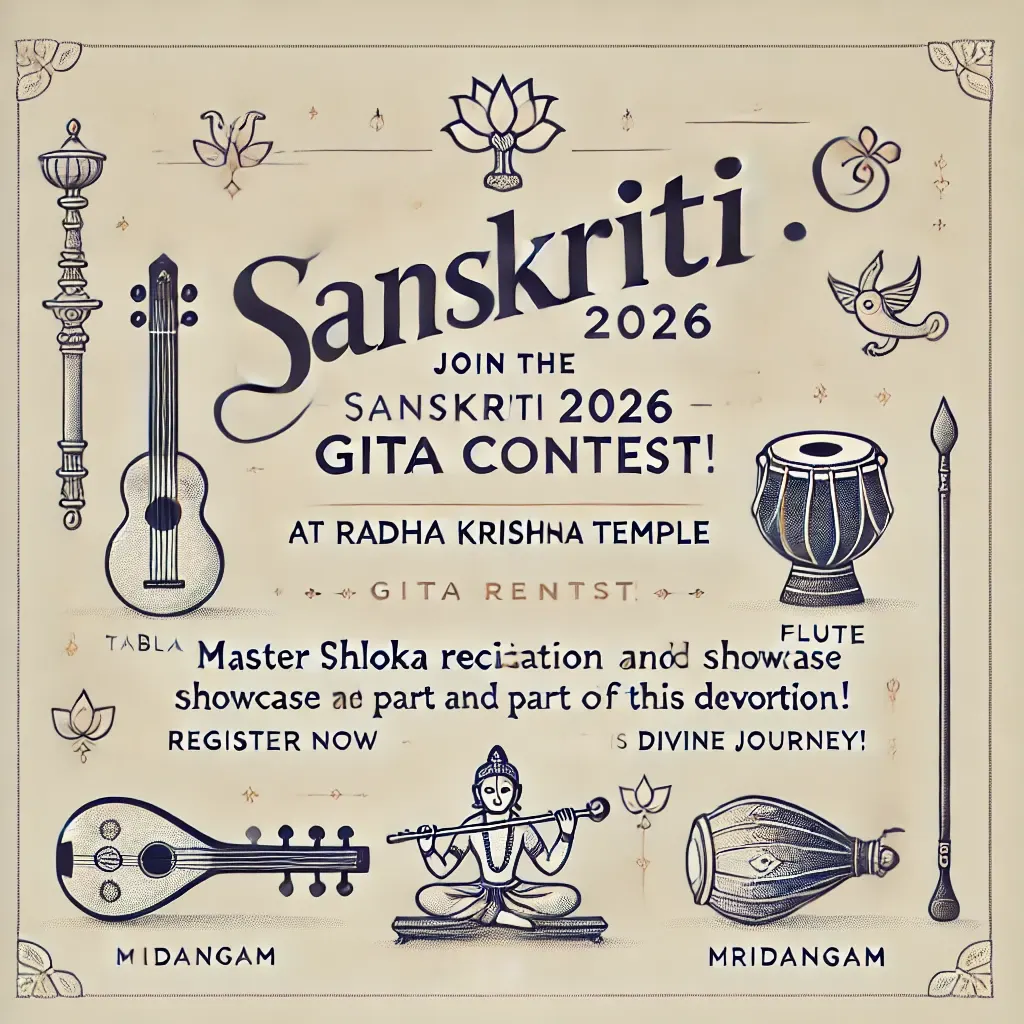
Alongside these details, families may also notice the Sanskriti flyer shared by the temple. Its visual presentation reflects the breadth and inclusivity of Sanskriti—bringing together recitation, music, dance, yoga, art, and other disciplines within a single cultural space. While each category has its own form of expression, they are united by a common intention: to provide children with a supportive platform where learning and devotion grow together.
This interlude is meant only to ground the reader. With practical details in place, we now return to the inner aspect of the journey—how preparation itself can become a quiet form of sādhanā for children, parents, and teachers alike.
When preparation is approached calmly and consistently, simple practices begin to work quietly on the child’s inner world. A few gentle elements of daily practice support this process naturally, without strain or pressure.
- Five to seven minutes of consistent practice — allows familiarity with the sound, rhythm, and flow of the shloka to develop naturally
- Repetition done with calm attention — helps the words settle deeply, rather than being rushed or forced
- Listening to clear shloka recitation — trains the ear first and gradually refines pronunciation without constant correction
Practiced in this way, preparation nurtures confidence without anxiety and focus without tension. Over time, children begin to associate shloka recitation with calmness, steadiness, and quiet joy rather than effort alone.
Parents may find it helpful to keep a few guiding principles in mind as preparation unfolds:
- keep practicing light, regular, and unhurried, allowing consistency to matter more than duration
- avoid comparisons with other children, remembering that each child’s journey and pace are unique
- offer reassurance about outcomes, emphasizing sincerity of effort over results
- remind the child that recitation is an offering to Shri Krishna, not a performance to be judged
When children feel supported in this way, confidence deepens naturally, and preparation itself becomes meaningful rather than stressful.
Teachers and mentors also play a vital role in shaping the experience. While they guide accuracy, structure, and rhythm, the way guidance is offered is equally important. Correction given with patience helps children develop resilience and self-trust, whereas excessive focus on error can create hesitation. When warmth accompanies instruction, children learn to receive feedback with openness rather than fear.
The temple environment further reinforces this sense of sādhanā. Visiting Radha Krishna Temple Dallas, sitting quietly before the deities, or even recalling the temple’s atmosphere during practice can remind children that their effort is sacred. In such moments, learning the Gita feels less like preparation for an event and more like participation in a living tradition.
As the contest day approaches, it is helpful to normalize nervousness. A certain degree of nervousness simply reflects care and sincerity. Children can be gently reminded that they are reciting first for Krishna, and only then for judges or audiences. This shift in perspective often dissolves anxiety and restores calm focus.
Looking Beyond the Stage — A Forward Vision
The true value of Gita shloka recitation is rarely measured in the moment it is performed. Trophies and certificates may mark a particular day, but the deeper impact unfolds quietly, often years later. A child who has learned to recite a shloka with care carries within them the memory of sacred sound—an inner reference point that can offer steadiness during moments of uncertainty, reflection, or change.
When approached with sincerity, shloka recitation becomes more than a childhood activity. It becomes a companion. The rhythm of the verses, the familiarity of Krishna’s words, and the habit of attentive listening together form a foundation that supports clarity and composure throughout life. Even if formal recitation does not continue, the inner discipline it cultivates remains.
Through platforms like Sanskriti, and within the s Through platforms like Sanskriti, and within the sacred environment of Radha Krishna Temple Dallas, this transmission takes place naturally. Children grow up associating learning with reverence, effort with meaning, and cultural practice with inner growth. In such an atmosphere, spirituality is not experienced as separate from life, but as its quiet underpinning.
This understanding reflects a broader vision often shared by Swami Mukundananda—that culture rooted in devotion refines the heart, and that sincere effort, when offered without attachment, becomes transformative. Those interested may explore his reflections at Sanskriti gatherings to gain deeper insight into how sacred arts, when guided by bhakti, uplift both the individual and the community.
Ultimately, mastering shloka recitation is not about mastery in the conventional sense. It is about learning to pause, to listen, and to offer one’s best with humility. When a child steps forward to recite—even a single verse—they take a step toward inner steadiness and self-awareness.
May Sanskriti 2026 serves as such a beginning: for children discovering the quiet strength of sacred sound, for parents guiding with patience and trust, and for teachers nurturing learning as an act of devotion. In a restless world, these gentle beginnings carry enduring promise.
Key Takeaways
- Gita shloka recitation is a formative spiritual practice, not merely a cultural activity. Through sound, rhythm, and repetition, children cultivate attention, steadiness, and a personal connection with Shri Krishna.
- The Sanskriti Gita Contest is a means, not the goal. Its true value lies in encouraging sincere effort, disciplined practice, and devotional engagement rather than performance or outcome alone.
- JKYog’s vision frames culture as lived bhakti, where learning and creativity refine character and nurture inner growth. Sanskriti serves as a child-centered platform through which this vision becomes accessible and experiential.
- Radha Krishna Temple provides a sacred ecosystem where children learn within an atmosphere of devotion, community, encouragement, and service—allowing spiritual values to be absorbed naturally.
- When parents and teachers guide gently, emphasizing calm practice, reassurance, and offering over evaluation, preparation itself becomes sādhanā, planting lasting samskāras that extend far beyond the contest stage
Call To Action
Frequently Asked questions
1. What is the purpose of Gita shloka recitation for children?
Gita shloka recitation introduces children to sacred wisdom through sound and repetition. Beyond memory and pronunciation, it nurtures attention, steadiness, humility, and a personal connection with Shri Krishna—planting values that quietly guide them through life.
2. Does my child need to understand the full meaning of the shloka to participate?
A complete philosophical understanding is not required at this stage. Familiarity with sound and rhythm comes first. Simple explanations offered with warmth help children relate to the verse naturally, allowing deeper understanding to unfold with time.
3. How much practice is ideal when preparing for the Sanskriti Gita Contest?
Short, consistent practice is far more effective than long or irregular sessions. Even five to seven minutes of calm, attentive recitation helps the words settle deeply and builds confidence without fatigue.
4. What if my child feels nervous or makes mistakes during recitation?
Nervousness is natural and often reflects sincerity. Children can be gently reminded that they are reciting first for Krishna, not for judgment. Mistakes are part of learning and do not diminish the value of sincere effort.
5. How does the Sanskriti platform support children beyond competition?
Sanskriti emphasizes encouragement over pressure. Recognition is balanced with participation, and the temple environment fosters a sense of belonging, devotion, and community—helping children associate learning with joy rather than evaluation
6. How can parents best support their child during this journey?
Parents support best by creating a calm atmosphere, avoiding comparisons, offering reassurance, and framing recitation as an offering. When preparation feels safe and meaningful, children grow naturally in confidence and devotion.
References & Citations
- Bhagavad Gita
The foundational scripture guiding the philosophy and practice of shloka recitation.
Reference: https://www.holy-bhagavad-gita.org/ - JKYog
JKYog’s vision of culture as lived bhakti underpins initiatives like Sanskriti, emphasizing character formation, devotion, and inner growth.
Reference: https://www.jkyog.org/ - Radha Krishna Temple Dallas
Host and sacred ecosystem for Sanskriti 2026, offering a devotional environment that integrates learning, community, and service.
Reference: https://www.radhakrishnatemple.net/ - Swami Mukundananda
Founder of JKYog, whose reflections emphasize culture rooted in devotion, effort without attachment, and spiritual growth through sacred arts.
References:
https://www.youtube.com/@swamimukundananda
https://www.jkyog.org/blog/
Sanskriti 2026, a youth-focused cultural platform of JKYog at Radha Krishna Temple Dallas, bringing together sacred learning, creative expression, and character formation in a devotional environment.