Maha Shivratri is one of the most spiritually significant nights in the Hindu calendar, dedicated to Lord Shiva, the supreme consciousness and cosmic force. This sacred night is celebrated with devotion, fasting, prayer, and reflection on the divine acts, or leelas, of Lord Shiva. His divine acts are many, each carrying profound meanings and symbols for the devotee. These leelas are not just mythological tales but teachings and reflections of the path of spirituality. The 64 Thiruvilayadal, or divine acts of Shiva, along with other cosmic events like the Tandava dance, are central to understanding the multifaceted nature of Shiva.
Each story associated with Shiva’s divine acts embodies his nature as a protector, teacher, destroyer of ignorance, and the embodiment of the eternal, infinite force. Through these acts, he teaches that everything in the universe is connected to the divine, and that true spiritual awakening lies in overcoming obstacles, transcending ego, and realizing the unity of all existence.
The 64 Thiruvilayadal (Divine Acts)
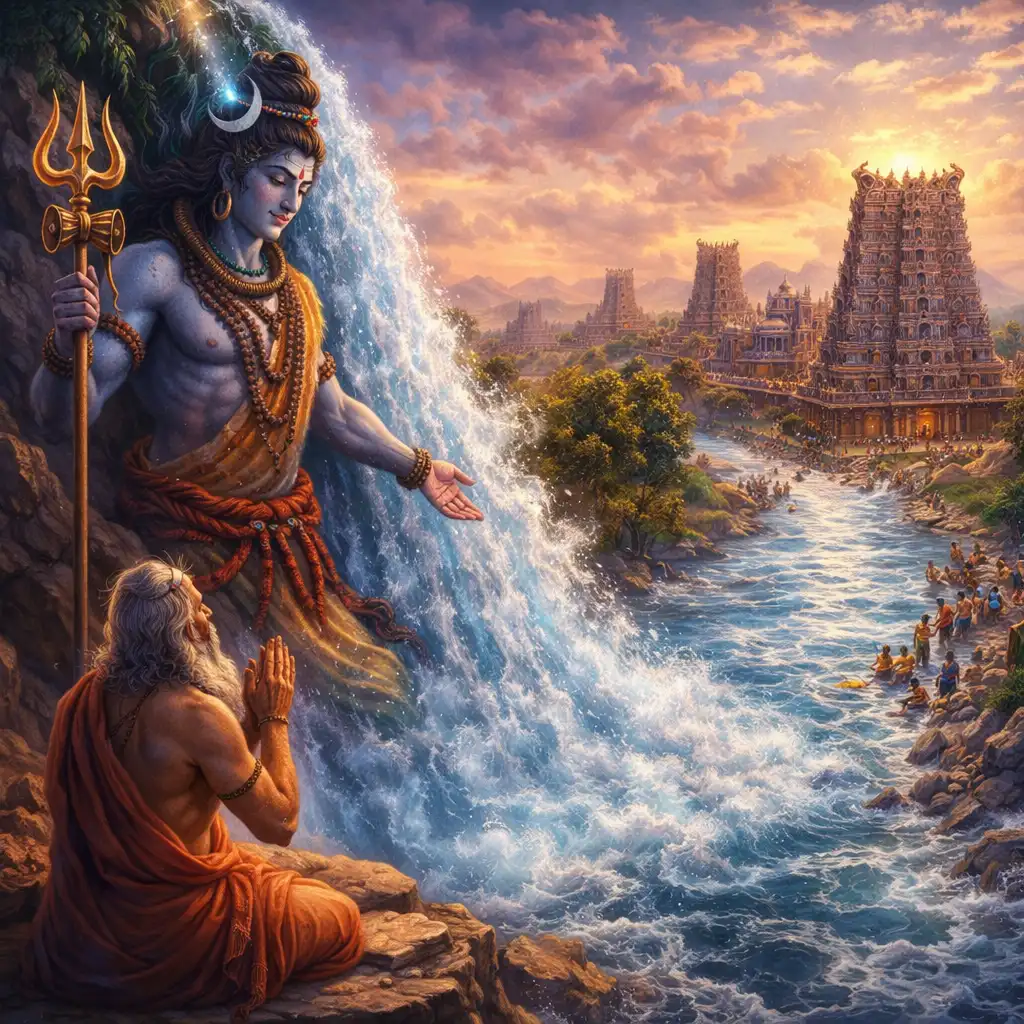
The 64 Thiruvilayadal, recorded in the Halasya Mahatmyam, part of the Skanda Purana, are a series of divine acts that Lord Shiva performed in the city of Madurai. These acts were performed to help his devotees, guide them on their spiritual path, and demonstrate his compassion, power, and grace. Though many scholars suggest that there may be more than 64 acts, these stories stand as powerful symbols of Shiva’s interaction with the world.
One of the most famous stories is that of bringing the river Vaigai to Madurai for a devotee. In this act, Shiva helped a devotee who had prayed for water, and through divine intervention, the river Vaigai was brought to the city, ensuring that the people had ample water. This act of compassion shows Shiva’s willingness to meet his devotees’ physical and material needs while guiding them towards spiritual fulfillment.
Another divine act involves Shiva taking the form of a laborer to help an old woman. When an old woman was struggling with her daily work, Lord Shiva disguised himself as a laborer and helped her carry heavy loads. This act symbolizes Shiva’s humility, his willingness to serve and connect with even the simplest of beings, and the teaching that divinity can be found in all aspects of life.
In yet another act, Shiva turned sand into gold, showing his ability to transform the mundane into the divine. This act also reflects the deeper teaching that through devotion and surrender, the ordinary can be transformed into something extraordinary.
These 64 acts are not merely events of the past but lessons that resonate with spiritual seekers. They teach humility, compassion, and the importance of selfless service, while also showing that Shiva’s divine presence is always with his devotees, guiding them at every step.
Cosmic Dance (Nataraja)
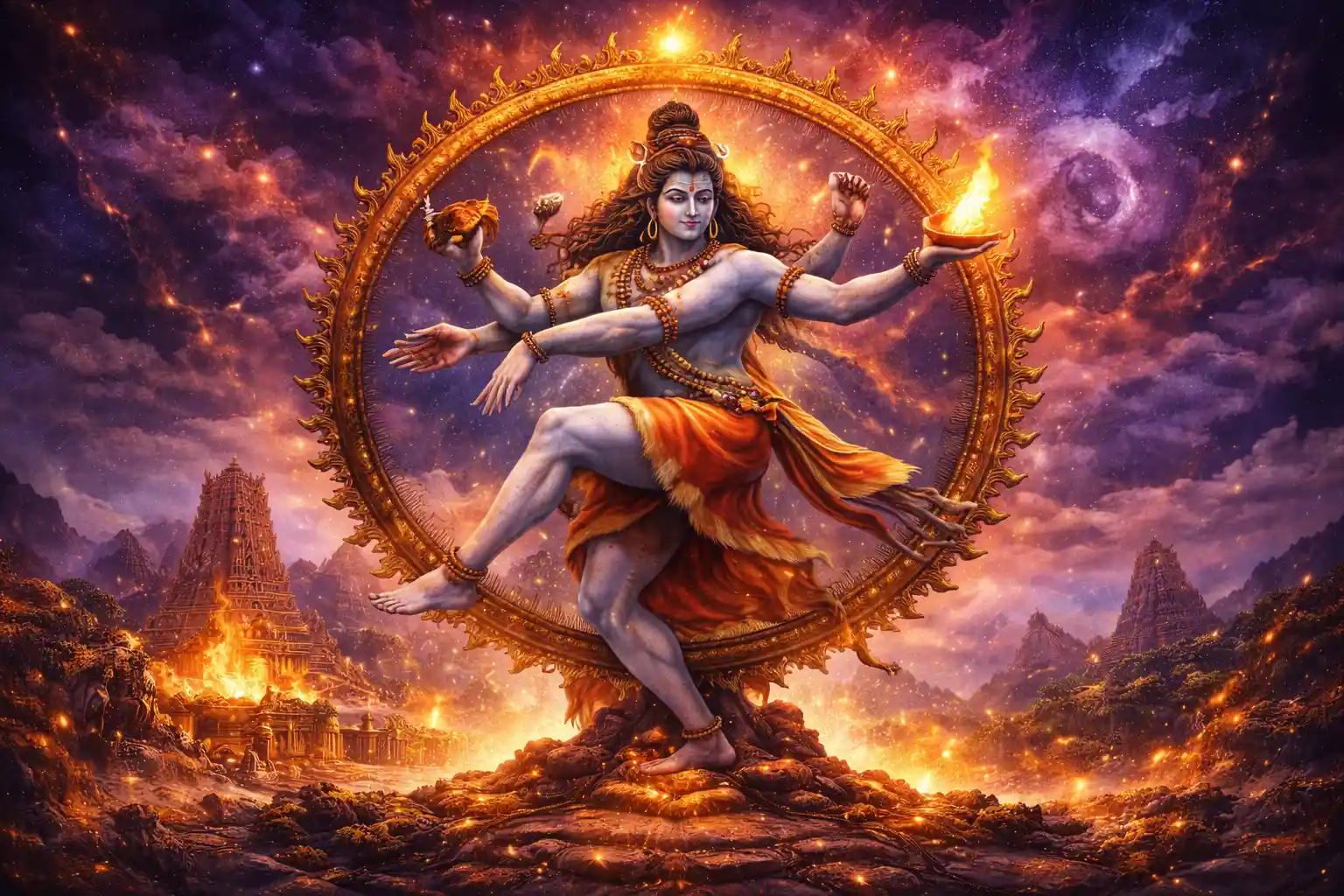
One of the most famous depictions of Lord Shiva is in the form of Nataraja, the cosmic dancer. In this form, Shiva is seen dancing the Tandava, a vigorous dance that represents the creation, preservation, and destruction of the universe. The Tandava is performed in the hall of consciousness, where Shiva destroys the world at the end of an eon, paving the way for the creation of a new world.
This dance embodies the dynamic rhythm of the universe, a reminder that the universe is constantly in a state of flux and transformation. The Tandava signifies the cyclical nature of life, where birth and death are part of an eternal cycle. Through his dance, Shiva shows that destruction is not an end but a necessary force for renewal and regeneration. It is through destruction that new life emerges, and thus the dance represents both an ending and a beginning.
The pose of Nataraja is filled with profound meaning. Shiva’s raised foot signifies liberation, his hand holding the fire represents destruction, and the drum in his other hand represents creation. The circle of flames around Shiva symbolizes the universe, and his calm expression amidst the dance reflects the stillness that underlies all movement. This dance teaches that within the chaos of life, there is always an underlying peace, and to reach this peace, one must engage with the universe without attachment.
Consumption of Halahala Poison
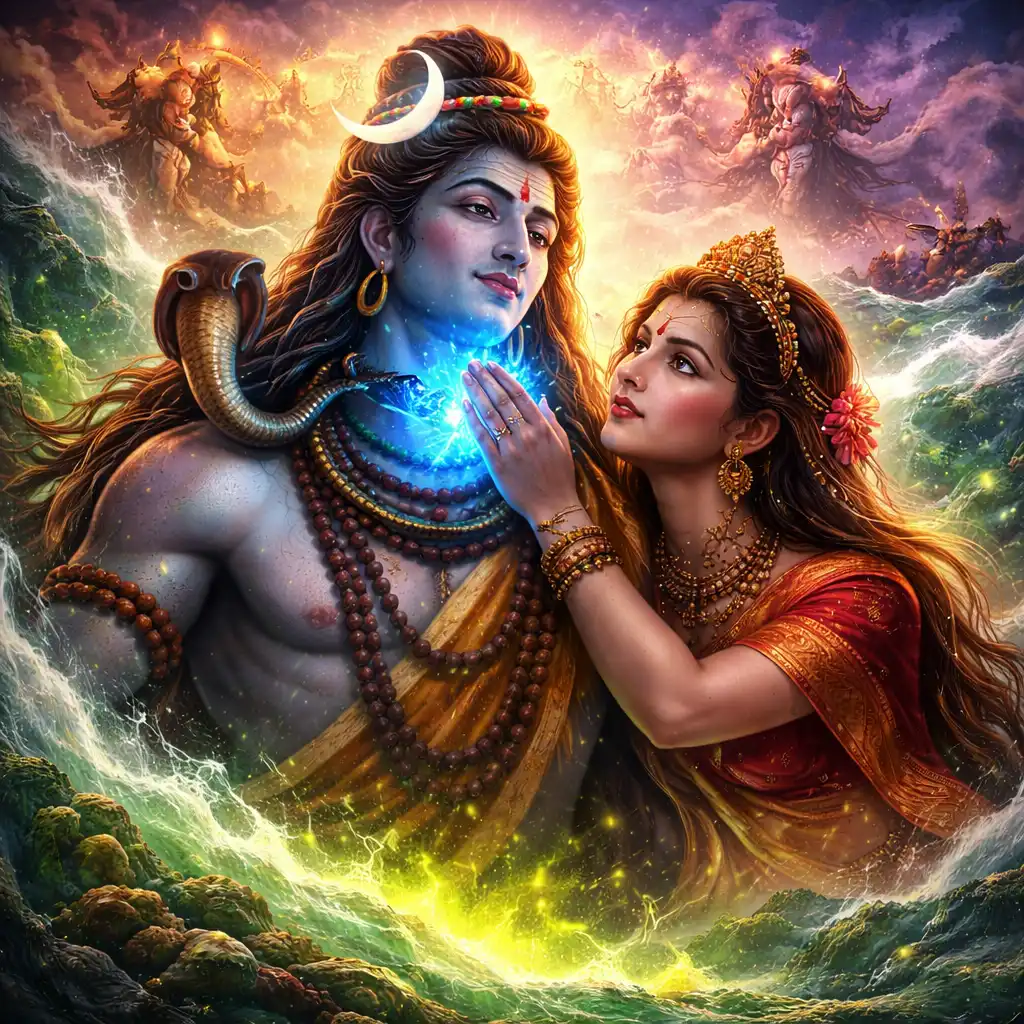
During the churning of the ocean (Samudra Manthan), a deadly poison called Halahala emerged from the depths of the ocean. The poison was so toxic that it threatened to destroy the entire creation. To save the world, the gods and demons turned to Lord Shiva. Without hesitation, Shiva consumed the poison to protect the cosmos. However, the poison was so potent that it began to burn his throat. To prevent the poison from spreading, Parvati, his consort, held his throat, turning it blue.
This act of consuming the poison earned Shiva the name Neelakantha, meaning "the blue-throated one." It is a powerful symbol of Shiva’s selflessness and his role as the savior of the universe. By drinking the poison, Shiva took on the suffering of the world to protect it from destruction. This story also symbolizes the spiritual truth that in the process of personal transformation, one must confront and assimilate the challenges, difficulties, and negative forces of the world. Only then can one transcend them and emerge purified.
Ardhanarishwar: The Divine Union of Shiva and Shakti
One of the most profound depictions of Lord Shiva is as Ardhanarishwar, the divine union of Shiva and Shakti. In this form, Lord Shiva is shown as half-male and half-female, representing the eternal union of masculine and feminine energies. This form symbolizes the unity of consciousness (Shiva) and energy (Shakti), showing that the ultimate reality is both masculine and feminine.
The concept of Ardhanarishwar reflects the spiritual truth that creation cannot exist without both energy and consciousness, and that they are inseparable. Shiva represents the consciousness that pervades all things, while Shakti represents the dynamic energy that manifests creation. Together, they form the perfect union, showing that both the spiritual and material realms are interconnected and interdependent.
The depiction of Ardhanarishwar teaches us about balance and harmony. It reminds us that both the masculine and feminine aspects exist within every individual, and spiritual growth comes when these energies are integrated and balanced within oneself.
Gopeshwar Mahadev: Shiva as a Gopi
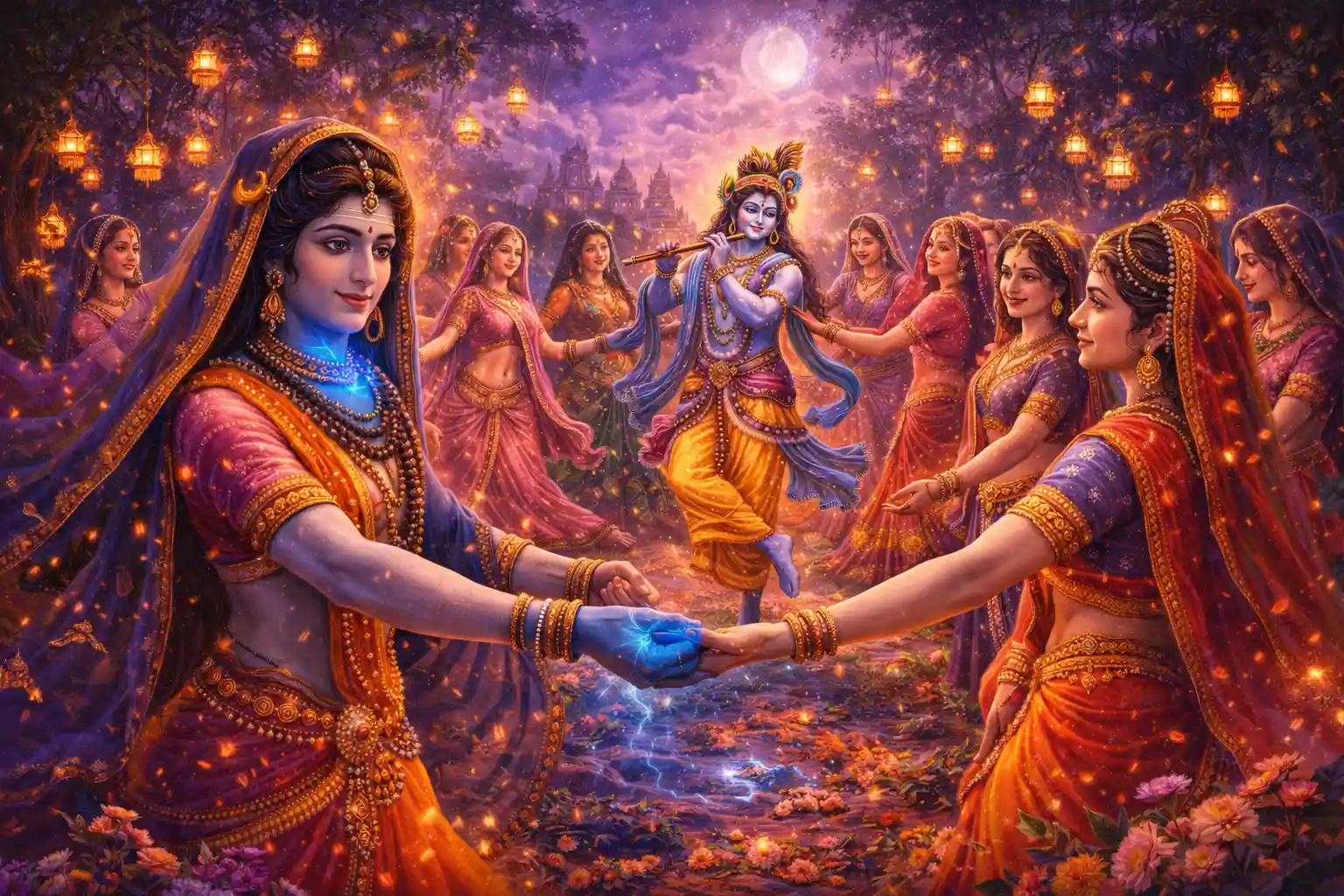
Lord Shiva, known for his many divine acts, also took the form of a Gopi (cowherd girl) in one of his most playful leelas. The story goes that Shiva, eager to witness the divine Ras Leela (dance of love) of Lord Krishna in Vrindavan, disguised himself as a Gopi to participate. This was a sacred dance that was closed to men, and only women were allowed to join.
Shiva, in his eternal desire to experience divine love, took a dip in the Yamuna River, transformed into a Gopi, and joined the Ras Leela. He is worshipped as Gopeshwar Mahadev in Vrindavan, a reminder of Shiva’s deep devotion to Krishna and his desire to experience divine love in all its forms. This story shows that even the greatest of beings are not beyond the yearning for divine love and the joy that comes from being in the presence of the Divine.
Testing Devotees: Shiva’s Trials of Devotion
Shiva is known to test his devotees to elevate them on their spiritual paths. These tests are not to punish, but to help the devotee transcend their limitations and achieve greater spiritual heights. One such test occurred with Arjuna, who was tested by Shiva in the form of a hunter. Arjuna, in his quest for greater strength, sought Shiva’s divine blessing. In the form of a hunter, Shiva tested Arjuna’s skills and devotion, ultimately granting him the Pashupatastra, a powerful weapon.
Another famous test involved Kannappa, a devotee who was so devoted to Shiva that he offered his own eyes to the Shiva Lingam as an offering. Impressed by his dedication and devotion, Shiva granted him divine grace. These stories show that through sincere devotion, even the greatest obstacles can be overcome.
Dakshinamurti: Shiva as the Supreme Guru
As Dakshinamurti, Shiva is depicted as the ultimate teacher, sitting under a banyan tree, imparting the highest knowledge to the four sages. Unlike other gods, Shiva’s teaching was not through words but through silence. His presence alone was enough to convey the profound truths of the universe.
Shiva as Dakshinamurti represents the idea that true wisdom transcends words and concepts. Knowledge is not just intellectual but a direct experience of the divine. This form of Shiva teaches that silence is the highest form of communication and that the ultimate knowledge comes not from external learning but from inner realization.
Burning of Kamadeva: Shiva's Mastery Over Desire
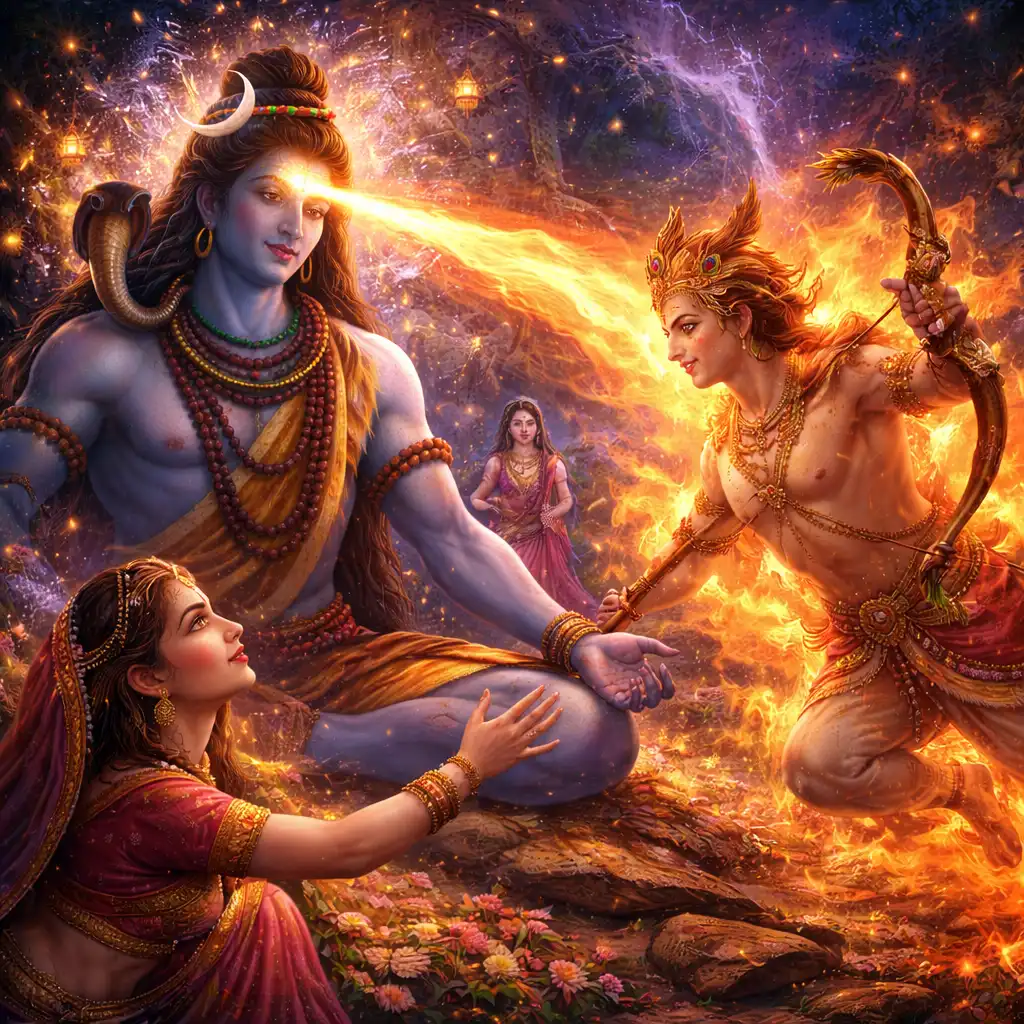
The story of Shiva burning Kamadeva, the god of desire, is another crucial act that teaches the mastery over lust and attachment. When Kamadeva attempted to disrupt Shiva’s meditation to get him to marry Parvati, Shiva, in a state of deep contemplation, opened his third eye and burned Kamadeva to ashes. This act symbolizes Shiva’s power over desire and attachment, showing that true spiritual growth comes from transcending worldly temptations.
Key takeaways from the divine leelas of Lord Shiva
1. Compassion and Selflessness
Shiva’s divine leelas demonstrate his boundless compassion for his devotees. Whether he is bringing water to the people of Madurai or taking the form of a laborer to help an old woman, Shiva’s acts of service remind us that true divinity lies in selfless service and helping others without expectation.
2. Mastery Over Desire and Ego
The burning of Kamadeva and the consumption of the Halahala poison highlight Shiva's ability to conquer worldly attachments, desires, and ego. Shiva’s leelas teach that spiritual growth involves overcoming the distractions of lust, greed, and pride in order to reach higher consciousness.
3. Union of Opposites
The form of Ardhanarishwar (half-male, half-female) symbolizes the union of the masculine and feminine energies, showing that ultimate reality transcends gender and form. Shiva’s leelas teach us that spiritual harmony is found when we balance opposites within ourselves—consciousness and energy, stillness and movement, action and contemplation.
4. Transcendence of the Material World
Through acts like transforming sand into gold or bringing the river Vaigai to the city, Shiva demonstrates that material desires, when rooted in devotion, can lead to divine transformation. These leelas remind us that the physical world is an expression of divine energy and that devotion can elevate the ordinary to the extraordinary.
5. Devotion as the Path to Liberation
Shiva’s tests of devotees, such as the trials of Arjuna and Kannappa, emphasize that true devotion involves challenges and sacrifices. Through sincere devotion and surrender, devotees transcend their limitations and attain spiritual grace. Shiva's tests are not to punish but to elevate.
6. Balance Between Creation and Destruction
The Tandava dance (Nataraja) teaches that destruction is a necessary part of creation. Just as night follows day and death precedes rebirth, Shiva's dance reflects the cyclical nature of the universe. Everything, including the ego, must be destroyed to make way for new beginnings. This highlights the importance of embracing change and transformation.
7. The Power of Silence in Knowledge
As Dakshinamurti, Shiva conveys the highest knowledge in silence. This leela teaches that true wisdom goes beyond words and intellectual understanding. Spiritual knowledge is an experiential realization that can only be received in the stillness of the mind.
8. Divinity in All Forms
Shiva’s transformation into Gopeshwar Mahadev to witness Krishna's Ras Leela emphasizes that divinity can take many forms to experience and participate in all aspects of life. Shiva’s willingness to assume different forms shows that the divine is not limited to a specific identity or role but is present in all creation.
9. Perseverance and Patience
Shiva’s leelas often involve perseverance through trials and struggles. Whether through meditation or service, Shiva teaches that spiritual progress requires patience, self-discipline, and unwavering devotion. The ability to persist through challenges is key to realizing one’s higher self.
10. Shiva as the Ultimate Protector
From consuming poison to saving the universe to testing his devotees for their spiritual elevation, Shiva is the eternal protector who is always present when needed. His actions teach that the divine will always protect and guide the true seeker, no matter the circumstances.
These key takeaways offer profound lessons on how to live a life that is in harmony with the divine. Through these divine leelas, Lord Shiva reveals that spiritual growth comes from selfless action, the transcendence of ego and desire, and the cultivation of inner wisdom and devotion
Call To Action
🌟 Embrace the Divine Wisdom of Lord Shiva! 🌟
🕉️ Join us in celebrating the power of Maha Shivratri by deepening your connection with Lord Shiva through meditation, devotion, and reflection. ✨
🔔 Subscribe now for more spiritual insights and stories of divine transformation. 🙏
💬 Share your thoughts on Shiva’s divine leelas in the comments below – let’s grow together on this sacred journey. 💖
📅 Don't miss out on the Maha Shivratri celebrations at Radha Krishna Temple of Dallas in Allen, Texas!
👉 Click here for event details ✨
FAQs
1. ❓ What is the significance of Maha Shivratri?
✨ Maha Shivratri is a sacred night dedicated to Lord Shiva, representing spiritual awakening and the union of the soul with divine consciousness.
2. ❓ Why do people stay awake during Maha Shivratri?
🌙 Staying awake symbolizes vigilance, focusing on the journey from ignorance to awareness, nurturing inner growth and devotion to Lord Shiva.
3. ❓ What is the meaning of the Shiva Lingam?
💫 The Shiva Lingam represents Lord Shiva’s formless, infinite nature, embodying the balance of creation, preservation, and destruction in the universe.
4. ❓ What does the cosmic dance (Tandava) represent?
🔥 The Tandava dance signifies the cyclical nature of the universe, representing creation, preservation, and destruction, and teaching that all things are in constant transformation.
5. ❓ What is the lesson from Shiva burning Kamadeva?
🌟 Shiva burning Kamadeva symbolizes mastery over desires and attachments, teaching the importance of overcoming worldly distractions to grow spiritually.