(Third Part of the 19-Part Blog Series on the Ishavasya Upanishad)
Introduction
Among India’s timeless spiritual texts, the Upanishads occupy a revered position. They distill the essence of the Vedas into concise yet profound teachings on the nature of life, the soul, and the ultimate purpose of human existence. One of the shortest yet most impactful of these is the Ishavasya Upanishad, composed of just eighteen mantras. Despite its brevity, it offers a complete blueprint for living a conscious, meaningful, and spiritually aligned life.
The second mantra of this Upanishad addresses a universal dilemma experienced by all human beings:
How can one engage fully in life: working, serving and striving, while remaining spiritually free?
Most individuals, knowingly or unknowingly, live in tension between material duties and spiritual aspirations. The world demands action, effort, achievement, and responsibility. Yet spiritual wisdom teaches non-attachment, inner equanimity, and liberation from desire. How can these two be reconciled?
The mantra solves this dilemma beautifully by teaching the philosophy of karma yoga, the art of working without attachment. It reveals that the problem is not action itself but the egoistic intention behind action. A person who works for personal enjoyment becomes bound by karma, while one who works for the Divine becomes free, even while engaging in the same outer duties.
This blog explores the fullness of this teaching, contextualizes it for modern life, and offers practical steps to embody karma yoga today. Whether one is a student, professional, homemaker, or spiritual aspirant, the guidance of this mantra remains as relevant now as it was thousands of years ago.
Mantra 2: Verse in Sanskrit and Translation
Sanskrit
कुर्वन्नेव हि कर्माणि जिजीविषेच्छतं समाः।
एवं त्वयि नान्यथेतोऽस्ति न कर्म लिप्यते नरे॥
Transliteration
kurvanneveha karmāṇi jijīviṣec chataṃ samāḥ
evaṃ tvayi nānyatheto ’sti na karma lipyate nare
Translation
Human beings should aspire to live a hundred years, while performing their duties with the proper attitude. Work done for the pleasure of God will not result in karmic bondage. In fact, there is no simpler means for getting rid of the bonds of karma.

| Sanskrit Term | Transliteration | Literal Meaning | Contextual Meaning | Role in the Verse |
|---|---|---|---|---|
| कुर्वन्नेव कर्माणि | kurvan eva karmāṇi | Surely performing actions | Continuously engaging in prescribed duties | Affirms that life must be lived actively, not passively or in escapism |
| जिजीविषेच्छतं समाः | jijīviṣec chataṁ samāḥ | Should desire to live for a hundred years | Desire for a full, meaningful lifespan dedicated to dharma | Highlights the value of human life and long-term spiritual effort |
| न कर्म लिप्यते | na karma lipyate | Action does not taint | Actions do not bind the soul when done in the right spirit | Explains freedom from karmic bondage through selfless work |
| नरे | nare | In the person | The human being acting in the world | Emphasizes that this teaching is specifically for the human situation |
| एवं त्वयि नान्यथेतोऽस्ति | evaṁ tvayi nānyatheto ’sti | Thus for you there is no other way | This is the simplest and surest path to freedom | Declares the uniqueness and practicality of karma yoga |
Explanation of the Verse

1. The Deeper Meaning of Human Birth
The Upanishads repeatedly affirm that the human realm is the only one in which spiritual growth is possible. Other beings such as animals, birds, insects and countless forms, function primarily under instinctive programming. The human mind alone possesses discrimination (viveka), reflection (manana), and spiritual inquiry (vichara).
Thus, human birth is not accidental but an earned opportunity. The soul transmigrates through millions of species until the impressions accumulated from past lives mature enough to merit a human body. This body becomes the instrument through which the soul can seek and feel divine love.
This awareness should inspire gratitude and responsibility, not complacency. The thought: I am human, therefore I must live with higher purpose, becomes the foundation of a spiritual life.
2. The Call to Live a Full and Responsible Life
The mantra does not promote escapism, despair, or rejection of life. Instead, it uses the word jijīviṣec, which means the desire to live fully, joyfully, and responsibly. The sages knew that spiritual maturity blooms gradually, through the experiences and duties of life.
To live long is to engage deeply, learn from mistakes, refine the mind, and grow spiritually. The encouragement to live a hundred years symbolizes:
- a complete life
- a devoted life
- a purposeful life
- a life integrated with dharma
This stands in contrast to some misconceptions that spirituality requires world-renunciation. True spirituality requires strength, clarity, and wisdom. These qualities are cultivated through life’s trials, relationships, responsibilities, joys, and struggles.

3. Philosophy of Work in the Upanishads
Work (karma) is unavoidable. The body functions, the senses perceive, and the mind thinks. Every moment is an action. Whether we choose to act or not, something is always occurring.
The Upanishads refine this understanding by teaching that action is not the problem; attachment is.
Attachment arises from:
- ego (“I am the doer”)
- expectation (“I want this result”)
- desire (“This action will bring me pleasure”)
- aversion (“This action will cause discomfort”)
These inner tendencies create karmic impressions (samskaras), which bind the soul to the cycle of rebirth.
The only way to escape this cycle is to act without attachment, offering actions to the Divine.
4. Why Selfless Work Does Not Bind

The mantra declares: na karma lipyate: action does not stain or bind.
A beautiful point emerges here:
Two individuals may perform the same external action, yet the spiritual outcome differs entirely based on intention.
For example:
- One person donates with pride and expectation → karmic bondage.
- Another donates with humility and surrender → karmic purification.
Just as a lotus grows in muddy water yet remains untouched, a person established in karma yoga lives in the world yet remains spiritually pure.
5. Misunderstanding Renunciation
Many imagine that spirituality demands renouncing family, career, or society. The Upanishad firmly counters this. If the mind is impure, running to a forest or monastery solves nothing. A person may abandon external duties while the mind continues to indulge in desires, fantasies, fear, or restlessness.
True renunciation is not physical withdrawal but mental non-attachment.
One must work in the world but not for the world. Rather, one should work for the pleasure of God.
| Aspect | External Renunciation | Internal Renunciation | Risks / Limitations | Ideal Outcome |
|---|---|---|---|---|
| Definition | Physically giving up possessions, roles, or social duties | Letting go of attachment, ego, and selfish expectation while acting | Can be superficial if the mind is still attached; may cause imbalance | Mental freedom while remaining outwardly engaged in life |
| Focus | Change of outer circumstances | Transformation of the inner attitude and intention | Person may escape duties without purifying the mind | Deep purification with or without change in outer lifestyle |
| Example | Leaving home and job to live in seclusion without preparation | Continuing one’s job and family role but offering all actions to God | Frustration, inner conflict, unresolved desires | Calmness, maturity, wisdom, and steady devotion |
| Alignment with Mantra 2 | Not encouraged as the primary path | Strongly encouraged: work selflessly while living fully | May lead to misunderstanding of spirituality as escape | Sees spirituality as transformation of life, not avoidance of life |
6. The Three Types of Action: Karm, Vikarm, Akarm
The Upanishadic triad provides a profound understanding of life:
- Karm – Prescribed duties
- Vikarm – Prohibited actions
- Akarm – Action done without attachment, for God
Of these, only akarm does not incur karmic bondage. This category represents action that purifies instead of binding, and is the essence of Karma Yoga.
| Type of Action | Definition | Typical Motivation | Examples | Immediate Result | Long-term Spiritual Effect |
|---|---|---|---|---|---|
| Karm | Scripturally prescribed duties performed as per varnashram dharma | Obedience, order, desire for merit and prosperity | Honest work, family duties, basic rituals, charity | Material prosperity, social harmony, heavenly enjoyment | Does not by itself grant liberation; keeps the soul within cycles of birth and death |
| Vikarm | Forbidden actions that violate dharma | Greed, anger, lust, jealousy, carelessness | Stealing, cheating, violence, intoxication, exploitation | Suffering, inner disturbance, guilt, social damage | Leads to lower births, pain, and bondage to negative karmic patterns |
| Akarm | Action done without ego and attachment, as an offering to God | Devotion, surrender, selflessness, desire to please the Divine | Doing one’s job for God, serving family as service to the Lord, selfless charity | Inner peace, clarity, lightness, reduction of ego | Purifies the heart, dissolves karmic bondage, and leads towards liberation |
7. The Role of Intention
Intention is everything.
For example, two people may cook a meal:
- One cooks to gain appreciation → bondage.
- One cooks as service to family and God → purification.
Two people may work the same job:
- One seeks prestige, control, or wealth → bondage.
- One works to serve society and fulfil duty → purification.
Thus, karma yoga does not require dramatic external change, it requires an inner shift.
Applications of the Verse in Daily Life
Below are deeper and more extensive applications for integrating this mantra into everyday life.
1. Transform Your Workplace into a Spiritual Field
Instead of viewing your job as separate from spirituality:
- treat each task as service
- offer your work to God
- detach from praise or blame
- stay honest and conscientious
- practice calmness under pressure
This transforms career into a vehicle for self-realization.
2. Make Household Duties Sacred
Housework, parenting, relationships, errands: all of these can be part of spiritual practice.
- Clean as an offering
- Cook with love
- Treat family interactions as opportunities to practice patience, empathy, and humility
- This removes monotony and turns daily life into yoga
3. Do Not Waste Time, Value Each Moment
Time is the most precious resource. Every moment can either uplift or degrade consciousness.
- Limit pointless entertainment
- Engage in purposeful rest
- Reflect daily on growth
- Practice gratitude
- Keep the mind focused on meaningful actions
4. Replace Ego with Surrender
Before beginning any task, pause and set an intention:
“O Lord, this action is Yours. May it be done through me.”
This instantly transforms the quality of action.
5. Bring Awareness into Every Action
Mindless activity creates karmic impressions, while mindful action purifies the heart.
Practice awareness when:
- speaking
- eating
- working
- resting
- interacting
- choosing
6. Cultivate a Daily Spiritual Practice
Even 10 to 20 minutes of spiritual discipline stabilizes the mind:
- meditation
- mantra chanting
- reading scriptures
- contemplation
- gratitude journaling
This strengthens inner renunciation.
7. Live with Purpose, Not Drifting
A purposeful life aligns with dharma:
- choose actions deliberately
- avoid harmful habits
- embrace growth
- remain disciplined
Purpose anchors the mind in clarity.
8. See All Work As Yoga
Yoga means “union", hence everything becomes yoga when dedicated to God.
Deepen Your Learning and Spiritual Practice
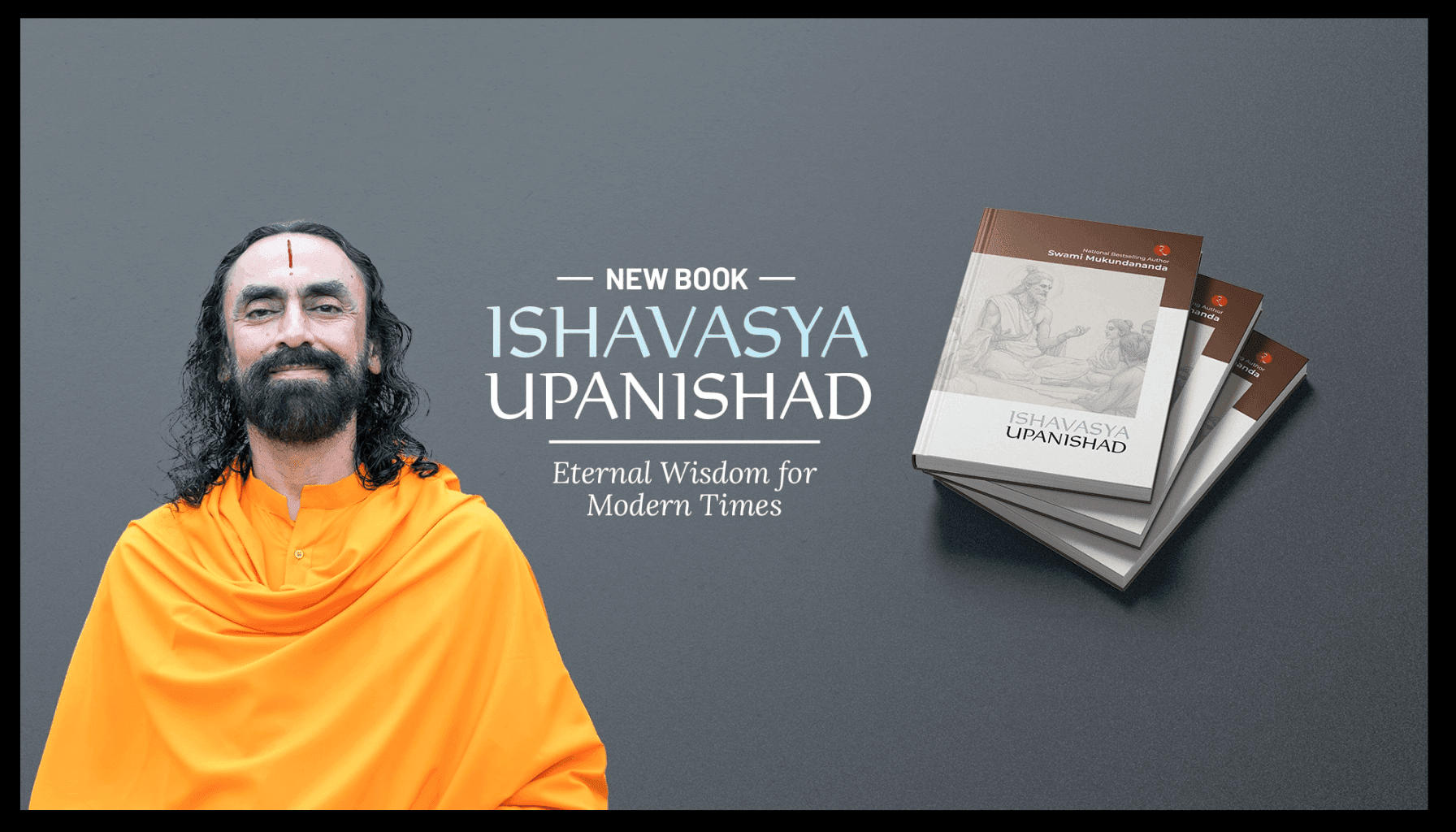
To deepen your understanding of the Ishavasya Upanishad, we highly recommend Swami Mukundananda’s commentary, which beautifully unpacks each mantra, including the Shanti Path, providing a clear and practical guide for modern seekers.
Order the Book: Swami Mukundananda’s Commentary
Unlock the deeper wisdom of the Ishavasya Upanishad with this insightful commentary by Swami Mukundananda. Perfect for modern seekers who wish to explore the divine teachings in greater depth.
Final Reflection
The core teaching of the Ishavasya Upanishad, particularly in the second mantra, offers a timeless solution to the paradox between material engagement and spiritual liberation. By practicing karma yoga—performing one's duties with detachment and without egoistic desires—one can live a life fully immersed in worldly responsibilities while maintaining spiritual freedom. The essence of this teaching is that the intention behind the action determines whether it binds or liberates the individual. When actions are dedicated to a higher purpose, such as serving the Divine or the greater good, they do not entangle the soul in the cycle of karma. Instead, they become a means of spiritual growth.
Key Philosophical Insights
- Karma and Detachment: The Upanishad teaches that it is not the action itself that leads to bondage but the attachment to the fruits of the action. When one acts with attachment or for selfish gain, one is bound by the consequences. On the other hand, actions performed without attachment and with selfless intention lead to freedom and spiritual advancement.
- The Role of Intention: The central philosophical insight of this mantra is that the intention behind actions is what defines their spiritual value. Actions performed for personal pleasure or egoistic reasons entangle the individual in karma, whereas actions performed for the divine or for the greater good transcend karma, leading to liberation.
- Integration of Material and Spiritual Life: The mantra offers a balanced approach to living. It doesn't ask one to renounce worldly duties or pursuits but to approach them with the right attitude—viewing them as opportunities for spiritual practice. This philosophy aligns both material responsibilities and spiritual growth, suggesting that one does not have to withdraw from life to attain liberation.
- Living a Purposeful Life: The Upanishad encourages individuals to live a full, meaningful life—aiming to live to the age of 100—while consciously engaging in duties. This is a call to balance longevity and purpose with spiritual mindfulness, encouraging people to live fully without being consumed by the desires of the world.
In conclusion, the Ishavasya Upanishad offers a powerful and practical roadmap for modern life. It teaches that spiritual freedom is not about avoiding the world, but about transforming one’s relationship to it. By working without attachment, with a heart dedicated to the Divine, one can live a life of purpose, harmony, and ultimate liberation.
FAQs
1. Does this mantra promote worldly life or spiritual life?
It promotes a balanced life—fulfilling worldly duties with spiritual intention.
2. Why aspire to live a hundred years?
To maximize the opportunity for spiritual growth through purposeful action.
3. Can we stop karma by not acting?
No. Even inaction creates karma. Freedom comes from detached action.
4. What is the simplest way to dissolve past karma?
Perform present actions selflessly and offer them to God.
5. Is external renunciation necessary?
No. Internal renunciation—letting go of attachment—is far more important.