
(Eighth Part of the 19-Part Blog Series on the Ishavasya Upanishad)
When we first meet the Ishavasya Upaniṣad, the rishis feel like master sculptors of consciousness: with just a few mantras they carve out an entire vision of God, the soul, and the world.
Mantra 5 showed us a Lord who is inside everything yet beyond everything.
Mantra 6 hinted at a seeker who begins to see this unity.
In Mantra 7, the curtain lifts completely. We are invited into the inner state of a God-realized soul: one whose awareness is so united with the Divine that delusion (moha) and sorrow (śoka) simply have no place left to stand. Drawing from Swami Mukundananda’s commentary, we’ll explore what this state means and how it can guide our own spiritual journey.
1. The Sacred Verse – Mantra 7 of the Ishavasya Upaniṣad
Sanskrit
यस्मिन्न् सर्वाणि भूतान्यात्मैवाभूद्विजानतः।
तत्र को मोहः कः शोक एकत्वमनुपश्यतः ॥७॥
Transliteration
yasminn sarvāṇi bhūtāny
ātmaivābhūd vijānataḥ
tatra ko mohaḥ kaḥ śoka
ekatvam anupaśyataḥ
Translation (sense meaning)
All living beings reside in God, and He resides in all living beings. One who clearly knows this Truth sees the unity of all creation with the Lord. For such a realized sage, how can there be delusion or grief?
At first glance it sounds poetic. But hidden inside is a complete description of enlightenment:
- All beings in God – the world is not separate from the Divine.
- God in all beings – the Lord is present in every heart.
- Seeing this unity clearly – when this is not just a belief, but a living perception,
moha and śoka dissolve.
Before diving deeper, let’s unpack some key Sanskrit terms.
2. Key Words of Mantra 7 – Quick Reference
Mantra 6 spoke of anupaśyati, “one who clearly sees by spiritual knowledge.” Mantra 7 upgrades this to vijānataḥ and anupaśyataḥ, “one who unmistakably knows and continually beholds.” The seeker has moved from practice to perfection.
3. From Practice to Realization – Two Stages of Vision
Swami Mukundananda explains that Mantra 7 describes a higher stage than Mantra 6. There is a shift from “I am learning to see correctly” to “I can’t see any other way anymore.”
Table 1 – Two Stages on the Path
Mantra 7 gives us a portrait of the second stage which is a consciousness soaked in God-awareness.
4. Moha & Śoka – The Twin Shadows
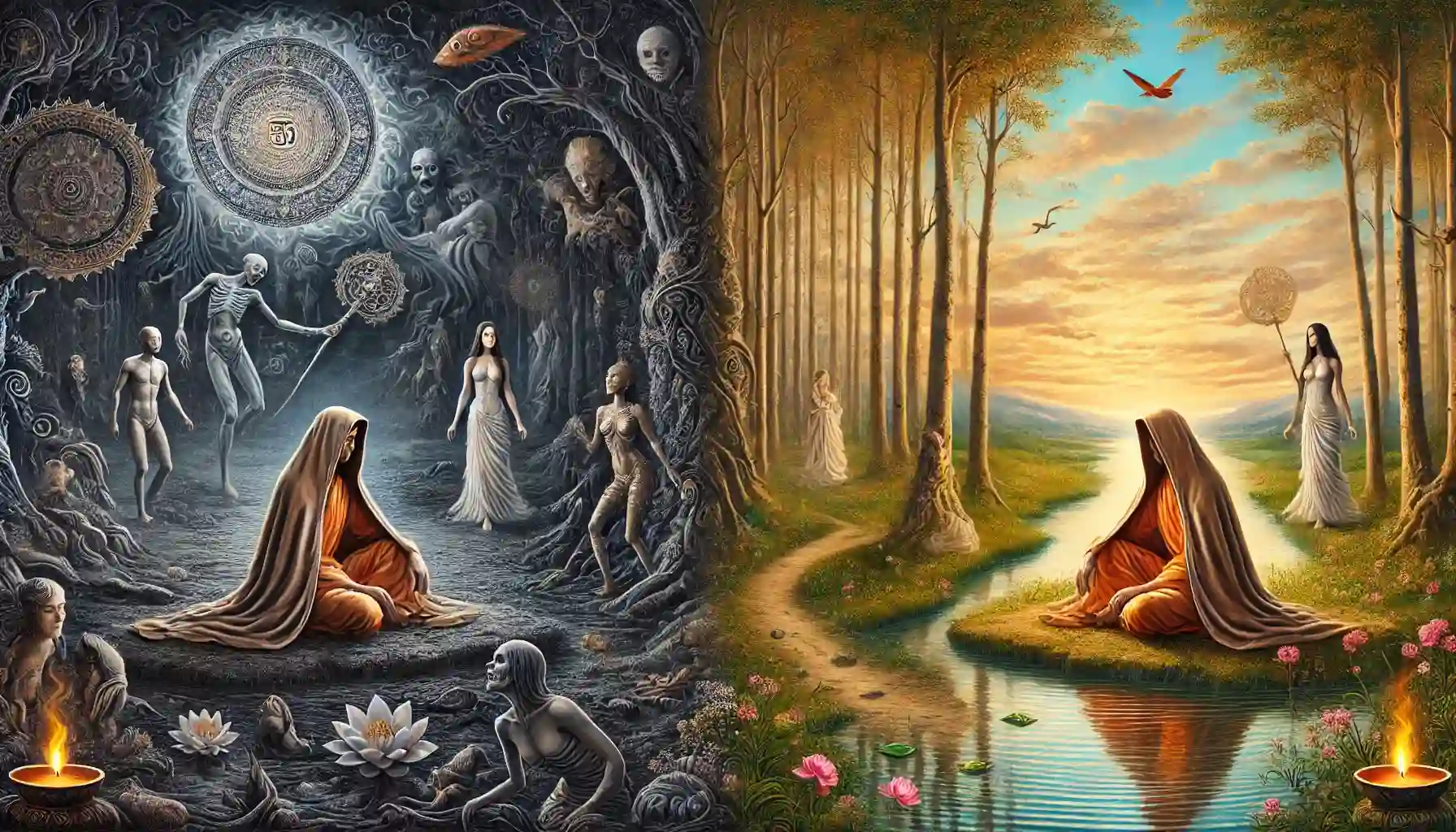
The mantra says that when unity is seen, moha and śoka vanish. To appreciate that, we need to know what they are.
4.1 Moha – Delusion
The word moha comes from a root meaning “to become bewildered or unconscious.” It is the inner fog that makes us:
- Mistake the temporary for the permanent,
- The body for the self,
- The world for the ultimate reality.Mantra7
The commentary explains that moha is the root of mental and emotional disturbance. Our judgments become cloudy and we cling to illusions. Just as a person may value colored glass as if it were priceless diamond, we overestimate worldly objects, relationships, and roles and build our identity around them.
4.2 Śoka – Sorrow
Wherever there is moha, śoka follows like a shadow. We become heartbroken when:
- the job is lost,
- the body ages,
- a relationship changes,
- or a possession is damaged.
The object itself is not the problem; our deluded expectation from it is. When the illusion collapses, sorrow arises.
Table 2 – Moha & Śoka: Cause and Effect
The Upaniṣad’s solution is not to freeze the world so nothing changes; it is to remove the moha that makes change so painful.
5. How Divine Knowledge Destroys Sorrow
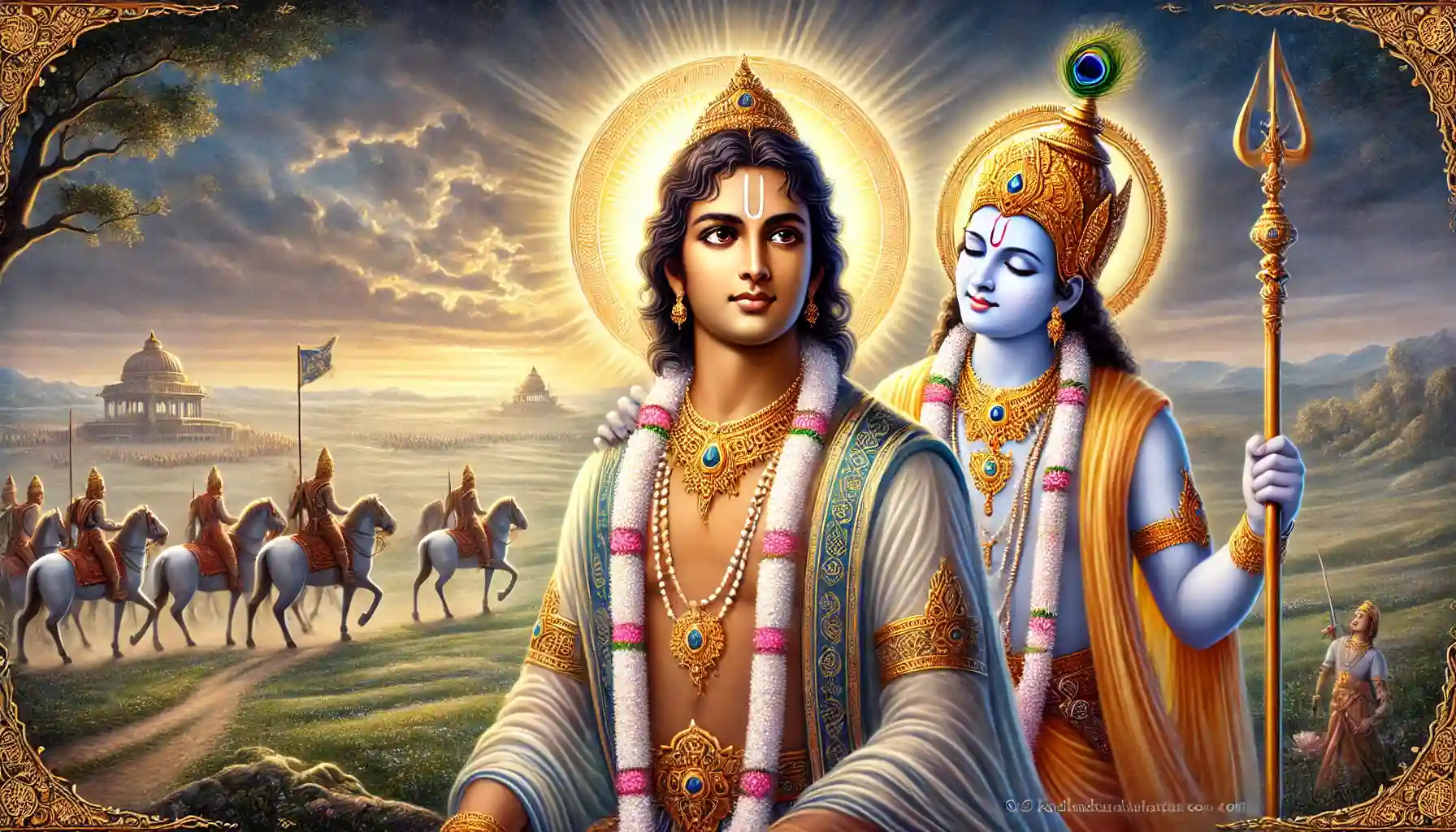
The Bhagavad Gītā begins by addressing exactly this problem. Arjuna is drowned in grief at the thought of his relatives dying. Shree Krishna points out that his sorrow is misplaced, because it is rooted in ignorance about the eternal soul.
By the end of the Bhagavad Gītā, Arjuna declares that his moha has been destroyed and his memory of his true identity restored. Interestingly, he doesn’t separately speak about śoka—it has already dissolved when delusion (moha) is destroyed and right understanding (smṛti) is restored, indicating that sorrow is not an independent affliction but a symptom of ignorance and misidentification.
The commentary on Mantra 7 highlights this principle:
When moha goes, śoka goes automatically;
sorrow is just delusion’s emotional echo.Mantra7
Table 3 – Before and After Divine Understanding
The realized sage of Mantra 7 lives permanently in the second column.
6. Ekatvam – Oneness Without Erasing Yourself
The phrase “ekatvam anupaśyataḥ” has sparked many philosophical discussions. Some thinkers read it as proof that, at the highest level, the individual soul merges and ceases to exist as distinct from Brahman.
Swami Mukundananda notes that this mantra is better understood as oneness of consciousness, not the loss of individuality.
On God-realization:
- The soul’s nature becomes aligned with God’s nature: pure, loving, free from selfishness.
- The soul does not become the source of creation or the controller of the universe.
- Rather, its attention, love, and awareness are fully unified with God.
Scriptures and saints often give the analogy of an iron rod in fire: the red-hot rod glows and burns like fire, yet it never stops being a rod.
Table 4 – Misunderstood vs True Oneness
Mantra 7 thus supports a vision of unity in love rather than identity in ego.
7. Seeing God Everywhere – The Vision of a
Bhakta
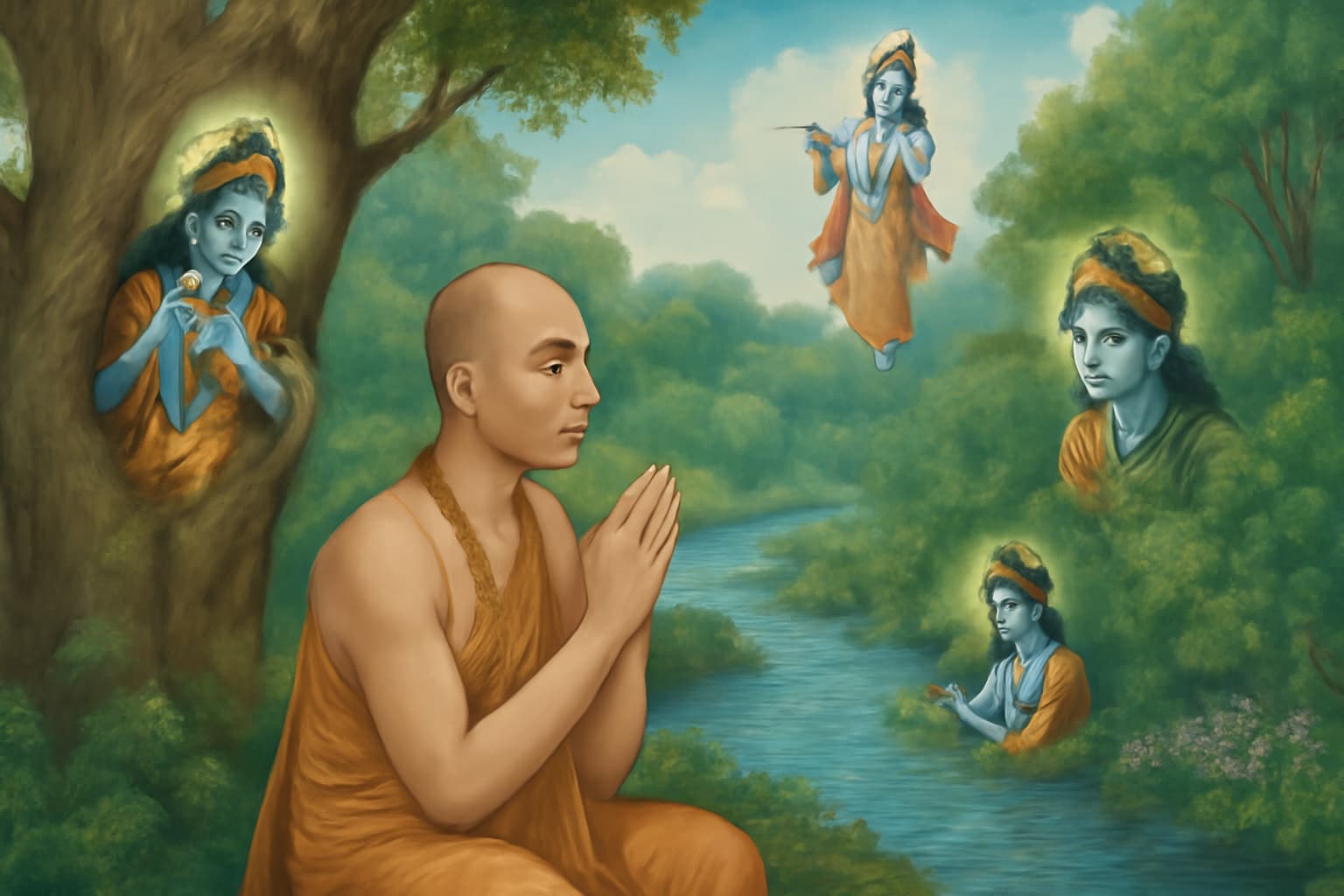
The commentary cites Nārada Bhakti Sūtras and Śrīmad Bhāgavatam to illustrate this state. The bhakta who has attained pure love:
Mantra7
- Sees only God – in every face, every object, every moment.
- Speaks only of God – their words naturally glorify the Divine.
- Thinks only of God – even their “ordinary” thoughts are coloured by remembrance.
The Bhāgavatam declares such a devotee bhāgavatottama (the highest kind) because they see God in all beings and all beings in God.
Table 5 – Where the Realized Soul Sees God
This is not forced positive thinking; it is the natural perception of one whose heart has awakened to ekatva.
8. Living Mantra 7 – Simple Daily Practices
We may not yet live in that exalted consciousness, but we can walk toward it. Here are some practical ways to bring Mantra 7 into everyday life.
Table 6 – Practising Oneness in Daily Life
Over time, these small practices chip away at the walls of moha and reveal the quiet luminosity of ekatva.
Deepen Your Learning and Spiritual Practice
To deepen your understanding of the Ishavasya Upanishad, we highly recommend Swami Mukundananda’s commentary, which beautifully unpacks each mantra, including the Shanti Path, providing a clear and practical guide for modern seekers.
Order the Book: Swami Mukundananda’s Commentary
Unlock the deeper wisdom of the Ishavasya Upanishad with this insightful commentary by Swami Mukundananda. Perfect for modern seekers who wish to explore the divine teachings in greater depth.
Key Philosophical Insights from Ishavasya Upaniṣad Mantra 7
1. Enlightenment Is a Shift in Perception, Not a Change of World
Mantra 7 does not describe a new world appearing for the realized soul; it describes a new way of seeing the same world. All beings were always in God, and God was always in all beings. What changes is perception (darśana), not reality. Enlightenment is therefore not an escape from life but a clarification of vision within life.
2. Unity Is Lived Awareness, Not Intellectual Belief
The mantra emphasizes vijānataḥ and anupaśyataḥ: one who knows unmistakably and continually sees. This indicates that unity is not a philosophical position or a belief system. It is a steady, lived perception that no longer fluctuates. When oneness becomes experiential rather than conceptual, it transforms consciousness at its root.
3. Delusion (Moha) Is the Fundamental Human Problem
Moha is not merely confusion; it is misidentification: mistaking the body, roles, and possessions for the self. This delusion distorts judgment, values, and priorities. The Upaniṣad identifies moha as the root cause of all psychological and emotional disturbance, rather than external circumstances.
4. Sorrow (Śoka) Is a Symptom, Not an Independent Reality
Śoka does not arise independently; it is the emotional consequence of moha. When false expectations are placed on temporary things, loss becomes devastating. The mantra teaches a radical insight: remove delusion, and sorrow dissolves automatically. Healing does not begin with managing grief, but with correcting vision.
5. Liberation Is Freedom from Inner Fragmentation
The realized sage is not described as inactive or withdrawn, but as internally unified. When identity is anchored in the eternal soul and God, inner conflict disappears. Fear, jealousy, and grief lose their footing because consciousness is no longer divided between competing identities and attachments.
6. Oneness Does Not Mean Loss of Individuality
The phrase ekatvam anupaśyataḥ does not imply that the soul becomes God in an egoic or literal sense. Rather, it indicates oneness of consciousness and alignment, not identity of existence. The soul remains distinct yet fully God-centered, like an iron rod glowing in fire. This preserves humility, devotion, and the possibility of love.
7. God-Realization Naturally Gives Rise to Compassion
Seeing God in all beings transforms how one relates to others. People are no longer seen as competitors, obstacles, or tools, but as souls carried by the same Divine reality. Compassion is not cultivated artificially; it flows naturally from the perception of unity.
8. The Highest Knowledge Eliminates Existential Fear
When God is seen as the inner Self of all beings and the ground of all existence, fear loses its foundation. Loss, change, and uncertainty no longer threaten one’s core identity. The realized soul may still experience human emotions, but existential anxiety and despair no longer dominate.
9. Spiritual Maturity Is Measured by Stability, Not Ecstasy
Mantra 7 describes a consciousness where unity is continuous and effortless, not dependent on moods or special experiences. This reframes spiritual success: it is not about visions or highs, but about unshakable clarity, emotional steadiness, and freedom from delusion.
10. Seeing God Everywhere Is the Pinnacle of Bhakti and Jñāna
The mantra harmonizes devotion (bhakti) and knowledge (jñāna). The highest devotee (bhāgavatottama) and the highest knower see the same truth: God everywhere, and everything resting in God. Love deepens knowledge, and knowledge purifies love—there is no conflict between the two.
Final Reflection
Mantra 7 doesn’t merely state a doctrine; it describes a transformed way of being:
- The realized soul sees all beings in God and God in all beings.
- Because of this, they no longer misidentify with the perishable body or with separate egos.
- Consequently, moha (delusion) and śoka (sorrow) fade, like darkness before the rising sun.
As we meditate on this mantra, our goal is not to pretend we are already enlightened, but to let its vision reshape our priorities:
Wherever I look, let me remember:
“The same Divine lives here as lives in me.”
Walking with that remembrance, step by step, we move closer to the state where grief loses its grip and life becomes a joyful participation in God’s own consciousness.
FAQs
1. What is the core message of Mantra 7?
It teaches that when we truly realize that God lives in every being and every being lives in God, our basic misunderstanding about who we are disappears. With that, the root causes of mental confusion and deep sorrow naturally fall away.
2. Does “oneness” here mean I literally become God?
No. The mantra speaks of oneness of vision and consciousness, not the erasing of individuality. You remain a unique soul, but your awareness becomes completely God-centred, just as a red-hot iron rod shares the qualities of fire without ceasing to be iron.
3. How does this help with ordinary problems like stress or heartbreak?
When you remember that you and others are souls within the same Divine, you stop seeing challenges as random cruelty or personal attacks. Instead, you view them as events in God’s classroom—meant to grow your wisdom, love, and detachment. This understanding doesn’t remove all emotion, but it takes away the despair.
4. What can I do when moha and śoka suddenly appear?
First, notice them: “Right now I am in moha; I’m clinging to something temporary.”
Then turn inward: remember your identity as a soul and gently offer the situation to God: “Please show me how to see this with Your eyes.” Over time, this habit weakens the hold of delusion and transforms even painful moments into opportunities to practice Mantra 7.
5. Is this state only for great saints, or can a normal person like me aim for it?
The fully realized state belongs to great saints, but the path belongs to everyone. Each time you see even a little more unity—treating another with kindness, letting go of needless resentment, remembering God in a crisis—you have taken a real step toward the consciousness described in Mantra 7. The Upaniṣad is inviting you to keep walking.