(Nineteenth Part of the 19-Part Blog Series on the Ishavasya Upanishad)
Ishavasya Upanishad Mantra 18: When the Soul Asks for the True Path
There comes a moment in spiritual life when surrender matures into responsibility.
Mantra 18 of the Ishavasya Upanishad is spoken from that moment.
The seeker has already offered the body, breath, and life itself in Mantra 17.
Now, standing at the culmination of the Upanishad, the soul makes its final request; not for escape, not even for liberation alone, but for the right guidance.

This mantra is not a cry of helplessness.
It is the voice of a devoted soul asking:
“Show me the path that truly leads to You.”
Mantra 18 transforms surrender into direction, devotion into movement, and faith into purposeful walking.
1. The Sacred Verse: Ishavasya Upanishad Mantra 18
Sanskrit
अग्ने नय सुपथा राये अस्मान्
विश्वानि देव वयुनानि विद्वान् ।
युयोध्यस्मज्जुहुराणमेनो
भूयिष्ठां ते नमउक्तिं विधेम ॥१८॥
Transliteration
agne naya supathā rāye asmān
viśhvāni deva vayunāni vidvān
yuyodhy asmaj juhurāṇam eno
bhūyiṣhṭhāṁ te nama-uktiṁ vidhema
Translation
O lord, Thou art the Deity of the fire of devotion. O Supreme Treasure of life, please take us by the divine path. O Resplendent One! You know all our countless intentions and karma performed in this world of maya. Please destroy the karmas that bind us and prevent us from attaining Your divine abode. We repeatedly sing Your glories and offer our prayerful obesiance unto You.
Key Sanskrit Terms of Ishavasya Upanishad Mantra 17
|
Sanskrit Term |
Literal Meaning |
Simple Spiritual Insight |
| Agne | O Fire | God as the inner divine guide who ignites devotion and removes ignorance |
| Naya | Lead, guide | A prayer for divine direction, not self-made navigation |
| Supathā | Auspicious / right path | The spiritually correct path that leads to God, not merely a moral or ritual path |
| Rāye | Radiant wealth | God Himself as the supreme treasure of life |
| Asmān | Us | Indicates collective prayer, compassion for all souls, not self-centered seeking |
| Viśhvāni | All, entire | Refers to the totality of creation and all paths within it |
| Deva | Radiant Lord | God as the self-effulgent Supreme Being |
| Vayunāni | Ways, paths, actions | All karmic paths, intentions, and movements of life |
| Vidvān | All-knowing | God as the knower of every action, intention, and karmic consequence |
| Yuyodhi | Remove, destroy | Request to eliminate inner obstacles like ego, desire, and karmic bondage |
| Asmat | From us | Acknowledgment that bondage exists within, not outside |
| Juhurāṇam | Sinful / binding actions | All acts (even good ones) that bind the soul to material existence |
| Enah | Impurity, fault | Moral and spiritual impurities blocking divine realization |
| Bhūyiṣṭhām | Again and again | Continuous surrender, not one-time faith |
| Nama-uktiṁ | Reverent offering / obeisance | Loving surrender expressed repeatedly |
| Vidhema | We offer | Willing participation in devotion and surrender |
2. The Mood of Mantra 18: Guidance After Surrender
Mantra 18 is not anxious prayer. Instead, it offers a confident dependence.
The devotee does not ask, “Where should I go?”
He asks, “Please lead me.”
Table 1: Emotional Shift Across the Final Mantras
|
Stage |
Dominant Mood |
Inner Focus |
| Mantras 15–16 | Longing | Vision of Truth |
| Mantra 17 | Surrender | Offering the self |
| Mantra 18 | Trust | Walking the divine path |
Spiritual maturity is marked not by self-navigation, but by willingness to be led.
3. “Agni”: God as the Inner Guide, Not External Fire
Although Agni literally means fire, in this mantra it represents the Divine Presence that illuminates the heart, not a physical flame
God is addressed as Agni because:
- He ignites devotion
- He reveals truth
- He burns ignorance
Table 2: Meaning of “Agni” in Mantra 18
|
Aspect |
Literal Meaning |
Spiritual Meaning |
| Fire | Physical flame | Inner illumination |
| Heat | Energy | Transformative devotion |
| Light | Visibility | Divine guidance |
The devotee is asking not for light outside, but clarity within.
4. “Supathā”: The Request for the Right Path
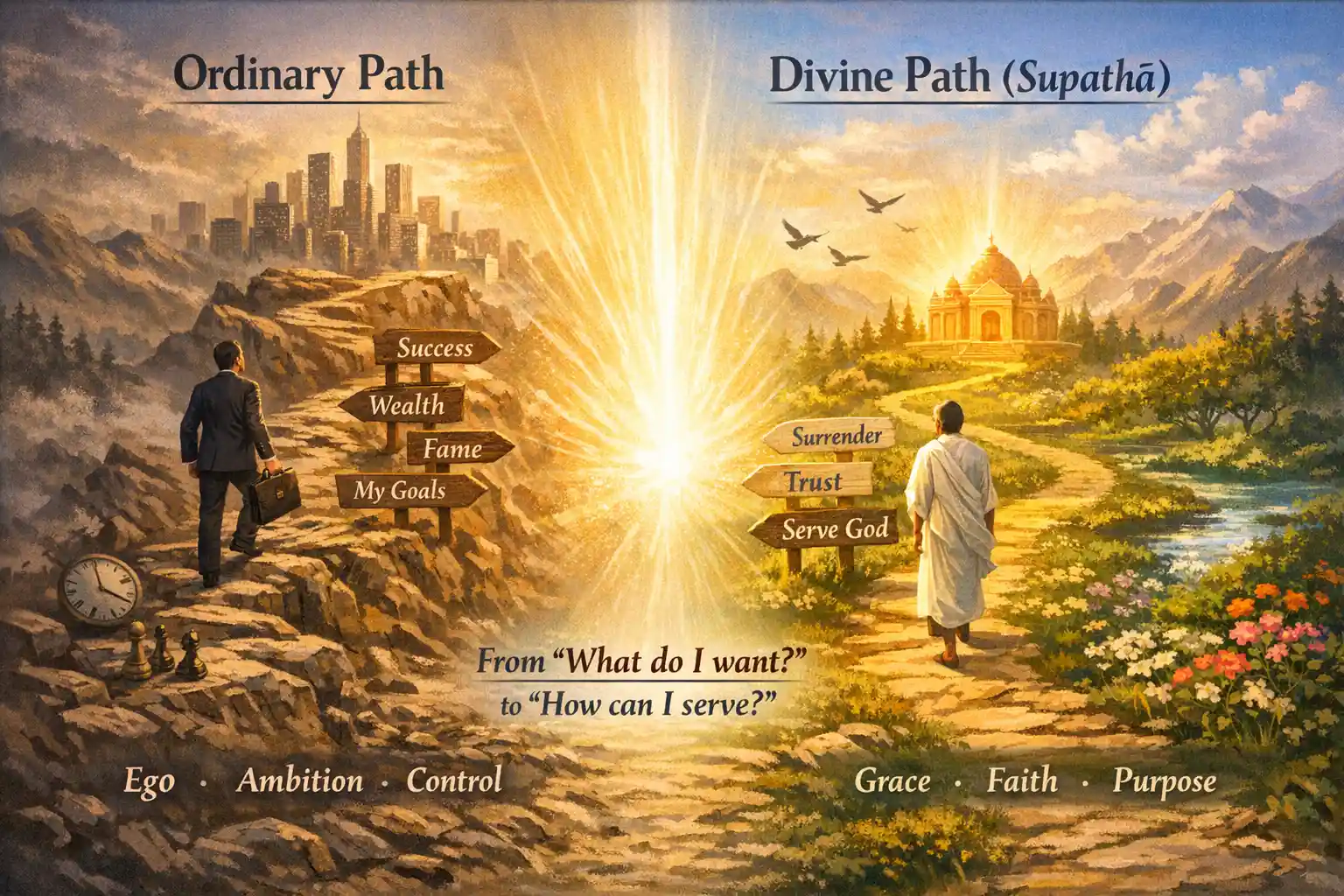
The word supathā means auspicious, correct, and beneficial path.
This reveals a profound insight:
Not every spiritual-looking path leads to God.
From Ordinary Paths to the Divine Path (Supathā)
On the ordinary path of life, progress is usually driven by the ego. We rely heavily on our own effort, intelligence, and planning, believing that success comes primarily from personal control. In contrast, the divine path- supathā- moves through grace. Here, effort is still offered, but it is guided by trust in God rather than by self-assertion.
Ordinary paths are often shaped by self-designed goals: ambitions we create to satisfy identity, achievement, or recognition. The divine path shifts the center completely. Instead of asking, “What do I want to become?” the seeker asks, “How can my life serve God’s purpose?” Direction replaces ambition.
Moral pride can also quietly dominate the ordinary approach. One may take satisfaction in being virtuous, disciplined, or spiritually knowledgeable. On the divine path, however, pride dissolves into humility. The soul recognizes that growth is not earned by superiority, but received through surrender.
Finally, ordinary living is often fragmented: work here, spirituality there, devotion confined to moments rather than woven into life. The divine path integrates everything. Action, intention, and devotion merge into a single offering, where every aspect of life becomes an expression of love and remembrance.
The devotee does not claim to know the way.
He trusts that God knows better.
5. “Rāye”: God as the True Wealth of Life

Rāya means radiant treasure: not material riches, but that which gives lasting fulfillment.
The mantra subtly shifts our understanding of wealth.
Redefining Wealth in Mantra 18
Mantra 18 gently overturns our usual understanding of wealth. In ordinary thinking, wealth is measured by possessions: what we own, accumulate, and protect. The mantra points to a deeper truth: the greatest wealth is not what surrounds us, but the presence of God within our life.
We often equate wealth with security, seeking safety in savings, status, or stable circumstances. Divine wealth, however, offers a different kind of shelter. It is found in devotion, the quiet assurance that comes from trusting God’s care rather than relying solely on external safeguards.
Worldly success is usually defined by achievement, recognition, or influence. Mantra 18 redefines success as loving service. Fulfilment is no longer tied to being admired or accomplished, but to how sincerely one offers actions and intentions to God.
Even longevity, so highly valued in material life, is transformed in meaning. Living longer is not the ultimate goal; eternal connection is. Divine wealth is measured not by the number of years lived, but by the depth of one’s relationship with God, which transcends time itself.
Through this redefinition, Mantra 18 teaches that true wealth does not diminish when shared, does not fade with time, and does not depend on circumstances. It resides in presence, devotion, service, and eternal relationship.
The soul declares:
“You are the treasure I seek, not what You give.”
6. “Yuyodhy Asmat”: Removing Inner Obstacles
The devotee does not blame circumstances.
He asks God to remove inner obstructions: desires, ego, karmic residue, and false identities.
Table 5: Inner Obstacles Identified in Mantra 18
|
Obstacle |
How It Binds |
Divine Resolution |
| Ego | Separates from grace | Humility |
| Desire | Distracts the heart | Contentment |
| Past karma | Repeats patterns | Purification |
| Fear | Paralyzes faith | Trust |
True freedom is not changing the world—but clearing the heart
7. The Shift from “Me” to “Us”: Compassion
Awakens

A remarkable feature of Mantra 18 is the use of plural language asmān (“lead us”).
The devotee no longer prays only for himself.
This reflects spiritual evolution:
As devotion deepens, compassion expands.
Table 6: Growth of Consciousness
|
Stage |
Focus |
Prayer |
| Early seeker | Self | “Help me” |
| Devoted soul | God | “Lead me” |
| Mature devotee | All beings | “Lead us” |
Love naturally grows inclusive.
8. “Nama-uktiṁ”: Repeated Surrender, Not One-Time Faith
The mantra ends with repeated offering:
“Again and again, I bow.”
This teaches that surrender is not a single event, but a living rhythm.
Faith is renewed daily.
Living Mantra 18: Walking the Divine Path in Everyday Life
Mantra 18 of the Īśāvāsya Upaniṣad is not merely a prayer recited at the end of life; it is a way of living. To live this mantra is to consciously step off the ego-driven paths we habitually follow and to walk instead on supathā—the divine, auspicious path guided by God.
1. From Control to Trust
Living Mantra 18 begins with a quiet but profound shift: releasing the illusion of total control. Much of ordinary life is spent managing outcomes—planning, protecting, and predicting. The mantra teaches trust instead. Trust does not mean passivity; it means offering effort without anxiety, action without ownership. One works sincerely, yet leaves the results in divine hands.
In daily life, this shows up as calm amid uncertainty, patience during delay, and steadiness when outcomes differ from expectations.
2. From Self-Centered Goals to God-Centered Direction
Ordinarily, goals arise from personal desire: success, recognition, comfort, identity. Living Mantra 18 gently realigns intention. The guiding question becomes not “What do I want?” but “Where am I being led?”
This shift transforms decision-making. Career, relationships, and responsibilities are approached as opportunities for service rather than platforms for self-assertion. Direction replaces ambition, and meaning replaces restlessness.
3. From Inner Obstacles to Inner Purification
Mantra 18 openly acknowledges inner bondage—ego, desire, fear, and karmic residue. Living the mantra means not denying these forces, but bringing them into the light of prayer and surrender.
Ego softens into humility.
Desire matures into contentment.
Fear dissolves into trust.
Past karma loosens through conscious, devoted action.
Every challenge becomes material for purification rather than a source of guilt or frustration.
4. From Fragmented Living to Integrated Devotion
Often, life is divided: work here, spirituality there; devotion in moments, forgetfulness in motion. Living Mantra 18 unifies life. Action itself becomes prayer when performed with remembrance. Speech becomes offering when guided by truth. Relationships become sacred when infused with compassion.
Nothing is excluded. Ordinary duties are no longer distractions from spiritual life. In fact, they are spiritual life when lived in awareness.
5. From “Lead Me” to “Lead Us”
A subtle but beautiful maturity emerges in Mantra 18: the prayer is not only personal. The seeker asks not merely for individual guidance, but for collective upliftment. Living this mantra naturally expands concern beyond the self—to family, community, and all beings.
Compassion becomes spontaneous. Service becomes joyful. One’s own liberation is no longer separate from the well-being of others.
6. From Fear of Death to Continuity of Trust
Though Mantra 18 is traditionally associated with life’s final moment, living it daily removes fear from that moment altogether. When surrender is practiced every day, death is no longer a rupture, it is a transition within the same trust that guided life.
To live Mantra 18 is to rehearse surrender gently, repeatedly and lovingly until it becomes natural.
In Essence
Living Mantra 18 means:
- Walking with trust rather than anxiety
- Acting with devotion rather than ego
- Serving with love rather than obligation
- Remembering God not occasionally, but continually
It is not a dramatic renunciation of life, but a quiet sanctification of it—where every step, choice, and breath becomes part of the divine path (supathā
Daily Practice Table: Living Mantra 18
|
Life Area |
Old Habit |
Mantra 18 Approach |
Inner Result |
| Decisions | Anxiety | Trust in guidance | Calm clarity |
| Work | Control | Offering effort | Reduced stress |
| Relationships | Possession | Compassion | Harmony |
| Prayer | Asking outcomes | Seeking direction | Stability |
| Challenges | Resistance | Acceptance | Growth |
Deepen Your Learning and Spiritual Practice
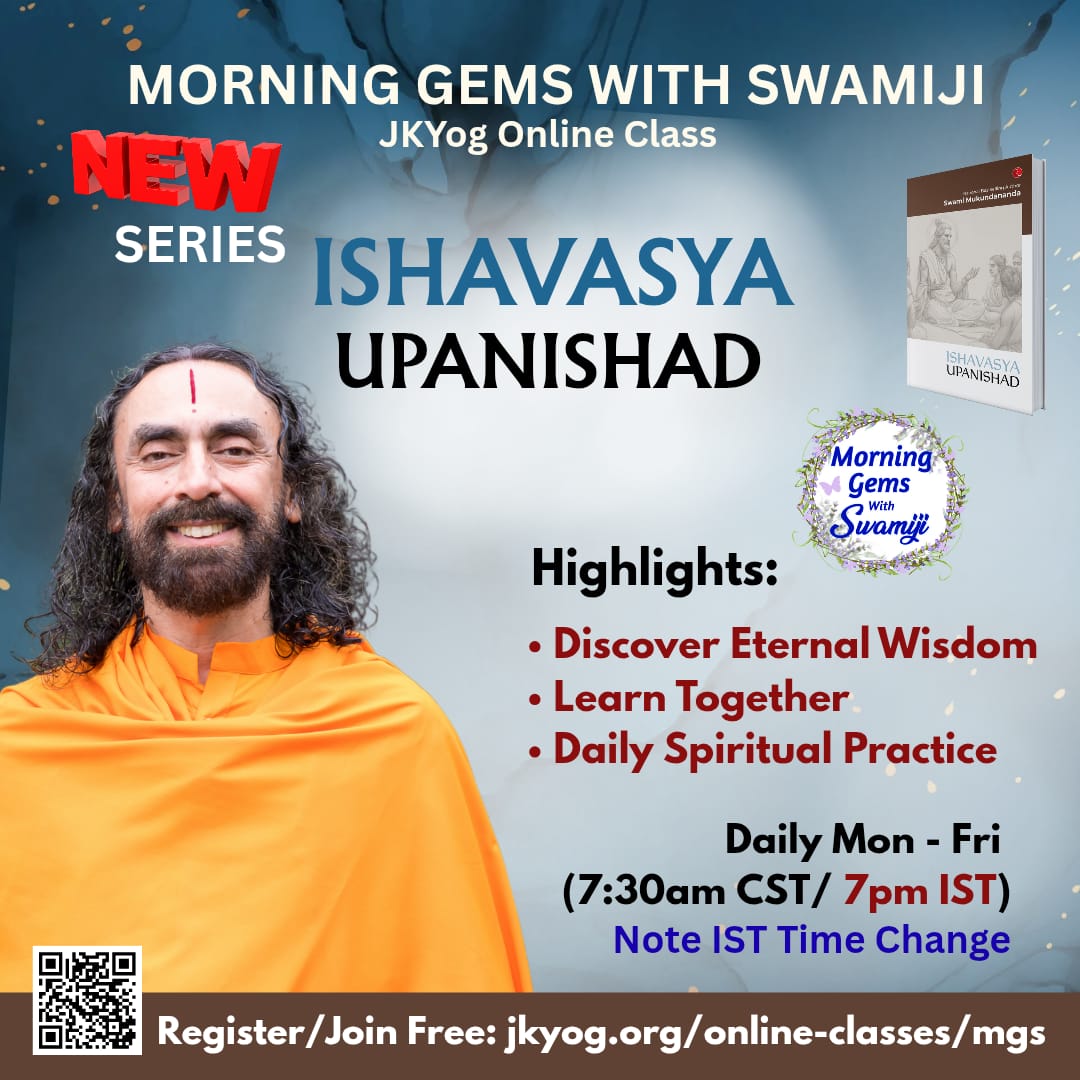
To deepen your understanding of the Ishavasya Upanishad, we highly recommend Swami Mukundananda’s commentary, which beautifully unpacks each mantra, including the Shanti Path, providing a clear and practical guide for modern seekers.
Order the Book: Swami Mukundananda’s Commentary
Unlock the deeper wisdom of the Ishavasya Upanishad with this insightful commentary by Swami Mukundananda. Perfect for modern seekers who wish to explore the divine teachings in greater depth.
Final Reflection: Walking, Not Wandering
Mantra 18 closes the Ishavasya Upanishad not with philosophy, but with movement.
The soul does not stand still.
It walks with trust.
Not alone.
But led.
The Upanishad ends where spiritual life truly begins:
Not in knowing everything, but in walking faithfully on the path shown by God.
Essence of Mantra 18
When surrender becomes trust,
And trust becomes guidance,
Life stops wandering
And begins returning home.
Key Philosophical Insights of Mantra 18
1. Guidance Supersedes Autonomy
Mantra 18 assumes that the human intellect, though valuable, is not self-sufficient. The request “naya supathā rāye” (lead us on the auspicious path) reflects a core Upaniṣadic insight: true freedom is not self-direction, but divine alignment. Liberation is not achieved by asserting independence from God, but by consciously consenting to divine guidance.
2. Karma Is Transcended Through Grace, Not Exhausted by Effort
The mantra acknowledges karmic bondage (juhurāṇam enah), yet does not propose mere moral rectification as the solution. Instead, it invokes divine removal (yuyodhi). Philosophically, this affirms that karma cannot be fully neutralized by action alone. Grace is not optional; it is essential.
3. Knowledge Culminates in Surrender
Earlier Upaniṣadic inquiry emphasizes knowledge (vidyā), but Mantra 18 reveals its culmination. The knower (vidvān) does not remain an observer; knowledge ripens into namoktiṁ, a reverent offering. Thus, the mantra resolves the tension between knowledge and devotion by showing that true knowledge ends in humility and surrender.
4. Liberation Is Relational, Not Isolated
The prayer is collective (asmān), not solitary. This expresses a profound metaphysical claim: liberation is not an isolated event of the ego, but a relational movement toward God. The self does not dissolve into abstraction; it advances toward a conscious, guiding divine presence (deva).
5. The Divine Is Both Transcendent and Immanent
Addressing God as Agni is not merely symbolic. Fire is immanent—present within—and yet points upward. The mantra philosophically bridges transcendence and immanence: God is not distant from action, nor confined to ritual, but actively guiding the soul from within life itself.
6. Ethical Purity Alone Is Insufficient Without Inner Transformation
The terms enah (impurity) and juhurāṇam (binding acts) indicate that even virtuous actions can bind if performed with ego or desire. This insight challenges moral absolutism and asserts that inner orientation, not outer correctness, determines liberation.
7. The Auspicious Path (Supathā) Is Singular
By asking to be led on supathā, the mantra implies that not all “good” paths lead to liberation. Philosophically, this affirms discernment (viveka): there are many paths of action, but only one path aligned with divine realization. The divine path integrates knowledge, action, and devotion.
8. Devotion Is an Ontological Act, Not Mere Emotion
Namoktiṁ vidhema is not a sentiment; it is an existential posture. To offer reverence is to reorient one’s being toward God. Thus, devotion is presented not as feeling-based religiosity, but as a mode of existence.
9. Fear Is Overcome by Orientation, Not Avoidance
The mantra does not deny obstacles; it asks for guidance through them. This implies a subtle metaphysical claim: fear dissolves not by escaping life, but by walking it under divine direction. Trust replaces anxiety through orientation, not insulation
10. Death Is the Final Act of Trust, Not a Philosophical Problem
Though placed at life’s end, Mantra 18 reframes death philosophically. Death is not something to be explained, solved, or conquered—it is something to be entrusted. The same divine guidance sought in life is sought at death, making liberation a continuity, not a rupture.
In Summary
Mantra 18 teaches that:
- Knowledge matures into surrender
- Karma yields to grace
- Autonomy gives way to alignment
- Action becomes devotion
- Life and death share a single guiding principle
To live Mantra 18 is to walk knowingly, act humbly, and trust completely.
Frequently Asked Questions (FAQs) – Mantra 18
1. Is Mantra 18 meant only for the moment of death?
No.
Although Mantra 18 is traditionally recited at the end of life, its essence applies to every stage of living. The mantra teaches surrender, trust, and divine guidance, which are all qualities meant to be practiced daily. When lived continuously, the final moment becomes a natural continuation of a life already aligned with God.
2. Why does Mantra 18 ask for guidance instead of liberation directly?
Mantra 18 recognizes that liberation is a consequence, not a demand. By asking God to lead the soul on the auspicious path (supathā), the seeker aligns with the process that naturally culminates in liberation. Guidance purifies intention, corrects direction, and dissolves ego, thereby making Divine love possible. Liberation pales when compared to Divine Love.
3. What does “removing sins” mean in Mantra 18?
The mantra refers not only to moral wrongdoing, but to all actions and tendencies that bind the soul, including ego-driven or attachment-filled acts. Even virtuous actions can bind if performed with pride. The prayer asks for divine removal of these inner obstacles through grace, not mere self-effort.
4. How is Mantra 18 different from asking God for favors or outcomes?
Mantra 18 does not ask for success, protection, or rewards. Instead, it asks for direction. This marks a mature spiritual shift, from seeking outcomes to seeking alignment. The focus is on walking rightly, not on controlling where the path ends.
5. What does Mantra 18 teach about the relationship between effort and grace?
Mantra 18 harmonizes effort and grace. Human effort is offered sincerely, but without ownership or anxiety. Grace is what transforms effort into Divine Love. The mantra teaches that effort prepares the soul, while grace completes the journey.
.
.
.
.
.