(Seventeenth Part of the 19-Part Blog Series on the Ishavasya Upanishad)
Introduction
Mantra 16 of the Ishavasya Upanishad is among the most intimate and devotionally charged prayers in the Upanishadic canon. Rather than presenting abstract metaphysics alone, it opens a window into the heart of a realized seeker who longs not merely for liberation, but for darśana: the direct vision of the Supreme’s most auspicious personal form.
This mantra stands at the threshold where jñāna (knowledge), bhakti (devotion), and tattva (philosophical truth) converge. The seeker addresses the Supreme with multiple sacred names such as Pūṣhan, Aekarṣhi, Yama, Sūrya, and Prājāpatya, each revealing a distinct divine function. What appears, on the surface, as a prayer to cosmic deities is in fact a profound appeal to the Supreme Brahman Himself, requesting that the dazzling veil of impersonal effulgence be withdrawn so that the personal, blissful form of God may be seen.
Far from being “a dying man’s prayer,” as some have suggested, this mantra is the mature culmination of spiritual realization. It affirms a central Upaniṣadic truth: the soul is simultaneously one with and different from God, united in essence yet distinct in identity, finding fulfillment not in dissolution but in loving service.
Mantra: Verse in Sanskrit, Transliteration, and Translation
Sanskrit (Devanāgarī)
पूषन्नेकर्षे यम सूर्य प्राजापत्य व्यूह रश्मीन् समूहर् तेजः ।
यत्ते रूपं कल्याणतमं तत्ते पश्यामि योऽसावसौ पुरुषः सोऽहमस्मि ॥ १६॥
Word-by-Word Meaning
- pūṣhan—nourisher of devotional sentiments
- aekarṣhe— highest rishi, knower of the Vedas
- yama—regulator
- sūrya—sun, inspirer of the souls
- prājāpatya—the giver of joy to Brahma
- vyūha—please remove
- raśhmīn—brilliant rays
- samūha—please withdraw
- tejaḥ—divine effulgence
- yat—so that
- te—your
- rūpam—form
- kalyāṇa-tamam—most auspicious
- tat—that
- te—your
- paśhyāmi—I may see
- yaḥ—one who is
- asau—like the sun
- asau—that
- puruṣhaḥ—Supreme Personality
- saḥ—myself
- aham—I
- asmi—am
Transliteration
pūṣhannaekarṣhe yama sūrya prājāpatya vyūha raśhmīn samūha tejo
yatte rūpam kalyāṇatamam tatte paśhyāmi yo ’sāvasau puruṣhaḥ so ’hamasmi
Translation
O Nourisher of devotional sentiments! O Supreme Knower of the Vedas! O Regulator of all! O Inspirer of the souls! O Giver of joy to Brahma! Please remove these brilliant rays and withdraw this divine effulgence, so that I may behold the vision of Your most auspicious Form. Being a fragmental part of the Supreme, I am one with You.
1. Pūṣhan: The Divine Nourisher of Devotion
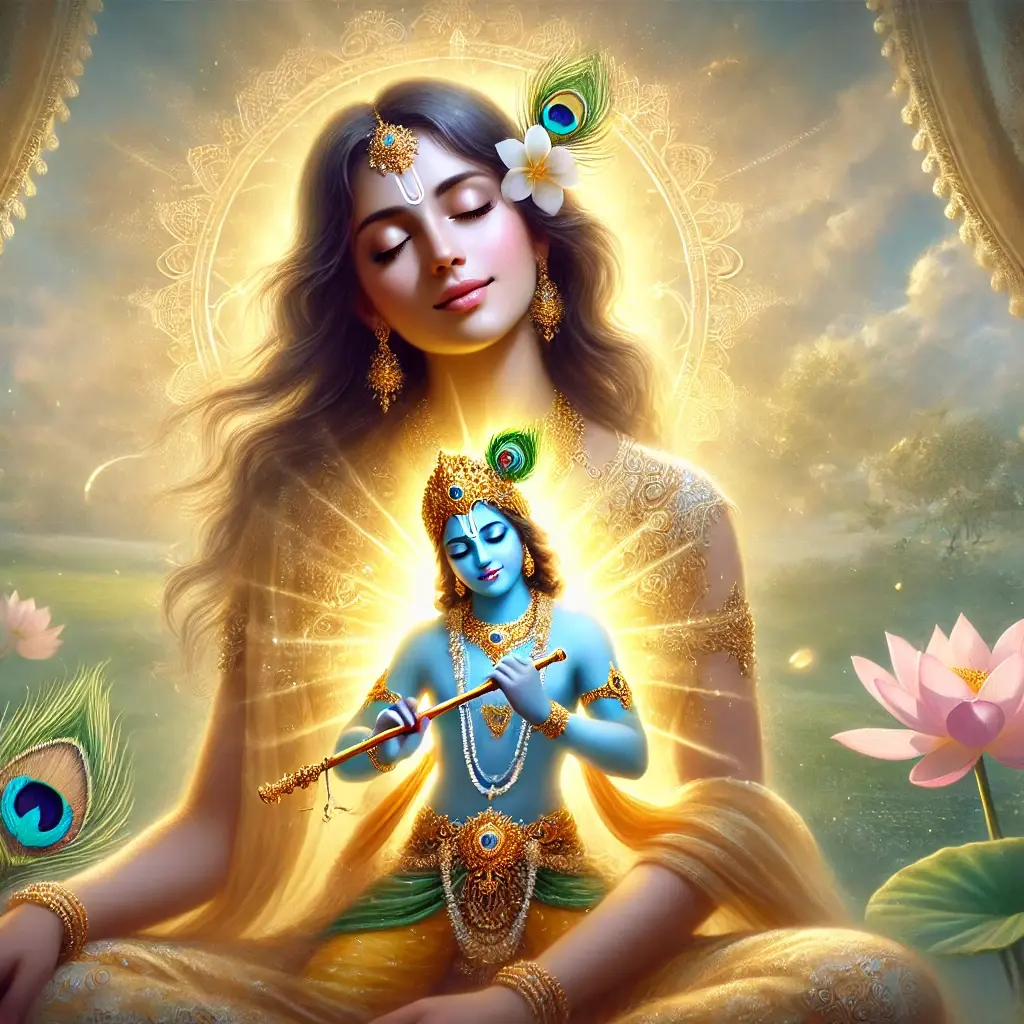
The name Pūṣhan arises from the root pūṣh, which means to nourish, sustain, or enrich. While materially it refers to that which nourishes vegetation and life, in this mantra it reveals God as the nourisher of devotional rasa.
God nourishes devotion in two complementary ways:
- Madhu-svabhāva – As the ocean of bliss, He pours divine nectar directly into the hearts of His purified devotees.
- Madhukar-svabhāva – Like a bee tasting honey, He Himself relishes the sweetness of the devotee’s love while residing within their heart.
Thus, devotion is not one-sided. The devotee tastes divine bliss, and God tastes the devotee’s love. This mutual nourishment is the essence of bhakti.
| Term | Literal Meaning | Spiritual Meaning |
|---|---|---|
| Pūṣhan | Nourisher | God who nourishes devotion |
| Madhu-svabhāva | Nectar-nature | God bestows bliss to devotees |
| Madhukar-svabhāva | Bee-like nature | God relishes devotee’s love |
2. Aekarṣhi: The Sole Knower of All Mantras
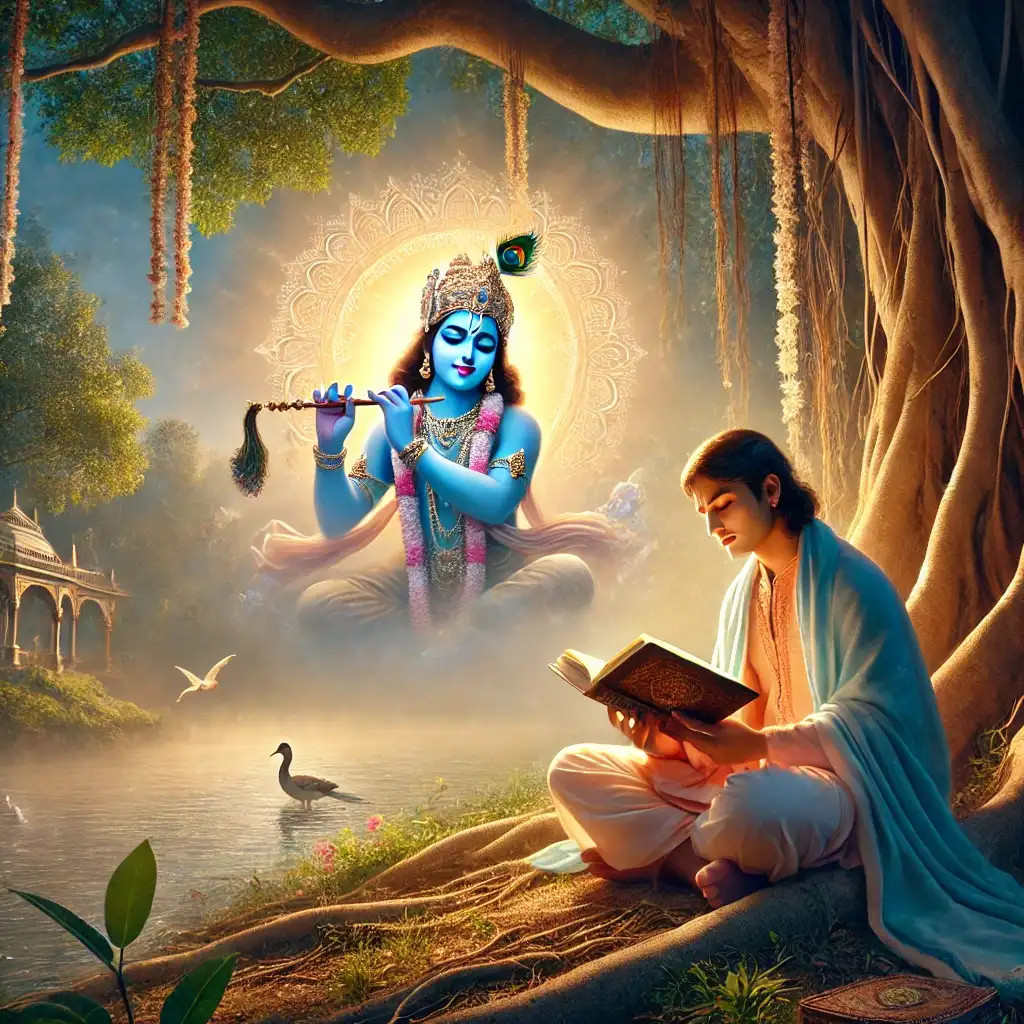
Aekarṣhi means “the one and only ṛṣhi.” A ṛṣhi is not merely a scholar, but one who has realized the truth of a mantra in lived experience.
While each Vedic mantra has a seer who realized it, no individual sage comprehends all Vedic knowledge in totality. Only God knows the Vedas completely with past, present, and future meanings alike. Hence, He alone is Aekarṣhi, the supreme and singular seer.
This reminds seekers that scriptural mastery without divine grace remains partial. Ultimate understanding flows from God Himself.
| Aspect | Description |
|---|---|
| Ṛṣhi | Seer with realized knowledge |
| Aekarṣhi | God as the only complete knower |
| Implication | True wisdom depends on divine grace |
3. Yama: The Supreme Regulator and Liberator
Derived from yamu bandhane which means to bind or regulate, Yama here transcends the popular notion of the god of death.
God is called Yama for three reasons:
- Ātyantika-mṛtyu – At realization, God appears as the “final death,” liberating the soul forever from rebirth.
- Cosmic Control – Creation, maintenance, and dissolution operate entirely under His will.
- Karmic Governance – As the indwelling Lord, He assigns each soul a body according to karma and qualities.
Thus, God is the greatest controller; not as a punisher, but as the ultimate liberator and well-wisher of the soul.
| Function | Meaning |
|---|---|
| Ātyantika-mṛtyu | Final liberation from rebirth |
| Cosmic control | Creation and dissolution |
| Karmic regulation | Assignment of bodies to souls |
4. Prājāpatya: Beloved of Brahmā and Indweller of All Beings
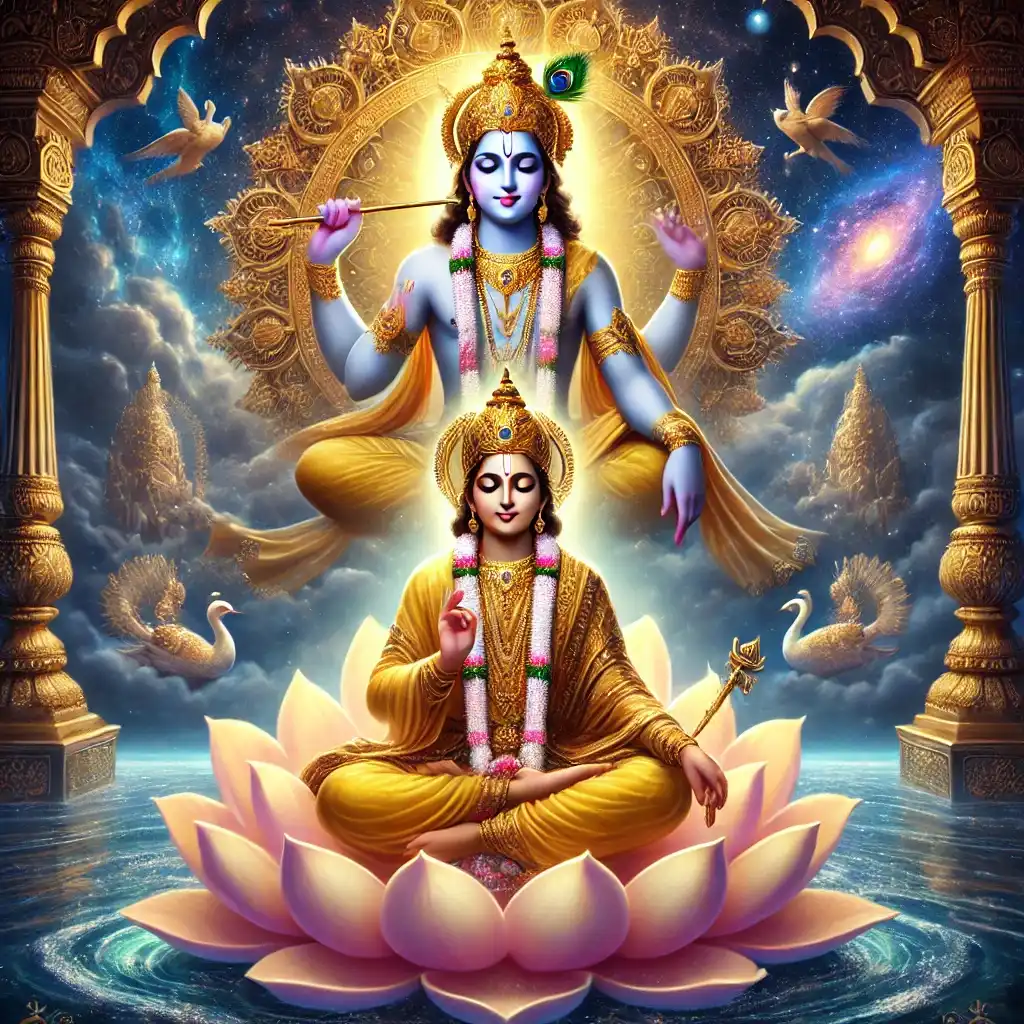
Prājāpatya connects God to Prajāpati Brahmā, the first created being.
It carries three layered meanings:
- Beloved of Brahmā – God is deeply loved by Brahmā, who eternally meditates upon Him.
- Bestower of Bliss – God grants divine joy to Brahmā, and the devotee longs for the same grace.
- Indwelling Lord – God resides within all living beings as their inner master.
The prayer becomes intensely personal: “As You give bliss to Brahmā, please give that same bliss to me.”
| Meaning | Explanation |
|---|---|
| Beloved of Brahmā | Object of Brahmā’s devotion |
| Bestower of bliss | Source of divine joy |
| Indwelling Lord | Resides in all beings |
5. Sūrya: The Inspirer of All Action

Sūrya is derived from the root meaning “to inspire movement.” Just as the physical sun awakens the world daily, God awakens consciousness within all beings.
By His power, the mind thinks, the senses function, and the intellect discriminates. The devotee prays that the same radiant Lord who inspires worldly action may now inspire divine service—and remove the blinding effulgence that hides His personal form.
| Symbol | Spiritual Meaning |
|---|---|
| Physical sun | Source of energy |
| Divine Sūrya | Source of consciousness |
| Devotional plea | Remove veil, reveal form |
Applications of the Verse in Daily Life
Mantra 16 of the Ishavasya Upanishad is not only a metaphysical prayer but a living guide for conscious, devotional living. Its applications extend across inner spirituality, relationships, work life, and existential understanding.
1. Removing the “Veils” in Everyday Consciousness
The devotee asks God to withdraw His blinding effulgence so the personal form may be revealed. In daily life, this translates into recognizing and removing inner veils:
- Ego, pride, and self-importance
- Over-identification with intellect or achievements
- Attachment to appearances rather than essence
Just as divine light can obscure divine form, excess brilliance in the material world such as status, knowledge, wealth, can conceal deeper truth. The mantra encourages us to seek what lies behind surface luminosity.
Practical reflection:
Before reacting or judging, pause and ask: “What deeper truth is hidden beneath what I am seeing?”
2. Transforming Work into Inspired Action (Sūrya Principle)
The invocation of Sūrya reminds us that all activity is powered by divine inspiration. Instead of viewing work as mechanical or burdensome, the mantra invites a shift:
- From doing for results → doing as service
- From exhaustion → inspiration
- From ego-driven action → God-empowered effort
When we acknowledge God as the inner inspirer, even routine actions become sacred.
Daily application:
Begin the day with a brief inward offering: “May today’s actions be inspired by You and offered to You.”
3. Accepting Regulation Without Resentment (Yama Principle)
Life often feels restrictive with deadlines, responsibilities, aging, loss. Seeing God as Yama reframes regulation as divine order rather than punishment.
- Limits shape growth
- Consequences educate consciousness
- Discipline refines awareness
This understanding reduces resistance and cultivates surrender.
Inner shift:
Instead of asking “Why is this happening to me?”, ask “What is being refined in me through this?”
4. Nourishing Emotional and Spiritual Health (Pūṣhan Principle)
Modern life often starves the soul while feeding the senses. Pūṣhan teaches that true nourishment is emotional, spiritual, and relational.
Devotion nourishes by:
- Creating inner sweetness independent of circumstances
- Healing emotional fragmentation
- Offering joy that is not externally dependent
This is especially relevant in times of anxiety, burnout, and loneliness.
Practical nourishment:
Daily remembrance, chanting, gratitude, or quiet prayer acts as spiritual nutrition.
5. Living in Loving Relationship, Not Isolation
The declaration so ’hamasmi affirms unity, but not isolation. The mantra shows that true unity expresses itself through relationship, not withdrawal.
In practical life, this means:
- Valuing connection over detachment
- Serving others as expressions of divine presence
- Seeing relationships as spiritual classrooms
Liberation does not mean disengaging from life, but engaging with deeper love and awareness.
Key Philosophical Insights
Mantra 16 condenses some of the most subtle and reconciliatory ideas of Vedānta. Its insights resolve apparent contradictions between unity and devotion, knowledge and love.
1. Unity Does Not Cancel Individuality
The statement so ’hamasmi has often been misunderstood as absolute identity with God. The Upaniṣadic context clarifies that:
- Unity is ontological (same spiritual nature)
- Difference is functional and relational
Just as a sunray shares the sun’s nature but not its magnitude, the soul shares God’s essence without becoming God.
This resolves the tension between Advaita and Bhakti by showing that identity and devotion coexist.
2. The Supreme Is Knowable, Lovable, and Relational
The prayer does not seek abstract realization alone but darśana—a loving vision. This reveals a profound Upaniṣadic stance:
- Truth is not only to be known
- Truth is to be encountered
God is not merely consciousness, but conscious of the devotee.
3. Divine Effulgence Is Not the Final Reality
The mantra boldly suggests that divine light (brahmajyoti) is not the highest truth but a covering over the personal form.
This overturns the assumption that impersonal realization is superior, presenting instead a hierarchy:
- Material perception
- Impersonal spiritual light
- Personal divine form and relationship
The highest fulfillment lies not in dissolution, but in loving communion.
4. Liberation Is Relational, Not Terminal
Liberation (mokṣa) is often imagined as an end-state. This mantra reframes it as a beginning:
- Beginning of vision
- Beginning of service
- Beginning of eternal participation in divine līlā
Freedom from rebirth is not emptiness—it is meaningful engagement.
5. Grace Is the Final Key
Repeatedly, the mantra implies that vision comes only when God chooses to reveal Himself. Effort prepares the heart, but grace opens the eyes.
This insight protects the seeker from:
- Spiritual arrogance
- Dry intellectualism
- Mechanical practice
True realization is both earned through sincerity and gifted through compassion.
Deepen Your Learning and Spiritual Practice
Now that we’ve explored the divine wisdom of the Shanti Path Mantra, it’s time to take the next step on your spiritual journey. To deepen your understanding of the Ishavasya Upanishad, we highly recommend Swami Mukundananda’s commentary, which beautifully unpacks each mantra, including the Shanti Path, providing a clear and practical guide for modern seekers.
Order the Book: Swami Mukundananda’s Commentary
Unlock the deeper wisdom of the Ishavasya Upanishad with this insightful commentary by Swami Mukundananda. Perfect for modern seekers who wish to explore the divine teachings in greater depth.
Final Reflections
Mantra 16 of the Ishavasya Upanishad stands as a luminous synthesis of Vedānta and bhakti. It teaches that the ultimate truth is not an impersonal abstraction but a loving, conscious Supreme Person who reciprocates devotion. The seeker does not vanish into God; rather, they awaken into relationship with Him.
By praying for the removal of the dazzling veil, the mantra invites us to seek depth over dazzle, love over luminosity, and service over self-absorption. In doing so, it offers not just liberation, but fulfillment.
FAQs
1. If the soul is one with God, why continue worship?
Because unity is essential, not positional.
The soul shares God’s spiritual nature but not His supreme status. Worship is not contradiction, it is the natural expression of love between the finite and the Infinite.
2. Why is divine light described as an obstacle?
Not because it is impure, but because it is incomplete.
Light reveals existence; form reveals relationship. The devotee seeks not mere awareness, but loving encounter.
3. Does this mantra reject non-dual philosophy?
No. It transcends and includes it.
It accepts non-dual essence while affirming duality of love. This is why multiple Vedāntic schools could embrace this mantra without contradiction.
4. How can modern seekers relate to such devotional language?
The language is symbolic, but the experience is universal:
- Longing for meaning
- Desire for connection
- Search for joy beyond material success
When stripped of cultural packaging, the mantra speaks directly to the human heart.
5. Is this mantra meant only for renunciates or mystics?
Absolutely not.
Its message applies equally to:
- Professionals seeking purpose
- Families seeking harmony
- Individuals seeking inner fulfillment
Devotion is not a lifestyle choice, it is a conscious orientation of the heart.