(Fifteenth Part of the 19-Part Blog Series on the Ishavasya Upanishad)
Introduction
The Ishavasya Upanishad stands as one of the most concise yet profound Upanishads, offering timeless spiritual guidance in merely eighteen mantras. Among these, Mantra 14 presents a masterful synthesis of spiritual wisdom and practical living. It addresses a dilemma that humanity has struggled with for millennia:
How can one live fully in the world without being trapped by it, and at the same time attain eternal spiritual bliss?
Rather than advocating escapism or indulgence, this mantra prescribes a balanced, integrated approach, one that combines detachment from the temporary world with loving devotion to the eternal Supreme. It teaches us how to cross the ocean of mortality while still performing our worldly responsibilities with grace, clarity, and purpose.
Mantra: Sanskrit, Transliteration, and Translation
Sanskrit Verse (Mantra 14)
सम्भूतिं च विनाशं च यस्तद्वेदोभयं सह ।
विनाशेन मृत्युम् तीर्त्वा सम्भूत्याऽमृतमश्नुते ॥ १४॥
Transliteration
sambhūtiṁ cha vināśhaṁ cha yastad vedobhayaṁ saha
vināśhena mṛityum tīrtvā sambhūtyā ’mṛitam aśhnute
Word-by-Word Meaning
- sambhūtim – the eternal God
- vināśham – the temporary world
- yaḥ – one who
- veda – truly understands
- ubhayam saha – both simultaneously
- vināśhena – through proper engagement with the perishable
- mṛityum tīrtvā – crossing over death
- sambhūtyā – through devotion to God
- amṛitam aśhnute – attains immortality
Translation
Learn to simultaneously engage in devotion to the eternal God, while judiciously using the temporary world. The proper use of the world will help you cross over the material realm of death, while devotion to the Supreme will bestow the bliss of the eternal realm.
1. Vināśham: Understanding the Temporary Nature of the World

The mantra deliberately uses the word vināśham (destructible) instead of asambhūti, used earlier in the Upanishad. While both refer to the material realm, vināśham emphasizes impermanence and inevitable destruction.
Shree Krishna confirms this truth in the Bhagavad Gita: BG 2.16: Of the transient there is no endurance, and of the eternal there is no cessation. This has verily been observed and concluded by the seers of the Truth, after studying the nature of both.
Everything in the world: relationships, possessions and identities, exist only for a limited time. Recognizing this truth is not pessimism; it is spiritual realism.
| Term | Meaning | Philosophical Insight |
|---|---|---|
| Vināśham | Destructible | Everything created must perish |
| Asambhūti | Created existence | Emphasizes origination |
| Mṛityu | Death | Result of attachment to the temporary |
2. The Traveler and the Hotel: Detachment Without Neglect

Saints often describe worldly life as a temporary lodging. Just as a traveler tolerates minor discomforts in a hotel, knowing the stay is brief, we too should treat worldly circumstances with calm detachment.
Jagadguru Kripaluji Maharaj beautifully expresses this sentiment in Radha Govind Geet:
“Live in the world like a traveler in a rest house.”
Detachment does not mean irresponsibility. It means freedom from mental clinging.
| Aspect | Attached Mind | Detached Mind |
|---|---|---|
| Relationships | Anxiety & fear | Calm duty |
| Possessions | Ownership obsession | Temporary use |
| Outcomes | Stress | Equanimity |
3. Duty Without Attachment: The Key to Inner Peace

A powerful illustration from the text explains how it is attachment and not duty which creates anxiety. A teacher can care for dozens of students without stress, yet feel overwhelmed by concern for her own children.
The difference lies in emotional clinging, not responsibility.
Similarly, a nurse serves patients diligently but remains mentally balanced whether a patient recovers or dies. The Upanishad encourages this same professional detachment infused with compassion.
| Concept | With Attachment | Without Attachment |
|---|---|---|
| Duty | Fear-driven | Clarity-driven |
| Mind State | Agitated | Stable |
| Effectiveness | Reduced | Enhanced |
4. Detachment Alone Is Not Enough
Stopping wrong movement does not mean reaching the destination. Detachment merely halts our misguided search for happiness in the world. To attain bliss, we must redirect the mind toward God.
The Ramcharitmanas states:
“Without surrender to Bhagavan Ram, eternal bliss cannot be attained.”
This is where sambhūti upāsanā: devotion to the eternal, becomes essential.
| Practice | Result | Limitation |
|---|---|---|
| Detachment | Stops suffering | No bliss |
| Devotion | Grants bliss | Requires surrender |
5. Karm Yog: Mind in God, Body in the World

The mantra culminates in the practice of Karm Yog; working in the world while keeping the mind absorbed in God.
Yoga means union, and karm yog is the union of action and remembrance. Shree Krishna instructs in the Bhagavad Gita BG 8.7: Therefore, always remember Me and also do your duty of fighting the war. With mind and intellect surrendered to Me, you will definitely attain Me; of this, there is no doubt.
When the awareness “God is with me” becomes continuous, every action transforms into worship.
| Component | Role | Outcome |
|---|---|---|
| Mind | Absorbed in God | Inner joy |
| Body | Performs duty | Outer efficiency |
| Life | Offering to God | Immortality |
Applications of the Verse in Daily Life
Mantra 14 of the Ishavasya Upanishad is not a doctrine meant only for monks or philosophers. It is a manual for conscious living, designed for people who are immersed in family life, professional responsibilities, and social engagement.
Below are key ways this mantra can be applied in everyday life.
1. Living in the World Without Emotional Enslavement
Most human suffering arises not from circumstances themselves, but from mental entanglement with circumstances. The mantra teaches us to recognize the world as vināśham (temporary) and thereby avoid giving it absolute emotional authority over our inner state.
In daily life, this means:
- Enjoy success without arrogance
- Face failure without despair
- Experience pleasure without addiction
- Endure difficulty without resentment
When we remember that every situation is transient, we gain psychological spaciousness. This does not reduce engagement; rather, it prevents burnout, bitterness, and emotional collapse.
The mantra thus trains us to participate fully but cling lightly.
2. Transforming Family Life Through Detached Love
Family relationships are often the deepest sources of both joy and anxiety. The Upanishad does not instruct us to withdraw from them, but to refine the quality of our involvement.
Applying this mantra at home means:
- Caring deeply, without possessiveness
- Advising wisely, without controlling outcomes
- Supporting loved ones, without losing inner balance
Detached love does not weaken bonds but purifies them. It replaces fear-based attachment with trust, patience, and emotional maturity. Parents become guides rather than controllers; partners become companions rather than emotional crutches.
Such relationships are calmer, more respectful, and spiritually uplifting.
3. Reducing Stress and Anxiety in Professional Life
Modern professional life is dominated by pressure, competition, deadlines, and uncertainty. The mantra offers a powerful antidote by reframing work through the lens of karm yog.
Practically applied, this means:
- Performing duties sincerely, without obsession over results
- Viewing work as service rather than ego-validation
- Accepting outcomes as part of a larger divine order
When the mind is detached from constant anticipation and fear, efficiency improves naturally. Decisions become clearer, communication becomes calmer, and stress loses its grip.
Thus, the mantra helps us work harder without being consumed by work.
4. Cultivating Emotional Stability in Uncertain Times
Life inevitably brings change in the forms of loss, illness, aging, separation, and unpredictability. Those who assume permanence are shaken deeply when change arrives.
The mantra prepares us in advance by training the mind to see impermanence as natural rather than tragic.
In daily application:
- Grief becomes acceptance rather than collapse
- Fear becomes preparedness rather than panic
- Change becomes transition rather than trauma
This does not eliminate emotions; it stabilizes them. The heart remains sensitive, but the mind remains grounded. Such emotional resilience is one of the greatest gifts of Upanishadic wisdom.
5. Turning Ordinary Actions into Spiritual Practice
One of the most practical teachings of this mantra is that spirituality does not require separate activities. When the mind is aligned with God, every action becomes sacred.
Daily actions such as cooking, working, cleaning, driving and teaching, can all be performed as offerings when accompanied by inner remembrance.
This application involves:
- Beginning tasks with a conscious intention
- Remembering the Divine presence during action
- Offering results mentally to God
Over time, this transforms life itself into continuous worship, dissolving the artificial divide between “spiritual” and “worldly” life.
6. Developing Inner Freedom Without External Renunciation
Many people believe spiritual growth requires drastic external changes. Mantra 14 gently corrects this misconception. What must be renounced is not the world, but bondage to the world.
Applied practically:
- One may live amidst wealth without greed
- Hold authority without ego
- Enjoy comfort without dependency
This inner renunciation creates freedom without upheaval. Life continues outwardly as before, but inwardly it becomes lighter, clearer, and more joyful.
7. Reorienting the Search for Happiness
The mantra exposes a subtle but universal mistake: seeking lasting happiness in what is by nature temporary. Recognizing this redirects our energy.
In daily life, this means:
- Using worldly success as support, not identity
- Enjoying relationships as gifts, not guarantees
- Seeking fulfillment through connection with the eternal
When happiness is rooted in sambhūti, the eternal, life gains a stable center. External events lose the power to define our worth or peace.
8. Integrating Spiritual Awareness into Modern Living
Perhaps the most relevant application today is the mantra’s compatibility with modern life. It does not demand withdrawal from technology, society, or ambition. It demands awareness.
A modern seeker can:
- Use technology without addiction
- Pursue goals without losing inner balance
- Live socially without spiritual dilution
This integration makes the mantra timeless. It remains as applicable in a corporate office as in a forest hermitage.
9. Preparing for Life’s Final Transition
Finally, the mantra subtly prepares us for the ultimate impermanence—death. By practicing detachment daily and cultivating devotion steadily, the fear of death diminishes.
Life becomes a gradual preparation, not a sudden reckoning.
When death arrives:
- The detached mind is not shocked
- The devoted heart is not empty
- Consciousness naturally flows toward the eternal
Thus, daily application of this mantra ensures that both life and death are lived with dignity and peace.
Key Philosophical Insights
1. The World Is Temporary (Asat), Not Illusory (Mithyā)
One of the most subtle yet crucial philosophical clarifications in Mantra 14 is the distinction between temporariness and illusion. The Ishavasya Upanishad does not declare the world to be false or unreal. In fact, its opening mantra explicitly states that the world is pervaded by God, which automatically rules out the idea that it is mere illusion.
However, the world is described as vināśham: that which is destined for destruction. This means the world is asat, or temporary. Temporariness does not negate usefulness. A bridge that helps us cross a river is temporary, yet invaluable. Similarly, the world serves as a field of spiritual evolution, not a permanent home.
This insight saves the seeker from two extremes:
- Worldly materialism, which assumes permanence where there is none
- World-denial, which rejects creation as meaningless
The Upanishadic middle path recognizes the world as real but fleeting, valuable but not ultimate.
2. Detachment Is Psychological Freedom, Not Physical Withdrawal
Detachment, as taught in this mantra, is entirely internal. It does not require abandoning family, profession, or society. Instead, it asks us to relinquish the emotional clinging of the mind.
Attachment binds the mind to outcomes, expectations, and fear of loss. Detachment liberates the mind while allowing action to continue unhindered. This is why the mantra insists that one must know both sambhūti and vināśham simultaneously.
When detachment is misunderstood as withdrawal, people fear it will lead to coldness or irresponsibility. The opposite is true. A detached mind performs duties with greater clarity, patience, and efficiency, because it is not distorted by anxiety or possessiveness.
Thus, detachment is not renunciation of action, it is renunciation of inner dependence.
3. Duty Performed Without Attachment Is the Highest Ethics
A profound ethical implication of this mantra is that true responsibility does not require emotional bondage. In fact, attachment often weakens responsibility by clouding judgment.
When the mind clings excessively:
- Fear replaces wisdom
- Anxiety replaces care
- Control replaces love
The examples of the teacher and the nurse illustrate this truth beautifully. When we act from duty rather than attachment, we serve others more effectively and with less inner turmoil.
This insight elevates daily life into a spiritual discipline. Parenting, teaching, healing, leading, and serving become sacred acts when performed with detachment and devotion.
4. Detachment Stops Suffering, but Devotion Grants Bliss
One of the most important philosophical contributions of this mantra is its clarity that detachment alone is insufficient for attaining the highest spiritual goal.
Detachment removes suffering by stopping our misguided attempt to extract lasting happiness from temporary objects. However, it does not automatically bestow joy. It merely creates inner stillness.
To fill that stillness with bliss, the mind must be positively engaged in loving devotion to the Supreme (sambhūti upāsanā). Without devotion, detachment risks becoming dry, void, or inert.
Thus, the Upanishad teaches a two-step spiritual movement:
- Withdraw misplaced love from the world
- Redirect that love toward God
5. Karm Yog Is the Practical Synthesis of Action and God-Remembrance
The philosophy of Mantra 14 finds its most practical expression in karm yog. This is not a new action, but a new inner orientation.
Everyone works. The difference between ordinary work and karm yog lies in where the mind resides while the body acts.
In karm yog:
- The body functions in the world
- The mind remains absorbed in God
This transforms every action—professional, domestic, or social—into worship. Life itself becomes a continuous offering.
The mantra assures that such a life leads to two results simultaneously:
- Freedom from death-bound consciousness
- Attainment of eternal, divine bliss
This is the spiritual genius of the Ishavasya Upanishad: integration, not division.
Deepen Your Learning and Spiritual Practice
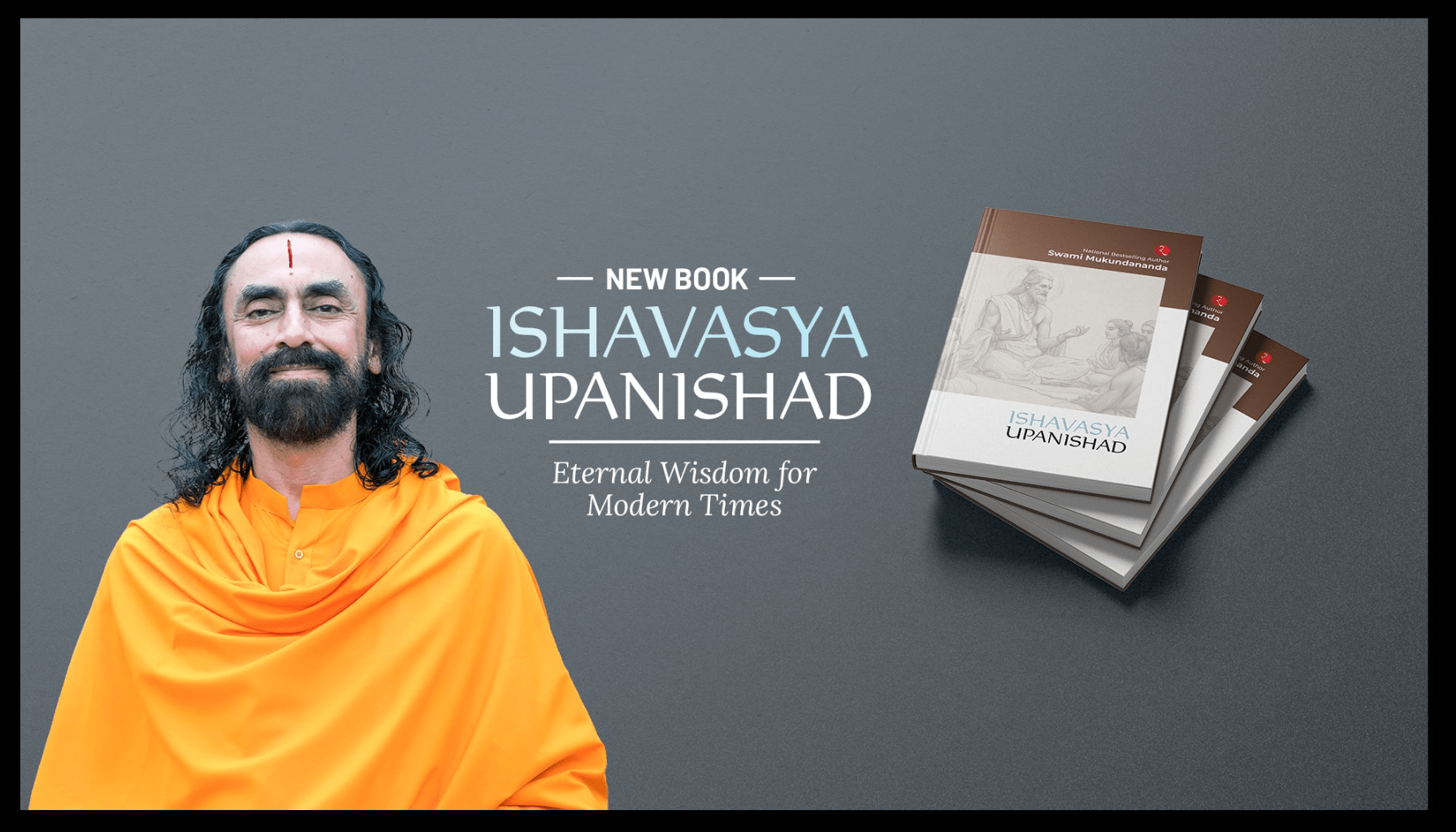
Now that we’ve explored the divine wisdom of the Shanti Path Mantra, it’s time to take the next step on your spiritual journey. To deepen your understanding of the Ishavasya Upanishad, we highly recommend Swami Mukundananda’s commentary, which beautifully unpacks each mantra, including the Shanti Path, providing a clear and practical guide for modern seekers.
Order the Book: Swami Mukundananda’s Commentary
Unlock the deeper wisdom of the Ishavasya Upanishad with this insightful commentary by Swami Mukundananda. Perfect for modern seekers who wish to explore the divine teachings in greater depth.
Final Reflections
Mantra 14 of the Ishavasya Upanishad offers a complete spiritual roadmap. It neither rejects the world nor glorifies it. Instead, it teaches us how to use the world wisely while anchoring the heart in the eternal.
When life becomes an offering and God becomes our constant companion, we cross death and taste immortality: here and now.
FAQs
1. Does detachment mean we should not love our family?
No. Detachment does not mean absence of love, it means absence of possessive dependence. True love seeks the well-being of others without demanding emotional control or certainty.
When love is mixed with attachment, it produces fear, anxiety, and expectations. When love is combined with detachment, it becomes pure, stable, and nourishing.
The Upanishad teaches us to love deeply while remembering that every relationship belongs to the realm of vināśham.
2. Why does the mantra emphasize the destructible nature of the world?
Because ignorance of impermanence is the root cause of suffering. When we assume permanence in relationships, health, wealth, or status, their inevitable change shocks the mind.
By clearly naming the world as vināśham, the mantra prepares the seeker psychologically. Awareness of impermanence does not create pessimism but instead creates emotional resilience and wisdom.
This insight allows us to enjoy the world without being shattered by it.
3. Is devotion enough, or must one also practice detachment?
Devotion without detachment often becomes conditional and transactional, based on personal desires and fears. Detachment purifies devotion by removing selfish motives.
Likewise, detachment without devotion may lead to dryness or indifference.
The mantra insists on both together. Detachment cleanses the mind; devotion fulfills it. One removes poison; the other supplies nectar.
4. What exactly does “crossing over death” mean in this mantra?
“Death” here refers not merely to physical death, but to death-bound consciousness, which is a state dominated by fear, anxiety, and impermanence.
When one engages wisely with the world, without attachment, one crosses over this mental state. When one practices devotion, one attains immortality of consciousness, even while living in the body.
Thus, immortality is not postponed to the afterlife. It begins here and now.
5. How can a modern professional realistically practice karm yog?
Karm yog does not require changing professions or lifestyles. It requires changing inner alignment.
A modern practitioner can:
- Begin the day by offering all actions to God
- Remember the Divine presence before starting work
- Accept success and failure with equanimity
- See work as service rather than self-validation
Over time, this practice stabilizes the mind, reduces stress, and infuses daily life with meaning and peace.