(Twelfth Part of the 19-Part Blog Series on the Ishavasya Upanishad)
Ishavasya Upanishad Mantra 11 with Swami Mukundananda’s Insights
The Ishavasya Upanishad is remarkable for its refusal to accept extremes.
Again and again, it dismantles rigid thinking, worldly versus spiritual, action versus renunciation, matter versus consciousness, and replaces it with harmony.
In earlier mantras, we saw the dangers of ignorance (avidyā) and incomplete knowledge (vidyā) when pursued in isolation.
Now, Mantra 11 delivers a profound corrective:
True wisdom lies not in rejecting the world, nor in drowning in it. It lies in mastering both.

This mantra offers one of the most practical teachings of the Upanishad, especially for modern life.
1. The Sacred Verse, Mantra 11 of the Ishavasya Upaniṣad
Sanskrit
विद्यां चाविद्यां च यस्तद्वेदोभयं सह ।
अविद्यया मृत्युं तीर्त्वा विद्ययाऽमृतमश्नुते ॥११॥
Transliteration
vidyāṁ cāvidyāṁ ca yastadvedobhayaṁ saha |
avidyayā mṛtyuṁ tīrtvā vidyayāmṛtam aśnute ||11||
Translation (Sense Meaning)
Those who adopt both vidya and avidya in unison, such expert spiritual seekers, navigate the world with the help of material science and reach the eternal abode of God through spiritual science
At first, this sounds paradoxical.
How can avidyā, often translated as ignorance, help us transcend death?
To answer this, the Upanishad radically redefines what ignorance and knowledge mean.
2. Key Words of Mantra 11, Quick Reference
|
Sanskrit Term |
Literal Meaning |
Simple Spiritual Insight |
| vidyā | spiritual knowledge | Knowledge of the soul, God, and eternal truth |
| avidyā | material knowledge | Knowledge of the physical world and bodily survival |
| ubhayam saha | both together | Not either/or, but a conscious synthesis |
| mṛityuṁ tīrtvā | crossing death | Managing material life skillfully |
| amṛitam aśnute | attains immortality | Realizing the eternal soul through God-knowledge |
Here, avidyā does not mean delusion, but material science and worldly competence.
Vidyā refers specifically to self knowledge and God realization.
3. Why the Upanishad Rejects Extremes
Swami Mukundananda explains that suffering arises when we cling to one sided living.
Table 1, The Two Dangerous Extremes
|
Extreme |
What It Looks Like |
Hidden Problem |
|
Only Avidyā |
Chasing money, comfort, status |
Inner emptiness, fear of death |
|
Only Vidyā |
Rejecting body, health, duties |
Physical collapse, impractical spirituality |
|
Mantra 11 Path |
Balanced pursuit of both |
Stability, clarity, fulfillment |
The Upanishad is not anti world, nor anti renunciation.
It is anti imbalance.
4. Avidyā, Why Material Knowledge Is Necessary
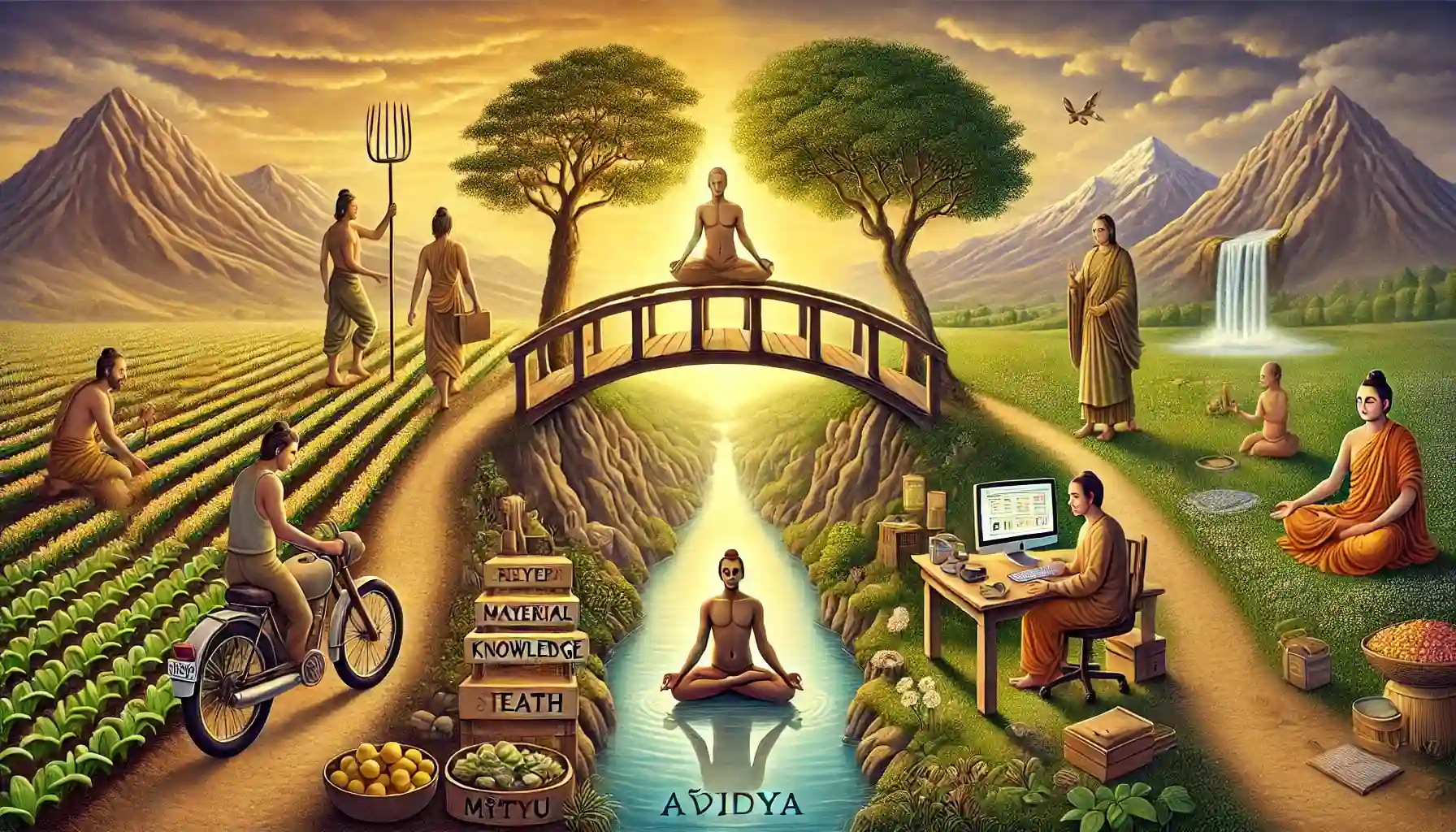
Material knowledge helps us cross mṛityu, meaning death, not in a literal sense, but by enabling us to:
- maintain health
- earn livelihood
- fulfill responsibilities
- survive in the physical world
Without this, spiritual practice itself becomes unsustainable.
Table 2, Role of Avidyā in Life
|
Area of Life |
How Avidyā Helps |
|
Body |
Nutrition, medicine,
exercise |
|
Society |
Skills,
profession, cooperation |
|
Mind |
Stability,
order, discipline |
|
Dharma |
Fulfilling
duties responsibly |
The Buddha’s Middle Path and Aristotle’s Golden Mean echo this same truth.
The body must be cared for, not tortured or indulged blindly.

5. Vidyā, Why Spiritual Knowledge Is Irreplaceable
While avidyā helps us live, it cannot tell us why we live.
Vidyā answers the deepest questions:
- Who am I?
- What is permanent?
- What happens beyond death?
Table 3, Role of Vidyā in Human Life
|
Dimension |
Effect of Vidyā |
|
Identity |
“I am the
soul, not the body” |
|
Values |
Ethics rooted
in eternity |
|
Emotions |
Reduced fear,
greed, envy |
|
Goal |
God
realization and liberation |
Without vidyā, life becomes a well decorated prison.
6. The Train on Two Tracks Principle
The Upanishad’s message is simple yet powerful.
Life moves forward only when both tracks are present.
Table 4, Two Tracks of Human Progress
|
Track |
Represents |
Without It |
|
Avidyā |
Material competence |
Physical collapse |
|
Vidyā |
Spiritual wisdom |
Existential despair |
|
Both Together |
Complete human life |
Balance and peace |
Material success without spirituality inflates ego.
Spiritual aspiration without grounding weakens life.
Mantra 11 integrates both.
7. How Spirituality Improves Daily Living
Contrary to popular belief, spirituality does not make life impractical.
It actually sharpens judgment and values.
Table 5, Life Decisions With and Without Vidyā
|
Situation |
Without Vidyā |
With Vidyā |
| Ethical choice | “What benefits me?” | “What is right?” |
| Success | Ego inflation | Gratitude |
| Failure | Depression | Learning |
| Desire | Endless craving | Discernment |
| Work | Survival | Service |
Spiritual wisdom provides an inner compass in complex situations.
Living Mantra 11, Daily Balance in Action
Mantra 11 is not meant to remain a philosophical ideal. It is meant to be lived, quietly and consistently, in the ordinary flow of daily life. The Upanishad does not ask us to renounce our responsibilities or withdraw from society. Instead, it invites us to bring spiritual intelligence into everything we do.
Living Mantra 11 means learning how to care for the material world without being enslaved by it, and how to pursue spirituality without neglecting life.
Below are practical ways to embody this balance each day.
1. Care for the Body as a Sacred Instrument
The body is the vehicle through which both worldly duties and spiritual practices are performed. Mantra 11 teaches that caring for the body is neither indulgence nor attachment when done consciously.
Eat to nourish, not to escape emotions.
Rest to restore energy, not to avoid responsibility.
Exercise to maintain strength, not to feed vanity.
When the body is seen as an instrument for service and spiritual growth, health becomes part of sādhanā rather than a distraction from it.
2. Perform Duties with Spiritual Awareness
Material responsibilities such as work, family care, and social obligations fall under avidyā. However, when guided by vidyā, these same actions become uplifting.
Before beginning a task, pause briefly and remind yourself:
“I am doing this responsibly, but the result belongs to God.”
This simple shift purifies action. Work becomes service. Effort becomes worship. Stress reduces because ego loosens its grip on outcomes.
3. Set Limits on Desire, Not on Growth
Mantra 11 encourages moderation in material pursuits and limitless expansion in spiritual growth.
Ask yourself regularly:
- Does this desire support my well-being, or is it feeding restlessness?
- Will this add clarity, or just momentary pleasure?
At the same time, place no limits on spiritual effort. Increase prayer, study, reflection, and devotion without fear of excess. Spiritual growth never creates imbalance.
4. Use Material Success as a Test of Wisdom
Success is not condemned in the Upanishad. What matters is how it is held.
When success comes:
- Practice gratitude rather than pride.
- Share rather than hoard.
- Remain aware of impermanence.
When failure comes:
- Practice learning rather than self-blame.
- Reflect instead of resenting.
- Strengthen surrender instead of despairing.
Mantra 11 teaches that both success and failure are classrooms for wisdom.
5. Create a Daily Rhythm of Vidyā
Even a busy life must include daily nourishment for the soul. Without it, material engagement slowly consumes attention.
Simple daily practices may include:
- Reading one verse or reflection from the Upanishads or Gita
- A few minutes of silent remembrance of God
- Journaling one insight about the self
- Offering the day’s actions mentally to the Divine
These practices anchor life in meaning and prevent spiritual drift.
6. Make Ethical Choices Your Spiritual Practice
Life constantly demands decisions, often under pressure. Mantra 11 teaches that spirituality should guide these choices, not remain separate from them.
When faced with a dilemma, ask:
- What choice aligns with truth rather than convenience?
- What preserves dignity, compassion, and integrity?
Spiritual wisdom simplifies complex decisions by giving clarity about what truly matters.
7. See the World as Training Ground, Not Trap
Instead of viewing worldly life as a bondage to escape, Mantra 11 invites us to see it as a training ground for inner freedom.
Relationships teach patience.
Challenges build detachment.
Responsibilities cultivate discipline.
When approached with awareness, the world refines the soul rather than entangling it.
8. End Each Day with Reflection and Surrender

Balance is sustained through reflection. At the end of each day, quietly review:
- Where did I act wisely?
- Where did I act mechanically or selfishly?
- What can I offer back to God with humility?
This gentle self-review, without guilt or pride, gradually aligns daily life with the vision of Mantra 11.
A Simple Summary of Daily Balance
To live Mantra 11 is to remember:
Care for life, but do not cling to it.
Engage with the world, but do not forget God.
Use matter wisely, and aim your heart toward eternity.
When lived this way, daily life itself becomes the bridge between avidyā and vidyā, between effort and grace, between survival and liberation.
Table: Living Ishavasya Upanishad Mantra 11 in Daily Life
|
Area of Daily Life |
Material Aspect (Avidyā) |
Spiritual Application (Vidyā) |
Balanced Practice (Mantra 11) |
| Body & Health | Nutrition, exercise, rest | Body as God’s instrument | Care for the body mindfully without obsession or neglect |
| Work & Career | Skills, income, efficiency | Offering actions to God | Work sincerely while remaining detached from ego and results |
| Desires & Comfort | Enjoyment, security | Discernment, moderation | Fulfill needs wisely, restrain excess, and grow inner contentment |
| Success & Failure | Achievement, loss | Gratitude, learning | Accept both as lessons arranged by Divine wisdom |
| Decision-Making | Practical outcomes | Ethics, higher values | Choose what is right, not merely what is convenient |
| Relationships | Roles, expectations | Compassion, soul-vision | Serve others while remembering the Divine within them |
| Daily Routine | Duties and obligations | Remembrance of God | Turn ordinary actions into conscious service |
| Spiritual Practice | Time management | Prayer, study, reflection | Maintain daily spiritual nourishment despite busyness |
| End of the Day | Review of events | Surrender and humility | Reflect, learn, and offer everything back to God |
How to Use This Table
- Read one row each morning as an intention
- Reflect on one row each night as self-review
- Use it as a discussion or teaching aid
- Convert it into a weekly spiritual checklist
This table captures the essence of Mantra 11 in a practical way:
Live responsibly in the material world,
but let spiritual wisdom guide every step.
Deepen Your Learning and Spiritual Practice
To deepen your understanding of the Ishavasya Upanishad, we highly recommend Swami Mukundananda’s commentary, which beautifully unpacks each mantra, including the Shanti Path, providing a clear and practical guide for modern seekers.
Order the Book: Swami Mukundananda’s Commentary
Unlock the deeper wisdom of the Ishavasya Upanishad with this insightful commentary by Swami Mukundananda. Perfect for modern seekers who wish to explore the divine teachings in greater depth.
Final Reflection
Ishavasya Upanishad Mantra 11 offers a vision of spiritual life that is both compassionate and realistic. It does not ask us to abandon the world in search of truth, nor does it allow us to forget truth in the pursuit of the world. Instead, it teaches us how to live fully and wisely at the same time.
Material knowledge helps us navigate daily life with responsibility, discipline, and stability. Spiritual knowledge lifts our awareness beyond the temporary, revealing our eternal nature and our relationship with God. When these two move together, life becomes purposeful rather than exhausting, and spiritual practice becomes grounded rather than abstract.
Mantra 11 gently reminds us that the world is not the enemy, but it is not the goal either. When worldly activity is guided by spiritual wisdom, action no longer binds us. Work becomes service, success becomes gratitude, and challenges become opportunities for inner growth and surrender.
As we reflect on this mantra, we are invited to examine our own lives with honesty and compassion. Where are we overemphasizing comfort at the cost of meaning? Where are we seeking spirituality while neglecting responsibility? Each small correction toward balance is a step toward freedom.
Living Mantra 11 means learning to care for life without clinging to it, and to seek God without escaping from duty. Walking this path steadily, we discover that balance itself becomes a form of devotion, and daily life transforms into a quiet offering at the feet of the Divine.
Key Philosophical Insights from Ishavasya Upanishad Mantra 11
1. Wisdom Lies in Integration, Not Rejection
Mantra 11 firmly rejects the idea that spiritual growth requires abandoning the material world. Instead, it teaches that wisdom lies in integrating material and spiritual knowledge intelligently. The Upanishad recognizes that human life unfolds in both inner and outer dimensions. Ignoring either leads to imbalance. True wisdom harmonizes worldly competence with spiritual depth.
2. Avidyā Is Not Evil, It Is Incomplete When Isolated
The mantra challenges the common assumption that avidyā, or material knowledge, is inherently negative. Material science, skills, and practical intelligence are necessary for sustaining life, caring for the body, and fulfilling responsibilities. However, when avidyā becomes the sole pursuit, it traps consciousness in fear, desire, and impermanence. The problem is not material knowledge itself, but material knowledge without spiritual direction.
3. Vidyā Gives Meaning Where Avidyā Gives Survival
Avidyā helps us survive, but vidyā helps us understand why survival matters at all. Spiritual knowledge reveals our identity as eternal souls and reconnects us with God, the ultimate reality. Without vidyā, even a comfortable life feels hollow. Mantra 11 teaches that meaning cannot be manufactured by possessions, only discovered through self-knowledge.
4. Liberation Is Not Escaping Life but Seeing It Clearly
Mantra 11 reframes liberation as a transformation of understanding rather than a physical withdrawal from life. Crossing “death” does not mean avoiding change or loss, but learning to live without being psychologically destroyed by them. Spiritual wisdom allows one to participate fully in life while remaining inwardly free. Liberation is clarity, not disappearance.
5. Balance Is a Spiritual Discipline, Not a Compromise
The Upanishad does not promote balance as a lukewarm middle ground, but as a deliberate spiritual discipline. To live with moderation, discernment, and self-control requires inner strength. Extremes are easy. Balance demands awareness. Mantra 11 calls for conscious restraint in material pursuits and limitless aspiration in spiritual growth.
6. The Body Is an Instrument, Not an Obstacle
Mantra 11 affirms the body as a necessary instrument for spiritual progress. Neglecting health, livelihood, or social duties weakens the very platform on which spiritual practice rests. Caring for the body is not indulgence when done with awareness. It becomes stewardship of a sacred tool given for God-realization.
7. Spirituality Refines Action Rather Than Replacing It
Rather than encouraging withdrawal from action, Mantra 11 teaches that spirituality purifies motivation behind action. When guided by vidyā, work becomes service, success becomes gratitude, and failure becomes growth. The same actions that bind a person when driven by ego can liberate them when guided by wisdom.
8. Human Life Has a Higher Goal Than Comfort
The mantra quietly but firmly reminds us that comfort, security, and pleasure are not the final goals of existence. They are supports, not destinations. The ultimate purpose of human life is God-realization and freedom from repeated birth and death. When spirituality becomes central, material life finds its proper place as a means, not an end.
9. Immortality Is a Shift of Identity, Not a Physical State
The “immortality” spoken of in Mantra 11 does not refer to the endless continuation of the body. It refers to awakening to the soul’s eternal nature. When identity shifts from the perishable body to the imperishable self, fear of death loosens its grip. This inner immortality is accessible here and now through spiritual knowledge.
10. Mantra 11 Is a Blueprint for Modern Living
Far from being abstract philosophy, Mantra 11 offers a practical blueprint for contemporary life. It validates education, career, family, and social engagement, while simultaneously insisting that they be guided by higher wisdom. In a world torn between material obsession and spiritual escapism, this mantra offers a stable, life-affirming path forward.
FAQs
1. What is the central teaching of Ishavasya Upanishad Mantra 11?
Mantra 11 teaches that a balanced life requires both material knowledge (avidyā) and spiritual wisdom (vidyā). Material knowledge helps us live responsibly in the world, while spiritual wisdom reveals our eternal identity and leads us toward liberation. The mantra emphasizes integration, not rejection.
2. Why does the Upanishad value avidyā, or material knowledge?
Avidyā is valued because it enables us to care for the body, earn a livelihood, fulfill duties, and function effectively in society. Without this foundation, spiritual practice becomes unstable. The Upanishad does not condemn material knowledge; it warns against making it our sole pursuit.
3. How is vidyā different from intellectual or academic knowledge?
Vidyā is not mere information or philosophy. It is experiential spiritual knowledge that reveals the soul’s eternal nature and its relationship with God. While academic learning sharpens the intellect, vidyā transforms identity, values, and consciousness.
4. Does Mantra 11 discourage renunciation or monastic life?
No. Mantra 11 does not reject renunciation, but it discourages premature or imbalanced renunciation. True renunciation arises from wisdom and detachment, not from neglect of responsibility. Whether one lives as a householder or a renunciate, balance and clarity are essential.
5 What does “crossing death through avidyā” actually mean?
This phrase does not mean achieving physical immortality. It means managing material life skillfully so that one is not constantly overwhelmed by fear, insecurity, or survival anxiety. When basic needs and responsibilities are handled wisely, the mind becomes free to pursue higher truth.