
(Fifth Part of the 19-Part Blog Series on the Ishavasya Upanishad)
Introduction: Contemplating the Eternal Stillness of the Supreme
The Ishavasya Upanishad is one of the most compact yet potent spiritual texts in the Vedic tradition. With only eighteen mantras, it encapsulates profound metaphysical truths about God, creation, consciousness, the soul, and our relationship with the Supreme Being. Among these eighteen, Mantra 4 stands out as a striking paradox: an expression of divine mystery designed to lift the human intellect beyond its limitations and help it glimpse the nature of the all-pervading Supreme
Welcome to another part of our ongoing journey through the Ishavasya Upanishad. In this instalment, we meditate on Mantra 4, where the rishis present a stunning paradox.
Drawing from Swami Mukundananda’s illuminating commentary, we will explore how this mantra reveals the omnipresence, omniscience, and sustaining power of the Divine, and how this vision can completely transform our inner life.
Mantra 4 invites us to drop the notion of a distant God who “comes and goes” and instead discover a Lord who is eternally present, within His divine abode, throughout the universe, and in the hearts of all beings, without ever undergoing change.
Mantra 4 of the Ishavasya Upanishad
Sanskrit
अनेजदेकं मनसो जवीयो
नैनदेवा आप्नुवन्पूर्वमर्षत् ।
तद्धावतोऽन्यानत्येत तिष्ठत्
तस्मिन्नपो मातरिश्वा दधाति ॥
Transliteration
anejad ekaṁ manaso javīyo
nainad devā āpnuvan pūrvam arṣat
tad dhāvato ’nyān atyeti tiṣṭhat
tasminn apo mātariśvā dadhāti
Translation
The Supreme Divine Personality, despite remaining unmoved, is quicker than the mind. He alone precedes everything and knows everything. Yet, He cannot be known even by celestial gods. Though He stays still, He surpasses all those who move. This world is like a child nurtured in the womb of God and is fulfilling its purpose.
At first glance, this verse seems riddled with contradictions.
How can someone be unmoving yet faster than the mind?
How can He “stand still” and yet surpass everyone who runs?
The mantra pushes us to look beyond material categories of space, motion, and time, and to discover a reality in which God’s presence is both utterly steady and dynamically all-pervading.

1. Key Words of the Mantra: A Simple Guide
Before diving deeper, let’s unpack a few important Sanskrit words from the mantra. Understanding them makes the message clearer and much easier to remember.
| Term | Simple Meaning & Spiritual Insight |
| anejāt | “Unmoving.” God never falls, fluctuates, or changes His divine nature; His glory is inseparable from Him. |
| ekaṁ | “One.” There is only one Supreme Divine Personality, the ultimate source and controller of all. |
| manaso javīyaḥ | “Swifter than the mind.” Even the lightning-speed of thought cannot outpace the Lord, who is already present everywhere. |
| devāḥ | “Celestial gods.” Guardians of cosmic forces like wind, fire, and rain, who still function under God’s authority. |
| atyeti tiṣṭhat | “He surpasses (all) while standing still.” God does not need to move from place to place in order to act. |
| mātariśvā | Often identified with Vāyu, the wind-god, but also hinting at the Lord who nourishes life, like a child in the womb. |
With these terms in mind, we can now appreciate how Mantra 4 describes the threefold presence of God and shows why none of our material instruments:body, senses, or mind, can ever “catch” Him.
2. The Unmoving Lord: Three Ways God Resides
The commentary explains that “unmoving” does not mean God is inert or inactive. Rather, it means that His divine position never changes. He simultaneously lives in three ways, without leaving His transcendental abode:
|
Mode |
Description |
|
Lokastha — Residing in His Abode |
The Lord eternally dwells in His own divine realm (such as Golok), untouched by material defects. From there He directs creation, maintenance, and dissolution without needing to “travel.” |
|
Viśvastha — Residing in the Universe |
At the same time, He pervades the entire cosmos as its support and shelter, like a thread holding beads together on a necklace. |
|
Jīvastha — Residing in All Hearts |
He also sits in the hearts of all living beings as the indwelling witness, gently guiding, inspiring, and tracking each soul’s karma. |
A beautiful analogy often shared is that of the midday sun. The sun remains in one position in the sky, yet it is reflected in countless pots of water on earth. In the same way, God stays in His divine abode and yet is mirrored in every heart as the indwelling Lord. The original sun does not split into pieces; similarly, the Supreme remains one, even while appearing in many hearts.
When we recall this, the phrase “anejād ekaṁ” becomes deeply reassuring: God does not “come into” our life at one time and “leave” at another. Rather, He has always been present; we are the ones who turn towards or away from Him.
3.Faster Than the Mind: Why Intellect Alone Cannot Reach Him

The mind is one of the fastest things we know. In a moment, our thoughts can jump across continents and even galaxies. Yet this mantra declares that the Lord is “manaso javīyaḥ”: far swifter than the mind.
Swami Mukundananda explains this with a simple example: imagine a fish swimming as fast as it can in the ocean. No matter how quickly it moves, the water is already there before it arrives. In the same way, wherever the mind runs, God is already present.
|
Aspect |
Mind |
Supreme Lord |
|
Speed |
Can think of distant places instantly, but only one thought at a time. |
Already present in all places and hearts, beyond the need to “travel.” |
|
Reach |
Limited to what it has heard, seen, or imagined. |
Knows every atom, every desire, every past and future event fully. |
|
Nature |
Restless, fickle, easily distracted. |
Ever steady, self-luminous, never disturbed. |
|
Capability |
Capable of thinking about God but not of catching Him on its own. |
Reveals Himself by grace to a heart filled with faith, humility, and devotion. |
This leads to an important spiritual conclusion: God cannot be grasped merely by mental speculation or intellectual gymnastics. Our mind and intellect are wonderful gifts, but they are still material instruments. We truly “know” the Lord only when He kindly reveals Himself to a surrendered heart.
Hence, the purpose of scriptural study is not to prove our brilliance, but to soften our heart, increase our humility, and inspire bhakti, or loving devotion. When the mind accepts its limitation and bows, it becomes a perfect channel for divine grace.
4. Even the Gods Cannot Overtake Him
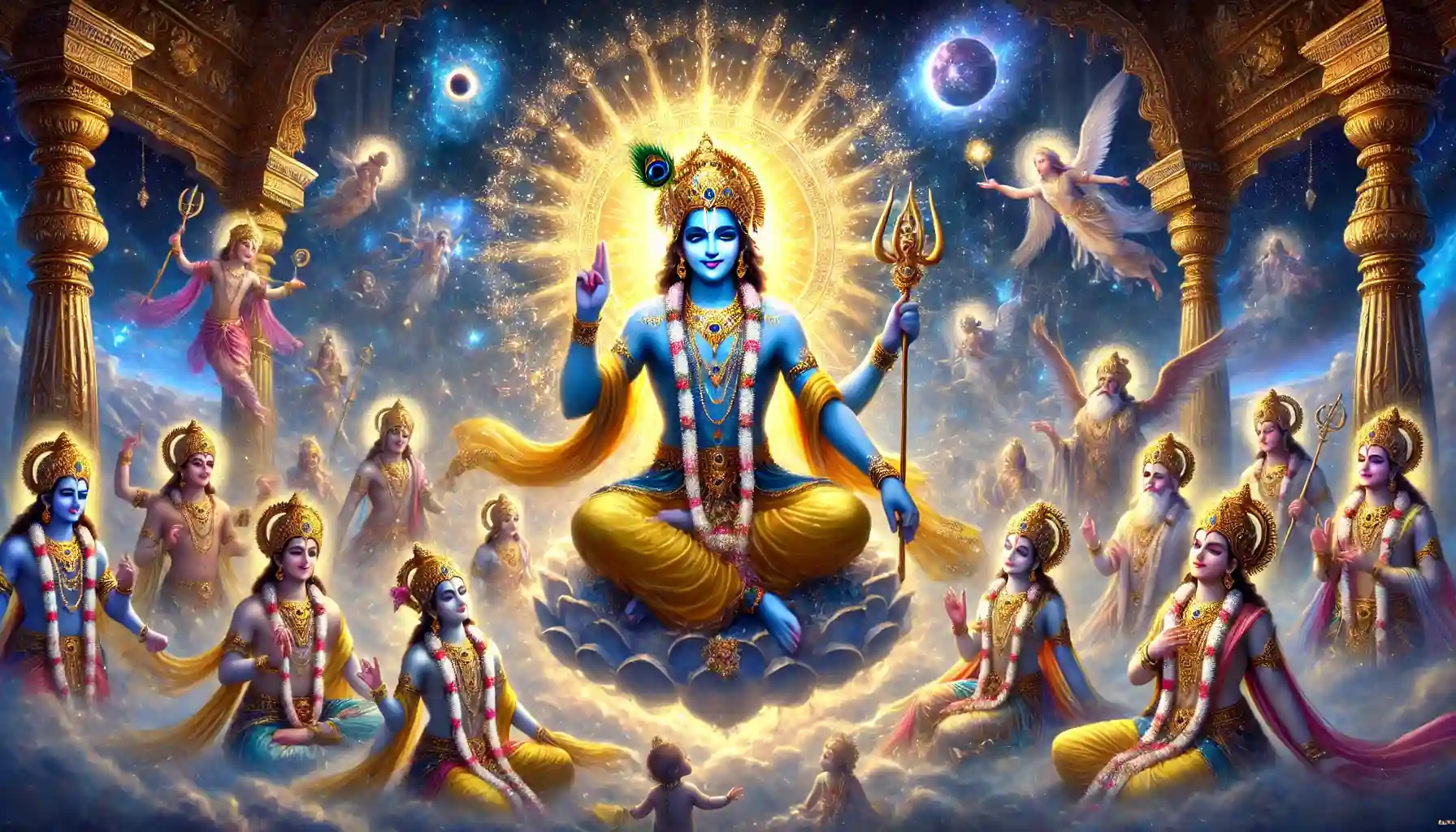
The mantra continues: “nainad devā āpnuvan”: even the celestial gods cannot reach or surpass Him. This reminds us that all powers in the universe, no matter how dazzling, are merely borrowed strengths granted by the Supreme.
The commentary recalls a famous episode from the Kena Upanishad. After a great victory over the demons, the gods became proud, thinking the success was entirely their own. To humble them, the Supreme appeared as a mysterious effulgent being. One by one, Agni (fire) and Vayu (wind) were sent to investigate and found themselves unable to perform even their usual feats before this presence. Finally, Indra approached and realized that the victory had truly belonged to the Supreme Lord alone.
|
Character / Element |
Role in the Story |
Spiritual Lesson |
|
Agni (Fire-god) |
Could not burn a simple straw before the mysterious Being. |
Our talents stop working the moment God withdraws His power. |
|
Vāyu (Wind-god) |
Could not move the straw even slightly. |
All motion and strength are rooted in the Supreme, not in us. |
|
Indra |
Approached with humility and was granted knowledge of the Lord. |
When pride drops and humility rises, divine knowledge is revealed. |
|
Mysterious Effulgent Being |
The cameo appearance of the Supreme to shatter the gods’ ego. |
God sometimes disrupts our plans just to save us from arrogance. |
5. “Mātariśvā Dadhāti”: The Lord as Our Inner Nourisher

The closing portion of the mantra says, “tasminn apo mātariśvā dadhāti,” in Him the powers of wind, water, and other life-sustaining forces are established.
On one level, mātariśvā refers to the wind-god who moves the waters and circulates life-giving air throughout creation. On a deeper level, the commentators explain another nuance of the word: it can also mean “that which grows within the mother,” pointing to the child developing in the womb.
Just as the unborn child is completely dependent on the mother for nourishment, in the same way all of us are spiritually and materially nourished by God from within. Our heartbeat, breath, digestion, and even our ability to think and love are quietly maintained by Him. Simple ways to remember God’s hidden care throughout the day.
|
Experience |
How It Reflects God’s Nourishing Presence |
|
Breathing effortlessly |
Each breath is powered by life-energy granted by the Supreme; we do not “manufacture” prāṇa ourselves. |
|
Body healing after illness |
The body’s intelligence to repair and restore is a gift placed there by God. |
|
A child growing in the womb |
The intricate orchestration of development silently proclaims an inner Divine Caretaker. |
|
Nature’s cycles (rain, seasons) |
The forces of wind and water that sustain crops operate within laws established by the Lord. |
|
Moments of sudden clarity or inspiration |
A gentle reminder that the Lord in the heart can illumine our understanding at any moment. |
When we recognize God as the silent supporter behind every function of our life, gratitude naturally blossoms. Worry loosens its grip, because we realize we are not trying to survive alone in an indifferent universe; we are held, watched, and nourished by the very Lord whom this mantra glorifies.
6. Living Mantra 4: Bringing the Teaching into Daily Life
How can Mantra 4 move from the page into our daily habits? Here are some practical ways to internalize its wisdom.
• Morning Mantra Contemplation:
Chant Mantra 4 slowly, reflecting on each line for a minute.
This practice deepens awareness of God’s constant presence and protection.
• “God is Already There” Reminder:
Whenever the mind races with anxiety, gently tell yourself: “Where my mind is running, God is already present.”
This reduces fear and brings a sense of being supported in every situation.
• Gratitude for Hidden Support:
Pause before meals, sleep, or important tasks to thank the Lord for the body, mind, and abilities He sustains.
This transforms ordinary moments into occasions of devotion and humility.
• Serving Without Pride:
After any success, mentally offer the credit back to God.
This protects from ego and keeps the heart pure, like the humbled gods in the Kena Upanishad.
• Heart-to-Heart Dialogue:
Speak to God in your own words, acknowledging Him as the One dwelling in your heart.
This makes the Lord feel personal and near, not abstract or distant.
|
Practice |
How to Do It |
Inner Transformation |
|
Morning Mantra Contemplation |
Chant Mantra 4 slowly, reflecting on each line for a minute. |
Deepens awareness of God’s constant presence and protection. |
|
“God is Already There” Reminder |
Whenever the mind races with anxiety, gently tell yourself: “Where my mind is running, God is already present.” |
Reduces fear and brings a sense of being supported in every situation. |
|
Gratitude for Hidden Support |
Pause before meals, sleep, or important tasks to thank the Lord for the body, mind, and abilities He sustains. |
Turns ordinary moments into occasions of devotion and humility. |
|
Serving Without Pride |
After any success, mentally offer the credit back to God. |
Protects from ego and keeps the heart pure, like the humbled gods in the Kena Upanishad. |
|
Heart-to-Heart Dialogue |
Speak to God in your own words, acknowledging Him as the One dwelling in your heart. |
Makes the Lord feel personal and near, not abstract or distant. |
Deepen Your Learning and Spiritual Practice
Now that we’ve explored the divine wisdom of the Shanti Path Mantra, it’s time to take the next step on your spiritual journey. To deepen your understanding of the Ishavasya Upanishad, we highly recommend Swami Mukundananda’s commentary, which beautifully unpacks each mantra, including the Shanti Path, providing a clear and practical guide for modern seekers.
Order the Book: Swami Mukundananda’s Commentary
Unlock the deeper wisdom of the Ishavasya Upanishad with this insightful commentary by Swami Mukundananda. Perfect for modern seekers who wish to explore the divine teachings in greater depth.
Final Reflection
Mantra 4 of the Ishavasya Upanishad shatters our habitual image of God as someone far away, sometimes active and sometimes absent. It paints instead a portrait of the ever-present, all-supporting Lord: unmoved in His divine perfection yet closer to us than our own breath.
When we remember that He is faster than the mind, we stop trying to “catch” Him by intellect alone and instead open our hearts in humility and devotion.
When we recall that even the gods cannot rival His power, we learn to stay grounded in gratitude. And when we recognize Him as the nourisher within, “mātariśvā,” we realize that every moment of our life is already happening in His loving care.
May this mantra become a gentle refrain in our day: wherever we go, whatever we face, the Lord is already there, unmoving, unchanging, and endlessly compassionate.
Key Philosophical Insights:
- Divine Stillness and Dynamic Action
The mantra presents a paradox: the Supreme is "unmoving," yet swifter than the mind, transcending space and time. This teaches us that the Divine's stillness isn't inactivity but a source of all movement, present everywhere while remaining unchanged. - God’s Omnipresence
The verse reveals that God is eternally present, not coming and going. Just as the sun stays in one place yet is reflected in many vessels, God is always with us, though we must turn our hearts toward Him to experience His presence. - Limitations of the Mind
God is swifter than the mind, emphasizing that intellectual knowledge cannot fully grasp the Divine. True understanding comes not from speculation but through surrender and devotion, as God’s presence transcends the limits of our intellect. - Humility and Surrender
Even the gods cannot surpass God, reminding us to recognize our limitations. All powers are manifestations of the Supreme, and wisdom lies in acknowledging that everything we are is by God’s grace, fostering humility and devotion. - God as Our Inner Nourisher
The mantra points to God as the sustainer of life, nourishing us like a mother nourishes her child in the womb. Recognizing this hidden divine support helps us appreciate life as a flow of divine sustenance, fostering gratitude.
FAQs
1: What does the mantra mean when it says God is “unmoving yet faster than the mind”?
This paradox teaches that God is not bound by material categories such as motion, space, or time. He does not “move” from place to place because He is already present everywhere. The mind travels quickly, but wherever it goes, the Lord is already there. His “speed” expresses His omnipresence, not physical motion.
2: Why can the senses, mind, and even the devas not reach or overtake the Supreme?
Because the Supreme Being is beyond material limitations, the senses and mind are made of matter and can only perceive material objects. The devas, though powerful, still operate within the boundaries of creation. God alone transcends all conditions. He can be known only through divine grace and a surrendered heart, not through sensory or intellectual effort alone.
3: What is the significance of the three ways God resides: lokastha, viśvastha, and jīvastha?
These three modes reveal God’s complete yet effortless presence:
• Lokastha : He eternally resides in His divine abode.
• Viśvastha : He pervades and sustains the entire universe.
• Jīvastha : He lives in the heart of every living being.
This teaches that the Lord is simultaneously transcendent, immanent, and intimately connected with each soul
4: What does “mātariśvā dadhāti” teach about God’s role in our lives?
Mātariśvā” points to the nourishing presence of God, similar to how a fetus is sustained in the mother’s womb. It means that all life-sustaining forces, such as wind, water, prāṇa, and inner intelligence, function only through His power. It reminds us that God quietly supports every breath, every heartbeat, and every moment of our existence.
5: How can reflecting on this mantra help us in daily life?
Contemplating this mantra dissolves anxiety and deepens trust. Knowing that God is already present wherever our mind runs helps us release fear of the future. Remembering that all abilities are granted by Him protects us from pride. Recognizing His presence within fosters humility, devotion, and a sense of inner companionship with the Divine.