
The Bhagavad Gita, a timeless spiritual guide, provides profound insights into human psychology, particularly the workings of the mind. In verses 2.62 and 2.63, Shree Krishna explains a subtle yet powerful chain reaction that begins with contemplation and culminates in the ruin of one's spiritual and intellectual faculties. Through these verses, Shree Krishna offers not only diagnosis but also a cure for the mental ailments plaguing modern life—anger, greed, desire, and delusion.
This blog explores these teachings in depth, as explained by Swami Mukundananda, a renowned spiritual teacher who decodes Vedic wisdom with clarity and practicality.
Understanding the Afflictions of the Mind

The ancient science of Vedic psychology focuses on mental afflictions—anger, greed, desire, hatred, lust, and others. While modern psychology often scratches the surface, the Gita dives deep into the root causes and solutions.
According to Swamiji, these afflictions are mental diseases, just as physical ailments disrupt bodily function. If a toothache can ruin an entire day, imagine what continuous inner turmoil caused by mental disturbances can do to the soul. The Bhagavad Gita addresses these disturbances at their root.
The Chain of Mental Corruption
Let us begin with the key verses:
📖 Bhagavad Gita 2.62
"dhyāyato viṣhayān puṁsaḥ saṅgas teṣhūpajāyate
saṅgāt sañjāyate kāmaḥ kāmāt krodho ‘bhijāyate"
Read on Holy-Bhagavad-Gita.org
Translation:
While contemplating the objects of the senses, a person develops attachment for them. From attachment, desire is born. And from desire, anger arises.
📖 Bhagavad Gita 2.63
"krodhād bhavati sammohah sammohāt smṛiti-vibhramaḥ
smṛiti-bhraṁśād buddhi-nāśho buddhi-nāśhāt praṇaśhyati"
Read on Holy-Bhagavad-Gita.org
Translation:
From anger arises delusion; from delusion, bewilderment of memory. When memory is bewildered, intelligence is lost, and when intelligence is lost, one falls down into the material pool.
Decoding the Verses: Step by Step Breakdown
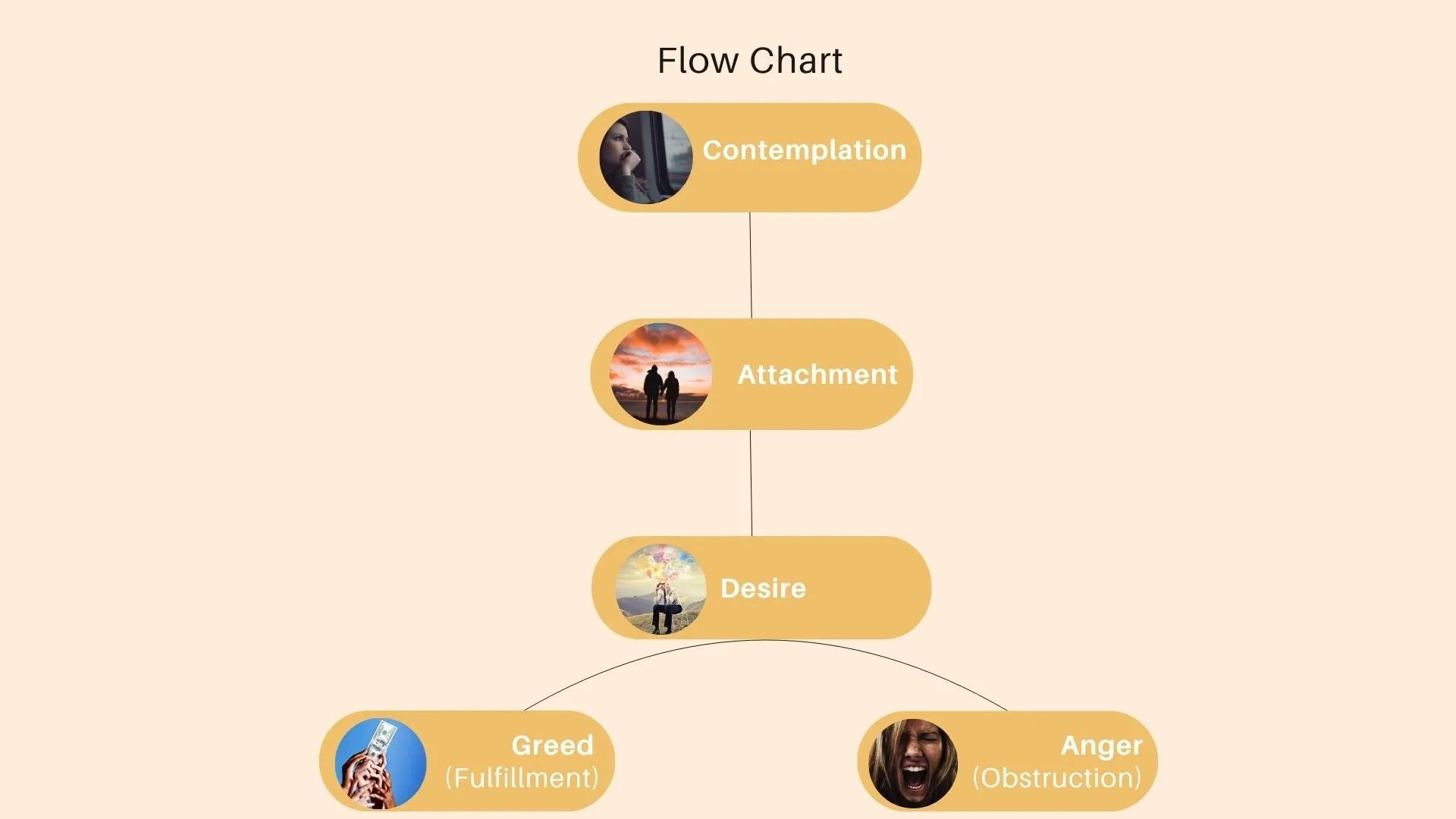
Swamiji walks us through how mental degradation happens in stages:
1. Contemplation (Dhyāna)
Everything starts with repeated thinking about sensory objects—food, wealth, people, pleasures. Constant contemplation leads the mind to develop attachment.
🧠 Example: Thinking again and again about ice cream leads to desire for it.
2. Attachment (Saṅgaḥ)
When the mind starts believing, “There is happiness here,” it gets attached. The mind clings to the object, believing it is the source of joy.
💡 Important: It is not the object that creates desire, but our attachment to it.
3. Desire (Kāmaḥ)
From attachment springs desire—the urge to possess, enjoy, or experience that object.
➡️ Desire is the mother of both anger and greed.
4. Anger (Krodhaḥ)
If the desire is obstructed, anger is born. This anger clouds our rationality, often leading to destructive behavior.
😠 Story: Swamiji illustrates this with the example of someone who buys ice cream but becomes furious when it’s thrown away for health reasons. The root cause? Desire not fulfilled.
5. Delusion (Sammohah)
Anger leads to delusion—a loss of inner clarity. The mind is no longer in control; it sees the world through a fog of emotional disturbance.
6. Loss of Memory (Smṛiti-vibhramaḥ)
Delusion corrupts memory—meaning we forget spiritual truths, past lessons, and our goals. It's not literal memory loss but a loss of higher understanding.
7. Destruction of Intellect (Buddhi-nāśhaḥ)
Without memory, our intellect—the power to discriminate right from wrong—is destroyed.
8. Ruin (Praṇaśhyati)
The final step is spiritual and moral collapse. One who has lost discrimination becomes a slave to impulses.
The Real Cause: Attachment

A profound realization here is that desire does not arise from the object itself but from our mental attachment to it. The object may be neutral or even repulsive to someone else. For example, alcohol may smell awful to many, yet the alcoholic is drawn to it—not due to the object’s quality, but their inner attachment.
Why Are We Attached? The Role of Contemplation
The Bhagavad Gita explains that attachment arises from repeated contemplation of a thing as a source of happiness.
🧘♂️ When the mind keeps thinking:
“There is happiness in this…”
…attachment forms.
So attachment is not about the object, but the mind’s repetitive narrative about the object.
The Deep Root: Our Search for Happiness
All this boils down to one fundamental drive: the innate longing for happiness. Swamiji points out:
“The yearning for happiness is intrinsic to the soul because we are tiny parts of God, who is the ocean of bliss.”
So our desire itself is not wrong—but its misdirection causes problems.
The Way Out: Redirecting the Desire
To escape this destructive cycle, Shree Krishna suggests reversing the process:
Just as repeated contemplation on the world leads to attachment and ruin,
repeated contemplation on God leads to divine attachment and liberation.
📖 Bhagavad Gita 2.70
"āpūryamāṇam achala-pratiṣhṭhaṁ
samudram āpaḥ praviśhanti yadvat
tadvat kāmā yaṁ praviśhanti sarve
sa śhāntim āpnoti na kāma-kāmī"
Read on Holy-Bhagavad-Gita.org
Translation:
Just as rivers flow into the ocean which is ever being filled but is never disturbed, so also, the desires of those who are fixed in God consciousness enter them but do not disturb them.
Shifting Contemplation from the World to God

The key practice is to repeatedly remind the mind:
🕉️ “There is happiness in God.”
🕉️ “True peace lies in devotion.”
🕉️ “My joy is not in possessions, but in divine connection.”
This redirection leads to:
- Divine attachment
- Desire for God
- Inner peace and purity
- Freedom from greed and anger
Transforming Desire: A Positive Approach
Swamiji emphasizes that saints also have desire—but their desire is for God. It is not about suppression, but divine redirection.
So:
- Don't kill desire.
- Elevate it.
- Channel it toward Shree Krishna.
Summary: The Mind’s Mechanism, According to the Gita
| Stage | Description |
|---|---|
| 1. Contemplation | Repeated thinking about something |
| 2. Attachment | Mind clings, believing happiness lies there |
| 3. Desire | Urge to attain the object |
| 4. Anger / Greed | Anger if unfulfilled; greed if fulfilled |
| 5. Delusion | Clouding of inner clarity |
| 6. Memory Loss | Forgetting spiritual truth |
| 7. Intellect Destroyed | No rational discrimination |
| 8. Ruin | Spiritual downfall |
Practical Steps for Mind Mastery
- Be aware of what you contemplate.
The root is repeated thinking. Watch where your thoughts go. - Redirect thought patterns.
Remind yourself that happiness lies in God. - Replace worldly attachment with divine attachment.
Through devotion, satsang, scripture reading, and japa (meditative chanting). - Accept desires as natural but elevate them.
Desire God instead of worldly pleasures.
Call to Action
If you found this analysis enriching and want to continue your journey into the depths of Vedic wisdom, here's what you can do next:
📺 Subscribe to Swami Mukundananda’s YouTube Channel
Gain regular insights into mind management, devotion, and personal transformation.
🔗 Subscribe Now
📖 Read the Bhagavad Gita Daily
Visit Holy-Bhagavad-Gita.org for the full text, with translation and commentary. Let these verses guide your thoughts and actions.
Final Thoughts
The Bhagavad Gita doesn't just explain the mind—it liberates it. In understanding how contemplation becomes attachment and how desire gives birth to anger or greed, we unlock the power to reshape our destiny. It’s not about renouncing the world, but about transforming the mind through awareness and spiritual redirection.
As Swami Mukundananda often says:
“Repeated thinking brought you to this state.
Repeated thinking will take you out.”
Let’s start today—by contemplating not on fleeting pleasures, but on the eternal bliss of the Divine.